The 10:47 p.m. No That Vanished
If you are the project coordinator who notices every missing detail at work, wedding-party scope creep can begin the moment a “quick favor” hits the group chat after hours and your planning reflex answers before your actual capacity does. That reflex sat beneath Jordan’s guilt about saying no to wedding tasks.
At 10:47 p.m. on a wet Tuesday, I watched her settle onto the edge of her bed during our video session from her Toronto condo. A dim lamp warmed one side of the room while her phone washed the other in blue. Below her window, tires hissed over rain-dark pavement, and the wedding group chat kept lighting the phone she held tightly in her palm.
She turned the screen toward me. A request had arrived asking someone to collect decorations across town on Saturday. Jordan told me she had typed, “I cannot do it,” watched the cursor blink, deleted the sentence, and sent, “I can make it work.” Then she had opened her color-coded Google Calendar and moved the quiet Saturday morning she had protected for herself.
“Every favor is small until I put all of them on the same calendar,” she said. “I agreed to be in the wedding party. I didn’t agree to become the backup planner. But I don’t know how to say that without sounding like I don’t care.”
I could see the exact physical cost before she named it. Her shoulders rose whenever the chat flashed. She swallowed before describing a boundary, as though the words had to pass through a throat narrowed to the width of a charging cable. Her boundary-related anxiety felt like a phone running too many background apps: each demand looked minor on its own, while the cumulative drain appeared later as exhaustion, resentment, and a battery that never quite recovered.
“What do I fear saying no will mean as my wedding role keeps growing?” she asked.
I told her I did not hear a woman who was confused about whether she had capacity. I heard someone who was frightened that naming her capacity would be treated as a character reference. “We’re not going to use tarot to decide whether you’re loyal enough,” I said. “We’re going to use it to separate the task, the fear, and the friendship, then find the part you can actually choose. Let’s make a map for this fog and hand the next line back to you.”

A Map for the Friendship, Not a Forecast
I asked Jordan to turn the group chat face down, place both feet on the floor, and take one unforced breath. I shuffled slowly while she held the question in mind. I treat that small ritual as a transition of attention, not a supernatural test: it gives the nervous system a moment to stop replying and start observing.
I chose the Relationship Spread · Context Edition, a six-card relationship tarot spread designed here for wedding-party boundary guilt and scope creep. I want to explain why. A basic relationship spread can distinguish the self, the perceived other, the bond, its resource, its challenge, and a constructive direction. That structure was useful because Jordan had fused all six into one frightening conclusion: “If I cannot do this task, I may lose my place in the friendship.”
I also made two ethical adjustments. The second position would examine Jordan’s projected story about the couple or group, not claim access to anyone else’s private thoughts. The sixth would identify a boundary stance she could practise, not predict what the relationship would do next. This is how tarot works best in my practice: the cards place an image outside the mind so I can compare fear with evidence, capacity with habit, and one possible response with another.
The first position would show the observable pattern keeping her stuck. The central position would reveal why a practical request had acquired so much relational meaning. The lower cards would contrast genuine friendship with unequal exchange, and the final card would offer language for a clear yes, no, or bounded alternative. Card meanings only become useful in context, so every symbol would have to meet Jordan’s calendar, bank balance, body, and actual words.
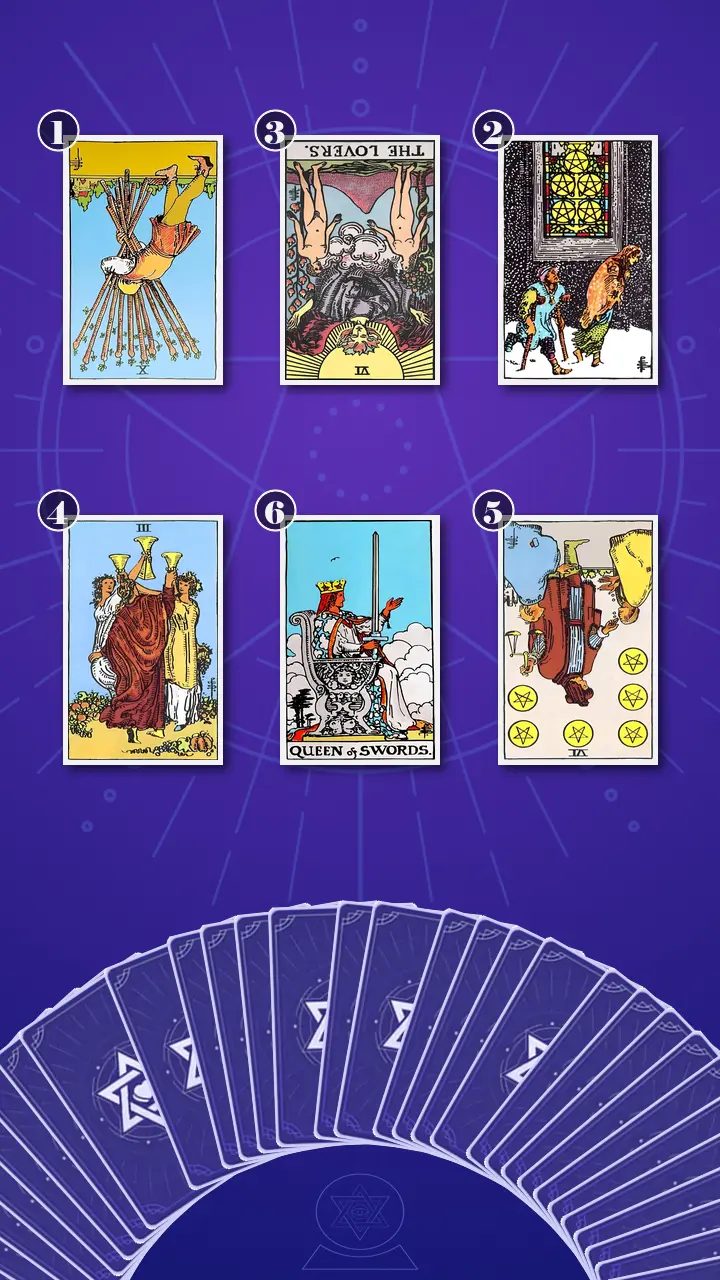
The Bundle Beneath the Group Chat
Position 1: The Load She Could Carry but Could Not Sustain
The first card I turned represented Jordan’s observable current pattern: she kept absorbing additional wedding tasks even after recognizing that the role had exceeded her capacity. It was the Ten of Wands, reversed.
I angled the card toward the camera. The carrier was bent beneath ten bundled staves, and the load blocked his view of the town ahead. I told Jordan that the image looked less like one dramatic crisis and more like a Notion task list where every new item was marked “quick” while the total workload disappeared below the scroll.
I returned to the scene she had just shown me. At 10:47 p.m., she had received the request to collect decorations across Toronto, typed the truthful limit, deleted it, and moved her quiet Saturday morning instead. The Ten of Wands reversed did not question her competence. She probably could complete the errand. It showed blocked release: compressed Fire with nowhere sustainable to go because she knew the full bundle was too heavy but could not put down one stave without interpreting the act as disloyalty.
I traced the internal sequence back to her: “It’s only one more thing. I can move my plan. Why am I so tired and angry?” The short-term relief came from avoiding an awkward message. The long-term cost landed in her sleep, spending, postponed plans, and the resentment she was careful not to show.
Jordan gave a brief laugh that had no amusement in it. “That’s so accurate it’s almost rude.” Her eyes moved toward the calendar open on her laptop.
I did not rush to soften the card. “Accurate is not the same as accusatory,” I said. “This card is not blaming you for being capable. It’s showing us that the problem is the total load, not a moral failure to carry the next item cheerfully.”
I asked what the decoration pickup would replace. She pressed her thumb into the edge of her phone case. “The only morning this month when nobody needed anything from me.”
Position 2: The Warm Window She Feared Losing
The next card represented Jordan’s projected story about what the couple or wedding party might think if she said no, without pretending I could read anyone else’s mind. I turned over the Five of Pentacles, upright.
Two figures moved through snow beneath an illuminated stained-glass window. I saw the feared scene immediately: everyone else remained inside the warmth of the celebration while Jordan’s one measured no moved her outside it.
I connected the card to the group-chat ritual she knew so well. A request arrived after work. Other wedding-party members replied with hearts and immediate yeses. Before anyone had reacted to Jordan at all, she imagined that a slower answer would be remembered as proof that she had not been supportive enough. She agreed in order to prevent an exclusion that felt vivid in her body but had not been established in the relationship.
I read the card’s energy here as an excess of anticipated scarcity. The fear of losing belonging was so loud that it drowned out the missing evidence. “This card does not say they will exclude you,” I told her. “It shows the rejection scene your mind screens before a boundary has even been tested.”
I asked her to picture sending, “I cannot take that on.” Then I asked what exact reply, silence, or later consequence she expected, and what current evidence supported it.
Her hand lowered from the phone. She looked at the card for several seconds. “Honestly? I don’t have evidence. I have a whole imaginary conversation. I’ve never sent a clean no, so I don’t actually know what would happen.”
I nodded. That distinction mattered. I could validate the social risk without converting an anticipated reaction into a prophecy. The card had placed the feared window on the table where we could examine it; it had not locked Jordan outside.
When Two Sentences Became One
Position 3: The Loyalty Equation Hidden Inside the Task
The third card represented the central dynamic of the relationship: the bond had become fused with role performance, turning a practical limit into a global judgment about care. I revealed The Lovers, reversed.
I pointed to the two separate figures and the mountain rising between them. Upright, The Lovers can speak to alignment, consciously held values, and consequential choice. Reversed here, that alignment was blocked. Jordan did not lack love for her friend. Fear had made care and self-respect appear mutually exclusive.
I asked her to open a private note and place two sentences side by side.
“I cannot collect the decorations on Saturday.”
“This friendship does not matter to me.”
I let her look at them. The first sentence described time, travel, and an existing commitment. The second made a sweeping claim about the relationship. Her mind had merged them like two spreadsheet cells that needed completely different formulas.
“You are answering a capacity question as though it were a loyalty test,” I said. “That is the blockage. A task asks what you can give. A friendship holds history, care, conflict, repair, choice, and reciprocity. They are related, but they are not the same unit of meaning.”
Her breathing paused. Her index finger remained suspended above the note, then curled slowly back toward her palm. Her eyes went unfocused as if she were replaying the deleted text. Finally, she let out a low, involuntary “Oh.”
“I know those are different sentences,” she said, quieter now. “But my body reacts as if they’re the same. The first one still feels mean.”
I told her that the feeling deserved attention, but it did not get sole authorship of the facts. “Your body may be bracing for reduced belonging because being visibly useful has helped you feel secure. That explains the alarm. It does not prove the verdict.”
I then gave the card a practical translation. Before the next request, Jordan could write two headings: “What this task asks of my capacity” and “What this friendship means to me.” She could respond to the first without forcing it to serve as evidence for the second.
When the Group Chat Gave Way to Takeout
Position 4: The Friendship Beneath the Event Plan
The fourth card represented the relationship’s existing resource: genuine friendship, mutual celebration, and connection that did not have to be purchased through unlimited usefulness. I turned over the Three of Cups, upright.
Three figures raised their cups at the same height. No one was kneeling, carrying the others, or standing backstage with a logistics spreadsheet. I read the card as balanced Water: shared feeling moving between people rather than one person continually supplying the experience.
I asked Jordan to remember a moment with her friend from before the wedding became a project. Her gaze shifted from the phone to the dark window. She described takeout on a living-room floor, a terrible reality show playing unwatched, and the two of them laughing until they could barely speak. She also remembered a difficult workweek when the same friend had listened without trying to turn the conversation back toward herself.
The room on my screen seemed to change with the memory. Jordan placed the phone face down. Her shoulders dropped by a fraction, then another.
“I wanted to stand beside my friend,” she said. “I didn’t want to keep earning my place by running the day.”
I told her that the Three of Cups was the catalyst in this spread because it restored the purpose that wedding-party scope creep had obscured. She had joined to participate in a shared celebration, not to become an invisible operations team. Remembering reciprocal friendship did not guarantee an easy boundary conversation, but it gave her present evidence that the relationship contained more than task compliance.
Position 5: The Scale Nobody Else Could See
The fifth card represented the primary challenge: unspoken costs, unequal giving, unclear ownership, and the resentment that develops when generosity has no agreed edge. I revealed the Six of Pentacles, reversed.
The standing figure held scales while distributing coins to two kneeling people. Reversed, I read its energy as an excess of outward giving combined with a deficiency of visible terms. Requests were visible. Jordan’s hours, money, travel, recovery time, and decision-making load remained largely private.
I brought us to the Sunday-night kitchen scene she had described before the reading. She had sat beside a mug of cold tea with her banking app open and a private Notes list of rides, extra purchases, itinerary edits, and weekday planning hours. Her stomach had dropped at the total, but she had closed the note and sent “No worries” to the group.
As a project coordinator, Jordan would never accept workplace scope creep indefinitely without eventually asking about ownership, budget, impact, and deadline. Inside the friendship, however, every added deliverable arrived without a change request because she treated visibility itself as an accusation. It was like Splitwise capturing brunch and decorations while no tool recorded three evenings of coordination.
I was careful not to cast the couple or group as villains. They could not account for limits Jordan had never made visible, and the spread could not tell us how they would respond once she did. What it could show was the mechanism: her private accounting kept growing precisely because the relevant capacity information never entered the conversation.
“Care without an edge can quietly become compliance with a resentment bill attached,” I said. “The scale is not asking you to invoice the friendship. It is asking you to know what you are giving before you decide whether to give it.”
I asked her to total the next four weeks in hours, expected cost, travel, and emotional availability. Jordan opened her calendar, scrolled twice, and stopped. Her jaw tightened, then loosened. “I keep saying each thing is fine because no single thing seems worth making weird. But all of it together is changing my month.”
When the Queen Raised One Clear Sword
Position 6: A Boundary That Keeps Its Hand Open
The traffic outside Jordan’s window briefly quieted before I turned the final card. A single streetcar bell reached us through the wet night, clear and separate from the softer city noise. In the lower center of the spread, beneath The Lovers reversed, I revealed the reading’s key card: the Queen of Swords, upright.
This position represented the boundary stance Jordan could deliberately practise: separating an added task from the relationship and communicating a specific capacity limit. The Queen was the antidote, carrying discerning honesty, self-respect, and calm relational clarity.
I showed Jordan the Queen’s single upright sword and her open left hand. The sword made one precise distinction; the hand kept the exchange relational rather than punitive. I read that combination as balanced Air. Clarity did not require coldness, and warmth did not require making capacity negotiable.
I returned to the setup beneath her decision fatigue. It was 10:47 p.m. She had typed the honest limit, deleted it, and moved the quiet Saturday morning she needed. The task looked tiny inside the chat, but it had landed on a calendar already carrying the whole wedding.
I gave the Queen a modern sentence: “I can attend the rehearsal, but I cannot coordinate transport.” Jordan could wait long enough to check her calendar, send that factual limit, and leave space for dialogue without apologizing for existing needs or predicting the group’s judgment.
Then I used my Narrative Fork Analysis, the way I deconstruct options as competing plotlines and ask which one serves the protagonist’s actual growth rather than merely ending discomfort fastest. In the first plotline, Jordan sent another immediate yes. The scene stayed socially smooth, but she lost another evening, kept the loyalty equation intact, and arrived at the wedding more resentful and less present.
In the second plotline, she sent one accurate boundary. That scene contained uncertainty and ordinary relational friction, but it moved her toward honest participation. I told her that the immediate yes was a classic case of Safe-Choice Sabotage Recognition: the seemingly sensible option was functioning as a defense against the necessary inciting incident, the moment when the friendship finally encountered her real capacity.
As an artist, I pictured an editing room. A painful scene does not become more truthful because I refuse to cut it, and a character does not become kinder by remaining trapped in the same take. Jordan did not need a dramatic rewrite. She needed one line that belonged to the next act.
A no to one added task is not a no to the friendship. It is the line that lets your care stay honest instead of turning into compliance and resentment.
I paused, then gave her the card’s central message exactly as it had formed for me.
A boundary is not a verdict on the friendship; name the capacity you actually have, offer only what is true, and let the Queen’s upright sword separate care from compliance.
Jordan did not relax immediately. First, her breath stopped; the thumb rubbing her phone case froze mid-stroke. Then her eyes moved away from the card and lost focus, as though she were replaying every “No worries” she had typed. Her pupils widened, and color rose along her cheekbones.
“But doesn’t that mean I handled all of this wrong?” she asked. The words came out sharper than anything she had said so far. “Like I created the whole problem by never speaking up?”
I kept my voice steady. “No. It means you used a strategy that protected you from a feared loss of belonging. It worked in the short term, and then it became expensive. We can respect why you learned it without asking you to keep paying for it.”
Her fist opened slowly against her knee. One shoulder lowered, then the other. She drew in a breath that trembled at the top and released it from somewhere deep in her chest. Her eyes shone, but her mouth lifted into a small, uncertain smile. For a second, I saw the light-headed blankness that can follow clarity: once the old equation was no longer inevitable, she had to face the vulnerable fact that the next choice was hers.
“Now, using this new perspective, think back to last week,” I said. “Was there a moment when this distinction could have made the situation feel different?”
She returned to the decoration pickup. “I could have seen the trip as a trip. Two hours on the TTC or a rideshare cost, plus the morning I’d lose. I didn’t have to turn it into a vote on whether I’m a good friend.”
I invited her to take no more than ten minutes and open the most recent wedding request in a private note. I gave her this prompt: “The task is ___. It would cost me ___ hours and $___, and it would displace ___. My truthful answer is yes / no / only if ___.” She did not have to send anything that night. If her throat tightened further or her body became more activated, she could close the chat and return later. The minimum version was simply naming what the request would replace.
I named the movement carefully. This was a first step from fear-driven overfunctioning and loyalty-test thinking to calm, capacity-based boundaries and sustainable wedding participation. It did not guarantee approval from anyone else. It gave Jordan a way to respond from observed capacity rather than imagined judgment.
Giving the Wedding Role a Visible Edge
When I read the six cards as one story, the logic was clean. Jordan’s project-coordinator reflex had taught her to notice gaps and prove reliability by filling them. The Ten of Wands showed that habit becoming an unsustainable role. The Five of Pentacles revealed the feared social punishment beneath it. The Lovers reversed exposed the central meaning collapse between task and friendship. The Three of Cups restored evidence of mutual connection, while the Six of Pentacles reversed made the hidden costs and uneven terms visible. The Queen of Swords replaced ten accumulated proofs of loyalty with one accurate statement of capacity.
Jordan’s cognitive blind spot was not a lack of boundary vocabulary. She had already written the words many times. The blind spot was treating an anticipated reaction as present evidence, then assuming that because she had said yes before, any limit now required a legal defense of her character. Her transformation direction was to stop answering each request as a loyalty test and start pausing, checking time and cost, and replying with a clear yes, no, or bounded alternative.
“The goal is not to carry the wedding better,” I told her. “It is to name what is actually yours to carry.”
I turned the reading into two actionable next steps. The six-card Relationship Spread · Context Edition had given us the storyboard, but Jordan would decide what entered production.
Two Small Edits to the Next Scene
- The 30-Minute Loyalty-Test PauseFor the next wedding request, Jordan would set a thirty-minute phone timer before replying. During the pause, she would check calendar time, travel time, expected cost, and the existing plan or recovery period that would have to move. She would complete the private sentence: “This request would replace ___.”If thirty minutes felt too activating, she could use ten. A neutral holding reply would be: “Let me check what I already have on and get back to you tonight.” Someone else’s urgency would not remove her right to gather information.
- The Protagonist Pivot ActionWithin twenty-four hours, Jordan would choose one pending or newly added wedding task and take one micro-action inside the more daunting but authentic plotline. She could send, “I cannot take that on,” or offer a bounded alternative such as, “I cannot collect the decorations, but I can bring the place cards I already have.”She would stop after one or two factual sentences, without attaching a retrospective list of favors or a defense of how much she cared. If no request was live, the minimum version was to pin three scripts in her phone: “Yes”; “No”; and “I can help with X, but not Y,” then practise one aloud.
I reminded Jordan that a boundary is information about availability, not a character reference. Tarot had not created that truth, and the Queen had not granted her permission. The cards had made the competing stories visible. The authority to choose, revise, pause, or decline remained hers.

A Week Later, the Quiet Proof
Six days later, I received a message from Jordan. Another transport request had appeared in the wedding chat. She had felt the familiar jolt, set the thirty-minute timer, checked her calendar, and sent: “I can attend the rehearsal, but I can’t coordinate transport. I can bring the place cards I already have.”
She told me there had been several minutes of silence before someone replied, “Thanks for flagging it. We’ll sort transport separately.” In this instance, the exchange was ordinary. The deeper proof was that Jordan did not send a second message explaining her workload, listing her previous help, or pleading to be understood.
She kept Saturday morning and spent it alone in a cafe near the lake. Relief arrived first; then a small ache. She still wondered whether the chat felt cooler, but she let the unanswered question sit beside her coffee without buying it another favor.
I did not call that certainty or claim that one message had solved the wedding. Jordan still had commitments to review and a friendship capable of surprising her in either direction. I called it clarity because the role now had its first visible edge. Her care had not disappeared; it had become honest enough to sustain.
That was the real Journey to Clarity I witnessed: not a prediction delivered by six cards, but a woman recognizing the old loyalty-test script, checking the facts, and choosing one new line. I could hold the light over the spread, but Jordan was the one who picked up the pen.
If your throat tightens over one small reply because your body is bracing for the friendship to shrink with your usefulness, I hope you remember the Queen’s open hand beside her sword. Care and an edge can occupy the same frame. Simply noticing that distinction means the old script is no longer invisible.
If care and capacity were allowed to be true in the same sentence this week, what is the smallest honest limit you could let the Queen’s single clear sword separate from the friendship it was never meant to judge?
This story is adapted from psychological research, written so that those in a similar struggle can see their own pattern in it — and find their next step clearly.These insights are not a substitute for professional psychological, medical, legal, or financial advice.
Learn more about our Journey to Clarity.
How did this insight land for you?
🫂 This Resonates Deeply
🌀 Living This Story
✨ Now I See Clearly
🌱 Seeing New Possibilities
🧰 Useful Framework
🔮 The Confirmation I Needed
💪 Feeling Empowered
🚀 Ready for My Next Step
Author Profile
 AI
AI“I’ve always felt our lives are films currently in production. As an artist, I know that when you feel stuck, it’s often because you’ve bravely stayed in a painful scene for just a little too long. I’m not here to coldly analyze you. I want to sit closely with you, look at those difficult moments with profound empathy, and gently hand you the pen so you have the courage to write your next beautiful act.”
In this Choice Tarot Reading :
Core Expertise
- Narrative Fork Analysis: Deconstructing your options as competing plotlines to see which genuinely serves your ultimate character growth arc.
- Safe-Choice Sabotage Recognition: Identifying when a seemingly logical option is merely a defense mechanism to avoid a necessary 'inciting incident'.
Service Features
- The Protagonist Pivot Action: A 24-hour creative mandate to execute one micro-action aligned with the most daunting, yet authentic, plotline, effectively breaking analysis paralysis.
Also specializes in :
Explore Related Patterns:
Approval-Driven Self-SilencingJordan types the accurate limit, watches the cursor blink, deletes it, and sends 'I can make it work.' In another scene, she closes a private record of the hours and costs she has absorbed before telling the group that there is no problem. The silencing is a short-term defense against disapproval. When you remove your capacity from the conversation, you preserve the possibility of approval by presenting only the version of yourself that can keep giving. The cost is that other people respond to incomplete information, while your unspoken no returns as depletion and resentment rather than as a usable boundary.
Boundary DiffusionJordan clearly states that she agreed to join the wedding party, not become the backup planner, yet that distinction does not enter the group conversation. New tasks arrive without visible discussion of ownership, and the group's need is allowed to override the protected time she had already chosen for herself. Boundary diffusion occurs when your availability, another person's request, and the relationship's value stop functioning as separate categories. You begin carrying what has not been explicitly assigned because leaving a gap open feels equivalent to failing the friendship. The role keeps growing because no visible edge tells either you or the group where voluntary care ends and unchosen responsibility begins.
Friendship OverfunctioningJordan's project-coordinator reflex notices a missing wedding detail and fills it before her calendar, budget, or protected time can enter the decision. That rapid competence keeps the group moving and reduces immediate uncertainty, but it also allows an agreed social role to expand into backup planning without a fresh choice. You may recognize this pattern when being the capable friend becomes the main way you secure your position in a relationship. The issue is not generosity itself. It is the repeated use of extra labor as a defense against the possibility that your ordinary presence may not feel sufficient, leaving your care visible while your capacity disappears.
People-Pleasing Resentment CycleEach wedding request gives Jordan the same sequence. She agrees, receives immediate relief from the awkward message she did not send, rearranges another part of her life, and later feels exhausted or resentful while keeping that resentment out of view. When you use compliance to end discomfort, the yes works briefly and then generates the conditions for the next difficult yes. Because the delayed cost stays private, no one can respond to it and the external role keeps expanding. The resentment is not evidence that you do not care. It is delayed information from capacity that was excluded from the original decision.
Safe-Choice SabotageAt 10:47 p.m., Jordan chooses the reply that ends discomfort fastest and gives up the only quiet morning she has protected that month. The message looks socially safe because it avoids uncertainty, but it also preserves the belief that the friendship must never encounter her real capacity. Safe-choice sabotage happens when you protect yourself from a feared immediate consequence by choosing an option that undermines what you need over time. The yes keeps the moment smooth while reducing rest, honest participation, and trust in your own limits. It is protective in intention and self-defeating in effect, which is why recognizing its function matters more than blaming yourself for using it.
Cognitive DissonanceJordan knows the wedding load is unsustainable and knows that declining a decoration pickup is not the same as rejecting her friend, yet her outward answer remains yes and her body still registers the limit as mean. Accurate knowledge and loyalty-test thinking continue operating at the same time. That contradiction creates cognitive dissonance. To reduce the immediate friction, you may change your calendar to match the old belief instead of revising the belief to match your known capacity. The relief is temporary because your actions preserve the very equation that creates the conflict, leaving self-respect and care falsely positioned as competing choices.
Mind ReadingBefore anyone responds to Jordan, she imagines that a slower answer will be remembered as proof that she was not supportive enough. She later recognizes that she has no evidence for this conclusion and has been rehearsing an entire conversation that has never occurred. When you treat a predicted reaction as present information, you start complying with another person's imagined judgment rather than their observable behavior. The defense reduces uncertainty by supplying an answer in advance, but it also prevents the relationship from showing you what it can actually tolerate. The feared meaning of no is therefore constructed before the no has been tested.
Rejection SensitivityJordan imagines one measured no placing her outside the warmth of the wedding party before anyone has reacted to her. Even after the group accepts her later transport boundary, part of her attention remains fixed on whether the chat might have become cooler. Rejection sensitivity makes ambiguous social information feel loaded with evidence of impending exclusion. When you are braced for belonging to shrink, silence can feel like punishment and a factual limit can feel like a relational threat. That alarm explains why compliance seems protective, but it does not establish that rejection is occurring or that usefulness is the price of staying connected.
Usefulness-Based Self-WorthJordan says she wanted to stand beside her friend, not keep earning her place by running the wedding day. Yet every missing logistical detail becomes another opportunity to prove reliability, and one unavailable Saturday begins to feel like evidence about whether she is loyal enough to belong. When usefulness becomes a condition of worth, you do not experience a request as a simple question about time. You experience it as a test of whether you still deserve your role in the relationship. Saying no then appears to mean that you are withdrawing care, even though the actual information is only that your capacity has an edge.
Boundary DiscernmentJordan places 'I cannot collect the decorations' beside 'This friendship does not matter to me' and sees that the sentences carry different information. She later applies that distinction by attending the rehearsal, declining transport coordination, and offering only the contribution she has genuinely chosen. Boundary discernment lets you separate what a task requires from what a relationship means. You can remain caring without treating every open need as your responsibility, and you can offer a bounded alternative without making your capacity negotiable. The emerging pattern is not emotional withdrawal. It is the ability to keep care, choice, and ownership distinct enough for each to remain honest.
Defensive MinimizationJordan calls each favor small, closes the private note containing the total cost, and sends 'No worries' while the requests continue to accumulate. Looking at one task at a time makes each concession seem easier than initiating a boundary conversation, even as the full workload changes her month. Minimizing the individual cost protects you from immediate guilt and social friction. It also fragments the evidence you need to make an informed choice, because no single request is allowed to represent the pattern created by all of them. The growing wedding role remains psychologically manageable only while its total size stays out of frame.
Explore Related Struggles:
Capacity-Identity FusionJordan places two sentences side by side: “I cannot collect the decorations on Saturday” and “This friendship does not matter to me.” She can see that one describes time and travel while the other judges the entire bond, yet the practical limit still lands in her body as though it were a verdict on who she is. You may know exactly what your calendar can hold and still fear that stating it will define you as disloyal, difficult, or uncaring. That is the central bind: capacity is treated as identity, so factual self-knowledge cannot enter the conversation without seeming morally dangerous. Separating what you can give from what kind of person you are allows care and limitation to remain true in the same sentence.
Utility-Belonging FusionJordan types “I cannot do it,” deletes the sentence, and gives up her protected Saturday morning before anyone has judged her response. The requested errand becomes more than a trip across Toronto: it appears to measure whether she is useful enough to remain securely inside the friendship. You can become trapped in the same equation when belonging seems to require uninterrupted usefulness. Each yes offers brief evidence that your place is intact, while a single no feels capable of moving you outside the group. Recognizing that fusion gives you a point of choice: the task can be measured in hours and capacity without turning your value to the relationship into another item being assessed.
Self-Erasure ReliabilityJordan deletes the sentence that accurately states her limit, closes the note recording her costs, and sends “No worries.” The wedding party continues to encounter a highly reliable version of her because the time, money, recovery, and resistance required to maintain that version never enter the exchange. You can become dependable in a way that leaves your own reality structurally absent. Reliability then depends on editing out every piece of information that might inconvenience someone else, until your visible role and your actual capacity no longer match. The problem is not that your care is false; it is that sustaining its current form requires repeated self-removal. Letting one accurate limit remain visible begins to make reliability compatible with having a self inside the relationship.
Competence-Obligation FusionJordan notices missing details for a living, and the same reflex activates when a wedding request appears after hours. Because she can identify the gap, organize the pickup, and rearrange the calendar, the task begins to look like hers before she has decided whether she owns it. When competence becomes fused with obligation, you are rarely allowed to reach the ordinary question of choice. The fact that you could solve a problem is treated as sufficient reason that you should, even when the role has exceeded what you agreed to sustain. The result is a locked form of capability in which your strengths keep assigning you more responsibility. Distinguishing ability from ownership returns competence to the realm of agency.
Pre-Resentment LockJordan’s immediate yes keeps the group chat smooth, but the cost arrives later as exhaustion and resentment she is careful not to show. Each avoided awkward moment preserves the appearance of easy generosity while adding another private charge to the relationship. You can become locked between preventing friction now and protecting your care from turning into compliance later. The strategy works just well enough in the moment to repeat, even as it steadily changes how freely you can give. Resentment is therefore not an isolated reaction here; it is the delayed record of choices made without visible capacity. Allowing one factual boundary to create ordinary relational friction can keep the relationship from carrying a larger unspoken bill.
Rest-Belonging SplitJordan moves the only quiet Saturday morning she has protected all month so she can collect decorations across town. The calendar change makes the trade visible: the wedding receives the time, while her recovery disappears without ever being named as something that also matters. You can get stuck when rest and belonging appear to demand opposite decisions. Keeping your own time seems to risk looking unsupportive, while surrendering it preserves your social position at the cost of arriving depleted. The tension is not simply between work and leisure; it is between being included and remaining resourced enough to participate honestly. Naming what a request will replace restores rest as real information rather than evidence against your care.
Unseen Cost BindJordan sits with her banking app and a private list of rides, purchases, itinerary edits, and planning hours, then closes the note and tells the group there is no problem. Everyone else can see the latest small request; only she can see the total that has accumulated behind it. When your costs remain private, you carry both the load and the burden of explaining why one apparently minor favor has reached a limit. Saying no can then feel disproportionate because the evidence that makes it proportionate never entered the shared space. This is the bind: concealment keeps the interaction smooth but makes every later boundary harder to understand. Measuring and naming the real cost allows the decision to reflect the whole role rather than the size of the latest request.
Systemic DepletionJordan can complete each individual favor, but the combined role reaches into her sleep, spending, postponed plans, evenings, and only free Saturday morning. The wedding continues to function because she repeatedly transfers resources from recovery into whatever new gap has appeared. You may still look capable while the system supporting that capability has stopped replenishing itself. Each yes resolves a local request, yet the larger cycle leaves less energy available for the next decision and less room to participate without resentment. That is why evaluating one task at a time cannot reveal the full strain. Seeing the whole bundle turns depletion from a private personal shortcoming into observable information about an arrangement that cannot continue on the same terms.
Explore Related Emotions:
Anticipatory ShameBefore Jordan has ever sent a clean no, she has already constructed the conversation in which it proves she is uncaring. She imagines a slower response being remembered, the chat becoming cooler, and a practical limit turning into a character reference without any current evidence that the group has reached that verdict. This is more than discomfort about disagreement. Anticipatory Shame is the sensation of preparing to be seen as fundamentally deficient before your actual words have even entered the relationship. Naming it helps you distinguish an imagined global judgment from the narrower reality that one request has a measurable cost and your truthful answer may be no.
Boundary GuiltJordan types that she cannot collect the decorations, watches the cursor blink, deletes the sentence, and moves the only quiet Saturday morning she has protected. Her shoulders rise when the chat flashes, and the words naming her limit seem to narrow in her throat before they can reach anyone else. You can know exactly what your capacity is and still experience its expression as a moral offense. Boundary Guilt appears here because the no does not register internally as neutral information about time and travel; it feels like evidence that you are withholding care. Separating availability from character gives the guilt a shape you can observe without allowing it to decide what your calendar must absorb.
Usefulness-Based Belonging FearJordan watches other wedding-party members answer with hearts and immediate yeses, then imagines that her slower or negative response will be remembered as proof that she was not supportive enough. Before the group has judged her at all, the decoration pickup has become a test of whether she still belongs inside the friendship. When being visibly useful functions as evidence of your value, saying no can feel like withdrawing the very thing that secures your place. Usefulness-Based Belonging Fear names that inner weather precisely: you are not only bracing for a task to be reassigned, but for the relationship to shrink once your labor is no longer available on demand. Recognizing that equation lets you examine belonging through the friendship's actual history and reciprocity rather than continually purchasing reassurance with another favor.
Clarity ShockJordan places two sentences beside each other: she cannot collect the decorations, and the friendship does not matter to her. She can see that they make entirely different claims, yet her breath pauses, her hand stills, and the distinction lands with enough force to make her question whether she handled everything wrong. Clarity Shock is the disorienting moment when an old emotional equation stops looking inevitable before a new way of responding feels familiar. You can suddenly see that capacity and loyalty require different evidence, but that insight also returns authorship of the next choice to you. The jolt matters because it marks a real separation between the alarm in your body and the facts available in the relationship.
Grounded Self-RespectJordan waits thirty minutes, checks her calendar, declines responsibility for transport, and offers only the place-card task she already owns. She lets the two factual sentences stand through several minutes of silence without listing her previous help or pleading for the group to understand her character. Grounded Self-Respect is present because your limit is anchored in observed capacity rather than sharpened into punishment or softened into another automatic yes. You remain available for honest participation while allowing your time to count as real information. The emotional steadiness comes from knowing exactly what you checked and offered, even when you cannot control how quickly anyone else responds.
Reciprocal WarmthJordan remembers takeout on a living-room floor, a terrible reality show going unwatched, and laughter that made it difficult to speak. She also remembers this friend listening through a hard workweek, and later receives a practical acknowledgment when she says transport will need to be handled separately. Those details return the friendship to a form you can actually recognize: attention moves both ways, and connection exists outside logistics. Reciprocal Warmth does not promise that every limit will be welcomed perfectly. It gives you grounded evidence that the relationship has contained shared presence and mutual response, allowing care to be remembered as something broader than unlimited usefulness.
Resentful ExhaustionJordan sits with cold tea, her banking app, and a private list of rides, purchases, itinerary edits, and planning hours, then closes the record and tells the group there is no problem. Requests remain visible and socially shared, while the recovery time and cumulative cost required to fulfill them stay almost entirely with her. Resentful Exhaustion names what happens when your giving continues after it has stopped feeling freely chosen, but the terms still cannot be spoken. Energy drains through the work itself, and the concealed imbalance adds a sharper internal edge. Bringing hours, money, travel, and displacement into the decision allows generosity to become a real choice again rather than a smooth message with an accumulating private bill.
Self-Betrayal AcheJordan writes the truthful limit and then erases it. She closes the private note containing the real cost, sends another reassuring message, and moves the one morning that belonged only to her even though she has already recognized that the wedding role has exceeded what she agreed to carry. Self-Betrayal Ache emerges from the repeated gap between what you know privately and what you permit to exist publicly. The pain is not evidence that you should blame yourself for every previous yes; it marks the cost of continually editing your own needs out of the relationship. Making one accurate limit visible begins repairing that gap without requiring a dramatic accounting of everything that came before.
Scope Creep AnxietyThe decoration pickup arrives as one quick favor, but Jordan's calendar already contains rides, purchases, itinerary edits, and weekday planning hours. The group sees each request separately while her sleep, spending, postponed plans, and only unclaimed morning carry the combined impact. Scope Creep Anxiety develops when the edge of a role keeps moving and no individual addition seems large enough to justify resistance. You remain physically capable of completing the next task, yet the absence of a visible endpoint keeps your body braced for whatever will be added after it. Looking at the total load restores scale to decisions that the chat presents as isolated favors.
Solitary ClarityJordan sits alone near the lake with her protected morning intact and lets the unanswered question about the group's mood remain beside her coffee. The chat no longer occupies every open space, and the trip she declined remains a trip rather than a referendum on whether she deserves the friendship. Solitary Clarity is the quiet experience of holding your own information without immediately seeking reassurance from the people whose response you cannot control. You can observe that the role now has an edge, that your care is still present, and that uncertainty does not require another act of compliance. The solitude becomes a place where the distinction can settle rather than a punishment for having made it.
Explore Related Contexts:
Designated Organizer BurdenJordan says she agreed to stand beside her friend, not become the backup planner, yet her project-coordinator skill repeatedly pulls her toward missing details, transport problems, itinerary edits, and unclaimed errands. Her competence is functioning as an informal assignment mechanism even though no one has explicitly defined, resourced, or limited an organizer role. When you are the person who reliably notices gaps, usefulness can become a position others depend on before anyone asks whether you consented to hold it. Designated Organizer Burden captures the structural cost of performing an essential group function without a clear mandate, shared workload, or protected endpoint, allowing you to distinguish being capable of organizing from being automatically responsible for it.
Unspoken Expectations GapJordan has a clear private distinction between joining the wedding party and becoming a backup planner, but that distinction has never entered the group's operating terms. With no shared agreement about ownership, response time, spending, or the expected ceiling on support, each completed favor can be read as evidence that similar work remains available. An Unspoken Expectations Gap makes a simple refusal feel unusually consequential because there is no mutually recognized role boundary to point toward. When you state what you can attend, what you can carry, and what requires another owner, you are supplying missing coordination information rather than submitting a defense of your character.
Friendship Role RenegotiationSix days after the reading, Jordan tells the group that she can attend the rehearsal and bring the place cards but cannot coordinate transport. The message preserves her accepted participation, removes one unaccepted logistics function, and gives the group enough concrete information to assign transport elsewhere. You are in Friendship Role Renegotiation when an established pattern of usefulness is being replaced by explicit, bounded participation and the new terms have only begun to be tested. The several minutes of silence do not settle the entire friendship, but the eventual practical response provides observable evidence that a role can change without requiring you to withdraw your care or surrender your place.
Care Reciprocity TestBefore the wedding became a project, Jordan and her friend shared unstructured time, laughter, and a conversation in which the friend listened through a difficult workweek. Later, when Jordan declines transport coordination, the group thanks her for flagging it and makes another arrangement; she keeps her Saturday without sending a second message to earn reassurance. A Care Reciprocity Test asks whether connection can continue when your contribution is honest rather than unlimited. The evidence here does not promise that every future boundary will be frictionless, but it shows that you can evaluate the relationship through actual exchanges of attention, flexibility, and respect instead of measuring care only by how much work you absorb.
Conditional Belonging PressureOther wedding-party members answer requests with hearts and immediate yeses, while Jordan types a refusal, deletes it, and predicts that a slower or limited response will be remembered as proof that she is not supportive enough. The public visibility of participation gives usefulness social meaning, even though nobody has yet told her that declining one task would reduce her place in the friendship. Conditional Belonging Pressure names the external social atmosphere without converting Jordan's anticipated rejection into a fact. You can separate the ambient pressure to perform support from the available evidence: the later transport boundary receives an ordinary acknowledgment, showing that one accurate no can test the social rule instead of automatically confirming it.
Planning Labor ImbalanceJordan sits with her banking app and a private list of rides, purchases, itinerary edits, and planning hours, then closes the record and tells the group, "No worries." The wedding party can see completed errands and quick replies, but it cannot see the schedule displacement, decision load, travel, spending, or recovery time required to produce them. Planning Labor Imbalance develops when one person's coordination keeps the event moving while the actual cost of that work remains outside the shared conversation. You gain leverage by making the inputs visible before offering them, because a group cannot redistribute time, money, and ownership that continue to appear effortless and unlimited.