The Old Chair and the Gravity of Adult Regression
When I met Jordan, she gave me a contrast I hear often but never dismiss as trivial. At 29, she could lead a tense stakeholder interview in a downtown Toronto tech office, then hear one childhood story over Sunday dinner and slip into family role regression before she had finished her answer.
She took me back to 6:52 p.m. in a North York condo dining room. She had slid into the same chair she used as a teenager and placed her phone face down beside the cutlery. Roasted garlic thickened the warm air. A pendant light hummed above her while plates clicked into place.
“Someone asked where I wanted to travel this summer,” she said. “I knew I wanted to go alone. Then I saw my aunt pause with her fork in the air, and I changed it to, ‘I haven’t decided. What do you think?’”
I watched Jordan demonstrate the moment as she spoke. Her eyes moved across an imaginary table, her throat worked around a swallow, and her shoulders folded inward. She knew what she thought until a familiar face changed; then her body pulled the drawstring on her voice, tightening it until only “whatever works” could get through.
“It feels easier to agree and be annoyed later,” she told me. “I don’t want a fight, but I also don’t want to disappear. I can make decisions at work, so why do I suddenly need permission here?”
The second half of the pattern happened at 9:36 p.m. on the westbound 504 King streetcar. Jordan described the rails shrieking around a bend, wet coats carrying the faint smell of rain, and her phone growing warm in her clenched hand. She had deleted a paragraph defending the preference she had not fully stated, then texted two friends: “Be honest, did I sound selfish?”
I said, “You did not lose your adult voice; the room activated an older edit. That distinction matters. We are not here to prove that you are secretly incapable, or to predict whether your family will approve. We are here to map the exact sequence that makes your voice smaller, then find the point where you can choose differently.”
Jordan let out a breath that seemed to have been waiting since Sunday. I told her that our Journey to Clarity would not require a dramatic confrontation, a family cutoff, or a perfect boundary speech. I wanted to help her identify one place where belonging and self-erasure had become confused, then return authority over her next sentence to her.

A Dining Table Drawn in Five Cards
I invited Jordan to put both feet on the floor and take two ordinary breaths while holding one question in mind: “Why do I keep returning to my child role at the family table?” I shuffled slowly. The pause was a way to narrow our attention, not a performance of mystery.
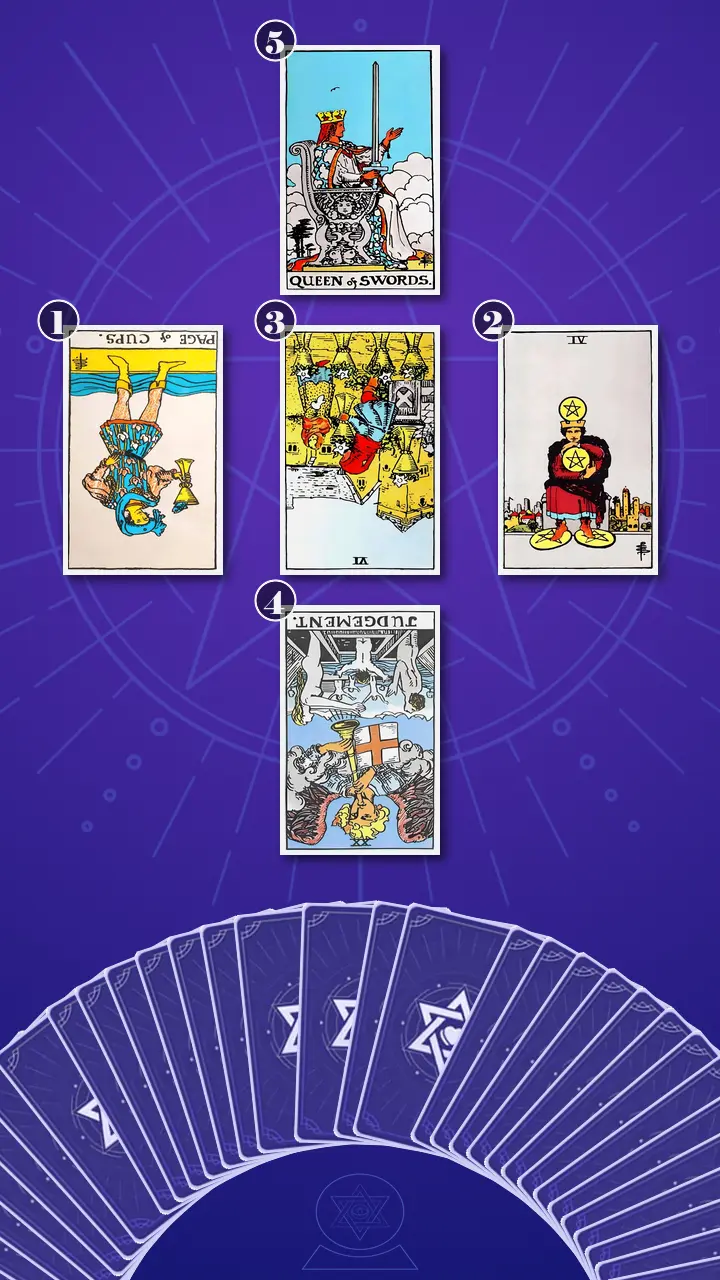
I chose the Relationship Spread · Context Edition, a five-card relationship tarot spread adapted for family dynamics. For readers wondering how tarot works in a situation like this, I use the cards as a structured cognitive map. They help separate a visible reaction from the surrounding system, the shared relational script, the deeper blockage, and the available response. They do not issue a verdict about anyone’s character or dictate what Jordan must do.
This compact spread suited her question because a self-reinforcing family-role loop was more important than distant predictions or a long timeline. A larger Celtic Cross could have added background, but it might also have blurred the smallest complete sequence we needed to see: cue, contraction, familiar role, self-doubt, and adult integration.
I arranged the cards like a dining table viewed from above. On the left sat Jordan’s current stance. On the right sat the family system’s investment in continuity. In the centre lay the shared script that linked them. Beneath it waited the fear that kept the script running; above it, the adult perspective capable of changing Jordan’s participation without demanding that everyone else change first.
Reading the Script Before It Repeats
The Message Edited Before It Arrives
I turned the first card, the position that reveals the current symptom: how Jordan’s adult voice contracts into approval-seeking and self-editing at the family table. It was the Page of Cups, reversed.
In the image, an unexpected fish rises from a cup while the youthful figure studies it with a tentative gaze. I read the fish as the honest preference trying to surface. Reversed, the Page’s emotional sensitivity was in a state of Blockage: Jordan could detect every small shift in the room, but the message could not travel cleanly from feeling to speech.
I brought the card directly into her Sunday scene. Jordan begins answering a question about summer plans, catches a relative’s doubtful expression, and edits “I want to travel alone” into “I haven’t decided; what do you think?” The adult thought exists. It simply leaves the conversation disguised as a joke, a softened fragment, or “whatever works.”
“You are a UX researcher,” I said. “At work, one raised eyebrow is data. At this table, your nervous system treats it as a product requirement. You redesign the answer in real time until it no longer contains what you meant to say.”
Jordan gave a short laugh, but there was no amusement in it. She rubbed her thumb along the rim of her mug and said, “That is so accurate it feels a little brutal.”
I did not hurry to soften the recognition. “I understand. Let’s be precise about where the brutality sits. It is not proof that you are weak or globally indecisive. It is the speed of the edit. You were about to say, ‘I want to travel alone.’ Then you saw the fork pause. So you changed it to, ‘What do you think?’ That half-second is the mechanism, and mechanisms can be observed and interrupted.”
I asked her, “What sentence would you finish if you did not have to manage the room’s reaction?”
She looked down at the card. “I want to take the trip on my own. I’m not asking whether that sounds like me.”
The Coins Beneath Every Familiar Seat
I turned the card representing the family system’s stance: how continuity is protected by holding familiar roles in place, without assigning blame to one relative. It was the Four of Pentacles, upright.
The figure clutches one pentacle against the chest while two more pin the feet to the ground. Preservation can be useful, but in Jordan’s context its energy had moved into Excess. Stability had become rigidity. Movement felt costly because everyone already knew the established workflow.
I described the modern version: before anyone consciously chooses a role, the same seat, the same teasing story, the same advice-giver, and the same assumption that Jordan will be flexible are already in place. A group-chat plan arrives as “We’ll see you at six” instead of “Are you available?” Jordan’s thumbs-up keeps the routine moving even when it conceals an unspoken no.
“This card is not asking us to invent a villain,” I said. “A family system can preserve an outdated role because predictability feels like closeness. The unspoken group monologue is: ‘We know how this dinner goes. Why introduce friction?’ But continuity is not the same as intimacy if no current information is allowed into the room.”
Jordan stopped rubbing the mug. Her fingers rested flat against the ceramic. “They probably do think they’re being close,” she said. “And I help keep it going because I know my lines.”
“Exactly. Seeing your contribution gives you leverage, not blame. You cannot force everyone to update their picture of you, but you can stop automatically restoring the shared document to its teenage version.”
The Flower-Filled Cup of an Old Identity
I turned the central card, representing the repeated relational script through which shared history returns Jordan’s present-day adult identity to a childhood role. It was the Six of Cups, reversed.
The larger child in the image offers a flower-filled cup to the smaller figure. Reversed, the card showed memory caught in Blockage: affection kept delivering an old identity, and Jordan kept receiving it unchanged because refusing the role felt dangerously close to refusing the relationship.
I asked her to revisit 7:43 p.m. A relative had tapped a fork against a plate and retold the story of Jordan being “the indecisive one” at fourteen, just before asking whether she planned to change teams at work. The sauce had tasted metallic. The laughter had landed too loudly in the small room. Jordan laughed on cue, folded her shoulders inward, and answered, “You know me. I can never decide.”
“That happened then,” I said, “but why is it deciding this now? The anecdote is the flower-filled cup. It may carry real affection and a true memory, but it also carries a role you are invited to accept as your complete identity.”
Jordan’s breathing paused. Her eyes lost focus for a moment, as though I had watched her replay that exact dinner behind them. Then she pressed her lips together and released a low, unsteady “Oh.” Her shoulders dropped by less than an inch, but the movement was unmistakable.
“I’ve been using their story as evidence against myself,” she said. “Even though I make complicated decisions all week.”
I nodded. “Shared history does not need to be denied. It needs to be updated. You can say, ‘That was me then, and now I make research decisions every week.’ You are placing a current fact beside the memory, not putting your childhood on trial.”
Then I gave her the sentence at the heart of this position: Agreement is not the admission price for belonging. A different opinion may create discomfort. Discomfort is not, by itself, evidence that connection has been revoked.
The Verdict Requested After the Answer Is Known
I turned the fourth card, representing the underlying blockage: the self-doubt and fear of answering an adult inner call that sustain Jordan’s drift after each family interaction. It was Judgement, reversed.
The angel’s trumpet carries a summons that cannot reasonably be mistaken for background noise. Reversed, the problem is not the absence of a call. It is an Excess of review combined with a Deficiency of response. Jordan already hears her preference, but she sends it to an imagined court of appeal before allowing it to become a choice.
I returned to the 9:36 p.m. streetcar: the warm phone, screeching rails, deleted explanation, clenched jaw, and messages asking friends to rule on whether one quiet weekend was selfish. It was like refreshing a delivery tracker after the package had already arrived. More checking could not provide the permission she was seeking.
“Your internal sentence is not ‘I don’t know,’” I said. “It is, ‘I know, but before I act, can everyone confirm that knowing is allowed?’ More verdicts cannot make a preference more yours.”
For a moment, the card took me back to the profile wall of an archaeological trench. I remembered how an older doorway could remain visible beneath a later structure. Its survival did not mean every generation was still required to use it. Jordan’s child role was similarly real and historically intelligible, but age alone did not make it binding.
I also pointed out that no Wands appeared in the spread. Feeling was abundant. Analysis was abundant. What was missing was Fire: one modest action capable of producing lived evidence. Judgement reversed did not ask Jordan to become completely confident. It asked her to make one reversible choice before another round of reassurance turned the choice back into a draft.
She exhaled and said, “So the work isn’t another perfect explanation.”
“No. Reflection has already delivered its finding. The next piece of information can only come from response.”
When the Queen Left Her Open Hand on the Table
The Adult Voice That Does Not Need a Closing Argument
I turned the final card, representing how Jordan could integrate a clear adult voice and relational boundaries without making her family’s reaction the measure of success. The light outside my window shifted as a cloud moved on, sharpening the edge of every card. It was the Queen of Swords, upright.
Her sword is vertical and undisguised. Her other hand remains open toward the person before her. Here the energy was Balance: discernment without contempt, firmness without withdrawal, and direct speech without a demand to win.
I placed the card beside a sentence Jordan could actually use: “I hear that you’d choose differently, and I’m going at seven.” The Queen does not add a joke, an apology, or a presentation explaining why she deserves control of her own arrival time. She maintains eye contact and remains in the conversation, but she does not use a relative’s smile as the success metric.
This was where I brought in the diagnostic lens I call Inherited Belief Stratigraphy. I explained that excavation is not demolition. I was not asking Jordan to declare every family value toxic or to blame herself for adapting to the structure around her. I wanted to separate three layers that had become compressed into one.
The oldest layer held a value she might authentically wish to preserve: family connection matters. Above it sat a fear-based rule: being easy, agreeable, and recognisable is how I earn my place. The newest layer contained Jordan’s adult value: I can care about connection while naming the person I am now. The Queen’s sword separated those layers; her open hand allowed Jordan to keep what was truly hers.
Jordan had reached the point where insight usually failed her: she could hear her own preference, but as soon as another person might dislike it, she treated accuracy as aggression and the family’s reaction as the court that certified her adulthood.
The old child role is not the price of belonging; name one present-tense truth with the Queen of Swords' raised blade and open hand.
I let the sentence remain between us without explaining it away.
For one beat, Jordan stopped breathing. Her fingers stayed suspended above the mug, and her eyes fixed on the Queen’s open hand. Then her mouth tightened. “But doesn’t that mean I’ve been doing it wrong for years?” she asked, her voice suddenly sharp. I told her no: becoming agreeable had been an intelligent way to keep visible tension low when she had fewer choices. Understanding its history removed personal blame; it did not require lifelong obedience. Her gaze drifted past me as memories seemed to reorganise. Her eyes reddened, her fingers slowly opened, and a long breath left her chest. Her shoulders sank, but relief did not arrive alone. I saw the brief, dizzy vulnerability that can follow clarity: if the role was no longer compulsory, her next sentence would genuinely be hers to choose. “That’s almost scarier,” she whispered. Then, after another breath, “But it also feels honest.”
I asked, “Now, using this new view, think back to last week. Was there a moment when this insight could have made the experience feel different?”
“The group chat,” she said. “They wrote that they’d see me at six. I had already decided I could come at seven, but I deleted it. I could have sent one accurate sentence and let them have their reaction.”
I offered a low-pressure rehearsal drawn from the card’s energy. She could set a ten-minute timer and write three options: “I’d prefer seven,” “I’m not discussing work tonight,” and “I’ll choose my own meal.” She would select the least exposing sentence and say it once into a voice memo without adding a reason. She did not have to send or use it, and she could stop at any point. Even writing one sentence and noticing where the apology tried to attach would count as information.
I named the transition clearly. This was not merely movement from a reversed card to an upright one. It was a first step from approval-sensitive child-role regression and reassurance seeking toward clear adult self-authorship with connection intact. Tarot had not certified Jordan’s preference. It had helped her see why she kept withdrawing her own certification.
The Loop Was History, Not a Verdict
When I read the five cards as one account, the logic was coherent. The Page of Cups reversed showed the current symptom: emotional sensitivity became rapid self-editing. The Four of Pentacles showed a family system protecting familiar continuity. The Six of Cups reversed revealed the exchange between them: an old identity was passed across the table, and Jordan accepted it to preserve immediate calm. Judgement reversed exposed the root cost: she left dinner knowing what she wanted, then delayed self-authorship by requesting more verdicts. The Queen of Swords supplied the resource the pattern lacked: one accurate adult sentence, delivered with contact rather than combat.
The family table had functioned like legacy software. Everyone knew the workflow, so repetition masqueraded as a rule. Jordan’s adult identity had not vanished; the setting kept loading an older version, and her automatic agreement helped the program continue. Her leverage point was not persuading the entire family to install a new system at once. It was changing one live setting she actually controlled.
I identified the cognitive blind spot gently: Jordan had been treating discomfort as proof that a boundary failed. A tightened face, a pause, or a different opinion became evidence that she had been selfish. In reality, the more useful success measure was simpler: Did she state her preference accurately and respectfully? The family’s response was relevant data, especially if an interaction became mocking, coercive, or unsafe, but it was not the authorisation stamp on her adulthood.
The transformation direction was equally specific. At the next family meal, Jordan would state one low-stakes, present-tense preference before asking anyone else what they thought. She did not need to feel calm first. She needed a small enough experiment that discomfort could exist without taking over the decision.
Three Small Ways to Supply the Missing Fire
- State One Present-Tense Coordinate.Before the next family meal, Jordan would open Notes and write one sentence in the form, “I’d prefer ___ tonight.” She could choose a drink, seat, serving, arrival time, or conversation topic. During the first fifteen minutes of dinner, she would say the sentence before polling the table and allow one short silence to exist.Keep an energy budget of one sentence. The minimum version is “I’d prefer sparkling water.” No joke, legal brief, or debate is required.
- Conduct a Lineage Artifact Review.For ten minutes at home, Jordan would divide a page into “Preserve” and “Bury.” She might consciously preserve Sunday connection or shared stories while burying the inherited rule that the easiest daughter is the most lovable one. When an old anecdote appeared, she could add: “That was me then, and now I make complex decisions every week.”Review the belief, not the relative. Jordan does not need to litigate the memory or persuade anyone to accept her update immediately. The smallest version is simply, “I’ve changed since then.”
- Create No-Verdict Evidence.After the meal, Jordan would make two columns titled “What happened” and “What I predicted,” recording observable words and actions only. Within forty-eight hours, she would make one reversible, low-risk choice without polling family or friends, such as declining an optional plan, booking a class, or choosing a weekend activity.If she wants support, she can tell a friend, “I don’t need a verdict; I’d like company while I get used to the discomfort.” If five minutes feels demanding, she can record the choice and one reason in under sixty seconds.
I reminded Jordan that a clear sentence is not the same thing as a fight. She retained complete control over whether and when to practise. If a meal became mocking, coercive, or too activating, leaving, pausing, or choosing not to test the exercise would also be adult decisions. Connection without self-erasure does not require enduring harmful behaviour for the sake of proving courage.

A Week Later, Seven O’Clock
A week later, Jordan sent me a screenshot from the family group chat. At 11:08 a.m., while waiting on the crowded Bloor-Yonge platform, she had received the familiar announcement: “We’ll see you at six.” This time, she kept both feet on the concrete and replied, “Seven works for me; six doesn’t.”
Her aunt answered with a thumbs-up, followed by, “Fine, we’ll keep something warm.” It was not a cinematic family transformation. Jordan’s breath still went shallow while she waited for the reply. Her thumb hovered over the keyboard with the old urge to add three sentences of explanation. She put the phone in her pocket instead.
At dinner, someone asked why she had come later. Jordan said, “Seven worked better for me,” and reached for the water. A relative looked unconvinced. The table paused, then the conversation moved to dessert. Jordan remained in her chair as the adult who had chosen her arrival time.
That night she slept straight through. Her first thought in the morning was, “What if they think I’m difficult?” She smiled, opened her two-column note, and wrote: “They disagreed. I still had dinner. I still belonged.”
I did not regard that message as proof that the cards had changed her fate. The Relationship Spread · Context Edition had given us a five-position map of the family-role loop and its integration point. Jordan supplied the missing Fire. She chose the sentence, tolerated the pause, and gathered evidence that an adult difference could exist without automatically becoming emotional exile.
That was the quiet shape of her Journey to Clarity: not permanent certainty, but clearer self-recognition; not rejection of family history, but the freedom to decide which parts of it remained hers. She was learning that an open hand could stay on the table while the sword of discernment kept one present-tense truth upright.
When a familiar face tightens across the table, your throat may close before your sentence is finished. Part of you may still want to remain recognisably theirs, while another part is trying not to disappear. Simply noticing that old edit means you are no longer entirely inside it.
If belonging did not have to be proved through agreement at the next meal, what small present-tense preference could you place beside the cutlery, like the Queen’s open hand, and allow to remain there?
This story is adapted from psychological research, written so that those in a similar struggle can see their own pattern in it — and find their next step clearly.These insights are not a substitute for professional psychological, medical, legal, or financial advice.
Learn more about our Journey to Clarity.
How did this insight land for you?
🫂 This Resonates Deeply
🌀 Living This Story
✨ Now I See Clearly
🌱 Seeing New Possibilities
🧰 Useful Framework
🔮 The Confirmation I Needed
💪 Feeling Empowered
🚀 Ready for My Next Step
Author Profile
 AI
AI“Having spent a lifetime at Cambridge and on archaeological digs, I’ve witnessed the rise and fall of countless civilizations. Please know that your current struggles are not a permanent fate, but merely a necessary fracture before rebuilding. I won't lecture you; instead, I invite you to sit with me in the ruins, using a patient, historical perspective to gently dust off the true, enduring value hidden beneath your temporary doubts.”
In this Family Tarot Reading :
Core Expertise
- Generational Trauma Excavation: Tracing the origins of toxic family behavioral loops across multiple generations to remove your personal blame.
- Inherited Belief Stratigraphy: Separating your authentic values from the obsolete, fear-based dogmas passed down by your ancestors.
Service Features
- The Lineage Artifact Review: An intellectual exercise to objectively decide which family traditions/beliefs to consciously preserve, and which to permanently bury.
Also specializes in :
Explore Related Patterns:
Approval-Driven Self-SilencingJordan knows that she wants to travel alone, but her aunt's paused fork is enough to turn that preference into "I haven't decided. What do you think?" The same edit appears in the group chat when a thumbs-up conceals an unspoken no. Approval is being protected by removing the part of the message that could expose a difference. When you edit before anyone has actually refused you, silence functions as a preventive defense against anticipated disapproval. The cost is that other people respond to a softened version of your position while your accurate preference survives only as later annoyance, doubt, or an explanation you never sent.
Borrowed Certainty LoopJordan's answer is already present before she asks the table what it thinks, and it is still present when she asks two friends whether she sounded selfish. The repeated request is not primarily gathering missing information. It is trying to borrow enough social certainty to make an internally known preference feel permissible. When you repeatedly send a formed decision to an outside court of appeal, review can imitate reflection while delaying self-authorship. No verdict can make the preference more yours; it can only temporarily reduce the discomfort of acting without unanimous certification.
Conditional Self-WorthJordan identifies an inherited rule beneath the dinner routine: being easy, agreeable, and recognizable is how she earns her place. That rule makes a changed arrival time or solo travel plan feel larger than an ordinary preference, because difference appears to threaten the basis on which connection has been secured. When you experience belonging as conditional on compliance, self-expression can feel like a referendum on your worth rather than current information about what you want. Separating the value of family connection from the rule of permanent agreeableness allows your place in the relationship to stop depending on the disappearance of your adult self.
Family Pattern RecognitionJordan pinpoints the half-second between seeing the paused fork and rewriting her travel answer. She then connects that edit to the same chair, the same old anecdote, the assumed six o'clock arrival, and her own admission that she knows the lines expected of her. When you can name the cue, contraction, inherited role, and later self-doubt as one sequence, the pattern becomes observable rather than identical with who you are. Recognition does not require blaming the family or yourself; it identifies the exact point where automatic participation can become a present-tense choice.
Family Role RegressionJordan's shift begins in the same teenage chair, where a paused fork, an old anecdote, and a familiar expectation of flexibility rapidly make her adult voice smaller. Her competence has not disappeared, as her work decisions clearly demonstrate; the family setting is activating a rehearsed role in which agreement and uncertainty once kept tension manageable. When you can make decisions elsewhere but become younger, quieter, or less self-authorizing around family, the contrast points to a context-bound role rather than a global inability. Mapping the cues that load the older version of you creates a point of choice between remembering that role and automatically performing it.
Internal ValidationJordan sends her seven o'clock message, notices the urge to add three explanatory sentences, and puts the phone in her pocket. The next morning she records the outcome in concrete terms: the family disagreed, dinner still happened, and she still belonged. When you let your own accurate assessment authorize a low-risk choice, other people's reactions remain relevant without becoming the source of your legitimacy. Internal validation here is not certainty or indifference; it is the capacity to keep a preference yours while discomfort and external disagreement are still present.
People-Pleasing Resentment CycleJordan describes the loop in direct terms when she says it feels easier to agree and be annoyed later. Laughing at the old indecisive story and hiding a no behind a thumbs-up keep the meal or group chat smooth, but the preference has not vanished; its emotional cost has simply been postponed. When you use agreement to secure immediate peace, resentment can become the delayed signal that your participation exceeded your actual consent. The cycle repeats because short-term relief rewards the agreement, while the later annoyance arrives away from the relationship and therefore cannot update the original interaction.
Relational HypervigilanceJordan sees a fork pause, scans the face across the table, and changes both her posture and her answer before anyone states an objection. Her sensitivity to interpersonal data is useful in her research work, but in this room the data is promoted into a requirement that dictates what she may say. When you monitor familiar people this closely, ambiguous micro-signals can acquire more authority than direct communication. The leverage point is not ignoring the room; it is separating what you observed from the instruction you automatically derived from it.
Emotional ReasoningJordan's throat tightens when her aunt pauses, and the discomfort quickly becomes evidence that traveling alone may be selfish. Even after she arrives at seven, stays for dinner, and remains connected, the next morning begins with the thought that the family may see her as difficult. When you treat discomfort as proof, an activated feeling can overrule observable facts and convert another person's uncertainty into a verdict about your behavior. The two-column note interrupts that conversion by allowing emotion to remain meaningful information without making it the sole judge of whether your boundary was accurate or respectful.
Boundary DiscernmentJordan separates two layers that had been compressed together: caring about family connection and obeying the rule that she must always be agreeable. Her message, "Seven works for me; six doesn't," gives the family accurate information while leaving them free to prefer the earlier time. When you distinguish a boundary from a demand, both autonomy and connection can remain present. Success is no longer measured by making everyone comfortable; it is measured by whether you stated your coordinate clearly, respected the other person's separate position, and retained your own.
Assertive CommunicationJordan writes, "Seven works for me; six doesn't," and later answers the follow-up with, "Seven worked better for me." She does not add a joke, apology, or legal brief, and she remains at the table while a relative looks unconvinced and the conversation moves on. When you communicate assertively, clarity does not require aggression and connection does not require retraction. A concise statement can define your position, leave room for another person's reaction, and keep you present in the relationship without turning their agreement into the success metric.
Cognitive FlexibilityJordan places a current fact beside the family's story of her fourteen-year-old indecision: she now makes complex research decisions every week. Later, she records that her relatives disagreed with her arrival time and that the relationship still continued through dinner. When you can hold past and present, discomfort and safety, or disagreement and belonging in the same frame, an inherited story no longer has to function as a total identity. Cognitive flexibility allows the old memory to remain real while losing its automatic authority over the person you are now.
Explore Related Struggles:
Belonging-Authenticity SplitJordan starts to say that she wants to travel alone, sees her aunt pause with a fork in the air, and converts the preference into a request for approval. She is trying to protect two things in the same moment: her place in the family exchange and the adult voice that knows what it wants. The visible contraction in her shoulders and speech shows how difficult it is for her to keep both present at once. You can recognize the deeper split in Jordan's own words: she does not want a fight, but she also does not want to disappear. Belonging-Authenticity Split names that live relational tension, where honest difference appears capable of disturbing connection. Her later experience of stating an arrival time and still sharing dinner provides concrete evidence that belonging and self-expression can occupy the same table, even while discomfort remains.
Inherited Role LockThe same chair, the same teasing anecdote, the same advice roles, and the same assumption that Jordan will be flexible are already in place before the meal develops. When the old story is repeated, she laughs on cue, folds inward, and supplies the line expected from the teenage version of herself. The script is carried by recognizable details and by her automatic participation, not by a formal decision that she must remain a child. Inherited Role Lock describes how shared history becomes a present-tense assignment that keeps reloading itself. You can be fully competent elsewhere and still find an older role waiting in a particular relational setting, complete with familiar cues and rehearsed responses. Seeing the role as inherited and repeatedly enacted gives Jordan a precise leverage point: she can update one line of her participation without needing to erase the relationship or persuade the whole family to change at once.
Internal Authority CollapseOn the westbound streetcar, Jordan holds a warm phone, deletes a paragraph defending the preference she did not state, and asks two friends whether she sounded selfish. The missing information is not what she wants; she already knows that she wants to travel alone and that seven works better than six. What she keeps requesting is a verdict that will authorize her to rely on that knowledge. You can see Internal Authority Collapse when a known preference remains only a draft until someone else certifies it as acceptable. In Jordan's family-role sequence, a relative's face becomes evidence, friends become an appeals court, and further analysis replaces the act of choosing. The point of agency appears when she measures success by whether her sentence was accurate and respectful, allowing other people's reactions to remain relevant information without turning them into ownership of the decision.
Recognizability-Identity FusionJordan sits in the chair she used as a teenager, hears a familiar story about being indecisive, and answers, "You know me. I can never decide." The line makes her immediately legible within the family's established picture of her, even though it contradicts the decisions she makes throughout her working week. Remaining recognizable keeps the dinner moving, while current information about her identity stays outside the exchange. Recognizability-Identity Fusion forms when being known by familiar people becomes tied to staying similar to the person they remember. You may feel the pressure of that fusion when updating your preferences seems dangerously close to rejecting the relationship itself. Jordan's present-tense sentence does not deny the history; it separates being connected from being permanently recognizable, creating room for the family to encounter who she is now.
Then-Now SplitA relative retells the story of Jordan being "the indecisive one" at fourteen just before asking about a current work decision, and Jordan answers, "You know me. I can never decide." That sentence conflicts with the adult who leads tense stakeholder interviews and makes complicated research decisions throughout the week. Both versions are present, but the family setting gives the older one immediate control over her reply. You can see the Then-Now Split in the collision between current evidence and inherited description. Jordan does not lose her adult capacity; she temporarily evaluates herself through a historical family reference point that cannot account for who she has become. Placing a present fact beside the old anecdote gives her a way to remain connected to her history without allowing that history to decide her current identity.
Voice-Safety FusionJordan's throat tightens and her shoulders fold when a familiar face changes across the table. A preference that was clear seconds earlier is reduced to "whatever works," because the relative's reaction is processed as a demand to make the answer safer. The ordinary act of stating what she wants becomes entangled with the prospect of conflict or relational withdrawal. You may recognize Voice-Safety Fusion when accuracy starts to feel aggressive before anyone has actually begun a fight. Jordan's voice is available, but it is permitted through only after being edited for other people's comfort, leaving immediate calm in place at the cost of her stated position. The later sentence "Seven works for me; six doesn't" isolates the distinction she needs: a clear voice can produce a pause without automatically producing exile.
Explore Related Emotions:
Adult Child PanicA fork pauses above the dinner table, and Jordan's throat, shoulders, and voice contract before she has finished answering. Her workplace competence has not disappeared; the familiar room has loaded an earlier relational position so quickly that her body begins performing the younger role before her adult thought can reach speech. You may recognise this as Adult Child Panic when your present-day capacity remains available everywhere except inside a familiar family script. The feeling is not proof that you have become incapable. It is the immediate internal alarm of being pulled toward a smaller version of yourself while still knowing that another voice exists.
Approval AnxietyJordan sees her aunt pause with a fork in the air and immediately changes "I want to travel alone" into "What do you think?" Later, she asks two friends whether she sounded selfish, extending the family's imagined review into the streetcar ride home. Approval Anxiety takes hold when another person's smallest reaction feels like a ruling on whether your preference is acceptable. You stop evaluating the choice itself and start monitoring faces, pauses, and messages for permission, leaving your own answer waiting behind everyone else's possible response.
Authorship AnxietyJordan whispers that the role no longer being compulsory is "almost scarier" because her next sentence would genuinely be hers to choose. Without the old script or another person's verdict to carry the decision, freedom becomes immediate and personally exposing. Authorship Anxiety is what you may feel when reclaimed choice brings responsibility into full view. The feeling does not cancel your agency; it marks the vulnerable threshold where you can no longer outsource the meaning of your preference, even while uncertainty and other people's reactions remain present.
Cautious Self-TrustOn the crowded platform, Jordan sends "Seven works for me; six doesn't" while keeping both feet on the concrete. Her breath still goes shallow and her thumb still hovers over the keyboard, but she puts the phone away instead of attaching three sentences of justification. Cautious Self-Trust grows when you let a known preference guide one reversible action before complete confidence arrives. The old urge to seek permission may remain audible, yet you can treat it as part of the moment rather than as the authority that decides what you send.
Conditional Belonging FearThe same teenage chair, the same teasing story, and the same expectation that Jordan will be flexible are already waiting when she sits down. Accepting those familiar lines keeps the dinner recognisable, while contradicting them feels uncomfortably close to rejecting the connection carried by the ritual. Conditional Belonging Fear appears when you experience agreement as the quiet admission price for staying close. A different opinion then carries more than ordinary discomfort; it can feel like a test of whether there will still be a place for you once you are no longer playing the version of yourself everyone knows.
Self-Betrayal AcheOn the streetcar, Jordan deletes a paragraph defending the preference she never fully stated and asks her friends to evaluate whether it was selfish. The painful contradiction is that she heard her answer clearly before she replaced it with something more acceptable to the room. Self-Betrayal Ache emerges when you become the first person to withdraw support from your own accurate experience. The hurt is not only that others may disagree; it is that your preference was abandoned before it had the chance to exist openly, leaving you to defend it afterward in private.
Voice Erasure DreadJordan knows that she wants to travel alone, yet her body tightens the sentence until only "whatever works" can pass through. She names the central cost herself: she does not want a fight, but she also does not want to disappear. Voice Erasure Dread is the internal weather created when keeping contact seems to require removing the most accurate part of what you were about to say. You remain physically present and socially cooperative, but the version of you with a current preference is repeatedly edited out of the interaction.
Cautious BelongingJordan arrives at seven, says the time worked better for her, and reaches for the water while a relative looks unconvinced. The table pauses, dinner continues, and the conversation eventually moves to dessert without Jordan retracting her choice. Cautious Belonging is the emerging sense that connection may survive a visible difference. You do not need to interpret every tightened face as emotional exile, and you do not need to pretend the discomfort has vanished. The new evidence is quieter: disagreement occurred, contact remained, and you were still present as yourself.
Clarity ShockJordan calls the description of her rapid self-edit "a little brutal," then goes still when she sees that an affectionate family role has been functioning like a requirement. Her eyes redden and her fingers slowly open as several previously separate moments reorganise into one coherent pattern. Clarity Shock is the jolt of seeing an old adaptation accurately enough that it can no longer remain invisible. You gain a cleaner account of what has been happening, but the recognition also removes the familiar explanation that you simply had no choice, leaving insight and vulnerability present at the same time.
Agency ReliefJordan lets out a breath when she hears that she did not lose her adult voice; the room activated an older edit. Pinpointing the fork pause, the bodily contraction, and the softened answer turns a global judgment about incapability into an observable sequence. Agency Relief arrives when you can finally locate where your participation remains changeable. You do not need to control the family's reaction or deliver a perfect confrontation. Recognising one moment in which you can keep your sentence intact restores authorship without denying the pressure around you.
Hidden ResentmentJordan says it feels easier to agree and deal with the reaction later. That later cost appears in her clenched jaw, the warm phone in her hand, and the defensive paragraph she writes and deletes after the dinner has already ended. Hidden Resentment forms when immediate harmony is maintained by repeatedly swallowing information that matters to you. The room receives cooperation, but the unspoken protest remains active underneath it, turning a conflict that was avoided in public into a private emotional aftershock.
Explore Related Contexts:
Family Approval BottleneckJordan begins with "I want to travel alone," notices her aunt pause with a fork, and changes the answer to "I haven't decided. What do you think?" Later, she deletes her own explanation and asks two friends to decide whether she sounded selfish. A small family reaction has become an informal approval checkpoint between knowing and acting. The decision is available, but it is sent through facial expressions, anticipated objections, and outside verdicts before Jordan allows it to count as her own. When you encounter this bottleneck, the useful question is not whether every person approves of the preference. It is whether the preference was stated accurately and respectfully before the surrounding reactions were allowed to rewrite it. That standard returns the next actionable step to you while leaving other people free to have their own response.
Family InfantilizationA relative retells the story of Jordan being indecisive at fourteen immediately before asking whether she will change teams at work. Family plans also arrive as "We'll see you at six," placing her adult availability inside an arrangement that has already been decided. The external hierarchy treats childhood evidence as more authoritative than Jordan's present-day competence. She can lead a tense stakeholder interview in Toronto, yet at the family table she is positioned as the person who needs guidance, adapts to the group, and remains uncertain about her own decisions. If your adult competence is recognized in other settings but repeatedly downgraded around relatives, greater confidence alone does not fully explain the mismatch. Identifying the infantilizing interaction shows where other people are using an earlier version of you and where a current fact, schedule, or preference can re-establish your adult position.
Inherited Family Role Lock-InJordan sits in the chair she used as a teenager, hears the familiar story about being "the indecisive one," and answers a current adult question with the line her family already expects. The repetition is visible across travel plans, work decisions, dinner timing, and the group chat. Those recurring cues give shared history structural authority over the present. The family system already has a stable part for Jordan to perform, and her automatic flexibility helps preserve that arrangement even though she exercises substantial decision-making authority at work. When your current preferences keep being routed through an inherited family part, the issue is larger than finding a more persuasive sentence. Naming the role lock-in lets you distinguish the relationship itself from the outdated position you have been expected to occupy within it, creating room to change your participation one interaction at a time.
Family Role RenegotiationOn the Bloor-Yonge platform, Jordan receives the familiar announcement that dinner is at six and replies, "Seven works for me; six doesn't." Her aunt keeps something warm, and Jordan later repeats the same information at the table without expanding it into a defense. The exchange changes a live family arrangement while preserving participation. Jordan is no longer restoring the old role automatically, and the family has concrete new information about how she expects her schedule to be handled. The table pauses, but the relationship continues through dinner and dessert. For you, family role renegotiation can begin with a similarly limited update rather than a sweeping confrontation. One accurate, low-stakes difference creates observable evidence about what the relationship can hold and establishes that continued connection does not require automatic compliance.