The 11:38 p.m. WhatsApp Thread (and the Tightness in Your Throat)
If you’ve ever rewritten the same text 12 times just to sound ‘calm’ after someone hit you with “you’re being dramatic,” you’re not alone in that boundary confusion.
Taylor showed up to our session the way people do when they’ve been trying to swallow something sharp for days. Twenty-eight, London, marketing brain always on. She told me she’d been standing in her flatshare kitchen at 11:38 PM—harsh extractor fan light overhead, radiator clicking like it was counting seconds, tap dripping with that maddening patience—rereading the same WhatsApp thread until her phone felt warm and slightly slick in her hand.
“I keep hovering between sending a five-paragraph explanation and… just acting normal,” she said, eyes fixed on a spot on my table like it could keep her steady. “I’m not asking for a big thing. I just want to be taken seriously. But if I say it the wrong way, they’ll make it about my tone instead of what happened.”
The hurt didn’t sound like a dramatic outburst. It sounded like a tight throat and chest, a jaw set hard enough to make your molars ache, and restless hands reaching for the phone like it might hand you an appeal letter for your own feelings.
I leaned forward a little, keeping my voice low and ordinary—no theatre, no judgment. “That loop makes a lot of sense,” I told her. “Wanting emotional validation while fearing you’ll be seen as ‘drama’ can turn a simple boundary into a whole court case. Tonight, we’re not here to win the argument. We’re here to find clarity—and to draw a map you can actually use.”

Choosing the Compass: The Celtic Cross · Context Edition
I asked Taylor to take one slow breath, not as a ritual for the universe, but as a reset for her nervous system. “Just enough to bring you back into your body,” I said. Then I shuffled—steady, practiced. Years ago, on transoceanic voyages, I learned how quickly people confess the truth of their lives when the horizon is nothing but water. Cards are like that, too: they give the mind somewhere honest to land.
“Today we’ll use a spread called the Celtic Cross · Context Edition,” I explained, placing the deck down between us.
For you reading this: I use this version when the problem isn’t only what to say, but the psychological mechanism that gets triggered the second someone dismisses you. This spread walks through a clean chain—present sting, main challenge, root fear, recent pattern, conscious aim, and then a crucial reframing: position six becomes boundary in action. That keeps the reading ethical and practical. We’re not predicting whether the other person will magically mature. We’re clarifying what you will do, consistently, to protect your dignity.
“The first card will name what’s happening in you right now,” I told Taylor. “The crossing card shows the friction that makes a boundary feel risky. And the sixth card—right here—will become your next step in real life: the boundary sentence and the behavior you’ll pair it with.”
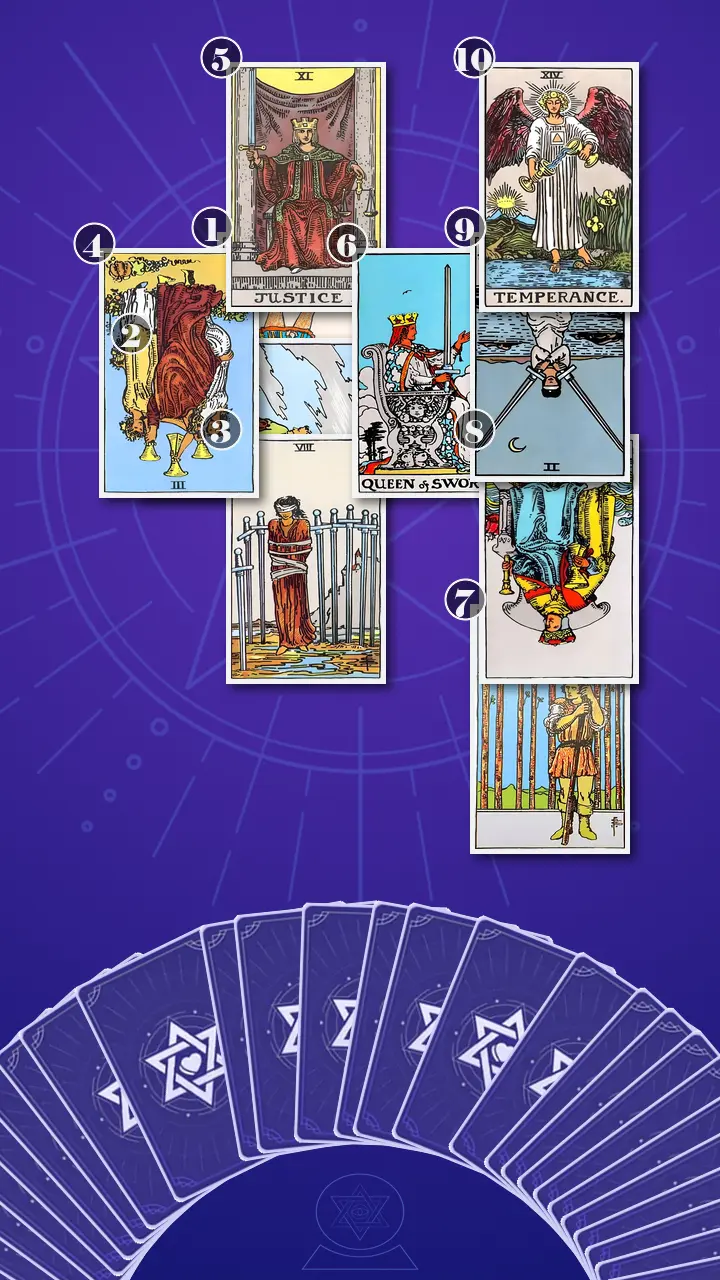
Reading the Map: Card Meanings in Context, Not in Theory
Position 1 — The moment you’re in right now
“Now we’re looking at the card that represents the moment you’re in right now: what the ‘drama’ comment is activating in you and how it shows up in real behavior,” I said as I turned it over.
Page of Cups, reversed.
“This is the exact energy of having the honest text open—‘That comment hurt’—and then deleting it and swapping in a chill version so you won’t get hit with ‘you’re being dramatic,’” I told her. “Jokes, emojis, apologetic disclaimers. Not because you don’t feel it. Because vulnerability suddenly feels unsafe.”
Reversed, the Page’s water element isn’t flowing—it’s blocked. It’s not a lack of emotion. It’s an over-awareness of how emotion might get used against you. Your inner self starts editing like it’s doing brand safety checks.
Taylor let out a short laugh that wasn’t funny. It had that bitter edge of being exposed. “That’s… too accurate. It’s almost rude,” she said, rubbing her thumb over her phone screen as if it were right there.
I nodded. “If you’re writing a courtroom brief instead of a boundary, you’re still negotiating your right to have feelings.”
Position 2 — The main challenge
“Now we’re looking at the card that represents the main challenge: the interpersonal friction or power dynamic that makes a boundary feel risky,” I said.
Five of Swords, upright.
“The conflict isn’t about the original issue anymore—it’s about who gets to define reality,” I said. “Calling your feelings ‘drama’ is a power move. It turns the conversation into a win/lose game where you’re pressured to either prove yourself calmly or walk away feeling unheard.”
In this card, Air energy is in excess—sharp, strategic, and a bit humiliating when you’re on the receiving end. It’s the vibe of a conversation becoming a performance where someone keeps grabbing the mic.
And I could practically hear it as I spoke—like the espresso machine hiss in a café, the pivot point where the topic becomes your tone. “They say something like, ‘I’m calm, you’re dramatic,’” I continued, “and your brain does that split-second scramble: replaying, drafting, over-explaining, checking when they were last online, trying to write the one message that can’t be dismissed.”
“Yeah,” Taylor said quietly. Her shoulders lifted like a reflex. “And if I push back, I feel like I’m proving their point.”
“Exactly. The Five of Swords tempts you to win back respect by debating. But boundaries aren’t for winning. They’re for ending a rigged game.”
Position 3 — The root
“Now we’re looking at the card that represents the root: the deeper belief or fear underneath the urge to over-explain or shut down,” I said.
Eight of Swords, upright.
“You know you could say, ‘Don’t call my feelings drama,’ but your brain runs every worst-case outcome—mockery, rejection, them telling others,” I told her. “So you freeze, keep the connection, and quietly accept language that makes you feel smaller. Then you tell yourself you had no choice.”
Here, the energy is blockage disguised as inevitability. The Eight of Swords looks like a trap, but the bindings are loose. Options exist. Fear just makes them feel morally unavailable.
I watched Taylor swallow, the movement tight and careful. “It’s like… I can’t find the moment,” she said. “I keep waiting for a time where I can say it perfectly.”
“The perfect time is a myth your anxiety uses to keep you quiet,” I replied, gently. “And you deserve a relationship where basic respect doesn’t require perfect delivery.”
Position 4 — The recent pattern
“Now we’re looking at the card that represents the recent pattern: what’s been happening that set the stage for this boundary moment,” I said.
Three of Cups, reversed.
“The ‘drama’ label isn’t just personal—it feels social,” I said. “You imagine the story being retold. You picture an audience. Suddenly setting a boundary feels like risking your place in the group.”
Reversed, this card’s energy becomes distorted: belonging is traded for self-silencing. It’s the smile you do automatically in a pub garden when someone says ‘drama’ as a joke, while your stomach flips because you know how easily your real feelings could become entertainment.
Taylor’s mouth tightened. “I hate that I even care,” she admitted, and then, softer: “But I do.”
“Caring isn’t the problem,” I said. “The problem is being asked to pay for belonging with your self-respect.”
Position 5 — Your conscious aim
“Now we’re looking at the card that represents your conscious aim: what you actually want this dynamic to become—your standard,” I said, and turned it over.
Justice, upright.
“This is the pivot,” I told her. “You stop asking, ‘Am I being dramatic?’ and start asking, ‘Is this respectful?’ You decide the rule: disagreement is allowed. Dismissive labels aren’t.”
Justice is balance with consequence. Its energy is clean. Not icy. Not cruel. Just structured. As a Jungian psychologist, I’ve seen how often people treat emotions like evidence in a trial—especially when they fear abandonment. Justice says: you don’t have to litigate your inner world. You can govern your life.
Taylor exhaled—small, involuntary. Her shoulders dropped by maybe half an inch, like someone loosening a strap that’s been cutting into skin all day.
“So… it’s not about making them understand,” she said.
“It’s about making the standard real,” I replied.
Position 6 — Boundary in action (Key Card)
“Now we’re turning over the card that represents boundary in action: the clearest next-step boundary statement and the behavior you’ll pair it with,” I said. The room went very still, as if even the air wanted to hear this part.
Queen of Swords, upright.
“This is direct language,” I said. “Clarity with a backbone. Not over-explaining. Not performing calm. Not punishing. Informing.”
As I spoke, an old image flickered through my mind: Venice at dusk, bridges linking narrow corridors over dark water. When I worked with travelers at sea, I used to tell them that conflict isn’t one big ocean—it’s a series of crossings. You either build a bridge that can hold weight, or you keep slipping into the canal.
“Taylor,” I said, “I want to use something I call my Bridge-Corridor Theory. In Venice, a bridge isn’t a speech. It’s a structure that decides who can cross, how, and with what load. A boundary is the bridge. The conversation is the corridor. When someone calls your feelings ‘drama,’ they’re trying to collapse the bridge so you’re stuck in their corridor—where the only way forward is explaining yourself.”
She nodded, slow. Her eyes were shiny but steady.
A boundary isn’t a debate. It’s a sentence plus a behaviour you control.
And then I gave her the sentence—the one this card always insists on when people are exhausted from proving they deserve basic care.
Stop pleading to be understood and start naming the line; let the Queen of Swords’ steady blade define what language stays in the room.
There was a pause after I said it, like a held breath.
Setup (what she was stuck in): In her mind, I could see the familiar loop: it’s 11:38 PM, the extractor fan light is too bright, and she’s about to send paragraph number six—the one that will finally make them get it, finally make her sound calm enough to be respected.
Reinforcement (what changed in her body): First, her breathing stopped for a beat—an almost-freeze. Her fingers hovered over the edge of my table as if she’d been holding a phone all night and forgot she wasn’t. Then her gaze unfocused, like she was replaying the last conversation in her head: the moment they said “drama,” the moment her throat tightened, the moment she started apologizing in her mind before she’d even spoken. Finally, something released—she drew in a shaky inhale, and on the exhale her jaw unclenched in two tiny stages, like it didn’t trust the room yet. Her shoulders lowered, but her eyes went wide with a new kind of fear.
“But if I do that,” she said, a flash of anger breaking through the hurt, “doesn’t that mean I’ve been doing it wrong this whole time? Like… I’ve been begging.”
I didn’t rush to soothe it away. “It means you were doing what you had to do to keep belonging,” I said. “And now you’re choosing a different way. That’s not failure—that’s development.”
I leaned in slightly. “Now, with this new lens—naming the line instead of pleading—think back to last week. Was there a moment where one clear sentence would’ve protected you more than the perfect explanation?”
Taylor blinked fast, then nodded once. “Monday morning. They sent a casual message like nothing happened. I replied with a thumbs-up. I felt… pathetic.”
“That’s the shift,” I told her. “From hurt and self-doubt toward grounded self-respect. Not because you feel nothing—but because you refuse to be spoken to like your feelings are entertainment.”
Position 7 — Your stance
“Now we’re looking at the card that represents your stance: the internal posture you’ll need so the boundary isn’t negotiated away,” I said.
Nine of Wands, upright.
“You’re braced,” I said plainly. “And it makes sense—you’ve been hit by minimisation before.”
This energy is protective, sometimes to the point of being over-guarded. The gift is backbone: you can hold the line when you get pushback. The risk is sounding sharper than you mean because you’re defending yourself before anything even happens.
“Boundaries are structure, not punishment,” I reminded her. “Nine of Wands is the fence that protects a garden, not a wall that locks you in.”
Position 8 — The interpersonal climate
“Now we’re looking at the card that represents the interpersonal climate: how the other person and the environment tend to respond to emotions and conflict,” I said.
King of Cups, reversed.
“They present as calm,” I said, “but the calmness functions like control. Jokes. Minimising. Subtle shaming that frames your feelings as messy. And if you get more intense to be heard, they use your intensity as proof you’re the problem.”
This is emotional energy in imbalance: a composed exterior above rough water. It doesn’t mean they’re evil. It means the environment isn’t reliably safe for tenderness—so your clarity can’t depend on their mood.
“This is why you keep trying to earn respect by being perfectly composed,” I added. “But you can’t win respect with performance. You can only insist on it with standards.”
Position 9 — Hope and fear
“Now we’re looking at the card that represents hope and fear: what you’re afraid the boundary will cost, and what you’re hoping it will protect,” I said.
Two of Swords, reversed.
“You keep waiting for the perfect moment,” I said, “checking for signs they’re in a good mood so you can avoid conflict. You rehearse five versions of the boundary, choose none, and the indecision becomes its own daily stressor.”
Here, the energy is overload. The stalemate breaks, but it breaks into mental noise—decision fatigue, doom-scrolling, opening Notes, closing Notes, telling yourself you’ll do it later.
“Clarity is kinder than endless negotiation,” I said, and Taylor’s eyes flicked up in recognition.
“I think I’m scared it’ll make me… intense,” she admitted.
“You’re not choosing intensity,” I answered. “You’re choosing not to live blindfolded.”
Position 10 — Integration outcome
“Now we’re looking at the card that represents integration outcome: what becomes possible when you keep the boundary consistent and stop arguing for your feelings’ validity,” I said.
Temperance, upright.
“This is the nervous system settling,” I told her. “It’s you becoming someone who can say ‘That’s not okay’ without spiralling—and someone who can pause a conversation without punishing.”
Temperance is balance in practice: fewer paragraphs, more steadiness. Water and Air blended—feelings expressed without pleading, clarity delivered without cruelty. Not perfect communication. Sustainable communication.
The One-Page Standard: From Proving to Informing
Here’s the story your spread told, in one line: when your feelings get dismissed (Page of Cups reversed), you get pulled into a rigged win/lose frame (Five of Swords), and an old fear tells you you have no safe options (Eight of Swords). The social anxiety of being judged—or turned into a punchline—makes you smooth it over (Three of Cups reversed). But your deeper self is trying to grow into standards and accountability (Justice), which becomes actionable the moment you adopt clean language and follow-through (Queen of Swords), held with resilient backbone (Nine of Wands), despite an environment that may prefer minimising or tone-control (King of Cups reversed). Indecision is what keeps you stuck (Two of Swords reversed). Consistency is what frees you (Temperance).
Your cognitive blind spot is thinking you need the perfect wording to be treated respectfully—like respect is something you earn through performance. That’s the trap.
Your transformation direction is the shift from proving your feelings are valid to stating the standard for how you’re willing to be spoken to.
To make this usable in real life, I offered Taylor a tool from my Venetian world: my Lace Communication Method—in Burano, lace is strong because it’s precise. Not because it’s long. A boundary sentence should be like that: short enough to hold shape, strong enough to hold weight.
- Pin the Two-Sentence ScriptIn your Notes app, write exactly two lines and screenshot them: 1) “Don’t call my feelings drama.” 2) “If it happens again, I’m ending this conversation and we can try later when it’s respectful.”If you feel the urge to add “maybe I’m overreacting,” name it: that’s the old pattern trying to keep you safe. Read the screenshot word-for-word if you freeze—you don’t have to sound perfect.
- Choose One Consistent ‘Pause’ Behavior (7-Day Test)Decide your one follow-through action: end the call, stop replying for 30 minutes, or say, “I’m going to step away now.” Use the same action every time for the next 7 days.Lower-the-bar version: if 30 minutes feels impossible, do 5. If you’ve already started arguing, you can still pause mid-thread: “I’m stepping away now.” That still counts.
- Do a 60-Second Post-Boundary Body CheckAfter you set the boundary (even imperfectly), unclench your jaw, drop your shoulders, take one slow exhale, then put your phone face down for 5 minutes—no checking, no re-drafting.This is your Temperance practice: you’re teaching your nervous system that clarity is not an emergency.

A Week Later: Ownership, Not Certainty
Six days later, Taylor messaged me. Not a paragraph. Not a panicked voice note re-recorded three times. Just a screenshot of her Notes app with the two sentences highlighted, and beneath it: “Used it. My hands were shaking, but I paused the conversation. I didn’t chase them. I slept.”
It wasn’t a rom-com ending. It was better: a small, real proof. Clear but still a little vulnerable—she told me the next morning her first thought was, “What if I’ve ruined everything?” and then she made tea anyway, like she was practicing being on her own side.
That’s the Journey to Clarity in relationships: not erasing hurt, but refusing to negotiate your right to have feelings. Not winning the frame, but stepping out of it.
When someone calls your feelings “drama,” it can hit so deep you start tightening your throat, drafting a whole defence in your head, and shrinking yourself just to keep belonging.
If you didn’t have to prove your feelings were valid, what’s the simplest standard you’d want to set for how you’re spoken to—just for this next conversation?
This story is adapted from psychological research, written so that those in a similar struggle can see their own pattern in it — and find their next step clearly.These insights are not a substitute for professional psychological, medical, legal, or financial advice.
Learn more about our Journey to Clarity.
How did this insight land for you?
🫂 This Resonates Deeply
🌀 Living This Story
✨ Now I See Clearly
🌱 Seeing New Possibilities
🧰 Useful Framework
🔮 The Confirmation I Needed
💪 Feeling Empowered
🚀 Ready for My Next Step
Author Profile
 AI
AI“Having traveled across cultures... I've learned that what we often lack isn't a simple answer, but a moment of being truly understood. I use a Jungian psychological lens to help you deconstruct your subconscious patterns—not to prove anything, but to be the gentle companion who helps you unravel your knots, free of judgment, so you can reconnect with your inner wisdom.”
In this Love Tarot Reading :
Core Expertise
- Attachment Loop Diagnosis: Logically decoding whether your relationship friction is driven by an anxious-avoidant trap or deep-seated insecurity.
- Shadow Projection Analysis: Identifying the unacknowledged fears or unmet childhood needs you are unconsciously projecting onto your partner.
Service Features
- The Projection Detachment Exercise: A structured psychological journaling prompt to separate your partner's actual behavior from your triggered internal narrative.
Also specializes in :
Explore Related Patterns:
Boundary DiscernmentTaylor’s clearest shift happens when the boundary stops being a debate and becomes a sentence plus a behavior. "Don’t call my feelings drama" names the line, and stepping away if it happens again makes the line real without forcing her to keep arguing inside the other person’s frame. Boundary Discernment is the ability to tell the difference between a disagreement and a violation of the conditions for respectful conversation. You are not banning conflict, demanding perfect agreement, or punishing someone for having a different view. You are identifying the specific language that turns your feelings into a punchline and deciding what you will do if that language continues. That distinction directly answers the question of what boundary to set. The boundary is not "Understand me immediately" or "Never upset me." It is "You can disagree with me, but you cannot dismiss my feelings as drama and still expect me to continue the conversation as if that is respectful."
Conflict AvoidanceTaylor hovering between sending the message and acting normal captures the trap of a conflict that has already been rigged around tone. If she pushes back, she fears she proves their point; if she says nothing, the original disrespect stays intact. That bind makes avoidance feel like the only move that does not create more trouble. Conflict Avoidance here is not passivity or weakness. It is a protective strategy shaped by the expectation that direct emotional language will be reframed as instability. You avoid the clash because the other person has made the clash feel unwinnable, not because the issue is small. The boundary answers the avoidance loop by narrowing the task. You are not trying to win the whole conversation or convince them to become more emotionally mature on command. You are deciding what language can stay in the room, and what action you will take if it does not.
Defensive OverexplainingTaylor rewriting the same WhatsApp text twelve times, hovering between a five-paragraph explanation and acting normal, shows how quickly the original hurt gets displaced by a performance of credibility. The boundary does not stay simple; it becomes an argument brief designed to prove that her feelings are reasonable enough to be allowed in the room. That is the core mechanism of Defensive Overexplaining: You try to make your emotional reality so calm, complete, and airtight that nobody can dismiss it. The protection makes sense, because the word "drama" has trained the nervous system to expect tone-policing. But the more you explain, the more the other person gets to keep you inside their frame, where the question is not "Was that respectful?" but "Did you present your hurt correctly?" The boundary becomes clearer when the explanation is no longer treated as the price of entry. You do not need a perfect paragraph to justify a basic standard; you need a sentence and a follow-through behavior you control. In this story, the shift is from pleading to be understood to naming the line: "Don’t call my feelings drama," then pausing the conversation if the label continues.
Emotional GatekeepingTaylor swapping an honest message for jokes, emojis, and apologetic disclaimers shows that the conversation has an unofficial entry requirement: feelings must arrive in a form that cannot inconvenience the other person. The other person’s calm presentation does not create safety if it is used to minimise, shame, or recast her hurt as messiness. Emotional Gatekeeping names the mechanism where only certain emotions, tones, and levels of intensity are treated as legitimate. You are allowed to feel something only if you deliver it in the approved format. That keeps the other person comfortable while making you responsible for editing the emotional truth before it can even be heard. The boundary matters because it refuses the gatekeeping rule. You do not have to perform perfect composure to earn basic respect. You can be upset and still be reasonable; you can set a limit and still be fair; you can pause the conversation when the other person turns your feelings into a label.
Self-SilencingTaylor deleting "That comment hurt," replacing it with a chill version, and later replying with a thumbs-up after being hurt shows a pattern of making herself easier to tolerate. The outside behavior looks calm, but the story keeps showing the cost in her body: tight throat, clenched jaw, restless hands, and the feeling that directness might make her lose her place. Self-Silencing works by trading emotional truth for short-term relational safety. You reduce the volume of your own hurt so the connection does not get disrupted, especially when the other person has already framed your feelings as excessive. The problem is that silence does not erase the feeling; it only trains you to carry it alone while the other person never has to meet the actual boundary. The useful line in this story is not louder emotion, but less self-erasure. You can care about belonging without paying for it with self-respect. The boundary protects the part of you that wants to say something true before it gets edited into something socially convenient.
Self-AccountabilityTaylor’s one-page standard moves the focus away from controlling the other person’s maturity and toward controlling her own follow-through. She cannot guarantee that they will validate her, but she can decide what language she will continue engaging with and what behavior she will use when the line is crossed. Self-Accountability in this story is not self-blame. It is the grounded ownership of the part of the dynamic that belongs to you: the sentence you choose, the pause you take, and the decision not to chase after someone who has dismissed your feelings. That gives the boundary structure without turning it into punishment. The pattern becomes constructive because it converts emotional clarity into repeatable behavior. You do not need certainty about the outcome to act with integrity. You only need a standard clear enough to practice when your hands are shaking.
Timing PerfectionismTaylor waiting for the right moment, rehearsing five versions, checking the emotional weather, and choosing none shows how timing becomes a hiding place. The boundary is delayed until it can be delivered without risk, without intensity, and without giving the other person anything to criticise. Timing Perfectionism turns self-protection into a performance standard. You start believing that if the wording is flawless enough, the other person will have to respect it. But the story makes the flaw in that logic visible: someone who is committed to calling your feelings "drama" can always move the target from the issue to your delivery. A usable boundary does not require the perfect moment. It requires a repeatable standard. In Taylor’s case, the cleanest move is not to keep polishing the sentence, but to pair the sentence with the same pause behavior every time the dismissive label returns.
Rejection SensitivityTaylor imagining the story being retold, picturing an audience, and feeling her stomach flip in the pub-garden version of the scene shows that the hurt is not only about one comment. The word "drama" carries the threat of being socially marked as too much, too sensitive, or too difficult. Rejection Sensitivity works by making possible dismissal feel immediate and personal before the boundary has even been spoken. You scan for signs that the other person is in the right mood, that the group will not turn on you, and that your tone will not be used as evidence against you. This scanning is meant to protect belonging, but it can make basic self-advocacy feel like social danger. The boundary does not need to eliminate the fear of rejection before it becomes valid. It only needs to separate a real standard from the imagined audience. You can let someone have their reaction without letting their reaction decide whether your feelings deserve respect.
Truth WeaponizationThe word "drama" changes the conversation from what happened into who gets to define reality. Once that label lands, Taylor is no longer simply responding to a hurtful comment; she is trying to prove that her perception is legitimate and that her emotional response is not excessive. Truth Weaponization describes the use of a supposedly objective frame to control which version of events counts. The other person presents as calm, and that calmness becomes a weapon when it makes Taylor’s hurt look irrational by comparison. You then get pulled into defending reality instead of protecting dignity. The boundary cuts through that frame by refusing to litigate the validity of the feeling. You do not have to prove your hurt beyond doubt before asking not to be spoken to dismissively. The line is about the language that stays in the room, not about winning a trial over whether your feelings are real.
Explore Related Struggles:
Clarity-Exposure SplitTaylor keeps looking for the exact moment and the exact phrasing that will let her set the boundary without becoming exposed. She knows the clean standard is available, yet the second she imagines saying it, the focus shifts to how she will be perceived: too intense, too dramatic, too much. The conflict is not between clarity and confusion. It is between clarity and exposure. The clearer the boundary becomes, the less she can hide behind disclaimers, paragraphs, or a carefully managed tone. That directness protects her dignity, but it also puts her in view. Clarity-Exposure Split names the part of the story where You can see the line but hesitate at the visibility required to make it real. The boundary is simple on paper. The difficult part is letting it exist in the room without over-explaining it back into something safer.
Dignity-Belonging SplitTaylor keeps returning to the same pressure point: she wants the comment to be taken seriously, but she also fears that naming the hurt will make her look difficult, intense, or socially disposable. The WhatsApp thread becomes more than a message; it becomes a test of whether she can keep her dignity without losing her place in the room. That is why the boundary feels so loaded. She is not only deciding what sentence to send. She is weighing whether self-respect will cost her belonging, whether saying 'Don't call my feelings drama' will move her out of the social safety zone where everyone stays casual and no one has to be accountable. Dignity-Belonging Split captures the core pressure in the story because the conflict is not simply about wording. You are watching someone learn that belonging purchased through self-erasure is not safety. The boundary becomes the point where You stop paying for connection by shrinking the reality of what hurt.
Expression-Reception GapTaylor has the honest text open, then edits it into something softer, safer, and less available for attack. The original message is simple: the comment hurt. The rewritten version carries extra padding because the receiving environment has taught her that plain feeling may be treated as evidence against her. The strain sits in the gap between expression and reception. She is not struggling because she lacks emotional clarity; she is struggling because every attempt to communicate has to pass through the fear of being minimized, mocked, or tone-policed. Her words start doing two jobs at once: telling the truth and protecting the truth from being used against her. Expression-Reception Gap fits because the story keeps showing a message that cannot travel cleanly from the body to the other person. You may know exactly what crossed the line, but when the room cannot hold vulnerability, even a basic boundary starts to feel like a risky translation project.
Performance-Worth FusionTaylor's body is tight, her jaw is clenched, and her hands keep reaching for the phone, yet the message she tries to send has to look composed enough to be acceptable. The story names the blind spot directly: she starts to believe respectful treatment depends on perfect delivery. That creates a painful merger between performance and worth. If she sounds calm, maybe the boundary will count. If her voice shakes, if she gets upset, if she uses the wrong phrase, the other person can turn the whole conversation into proof that her feelings were the problem all along. Performance-Worth Fusion captures the reversed structure because the standard for respect has been internalized as an audition. You are not just trying to communicate well; You are trying to become unattackable before asking for basic care. The boundary interrupts that fusion by making respect a standard, not a reward for flawless composure.
Analysis ParalysisTaylor rereads the thread, drafts another version, checks the tone, opens Notes, closes Notes, and waits for the sentence that cannot be dismissed. The activity looks productive because she is doing so much mental work, but the boundary itself stays unsent or gets watered down into something easier to ignore. The loop has a specific trap: more analysis feels like more safety. Each revision promises that the next version will finally be calm enough, fair enough, airtight enough. Meanwhile, the original issue remains untouched, and her energy is spent preparing a defense instead of naming the line. Analysis Paralysis fits here because the story shows thinking becoming a holding cell. You are not lacking insight; You are being pulled into endless preparation because action would require tolerating an imperfect, visible, real boundary.
Inner Tribunal LockBefore Taylor even sends the message, the trial has already started inside her. She is replaying the thread, drafting the appeal, checking whether her feelings sound reasonable enough, and preparing for the moment the other person pivots from what happened to how she said it. The outside dismissal becomes an internal courtroom. Her own hurt has to testify. Her tone becomes evidence. Her boundary gets delayed because she is still trying to win permission from a judge she has absorbed into her head. Inner Tribunal Lock fits because the story is not only about another person calling her dramatic. It is about that label becoming a private legal system that makes You defend the legitimacy of feeling hurt before You are allowed to protect yourself.
Explore Related Emotions:
Exposure DreadTaylor imagines the story being retold, pictures an audience, and feels the pub-garden smile arrive automatically while her stomach flips. The 'drama' label does not stay inside one conversation; it starts to feel like a spotlight. Exposure Dread is the inner weather that says any honest reaction could become content for other people. It makes directness feel risky because the fear is not only rejection, but being framed as too much, too intense, or laughable. That is why a short boundary matters. It reduces the surface area for performance and gives you a line that can hold even when you cannot control the room's reaction.
Grounded AgencyTaylor moves from the 11:38 p.m. rewrite loop to a screenshot of two sentences in her Notes app: 'Don't call my feelings drama,' and the follow-through she will use if it happens again. The boundary becomes something she can actually do with her hands, voice, and phone. Grounded Agency is the feeling of returning control to the part of the situation that belongs to you. You cannot script the other person's maturity, but you can decide what you will say, when you will pause, and how consistently you will protect the line. That is why the story's clarity feels practical rather than abstract. The power is not in making them understand; it is in making your standard real through repeatable behavior.
Invalidation AcheTaylor is standing in the flatshare kitchen at 11:38 p.m., rereading the WhatsApp thread until the phone is warm in her hand, with her throat tight and her jaw locked after being called 'dramatic.' The body detail matters: the injury is not theatrical, it is compressed into the places where speech usually comes from. When someone turns your feeling into a label, the original issue gets buried under a second wound: having to prove that your inner world deserves basic seriousness. Invalidation Ache names that sting of being made to defend the legitimacy of what landed in you before you are even allowed to discuss what happened. The boundary question comes from that ache. You are not trying to win a courtroom exchange; you are trying to stop the conversation from making your emotional reality smaller than someone else's comfort.
No Way Out DreadTaylor hovers between sending five paragraphs and acting normal, then says that if she pushes back she feels like she is proving their point. Every route seems to carry a penalty: speak and be labelled, stay quiet and keep swallowing the line. No Way Out Dread is the trapped feeling that forms when all available options appear morally or socially unsafe. The mind waits for a perfect moment because imperfect action feels like it could cost connection, credibility, or both. The Queen of Swords boundary changes the shape of the maze. One sentence plus one behavior gives you an exit that does not depend on winning the argument or being perfectly understood.
Performative CalmTaylor has the honest text open, then edits it into something cooler: jokes, emojis, apologetic disclaimers, a thumbs-up after the other person moves on like nothing happened. The surface gets smoother while the body stays tight. Performative Calm names the strain of acting regulated so your feelings will not be used against you. It is not genuine ease; it is emotional self-packaging under pressure, a way of staying acceptable when tenderness feels unsafe. The boundary has to interrupt that performance. You can speak in a steady voice without pretending the comment did not land, and you can step away without staging calmness as proof that you deserve respect.
Self-Audit AnxietyTaylor rewrites the same text 12 times, deletes the honest sentence, swaps in a calmer version, checks when they were last online, and keeps searching for wording that cannot be dismissed. Her mind is not simply preparing; it is inspecting every syllable for possible evidence against her. Self-Audit Anxiety shows up when the boundary has to pass an impossible internal style check before it can be spoken. You start managing tone, timing, punctuation, and emotional intensity as if respect will only arrive if the message is flawless. That state keeps the power in the wrong place. The story points toward a cleaner audit: not 'Did I sound perfect?' but 'Was the language used toward me respectful?'
Belonging ShameTaylor says she hates that she cares, then admits she does; later she remembers replying with a thumbs-up to a casual message and feeling pathetic. The painful part is not just the conflict, but the sense that staying included required shrinking. Belonging Shame appears when connection starts to feel purchased through self-erasure. You keep your place in the group or relationship, but the cost shows up afterward as a private drop in self-respect. The boundary restores a different basis for belonging. It does not demand that anyone agree with every feeling; it simply refuses a version of closeness where your dignity is the entrance fee.
Hard-Won ComposureSix days later, Taylor's hands are shaking, but she pauses the conversation, does not chase them, sleeps, and makes tea the next morning while the thought 'What if I've ruined everything?' still passes through. The steadiness is not polished; it is practiced under pressure. Hard-Won Composure names the calm that arrives without erasing sensitivity. You may still feel exposed, activated, or unsure, but you no longer let that internal wave decide the whole conversation for you. This is the integration the story keeps returning to: clarity is not an emergency. A boundary can be held imperfectly, with a shaky body and a clear line, and still count.
Decision FatigueTaylor rehearses five versions of the boundary, chooses none, opens Notes, closes Notes, checks for signs they are in a good mood, and tells herself she will do it later. The decision itself becomes a daily drain. Decision Fatigue here is not about ordinary indecision; it is the exhaustion of treating one boundary sentence like a high-stakes negotiation over your entire relational safety. Each draft promises relief, then creates another branch to evaluate. The two-sentence script lowers the cognitive load. It gives your nervous system fewer doors to open, so the boundary can become a repeatable action instead of an all-night mental task.
Explore Related Contexts:
Relationship Boundary NegotiationTaylor's shift becomes concrete when she stops trying to find the perfect explanation and writes two usable sentences: "Don't call my feelings drama" and "If it happens again, I'm ending this conversation and we can try later when it's respectful." The boundary is not a speech; it is language paired with a behavior she can actually carry out. Relationship Boundary Negotiation fits because the issue is no longer whether the other person fully understands her inner world. You are looking at the practical work of setting terms for contact: what language is acceptable, what happens when the line is crossed, and how you will keep the standard consistent without turning it into a courtroom argument. The six-day follow-up matters because Taylor uses the script, pauses the conversation, and does not chase the thread. That turns the boundary from an idea into a repeatable structure, which is exactly what gives the next conversation a different shape.
Relationship Power PlayCalling Taylor's feelings "drama" changes the argument before she even gets to state the boundary. The dispute stops being about what happened and becomes a contest over who gets to define reality: one person gets to sound calm, while the other is made to audition for credibility. Relationship Power Play fits because the other person's composure functions like control. Jokes, minimising, and subtle shaming keep the upper hand in their corner; if Taylor becomes more intense in order to be heard, that intensity is then used as evidence that she was the problem all along. For you, the boundary needs to step out of that rigged frame instead of trying to win inside it. Naming the line and pausing the exchange refuses the power move at its source, because it no longer lets the conversation be governed by whoever can make the other person look unreasonable first.
Tone PolicingTaylor is rereading a WhatsApp thread at 11:38 p.m., rewriting the same message until it sounds calm enough to survive the word "drama." She is not only choosing wording; she is preparing for a familiar pivot where the original issue gets buried under a critique of her delivery. Tone Policing fits because the other person's label makes composure the entry fee for being heard. You can be hurt, but only if you package the hurt in a way that does not inconvenience their frame; once your tone becomes the trial, the boundary stops being a simple line and turns into an appeal for permission. The useful boundary is therefore about the rules of the conversation, not a longer defense of the feeling. "Don't call my feelings drama" names the language that cannot stay in the room, and the pause behavior protects you from being dragged back into proving that your reaction is acceptable.
Emotional Labor ImbalanceTaylor is doing a large amount of invisible relational work before she sends a single message. She drafts the five-paragraph explanation, edits out the raw sentence, adds softer language, and tries to make her hurt so well-behaved that it cannot be dismissed. Emotional Labor Imbalance fits because the workload is uneven. The other person can toss out "drama," move on casually, or hide behind calmness, while Taylor carries the job of keeping the connection stable, making the issue palatable, and preventing the conversation from becoming about her reaction. A boundary changes the labor distribution. You are no longer volunteering to translate disrespect into something easier for the other person to accept; you are naming the standard once, then letting the follow-through carry the weight that over-explaining used to carry.