Finding Clarity in the 8:47 a.m. Slack Ping
You’re a hybrid tech PM in a big city and a single Slack DM—“quick call?”—turns your whole day into a live competence test (instant-message performance pressure).
Jordan appeared on my screen from a small Toronto condo kitchen, shoulders angled toward two monitors like she was bracing for impact. Slack was open on the left. Google Calendar on the right—solid blocks of color, no white space. The radiator clicked in that dry, impatient way radiators do, and her coffee sat ignored, already going lukewarm.
“It’s the vagueness,” she said, voice flat but eyes too alert. “If there’s no agenda, my brain fills in the worst one. My body hears ‘quick call?’ as ‘test.’”
I watched her jaw tighten on the word test, like her teeth were trying to hold a door closed. Her hand hovered near the keyboard, fingers slightly curled—half ready to type “sure,” half ready to run.
“So the question you’re bringing,” I reflected back to her, “is why that two-word ping flips a switch—why you say yes instantly, jump on without scoping, and then you do a whole second shift afterward trying to make it bulletproof.”
Jordan nodded once. Not agreement—recognition. “I don’t even know what I’m agreeing to,” she said, “but I say yes anyway.”
The dread in her wasn’t abstract. It sat like a tight band across her chest, a buzzy urgency under the skin—like a push notification her nervous system treated as an emergency alert. And under it, I could hear the core contradiction humming: she wanted to be seen as reliable and on top of things—but she feared that any pause, boundary, or clarifying question would make her look incompetent or replaceable.
“Okay,” I said gently, letting my voice be the hand on the rail. “Let’s not argue with your nervous system today. Let’s map it. We’re going to do a Journey to Clarity—figure out the pattern, the root driver, and the smallest real-time interrupt that actually works in a Slack-driven workplace.”

Choosing the Compass: The Celtic Cross · Context Edition
I asked Jordan to take one slow breath—not as a mystical ritual, but as a clean transition between reacting and observing. On my side of the call, in Tokyo, it was late; the planetarium dome I work under by day was long dark, but I still felt that familiar comfort of timed cycles—things moving in patterns, not personal attacks.
I shuffled slowly, the way I do when I’m trying to give someone’s mind a softer landing. “Today we’ll use a spread called the Celtic Cross · Context Edition,” I told her.
And for you reading along: I chose this version because Jordan’s question isn’t “Which option should I pick?” It’s “Why does this loop keep running?” The Celtic Cross is one of the best maps for a self-reinforcing pattern—moving from the immediate trigger, to the pressure that crosses it, to the unconscious driver underneath, and then forward to an actionable pivot point. In this context edition, the last two positions are tuned ethically: position 9 reveals what the overwork is trying to protect, and position 10 becomes an integration direction rather than a fixed prediction.
“We’ll read from the center outward,” I said, “like walking from a crowded notification hub to a higher vantage point.” I tapped three points on the table as I spoke: “First card is the exact trigger response. The card beneath shows the root ‘why.’ And the near-future card shows the smallest pivot that can interrupt the chain reaction.”
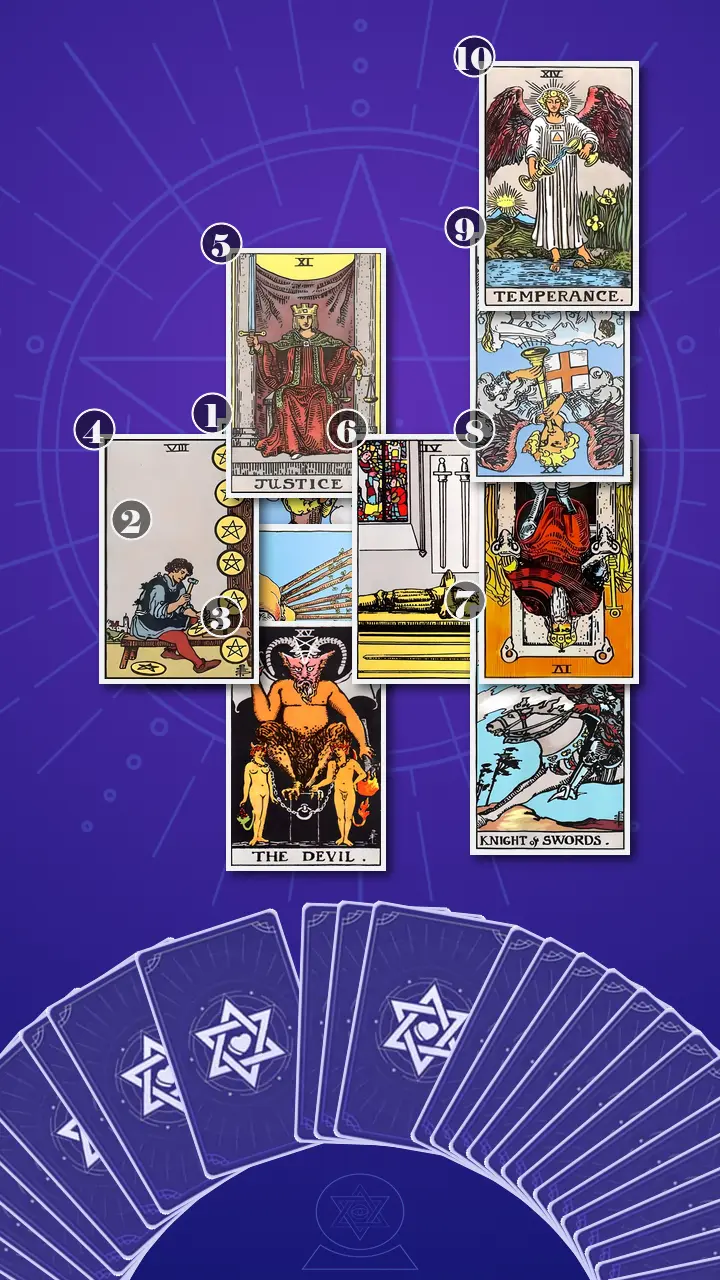
Reading the Map: How Tarot Works in a Slack-Driven Loop
Position 1 — The trigger you feel in the first three seconds
“Now flipped,” I said, “is the card that represents the exact present-moment trigger and your immediate internal reaction to ‘quick call?’.”
Page of Swords, upright.
“This is the notification posture,” I told her, and I angled my camera slightly so she could see the image clearly: the Page standing in wind, sword raised—not attacking yet, but ready. “In modern life, it’s exactly what you described: you see ‘quick call?’ and instantly sit up straighter, open five tabs, and start drafting an answer before you even know the question.”
Energy-wise, the Page is Air in excess: alertness tipped into hypervigilance. The mind decides that speed equals safety. And the moment that belief clicks, your body responds like it’s on call for an emergency.
I asked, “Think of the last time it happened. In the first three seconds, what did you assume was at stake?”
Jordan didn’t hesitate. “Credibility,” she said. “Like—if I’m not instantly helpful, I’m failing.”
Her fingers flexed once, then went still. That tiny movement told me the Page wasn’t just a card—it was her nervous system doing its job too well.
Position 2 — Where the 10-minute ask turns into a two-hour drain
“Now we’re looking at what crosses the situation: the immediate block that turns a small request into an overwork spiral,” I said.
Ten of Wands, upright.
“This,” I told her, “is when a ‘quick call’ becomes a bundle added to your arms.” And I used the translation that fits her life: “Call ends → Slack recap draft → Jira tickets → ‘just one more clarifying message’ → and suddenly it’s 9:47 p.m.”
Jordan let out a laugh—one sharp little sound, half disbelief, half grief. “That’s… kind of brutal,” she said. “But yeah. I’ve turned ten minutes into two hours. More than once.”
That laugh was the moment her shame loosened enough to become information. The Ten of Wands is Fire in excess: responsibility and effort without a container. The more you carry, the less you can see. The card literally shows a blocked line of sight—arms full, head down—like overwork narrowing your perspective until everything feels urgent and personal.
Under her laugh I could hear the inner operating system line: If I close the loop perfectly, no one can poke holes in it.
“And what does it cost you?” I asked softly.
She swallowed. “Everything that’s not work gets pushed to late night,” she said. “And then I hate my laptop… and I open it again.”
Position 3 — The root driver: why you feel like you can’t pause
“Now flipped is the hidden root driver of the overwork loop—the ‘why it keeps happening’ layer,” I said.
The Devil, upright.
In my work at the planetarium, I teach people to recognize the difference between a star and a satellite: one is a fixed light with its own gravity; the other looks urgent because it’s moving fast across your view. The Devil is that kind of illusion—something that feels like an external force, but is often an internalized rule with a loose chain.
“The chains here are the giveaway,” I told Jordan. “They’re not welded shut. They’re self-imposed rules about responsiveness. Worth equals availability. Safety equals being indispensable.”
And translated into her Slack life: “This is like when you know you could ask for an agenda, but your fingers type ‘sure!’ anyway because not being instantly helpful feels dangerous.”
Energy-wise, this is attachment—a compulsion loop. Not because you’re weak, but because the loop pays out a short-term reward: you avoid awkwardness, you avoid silence, you avoid the terrifying possibility of being seen as ‘not on top of it.’
“If you didn’t respond instantly,” I asked, “what’s the feared outcome your mind paints?”
Jordan stared at the card a second too long. “That they’ll think I’m… behind,” she said. “Or that I’m not good. And then it’ll snowball.”
Her jaw clenched again—Devil chain, tightened.
Position 4 — The conditioning: how ‘good work’ turned into ‘endless work’
“Now we’re looking at the recent conditioning that trained the pattern,” I said.
Eight of Pentacles, upright.
“This is the grind that built your competence,” I told her—no sarcasm, because I respect this card. “It’s craftsmanship. It’s the part of you that cares. It’s also the part of you that learned: effort equals worth.”
In her life translation: “You have a strong work ethic and you genuinely care about quality, but it also makes you default to ‘I’ll just handle it’ whenever something pops up.”
Energy-wise, this is Earth in balance—until it gets recruited by the Devil and Ten of Wands. Then it becomes over-functioning: you try to carve your way to safety, one more pentacle, one more artifact, one more recap message.
I nodded toward her Notion window peeking behind Slack. “Notion pages titled something like ‘Meeting Notes (please don’t judge)’—that’s Eight of Pentacles energy trying to control perception.”
Jordan’s mouth twitched. “I literally have one called that,” she said, and her shoulders dropped a millimeter—the tiniest relief in being accurately seen.
Position 5 — The standard you’re trying to live up to
“Now flipped is the conscious standard you’re trying to live up to when you over-respond,” I said.
Justice, upright.
“You want clear standards,” I told her. “Fair expectations. A sense that you’re doing the right thing.”
And the modern translation landed easily: “This is like wanting a simple, fair operating system for Slack requests—so you don’t have to guess what ‘good enough’ looks like every time.”
Justice is Air in balance when it’s healthy: discernment. But under pressure, Justice can become rigid—an inner rulebook that says: Be correct. Be responsible. Don’t give anyone a reason to doubt you.
“Here’s the thing,” I said. “Justice can’t deliver certainty in an ambiguous system. So you try to earn certainty with effort.”
Jordan looked down, then back up. “Yeah,” she admitted. “I’m trying to be perfectly accountable for… messy inputs.”
Position 6 — The pivot: the smallest interrupt that works in real time
“Now flipped is the near-future pivot—the smallest change that can interrupt the loop in real time,” I said.
Four of Swords, upright.
I felt the whole reading exhale here. “This is your medicine,” I told her. “Not a week off in Bali. A deliberate pause—small enough to actually do—right at the moment you get pinged.”
I described it the way the body understands: “Like putting your phone face down before you answer a tough text. Slack chime hits. Screen glow feels harsh. And instead of snapping your fingers into ‘sure,’ you take one breath. You unclench your jaw. Your shoulders drop.”
Then I said the line I wanted her to keep: “Clarity is not pushback. It’s scope.”
“In Toronto tech Slack,” I added, “a normal, non-defensive script can be: ‘Happy to chat—what’s the goal for the call, and can we timebox 15 minutes? I can do 2:30 or 4:00.’ That’s not you being difficult. That’s you being a PM.”
Jordan’s eyes softened, like she’d been offered a third door besides drop everything or ghost them. “Oh,” she said quietly. “There’s a move here.”
As she spoke, I noticed her hand finally rest flat on the table instead of hovering. That’s what Four of Swords does—it creates a protected pocket of time where your mind can regain perspective before acting.
Position 7 — Your default move under pressure
“Now flipped is your role in maintaining the loop—your default move when pressure hits,” I said.
Knight of Swords, upright.
“This is the part of you that charges,” I told her. “You move fast. You prioritize immediacy. You treat conversation like a problem to solve live.”
Her modern translation was almost word-for-word her life: “You accept the call instantly, talk fast, volunteer solutions, and only afterward realize you committed to more than was necessary.”
Energy-wise, this is Air in excess again: speed as identity. The Knight is impressive—and exhausting. In a Slack-triggered loop, the Knight keeps winning battles that were never declared wars.
Jordan rubbed her temple. “I can feel myself doing it,” she said. “Like my brain is trying to be the fastest thinker in the room.”
“Exactly,” I said. “And speed becomes a form of reputation insurance.”
Position 8 — The context: why your workplace makes it worse
“Now flipped is the workplace context that fuels the pattern—signals, culture, authority dynamics,” I said.
The Emperor, reversed.
“This is the part that’s not ‘all in your head,’” I told her immediately, because I could feel her trying to make it purely personal. “Reversed Emperor is unreliable structure: unclear authority, shifting expectations, rules that are implied but not stated.”
I painted the contrast like an A/B test: “In one workplace, calls come with an agenda, a timebox, and an async-first norm. In the other, ‘quick call?’ is a summons, and you’re expected to read between the lines while playing calendar Tetris and somehow still shipping.”
Jordan’s expression changed—not relief exactly, more like validation. “It’s… the second one,” she said. “The rules change depending on who’s asking.”
“And here’s the compensation move,” I said. “When structure outside feels inconsistent, you try to become the structure yourself—by over-documenting, over-prepping, and over-following up.”
She nodded slowly, like something clicked into place that wasn’t self-blame, just system logic.
Position 9 — What you’re protecting: the hope/fear under the reflex
“Now flipped is what you’re trying to protect by overworking—the inner hope/fear underneath the reflex,” I said.
Judgement, reversed.
I let the word Judgement sit between us for a beat. In the Rider-Waite image, there’s a trumpet—a call. In Jordan’s life, the trumpet is a Slack ping.
“This is tender,” I said. “Because reversed Judgement isn’t ‘you’re being judged’—it’s that you’re running an inner courtroom after every interaction.”
And I slipped into the echo technique on purpose, so she could feel the loop rather than intellectually label it:
You hear the trumpet blast—‘quick call?’—and you don’t just hear a request. You hear a summons. You stand up inside yourself like you’ve been called to the stand. You start gathering evidence: extra notes, extra follow-ups, a recap that reads like a mini-PRD. You want a verdict—‘I’m safe.’
But the verdict never comes. So you keep working, because working feels like adding more proof. Clarity becomes confused with closure, and closure becomes a thing you chase through more output.
Jordan’s reaction came in a quiet chain: first her breathing paused (a tiny freeze), then her gaze unfocused like she was replaying three specific calls, and then she exhaled—slow, tired, accurate.
“You’re not lazy,” I said, using the phrase I knew she needed to hear. “You’re stuck in an inner performance review that never ends.”
She pressed her lips together, fighting tears she didn’t want on a Monday. “That’s… yeah,” she whispered. “Even when the call was fine, I’m still on trial afterward.”
When Temperance Spoke: Turning “Quick Call?” Into a Call Container
Position 10 — The integration direction (your most supportive outcome)
I slowed my hands before flipping the last card. Even over video, the room felt quieter—like the radiator had decided to listen too.
“We’re turning to the most important card in this reading,” I said. “Not a prediction of what will happen to you, but the direction your system can stabilize into if you practice the pivot.”
Temperance, upright.
Temperance is the angel pouring between two cups. One foot on land, one in water. A path leading toward a rising sun. It’s not dramatic. It’s repeatable. It’s regulation that you can actually live inside.
And right away, I framed it the way she’d respect—as a workflow, not a personality lecture. “Think of it like product thinking,” I said. “Input: a vague ping. Constraint: a pause plus a container. Output: a scoped call and a clean next step. This is structured responsiveness—not reactive availability.”
Setup (30–50 words): Jordan was still stuck in that moment she’d described—the calendar already packed, the DM landing anyway. Chest tight. Jaw clamped. Fingers typing ‘sure’ before her brain catches up, because it feels like a live test she can’t afford to fail.
Delivery (the line that changes the frame):
Stop treating every ‘quick call’ like a verdict you must pass, and start mixing urgency with calm—like Temperance pouring between two cups—so your yes is intentional, not automatic.
I let silence do its job.
Reinforcement (100–200 words): Jordan’s body answered before her mouth did. First, her breath caught—like she’d stepped too close to the edge of a pool and realized she could either jump or back away. Her eyes widened a fraction, then softened as if something in her finally stopped arguing. Her shoulders, which had been lifted toward her ears like a defensive shrug, dropped with a small, involuntary release. One hand came up to her jaw—almost embarrassed—and she massaged the muscle like she’d just noticed she’d been clenching for hours. A flicker of resistance passed across her face, then moved through.
“But if I pause,” she said, voice sharper for a second, “won’t I look slow? Like I’m… not on top of it?”
I nodded. “That’s the inner courtroom talking. Temperance isn’t slowness. It’s pacing. It’s you choosing the rhythm instead of letting Slack choose it.”
This is where I brought in my own diagnostic lens—my planetarium work translated into something she could feel. “I use a technique I call Pulsar Breathing,” I told her. “Pulsars are stars that send out signals in steady, precise pulses. Not frantic. Not random. Consistent. Your pause is a pulse.”
“For the next week,” I said, “let your default be a 60–90 second pulse before you answer. Hand on your chest or jaw—notice what’s tight. Then reply with a container.”
I looked at her closely and asked the question that turns insight into memory: “Now—with this frame—think back to last week. Was there a ‘quick call?’ moment where a 60-second pulse could have made you feel different?”
Jordan blinked hard. Then she nodded, once, slower than before. “Tuesday. 3:18,” she said. “I could’ve asked what the decision was. I… didn’t have to volunteer two follow-ups.”
“Exactly,” I said. “This is the shift from a jolt of alarm to grounded self-trust. From ‘I must prove myself live’ to ‘I create clarity with structure.’”
Temperance didn’t ask her to care less. It asked her to mix two truths—helpfulness and boundaries—without losing either.
The Call Container Protocol: Actionable Advice for the Next 48 Hours
I pulled the whole spread together for her, the way I’d summarize a star map for a crowded planetarium audience.
“Here’s the story the cards are telling,” I said. “A vague Slack ping hits (Page of Swords), your system treats it like a competence test and you respond fast (Knight of Swords). Because your workplace has unclear structure (Emperor reversed), you try to create structure by yourself—after the fact—through extra artifacts (Eight of Pentacles). The burden expands (Ten of Wands). Underneath, there’s a compulsion to buy safety through being instantly impressive (Devil), and an inner performance review that never closes (Judgement reversed). What you consciously want is a fair standard (Justice). The pivot is a deliberate pause (Four of Swords). The integration is Temperance: structured responsiveness.”
“Your cognitive blind spot,” I added, “is thinking that clarifying will be read as pushback, so you skip clarity and pay for it with overwork. The transformation direction is simple but powerful: instant compliance → 60–120 seconds of pause → purpose + timebox → intentional yes.”
Then I gave Jordan steps that were small enough to actually do on a Tuesday afternoon.
- 60-Second Scope CheckFor the next “quick call?” ping, don’t reply for 60–90 seconds. Read the thread, check your calendar, and name the first body cue (tight chest, clenched jaw, buzzing hands) before you type.Tip: Use my Pulsar Breathing cue—one steady inhale/exhale cycle, like a consistent signal. Your pause is your professionalism, not your delay.
- Boundary-First Reply SnippetSave this as a Slack snippet: “Happy to chat—what’s the goal/decision for the call? Can we timebox 15 min? I can do 2:30 or 4:00.” Use it verbatim once this week.Tip: If proposing times spikes fear, lower the bar—ask only the purpose question first (“What do we need to decide?”). Clarity is scoping, not refusing.
- Three-Line ClosureAfter the call, send only three lines: “Decision: … / Next step: … / Owner + due date: …” Then stop. No paragraph #3.Tip: Set a 6-minute timer. If you start drafting extra context, paste it into a private note instead of the channel—practice closure without chasing a verdict.
Before we ended, I offered one of my more grounded “space nerd” strategies—because Jordan works best with something physical. “If you’re home and you feel that post-call adrenaline,” I said, “put on a steady background sound—laundry, a dishwasher, even a washing machine. I know it sounds silly, but consistent noise gives your nervous system a ‘cosmic hum’ to settle into. Let it be your signal that the trial is over.”
Jordan smiled—small, real. “I actually do laundry during meetings sometimes,” she admitted.
“Great,” I said. “Then let the washing machine be your new courtroom adjournment.”

A Week Later: The Quiet Proof of Intentional Responsiveness
Six days later, I got a message from Jordan.
“I did it,” she wrote. “Someone DMed ‘quick call?’ and I waited one minute. I asked what decision we needed. They said it was just a quick yes/no. We did 12 minutes at 4:00. I sent the three-line recap. Closed my laptop.”
Then a second text: “My jaw still clenched while I waited, not gonna lie. But it unclenched. Like… halfway.”
I pictured her in that same kitchen, same harsh screen glow—only this time, the glow didn’t own her whole nervous system. (A small shift. Not a new personality. A new rhythm.)
She added one more detail that stayed with me: she celebrated by walking to a café alone after work, sitting by the window with an iced coffee, phone face down. She still felt a flicker of “What if I messed up?”—but she didn’t open Slack to soothe it. She just let the feeling pass like weather.
That’s what this Journey to Clarity looked like in real life: not becoming someone who never feels urgency, but becoming someone who can hold urgency inside a container.
When a vague “quick call?” hits and your chest tightens, it’s not that you’re bad at boundaries—it’s that part of you is trying to buy safety by being instantly impressive, because silence feels like evidence against you.
If you gave yourself a 60-second pause next time—just long enough to ask for the goal and set a timebox—what kind of ‘professional’ would you get to be in that moment?
This story is adapted from psychological research, written so that those in a similar struggle can see their own pattern in it — and find their next step clearly.These insights are not a substitute for professional psychological, medical, legal, or financial advice.
Learn more about our Journey to Clarity.
How did this insight land for you?
🫂 This Resonates Deeply
🌀 Living This Story
✨ Now I See Clearly
🌱 Seeing New Possibilities
🧰 Useful Framework
🔮 The Confirmation I Needed
💪 Feeling Empowered
🚀 Ready for My Next Step
Author Profile
 AI
AI“After a decade of guiding people through the stars, I’ve come to see life much like the orbits of planets: everything has its inevitable cycles. When you feel lost, please don't blame yourself; you might just be in a natural low tide. I’m here to sit under the night sky with you, offering a gentle cosmic perspective to distinguish temporary pain from the beautiful breakthroughs just around the corner.”
In this Personal Growth Tarot Reading :
Core Expertise
- Cognitive Spiral Mapping: Validating that feeling 'stuck' is often just a necessary orbital slingshot phase before a major intellectual breakthrough.
- Gravity Well Identification: Diagnosing the obsolete habits or environments exerting a downward pull on your personal evolution.
Service Features
- The Orbit Expansion Strategy: A macro-perspective exercise to map the precise trajectory and momentum needed to escape your current cognitive gravity well.
Also specializes in :
Explore Related Patterns:
Competence TheaterJordan names the stakes as credibility, and the Slack ping immediately becomes a live competence test. She accepts quickly, solves out loud, volunteers answers, and then keeps producing proof afterward, as if the whole interaction is being watched by an invisible review panel. That is Competence Theater: not fake competence, but competence performed under pressure because silence feels like evidence against you. The defensive mechanism is impression management under threat; you move fast and over-explain so no one can conclude that you are behind, slow, or replaceable. The trap is that the performance never gets a clear ending. Even when the call goes fine, the inner performance review keeps running, so you keep adding proof instead of letting the interaction be complete.
Defensive OverfunctioningJordan does not just take the call; she builds an entire support structure around it afterward: recap drafts, Jira tickets, another clarifying message, and eventually a late-night second shift. When the workplace does not provide agenda, timebox, or stable expectations, you compensate by generating structure yourself. That is Defensive Overfunctioning: extra labor becomes a shield against unclear authority and possible scrutiny. The overwork is not random productivity. It is an attempt to make ambiguity controllable by producing more artifacts than the situation actually asked for. The cost is that your competence gets expressed through carrying more than your role requires. The more you over-function, the more the system can stay vague, because your nervous system keeps filling the missing structure with your own energy.
Urgency BiasJordan's first three seconds after 'quick call?' are all speed: she sits up, opens tabs, starts drafting before she knows the question, and types 'sure' without scoping. The Slack ping becomes a trigger for action before information, so your nervous system treats velocity as the safest available move. That creates Urgency Bias because the mind mistakes immediate response for competence protection. The faster you move, the less time there is to feel the ambiguity, but the price is that you skip scope, accept the frame, and inherit the whole follow-up chain. The pattern is not a discipline failure. It is a fast defensive shortcut. You are trying to stabilize uncertainty by being instantly useful, but the loop turns speed into obligation before you have defined the actual ask.
Achievement FusionJordan's work ethic is real, but the story shows it getting fused with self-worth: worth equals availability, safety equals being indispensable, and effort equals proof. A Slack request therefore lands less like a task and more like a referendum on whether you are valuable. Achievement Fusion turns professional output into identity protection. Instead of asking what the request requires, the mind asks what kind of worker you must prove yourself to be, and the answer is usually more available, more prepared, more correct, and more useful than the situation actually needs. That is why the laptop reopens even after she hates it. The work is not only work anymore. It has become a way to soothe the fear that if you are not instantly impressive, you might not be safe in the role.
CatastrophizingJordan says the vagueness is the problem: if there is no agenda, her brain fills in the worst one. A neutral two-word message becomes a possible verdict about whether she is behind, not good, or about to lose credibility. That is Catastrophizing because the cognitive system jumps from ambiguity to professional threat without enough evidence in between. The mind is trying to protect you by preparing for the worst case, but it ends up treating every unclear Slack ping as if it already contains bad news. Once the worst-case script is running, a clarifying question no longer feels like normal scope. It feels like risk. So you skip the question that would reduce ambiguity, and the unasked question turns into extra work later.
Closure ChasingJordan keeps working after the call should be over: recap, tickets, extra clarification, and more proof that the loop is handled. Even when the interaction was fine, she still feels on trial afterward, waiting for some internal verdict that says she is safe. That is Closure Chasing. The mind tries to turn uncertainty into completion by adding another artifact, another message, another polished paragraph, but the psychological closure never arrives because output cannot fully answer the fear underneath it. The three-line recap matters because it creates behavioral closure where emotional closure is unreliable. You stop asking the work to deliver a perfect verdict and give the interaction a clean ending instead.
Boundary DiscernmentSix days later, Jordan waits one minute, asks what decision is needed, holds the call to 12 minutes, sends a three-line recap, and closes the laptop. The same Slack trigger is still there, but the response now has a container. That is Boundary Discernment because the boundary is not a refusal; it is a clear distinction between availability and automatic compliance. You can be helpful while still asking for purpose, timebox, and a clean next step. The psychological shift is subtle but decisive. Clarifying stops being coded as pushback and becomes part of the work itself, which lets your yes become intentional instead of reflexive.
Explore Related Struggles:
Clarity-Exposure SplitThe 'quick call?' DM arrives without an agenda, and Jordan already knows the move that would help: ask what the call is for, set a timebox, and choose a real slot. The friction begins because that clean PM move feels exposed under pressure, as if asking for scope might be read as being slow, difficult, or not on top of it. You are caught in the place where clarity would protect your day, but requesting it feels like it could put your competence on display. So the ambiguity gets accepted upfront and paid for later through extra recaps, extra follow-ups, and a second shift of proof-building. The struggle is not that you lack a boundary script; it is that the act of clarifying has been loaded with the risk of being judged.
Performance-Worth FusionThe two-word Slack ping becomes a live competence test because Jordan hears more than a request. She hears a demand to prove that she is reliable, fast, useful, and hard to question, while any pause or clarifying question seems to carry the risk of looking incompetent or replaceable. You are not just answering a message in that moment; you are trying to keep your work identity intact. Availability starts functioning like evidence of worth, and every extra artifact becomes another attempt to make your value undeniable. The loop keeps running because competence has no natural off switch when it is being used to secure the right to feel safe at work.
Urgency-Compass FusionJordan's hand hovers over the keyboard before she even knows the ask, and the Slack chime starts acting like an emergency signal. Her body moves faster than the situation requires: sit up, open tabs, type 'sure,' solve live, and only later notice that speed has committed her to work she never actually scoped. You lose your inner compass when urgency is treated as evidence that something must be handled immediately. The ping starts choosing your rhythm, your availability, and your definition of being professional before you have checked what is actually needed. The 60-second pause matters because it returns the first decision to you; helpfulness can stay intact without letting the notification set the pace.
Inner Tribunal LockAfter the call, Jordan keeps gathering evidence: extra notes, extra follow-ups, a recap that reads like a mini-PRD. The actual meeting may be over, but the internal review is still open, and even a fine interaction does not automatically register as closure. You do not stop when the task ends; you stop only when some imagined verdict says you are safe. Because that verdict never fully arrives, more work starts to feel like more proof. The struggle is an inner performance review that converts silence, ambiguity, and normal workplace uncertainty into an open case you keep trying to win with output.
Responsibility-Authority SplitJordan describes a workplace where the rules change depending on who is asking, where a 'quick call?' can operate like a summons, and where expectations are implied instead of stated. In that unstable structure, she tries to compensate by becoming the missing structure herself through extra preparation, documentation, and follow-up. You are carrying accountability for a system that has not clearly defined the terms. The PM part of you knows that scope, ownership, and timeboxes should exist, but the pressure of unclear authority makes you absorb the gap as personal responsibility. The split keeps the overwork alive because you are trying to guarantee clean outcomes while the inputs remain messy and only partly within your control.
Systemic DepletionA ten-minute call turns into a recap draft, Jira tickets, one more clarifying message, and then suddenly it is 9:47 p.m. Jordan is not only doing the original work; she is doing a second shift designed to make the interaction bulletproof after the fact. You are not simply busy inside this loop. The repair mechanism is consuming the same time and energy it is supposed to protect, pushing everything outside work later and later until opening the laptop again feels both irritating and unavoidable. The depletion becomes systemic because every ambiguous input demands a larger output than your day can hold.
Explore Related Emotions:
Ambiguity DreadJordan names the vagueness directly: if there is no agenda, her mind fills in the worst one. The request is not frightening because it is long or complicated; it is frightening because it arrives without a frame. Ambiguity Dread is the emotional weather created by unclear inputs, implied rules, and shifting expectations. You are trying to operate fairly inside a system that does not tell you what fair or good enough means. In that gap, your mind starts supplying threats, and your body starts treating the unknown as urgent. That is why the loop begins before the call itself. The missing agenda becomes a blank screen for professional fear. You overwork afterward because the original request never gave you enough shape to know where the edge was.
Message DreadA two-word Slack DM lands while the calendar is already packed, the coffee is going cold, and Jordan's body is angled toward the screen as if something is about to hit. The message is small on the surface, but the story shows how quickly it becomes a live competence test inside her body. You are not reacting to a message as pure information here. You are reacting to the emotional charge that has attached itself to that format: no agenda, no scope, no visible endpoint, just a sudden demand for readiness. Message Dread names the way the notification becomes a trigger before the actual content is known. The key is that the dread arrives before the work does. It shows up in the jaw, the hovering fingers, the urge to type 'sure' before you understand what you are agreeing to. That makes the Slack ping feel less like communication and more like an assessment you have to pass immediately.
Replaceability DreadJordan says yes before she knows what she is agreeing to because the pause itself feels risky. The feared outcome is specific: if she asks for scope, if she takes a breath, if she is not instantly useful, someone might decide she is behind, not good enough, or easier to replace. Replaceability Dread captures the emotional logic under the overwork loop. You are not just trying to be helpful; you are trying to prevent a story where your value becomes questionable. That is why availability starts to feel like professional protection. The cost is that your yes stops belonging fully to you. It becomes a defensive reflex against being seen as disposable. Once that reflex takes over, even a small Slack ping can make your whole day reorganize itself around proving that you still deserve your place.
Verdict DreadAfter the call ends, Jordan does not simply close the loop. She gathers extra notes, drafts follow-ups, turns a recap into something almost like a mini-PRD, and keeps adding proof long after the original request should have been over. Verdict Dread names the feeling that there is an invisible evaluation still running. You are not only trying to complete the task; you are trying to reach an internal verdict that says you are safe, credible, and not at risk of being doubted. The painful part is that the verdict never fully arrives, so more work starts to feel like the only available evidence. This is why the overwork continues even when the call was fine. The external interaction ends, but the inner courtroom stays open. You keep working because closure has been confused with proof, and proof has been confused with emotional safety.
Hypervigilant AnxietyJordan's eyes are too alert even when her voice is flat, and her body starts preparing before the situation has been defined. She opens tabs, scans for threat, drafts responses, and tightens around the word 'test' as if speed itself could keep her safe. Hypervigilant Anxiety fits because the story is not just about being busy. It is about a body that has learned to treat ambiguity as an incoming problem and immediacy as protection. You can see the alert system working overtime: chest tight, skin buzzing, fingers ready to move before judgment has had a chance to arrive. That kind of anxiety keeps you functional, but it also keeps you trapped in reaction speed. The Slack ping becomes a signal to monitor everything at once: tone, status, competence, reputation, and possible consequences. The loop starts because your system tries to solve uncertainty by becoming faster than uncertainty.
Survival Mode FatigueA ten-minute ask becomes a call, a recap, Jira tickets, another clarifying message, and work stretching toward 9:47 p.m. The laptop becomes something Jordan hates and still reopens, because stopping feels emotionally unfinished. Survival Mode Fatigue fits the point where productivity is no longer just effort. It becomes a state of constant readiness, where the body treats routine work ambiguity as something to survive. You are tired not only because there is too much to do, but because the work is carrying the job of reassurance. The fatigue deepens when everything outside work gets pushed into whatever time is left. Rest does not feel clean, because the inner system is still checking whether enough has been done to stay safe. That is the drain inside the overwork loop: output keeps expanding because the body is trying to stand down and cannot find the signal.
Cautious Self-TrustSix days later, Jordan waits one minute before answering, asks what decision is needed, keeps the call to twelve minutes, sends the three-line recap, and closes her laptop. Her jaw still clenches, but it also unclenches halfway. Cautious Self-Trust fits because the change is not dramatic confidence. It is the smaller, sturdier feeling of letting yourself act with structure while the old fear is still present. You do not need to feel completely calm before you choose a clearer move. The cafe scene matters: phone face down, iced coffee by the window, a flicker of 'What if I messed up?' passing through without needing Slack to settle it. That is trust in its early form. You let the feeling move like weather instead of turning it into another work loop.
Contained OverwhelmJordan's body still reacts when the next 'quick call?' arrives, but the response changes shape. She waits one minute, checks the thread, asks what decision is needed, sets a time, and keeps the recap to three lines. Contained Overwhelm names the middle state where the pressure is real, but it no longer owns the whole system. You are not pretending the urgency disappeared. You are giving it edges: purpose, timebox, next step, and an ending. This is why the pause matters. It turns overwhelm from a flood into something that can be held in a container. You still feel the charge, but you get to choose the rhythm before Slack chooses it for you.
Explore Related Contexts:
Always On AvailabilityJordan's fingers move toward 'sure' before she knows what the call is about, because the Slack ping lands as a test of whether she is available, useful, and on top of things. Her calendar is already packed, but the implied expectation is that responsiveness should override the existing shape of the day. Always On Availability appears when a workplace treats speed as proof of competence. You are not being asked only whether you can talk; you are being measured against an invisible norm that says a reliable person responds immediately, absorbs interruption smoothly, and does not make the requester do the work of clarifying. The story makes this context concrete through the hybrid tech setting, the open Slack window, the no-white-space calendar, and the fear that a pause will read as incompetence. The issue is not a lack of discipline; it is a digital work culture where availability becomes reputation insurance.
Evaluation Pressure LoopJordan names credibility as the thing at stake in the first three seconds after the Slack ping. The message is only 'quick call?', but her day reorganizes around proving she is reliable, prepared, and not replaceable. Evaluation Pressure Loop captures the repeated external script: ambiguous request, instant performance, extra proof, no clear closure. You are operating in a work culture where the evaluation may not be formal, but it is constantly implied through speed, tone, authority, and responsiveness. The loop persists because the workplace does not provide stable criteria. Jordan tries to create a verdict through more output, but the system keeps producing new moments where she has to demonstrate competence again.
Performance Criteria Black BoxJordan says the rules change depending on who is asking, and the 'quick call?' arrives without an agenda, decision target, or timebox. She is trying to be accountable inside a system that does not clearly state what accountable actually means in the moment. Performance Criteria Black Box fits because the standard is implied rather than explicit. You are pushed to deliver the right level of responsiveness, preparation, and follow-up, but the acceptable threshold is hidden until someone reacts to your output. That uncertainty keeps the loop running. When Jordan cannot tell what will be considered enough, she tries to make the work bulletproof, using speed and extra artifacts to cover the gap left by vague expectations.
Slack Scope CreepJordan receives a two-word Slack DM, says yes before knowing the agenda, and then turns a supposedly quick call into recaps, Jira tickets, follow-up messages, and late-night laptop time. The external trigger is small, but the work container is never clearly closed. That is the structure of Slack Scope Creep: the request arrives through a casual channel, carries hidden authority, and expands through ambiguity. You are not simply answering a message; you are being pulled into a workplace rhythm where every unclear ping can generate extra coordination labor. The pressure becomes especially sticky because Jordan's role as a PM rewards clarity, ownership, and follow-through. When the workplace does not define the scope upfront, she fills the gap herself, and the cost shows up after the call when the invisible cleanup becomes the real workload.
Undefined Role ScopeJordan is told, directly through the reading, that the workplace context is unreliable structure: unclear authority, shifting expectations, and rules that are implied rather than stated. She confirms that the rules change depending on who is asking. Undefined Role Scope is the external condition underneath the overwork loop. You are expected to act like the owner of clarity, urgency, documentation, and follow-through, but the organization has not clearly defined what belongs to you, what belongs to the requester, and what can stay async. That gap pulls Jordan into compensating behavior. She over-documents, over-preps, and over-follows up because the role boundary has become elastic, and the workplace lets ambiguity expand into her personal workload.
Invisible WorkloadThe call itself is framed as quick, but Jordan's actual labor begins after it ends: recap draft, Jira tickets, another clarifying message, another pass at making the output defensible. By 9:47 p.m., the small request has created a second shift. Invisible Workload names the labor that is not visible in the original ask. You are carrying coordination, documentation, risk management, and emotional cleanup as if they are just part of being reliable, even though none of that work was scoped when the Slack message landed. The story shows how this hidden layer steals time from everything outside work. The laptop reopens because the workplace interaction has left unfinished residue, and Jordan tries to close it by producing more proof that she handled it correctly.
Work Life Boundary CreepJordan is working from a small Toronto condo kitchen with Slack open beside a calendar that has no white space. A vague DM interrupts that already packed structure, then the aftermath pushes everything that is not work into late night. Work Life Boundary Creep shows up when work does not need a formal emergency to cross the line. You are pulled by small signals, casual pings, and follow-up obligations that seem reasonable one by one, but together they take over the edges of the day. The story does not frame this as poor time management. It shows a hybrid workplace where digital access, unclear urgency, and self-imposed cleanup make the boundary porous, so closing the laptop becomes an achievement rather than the default end of work.