Finding Clarity in the 11:26 p.m. Hinge Draft
If you’ve ever rewritten the same Hinge message for 30 minutes like it’s a client email—then decided “now it’s weird if I text,” this is for you.
Jordan showed up on my screen from a Queens walk-up with one lamp on behind her and that particular NYC-night soundtrack—radiator clicking, a siren smoothing out into distance. Her phone was warm in her palm like it had been there all evening. She angled it toward me for half a second, embarrassed, like she was showing a bad grade.
“I typed, ‘Hey, I had a really good time,’” she said. “Deleted it. Then I tried ‘lol same,’ deleted that too. I just want to send something normal, but nothing sounds normal once I’ve read it five times.”
I watched her thumb hover in midair, not even touching the screen now—muscle memory still doing the hovering. Her chest rose and didn’t fully fall. Her jaw looked like it was holding a secret.
Dating perfectionism has a very specific body. It’s like your throat becomes a narrow straw, your hands turn into restless little animals over the keyboard, and your chest tightens the way it does right before a train doors-close beep—like you’re about to miss something, but you’re also terrified to step in.
“So the question,” I reflected back, keeping it simple, “is: before you hit send to them… what is your dating perfectionism hiding?”
Jordan nodded fast. “Yeah. Because I’m not trying to play games. I’m trying to not be… cringe. Or needy. Or whatever.”
“We can work with that,” I told her. “Not by ‘fixing’ you, but by finding clarity—what’s actually happening in that last ten seconds before you send, and what your nervous system thinks it’s protecting you from.”

Choosing the Compass: The Celtic Cross for Dating Text Anxiety
I began the way I always do: not with drama, but with focus. I asked Jordan to put both feet on the floor, loosen her grip on the phone, and take one slower exhale than inhale—just enough to tell her body, we’re here, not in a courtroom.
“Today,” I said, “I’m going to use the Celtic Cross spread.”
For anyone reading along: the Celtic Cross is perfect for questions like this because it maps a chain. It doesn’t just tell you what you’re doing; it shows why you’re doing it—present behavior, the specific obstacle, the root fear under the behavior, your conscious desire, and the integration path. When you’re stuck in decision fatigue—especially at a dating crossroads where one tiny message feels huge—you want structure that can separate truth from noise.
I also told Jordan what to expect. “The center cards will show the freeze and what crosses it. A lower card will show what this pattern is protecting. And later, we’ll climb the right side—your stance, the environment of apps and comparison, what you hope and fear, and what integration looks like.”
In my family’s old language from the Highlands, we’d say: we’re not predicting weather. We’re learning the season you’re in, so you stop blaming yourself for the temperature.
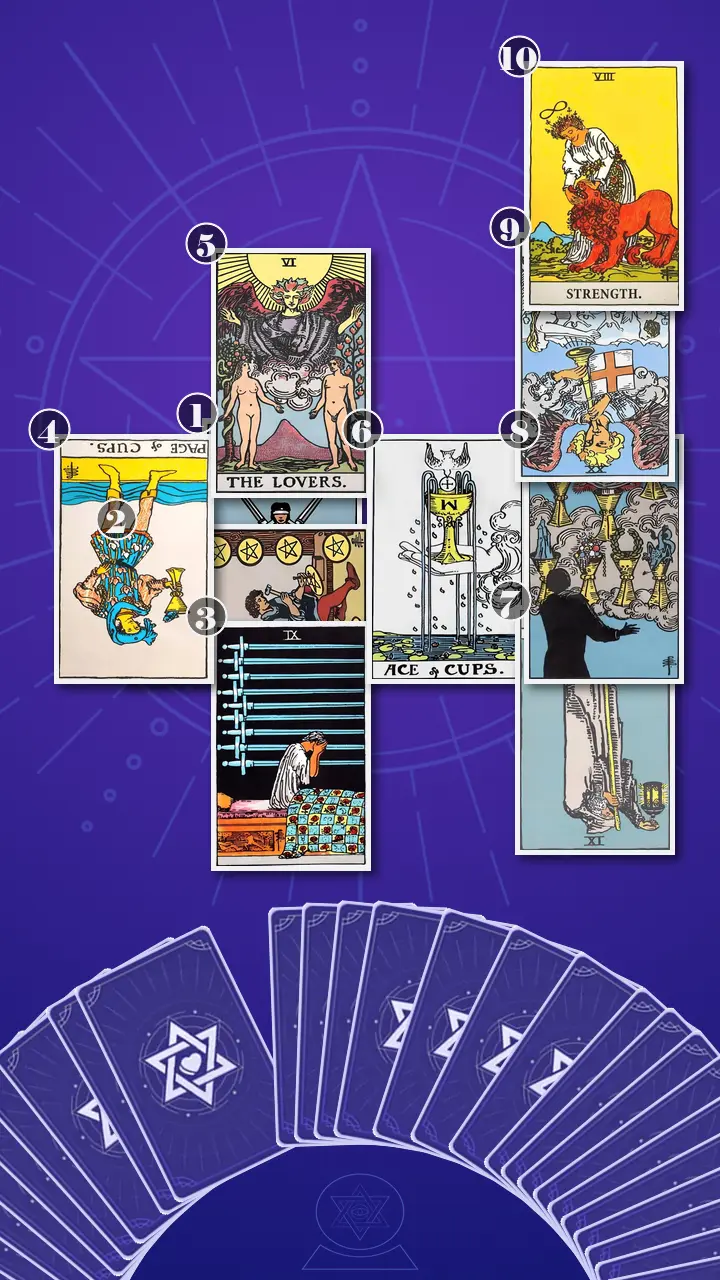
Reading the Map: Card Meanings in Context
Position 1: The exact “hovering over send” freeze — Two of Swords (upright)
I turned over the first card. “Now we’re looking at the card that represents the exact ‘hovering over send’ freeze: what is happening in your body and behavior right now.”
The Two of Swords, upright.
The image is a person blindfolded, arms crossed, holding two swords tight to their chest. Still water behind them. It’s such a clean freeze-frame.
“This,” I told Jordan, “is like when you reread a text until you can’t tell what it actually sounds like anymore—because you’re trying not to feel exposed.”
Energy-wise, this is blockage. Not because you don’t know what to say, but because part of you believes safety equals not choosing. If you don’t press send, you don’t have to feel the first ten seconds after sending—the little drop in your stomach, the open space of not knowing.
Jordan’s fingers tightened around her phone and then loosened. She stared at the card on her side of the screen like it had just described her browser history.
“It’s literally my body,” she said quietly. “Like… I lock up.”
Position 2: How perfectionism blocks movement — Eight of Pentacles (reversed)
I drew the next card. “Now we’re looking at the one that represents how perfectionism blocks movement—the pattern that turns communication into overwork.”
The Eight of Pentacles, reversed.
In the traditional image, someone is meticulously crafting—pentacle after pentacle—learning by doing. Reversed, the craft becomes a trap: effort without progress, revision without life.
“This is the part where your draft becomes a final deliverable,” I said, and I saw Jordan’s eyes flash with recognition. “Like your marketing brain kicks in—pixel-perfect, stakeholder-approved, five rounds of revisions.”
“Except the ‘stakeholder’ is someone you barely know,” I added. “And the more you polish, the less human it sounds.”
The energy here is excess—too much effort applied in the wrong place. Editing becomes a substitute for the real risk: letting someone receive you in real time.
Jordan let out a small laugh that had a sting in it. “That’s… yeah. That’s exactly what I do. It’s kind of brutal.”
“Brutal,” I agreed gently, “but not shameful. It makes sense. You’re trying to earn safety through control.”
Position 3: What the perfectionism is protecting you from feeling — Nine of Swords (upright)
I turned over the third card. “Now we’re looking at the card that represents what your perfectionism is protecting you from feeling—the deeper fear underneath the editing.”
The Nine of Swords, upright.
In the picture, someone sits up in bed, face in hands, swords lined up on the wall like accusations you can’t unsee. And immediately, the room around Jordan seemed to get quieter—like her night brain had walked in and sat down between us.
“This is 2 a.m. rumination,” I said, letting my sentences go short and sharp the way worry does.
“What if that emoji was cringe. What if I’m misreading everything. What if they’re laughing. What if I send it and they don’t reply, and I have to hold that feeling in my body.”
The energy here is overload—Air running too fast, turning one message into a whole trial in your head. And the sensory details matter: dim phone glow, buzzing silence, jaw clenched so hard you wake up with a headache.
Jordan exhaled in a long line, like she’d been holding her breath for weeks. She didn’t nod. She just went still—eyes unfocusing for a second, as if replaying a thread from months ago.
“I do that,” she whispered. “I replay everything. Like I’m… searching for the mistake.”
Position 4: Recent emotional learning — Page of Cups (reversed)
I moved to the next card. “Now we’re looking at the recent emotional learning that trained you to self-edit in dating conversations.”
The Page of Cups, reversed.
This is the tender part of you—the one who wants to say something sweet—getting flipped upside down by self-consciousness.
“This,” I said, “is when you type something warm and sincere… and then delete it and replace it with something flatter that you don’t even like. Because warmth feels like exposure.”
The energy here is deficiency: not a lack of feeling, but a lack of permission to show it.
Jordan’s mouth pulled to one side. “I almost sent ‘I’d love to see you again’ last week,” she admitted. “Then I changed it to ‘Yeah that was fun.’ And I was mad at myself immediately.”
“That’s the Page reversed,” I said. “You can be warm without making it a promise.”
Position 5: The real desire beneath the overthinking — The Lovers (upright)
I turned the fifth card. “Now we’re looking at what you’re truly trying to create beneath the overthinking.”
The Lovers, upright.
People often reduce this card to romance, but in readings like this, I watch for its deeper spine: values-based choice. Mutuality. Saying something that sounds like you, not like a performance designed to manage someone’s reaction.
“This is important,” I told Jordan. “Your goal isn’t a perfect line. Your goal is alignment—texting in a way that matches your values.”
I asked her, “When you look at your draft, does it sound like you—or like you trying to become unjudgeable?”
Jordan blinked, as if that question had finally named the real opponent.
Position 6: Supportive next-step energy — Ace of Cups (upright)
I drew the sixth card. “Now we’re looking at the most supportive next-step energy available if you loosen control and act with warmth.”
The Ace of Cups, upright.
This is the release valve. The overflow. The moment you stop sculpting ice and just pour water.
“I want you to picture this,” I said, and my own Nature Empathy Technique kicked in—because water always teaches faster than lecture. “A cup doesn’t become meaningful because it’s decorated perfectly. It becomes meaningful because it holds something real.”
Energy-wise, this is balance: simple warmth and emotional clarity over cleverness. A short message that’s kind and clear. Not a thesis statement. A doorway.
Jordan’s shoulders lowered a fraction. Her face softened in a way that said, I could actually do that.
Position 7: Your inner stance — The Hermit (reversed)
I turned over the seventh card. “Now we’re looking at your current inner stance and self-image while dating—how you relate to vulnerability.”
The Hermit, reversed.
Reversed Hermit is when reflection turns into isolation. When you treat dating like a solo puzzle you can solve in your Notes app if you just think hard enough.
“This is ‘living in drafts,’” I said. “The lantern is turned inward so long you forget it’s meant to light a path through the world, not keep you in a cave.”
The energy here is blockage again—wisdom stuck in private rehearsal. And I felt an old memory flicker in me: a Highland winter where you can survive by staying indoors, yes—but you can also lose your sense of time. In cities, the cave is often your phone at midnight.
Jordan nodded, slow and resigned. “I try to figure out the whole relationship trajectory before I send one sentence.”
Position 8: The modern dating context — Seven of Cups (upright)
I turned the eighth card. “Now we’re looking at the environment—apps, comparison, social media noise—that amplifies the pattern.”
The Seven of Cups, upright.
Too many imagined outcomes. Too many projections. The way one unsent text balloons into five parallel universes: the rooftop date pic universe, the soft-launch universe, the ‘they’re already talking to someone cooler’ universe.
“This is the Instagram Stories spiral,” I said. “It’s also Hinge culture—pressure to be effortlessly witty, like you’re A/B testing your personality in real time.”
Energy-wise, this is excess—choice overload. Not more options in the app necessarily, but more options in your head. Twelve tabs open, all running at once.
Jordan’s thumb reflexively tapped her screen off, like she’d just closed a tab.
Position 9 (Key): The hidden verdict layer — Judgement (reversed)
I paused before turning the ninth card. The way I do when I can feel the room ready to tell the truth.
“This,” I said, “is our key position: what you hope will happen, what you fear it would mean if it doesn’t.”
When I flipped it over, even through the distance of a video call, I felt Jordan’s attention snap into place.
Judgement, reversed.
In the upright card, there’s a trumpet call—an awakening, an invitation to rise. Reversed, that trumpet becomes something else: the fear of being evaluated. And the bigger fear—your own inner verdict.
I’ve spent decades watching relational patterns repeat like seasons. My signature skill is Relationship Pattern Recognition: naming the emotional script that keeps running even when you change the cast. And Jordan’s script was suddenly unmistakable:
Bid → Panic → Polish → Pre-Judge → Withdraw.
“Here’s the courtroom,” I told her, using the metaphor the card was begging for. “Your draft becomes evidence. Their reply becomes the ruling. And you become both defendant and judge.”
Her breathing got shallow. She held still—like she didn’t want to move and accidentally admit it was true.
Setup: She was back on that couch at 11:26 PM, rereading three lines like they were a performance review. Thumb hovering over “Send,” chest tightening, tone-checking again—because a slow reply wouldn’t just feel awkward. It would feel like a score.
Delivery:
Stop treating your text like a verdict; let it be a trumpet call toward honesty, even if your voice shakes.
I let the sentence sit between us for a beat, the way you let thunder finish echoing before you speak again.
Reinforcement: Jordan’s reaction came in layers, not all at once. First, her body froze—breath caught high, fingers hovering above the phone like she’d been interrupted mid-compulsion. Then the idea seeped in: her eyes drifted off-screen, unfocused, as if she’d just remembered every time she’d watched “active now” and decided it meant something about her worth. Finally, the release: her shoulders dropped, her jaw unclenched, and she let out a shaky half-laugh that turned into a softer exhale.
“But if I send something imperfect,” she said, and there was a flash of anger in it—protective, young, honest—“doesn’t that mean I’ve been doing it wrong this whole time?”
“No,” I said, steady. “It means you’ve been trying to stay safe with the tools you had. Judgement reversed isn’t here to shame you. It’s here to stop the sentencing.”
I guided her through a tiny reset—my modern version of an old Highland practice: not magic, just nervous system care. “One hand on your chest. Exhale longer than you inhale three times. Then type one private line above your draft: ‘This is a bid for connection, not a verdict on me.’ Make exactly one edit for clarity. Then either send… or close the app on purpose. Pausing on purpose is different than spiraling.”
Then I asked, “Now, with this new lens—can you think of a moment from last week when you treated a reply like a ruling? Where this could have made you feel different?”
Jordan swallowed. “Sunday. I saw couples on Stories, and my draft suddenly felt like proof I’m failing at dating. I wasn’t even thinking about him. I was thinking about… me.”
“That’s the shift,” I said. “From outsourced worth to self-kindness while you wait.”
And I named it plainly, so her mind could stop spinning: this is the movement from tense hyper-control toward steadier self-trust and warmth—data replacing guessing, presence replacing performance.
Position 10: Integration pathway — Strength (upright)
I turned the final card. “Now we’re looking at the integration pathway—what this becomes when you practice self-trust and send anyway.”
Strength, upright.
Strength isn’t hype. It’s not “be confident.” It’s the calm hand on the lion—the part of you that can feel your own fear and not punish yourself for having it.
The energy here is balance: gentle courage. The ability to act while your voice shakes—and stay on your own side afterward.
“This card is you,” I told Jordan, “not forcing yourself to be chill, but being gentle with your nerves while still moving.”
“So I don’t have to be… flawless,” she said.
“No,” I said. “You have to be present.”
The One-Page ‘Bid, Not Verdict’ Plan: Actionable Advice for Your Next 48 Hours
I gathered the whole spread into a single story, the way I’d describe weather to someone who only has an umbrella and ten minutes to leave the house.
Here’s what I saw: the Two of Swords shows the freeze—your body protecting your heart by stalling. The Eight of Pentacles reversed shows the method—perfectionism dressed up as productivity, turning one text into a deliverable. The Nine of Swords reveals the engine underneath—night-brain rehearsal and self-critique. The Page of Cups reversed shows what gets edited out: your warmth. The Lovers reminds you of the real goal: mutual, values-based connection. The Ace of Cups offers the corrective: one simple, sincere line. And Judgement reversed exposes the deepest layer—your inner courtroom—until Strength turns it into a practice of gentle bravery.
Your cognitive blind spot is this: you’ve been treating “perfect wording” as if it can control the outcome. But the outcome is not controlled by punctuation. Perfectionism is trying to protect you from the feeling of being evaluated—especially by you.
The transformation direction is just as practical as it is emotional: shift from “write the perfect message” to “send one clear, kind message after one edit, then let real interaction provide the feedback.”
Here are your next steps—small, concrete, and designed for real NYC life (work brain, late-night spirals, all of it):
- The One-Edit Rule (3-minute send experiment)Tonight or this week, write the message once, revise it exactly once for clarity (not tone-polishing), and hit send within 3 minutes. Keep it to 1–3 sentences max—“kind + understandable” is your definition of good enough.Expect your brain to yell “cringe” like an alarm. Treat it as a normal noise, not a command. One edit for clarity. Zero edits for approval.
- The “Bid, Not Verdict” Note (90-second reset)Before you send, add one private line above the draft: “This is a bid for connection, not a verdict on me.” Then make one clarity edit and either send—or close the app on purpose (no doom-hovering).If your throat tightens or hands shake, pause and do three slow exhales. Pausing on purpose is different than spiraling.
- The No-Analysis Window (30 minutes)After sending, put the phone face-down and do something physical for 30 minutes (shower, dishes, quick block walk). No rereading the thread. No decoding punctuation. Let your body discharge the adrenaline first.If you catch yourself about to screenshot for a group-chat “tone committee,” send the version you were about to screenshot—then text your friend the outcome instead.
And because my work is relational—not just individual optimization—I offered one more option from my own toolkit, adapted for modern dating without forcing anything.
“If this turns into an actual conversation,” I told Jordan, “I have a simple breathing sync practice I teach couples. You don’t need to be a couple to use it. Before a vulnerable text, do three breaths where your exhale is longer than your inhale. Later, if you’re sitting across from someone over dumplings or tacos, you can take one subtle shared breath before an important topic. It’s not cheesy—it’s regulation. It turns arguments into growth opportunities because you’re not fighting from a clenched body.”
Jordan smiled, small but real. “That feels… doable. Like I’m not trying to become a different person overnight.”

A Week Later: The Quiet Proof
A week later, Jordan DM’d me a screenshot—not of a draft, but of a sent message. One edit. No apology paragraphs. No over-explaining.
“I wrote: ‘I’d like to see you again—are you free this week?’” she said. “My heart was racing. I did the hand-on-chest thing. I sent it. Then I literally went downstairs and walked to the bodega before I let myself look at my phone.”
She added something that mattered more than the outcome: “Even while I was waiting, I didn’t sentence myself. I kept thinking: don’t outsource your worth to a notification.”
That’s what a real Journey to Clarity looks like in practice. Not a perfect ending. A softer nervous system. A cleaner boundary. A message that’s a bridge instead of a performance review.
When a three-line text makes your chest tighten, it’s usually not because you don’t know what to say—it’s because you’re trying to want connection without risking the possibility that someone won’t choose you back.
If you stopped treating your next message like a score, what’s the smallest honest line you’d be willing to send—just to let reality answer instead of your imagination?
This story is adapted from psychological research, written so that those in a similar struggle can see their own pattern in it — and find their next step clearly.These insights are not a substitute for professional psychological, medical, legal, or financial advice.
Learn more about our Journey to Clarity.
How did this insight land for you?
🫂 This Resonates Deeply
🌀 Living This Story
✨ Now I See Clearly
🌱 Seeing New Possibilities
🧰 Useful Framework
🔮 The Confirmation I Needed
💪 Feeling Empowered
🚀 Ready for My Next Step
Author Profile
 AI
AI“As the seventh generation of a Highland healing family, I see modern anxieties as a simple, temporary disconnection from nature's rhythm. I bring 67 years of lived seasons not to instruct you, but to hold space for you. Using tarot as a mirror, I want to gently guide you out of the chaos, helping you breathe deeply and rediscover the organic, steady heartbeat of your own life.”
In this Love Tarot Reading :
Core Expertise
Service Features
Also specializes in :
Explore Related Patterns:
Control CopingJordan keeps revising because the edit box feels safer than the space after Send. If the wording is still under her control, then the uncertainty of being received, ignored, misunderstood, or wanted has not fully arrived yet. Control Coping shows up when precision becomes a substitute for emotional risk. The hidden bargain is that if you can perfect the tone, timing, punctuation, and warmth level, maybe you can control the outcome. The story exposes the limit of that bargain: the other person's response is not controlled by punctuation, and real connection requires letting reality answer.
Relationship Performance AnxietyThe Hinge draft starts acting like a client email: pixel-perfect, stakeholder-approved, revised until it stops sounding human. In that moment, the text is no longer a small bid for connection. It becomes a performance object, and you start managing a future evaluation before the other person has even had a chance to respond. That is the logic of Relationship Performance Anxiety here: vulnerability gets converted into presentation strategy. The more you polish, the more the message is asked to protect you from cringe, neediness, rejection, and your own internal scorekeeping, so dating becomes a review process instead of a live exchange.
Self-Judgment LoopThe courtroom metaphor lands because the draft is treated like evidence and the reply like a ruling. A slow response would not simply be disappointing; it would become a score, a verdict, and a reason to review every line for proof of failure. Self-Judgment Loop is the private trial that dating perfectionism is hiding. You are not only afraid they will judge you. You are afraid their response will give your inner critic permission to sentence you. The work is to stop making every notification a case file about your worth.
Self-SilencingThe warm sentence is already there: she wants to say she would love to see them again. Then it gets flattened into something safer, less direct, and less alive, and she feels angry at herself as soon as the edit is made. Self-Silencing is the pattern underneath that deletion. You are not removing warmth because it is false; you are removing it because it makes you visible. The hidden fear is that direct desire will be read as too much, so the draft becomes a place where your own sincerity is edited before anyone else can respond to it.
Analysis ParalysisHer thumb hovers over Send while the message gets reread until language loses its shape. A normal line starts to feel abnormal because the mind is no longer reading for clarity; it is scanning for every possible future consequence. Analysis Paralysis is the freeze created by too many imagined data points and not enough lived feedback. You are trying to solve the whole relational trajectory before sending one sentence, which turns a small action into an impossible prediction task. The body then does the only thing that feels safe: it stalls.
Rejection SensitivityThe fear spikes around the waiting space: active now, no reply yet, maybe they saw it, maybe they chose someone else, maybe this says something about her. The other person's delay becomes emotionally larger than the actual text. Rejection Sensitivity is the nervous-system shortcut that turns ambiguous dating signals into personal danger. You are not reacting only to a message thread; you are reacting to the possibility that wanting connection might expose you to not being chosen back. That is why a three-line text can feel like a test of whether you are wanted at all.
RuminationThe 2 a.m. sequence is precise: the emoji might be cringe, the signal might be misread, the silence might mean they are laughing, and somewhere in the thread there must be a mistake to find. The mind keeps reopening the case because uncertainty feels unfinished. Rumination is not careful thinking; it is repetitive threat-scanning disguised as analysis. You are not getting new information from the thread after the fifth reread. You are trying to reduce the bodily discomfort of not knowing, but the replay loop keeps the nervous system activated instead of giving it closure.
Secure VulnerabilityA week later, the screenshot is not a perfect draft; it is a sent message. One edit, one clear invitation, a racing heart, a hand on the chest, and a walk to the bodega before checking the phone again. Secure Vulnerability is the healthier pattern emerging underneath the control. You do not have to be detached, flawless, or impossible to judge. You can let the message be a bridge, keep your body regulated while you wait, and stay on your own side even before the other person answers.
Explore Related Struggles:
Clarity-Exposure SplitJordan already has the words close at hand: a simple line like, "Hey, I had a really good time." The conflict begins when that clarity has to leave the private draft box and become visible to another person. Her thumb hovers, her chest tightens, and the message stops being a sentence; it becomes a small act of being seen. You can recognize this struggle when the problem is not what you want to say, but what it would expose if you said it plainly. The draft holds connection on one side and self-protection on the other, so every clear word starts to feel too revealing once it could be received. Clarity-Exposure Split names that threshold. You are not lacking language; you are caught between the relief of being direct and the risk of letting your desire become observable in real time.
Control LockJordan keeps revising the message as if one more tone adjustment could secure the response. The draft becomes the only controllable object in a situation where the real variable is another person's freedom to answer, delay, misunderstand, or choose differently. You can get trapped here because control feels practical. Editing gives your hands something to do while the deeper risk remains untouched: someone else gets to receive you without being managed by your wording. The more pressure you place on control, the more the message becomes a holding cell for uncertainty. Control Lock describes that closed circuit. You are trying to reduce relational risk through precision, but the precision starts replacing the relationship itself, leaving you stuck managing the bid instead of making it.
Inner Tribunal LockJordan's draft becomes evidence, their reply becomes the ruling, and she becomes both defendant and judge. The message is no longer just a bid for connection; it enters an inner courtroom where every word can be used to prove that she did something wrong. You can hear the tribunal in the way she replays old threads and searches for the mistake. A slow reply does not stay a slow reply; it starts to feel like a score. Silence does not remain incomplete data; it becomes material for self-sentencing. Inner Tribunal Lock names the hidden verdict layer beneath the perfectionism. You are not only afraid of being evaluated by someone else; you are already evaluating yourself so harshly that the other person's response arrives inside a trial that has begun without them.
Performance-Worth FusionJordan treats a casual Hinge message like a client email: polished, reviewed, stakeholder-safe, and stripped of anything that could land wrong. The more she edits, the less the text sounds like a person reaching out and the more it sounds like a submission being graded. You can feel the pressure shift from communication into self-measurement. A three-line message starts carrying the weight of whether you are smooth enough, chill enough, desirable enough, or impossible to mock. The performance is no longer just the wording; it becomes a proxy for worth. Performance-Worth Fusion captures the trap underneath the perfectionism. You are not simply trying to write well; you are trying to make the message prove that you are safe from rejection before the other person has even had a chance to respond.
Permission ParalysisJordan reads the same message so many times that it stops sounding normal, then decides sending it would now be weird. Even when the line is ordinary and kind, the final permission to act keeps getting withheld. You can see the paralysis in the gap between capacity and authorization. The message exists, the desire exists, and the next step is technically small, but an internal gate stays closed until the wording feels immune to judgment. That standard keeps moving, so action never feels fully allowed. Permission Paralysis names the moment when you are not blocked by confusion, but by the feeling that you need a cleaner, safer, less vulnerable version of yourself before you are allowed to reach out.
Read Receipt Worth LockJordan sees couples on Stories, watches app signals, and starts reading the dating interface as a scoreboard. A draft that was supposed to be about one person suddenly becomes evidence in a wider comparison feed: who is chosen, who is effortless, who is falling behind. You can feel the lock when a notification starts carrying more authority than your own sense of self. "Active now," a delayed reply, or a quiet screen begins to answer questions it was never built to answer: Am I wanted? Am I failing? Did I lose? Read Receipt Worth Lock captures the way modern dating turns waiting into self-measurement. You are not just waiting for a text back; you are trying not to hand your worth to the timing, silence, and tiny status signals of an app.
Vulnerability Containment StrainJordan almost sends, "I'd love to see you again," then flattens it into, "Yeah that was fun." The original warmth does not disappear; it gets contained, compressed, and made less specific before the other person can meet it. You can feel the strain in wanting to be emotionally honest without giving the message enough tenderness to expose you. The safer version protects you from seeming needy, but it also makes the bid less alive than what you actually meant. Vulnerability Containment Strain points to that controlled half-opening. You are trying to let connection happen while keeping your warmth under glass, so the other person receives a version of you that is technically available but emotionally edited down.
Explore Related Emotions:
Approval AnxietyJordan turns “Hey, I had a really good time” into something that has to survive five rereads, alternate drafts, and an imagined stakeholder review from someone she barely knows. The draft starts behaving less like a text and more like a deliverable. Approval Anxiety is the pressure underneath that overwork. The goal has shifted from being understood to being impossible to criticize. Every edit tries to remove the chance that the other person could see need, warmth, or awkwardness in her. You can feel the cost when the warmer version gets flattened into something she does not even like. The message may become safer on the surface, but it also becomes less hers, and that is where the anxiety keeps feeding itself.
Exposure DreadJordan almost sends “I’d love to see you again,” then changes it to “Yeah that was fun” and feels mad at herself immediately. The sincere line is not dangerous in itself, but her body reads warmth as exposure. Exposure Dread is the feeling that wanting will become visible before there is proof it is safe to want. A clear bid for connection risks showing softness, and softness risks being read as needy, cringe, or too available. You can hear the dread in the way she says she is not trying to play games; she is trying not to be judged for caring. Her perfectionism is hiding the fear that sincerity might make her easier to dismiss.
Performance FreezeJordan’s thumb hangs in midair above the screen, still performing the motion of sending while refusing to complete it. Her chest rises without fully falling, and the phone has been in her palm long enough to feel warm from the whole evening of rehearsal. Performance Freeze names the moment when communication stops being a human exchange and becomes a stage test. The body stalls because any wording might expose her as too much, too awkward, too obvious, or not effortless enough. You are not looking at a lack of desire here. The desire is present, but it is pinned under the pressure to appear perfectly casual before another person can witness it. The freeze protects her from visibility, while quietly keeping her locked outside the connection she actually wants.
Verdict DreadJordan rereads three lines at 11:26 p.m. as if they are a performance review, with her thumb hovering over Send and her chest tightening before anything has actually happened. The message is small, but the body treats it like evidence entering a courtroom. That is why Verdict Dread sits at the center of the story. The feared reply is not only a reply; it becomes a ruling she might use against herself. A slow response would not simply be awkward in that moment. It would feel like a score, a sign, a private sentencing. You can see the hidden structure in the line where the draft becomes evidence, their reply becomes the ruling, and she becomes both defendant and judge. The perfectionism is trying to prevent the trial from starting, but it also keeps her trapped inside it.
Guarded LongingJordan is not cold in the story. She wants to say she had a good time, wants to see the person again, and wants the message to sound like something real. The problem is that every warm impulse has to pass through a security checkpoint before it can leave her phone. Guarded Longing names that pull toward connection when the heart is interested but the self-protection system is faster. She is reaching and withholding at the same time, trying to want without giving the other person enough evidence to hurt her. You can feel it in the late-night cave of drafts, where the lantern is turned inward for so long that it stops lighting a path outward. The longing is alive, but it is held behind rehearsed distance until it starts to feel lonely inside its own protection.
Relational Catastrophe DreadJordan says she tries to figure out the whole relationship trajectory before she sends one sentence. The Hinge draft stops being a present-tense message and turns into a portal of possible outcomes, from the rooftop-date fantasy to the fear that they are already talking to someone cooler. Relational Catastrophe Dread appears when one small uncertainty starts carrying the emotional weight of the entire dating future. A delayed reply can feel like a collapsed timeline. A slightly imperfect tone can feel like proof that the connection is already slipping away. You can see why the text becomes so hard to send. She is not only risking one interaction; she is bracing for the imagined story that might form around it. The dread makes reality wait outside while her imagination generates the verdict first.
Self-Betrayal AcheJordan changes “I’d love to see you again” into “Yeah that was fun,” then feels mad at herself immediately. The safer sentence gets the job done, but something in her knows it has traded honesty for protection. Self-Betrayal Ache is the sting that arrives when self-editing goes past clarity and starts erasing the person underneath. The message becomes less vulnerable, but it also becomes less aligned with what she actually wants to say. You can hear the ache in the gap between her warmth and the line she finally lets herself send. The perfectionism is hiding a painful recognition: the version of her that feels safest to present is not always the version that feels true.
Cautious Self-TrustJordan’s shoulders drop after the courtroom dynamic is named, and later she sends the message without sentencing herself while she waits. The reply is still unknown, but her worth is no longer handed over to the notification screen. Cautious Self-Trust is not swagger. It is the steadying feeling that comes from making one clear choice and staying on your own side afterward. The text becomes a bridge instead of a performance review because she stops asking it to prove her value. You can see the shift in the phrase “don’t outsource your worth to a notification.” The emotional center moves from guessing what the other person thinks to tracking what she can actually choose: one honest line, one edit, one grounded pause.
Cautious VulnerabilityA week later, Jordan sends “I’d like to see you again—are you free this week?” after one edit, with her heart racing and her hand on her chest. The message is still vulnerable, but it is no longer trapped in the polishing loop. Cautious Vulnerability is the small opening that appears when she lets a sincere line be enough. She does not become instantly chill, and she does not need to. The point is that she can be visible while still feeling the shake in her body. You can see the agency in how she walks to the bodega before checking her phone. She lets the bid exist in the world without turning the waiting period into self-punishment, which makes the vulnerability careful, real, and self-held.
Explore Related Contexts:
Dating App Performance LoopJordan rewrites the same Hinge message for thirty minutes, deletes normal lines like "Hey, I had a really good time," and starts handling a casual follow-up as if it were a client email. The social setting matters: this is not only one person's hesitation, but a dating app environment where every word can feel optimized, compared, and quietly scored. The external pressure comes from the format itself. Hinge reduces early intimacy to short text, timing, tone, and perceived effortlessness, while social media keeps nearby examples of other people's dating lives in view. In that arena, one message stops being a bridge and starts behaving like a miniature public performance, even when the exchange is technically private. You are not dealing with a lack of words; you are dealing with a communication stage that makes ordinary warmth feel like a brand risk. Naming this as a Dating App Performance Loop helps separate the real app-shaped pressure from your own agency, so the next move can become smaller, clearer, and more human.
Digital Intimacy Boundary ConfusionJordan almost writes "I'd love to see you again," then flattens it into "Yeah that was fun" and immediately knows something real got edited out. The tension is not about grammar; it is about where the boundary sits between honest warmth and feeling too exposed through a screen. Digital dating makes that boundary harder to read. A short message has to carry tone, interest, timing, restraint, and self-respect without the stabilizing cues of voice, face, or shared context, so sincerity can start to look like overexposure before anyone else has responded. You are navigating Digital Intimacy Boundary Confusion when the channel itself makes connection and self-protection blur together. This label keeps the focus on the medium and its pressures, so your next message can be treated as a clear relational bid rather than a risky leak of too much feeling.
Read Receipt PressureJordan is still on the couch at 11:26 p.m., thumb hovering over Send, because the seconds after the message feel loaded before they even happen. The story names the structure clearly: her draft becomes evidence, their reply becomes the ruling, and a slow response starts to look like a score. This is the external pressure of app-based waiting, where a notification, delay, or missing reply can seem to carry more authority than the actual relationship has earned. The phone turns response time into a social signal, and that signal begins to govern what Jordan allows herself to say. You are facing a waiting architecture that makes silence feel measurable. Read Receipt Pressure captures that exposed interval after sending, where the need for connection collides with the app's tiny indicators of attention, availability, and delay.
Algorithmic Comparison LoopJordan remembers seeing couples on Stories, and the draft in front of her suddenly starts to feel like evidence that she is failing at dating. A private message to one person gets pulled into a wider feed of soft launches, rooftop-date images, and imagined rivals who seem cooler, faster, or easier to choose. The pressure is not coming only from the person she wants to text. It is also coming from the algorithmic dating backdrop, where curated couple visibility and app-based comparison make one ordinary follow-up feel like a referendum on where she stands socially and romantically. You are trying to communicate inside an attention economy that constantly supplies comparison material. Algorithmic Comparison Loop names the way social platforms inflate a single dating decision until it feels like proof of your entire romantic progress, which is exactly the distortion the story is trying to make visible.