Finding Clarity When You’re the Default Target at Game Night
Jordan didn’t come in saying, “My friends are mean.” They came in saying, “I don’t mind losing—I mind being the default target.”
It was the kind of sentence that lands in the body before it lands in the brain. The tight jaw. The shallow, careful breathing that tries to look like a laugh. The little spike of heat in the cheeks when someone says, “It’s not that deep,” and the room moves on like you’re the only one who felt it.
They described a weekly game night in Toronto that used to be their social anchor—something to break up a busy hybrid work week, something that made the city feel less lonely. But around round three, the vibe kept shifting. Not always dramatically. Sometimes it was a look between two friends. Sometimes it was a quick alliance formed “as a joke.” Sometimes it was someone saying, “Okay, everyone target Jordan,” and the table laughing like it was tradition.
“I can’t tell if it’s banter or disrespect,” they told me. “And I’m scared if I say something I’ll become the vibe killer.”
What I heard underneath was the core contradiction: wanting to belong and relax with friends vs fearing that speaking up will make you look ‘too sensitive’ and cost you your place in the group. That fear isn’t abstract. It shows up as a whole internal operating system: scanning, tracking, replaying. Like reading a group chat the next morning as if it’s evidence—because if you can prove it, maybe you’re allowed to feel it.
Jordan’s humiliation didn’t look like tears. It looked like a forced smile that felt like holding a paper cup full of hot coffee with no sleeve—your hand burning, your face staying polite.
“Let’s not treat this like a personality flaw,” I said gently. “We’re going to treat it like a pattern. And today, we’re going to do what tarot does best: we’re going to draw a map through the fog—toward clarity, toward a next step you can actually take.”

Choosing the Compass: The Five-Card Cross Tarot Spread for Friend Group Dynamics
I asked Jordan to take one slow breath—nothing mystical, just a nervous system handoff: from reacting to observing. While I shuffled, I invited them to hold the exact question in mind: “Game night: why do they always team up on me—what’s my next step?”
For something like this—friendship conflict, subtle exclusion, “is it banter or disrespect,” and the spiral afterward—I like a Five-Card Cross. It’s small enough to feel practical, but it still separates the situation into the pieces that actually matter: what’s happening on the surface, what’s reinforcing it in the group atmosphere, what your blind spot is, what your next constructive move is, and what the likely direction becomes if you take that move.
That matters because this isn’t about predicting who “wins” socially. It’s about getting out of decision fatigue—out of the endless mental replay—and into one grounded experiment. The cross shape also mirrors the felt experience: you feel “crossed” at the table… and then you need a vertical axis (inner truth) and a horizontal axis (social pressure) to find your center again.
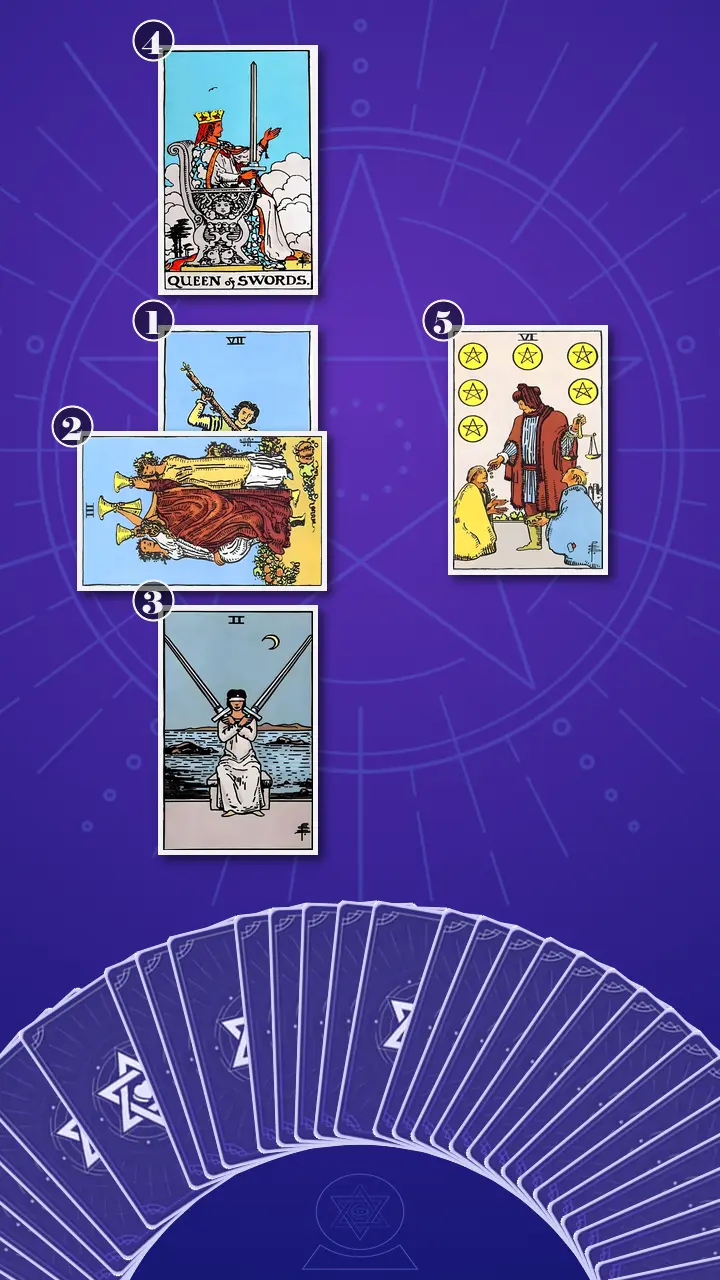
“We’ll read it like this,” I said, laying the cards down. “Card one is the surface snapshot—your most observable game-night reaction. Card two is what’s actively reinforcing the pile-on dynamic. Card three is your blind spot—what you’re not naming that keeps the cycle stable. Card four is advice: the next step that preserves self-respect without mind-reading. Card five is what you can build if you take that step—fairer norms, or a clean decision about access.”
Reading the Map: From ‘Everyone vs Me’ to Something You Can Name
Position 1 — Surface snapshot of the game-night dynamic and your most observable reaction
“Now flipped over,” I told Jordan, “is the card representing the surface snapshot of the game-night dynamic and your most observable in-the-moment reaction.”
Seven of Wands, upright.
I didn’t even have to stretch for the real-life translation. “This is the exact moment you described,” I said. “You sit down telling yourself it’ll be fun, but within the first few rounds you’re bracing. The second someone says, ‘We have to stop Jordan,’ your body spikes—jaw tight, breath short—and you start defending every play like you’re in a debate, not a living room.”
In energy terms, the Seven of Wands upright is excess fire: not passion, but pressure. Adrenaline. The feeling of being put on higher ground against your will—like the table decided you’re the one who has to justify yourself. It’s dignity turning into defense because your nervous system reads, I’m under attack.
Jordan let out a small laugh that wasn’t amusement so much as recognition with a bruise under it. “Yeah,” they said. “That’s… kind of brutal.”
“I know,” I said. “And I want you to notice something: the card isn’t judging you for defending yourself. It’s naming the role you’ve been assigned. You’re being pushed into ‘fairness attorney’ mode when you actually came for friendship.”
As a Jungian psychologist, I can’t help but see the archetype here: the group unconsciously casts someone as the sparring partner so everyone else can bond. The card is saying: you’re not imagining the pressure. But it’s also asking: are you protecting your score… or your right to be respected in the room?
Position 2 — What’s actively reinforcing the “everyone vs me” pattern in the group atmosphere
“Now we flip the card representing what’s actively reinforcing the ‘everyone vs me’ pattern in the group atmosphere,” I said.
Three of Cups, reversed.
This is the one that often makes people sit back, because it’s so socially specific. “Reversed,” I explained, “the Three of Cups is celebration that turns into a closed circle. It’s not just strategy—it’s social glue. You notice the same two or three people sync up fast, share a look, and get louder when you’re the one getting hit. The teaming-up feels like an inside joke you weren’t in on, and suddenly you’re playing two games at once: the board game and the ‘am I actually included?’ game.”
Energy-wise, this is blocked water: connection that can’t circulate fairly. The attention in the room behaves like an algorithm—like the unspoken mod rule of a group chat: the fastest way to get laughs is to dunk on one person, so the algorithm keeps rewarding it.
I watched Jordan’s face as I said that. Their eyes unfocused for half a second, like they were replaying a specific moment: two people locking eyes, a private laugh, the room volume rising right when their piece got hit.
“It’s like… I’m supposed to laugh,” they said quietly, “but I’m not having fun.”
“Exactly,” I said, matching their pace. “That two-track line? That’s the heart of this card: I’m supposed to laugh vs I’m not having fun. Belonging vs being used as entertainment.”
They nodded once—slow, almost relieved. The confusion loosened a notch. Not because it felt good, but because it felt real.
Position 3 — Your blind spot in the cycle: what you’re not naming that keeps the pattern stable
“Now we flip the card representing your blind spot in the cycle—what you’re not naming, deciding, or acknowledging that keeps the pattern stable,” I said.
Two of Swords, upright.
“This is the Notes-app draft,” I told them. “In the moment, you keep your face calm and your voice light. Afterward, you can’t stop replaying it. You draft a message—polite, careful, totally reasonable—then delete it because you’re afraid that naming it will make you the problem.”
In energy terms, the Two of Swords is blockage: air held in the chest. It’s silence as self-protection. And the cost shows up later—like muting notifications instead of leaving the group chat. Temporary relief, same dynamic waiting when you return.
I said it the way I’d say it to someone sitting beside me on a train: “Silence isn’t ‘chill’ here. It’s a strategy. And it’s expensive.”
Jordan’s reaction came in a chain—three small steps I’ve learned to watch for.
First: a physical freeze. Their breath paused; their fingertips stopped moving on the edge of their sleeve.
Second: cognitive seep. Their eyes slid to the side like they were reading the same sentence on a screen: Hey, can I ask about something from last night?
Third: emotional release, but tiny. Not tears—just a long exhale through their nose, like their body finally admitted, yeah… that’s me.
“Because if I say it,” they murmured, “I’ll sound dramatic. If I don’t say it, I’m basically teaching them it’s fine.”
“That’s the crossroads,” I said. “And it’s why it feels like there’s no safe way to be taken seriously. The card isn’t calling you wrong. It’s showing you the stalemate.”
When the Queen of Swords Cut Through the Noise
Position 4 — The most constructive next step that preserves self-respect and tests the dynamic
I let the room get a little quieter before turning the next card. Outside my studio window, Toronto traffic made that soft, distant hush—like the city itself was holding its breath with us.
“We’re flipping the card representing the most constructive next step you can take that preserves self-respect and tests the relationship dynamic without mind-reading,” I said. “This is the key.”
Queen of Swords, upright.
“This is you, but in a different mode,” I told Jordan. “Instead of arguing rules mid-game, you choose one calm line and say it early: ‘I’m down to play, but I’m not into everyone-vs-me.’ You don’t over-explain. You offer one alternative—rotate teams, free-for-all, switch games—and you let the room show you whether it can handle basic respect.”
The Queen of Swords is balanced air: clarity without cruelty. Boundaries without drama. The sword is upright, but she’s not swinging it around. She’s not performing. She’s stating.
And this is where I brought in one of my most practical tools—something I learned long before I became “the tarot person,” back when I trained staff on international cruises. On a ship, social friction escalates fast because you can’t escape the room. People would come to me with the same question Jordan was asking, just in different clothes: How do I keep my place in the group without swallowing disrespect?
“I want to use what I call Social Role Switching,” I said. “It’s not ‘being fake.’ It’s choosing the right mode for the moment. At game night, you’ve been snapping between two modes: defensive lawyer (Seven of Wands) and silent peacekeeper (Two of Swords). The Queen is a third mode: Assertive Mode. Calm. Slow speech. One sentence. No receipts.”
Jordan swallowed. Their shoulders lifted, then dropped like they were trying to make space in their chest. “But if I’m assertive,” they said, “won’t I sound… intense?”
That question is the setup, and I honored it.
Setup (the moment you recognize yourself): You know that moment when the table gets loud, someone says “it’s just a joke,” and you feel your jaw lock while you start explaining rules like it’s a courtroom—then you replay it all the next morning over coffee, drafting a text you never send.
I looked at them and slowed my own voice down, the way you do when you want someone’s nervous system to believe you.
Not “I’ll just take it and hope it changes,” but “I’ll raise the sword of clarity once,” and let that clean line redefine the game.
There was a beat of silence after that—clean, almost echoing.
Reinforcement (what it looks like in a body): Jordan’s face did something subtle first: their brows lifted like the sentence had surprised them. Then their eyes went glassy for a second—not crying, just wet with the shock of being seen. Their jaw unclenched in a way you could actually see, like they’d been holding a bite down all night and finally realized it wasn’t food.
Then came the three-step reaction chain again, but stronger: (1) a brief freeze—hands still, breath caught; (2) the mind rewinding—like a highlight reel of game nights and unsent drafts; (3) a release—shoulders dropping an inch, a shaky laugh that was half relief, half grief for how long they’d been proving instead of stating.
“But… if I say it,” they said, a little sharper now, “doesn’t that mean I was wrong to just take it before?”
“No,” I said, steady. “It means you were doing what you had to do to keep access to belonging. And now you’re choosing a different kind of belonging—one that includes you.”
I leaned in and made it practical. “Let’s do a 10-minute one-line boundary practice—because the goal is not to write a TED Talk. The goal is to get one sentence into your mouth so it’s not the first time you say it when you’re activated.”
“Open Notes,” I said. “Write one line you could say at the table: ‘I’m down for competition, but I’m not doing everyone-vs-me tonight.’ Then write one concrete alternative: ‘Can we rotate partners each round?’ or ‘Free-for-all, no alliances.’ Then read it out loud once—quietly—like you’re testing the tone.”
I paused and added the part people always need permission for: “If your body spikes—jaw clenches, face gets hot—you’re not required to justify, debate, or keep talking. You can repeat the boundary once and stop. You can say, ‘I’m not debating it—I’m just letting you know what I’m up for.’”
This is the shift from the starting state to the desired state in real time: from humiliation-driven hypervigilance and rule-lawyering to calm, self-respecting boundary-setting. Not certainty. Not control. Just a clean line.
“Now,” I asked them, “with this new lens—can you think of a moment last week when this could’ve changed how you felt?”
Jordan stared at the edge of the table for a second. “When they said, ‘we HAVE to stop Jordan,’” they said. “I joked back. But I felt my face go hot. If I’d said it then—early—I think I would’ve stayed in my body instead of… leaving it.”
“If your body braces,” I said softly, “your ‘chill’ is already gone—honesty is just catching up.”
Position 5 — How the situation can evolve if you take the next step
“Now we flip the card representing how the situation can evolve if you take that next step—healthier norms and your sense of agency,” I said.
Six of Pentacles, upright.
I pointed to the scales in the image. “This card is the antidote to mind-reading. It says: make fairness visible.”
In modern life terms: “The next game night doesn’t rely on everyone reading each other’s minds. There’s a simple structure—rotating partners, random teams, a quick pre-game ‘teams or free-for-all?’ check. And then you watch: who’s generous with fairness? Who acts like fairness ruins their fun?”
Energy-wise, it’s earth: practical reciprocity. The vibe becomes a structure. And I used one of my favorite anchor phrases because it’s true in friendships as much as it’s true in workplaces:
Fairness isn’t a vibe. It’s a structure.
Jordan’s face changed on that line. Less heat. More steadiness. Like they could finally stop collecting evidence and start designing a better game night—one lightweight process tweak instead of a courtroom argument.
The One-Page Plan: Stop Proving, Start Stating
I pulled the reading together as a single story, so Jordan could feel the logic under their emotions.
“Here’s the arc,” I said. “On the surface, you’re in Seven of Wands: you brace, you defend, you try to earn respect in real time. The challenge is Three of Cups reversed: the group bonds through a closed-circle dynamic, and you become the easiest target for laughs. Underneath, Two of Swords keeps it stable: you don’t name it because you fear losing your place, so the pattern never gets updated. The Queen of Swords is the pivot: one clean line, said once, early. And the Six of Pentacles is what comes next: visible agreements—fair play by design—so you’re not begging for basic respect.”
“The blind spot,” I continued, “is believing you need court-level proof to speak. That’s the trap: you stay in ‘proving mode’ because it feels safer than being direct. The transformation direction is exactly the opposite: name the pattern plainly and propose one specific boundary or structure change. That’s how you find clarity without mind-reading.”
Then Jordan hit me with a real obstacle—practical, immediate, and honest. “Okay,” they said, “but I can’t do some big confrontation. And I barely have time. I’m fried after work. I don’t have 45 minutes to script my feelings.”
“Good,” I said, almost relieved. “We’re not doing a big confrontation. We’re doing a small, ship-tested protocol.”
On cruise ships, I used what I call Maritime Social Protocol: you don’t debate the weather; you adjust the sails. In a crowded social space, you keep it brief, respectful, and structural. And you keep a ready-to-use script for when someone tries to pull you into chaos.
Here are Jordan’s next steps—low-drama, actionable advice you can start within 48 hours:
- The “Teams or Free-for-All?” Check-In TextBefore the next game night, text the host (or your closest friend in the group): “Quick check—are we doing teams or free-for-all tonight? I’m down to play, just not into ‘everyone vs me’ dynamics.”Keep it to one sentence + one request. If you feel the urge to explain, you’re slipping back into proving mode—pause and send the short version.
- The One-Line Boundary at the Table (Say It Early)When you arrive—before round three, before you’re activated—make eye contact, slow your speech, and say: “I’m competitive, but I don’t enjoy being the default target.” Then stop talking.Use the “one-repeat rule”: you’re allowed to state it twice, not ten times. If someone pushes back, repeat once: “I’m not debating it—I’m just letting you know what I’m up for.”
- Fair-Play by Design (One Structural Tweak)Offer one concrete alternative: “Can we rotate partners each round?” or “Let’s keep it free-for-all—no alliances.” If they want a game that rewards dogpiling, suggest a swap (co-op, party game, or hidden-role game).Offer two options so it feels collaborative, not controlling. Then observe-the-response: who adapts easily, and who gets weird about basic fairness?
I added one more tool from my own toolbox—because Jordan’s fear wasn’t just about words. It was about identity. “When you walk in,” I told them, “choose your mode on purpose. Supportive Mode is for comforting a friend. Assertive Mode is for boundaries. Game night needs Assertive Mode—not because you’re cold, but because you’re protecting your fun and your dignity.”
And I said the line I wanted them to remember when their brain tried to build a case file: Stop proving. Start stating.

A Week Later: The Quiet Proof
Six days later, Jordan sent me a message that was almost annoyingly short—exactly what we’d practiced.
“I texted the host,” they wrote. “Teams or free-for-all. I said I’m down to play, just not into everyone-vs-me. My hands were shaking but I sent it.”
They told me the response was… mixed. One friend replied immediately with, “Oh damn, fair. Free-for-all.” Another tried to joke it off with “lol are we that mean?”—and Jordan, for the first time, didn’t pile on their own discomfort with a paragraph.
“I just said, ‘Yeah, it stops being fun for me,’” Jordan wrote. “And then I stopped talking.”
The bittersweet part came later: they still felt a flicker of fear walking in. They still had that morning-after impulse to check the chat. But this time, they didn’t feel like a passenger in their own friendships.
Clear but a little vulnerable: they slept through the night for the first time in weeks, but when they woke up, their first thought was still “What if I made it weird?”—only this time, they exhaled, and the thought didn’t own the whole day.
This is what I mean by a Journey to Clarity. Not a magical outcome. A measurable shift: from bracing and shrinking to choosing your words once, choosing your structure, and letting reality respond.
When you’re trying so hard to be “chill” that your jaw is clenched the whole night, the real humiliation isn’t losing the game—it’s watching yourself shrink just to keep your seat at the table.
If you let yourself say one clean sentence next time—no jokes, no over-explaining—what would you want your boundary to protect: your fun, your dignity, or your time?
This story is adapted from psychological research, written so that those in a similar struggle can see their own pattern in it — and find their next step clearly.These insights are not a substitute for professional psychological, medical, legal, or financial advice.
Learn more about our Journey to Clarity.
How did this insight land for you?
🫂 This Resonates Deeply
🌀 Living This Story
✨ Now I See Clearly
🌱 Seeing New Possibilities
🧰 Useful Framework
🔮 The Confirmation I Needed
💪 Feeling Empowered
🚀 Ready for My Next Step
Author Profile
 AI
AI“Having traveled across cultures... I've learned that what we often lack isn't a simple answer, but a moment of being truly understood. I use a Jungian psychological lens to help you deconstruct your subconscious patterns—not to prove anything, but to be the gentle companion who helps you unravel your knots, free of judgment, so you can reconnect with your inner wisdom.”
In this Friendship Tarot Reading :
Core Expertise
- Guilt-Trip Deconstruction: Uncovering the subconscious codependency that forces you to act as an unpaid 'emotional dumping ground' for friends.
- Savior Complex Auditing: Identifying whether your inability to set boundaries stems from a deeply ingrained psychological need to 'fix' others.
Service Features
- The Compassionate Detachment Protocol: A psychological boundary script to validate a friend's emotions while firmly refusing to absorb their psychological toxic waste.
Also specializes in :
Explore Related Patterns:
Conflict AvoidanceJordan's calm face, light voice, and deleted texts show how the conflict gets postponed even when the discomfort is already clear. The moment they imagine saying something, the fear is not just awkwardness; it is that speaking up could make them lose their place in the group. Conflict Avoidance fits because silence gives temporary relief while preserving the same game-night setup. You avoid the immediate tension, but the unspoken rule remains intact: the group can keep targeting You, and You are expected to make it look fine. The pattern is reversible through a small test rather than a dramatic confrontation. One early sentence and one fair-play structure let the room reveal whether it can handle basic respect without requiring You to keep absorbing the discomfort.
Defensive OverexplainingJordan keeps getting pushed into 'fairness attorney' mode: defending moves, explaining rules, and mentally building a case file after the night is over. The story makes the mechanism visible when they feel they need court-level proof before they are allowed to say, 'This does not feel good to me.' That is Defensive Overexplaining: a protective attempt to make discomfort undeniable by making the argument airtight. It gives You the feeling of control, but it also traps You in proving mode, where the group gets to debate the evidence instead of responding to the boundary. The clean shift is not to become harsher; it is to stop treating basic respect like a thesis defense. In this story, the useful move is one clear sentence, said early, so Your dignity is not dependent on winning the room through perfect explanation.
HypervigilanceJordan's jaw tightening, careful breathing, and immediate shift into defending every play show a body that has started reading game night as a social threat, not just a game. The repeated looks between friends, quick alliances, and 'everyone target Jordan' jokes give their attention a reason to keep scanning the room for the next hit. That scanning becomes a protective strategy: if You can track every glance, joke, and group chat tone, maybe You can catch the moment where banter turns into disrespect before it costs You belonging. The problem is that the same vigilance that keeps You socially alert also keeps You braced, replaying, and unable to relax in the very space that used to feel like an anchor. Hypervigilance fits because the story is not only about being targeted; it is about the nervous system staying on watch before, during, and after the table turns on You. The pattern turns friendship into threat monitoring, where clarity has to come from observable boundaries rather than endless scanning.
Self-SilencingJordan's forced smile, deleted message drafts, and fear of becoming the 'vibe killer' show a clear pattern of swallowing the direct sentence before it reaches the room. They are not confused because nothing happened; they are confused because they keep making their own reaction smaller so the group can stay comfortable. Self-Silencing works as social self-protection. If You keep the tone light, laugh along, and avoid naming the target dynamic, You reduce the immediate risk of rejection or awkwardness. But the cost is that the group never receives updated information about what is no longer okay. The story points to this pattern because silence is not neutral here; it stabilizes the cycle. Jordan's next step works precisely because it replaces the swallowed sentence with a clean boundary that does not ask permission to exist.
Assertive CommunicationJordan's practiced line, 'I'm down to play, but I'm not into everyone-vs-me,' changes the emotional task from proving harm to stating a boundary. They say it early, before the body is fully activated, and they keep it short enough that it cannot turn into a courtroom. Assertive Communication fits because the pattern is clarity without performance. You are not asking the group to read Your mind, and You are not attacking them; You are giving accurate information about what keeps the game fair enough for You to stay present. The power of the move is that it tests the relationship dynamic cleanly. If the room can adapt, the structure improves; if it cannot, You have clearer information about whether this group can offer basic respect.
Boundary DiscernmentJordan's one-line boundary separates the actual issue from the noise: competition is welcome, but being made the default target is not. That distinction matters because it protects the friendship context without pretending the group dynamic is harmless. Boundary Discernment fits because the shift is not about winning the argument; it is about identifying what belongs to You and what belongs to the room. You do not need to prove malicious intent before naming the limit of what You are available for. The suggested structure, like rotating partners or choosing free-for-all play, turns the boundary into something observable. It lets fairness become a shared design choice instead of a private feeling Jordan has to defend alone.
People-PleasingJordan jokes back, keeps their voice light, and tries not to disturb the group's fun even when the game has stopped feeling fun for them. The room gets to laugh, while Jordan carries the discomfort privately. People-Pleasing fits because the coping move is to preserve belonging by managing other people's comfort first. You make Yourself easier to be around by hiding the cost, but the hidden cost becomes the exact reason the pattern continues. The story's boundary practice works because it interrupts that trade. Jordan does not have to become cold or combative; they only have to stop paying for connection with self-erasure.
Mind ReadingJordan keeps trying to decode whether the pile-on is banter or disrespect by studying looks, private laughs, alliances, and the next morning's group chat. The social rules stay vague, so their mind starts treating every signal like evidence of what the group really means. Mind Reading appears here as a coping strategy for ambiguity. If You can correctly infer everyone's intent, maybe You can decide whether You are overreacting or whether the room crossed a line. But this keeps the power outside You, because Your right to set a boundary becomes dependent on proving what other people secretly meant. The story moves toward clarity by replacing inference with structure. Asking 'teams or free-for-all?' and saying 'I'm not into everyone-vs-me' removes the need to solve hidden motives before You are allowed to protect Your experience.
Rejection SensitivityJordan's fear of being called dramatic, too sensitive, or the vibe killer shows that the real threat is social rejection, not losing points in the game. Because game night has been a social anchor in a lonely city rhythm, any risk to belonging lands with extra force. Rejection Sensitivity fits because the possible social cost of speaking up becomes louder than the boundary itself. You start managing tone, timing, facial expression, and proof because the nervous system is trying to prevent exclusion before it happens. The story does not frame this as weakness; it shows a protective adaptation that has become too expensive. The useful test is whether the group can tolerate a simple statement of preference without making You pay for having one.
RuminationJordan does not leave game night when the game ends; they carry it into the next morning through replaying, drafting, deleting, and checking the group chat for proof. The mind keeps circling the same question: was it real enough to name? Rumination fits because the mental loop is trying to create certainty where a boundary is actually needed. You keep reviewing the footage internally, hoping the perfect interpretation will make the next move safe, but the review process never gives the body the relief it is looking for. The practical shift in the story is from replay to statement. Once Jordan sends the short text and stops adding paragraphs, the loop loses some of its authority because reality is allowed to respond directly.
Explore Related Struggles:
Boundary Ambiguity LockYou keep coming back to the same question: is it banter or disrespect? The room laughs, someone says it is not that deep, and the moment passes before the boundary can become visible. The ambiguity keeps you stuck because every possible answer carries a cost. If it is banter, speaking up risks making you look too serious. If it is disrespect, staying quiet teaches the room that the pattern is fine. So you start collecting evidence instead of trusting the repeated shape of the experience. This struggle is not about needing perfect certainty. It is about learning that a boundary can be valid before the room agrees to name the violation. You do not need a courtroom standard of proof to say what kind of game night you are willing to participate in.
Dignity-Belonging SplitYou sit down for a weekly game night that is supposed to make the city feel less lonely, then the room shifts around round three and you become the person everyone is allowed to target. The problem is not losing the game. The pressure lands where belonging and self-respect start asking for different things at the same table. Your body already knows the split before your words catch up: jaw tight, breath shallow, face trying to stay casual. You want to keep your seat in the group, but every forced laugh asks you to trade a little dignity for continued access. The struggle is that speaking up feels like it could cost you the connection, while staying quiet costs you your own steadiness. Clarity begins when you stop treating respect as something you have to earn mid-game and start treating it as part of the invitation itself.
Fairness-Agency SplitYou start defending every play like you are in a debate, because the visible argument is about game strategy while the real friction is about respect. The more you try to prove the unfairness, the more your agency gets trapped inside the rules of a game that is not the whole problem. Fairness cannot stay as a vibe that everyone is supposed to intuit. When the table keeps rewarding the same pile-on, your next step is to make the structure visible: rotate partners, keep it free-for-all, or name that everyone-vs-me is not fun for you. This struggle shifts when you stop asking the room to read your discomfort and give it a clean design choice instead. The response then tells you something useful: who can adapt to basic fairness, and who only enjoys the game when your dignity is the hidden cost.
Voice-Visibility LockYou keep your face calm at the table, then draft the message later and delete it before anyone can see it. The words are not absent; they are trapped behind the fear that naming the pattern will make you the problem. That is the lock: visibility feels risky because the moment you speak, you stop being the easygoing friend and become the person asking the room to adjust. Silence protects your place for one more night, but it also protects the pattern from being updated. The next step is not a dramatic confrontation. It is one clean sentence said early enough that your voice does not have to fight through panic, receipts, and over-explaining. You reclaim agency by letting the room respond to a clear line instead of trying to prove your discomfort into legitimacy.
Triangulated BelongingThe same two or three people sync up fast, share a look, and get louder when your piece gets hit. You are technically included in the room, but the group’s energy starts moving around you instead of with you. That is what makes the pile-on so disorienting. The board game becomes a second social game where everyone else gets a shortcut to closeness by casting you as the common target. Their laughter creates a circle, but your role inside it is not equal participation. This struggle locks belonging into a triangle: the group bonds, you absorb the role, and the joke keeps renewing itself because it works for everyone except you. Naming it matters because you are not asking for special treatment; you are testing whether the group can connect without needing someone to stand underneath the joke.
Vigilance-Connection SplitThe game night used to break up a busy hybrid work week, but now your body starts scanning before the fun can land. A look between friends, a sudden alliance, a laugh at your expense, then the next morning becomes a review session with the group chat. Connection is still the thing you want, but vigilance has taken over the channel that was supposed to carry it. You are not relaxing with friends anymore; you are tracking whether the room is safe enough to stay in. This struggle becomes exhausting because the monitoring never produces the relief it promises. The clearer move is to stop making your nervous system do all the research and create one observable test: a boundary, a structure, and a real response from the people at the table.
Explore Related Emotions:
Clarity ReliefJordan finds relief when fairness stops being a vague vibe and becomes a visible structure. Rotating partners, free-for-all rules, and a quick check-in give the situation edges that can actually be seen. That clarity loosens the need to keep collecting evidence. Instead of proving every micro-moment, Jordan can watch whether the group can handle a basic request without turning it into a referendum on their sensitivity. Clarity Relief fits because the emotional release comes from naming the pattern plainly. You are no longer trapped in mind-reading; you have a clean experiment, a clear boundary, and a way to tell whether the room can include you fairly.
Conditional Belonging FearJordan keeps joking back even when the joke has stopped feeling shared. The weekly game night used to make the city feel less lonely, but now belonging seems to depend on staying easygoing while being made the default target. The pressure is not only social; it is existential in the small, everyday way friendships can become existential. If speaking up makes them the 'vibe killer,' then their place in the group feels conditional on silence, tolerance, and a version of chill that costs too much. Conditional Belonging Fear fits because the core question is not simply whether the others are teaming up. It is whether Jordan can still belong if they stop shrinking, stop laughing on cue, and ask for basic respect without apologizing for needing it.
Grounded AgencyJordan's shift begins when the next step becomes small enough to say out loud: one clean line, one concrete alternative, and no courtroom-level proof. Their shoulders drop because the task is no longer to win an argument about whether the hurt is valid. The structure gives their agency somewhere to stand. Asking 'teams or free-for-all?' turns the fog into an observable test, and the group's response becomes information rather than a mystery Jordan has to solve alone. Grounded Agency fits because the story moves toward action without forcing certainty. You do not need to control the room; you need one honest sentence, one fair structure, and enough self-trust to let reality answer back.
Hypervigilant AnxietyJordan sits down wanting a normal night with friends, but by the third round their body is already bracing: jaw tight, breath short, attention scanning every look, alliance, and laugh. The game stops feeling like a shared activity and starts feeling like a room where they have to track the social temperature in real time. That monitoring follows them home. Reading the group chat the next morning like evidence shows how the nervous system keeps working after the event is over, trying to prove whether the discomfort was real enough to count. Hypervigilant Anxiety fits because the story is built around constant threat-checking inside a casual social space. You are not simply worried about losing; you are watching for the moment play turns into social exposure, and that vigilance drains the ease out of belonging.
Invalidation AcheThe table laughs like the targeting is tradition, and when someone says, 'It's not that deep,' the room moves on while Jordan is still holding the heat of it in their face. That split between what everyone treats as harmless and what lands painfully in the body is the emotional center of the story. The ache comes from having to question the legitimacy of the hurt before anyone else will take it seriously. Jordan is not only asking whether the group is being unfair; they are asking whether their own reaction is allowed to be trusted. Invalidation Ache names the private sting of being dismissed before the feeling has even had room to form. You are left carrying both the original discomfort and the extra burden of wondering whether naming it will make you look too sensitive.
Message DreadJordan can draft the message, make it polite, make it reasonable, and still delete it. The issue is not a lack of words; it is the fear that the moment those words leave Notes, they will become evidence against Jordan's character. The unsent text becomes a pressure point where social belonging, self-respect, and fear of being misread all meet. Silence brings temporary relief, but it also leaves the same table waiting for them next week. Message Dread fits because the next step is emotionally concentrated in one small act of communication. You know the sentence that would make the pattern visible, but sending it feels like exposing your need to be taken seriously.
Performative CalmJordan looks calm enough to keep the night moving: a laugh, a joke back, a face that does not make the room stop. Underneath, their jaw is tight and their body has already registered that the fun has shifted into something they have to endure. The calm is doing social work. It protects them from being labeled dramatic, but it also hides the exact signal that would tell the group the dynamic has crossed a line. Performative Calm names the gap between the surface performance and the inner weather. You are not relaxed; you are making relaxation believable so the room does not have to notice what it is costing you.
Quiet ShameJordan's humiliation does not arrive as a dramatic scene. It arrives as a forced smile, hot cheeks, and the effort to keep their face polite while the room laughs at a pattern that is starting to hurt. That quietness matters. The shame is not loud because Jordan is still trying to preserve access to the group; they are managing the burn privately so nobody else has to deal with the discomfort publicly. Quiet Shame names the small, contained humiliation of being turned into entertainment while also feeling responsible for making the moment socially smooth. You are not collapsing outwardly, but something in you is shrinking each time you laugh along to keep your seat at the table.
Courageous VulnerabilityJordan sends the text with shaking hands, then resists the old pull to cushion it with a paragraph. When one friend jokes it off, they answer simply: 'Yeah, it stops being fun for me,' and stop talking. That restraint is vulnerable because it leaves the truth visible without wrapping it in over-explanation. It is courageous because Jordan lets the group respond to the actual boundary instead of managing everyone's possible discomfort in advance. Courageous Vulnerability fits the moment where the fear is still present but no longer in charge. You are exposed, but you are also intact; the sentence protects your dignity without pretending the risk has disappeared.
Conflict HangoverAfter game night, Jordan does not fully leave the room. They replay the looks, reread the chat, and keep checking whether the social atmosphere has shifted against them. This is the aftertaste of conflict that never became a clean conversation. Because the discomfort was managed indirectly for so long, the body keeps searching for signs that something has been damaged or that the group has silently judged them. Conflict Hangover fits because the emotional event keeps echoing past the actual event. You may have said the line or survived the night, but the next morning still asks, 'Did I make it weird?' before the day has even started.
Explore Related Contexts:
Clique GroupthinkThe table keeps rewarding the same script: two or three people sync up, the room gets louder, and the easiest laugh comes from making Jordan the shared target. Once that pattern starts functioning as group glue, individual players do not have to plan anything cruel for the dynamic to keep repeating. Clique groupthink shows up when the room values the shared bit more than the impact of the bit. You are dealing with a social feedback loop where the group gets a quick sense of unity from agreeing on who the target is, and questioning that unity can be treated as ruining the fun. Jordan’s next move interrupts the loop without trying to read everyone’s private motives. A simple structure like rotating teams or no alliances forces the group to choose whether game night is about mutual play or preserving the clique’s easiest bonding ritual.
Conditional Belonging PressureJordan says they are scared that speaking up will make them the vibe killer, and the story shows why that fear is practical rather than imaginary. Someone can say “It’s not that deep,” the room can move on, and Jordan is left managing the gap between wanting to belong and knowing they are not actually having fun. Belonging becomes conditional when access to the group depends on swallowing a role you did not choose. You can stay at the table, but only by laughing at the joke, keeping your voice light, and not asking the room to examine why the same person keeps becoming the target. The boundary matters because it separates friendship from performance. A group that can handle “I’m not into everyone-vs-me tonight” is offering a different kind of belonging than a group that only makes room for you when you stay convenient.
Friendship Boundary ResetJordan practices a single line before the next game night: “I’m down to play, but I’m not into everyone-vs-me.” They also prepare one concrete alternative, such as rotating partners or keeping the game free-for-all, so the boundary is paired with a workable structure. A friendship boundary reset is not a dramatic confrontation. It is a clean update to the terms of access: you are still willing to play, still open to the group, and no longer willing to make your discomfort the entry fee for belonging. The reset gives reality a chance to answer. A friend who says “Oh damn, fair” shows that the group may be able to adapt; someone who turns basic fairness into a joke gives you useful information about how much access they should have to your time.
Soft ExclusionThe same two or three friends sync up quickly, share looks, and get louder when Jordan is the one being hit in the game. Nothing has to be formally announced for the exclusion to register; the room still has chairs, jokes, and invitations, but the social current moves around Jordan instead of with them. Soft exclusion works through ambiguity. You are present enough that leaving would look dramatic, but sidelined enough that staying requires constant decoding: is this banter, disrespect, or an inside joke you were never invited into? That uncertainty is why the situation keeps pulling Jordan into a second game beneath the board game. A clean next step gives the ambiguity less room to run. Asking for free-for-all play, rotating partners, or no everyone-vs-me dynamic makes the inclusion question visible without demanding that you accuse the whole group of bad intent.
Zero-Sum Friendship ConflictJordan came to game night for friendship, routine, and relief from a busy hybrid work week, but by round three the table has turned into an everyone-vs-me structure. The score is no longer only about the game; it starts measuring who gets to relax and who has to keep defending their place. A zero-sum friendship conflict forms when one person’s discomfort becomes the group’s entertainment advantage. The more the room bonds through beating Jordan down, the less space Jordan has to experience the night as mutual play. The practical repair is to remove the hidden social scoreboard. Rotating partners, free-for-all play, or a direct no-alliances request changes the rules from “who can we all pile onto” to “can this group create a fair structure that includes everyone at the table.”
Direct Communication TrialJordan moves from drafting and deleting careful messages to sending one short check-in: “Teams or free-for-all. I’m down to play, just not into everyone-vs-me.” That shift matters because it replaces private over-preparation with a direct social experiment. A direct communication trial keeps the stakes contained. You are not asking for a group trial, a confession, or a perfect apology; you are asking whether a simple sentence can travel through the friendship without being punished. The mixed response gives Jordan usable data. One friend adapts immediately, another jokes it off, and Jordan answers with one clear line instead of a paragraph. That is the trial doing its job: making the group’s capacity for respect visible.
Tone PolicingSomeone says “It’s not that deep,” and Jordan immediately has to manage not only the targeting but the risk of being labeled too sensitive. The social problem shifts away from the behavior at the table and toward whether Jordan can name it in a way that nobody can dismiss. Tone policing turns a basic fairness request into a presentation test. You are pushed to sound calm enough, casual enough, brief enough, and unbothered enough before the substance of the issue is allowed to matter. The one-line boundary cuts through that trap because it does not ask the group to approve Jordan’s emotional tone. “I’m competitive, but I don’t enjoy being the default target” is clear, proportionate, and observable, which makes the group’s response more revealing than another round of self-editing.