The Midnight Personality Audit: Why I Replay My Whole Personality After Hanging Out
If you're a 20-something early-career city person who can get through the hangout just fine and then spend the TTC ride home doing a full social anxiety after hanging out review of one joke, this was exactly the post-hangout social overthinking that turns a normal night into a personality audit when Maya came to see me.
When she sat down, she did not look socially lost. She looked polished, funny, and tired in the very specific way Toronto weekdays make people tired. She was a junior marketing coordinator, the kind of person who reads tone for a living and had a real Severance problem with it — the office-brain part would not clock out after work. She told me about 11:42 p.m. on a Thursday in her Queen West apartment: one earring still in, half under the duvet, cold face-wash smell still on her skin, thumb refreshing the group chat while a streetcar bell rang faintly outside. The phone was warm in her palm. Her chest felt hollow-tight. She kept replaying a two-second pause after her joke, trying to work out whether it had been normal or the moment she somehow became too much.
'I can never tell if I was fun or just a lot,' she said.
That was the whole contradiction in one line: she wanted relaxed connection after hanging out, but the quiet afterward turned every joke, pause, and text exchange into possible proof that something was wrong with her whole personality. By bedtime, self-consciousness had turned into a private courtroom under the duvet — as if her ribs were the witness stand and every breath had to testify.
I nodded. 'Post-hangout uncertainty is uncomfortable. It is not automatically incriminating. Let me help you map what happens between the ride home and the midnight investigation, and see where clarity actually returns.'

Choosing the Compass: The Shadow Spread for Post-Social Overthinking
I asked her to put both feet on the floor, take one slow breath, and hold the question in plain language: why do I replay everything after hanging out? Then I shuffled slowly. Not as theatre. As a threshold. A small psychological bridge from noise into focus.
I chose The Shadow Spread, a four-card tarot spread for post-social overthinking. This is how tarot works best for me: card meanings in context, not as random fortune-cookie lines. For a question like Maya's, I do not want ten cards and more fog. I want a clean structure that separates symptom from wound, wound from medicine, and medicine from practice.
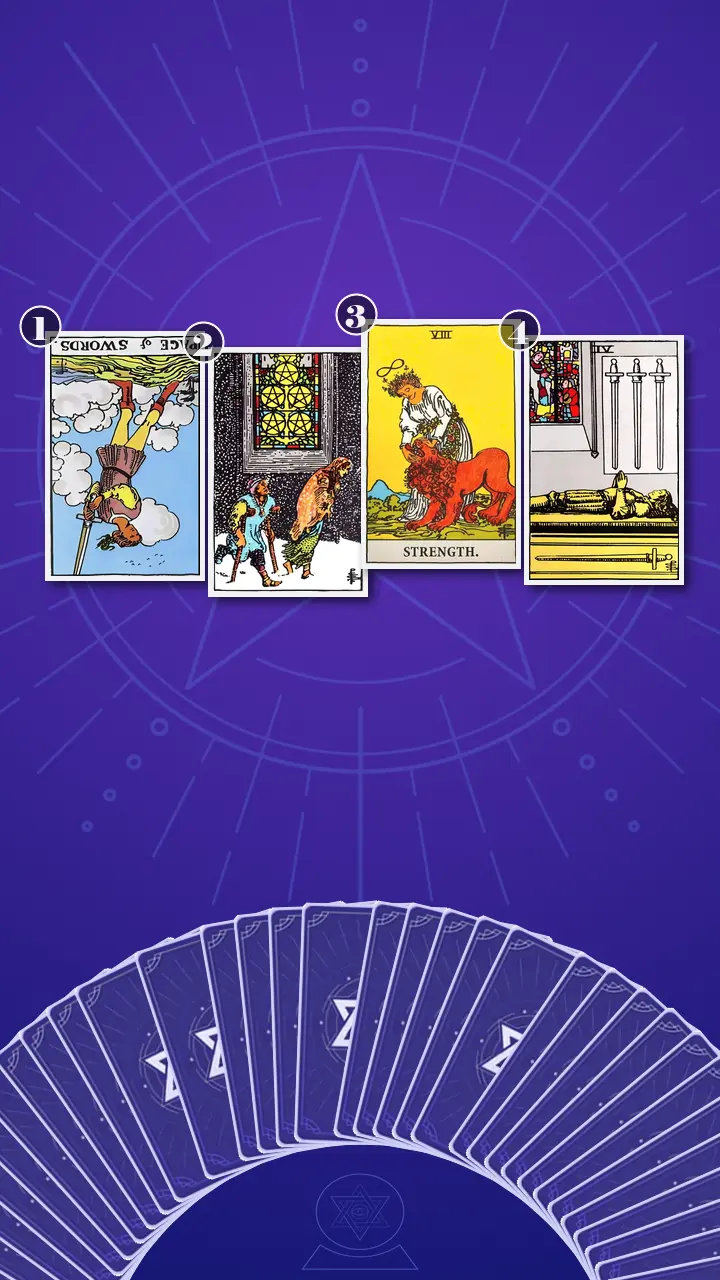
That is why The Shadow Spread fit so well. The first card would show the visible pattern she already knew too well — the replaying, the message-checking, the self-monitoring after hanging out. The second would reveal the hidden driver beneath it. The third, the key card of the reading, would show the inner resource that restores self-trust. The fourth would make the reading practical by showing the next step she could use in real life, likely that very night.
Reading the Left Side of the Hallway
The Card That Keeps Refreshing
I turned over the first card in the position that presents the surface symptom from the diagnosis: the replaying, message-checking, and self-monitoring that flare up after hanging out.
It was the Page of Swords, reversed.
The image says almost everything. A sideways stance. A wind-whipped sky. A sword held away from the body. Thought has left the body behind and is still fighting weather even though the person is technically home. In Maya's life, this is the TTC ride back or the moment she gets into bed and reopens the group chat, rereads her own wording, zooms in on one emoji, one pause, one reply time, and starts treating scraps of ambiguity like hard evidence about her likability.
Page of Swords reversed is distorted Air — quick perception tipped into scattered vigilance. The mind thinks it is being smart, prepared, discerning. But really it is weaponizing uncertainty against the self. It is the emotional equivalent of turning a casual night with friends into a Slack sentiment-analysis thread in your head.
One of my oldest tools is what I call Energy Flow Diagnosis: before I go deeper into the meaning, I watch where the body tightens. With Maya, I saw it immediately. Her shoulders had climbed a little higher. The back of her neck had gone still. Her body was telling the truth before her words did: the hangout had ended, but her alarm had not.
'So accurate it's almost rude,' she said with a short laugh that tasted more bitter than amused.
'Not rude,' I told her. 'Precise. You are not finding the truth. You are catching yourself mid-alarm.'
Her fingers moved to the edge of her sleeve and stayed there. That was the recognition I wanted — not shame, but contact with the pattern as it really was.
The Lit Window and the Fear of Being Outside
I turned to the second card, in the position that reveals the hidden fear driving the situation beneath the surface: the belonging wound that makes normal social ambiguity feel like a threat of exclusion.
It was the Five of Pentacles, upright.
This card is colder the longer you look at it. The snow. The physical strain. The lit window nearby. For Maya, it translated instantly: one shorter follow-up text, one quieter goodbye, or seeing friends still active online before anyone messages the next day, and her body starts reading it as if she is already drifting outside warmth and not sure she is allowed back in.
This is Earth in lack mode. Not lack of friends, necessarily. Lack of felt security. The replay loop is not really about one joke landing oddly. It is about a deeper expectation that belonging can disappear quietly and fast. Everyone else seems to go home warm while you are mentally standing in the cold, checking whether your membership code to closeness still works.
'This is why the spiral feels so convincing,' I said. 'It is built on top of a fear of being left out. One small change in tone, and your mind treats it like the soft-launch version of rejection.'
I watched the shift move through her in three small stages: first her breath paused, then her eyes dropped to the cards, then the brittle half-smile fell away completely.
'I think I'm always trying to catch it early,' she said quietly. 'Like if I can figure out the exact moment people got tired of me, maybe I can fix it before I'm actually outside.'
'Exactly,' I said. 'You are standing outside a party because your brain decided the door might be locked, even though you were invited.'
For a moment, embarrassment gave way to sadness. And that was important. Sadness is often closer to the wound than self-roasting ever is.
When Strength Put a Hand on the Lion
The Medicine in the Middle
When I reached for the third card, the room seemed to go quieter with me. Outside, rain drew one slow line down the window. This was the turning point of the entire reading — the antidote card, the one that had to answer the question underneath all the others.
I turned over the card in the position that shows the key shift: the inner resource or truth that directly challenges self-surveillance and restores self-trust.
It was Strength, upright.
By then Maya was back inside the logic that keeps the post-social spiral alive: if she could just identify the exact second she became embarrassing, maybe she could prevent distance before it started. Her jaw was tight. Her phone lay dark on the table, but one thumb hovered near it anyway.
This is not proof that your whole personality needs editing; place Strength's calm hand on the lion of post-social fear and let steadiness replace the midnight interrogation.
I let the sentence rest between us before I said anything else. Then I added, softer, 'Post-hangout uncertainty is a gap, not a verdict.'
She went completely still. First her breath caught high in her chest and her fingers froze beside the phone. Then her gaze unfocused, as if she were replaying a streetcar ride only she could see — fluorescent light, wet coat, a flat-looking emoji, a brain trying to turn ambiguity into a case file. Then the emotion came out sideways, not as relief but as anger. 'But that makes me so mad,' she said, voice suddenly sharper. 'Because I've been acting like this is a personality problem I need to solve.'
'Not a personality problem,' I said. 'A protection strategy.'
This is where my Energy Flow Diagnosis becomes more than observation. Years of working with people in transit — first on Atlantic crossings, now in quiet reading rooms — taught me that fear climbs upward before it becomes a story. The shoulders lift. The throat narrows. The breath gets thin. Maya had been trying to fix the lion by editing herself, when the real blockage was the alarm parked in her chest, throat, and shoulders. A loud nervous system is not the same thing as a true read.
I had a brief flash of rough water off a cruise deck at dusk: the passengers who steadied fastest were never the ones who fought the swell hardest, but the ones who let their bodies find rhythm again. Strength works exactly like that. Not domination. Not self-punishment. Control versus kindness, surveillance versus self-trust. The calm hand on the lion, not the hand around its throat.
I asked her to place one hand over her chest and take three slow breaths before speaking again. By the second breath, her face had softened — not because the fear vanished, but because it finally had company instead of interrogation.
'What would comfort look like here,' I asked her, 'if you stopped treating this feeling like evidence against you? And using this new lens, think back to last week. Was there a moment when kindness to the alarm would have changed the night for you?'
She exhaled so deeply her shoulders finally dropped. 'On the streetcar,' she said. 'I was already home in my body, but not in my nervous system.'
That was the breakthrough I had been waiting for: the first step from midnight personality audits and belonging panic to gentler self-trust after social connection. Not instant confidence. Not a personality transplant. Just a different relationship to the alarm.
Airplane Mode for the Social Nervous System
The Card That Lets the Night End
I turned over the fourth card in the position that grounds the transformation into a realistic next step: the decompression practice that interrupts the pattern before it escalates.
It was the Four of Swords, upright.
'Good,' I said as soon as I saw it. 'Because this card does not ask you to become less sensitive. It asks you to stop calling activation clarity.'
Four of Swords is Air returned to balance. The swords are still present, but they are no longer swinging. In real life, this looks like putting the phone on the other side of the room, washing your face, changing into pajamas, drinking water, maybe playing one song, and letting the social energy settle before you decide what anything meant. Rest first. Meaning later.
I translated it into a scene she could picture that same night: shower steam, a dim lamp instead of the overhead light, the group chat on mute, no late-night rereading of punctuation, no trying to solve the night while still half-dressed and buzzing. This is not avoidance. It is airplane mode for your social nervous system.
She gave me the smallest nod, but this time it was relaxed. 'That feels weirdly allowed,' she said. 'Like I could do shower-before-chat and not make it a whole thing.'
Finding Clarity in the First Ten Minutes Home
When I looked across the whole spread, the story was beautifully clear. Page of Swords reversed showed the visible loop: replaying everything after hanging out, rereading texts, checking whether a delayed reply means people suddenly like you less. Five of Pentacles showed why the loop bites so hard: underneath it lives a quiet fear that belonging is fragile and can be withdrawn without warning. Strength changed the central question from 'What did they think of me?' to 'How do I meet the alarm that got activated in me?' And Four of Swords made that insight usable by giving the body somewhere to land.
The blind spot was simple and brutal: Maya had been mistaking alarm for accuracy, and analysis for safety. But more surveillance was never going to heal a belonging wound. The transformation direction was compassion before analysis, decompression before interpretation.
I told her that one of my oldest Venetian lessons is about water. In Venice, when water stagnates, it clouds. When it circulates, it clears. Emotions are often the same. After a hangout, you do not always need more evidence. Sometimes you need movement, warmth, and a little time so the inner canal stops filling with debris. That is my Venetian Aqua Wisdom in its simplest form: circulation before conclusion.
- Facts Before Story Reset After your next hangout, open Notes before you reopen the group chat. Make two headings: Facts and Story. Under Facts, write three plain things that happened — for example, We stayed for two hours, they laughed at my story, nobody said anything was wrong. Under Story, write the theory your mind is trying to sell you. Stop there. Ninety seconds is enough. If it feels cheesy, treat it as data collection, not a personality overhaul. You can even do it between two TTC stops.
- The 10-Minute Buffer For one week, give yourself ten minutes at home before interpreting the night. Drink water, wash your face or shower, change clothes, dim one light, and put the phone across the room or on Do Not Disturb until the buffer ends. Lower the bar if needed: five minutes counts. Minimal version: phone face down until you're in pajamas.
- No Midnight Forensics If you feel pulled to send a clarifying or lightly apologetic text after 11 p.m., save it to drafts and revisit it in the morning. If you absolutely must look at the chat, set a two-minute timer and only notice what is observable, not what you think it means. Not every pause is data, and not every feeling needs a midnight investigation.
None of this was about becoming chill on command. These were small, practical ways of separating facts from interpretations and calming the post-social alarm before assigning meaning — actionable advice that respects how modern city life actually feels at the end of the night.

A Week Later, the Phone Stayed Across the Room
A week later, Maya messaged me after tacos with friends. 'Did the Notes thing on the streetcar,' she wrote. 'Then shower-before-chat. I still had the first thought — what if I was weird? — but it didn't run the whole night.'
That was enough for me. In any real journey to clarity, the first proof is rarely dramatic. It is usually this: the old script shows up, and for the first time, it does not get the final line.
That is what this Shadow Spread tarot reading for post-social overthinking opened for her. Not a perfect personality. Not a guarantee against awkward moments. Just a calmer recovery after connection, and a little more trust in the self who was already there at the table.
Sometimes the hardest part is not the hangout itself but the quiet afterward — when your chest tightens, the room goes still, and you start trying to solve whether one ordinary moment means you are about to be left out. If that is where you are tonight, remember: noticing the courtroom is already a form of stepping out of it.
If you did not have to treat tonight's uncertainty like an emergency, what might the next ten minutes of care look like for you?
This story is adapted from psychological research, written so that those in a similar struggle can see their own pattern in it — and find their next step clearly.These insights are not a substitute for professional psychological, medical, legal, or financial advice.
Learn more about our Journey to Clarity.
How did this insight land for you?
🫂 This Resonates Deeply
🌀 Living This Story
✨ Now I See Clearly
🌱 Seeing New Possibilities
🧰 Useful Framework
🔮 The Confirmation I Needed
💪 Feeling Empowered
🚀 Ready for My Next Step
Author Profile
 AI
AI“Having traveled across cultures... I've learned that what we often lack isn't a simple answer, but a moment of being truly understood. I use a Jungian psychological lens to help you deconstruct your subconscious patterns—not to prove anything, but to be the gentle companion who helps you unravel your knots, free of judgment, so you can reconnect with your inner wisdom.”
In this Introspection Tarot Reading :
Core Expertise
- Shadow Integration Audit: Objectively mapping suppressed emotions (anger, shame, grief) that are covertly draining your psychological bandwidth.
- Inner-Critic Neutralization: Deconstructing the harsh, subconscious self-judgment loop that masquerades as 'self-discipline'.
Service Features
- The Active Imagination Protocol: A structured psychological journaling technique to safely dialogue with your 'Shadow', turning internal friction into deep self-compassion.
Also specializes in :
Explore Related Patterns:
Mind ReadingMaya rereads her own wording and zooms in on one emoji, one pause, and one reply time as if those fragments can reveal what everyone secretly thought. The group chat becomes a projection screen for unspoken verdicts. Mind Reading fits because the uncertainty gets filled in with imagined social conclusions. Instead of staying with what is observable, the mind leaps from 'they replied later' to 'they like me less' or from a pause after a joke to 'I was too much.' You end up responding to inferred judgments as if they were confirmed data.
Rejection SensitivityMaya's body reacts to a shorter follow-up text, a quieter goodbye, or friends being active online as if belonging is already slipping. She says she is trying to catch the exact moment people got tired of her so she can fix it before she is actually outside. Rejection Sensitivity names that threat-scanning pattern without turning it into a character flaw. Ambiguous social cues get processed as early warnings of being left out, so your system moves fast to prevent distance before there is clear evidence that distance is happening. The replay is not about the joke alone. It is about trying to protect your place in the room after the room has gone quiet.
Certainty SeekingMaya keeps trying to work out whether the two-second pause was normal or the exact moment she became too much. She says that if she can locate when people got tired of her, maybe she can fix it before she is actually outside. Certainty Seeking fits because analysis is being used as a control strategy against social ambiguity. You are not checking because the evidence is strong. You are checking because uncertainty feels unsafe. The more the mind demands a definite answer from inherently ambiguous cues, the more the night stays open and unresolved.
Post-Event RuminationMaya's TTC ride home and the 11:42 p.m. bed scene keep returning to the same loop. One joke, one pause, one emoji, and one reply time become objects for review, even though the hangout has already ended. Post-Event Rumination fits because the mind is trying to reduce uncertainty by replaying the social event, but the replay changes function. It stops being reflection and becomes a safety ritual. You are not simply remembering the night. You are using analysis to chase relief from a belonging alarm, which is why the review starts to feel like a trial of your whole personality.
Emotional ReasoningMaya's shoulders lift, her neck goes still, her chest feels hollow-tight, and the alarm in her body keeps running after she is technically home. The reading names the blind spot directly. She has been mistaking alarm for accuracy and activation for clarity. Emotional Reasoning fits because the feeling of threat gets treated as evidence that a threat exists. When your body is loud, the mind can start building a case around that intensity, turning 'I feel exposed' into 'I must have done something wrong.' The pattern softens when the feeling is met as activation first, not as a verdict about your personality.
Self-SoothingMaya places a hand over her chest and takes three slow breaths before speaking again, then later uses shower-before-chat after tacos with friends. The phone stays across the room long enough for her body to arrive home before the group chat gets another vote. Self-Soothing fits because the turning point is not more analysis but a different response to activation. You give the social nervous system warmth, rhythm, and a short buffer before interpretation, which interrupts the old need to interrogate yourself for relief. The fear still appears, but it no longer gets to run the entire night.
Reality TestingThe Facts Before Story Reset asks Maya to write down what actually happened before reopening the group chat. The practice separates plain observations like 'we stayed for two hours' from the theory her mind is trying to sell her. Reality Testing fits as the corrective pattern because it gives the mind a cleaner standard of evidence. Instead of arguing with every fear, you sort observable facts from interpretation and let ambiguity remain ambiguity. That shift does not force you to become detached. It stops the alarm from acting like the only witness in the room.
Explore Related Struggles:
All-or-Nothing BelongingOne shorter follow-up text, one quieter goodbye, or seeing friends active online before the next message is enough for Maya's body to start reading the night as if she is already outside the lit window. She was invited and present, yet the quiet after the hangout flips the inner map from warmth to exclusion. All-or-Nothing Belonging names that binary switch. You can have real signs of connection and still feel as if one ordinary gap might cancel your place in the room. The struggle is not a lack of friends in the simple sense. It is the way access to closeness starts to feel conditional, fragile, and silently revocable, so a normal social pause becomes a test of whether you still count.
Certainty-Safety FusionPost-hangout uncertainty is described as a gap, not a verdict, because Maya's system treats the gap like an emergency. When no one has clearly confirmed that everything is fine, the silence starts to feel like something that has to be solved before sleep is allowed. Certainty-Safety Fusion is the point where not knowing becomes physically unsafe-feeling, even when nothing concrete has gone wrong. You do not replay because every detail deserves a verdict; you replay because a verdict seems like the only thing that could make the body unclench. The shift offered by the reading is small but structural. Rest comes before meaning, so uncertainty can remain unfinished for ten minutes without being promoted into proof of rejection.
Inner Tribunal LockBy bedtime, Maya describes the quiet as a private courtroom under the duvet, where every joke, pause, and text exchange becomes possible proof against her whole personality. The witness stand is not outside her; it is in her ribs, in the breath that feels like it has to testify. Inner Tribunal Lock shows up when review stops being reflection and becomes prosecution. You are not just remembering what happened; you are being forced to defend the entire self who showed up at the table. That lock keeps the night open long after the social event has ended. The more the mind tries to reach a clean verdict, the more the self becomes an object under examination instead of a person allowed to recover.
Monitoring-Safety FusionAt 11:42 p.m., Maya is half under the duvet with one earring still in, refreshing the group chat while the phone warms her palm. The hangout is over, but her attention keeps returning to one pause, one emoji, and one reply time, as if the right scan could tell her whether she is still safely inside the group. The friction is that monitoring promises protection while keeping the alarm switched on. You are not simply gathering data after a night out. You are trying to turn surveillance into a railing against the fear that connection can disappear before you notice. When checking becomes the route to safety, every ambiguous signal has to be inspected, and the inspection itself makes the signal feel more dangerous. Clarity returns only when the body is allowed to land before the chat becomes evidence.
Self-Editing ExhaustionMaya's line, 'I can never tell if I was fun or just a lot,' turns a normal social memory into an editing demand. A joke, a pause, and a flat-looking emoji become materials for deciding whether her personality needs trimming before the next time she is seen. Self-Editing Exhaustion lives in that constant revision pressure. You are not only wondering how the hangout went. You are trying to adjust the volume, shape, and acceptability of your whole presence after the fact. The exhaustion comes from treating connection as something earned through perfect calibration. The social self becomes a draft that is never allowed to stay finished, even when the night itself gave no clear evidence that repair was needed.
Evidence DisconnectionOn the streetcar and under the duvet, a two-second pause after Maya's joke is treated as if it might reveal the exact moment she became too much. A delayed reply, a shorter goodbye, and one emoji start carrying more authority than the broader fact of being invited, staying for hours, and sharing the night. Evidence Disconnection appears when observable events and the story built around them stop feeling separate. You are not choosing to be irrational; you are losing the boundary between what happened and what the alarm says it proves. That is why the Facts Before Story reset matters in the article. The struggle loosens when the pause can return to being a pause, the emoji can return to being an emoji, and the whole self no longer has to stand trial on scraps.
Explore Related Emotions:
Cautious Self-TrustWhen Maya places a hand over her chest and takes three slow breaths, her shoulders finally drop. The fear does not disappear, but it has company instead of interrogation, and the phone no longer gets to set the entire pace of interpretation. Cautious Self-Trust fits because the change is small and earned. You are not asked to force confidence or pretend nothing landed badly; you are learning to notice the alarm without making it the final authority. A week later, the old thought still appears after tacos with friends, but it does not run the whole night. That is the emotional proof point here: self-trust begins as a quieter relationship with uncertainty, not as a perfect personality or a guarantee that every moment will feel easy.
Conditional Belonging FearMaya does not describe having no friends; she describes one shorter follow-up text, one quieter goodbye, or friends still active online before anyone messages the next day. Those small cues start to feel like she is already outside the warmth, checking whether the door to closeness is still unlocked. Conditional Belonging Fear names the way connection feels available but not fully secure. You can be invited, present, and liked, yet still feel as if one wrong note might change your access to the group. That is why the replay loop feels so convincing in the story. It is not only trying to understand the hangout; it is trying to detect the earliest possible sign that belonging has become conditional, so the self can fix itself before the imagined exclusion hardens.
Evidence AnxietyMaya rereads her own wording, zooms in on one emoji, one pause, one reply time, and starts treating scraps of ambiguity like hard evidence about her likability. The same tone-reading skill that helps her in marketing follows her into bed and keeps working long after the social situation has ended. Evidence Anxiety fits because the inner pressure is not vague worry alone. It is the urgent need to prove what happened, to turn soft social signals into something solid enough to stop the uncertainty. When this pattern shows up in you, the mind may call it data collection, but the body experiences it as a trial. The shift begins when you can separate what actually happened from the meaning your alarm is trying to attach to it.
Micro-Performance ShameMaya keeps returning to a two-second pause after her joke, trying to work out whether it was normal or the exact moment she became too much. A tiny social beat expands until it feels large enough to judge her whole personality. Micro-Performance Shame fits because the sting is attached to a small moment of visibility. You are not reacting to a clear social failure; you are reacting to the possibility that a brief performance of yourself may have exposed something unacceptable. The story shows how quickly a minor pause can become a full self-editing demand. Naming this emotion helps locate the pain where it actually lives, not in the joke itself, but in the exposed feeling that follows when ordinary social ambiguity is treated like proof of being wrong.
Self-Audit AnxietyAt 11:42 p.m., Maya is half under the duvet with one earring still in, refreshing the group chat and replaying a two-second pause after her joke. The hangout is over, but the mind keeps rebuilding it as a review session where every detail has to explain whether she was fun, too much, or secretly off. Self-Audit Anxiety fits because the pressure does not stay attached to one awkward moment. It spreads into a full internal performance review of the self. When this shows up in you, analysis can start pretending to be clarity while your body is still carrying the alarm from the night. The emotional logic is specific: ambiguity enters through a joke, a pause, or a message gap, then gets routed into the question of whether your whole personality needs correction. Naming the audit helps separate the social facts from the inner courtroom, which is where your agency starts to come back.
Verdict DreadUnder the duvet, Maya's quiet room turns into a private courtroom where every joke, pause, and text exchange becomes possible proof that something is wrong with her whole personality. The night cannot simply be over because each detail keeps reopening the case. Verdict Dread names the feeling of waiting for an unseen social ruling. You are not only wondering what people thought; you are bracing for the possibility that the evening has already decided something final about your acceptability. The key line in the story is that post-hangout uncertainty is a gap, not a verdict. That distinction matters because it gives you a way to stop treating every unclear moment as a sentence handed down against the self.
Emotional HangoverBy the time Maya gets home, the social event is over, but her body has not received that message. Her shoulders climb, the back of her neck goes still, and she is half-dressed and buzzing while trying to solve what the night meant. Emotional Hangover fits because the replay is partly an after-effect of connection that has not had time to metabolize. You can be physically home while the social charge is still moving through your chest, throat, and shoulders. The story's practical turn toward water, pajamas, dim light, and distance from the phone matters because it gives that residue somewhere to go. The goal is not to become instantly relaxed; it is to stop assigning meaning while the body is still carrying the noise of the night.
Guilt-Free RestThe Four of Swords becomes very concrete for Maya: phone across the room, shower-before-chat, pajamas, water, one dim light, and no rereading punctuation while still half-dressed and buzzing. The night is allowed to end before it is interpreted. Guilt-Free Rest fits because the rest is not framed as avoidance or failure to be self-aware. You are allowed to give the body a landing strip before asking the mind to make meaning. That permission changes the emotional sequence. Instead of rushing from social contact into self-investigation, you create a buffer where care comes before conclusion, which gives clarity a better chance to return without punishing you first.
Explore Related Contexts:
Conditional Belonging PressureThe hangout is over, but you are still measuring the pause after the joke, the shorter follow-up text, the quieter goodbye, and the fact that friends are still active online before anyone says goodnight. Those small shifts get read like access control, not casual social noise. That is why the replay turns into a full personality audit. When warmth feels conditional on timing and tone, every ordinary ambiguity starts to look like evidence about whether you are still allowed inside the circle.
Post-Party Social DrainYou get through the hangout just fine, then spend the TTC ride home replaying one joke while 11:42 p.m. and the half-settled apartment keep the night open. The conversation is already over, but your attention is still riding home with you. That stretched-out after-social hour is where the whole loop gets bigger than the event itself. Once the body is home but the mind is still in the room, every pause and reread has space to swell into a much larger story.