A Quiet Reply Reopened the Deck: From Approval to a One-Week Test

The 10:47 p.m. Figma Spiral
If an unanswered Slack message sends you back into a completed draft at 10:47 p.m., I know how quickly comparison fatigue can become a private performance review. Jordan, a 27-year-old non-binary product designer, joined my video call from their Toronto kitchen on a Tuesday night. A finished Figma presentation glowed on a warm laptop. The fridge hummed beneath the thin buzz of the overhead light, while their thumb moved between Slack and three message threads.
The work was complete, but the decision no longer felt real without a reaction. Their manager had written, “Looks good, let’s discuss.” Two friends had not replied. Jordan looked at me and said, “I know what I think until someone else looks unconvinced. Why do I lose direction whenever nobody is there to approve of me?”
I watched their jaw tighten as they refreshed one thread again. Their chest seemed to be holding an unfinished inhale. Self-doubt moved through them like several notification sounds playing over the same song: none was catastrophic on its own, but together they made the original melody almost impossible to hear.
“I keep asking for advice until I can’t remember my first choice,” they said. “I want feedback, but I use it like permission.”
I told them I did not see a lack of intelligence, discipline, or talent. I saw a competent person whose internal compass had become notification-driven, its needle swinging whenever Slack, LinkedIn, or a group chat produced a new signal. I named the pattern carefully: approval-dependent identity can create decision paralysis when external validation is delayed, neutral, or absent, but it is a learned loop rather than a fixed identity.
“I’m not going to tell you to stop caring what people think,” I said. “Feedback matters in design, work, relationships, and any decision with real consequences. I want us to find the point where useful input turns into borrowed authority. Let’s draw a map of that moment and see whether your own direction is still underneath the noise.”

Choosing a Compass Beneath the Noise
I asked Jordan to place their phone face down, set both feet on the kitchen floor, and take one unforced breath with a slightly longer exhale. I use that kind of pause as a psychological threshold: not a mystical performance, simply a way to stop reacting long enough to look at the question.
I shuffled slowly while Jordan held one specific situation in mind: the finished presentation, the neutral Slack response, and the urge to revise before anyone had identified an actual problem.
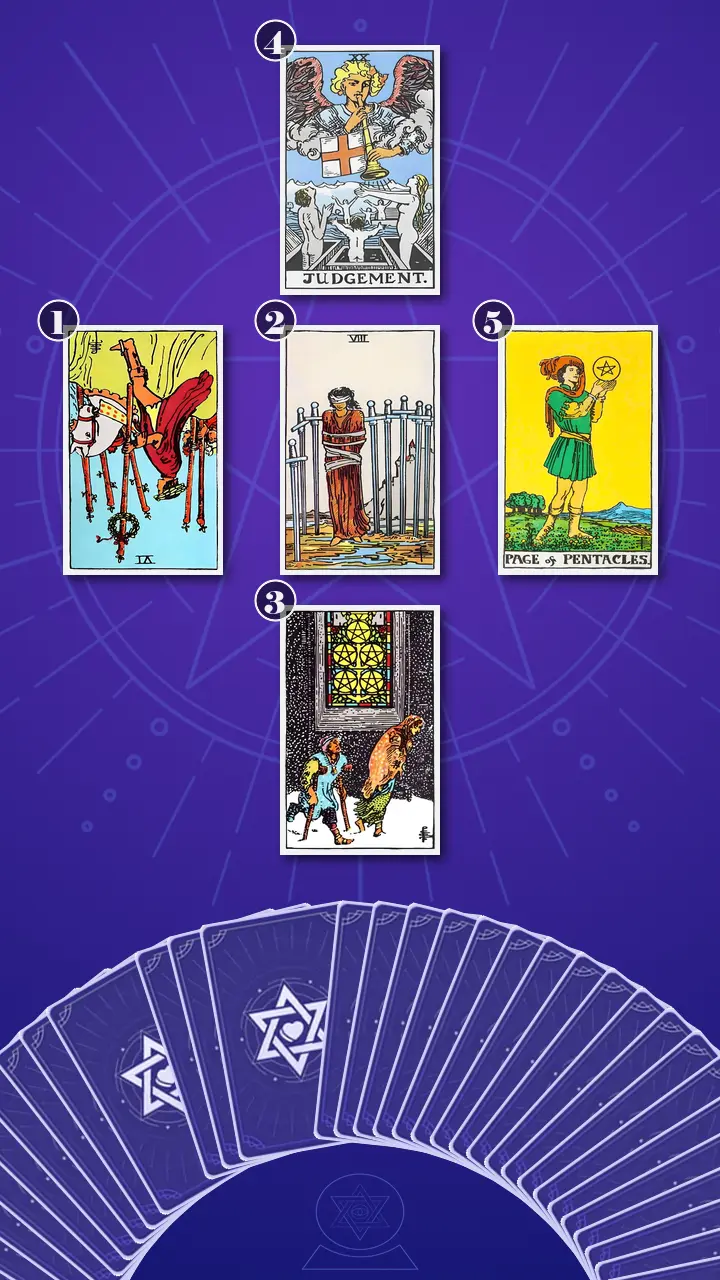
I chose the classic five-card Shadow Spread. For anyone wondering how tarot works in a consultation like this, I use the cards as an external cognitive map, not as a fixed prediction. Symbol, position, and conversation help separate facts from assumptions so that card meanings in context can reveal a pattern the mind has been running too quickly to examine.
The spread suited Jordan’s question because approval dependence has several layers. A broader ten-card reading could have explored timing, other people, and possible outcomes, but that would have added more signals to a problem already crowded with them. This five-card structure stayed with the essential chain: visible behaviour, hidden rule, root fear, reclaimed resource, and practical integration.
I placed the second card at the centre. The first sat to its left, showing the visible pattern. The third went below the centre, revealing the fear that gave the pattern weight. The fourth rested above it as the resource Jordan could reclaim, and the fifth waited on the right as a grounded next step. The cross resembled a compass built around one hidden rule. We would move from symptom to restriction, descend into fear, rise into self-authority, and finish with practice.
Reading the Route Behind the Reactions
Position 1: The Victory Wreath Above an Empty Thread
Now I turned over the card representing Jordan’s diagnosis-level presenting pattern: the visible habit of stopping or revising a chosen direction when clear approval is absent.
It was the Six of Wands, reversed.
I pointed to the rider, the white horse, the gathered figures, and the laurel wreath held high. Upright, the card often carries confidence, recognition, and a public sense of progress. Reversed, the rider’s direction can become secondary to the crowd’s response. The route may still be sound, but the missing applause starts to feel like evidence that there should be no route at all.
“This is your Tuesday night in one image,” I said. “You have completed a credible presentation, but instead of submitting it, you watch Slack reactions and message threads. The reversed wreath becomes the missing notification. Without visible enthusiasm, work that was already usable begins to feel embarrassing or undeserved.”
In energy terms, I saw a blockage in the Six of Wands’ Fire. Jordan had enough momentum to create and finish, but not enough internally anchored recognition to sustain movement after the work left their hands. At the same time, attention to the audience had moved into excess. Each new opinion created another design constraint, until the presentation risked becoming polished, safe, and almost impossible to recognise as Jordan’s own point of view.
“What would remain worth testing,” I asked, “if nobody could publicly validate it for the next twenty-four hours?”
Jordan gave a short laugh with a bitter edge. “That is so accurate it’s almost cruel.” Their thumb froze above the face-down phone. Then their eyes moved back over the card as if replaying every after-hours revision in Figma version history. Finally, their mouth softened, though their shoulders remained lifted.
I let the reaction breathe before answering. “Cruel would be using this card to blame you. I’m not doing that. Approval has probably given you real relief, useful information, and a sense of belonging. We’re looking at what happens when that relief becomes the only signal your body trusts.”
Position 2: The Permission Modal Behind Thirty Tabs
Now I turned over the card representing the limiting rule that maintained the problem: Jordan interpreted missing approval as evidence that independent movement was unsafe or invalid.
It was the Eight of Swords, upright.
The blindfolded figure stood among swords, loosely bound but not completely enclosed. I drew Jordan’s attention to the opening in the arrangement. The restriction was real as an experience; the card did not pretend they could simply think themselves out of a tight chest, workplace hierarchy, rent pressure, or a consequential decision. Yet the visible gap showed that feeling unable to move was not identical to having no available move.
I translated the card into the moment after a neutral reply to a Figma proposal. Jordan already had enough information for one reversible next step, but they opened more browser tabs, reread the message, searched advice threads, and asked another person to interpret the tone. Their personal operating system seemed to launch the same permission modal before every choice: “Someone else must click approve before you can continue.”
This was Swords energy in excess and in blockage at once. The mind kept producing analysis, but the analysis no longer clarified the decision. It circled imagined reactions instead. Reassurance-seeking reduced discomfort for a few minutes, yet every rescued decision gave Jordan less practice in evaluating the next one.
“The exit exists,” I said, touching the gap between the swords, “but the rule says you are not allowed to use it. The rule sounds like, ‘If I move before they approve, I’ll have no protection.’”
Jordan’s fingertips pressed flat against the table. I asked them to separate the observable message from the meaning their body had added.
“The observable message was, ‘Looks good, let’s discuss,’” they said slowly. “What I added was, ‘They don’t endorse this, so I’ve missed something obvious.’”
“That distinction is the opening,” I replied. “Silence is missing data, not a verdict. A neutral message may justify a specific follow-up question, but it does not automatically justify dismantling the whole decision.”
Their hand moved toward the phone and then stopped. I saw the stuckness become visible to them in real time: the restless hand still wanted another signal, but another part of them had begun to notice that checking was not producing clarity.
Position 3: The Lit Window on the Other Side of “Are You Sure?”
Now I turned over the card representing the root fear beneath the approval loop: the fear that disapproval or being ignored could prove a lack of worth and threaten belonging.
It was the Five of Pentacles, upright.
Two figures moved through snow beneath an illuminated stained-glass window. I told Jordan that this card did not establish that rejection was coming. Tarot was not presenting a social or professional sentence. It was showing the emotional scale their mind assigned to disagreement.
Jordan told me about a 504 streetcar ride home after a friend had replied to a possible career move with, “That sounds big. Are you sure?” Snow had melted into grey lines on the window, the heater smelled of dust and wet coats, and rent was due in four days. The friend had asked one question. Jordan’s stomach had heard an entire verdict: “If this goes badly, everyone will know I never belonged at this level.”
That was the Five of Pentacles in contracted Earth. Practical concerns such as salary, rent, and reversibility were valid, but scarcity had expanded until one questioned choice seemed capable of disqualifying the whole person. The lit window represented the professional room Jordan imagined being locked out of. It also suggested that support and alternative interpretations might still exist even when their nervous system could not access them.
“A choice can be questioned without you being disqualified,” I said. “Those are different events.”
Jordan’s inhale stopped high in their chest. Their gaze slipped past the screen and held on something I could not see, as though the streetcar scene had started playing again. When they spoke, the words came out quieter. “If I choose something because I genuinely want it and it fails, I can’t hide behind anyone else’s advice. It would have my name on it.”
“Yes,” I said. “That is more vulnerable than indecision. Wanting reassurance is not shameful. Wanting to know that you still belong after an imperfect choice is human. The problem begins when that emotional need has to disguise itself as endless research.”
When Judgement’s Trumpet Cut Through the Static
As I moved from the lower card to the one above the centre, the refrigerator compressor clicked off. The kitchen became suddenly quiet, and sleet touched the window in small, distinct taps. The change in sound felt almost like part of the spread.
Position 4: The Call That Was Never a Crowd Verdict
Now I turned over the card representing Jordan’s reclaimed resource: honest self-assessment and the authority to answer personally owned values.
It was Judgement, upright.
I centred the angel’s trumpet and the figures rising with open arms. I did not frame the trumpet as an authority announcing whether Jordan was impressive enough. I framed it as an awakening that required a response. In modern terms, this was a personal design review in which Jordan defined success criteria before looking at audience metrics.
I asked them to picture a Sunday cafe near Queen Street West: a notebook open, a blank receipt beside it, and the phone turned face down before the group chat could become an approval panel. Judgement’s trumpet became an internal notification asking, “What matters here, and what evidence would help me learn?” The movement was from “Will they approve?” to “What criteria do I actually own?”
This was the spread’s balanced power: values-based self-authorisation, honest review, and the willingness to answer a meaningful call without demanding certainty. It did not require Jordan to reject advice. Feedback could inform the route without becoming permission to move.
At this point, I used the diagnostic framework I call Mental Noise Cancellation. After ten years of working with sound and internal rhythm, I have learned not to treat severe inner friction as a moral failure. I listen for psychological frequencies that have become layered so tightly that they sound like one command.
I separated Jordan’s noise into three channels. The first contained actual information: the presentation was finished, their recommendation was supported, and the manager wanted a discussion. The second carried a legitimate emotional need: “I want reassurance that I still belong if someone disagrees.” The third carried the borrowed rule: “Without enthusiasm, my choice has no valid basis.”
Mental Noise Cancellation did not erase the need for support or mute useful critique. It stopped those channels from impersonating one another. Once I isolated them, Jordan could ask for reassurance honestly, seek information specifically, and still hear the quieter frequency of their own criteria.
Jordan was still trying to turn the card into another authority, one more voice that could guarantee the correct answer. I could see the old equation tightening again: certainty before movement, approval before ownership, and no chance to learn until the risk of being wrong had disappeared.
Your direction is not invalid when the crowd is silent; answer Judgement's trumpet with your own criteria, then let one lived step test the call.
I stopped speaking. The sleet continued its light percussion against the glass.
Jordan’s breath stopped midway in. Their fingers remained suspended above the table, slightly curled, and their eyes widened before losing focus. I could almost see the memory sequence moving behind their face: the neutral manager reply, the unanswered screenshots, the first clear Figma version buried beneath reassurance-driven edits. Their eyebrows drew together, and for a moment they looked angry rather than relieved. “But doesn’t that mean I’ve been doing this wrong for years?” they asked, their voice sharper than before. Then the sharpness broke. Their fist opened one finger at a time, their shoulders sank, and a long exhale left them with a faint tremor. Their eyes shone, but they also looked briefly unsteady, as if putting down a familiar weight had left their hands unsure what to hold. I told them clarity sometimes creates that blank space: once an audience no longer owns the decision, responsibility returns to the person choosing.
“I’m not putting your past self on trial,” I said. “The strategy made sense because approval gave you relief and social safety. We’re noticing that it now costs you authorship. Understanding the cost does not make your earlier choices foolish.”
I asked, “Now, using this new perspective, can you think of a moment last week when this insight might have made you feel different?”
Jordan looked at the finished deck. “The design review,” they said. “I had usability evidence for the recommendation. I knew the next sprint could test it. I didn’t need my colleague to sound excited before I could defend it.”
I gave them ten minutes to write two criteria for that one reversible choice. They wrote: “The recommendation must follow the user evidence,” and, “The team must be able to review it after the next test.” I asked them to make the criteria visible before checking anyone else’s reaction. If the exercise had involved immediate safety, health, legal obligations, workplace power, or a major financial risk, I would have directed them toward appropriate outside support. Self-trust does not require isolation or reckless certainty.
What happened at the table was a small but important crossing: from approval-driven hyper-analysis toward grounded, evidence-based self-trust. Jordan did not suddenly feel invulnerable. They became willing to let discomfort sit beside a provisional choice without giving it sole voting power.
Position 5: A One-Week Beta for Self-Trust
Now I turned over the card representing conscious integration: making one reversible choice from personal criteria and learning from the result before seeking opinions.
It was the Page of Pentacles, upright.
The Page held one pentacle at eye level while standing on cultivated ground. I described the card as focused beginner energy, not instant mastery. Jordan did not need to prove perfect self-trust. They needed one bounded experiment concrete enough to create evidence.
In Jordan’s life, the Page could look like choosing one reversible plan, following it for a week, and recording observable outcomes before asking friends, colleagues, or social media to decide whether it had been worthwhile. The pentacle became one real result held steadily enough to examine. The cultivated field became repeated practice rather than a public victory lap.
This was Earth in balance. The Five of Pentacles had turned Earth into a fear of scarcity and exclusion; the Page returned it to practical learning. Instead of predicting every possible response, Jordan could test one screen, one proposal, one meeting format, or one week of a creative direction.
“Make the next choice small enough to learn from and reversible enough to survive,” I said. “A revised plan is evidence about the experiment, not evidence against the person who began it.”
Jordan glanced at the two criteria they had written. Their jaw was not fully relaxed, but their hands had gone still. “So the goal isn’t to become someone who never needs feedback,” they said. “It’s to have a position before the feedback arrives.”
“Exactly,” I said. “Then critique can meet a direction instead of replacing one.”
From Signal to Structure
I drew the five cards together into one coherent story. The reversed Six of Wands showed the visible symptom: motivation collapsed when recognition was quiet. The Eight of Swords exposed the hidden mechanism: an untested rule converted ambiguity into a stop sign. The Five of Pentacles explained why the rule felt protective: disagreement had become emotionally linked with exclusion, insufficiency, and being exposed as someone who did not belong.
The pattern had strengthened through repetition. Each time Jordan requested reassurance and received praise, their body felt temporarily permitted to continue. That relief made perfect sense, but it also reduced the chance to practise independent evaluation. The next neutral response therefore felt even louder. Their notification-driven compass was not broken; it had simply been trained to treat public reaction as its only reliable signal.
Judgement reclaimed the capacity hidden inside the shadow: Jordan could conduct an honest review using values and evidence they personally endorsed. The Page of Pentacles grounded that awakening in practice. Direction did not have to arrive as certainty. It could emerge through one owned choice, one lived result, and one thoughtful adjustment.
I named the central blind spot directly. Jordan had been confusing the sensation of reassurance with evidence that a decision was sound. They had also been treating revision as protection, even when each revision erased the criteria that made the original direction coherent. The transformation was not from “caring about feedback” to “ignoring everyone.” It was from needing visible permission to making a provisional judgement first, then inviting relevant information.
I also pointed out that no Cups had appeared in the spread. I did not treat that absence as ominous. I used it as a practical observation: Jordan’s need for comfort and belonging had been processed through Swords, Wands, and Pentacles through analysis, performance, and metrics rather than named as a feeling. Saying “I want reassurance right now” could relieve feedback of a job it was never designed to do.
Jordan frowned at the action plan. “But I work in product design. Feedback is literally the job. I can’t ignore people for twenty-four hours if a decision is blocking the team.”
“Agreed,” I said. “The pause is for nonessential approval-seeking, not operational information, deadlines, consent, or qualified advice. You can ask one specific question when the work genuinely needs an answer. We’re interrupting the fourth opinion that makes your original judgement disappear, not the first piece of relevant feedback.”
I built our next steps around two contained practices:
- The Frequency Reset and Two-Criteria CompassWhen the urge to send another screenshot or reopen a finished draft appears, place the phone face down and use my Frequency Reset Pause: keep both feet on the floor, inhale gently for four counts, exhale for six, and repeat three times without holding your breath. Then write exactly two criteria in your notes app: one about the value the choice should serve and one about reversibility or practical fit. For one genuinely low-stakes decision, act from those criteria and wait up to twenty-four hours before seeking nonessential opinions or checking engagement.Use a timer and keep the criteria to two lines, even when perfectionism requests a third. Shorten or skip the delay when a deadline, safety issue, legal question, health concern, consent requirement, or serious financial consequence makes timely outside input appropriate.
- The Seven-Day Reversible Evidence LoopChoose one work or creative task that can be completed within seven days, such as testing one portfolio concept, sending one proposal, or trying one meeting format. Write a one-sentence hypothesis: “I am testing whether this direction gives me useful evidence about ___.” At the end of the week, record three observable results, one feeling, and one adjustment before asking anyone whether the experiment was worthwhile.Make the beta smaller than your perfectionism prefers: one user, one screen, one conversation, or one week. If you begin predicting reactions, return to the hypothesis. You remain free to stop, revise, or request relevant help at any point.
I told Jordan that actionable advice should leave them with more agency, not another standard they could fail. The goal was not a flawless twenty-four-hour pause or a triumphant week. The goal was to create one piece of evidence that their judgement could participate in the decision before the audience arrived.

A Week Later, the Quiet Proof
Six days later, I received a photo from a small cafe near Queen Street West. A milk steamer had blurred the background, and two criteria were written on the back of a receipt. Jordan’s phone rested face down beside it.
The message beneath the photo read: “I submitted the presentation without sending it to the group chat first. My manager asked one clarifying question. I answered the question instead of rebuilding the deck.”
There had been no cinematic burst of confidence and no wall of celebratory reactions. Jordan had used the user evidence and reversibility criteria, scheduled the work for the next morning, and allowed the discussion to produce information. The original direction remained visible in the final file.
They slept through the following night. Their first thought in the morning was still, “What if I missed something?” This time, they smiled, checked their two lines, and made coffee before opening Slack.
I did not credit the cards with making that choice. The Shadow Spread had offered images, distinctions, and a structure for finding clarity; Jordan supplied the criteria, tolerated the quiet, and took the lived step. Tarot had functioned as a mirror for their internal wisdom, not as an authority replacing it.
That was the real Journey to Clarity: not a permanent escape from doubt, but movement from approval-driven self-surveillance toward grounded flexibility. Jordan could still seek feedback, change their mind, or ask for support. The difference was that a revision could now describe what the experiment taught them instead of prosecuting the person who began it.
When the room goes quiet after you name what you want, I know how quickly your chest can tighten and your jaw can rehearse every possible objection. Abandoning the choice may still feel safer than discovering that it mattered first to you. Yet the quiet can be a gap in the signal rather than a verdict, and noticing that distinction means the crowd no longer owns the entire compass.
If one choice this week could become a Page-sized, reversible experiment instead of a verdict on who you are, what two criteria would you write before answering Judgement’s trumpet and asking the room to decide what it means?