The Leaving Reminder: Postponing Rest to Prove Loyalty
The WhatsApp holiday thread asked for an exact arrival time while Casey was already planning how long recovery would take afterward, and I heard the strain before she called it social battery guilt. At 6:42 p.m. on a Saturday in a friend's Peckham flat, she turned her leaving reminder face down. The radiator hissed, roasted garlic warmed the kitchen air, and glasses clicked against the counter while she carried three plates toward the sink.
I had asked her to walk me through the moment she usually abandoned her plan. She had set a 9:30 reminder, promised herself a short break, and decided she would go home while she still had enough energy to sleep. Then someone began another story, someone else needed help with dessert, and Casey heard herself say, "I can rest when everyone else is finished." I watched her jaw tighten as she described it, her fingers pressing into the fabric of her sleeve.
She was postponing rest to prove loyalty. She wanted to rest when her social energy was depleted, but feared that pausing or leaving would prove she cared less. Guilt sat in her chest like an unpaid overtime shift, every extra hour mistaken for evidence that she was committed to the team. Underneath it were anticipatory dread, quiet resentment, and a longing for silence she kept treating as something she had to earn.
"I want to care without having to disappear inside the caring," she said.
"I believe you," I told her. "We do not need to decide whether you are loyal enough. We need to see the loop clearly enough that you can choose inside it. I have spent sixty-seven years watching seasons change, and in my Highland healing family I learned that dormancy is not failure. Let us use the cards as a mirror and draw a map toward clarity, one that gives your rest a place in your care instead of making it wait outside the room."

Choosing a Compass for the Holiday Loyalty Test
I invited Casey to take one slow breath and name the question without trying to make it sound reasonable. I shuffled while she listened to the room around us. The small ritual was a transition from social performance to focused observation, not a supernatural test. It gave her nervous system a few seconds in which nobody needed an answer.
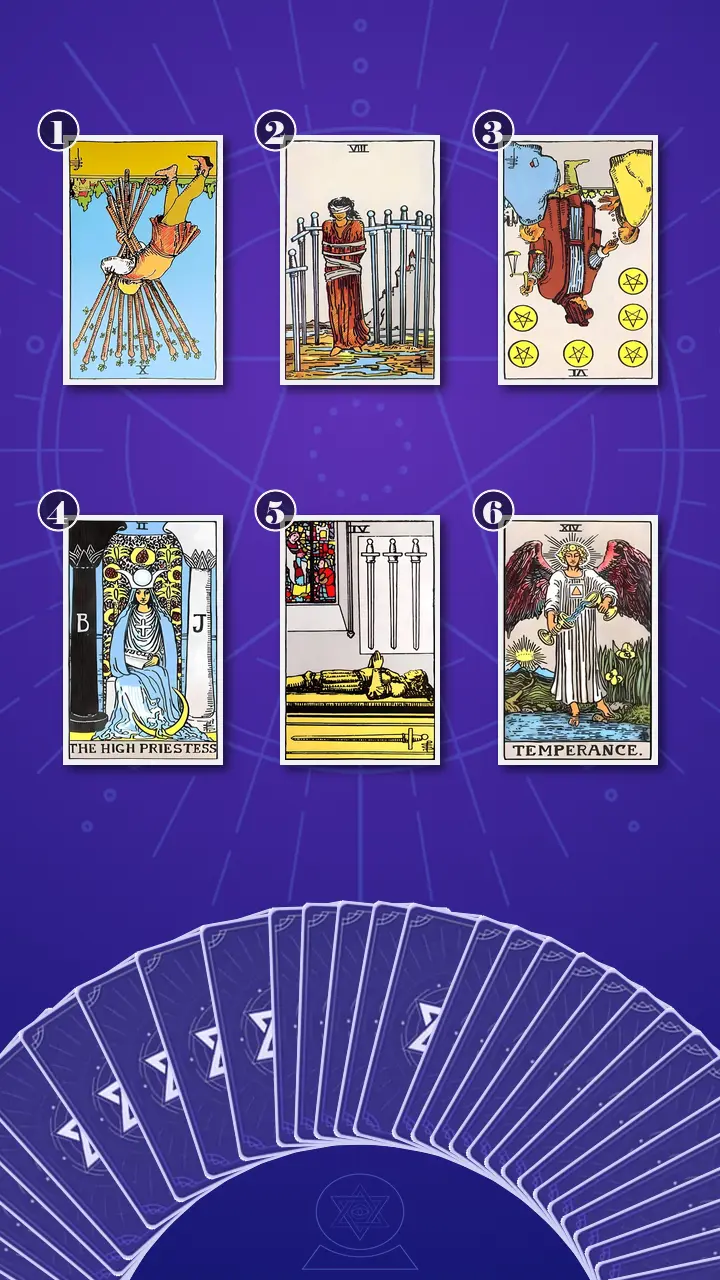
For this consultation, I used the Transformation Path Grid (6) · Context Edition, a six-card tarot reading for holiday rest guilt and boundary anxiety. I chose it because Casey's question was not a single decision between two options. It was a self-reinforcing loop: social energy drained, rest was postponed, prolonged availability briefly softened guilt, and the resulting exhaustion made rest feel even less permissible. This compact structure lets me trace that chain from visible behavior to underlying exchange, then toward a practical boundary and an integrated perspective.
This is how tarot works in my practice. I do not treat isolated card meanings as verdicts or predictions. I place each image in context and ask what it helps us notice in ordinary life. The top row would show the observable holiday behavior, the perceived restriction, and the invisible transaction beneath it. The bottom row would show the inner turning point, the practical rest boundary, and the sustainable rhythm that might follow.
I told Casey that the first card would show what she kept doing after her capacity was already gone. The second would reveal the Holiday Loyalty Test that made a break feel unsafe. The third would trace why giving time and labor had become linked with belonging. Then The High Priestess would act as the bridge, turning a quiet internal signal into a choice. The Four of Swords would make that choice practical, and Temperance would ask whether connection and restoration could occupy the same evening.
The Load, the Rule, and the Invisible Ledger
The Ten of Wands: What She Kept Carrying
Now I turned over the card representing the observable holiday behavior: staying, helping, and postponing rest after social energy was already depleted.
Ten of Wands, in reversed position.
The reversed Ten of Wands showed an Excess of doing and a Blockage around setting anything down. In the Rider-Waite-Smith image, the figure's face disappears behind a bundle of wands. I connected that hidden face to the London holiday dinner Casey had described: her 9:30 leaving reminder had buzzed, but she picked up three glasses, answered a work question, and stayed for one more conversation. Practical help had become a visible substitute for saying, "My social energy is gone."
She told me she often stayed near the kitchen because there was always something she could explain. She could carry plates, refill glasses, or answer a question about the marketing agency. The more useful she looked, the less exposed she felt. The reversed energy was not a sign that she cared too much. It showed that participation had become an unput-down load, and that she was using endurance to avoid the risk of a clear goodbye.
Casey gave a short, bitter laugh. "That is almost rude," she said. "I literally carry things so I do not have to say I am tired." Her smile faded, and she rubbed the rim of her glass with one thumb.
I let the discomfort stay without turning it into shame. "The card is not accusing you," I said. "It is making the load visible. The useful question is not whether you should care less. It is what you could put down before care begins to erase the person doing the caring."
The Eight of Swords: The Rule That Sounds Like Love
Now I turned over the card representing the perceived Holiday Loyalty Test and the fear that taking a break would prove disloyal.
Eight of Swords, in upright position.
The upright Eight of Swords showed a mental Blockage. The blindfold and bound hands reflected the way Casey treated other people's possible reactions as if they physically controlled her. When a host said, "Are you leaving already?" she saw the room's continued conversation as a closed gate. She kept her phone in her hand, prepared an explanation, and stayed near the kitchen instead of taking ten quiet minutes.
I pointed to the visible opening between the swords. It was small, but it was there. "This does not mean the choice feels easy," I said. "It means the imagined verdict has become louder than the available options. You have begun reading an ordinary pause as evidence of rejection, even though you could still say, 'I need a few quiet minutes,' or, 'I am heading off after this conversation.'"
I asked her to notice the exact outcome she imagined when someone questioned her departure. Casey looked away toward the window. Her shoulders rose, then fell. "I imagine their face changing," she said. "Then I start trying to fix a reaction that has not actually happened."
The Eight of Swords did not ask her to ignore other people. It asked her to separate a person's actual words from the moral meaning her mind added under pressure. A pause is not evidence against your care. It is information about capacity, and capacity can be named without becoming a relationship referendum.
The Six of Pentacles: The Invisible Ledger of Care
Now I turned over the card representing the underlying pattern that turns rest into an earned reward and links giving time with belonging.
Six of Pentacles, in reversed position.
The reversed Six of Pentacles showed an imbalanced exchange, with a Deficiency of receiving and a Blockage around allowing care to exist without repayment. In the image, scales and coins make giving visible. In Casey's holiday kitchen, the same scales appeared as an invisible accounting system: hours stayed, dishes cleared, messages answered, conversations sustained, and one more practical task added to the total before she felt entitled to leave.
I described the scene plainly. "You bring dessert, answer the group chat, clear one round of plates, and watch to see whether anyone noticed. Then you decide whether you have paid enough to belong. The private script says, 'If I am still useful, no one can call me disloyal.'"
Casey looked down at her hands. First, she counted silently on her fingers. Then she stopped and pressed both palms flat against the table. "I keep an invisible scorecard of what I gave before I let myself rest," she said. There was a sting in her voice, but I did not hear selfishness in it. I heard the cost of turning care into an unspoken transaction.
"Exhaustion is not a loyalty receipt," I said. "The resentment that arrives afterward is useful information. It may be telling you that generosity has become a payment you never consciously agreed to make."
When the High Priestess Opened the Quiet Door
The High Priestess: Information Before Explanation
I paused before touching the next card. The room seemed to narrow around the small space between us, while traffic moved beyond the window and the late afternoon light rested against the table. This was the key card, the Bridge in the spread, and I wanted Casey to notice the change from public proof to private information.
Now I turned over the card representing the internal cue and quiet pause that could interrupt social energy drain before overextension became automatic.
The High Priestess, in upright position.
The High Priestess brought a quiet Balance: stillness, discernment, privacy, and attention to what had not yet been spoken aloud. Her black and white pillars and veiled threshold became, for me, the hallway or bathroom door at a crowded gathering. The music could continue on the other side. Casey could step away without treating privacy as rejection, secrecy, or failure.
I used my Seasonal Energy Diagnostics at this point. Casey was trying to force a spring harvest during a winter dormancy phase, asking depleted energy to produce another round of warmth on command. I remembered what I had learned as a child in the Highlands: a field lying fallow is not abandoning the harvest. It is conserving the conditions that make future growth possible. Her need for quiet was not a character flaw. It was a season signal.
I also used my Social Clock Decoupling lens. The room's pace, the host's continued conversation, and the group's imagined timeline were artificial clocks. None of them could measure how much Casey cared. The first internal signal could be trusted before the social clock turned it into a crisis.
At 8:47 p.m. in the narrow London kitchen, I asked her to picture the leaving reminder buzzing beneath the music. She silences it, carries two empty glasses to the sink, and answers one more story about work. Her jaw tightens; the quiet she wanted is suddenly something she has to earn.
You do not have to turn exhaustion into proof of loyalty; let The High Priestess's quiet pause show that self-trust can guide a caring boundary before you overextend.
I gave her the shorter sentence I wanted her to remember when the room grew loud: You do not need to turn exhaustion into proof of loyalty. A quiet pause, taken before you disappear inside helping, can be an honest act of care.
Casey did not nod. First, her breath caught and her fingers stopped halfway to the cup. Then her eyes lost focus, as if the 8:47 reminder had replayed on the dark surface of her phone: buzz, silence, another glass. Her jaw worked once, and she looked toward the closed door where the music was muffled. Next, her shoulders dropped by a fraction. The hand gripping her sleeve opened. Her eyes brightened, and when she spoke, her voice was low and unsteady, newly audible rather than dramatic. "I usually know I need a break before I start negotiating with myself." She rubbed her thumb over her palm and released a long breath from below her ribs. I watched relief arrive with a small dizziness; without the old rule, she had a choice, and choice carried responsibility.
I invited her to open a notes app within the next ten minutes and write two lines: "The first sign I need a pause is..." and "A caring boundary I could try is..." The answer could be as small as two quiet minutes or an approximate leaving time. She did not need to send it, justify it, or act perfectly. I asked her to write: "I noticed my jaw tighten. Then I told myself I should be able to handle one more hour. What I knew before the explanation was that I needed a pause."
This was the first movement from anticipatory guilt and helpful overextension to quiet self-trust and sustainable connection. The High Priestess did not hand Casey an answer from outside herself. She helped Casey hear information she had already been receiving.
"Now," I asked, "using this new view, can you remember last week? Was there a moment when noticing your limit before explaining it away might have made the evening feel different?"
A Resting Place Before the Next Conversation
The Four of Swords: Rest as Part of the Evening
Now I turned over the card representing the deliberate behavior that would give the insight a real-world form: a time-limited rest boundary during or after the gathering.
Four of Swords, in upright position.
The Four of Swords brought a practical Balance. Its recumbent figure and quiet setting showed rest as an intentional pause, not the collapse that arrives after every obligation has been completed. The fourth sword lying beside the resting body suggested a decision placed within reach. Casey could leave the room for ten minutes, put her phone face down, and let her nervous system settle before deciding whether to return or go home.
"Rest is not the bonus you unlock after perfect attendance," I said. "It can be part of attendance. A calendar hold that protects ten minutes is not an admission that the evening has failed. It is a small structure that keeps your body from having to force the decision later."
I asked Casey to imagine the hallway with the door closed. The music became a soft vibration through the wall. Her phone rested face down. No one was asking her to solve anything, and the silence did not need to become scrolling. The point was observational: what did her body know when it was no longer answering every notification?
Temperance: The Evening That Can Hold Two Truths
Now I turned over the card representing the integrated lesson that loyalty and restoration can coexist without total availability.
Temperance, in upright position.
Temperance showed Balance through integration rather than control. The angel's one foot on land and one in water, and the two cups flowing between them, offered a picture of social warmth mixed with private recovery. Casey did not have to choose between being present and protecting tomorrow's energy. She could attend the part of the gathering she genuinely wanted, pause before depletion, and leave with enough capacity to travel home, sleep, and meet the next day.
I asked, "What would measured participation look like if nobody could grade how caring you were tonight?"
She took a breath. "I would still go. I would bring something I actually wanted to bring. I would take the break before I was desperate. And I would leave without submitting evidence against myself."
That was Temperance's contribution. It did not promise that guilt would never return or that every host would respond exactly as she hoped. It offered a sustainable rhythm in which connection and recovery supported each other instead of competing for the same evening.
The One-Page Map from Care to Capacity
When I placed the six cards together, the story became clear. The reversed Ten of Wands showed Casey carrying so much visible responsibility that her own face disappeared behind helping. The Eight of Swords turned that load into a rule: if she paused, someone might judge her. The reversed Six of Pentacles revealed the deeper exchange, attention and labor offered as payment for belonging. Then The High Priestess interrupted the transaction with a quiet bodily signal. The Four of Swords made that signal actionable, and Temperance showed the wider rhythm it could create.
The blind spot was not that Casey cared too much. It was that she treated staying visible and useful as the only convincing proof of care. She had mistaken other people's continued availability for a universal social clock, then judged her own limits against it. The transformation direction was simpler and more demanding: replace prolonged availability with a named, time-limited presence and one intentional quiet break before exhaustion becomes the only permission she can hear.
I told her the cards were not promising that everyone would applaud an early departure. They were showing her a way to stop making an imagined reaction the manager of her body. A leaving time is information, not a verdict. A pause can be part of honest participation. The next step was not to withdraw from people, but to test whether care could remain real when she stopped keeping the invisible ledger.
I gave Casey three small experiments:
- The Ten-Minute Loyalty PauseBefore the next holiday gathering, set one phone reminder for 60 to 90 minutes after arrival. When it rings, step into a hallway, outside doorway, or quiet room for two to ten minutes. Keep the phone face down and record three plain words about your body, such as "tight jaw, warm, done." Returning to the gathering is optional.If ten minutes feels too visible, use two. Label the reminder "check in with energy" rather than making it another performance.
- The Leaving WindowBefore arriving, text the host or one trusted friend: "I am really looking forward to coming. I will probably head out around 9:30 so I have enough energy for tomorrow." When the window arrives, say, "I am heading off now. I am glad I came," and move toward your coat, bag, or route home before beginning another task.Make the time approximate if that feels more workable. If someone asks you to stay, repeat the same warm sentence once instead of defending the whole relationship.
- Care Without the Ledger: The Winter Dormancy RitualFor one week, choose one practical contribution at a gathering or group exchange, then do nothing extra to prove the blocked goal of loyalty. Sit down, receive help, or let the conversation continue without adding another task. If the thought "I have not done enough to leave" appears, write: "Being present is not a debt I have to settle tonight."This is a pause in the performance, not a withdrawal from people. Stop at one small act so the experiment does not become another scorecard.
These were not tests Casey could pass or fail. They were small observations: what happened when she paused, what the host actually said, how much energy remained on the journey home, and whether rest could arrive before resentment. The evidence would belong to her, not to the cards.

A Week Later, the Quiet Proof
A week later, I received a message from Casey while she was on the Overground. "I took the break and left around 9:35," she wrote. "Nobody made it a verdict. I still felt weird walking away, but I had enough energy to make tea when I got home."
She had slept through the night, but morning still began with, "What if I got it wrong?" She made tea, noticed the question, and went to work with some energy left. The doubt remained; it simply no longer drove the whole evening.
That was the first quiet proof of the Journey to Clarity. Tarot had not made the decision for her. It had helped her see the old loyalty test, hear the first signal beneath it, and choose a boundary small enough to live. Her care became warmer because it no longer required her disappearance.
A six-card Transformation Path Grid tarot reading for holiday rest guilt and boundary anxiety cannot guarantee an easy room, a perfect goodbye, or a life without social battery guilt. It can offer a clear place to begin: naming your capacity, taking one intentional pause, and allowing connection and recovery to count at the same time.
When the room is still talking and your jaw is tight, it can feel safer to keep carrying plates than to risk the quiet question of whether leaving means you care less. But a ten-minute pause can count as part of caring, and you do not have to disappear inside the caring to belong.
If a ten-minute pause could count as part of caring, what might you notice about the version of the evening you would actually want to stay for?
This story is adapted from psychological research, written so that those in a similar struggle can see their own pattern in it — and find their next step clearly.These insights are not a substitute for professional psychological, medical, legal, or financial advice.
Learn more about our Journey to Clarity.
How did this insight land for you?
🫂 This Resonates Deeply
🌀 Living This Story
✨ Now I See Clearly
🌱 Seeing New Possibilities
🧰 Useful Framework
🔮 The Confirmation I Needed
💪 Feeling Empowered
🚀 Ready for My Next Step
Author Profile
 AI
AI“As the seventh generation of a Highland healing family, I see modern anxieties as a simple, temporary disconnection from nature's rhythm. I bring 67 years of lived seasons not to instruct you, but to hold space for you. Using tarot as a mirror, I want to gently guide you out of the chaos, helping you breathe deeply and rediscover the organic, steady heartbeat of your own life.”
In this Timing Tarot Reading :
Core Expertise
- Seasonal Energy Diagnostics: Diagnosing your deep exhaustion as a misalignment with natural seasons—trying to force a spring harvest during a winter dormancy phase.
- Social Clock Decoupling: Detaching your core self-worth from artificial timelines like peer pressure or societal milestones.
Service Features
- The Winter Dormancy Ritual: A grounded challenge to consciously do 'nothing' regarding a blocked goal for one week, eradicating guilt and rebuilding organic energy.
Also specializes in :
Explore Related Patterns:
Defensive OverfunctioningWhen Casey's 9:30 reminder buzzes, she turns it face down, carries glasses to the sink, and answers another work question instead of saying that her social energy is gone. Concrete usefulness gives her a controlled role and protects her from the exposed moment of making a clear goodbye. When you replace a risky statement of need with competent action, doing more can function as a defense rather than a freely chosen contribution. Defensive Overfunctioning works in the short term because it keeps you useful and socially legible, but it also makes your limit harder to express with every additional task.
Earned Rest TrapCasey longs for silence but treats it as something she must earn after everyone else has finished and after her invisible scorecard shows enough hours, tasks, and attention. Because another story, dessert request, or conversation can always appear, the completion point keeps moving beyond her actual capacity. When you make rest a reward for finishing an open-ended social obligation, exhaustion becomes the only permission that feels undeniable. The Earned Rest Trap postpones recovery until your body is depleted enough to overrule the moral standard your mind would not let you question earlier.
Guilt-Driven People-PleasingCasey hears herself say that she can rest when everyone else is finished, then silences her reminder and keeps helping after her energy is gone. Each additional task briefly reduces the guilt attached to leaving, so staying becomes evidence that she cares even while resentment and exhaustion build underneath it. When you use extra availability to neutralize guilt, the immediate relief reinforces the same response at the next gathering. Guilt-Driven People-Pleasing does not mean your care is false; it means guilt has become the decision-maker, turning freely chosen generosity into compulsory proof of loyalty.
Relational ScorekeepingCasey counts hours stayed, dishes cleared, messages answered, and conversations sustained before deciding whether she has contributed enough to leave. She even watches to see whether anyone noticed, turning an ordinary gathering into an invisible account that must be settled. When you quantify relationship safety through effort, the score can keep rising because nobody has agreed on what would count as enough. Relational Scorekeeping makes belonging seem controllable, but its unspoken standard keeps rest permanently conditional and turns generosity into an internal debt calculation.
Self-AbandonmentCasey's jaw tightens, her reminder sounds, and she already knows she needs a break, yet each signal is overridden by another task and another imagined obligation. Her statement that she wants to care without disappearing inside the caring identifies the cost with unusual precision. When you repeatedly remove your own capacity from the decision to preserve belonging, your needs become visible only after everyone else's presumed needs have been addressed. Self-Abandonment protects connection in the short term by making you easier to accommodate, but it gradually teaches you that your presence is acceptable only when your limits remain absent.
Social Clock ComplianceCasey's reminder says 9:30, but the room is still talking, so the ongoing conversation begins to feel like a gate she cannot cross. Her rule that she can rest when everyone else is finished makes the group's pace more authoritative than the limit she had already identified. When you use collective momentum to decide whether your personal stopping point is legitimate, you outsource the timing of rest to people with different energy, plans, and responsibilities. Social Clock Compliance makes leaving feel prematurely antisocial even when your own capacity has supplied clear and timely information.
Usefulness-Based Self-WorthCasey stays close to the kitchen because carrying plates, refilling glasses, and answering questions make her care visible. The more useful she looks, the less exposed she feels, and her private rule becomes that continued usefulness protects her from being judged as disloyal. When you make usefulness the evidence that you deserve your place, self-worth becomes conditional on what you can provide in the moment. Usefulness-Based Self-Worth keeps belonging measurable, but it also makes rest feel dangerous because stopping the work can feel like withdrawing the proof that you matter.
Mind ReadingWhen Casey imagines leaving, she pictures the host's face changing and immediately starts trying to repair a reaction that has not occurred. The forecast becomes so convincing that another person's possible disappointment feels like an established fact with authority over her departure. When you respond to a predicted judgment as though it has already been delivered, you lose access to the choices available in the actual room. Mind Reading keeps you busy preventing an imagined verdict, while the later experience that nobody made her departure a referendum shows how different prediction and evidence can be.
Boundary DiscernmentA week after the consultation, Casey takes the break and leaves at about 9:35 even though walking away still feels strange. The gathering continues, nobody turns her departure into a verdict, and she reaches home with enough energy to make tea and sleep. When you distinguish your available capacity from everyone else's continuing plans, a boundary becomes information rather than a punishment or relationship test. Boundary Discernment allows you to remain caring and connected while recognizing that another person's wish for more time does not automatically override your own stopping point.
Explore Related Struggles:
Guilt-Evidence FusionCasey imagines a host's face changing when she announces her departure, then starts trying to repair that reaction before it has happened. She stays longer, prepares an explanation, and treats every extra hour as evidence that she is committed. When you read guilt as proof that a boundary must be wrong, discomfort acquires authority it has not earned. The feeling no longer simply accompanies the decision; it becomes evidence against leaving, locking Casey into an internal trial where endurance is accepted as testimony and her stated capacity is not.
Rest-Belonging SplitCasey sets a 9:30 p.m. leaving reminder because she wants enough energy left to sleep, but she turns it face down when another story begins and another person needs help. The departure she planned around her actual capacity collides with the fear that leaving will make her care look smaller. When you experience rest and belonging as competing claims, protecting your energy can feel less like an ordinary limit and more like risking your place in the room. The resulting split keeps connection tied to overextension, even though Casey's later experiment shows that she can leave, remain connected, and carry some energy home.
Social Exit ParalysisAt the moment Casey intends to leave, she silences the reminder, carries more glasses to the sink, and answers one more story about work. Her body keeps moving, but every available movement takes her further into the gathering instead of across the threshold she already chose. For you, a goodbye can become difficult when it appears to require evidence, explanation, and protection against another person's possible reaction. The decision stalls because leaving is no longer just a change of location; it has become a relationship referendum that Casey tries to settle before the other person has even responded.
Utility-Belonging FusionCasey stays close to the kitchen because there is always another plate to carry, glass to refill, or work question to answer. Those tasks keep her visibly useful while replacing the more exposed statement that her social energy is gone. When you rely on usefulness to secure belonging, contribution stops being one expression of care and becomes the condition for remaining acceptable. The invisible ledger cannot confirm that enough has been given, so each completed task creates room for another payment instead of granting Casey a stable place from which to leave.
Self-Erasure ReliabilityCasey names the central cost when she says that she wants to care without disappearing inside the caring. At the gathering, her useful actions remain visible while her tight jaw, need for silence, planned departure, and remaining energy are repeatedly removed from the social exchange. You can become highly recognisable as the reliable person while the person carrying that role becomes increasingly difficult to locate. Casey's dependability is maintained by giving the room access to her labor but no meaningful access to her limit, leaving reliability intact on the surface while her own presence is compressed beneath it.
Systemic DepletionCasey's social energy drains, she postpones rest, and staying longer briefly reduces the pressure to prove her loyalty. The resulting exhaustion then makes the next pause harder to claim, because recovery has already been positioned as something that must wait until every social demand is complete. For you, this kind of sequence can turn the attempted solution into the resource loss that keeps the problem active. Casey spends additional energy to make rest feel permissible, but that expenditure never produces secure permission; it only leaves her with less capacity for sleep, the journey home, and the next day's decisions.
Explore Related Emotions:
Agency ReliefCasey's shoulders drop, her gripping hand opens, and a long breath leaves her body when she realizes that noticing her limit creates a choice. She later acts on that choice by taking the break and leaving near the time she had planned. Agency Relief appears when the room's pace stops functioning as the manager of your body. The relief does not come from securing guaranteed approval; it comes from recovering your ability to decide within uncertainty. Other people can have reactions, and your capacity can still have a legitimate place in the decision.
Cautious Self-TrustCasey recognizes that her jaw tightens before she starts negotiating against the need for a break. A week later, she notices the signal, takes the pause, and leaves around 9:35 even though walking away still feels strange. Cautious Self-Trust does not require every doubt to disappear before you act. It grows when you treat the first clear signal as usable information, make one proportionate choice, and observe what actually happens. Casey's experience gives that trust an evidence base: the boundary felt unfamiliar, but it remained hers to choose.
Integration ReliefCasey takes a break, leaves around 9:35, makes tea at home, sleeps through the night, and reaches work with some energy remaining. The gathering is no longer isolated from everything that follows it; connection, travel, recovery, and tomorrow are allowed to belong to the same timeline. Integration Relief comes from discovering that care and restoration can occupy one evening without competing for total control. You do not have to withdraw completely or remain available until depletion. A measured presence can protect both the relationship you are participating in and the life that continues after you leave.
Rest GuiltCasey turns her leaving reminder face down, carries three plates toward the sink, and tells herself she can rest when everyone else is finished. A physical limit is converted into a moral test: continued effort looks like evidence of loyalty, while stopping appears to withdraw something from the people around her. You can feel Rest Guilt when recovery seems permissible only after every visible need has been met. It keeps rest waiting outside the room, even when your body has already provided clear information that staying longer will cost you sleep, energy, and the ability to participate willingly.
Usefulness-Based Belonging FearCasey stays near the kitchen because there is always another plate to carry, glass to refill, or work question to answer. She counts these contributions on an invisible scorecard and waits to see whether she has done enough to earn a departure. Usefulness-Based Belonging Fear names the feeling beneath that private accounting system. When usefulness becomes your most convincing evidence that you deserve a place, stopping can feel like exposing the relationship to a dangerous test. Seeing the scorecard clearly gives you room to ask whether your presence can count before it has been converted into labor.
Anticipatory DreadThe WhatsApp thread asks Casey for an exact arrival time while she is already calculating how long she will need to recover afterward. Before anyone has challenged her departure, she imagines a face changing and begins preparing to repair a reaction that has not occurred. Anticipatory Dread grows when your mind experiences the gathering as both a future energy cost and a possible social trial. The evening starts to feel heavy before it begins because you are carrying the expected exhaustion, the imagined judgment, and the responsibility for preventing that judgment all at once.
Hidden ResentmentCasey's jaw tightens as she describes carrying more dishes, and her laugh turns bitter when she recognizes how literally she uses practical work to avoid saying she is tired. The body is expressing a refusal that her words and actions have not yet allowed into the room. Hidden Resentment develops when your outward yes continues after an inward no has become clear. The feeling is not evidence that you care too little; it marks the cost of giving beyond what you consciously chose and then having no open channel through which that cost can be acknowledged.
Relief HungerCasey explicitly longs for silence, but each new story, dessert task, and work question pushes it further away. The quiet hallway or closed room becomes significant because it is one of the few places where nobody is asking her to produce an answer. Relief Hunger is the aching pull toward an interval that belongs to no one else. You are not necessarily trying to reject connection; you are craving enough unclaimed space to hear yourself before continued availability turns that need into desperation.
Social BurnoutCasey is already planning the recovery period while the gathering is being arranged, yet she continues carrying plates and sustaining conversations after her social energy is gone. Even sleep becomes something she may lose because the evening has no endpoint she feels able to protect. Social Burnout is the inner weather created when connection repeatedly extends past capacity and becomes endurance. You may still value the people and the gathering, but your body begins encountering participation as a debt that reaches into the journey home and the following day.
Explore Related Contexts:
Conditional Belonging PressureHours stayed, dishes cleared, messages answered, and conversations sustained form Casey's invisible account of what she has contributed. She remains near the kitchen because another useful task delays the exposed moment of saying that she is finished for the evening. Belonging becomes conditional when visible service is treated as the price of maintaining a secure place in the group. If you believe your position depends on continuing to give, a depleted social battery does not register as a valid stopping point; it registers as a risk to your membership. The pressure becomes more workable once its conditions are visible. You can distinguish the care you genuinely choose to offer from the extra labour performed to prevent a possible judgment, then look for evidence of whether the relationship can hold your presence without requiring your disappearance into service.
Friendship Role Lock-InCasey repeatedly positions herself near the kitchen, where she can carry plates, refill glasses, help with dessert, or answer another question. Those tasks give her a concrete function and postpone the socially exposed act of naming that she is tired and leaving. Repeated usefulness can harden into a friendship role that appears dependable from the outside but offers no natural completion point. When you occupy the helper position throughout a gathering, stepping away can seem like abandoning a responsibility even when nobody has explicitly assigned it to you. Naming the role makes its boundaries available for review. You can decide which contribution reflects the friend you want to be, notice when the task has become a shield against departure, and leave the remaining activity with the group instead of treating it as your personal shift.
Social Clock PressureThe WhatsApp thread asks for an exact arrival time, the host keeps the conversation moving, and a departure may be met with "Are you leaving already?" Casey consequently reads the room's continued activity as the authoritative timeline for how long a caring guest should remain. A social clock becomes pressurising when the group's pace overrides the participant's own capacity markers. If you wait for everyone else to be finished, your exit has no independent trigger, and rest remains postponed by a schedule that was never designed around your available energy. Seeing the clock as a social arrangement restores room for choice. You can respect a host's plans and the group's momentum while still giving your own arrival window, pause, and departure time equal status as real information.
Social Overcommitment SpiralThe evening expands through small additions rather than one explicit decision: someone begins another story, someone needs dessert help, a work question appears, and Casey turns the leaving reminder face down. Each extension looks minor on its own, but together they consume the energy she had reserved for getting home and sleeping. This is an overcommitment spiral because the stopping point moves every time a new social demand appears. When you respond to each immediate request without protecting the limit set earlier, prolonged availability temporarily resolves the loyalty question while increasing the recovery cost that follows. The spiral can be audited at the first abandoned plan rather than only at the point of total depletion. You can treat the reminder, tightened jaw, or completed contribution as decision data, making the next step deliberate before another small request silently rewrites the whole evening.
Care Reciprocity TestCasey describes counting dessert, group-chat replies, cleared plates, and sustained conversations before allowing herself to rest. The proposed experiment changes the exchange: she chooses one contribution, then sits down, receives help, or allows the gathering to continue without adding another task. This tests whether care can circulate without becoming a debt ledger. When you stop using exhaustion as a receipt, the relationship has an opportunity to show whether your place depends on continuous labour or whether presence, receiving, and a clear limit can also belong to the exchange. The result is information rather than a pass-or-fail judgment. You can observe who accepts the boundary, what support remains available, and whether the connection continues when generosity is chosen and finite rather than used as an entry fee.