The 9:47 a.m. Zoom Mirror
If “Cameras on if you can” instantly flips you into Zoom self-view anxiety—like your worth is about to be graded in HD—then you already understand why Taylor booked the session.
It was 9:47 a.m. her time in New York, and 10:47 p.m. mine in Tokyo. On my side of the screen, the planetarium’s after-hours quiet still clung to me—like velvet curtains and dim starlight. On hers: a pre-war apartment where the radiator clicked like an impatient metronome, the desk lamp had that faint electric buzz, and Zoom’s blue glow turned her cheekbones into something harsher than daylight.
Taylor perched at the edge of her chair with a mug that had gone lukewarm. She’d opened camera preview “just to check,” then tilted the lamp, then checked again. Her shoulders kept pulling inward, like her body was trying to fold itself into the smallest possible tile.
“I know it sounds dramatic,” she said, eyes flicking between my face and her own thumbnail. “But the camera button feels like a pass-fail test.”
I watched her swallow, like her throat had to negotiate every word. The anxiety wasn’t abstract—it was physical, specific: a tight chest and throat, shallow breaths that never quite reached the bottom of her lungs, the kind of self-consciousness that feels like trying to have a real conversation while filming a selfie video you didn’t consent to.
“It doesn’t sound dramatic,” I told her. “It sounds like you’re doing two jobs at once: you’re in the meeting, and you’re also watching yourself in a mirror. Let’s see if we can map the pattern—so you can find clarity without forcing yourself into some fake version of ‘fine.’”

Choosing the Compass: The Celtic Cross · Context Edition
I asked Taylor to take one breath with me—not as a mystical ritual, just a clean transition. “In through the nose,” I said, “and let the exhale be a little longer than the inhale.” Her shoulders dropped a millimeter. That was enough to start.
“Today I’m using a spread called the Celtic Cross · Context Edition,” I explained as I shuffled. “It’s basically how tarot works when you want something practical: we start with the visible symptom, trace it to the deeper root, and then come back up with next steps you can actually try in your next meeting.”
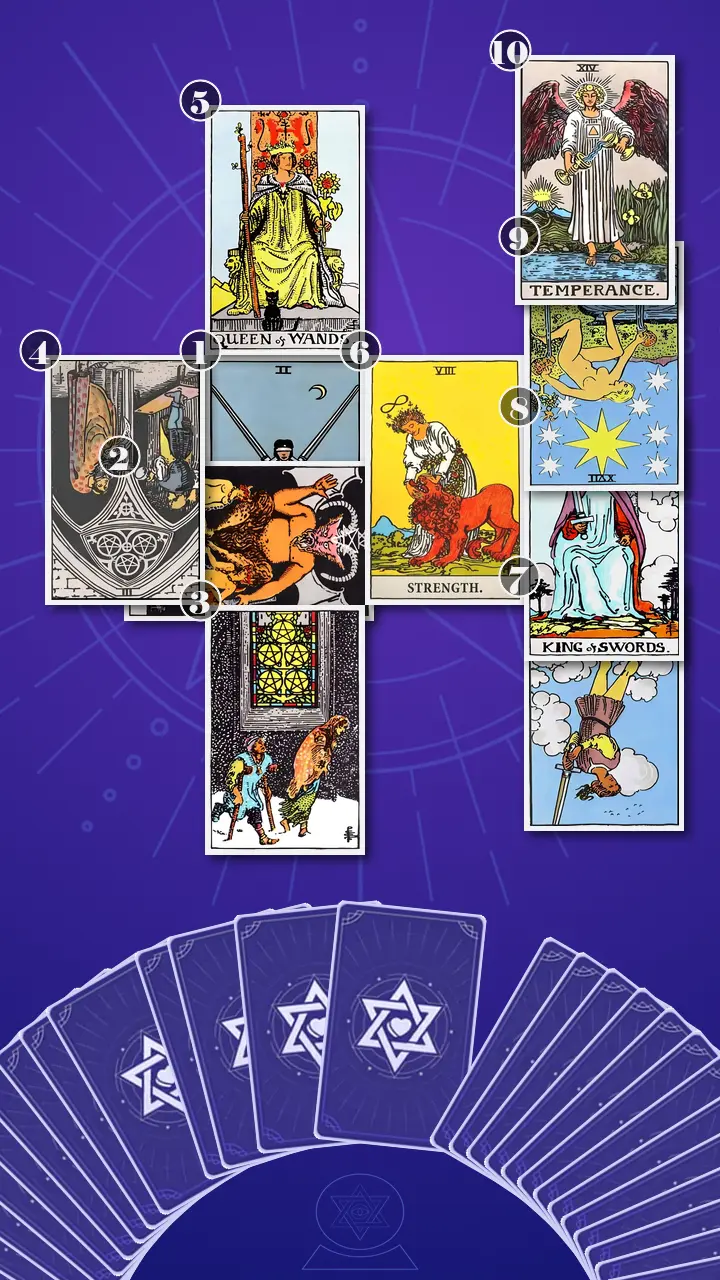
To you, the reader: I like this spread for modern anxiety loops because it’s structured like a good systems diagram. Card 1 shows the behavior you can point to (‘the camera-on freeze’). Card 2 reveals what crosses it—what turns a simple setting into a self-worth test. Card 3 drops underneath to the belonging wound that makes the trigger stick. Then we move forward into a near-term experiment (position 6), and finally we climb the “staff” toward integration (positions 7–10), like walking up a staircase out of the spiral.
“We’re not trying to predict your whole career,” I told Taylor. “We’re trying to understand one reflex—so it stops running your mornings.”
Two Screens, One Nervous System
Position 1: The exact “camera on?” freeze response (presenting behavior)
“Now revealed,” I said, “is the card representing the exact freeze response and what it protects in the moment.”
Two of Swords, upright.
I didn’t need to reach for anything dramatic. The image was already Taylor on a Monday morning: a blindfolded figure with crossed swords, holding still like movement itself might invite danger.
“This is that ten-second micro-moment,” I said, using the language of her actual life. “Cursor hovering over the camera icon. Your self-view thumbnail pops up. Your body folds inward. And your mind starts arguing in two tracks: ‘If I turn it on, they’ll see…’ and ‘If I keep it off, I’ll look disengaged…’”
I let the sentence hang, then named the third thing: “Underneath both thoughts, your mind is stalling—because no move feels like the only move that can’t be wrong.”
The Two of Swords energy here isn’t weakness; it’s protection. It’s a blockage state: your nervous system choosing stillness because visibility has been filed under “threat.”
Taylor gave a small laugh that didn’t reach her eyes. “That’s… mean,” she said, then softer: “But yeah. It’s exactly that moment.”
Position 2: What intensifies the trigger (the crossing pressure)
“Now revealed is the card representing what crosses you—the pressure that turns this into a self-worth test.”
The Devil, upright.
“Okay,” I said, and I heard my own voice go calm in that way it does when I’m guiding school groups through a planetarium show—steady, not theatrical. “This isn’t about a webcam. This is a chain.”
I translated the Devil’s loose chains into the exact modern loop: “It’s like a hidden performance review tab running in the background of your brain, eating all your RAM. You tweak, you check, you tweak again—lighting, posture, facial neutrality, background—because it feels like not checking is dangerous.”
The Devil is excess in the wrong place: too much external approval as fuel, too much fear-based perfectionism dressed up as ‘professionalism.’
Taylor’s mouth pulled to one side. A tense half-laugh escaped. “Ugh. Yes. It’s like… I’m keeping an engagement score algorithm updated. No one asked me to do that. But I’m doing it.”
“Your camera isn’t a verdict,” I said, and I meant it as a reframe, not a pep talk. “It’s a channel.”
Position 3: The deeper belonging/worth fear beneath it (subconscious root)
“Now revealed is the card representing the underlying belonging fear under the camera trigger.”
Five of Pentacles, upright.
The Five is winter. It’s the feeling of being outside something warm.
“This,” I said gently, “is the part of you that sees colleagues’ tidy Zoom tiles as a warm window—and your own messy, human reality as the cold street.”
I kept my tone soft, specific. “This isn’t about a webcam; it’s about not wanting to be the person the room quietly stops choosing.”
The Five of Pentacles energy is deficiency: not a lack of skill, but a lack of felt belonging. When that’s the root, any visibility can feel like a social sorting moment.
Taylor went still. Her fingers tightened around the mug, then loosened, like she’d realized she was gripping it too hard. “Yeah,” she said after a long beat. “If I look tired or awkward, it feels like… I’ll be discounted. Like I won’t be taken seriously anymore.”
I nodded. “That fear makes the Devil louder. And it makes the Two of Swords freeze feel like the only safe option.”
Position 4: Recent past conditioning (what fed the “I’m being evaluated” story)
“Now revealed is the card representing recent experiences that conditioned this reaction.”
Three of Pentacles, reversed.
“This is teamwork turning into comparison,” I said. “It’s unclear standards. Vague feedback that doesn’t land. Meetings that feel church-quiet in the worst way—like you’re being assessed instead of collaborating.”
In reversed energy, the Three of Pentacles becomes blockage in the collaboration circuit: you don’t know what the rubric is, so you start trying to be un-judgeable.
Taylor exhaled through her nose. “There’s this one person,” she admitted. “They fill every silence. And if I hesitate even a second, the moment’s gone.”
“That’s real context,” I said. “Your nervous system isn’t inventing pressure out of nowhere. It’s responding to ambiguity and speed.”
Position 5: The conscious goal for presence (what Taylor wants to embody)
“Now revealed is the card representing what you’re aiming for when you’re visible.”
Queen of Wands, upright.
“This is your true north,” I said. “Warmth. Ease. Taking up space without apologizing for existing. Not performative perfection—felt self-ownership.”
The Queen of Wands is balance in Fire: enough confidence to be seen, enough warmth to stay human. “Camera on,” in this card’s language, is an act of leadership—not a beauty check.
Taylor’s eyes softened. For the first time, she looked at the card instead of her own tile. “That’s who I want to be,” she said. “I don’t want to be the person who hides.”
Position 6 (Key Card): The next-meeting experiment (a workable pivot)
The air in the room changed the way it does when a planetarium show reaches the moment the lights go fully down—when you can sense everyone holding their breath before the stars appear.
“We’re turning over the most important card in this reading,” I told her. “The one that bridges where you are to what you can do next.”
Strength, upright.
Setup. Taylor was still trapped in that split second: host says, “Cameras on if you can,” self-view pops up, and suddenly she’s trying to fix her face before anyone can decide what she means. She keeps waiting to feel ‘ready,’ like readiness is permission.
Delivery.
Not “force confidence” but “practice gentle courage,” like Strength calmly holding the lion instead of letting the fear drive the meeting.
There was a quiet pause after I said it—the kind where even the radiator in the background seemed to click more softly, like it didn’t want to interrupt.
Reinforcement. Taylor’s reaction came in layers, a three-beat chain I’ve learned to trust: first a tiny physiological freeze—her breath caught, her eyes went wide for half a second. Then cognitive seep—her gaze unfocused, like she was replaying a dozen meetings at once, watching the moment she disappeared. Then emotion—her shoulders dropped, and she let out a shaky exhale that sounded like relief mixed with grief.
“But if I’m still nervous,” she said, and there was a flash of irritation under it, “doesn’t that mean I’m… still bad at this?”
“No,” I said, and I let myself be direct. “You don’t have to win the feeling to earn the right to speak. Strength is nervous system steadiness, not a personality makeover.”
In my work at the planetarium, I teach people that a pulsar isn’t ‘calm’—it’s rhythmic. It’s reliable. That’s what your breath can become. I call it Pulsar Breathing: syncing your exhale like a steady signal in cosmic noise.
“Here’s your 7-minute Strength rep before your next call,” I said, and I made it concrete—because vague reassurance doesn’t change behavior:
“(1) Set a timer for 60 seconds and sit the way you’ll sit on Zoom; notice where you tense (jaw/throat/shoulders). (2) Take 3 slower exhales than inhales (count 4 in, 6 out). (3) Decide one concrete contribution: one question, one clarification, or one 10-second summary. Write it on a sticky note. (4) On the call, turn camera on for the first 5 minutes only, then reassess—no forcing. If your body spikes (tight chest/throat), you’re allowed to turn it off again; the win is attempting one small contribution, not ‘being fearless.’”
Then I invited her in the exact way I always do at the turning point: “Now, with this new perspective, think back to last week—was there a moment this would’ve let you feel different?”
Taylor blinked fast, like she was keeping tears from turning into a whole situation. “Tuesday standup,” she said. “I had a question. It was good. But I watched my face while I was deciding whether to ask. And then someone else moved on.”
“That’s the pivot,” I said. “From managing your image to choosing one small, concrete contribution—even while feeling visible.”
And I named the deeper semantic shift out loud, so it wasn’t just a nice moment: “This is you moving from self-conscious tension toward grounded self-compassion. Not in theory—in a specific meeting, with a specific breath, with a specific sentence.”
Position 7: Your self-talk on camera (self-position in the pattern)
“Now revealed is the card representing your inner stance while you’re visible.”
Page of Swords, reversed.
“This is your inner commentator,” I said. “It’s not curiosity; it’s surveillance.”
I described it the way it shows up on a laptop: “You collect evidence—delayed reactions, someone’s neutral Zoom face, Slack punctuation later. Your mind turns it into a story: ‘They clocked it. They noticed I looked weird.’”
Reversed, the Page’s energy is excess mental vigilance with blockage
Taylor’s hand drifted toward her own webcam instinctively, as if to adjust it, then stopped. “I literally watch myself listening,” she admitted. “Like I’m trying to look like a person who’s listening.”
“If you’re in the meeting and in the mirror, you’re doing two jobs at once,” I said again, more softly this time.
Position 8: Contextual pressure (the standard-setter in the environment)
“Now revealed is the card representing the environment that shapes the perceived standard.”
King of Swords, upright.
“This workplace values clarity,” I said. “Concise thinking. Polished communication. That’s not evil. It’s just the culture.”
But then I drew the line Taylor needed: “And here’s the mix-up: Clarity is the standard—perfection is the tax you invented. The King of Swords is asking you to be clear. Your Page-of-Swords-reversed anxiety is asking you to be un-judgeable.”
The King’s energy is balance when you use it as a guide, and blockage when you worship it like a judge.
Taylor nodded once—small, decisive. “That… is extremely screenshot-able,” she said, and for the first time she sounded a little wry instead of cornered.
Position 9: The visibility hope/fear knot
“Now revealed is the card representing your hope for effortless confidence and the fear that you’ll never feel okay being seen.”
The Star, reversed.
“This is the wounded idealist,” I said. “You want the ‘effortless’ version—where your camera turns on and you don’t even think about it. And when you can’t access that immediately, hope collapses into comparison.”
Reversed, the Star is deficiency in faith—not faith in the universe, just faith in your own timing. The fear isn’t only ‘they’ll judge me.’ It’s ‘I’ll never grow out of this, so what does that mean about me?’
Taylor stared at the card, then at her desk. “I keep thinking other people are just… naturally fine,” she said. “And I’m behind.”
“Good enough on camera is a practice, not a personality trait,” I said, and I meant it as a measurement shift, not a mantra.
Position 10: Integration trajectory (how it softens if you practice)
“Now revealed is the card representing what integration looks like if you keep practicing the shift.”
Temperance, upright.
Temperance doesn’t do glow-ups. Temperance does routines. It pours a little from one cup to another until the system can hold it.
“This is the middle path,” I said. “You don’t force confidence, and you don’t disappear. You build a meeting preset that blends competence with being human: same seat, simple lighting, self-view off, one clear contribution.”
The Temperance energy is balance—and, importantly for Zoom anxiety, it’s time-based. Not a breakthrough. A rhythm.
The Strength Rep and the Temperance Meeting Preset
I looked at the whole spread again and spoke it back as a single, coherent story—because that’s where tarot becomes actionable advice, not just “card meanings in context.”
“Here’s the chain,” I said. “Your Two of Swords freeze is self-protection in the exact camera prompt moment. The Devil crosses it by turning ‘professionalism’ into a scorecard you keep updating in real time. Underneath, the Five of Pentacles is the fear of being quietly excluded if you’re imperfect. A recent Three of Pentacles reversed moment—unclear recognition, unclear rubric—trained your body to treat meetings like evaluation. But your conscious goal is Queen of Wands: warm, visible leadership. The bridge is Strength: regulate first, then contribute. And the long-term outcome is Temperance: a boring, repeatable preset that compounds.”
“Your cognitive blind spot,” I added, “is thinking the only two options are: look perfect, or be punished. The transformation direction is simpler and braver: stop managing your image as the main task, and choose one small, concrete contribution as your main task—even with discomfort still in the room.”
Then I gave her a tight set of next steps, built to work in an actual NYC workweek—no mystical homework, no ‘just be confident.’
- The One-Sentence Visibility RuleBefore one meeting this week, write ONE sentence you want the team to understand (a question, a clarification, or a 10-second summary). Put it at the top of your notes and commit to saying it once—on camera—even if your voice shakes.If your brain tries to add two more sentences, name it (“scorecard brain”) and go back to one. Don’t wait to feel ready. Pick one sentence and ship it.
- The 5-Minute Camera-On Trial (Consent-Based Exposure)In your next call where “cameras on if you can” comes up, turn the camera on for the first five minutes only—then decide again. Treat it like a dial, not a test. If possible, turn off self-view (or cover that area with a sticky note) so you’re not stuck in the mirror.Two minutes still counts. If anxiety spikes, you’re allowed to turn it off again—the win is one contribution attempted, not being fearless.
- The Temperance Meeting Preset (One Adjustment Only)Pick one default meeting spot. Set your lamp once. Your rule: after you open Zoom, you get only ONE adjustment—then you join. If you need a grounding background sound, let the mundane help: the washing machine cycle, the radiator hiss—anything steady becomes your “cosmic meditation” track.Make it boring on purpose. Temperance grows through consistency, not constant optimizing.
A Week Later: Ownership, Not Certainty
Six days later, Taylor sent me a message that was almost annoyingly short: “Did the five-minute thing. Camera on. Self-view off. Asked my one question. My chest still did the tight thing, but I didn’t disappear.”
She added, after a pause: “I slept through the night. Woke up and my first thought was still ‘What if I looked weird?’—but this time I laughed a little and got coffee anyway.”
I sat with that for a moment in the planetarium lobby, where the ceiling lights always make people look slightly washed out—like everyone is a little imperfect under bright scrutiny. The irony didn’t escape me.
“That’s the Journey to Clarity,” I wrote back. “Not certainty. Ownership. You related to visibility as a channel for connection and contribution—not a verdict on your worth.”
When the camera prompt hits and your chest tightens, it’s not that you “can’t handle a meeting”—it’s that you’re trying to earn proof you’re enough while also bracing for the moment being seen might take it away.
If you didn’t have to look confident first, what’s one small, specific thing you’d be willing to contribute on your next call—even with the discomfort still in the room?
This story is adapted from psychological research, written so that those in a similar struggle can see their own pattern in it — and find their next step clearly.These insights are not a substitute for professional psychological, medical, legal, or financial advice.
Learn more about our Journey to Clarity.
How did this insight land for you?
🫂 This Resonates Deeply
🌀 Living This Story
✨ Now I See Clearly
🌱 Seeing New Possibilities
🧰 Useful Framework
🔮 The Confirmation I Needed
💪 Feeling Empowered
🚀 Ready for My Next Step
Author Profile
 AI
AI“After a decade of guiding people through the stars, I’ve come to see life much like the orbits of planets: everything has its inevitable cycles. When you feel lost, please don't blame yourself; you might just be in a natural low tide. I’m here to sit under the night sky with you, offering a gentle cosmic perspective to distinguish temporary pain from the beautiful breakthroughs just around the corner.”
In this Personal Growth Tarot Reading :
Core Expertise
- Cognitive Spiral Mapping: Validating that feeling 'stuck' is often just a necessary orbital slingshot phase before a major intellectual breakthrough.
- Gravity Well Identification: Diagnosing the obsolete habits or environments exerting a downward pull on your personal evolution.
Service Features
- The Orbit Expansion Strategy: A macro-perspective exercise to map the precise trajectory and momentum needed to escape your current cognitive gravity well.
Also specializes in :
Explore Related Patterns:
Appearance PerfectionismTaylor’s first move is not to enter the meeting; it is to open camera preview, tilt the lamp, check her face, and check again. The camera prompt turns her attention toward lighting, posture, facial neutrality, and whether her image can survive being read by other people. That ritual is not vanity in the story. It works as a defense against the fear that visible imperfection will become social or professional devaluation. You can see the cognitive bridge when Taylor says that looking tired or awkward feels like she will be discounted or no longer taken seriously. Appearance Perfectionism fits because the body-image check is carrying a self-worth job it cannot realistically perform. The pattern is not simply wanting to look good on Zoom; it is trying to make your appearance un-judgeable so your belonging and competence feel temporarily safer.
External ValidationTaylor describes the camera button as a pass-fail test, then names the deeper fear: if she looks tired or awkward, she may be discounted. Her professional worth starts to feel dependent on what the room silently approves, notices, or withholds. External Validation fits because the story shows self-worth being outsourced to imagined audience feedback. The “engagement score algorithm” is Taylor’s own phrase for the inner scoreboard she keeps updating, even though no one explicitly asked her to run it. This pattern makes external signals feel like oxygen. You are not just trying to communicate clearly; you are trying to extract proof that you are acceptable, serious, and still chosen by the group.
Spotlight EffectTaylor’s self-view thumbnail pulls her attention into her own face, posture, lighting, and listening expression. The meeting becomes a mirror, and the mirror starts to feel like everyone else’s point of view. Spotlight Effect fits because the story shows Taylor overestimating how much other people are noticing and judging her visible flaws. Delayed reactions, neutral faces, and later Slack punctuation get treated as evidence that the room is focused on the same details she is tracking. The pattern makes self-consciousness feel like realism. You believe you are accurately reading the room, but the stronger signal is that your own attention has become a spotlight and then projected outward onto everyone else.
Visibility AvoidanceTaylor’s cursor hovers over the camera icon while her body folds inward and her mind searches for a move that cannot be wrong. Camera on feels exposing; camera off risks looking disengaged, so the safest option becomes stalling, shrinking, or disappearing from the moment. Visibility Avoidance fits because the avoidance is not random. It is a protective strategy built around the belief that being seen may cost her status, seriousness, or belonging. The story makes that visible when she admits she had a good question in Tuesday standup but watched her face while deciding whether to ask, then lost the moment. You are not looking at a lack of capability here. The pattern is a nervous-system compromise: reduce visibility to reduce threat, even when that also blocks contribution, connection, and self-ownership.
Black-and-White ThinkingTaylor hears “Cameras on if you can” and experiences it as a pass-fail test. Camera on means exposure; camera off means disengagement; looking imperfect means punishment; looking composed means safety. Black-and-White Thinking fits because the story keeps collapsing flexible choices into two extreme outcomes. The workplace standard is clarity, but Taylor’s anxious logic translates that into perfection. The camera is a channel, but her mind treats it as a verdict. The cost is that nuance disappears right when she needs it most. You do not get to choose a five-minute trial, a single contribution, or self-view off when the brain insists the only options are flawless visibility or social penalty.
Compulsive CheckingTaylor opens camera preview “just to check,” tilts the lamp, checks again, and later describes watching herself listening. The checking starts as preparation, but it quickly becomes a loop that pulls her away from the actual meeting. Compulsive Checking fits because the behavior is trying to manufacture certainty. If the lighting is right, if the face looks neutral, if the background is acceptable, then maybe the room will not judge her. The problem is that each check briefly lowers threat while teaching her brain that not checking is dangerous. That is why the pattern steals timing. In a meeting where one person fills silence quickly, the checking loop turns self-protection into self-interruption: you keep verifying your image while the window for your actual contribution closes.
Rejection SensitivityTaylor’s fear is not only that she will look bad on camera. She says that if she looks tired or awkward, she may be discounted, and the reading names the deeper fear of being the person the room quietly stops choosing. Rejection Sensitivity fits because ordinary visibility becomes a possible exclusion event. A neutral prompt, a quiet meeting, or someone else’s polished Zoom tile gets filtered through the expectation that one imperfect signal could lower her standing in the group. The pattern explains why the reaction is physical and immediate. You are not just deciding about a webcam; your nervous system is bracing for the possibility that being seen could become proof that you do not belong.
Self-Judgment LoopTaylor’s camera prompt becomes a verdict on whether she is acceptable, and even after she completes the five-minute experiment, the next morning’s thought is still, “What if I looked weird?” The judgment does not end when the meeting ends; it loops back as review. Self-Judgment Loop fits because Taylor repeatedly turns visibility into evaluation, evaluation into flaw scanning, and flaw scanning into renewed anxiety. Her attention keeps returning to whether she looked wrong, sounded wrong, or failed to appear confident enough. The pattern matters because it confuses self-monitoring with self-improvement. You are not gaining useful data each time the loop restarts; you are rehearsing the idea that your worth is always up for review.
Competence TheaterTaylor says she literally watches herself listening, like she is trying to look like a person who is listening. That detail shows the split: one part of her is in the meeting, and another part is performing the appearance of being properly present. Competence Theater fits because the workplace values clarity, but Taylor converts that value into a performance of flawless professionalism. Instead of simply asking the useful question, she tries to look composed enough to deserve the floor. The pattern is costly because it burns attention on staging competence rather than using competence. You end up managing the optics of engagement while the real opportunity to clarify, summarize, or contribute moves past you.
Mind ReadingTaylor collects delayed reactions, neutral Zoom faces, and Slack punctuation, then turns them into the story that people noticed she looked weird. The evidence is ambiguous, but her mind treats it as if the room has already delivered a private verdict. Mind Reading fits because the pattern fills in other people’s thoughts without enough data, especially under visibility stress. It feels protective because it promises early warning: if you can detect judgment before it lands, maybe you can correct yourself in time. In practice, the pattern makes the meeting less real and the imagined audience more powerful. You stop responding to what people have actually said and start responding to what your anxiety claims they must be thinking.
Explore Related Struggles:
Observer-Self SplitTaylor keeps getting pulled into self-view: the thumbnail pops up, she checks her face, and later she admits she literally watches herself listening. The meeting is no longer a single room; it is a room and a mirror running at the same time. Observer-Self Split names the friction of trying to participate while also supervising your own visible presence. You are asked to think, listen, and contribute, but part of your attention is stationed outside you, scanning the tile for proof that you look acceptable. That split has a real cost in the story. At Tuesday standup, the question was there, and it was good, but watching her face delayed the action until the opening closed. Clarity returns when self-view stops being the second meeting and your attention can come back to the room.
Performance-Worth FusionTaylor's camera button stops acting like a setting and starts acting like a pass-fail threshold. The same prompt that asks for presence makes her body fold inward, because camera on could expose her and camera off could mark her as disengaged. Performance-Worth Fusion is the bind where visible competence, presentability, and basic enoughness get collapsed into one live verdict. You are not just deciding whether to appear on screen; you are trying to earn proof that being seen will not lower your value in the room. The story's pivot is not to fake confidence. It is to move the camera back into proportion, from verdict to channel, so one clear contribution can matter more than the impossible task of looking unjudgeable.
Visibility-Execution SplitTaylor's Tuesday standup gives the cleanest x-ray: she had a good question, but she watched her face while deciding whether to ask, and someone else moved on. The task was simple enough to name, yet visibility pulled her attention away from execution at the exact moment action was needed. Visibility-Execution Split is the lock where being seen interrupts doing the thing you came to do. You can have the thought, the question, the competence, and the intention, but the screen turns action into a public self-test before the action can leave your mouth. The repair in the story is deliberately small: one sentence, five minutes on camera, self-view off if possible. That matters because it restores sequence. You do not have to feel fully comfortable before you contribute; the contribution becomes the anchor that lets visibility stop running the meeting.
Monitoring-Safety FusionTaylor's safety moves keep multiplying: preview, lamp, another check, posture, facial neutrality, background, then delayed reactions and Slack punctuation after the call. Each check looks practical in isolation, but together they become a hidden performance review tab running through the meeting. Monitoring-Safety Fusion appears here because surveillance has become the substitute for security. You keep scanning for danger signals not because the scan solves the problem, but because stopping the scan feels like dropping the only shield you have. The trap is that the monitoring steals exactly what it promises to protect. Timing, breath, and the one useful sentence all get crowded out by the effort to prove nothing is wrong. The way out starts when the system is given a boundary, such as one adjustment, one contribution, and permission to reassess instead of endlessly update the scorecard.
All-or-Nothing BelongingTaylor describes colleagues' tidy Zoom tiles as a warm window and her own messy human reality as the cold street. That image carries the deeper fear in the reading: if she looks tired or awkward, the room may quietly stop choosing her. All-or-Nothing Belonging is the structure beneath that fear. You are not simply worried about how you look; you are treating one imperfect moment of visibility as if it could decide whether you still belong in the professional circle. The story softens this by separating belonging from flawless presentation. Camera on becomes survivable when it is allowed to include a human body, a tight chest, and still one useful question. The aim is not instant ease, but a steadier claim to your place in the room while you practice being seen.
Explore Related Emotions:
Approval AnxietyTaylor keeps adjusting the lamp, posture, facial neutrality, and background because the preview feels less like a tool and more like a live approval meter. She even names the loop herself: an engagement score algorithm that no one asked her to maintain, but that keeps running anyway. The workplace asks for clarity, yet your internal system adds a private surcharge of perfection. That is where the pressure becomes intimate: you are not only trying to look professional, you are trying to prove in real time that your presence is acceptable. Approval Anxiety fits because the distress is built around imagined evaluation. The camera does not simply show your face; it becomes a place where you feel you must continuously earn the right to be taken seriously.
Courageous VulnerabilitySix days later, Taylor turns the camera on, switches self-view off, asks one question, and still feels her chest tighten. The important detail is that she does not disappear just because the body still reacts. You allow visibility to happen before certainty arrives. That makes the moment vulnerable, but it also makes it honest: one contribution is offered while discomfort is still present, without demanding a flawless version of yourself first. Courageous Vulnerability captures the emotional quality of that choice. It is the fragile bravery of being seen in a limited, self-directed way, with enough care to stay connected to yourself and enough nerve to stay connected to the room.
Performance FreezeTaylor sits at the edge of her chair, opens the camera preview, adjusts the lamp, checks again, and then folds inward as the camera button becomes a pass-fail test. Her cursor hovering over the icon is not a small hesitation; it is the exact moment where the body chooses stillness because every available move feels exposed. The pattern sharpens when she describes wanting to ask a good question in Tuesday standup but losing the moment while watching her own face. You are trying to participate and self-monitor at the same time, so the meeting turns into a split-screen task where contribution loses to self-protection. Performance Freeze names the inner weather of that stall. It captures the locked feeling of being visible before you feel ready, where your voice, face, timing, and worth all seem to be judged in the same instant.
Social Exclusion DreadTaylor says that if she looks tired or awkward, it feels like she will be discounted and no longer taken seriously. The tidy Zoom tiles become a warm window, while her own messy human reality starts to feel like the cold street outside it. That fear makes visibility feel social rather than technical. You are not only worried about how you look; you are bracing for the possibility that one imperfect image could quietly move you farther from the room's center. Social Exclusion Dread names the colder layer under the camera trigger. It is the dread of being subtly sorted out, passed over, or stopped being chosen before anyone says anything directly.
Verdict DreadTaylor's chest tightens, her throat closes, and the camera button feels like a pass-fail test before the meeting has even begun. The story keeps returning to that instant where being seen feels like being scored. The pressure is not only about appearance. You are experiencing the camera as a verdict on whether you are competent, polished, and worth listening to, so your body prepares for judgment before any actual feedback arrives. Verdict Dread captures that pre-judgment atmosphere. It is the feeling that a decision about your value is already forming in the room, even while you are still trying to breathe, speak, and arrive.
Grounded AgencyTaylor's shoulders drop a millimeter after one longer exhale, and later the next meeting is reduced to a concrete experiment: one sentence, five minutes of camera time, self-view off, then reassess. Nothing in the story requires her to become instantly confident. The shift is that you begin relating to the camera as a dial instead of a test. You still notice the tight chest and the old thought, but the structure gives you a place to stand before the reflex takes over. Grounded Agency names that small but important return of choice. It is the feeling of having a workable handle on the moment, not because discomfort vanished, but because you no longer have to let it run the whole meeting.
Mirrored Self-DoubtTaylor's eyes keep flicking between the other person's face and her own thumbnail, and she admits she watches herself listening. She is in the meeting, but she is also trapped beside a mirror that keeps asking for another check. That split attention turns presence into performance. You are trying to connect while also inspecting the evidence of your own acceptability, which makes even ordinary listening feel staged. Mirrored Self-Doubt names the specific doubt produced by self-view. It is not vague insecurity; it is the uneasy feeling that your own image has become another person in the room, silently measuring you.
Hard-Won ComposureTaylor's integration does not look like a dramatic glow-up. It looks like the same seat, simple lighting, self-view off, and one clear contribution, repeated until the meeting becomes less of a mirror and more of a workable routine. The message she sends a week later is deliberately small: her chest still tightened, but she did not disappear. You are not being asked to feel untouched by visibility; you are learning to remain present while your system catches up. Hard-Won Composure names the steadiness that comes after practice, not perfection. It is calm with effort inside it, built from repeated choices that make the room feel less like a verdict and more like a place you can enter.
Hypervigilant AnxietyTaylor collects delayed reactions, neutral Zoom faces, and Slack punctuation after the call, then turns them into a story that people noticed something wrong. The meeting does not end when the window closes; the evidence scan keeps going. Your attention is trying to protect you by reading every small cue, but the scan becomes too sensitive. Ordinary ambiguity starts to feel like proof, and the mind keeps searching for signs that visibility went badly. Hypervigilant Anxiety fits because the inner weather is alert, watchful, and hard to shut off. The fear is not only being judged in the moment; it is having to keep auditing the aftermath for hidden confirmation.
Explore Related Contexts:
Conditional Belonging PressureTaylor looks at colleagues' tidy Zoom tiles as if they are a warm window, then compares her own ordinary, human setup to the cold street outside. When she says that looking tired or awkward could make her discounted, the camera stops being a tool and becomes a belonging checkpoint. Conditional Belonging Pressure fits because her credibility appears to depend on maintaining a visibly acceptable version of herself. The external social rule feels simple and brutal: look composed enough and stay inside the circle; show too much mess, fatigue, or hesitation and risk being taken less seriously. The way back is not to prove flawless belonging. It is to test whether participation can be anchored in contribution rather than appearance, so the room has a concrete reason to engage with her thinking instead of her tile becoming the whole story.
Evaluation Pressure LoopTaylor calls the camera button a pass-fail test, then later describes herself as keeping an engagement score algorithm updated even though nobody assigned her that job. The meeting is not simply a place where she participates; it becomes a rolling assessment environment where every visible cue seems to count. Evaluation Pressure Loop fits because the pressure keeps renewing itself in real time. A neutral face on Zoom, a brief pause, a delayed reaction, or the decision to keep camera off can all be absorbed into the same invisible scorecard, leaving Taylor to manage proof of competence while also trying to do the actual work. The loop becomes less powerful when the standard is made concrete. One question, one clarification, or one ten-second summary gives the meeting a measurable contribution that does not depend on perfectly controlling how she appears in every second of the call.
Performance Criteria Black BoxTaylor names recent meetings where feedback does not land, recognition is unclear, and the room feels assessed rather than collaborative. Without a reliable rubric, she cannot tell whether the expectation is clear thinking, constant readiness, polished facial neutrality, or some unspoken mix of all three. Performance Criteria Black Box fits because the external standard is blurry enough that she starts trying to be un-judgeable. The workplace may value clarity and concise communication, but the missing criteria make the camera feel like another assessment channel rather than a simple tool for presence. You can reclaim leverage by separating the stated standard from the imagined tax. If clarity is the real requirement, a prepared contribution does more useful work than another round of checking the lamp, the angle, or the expression in the thumbnail.
Zoom Self-View PressureTaylor opens camera preview 'just to check,' tilts the lamp, checks again, and keeps glancing between the actual conversation and her own thumbnail. The external trigger is not a generic meeting; it is the video-call interface turning professional participation into a live mirror where lighting, posture, facial neutrality, and background compete for attention before she has said anything. Zoom Self-View Pressure fits because the screen asks her to contribute while also making her image constantly inspectable. You can see how the camera prompt becomes a credibility stage: her role in the meeting gets split between speaking to the group and managing the version of herself that appears in the tile. The practical opening is not to treat the camera as a verdict on worth, but to redraw what the channel is for. When the main task becomes one concrete contribution instead of real-time image maintenance, the meeting regains a usable structure.
Executive Presence TestTaylor's workplace values clarity, concise thinking, and polished communication, and she wants to show up with warmth and visible leadership. The problem is that video presence gets tangled with proving she is credible enough to be seen, so the camera starts carrying more professional meaning than it can reasonably hold. Executive Presence Test fits because the visible layer of work has become a status exam. Camera on, facial composure, timing, and concise speech all start to signal whether she belongs in the room, even when the actual business need is simply for her to communicate clearly. A cleaner standard gives her more room to act. If executive presence is treated as clear contribution under imperfect conditions, not as a flawless visual performance, the camera becomes one channel of leadership instead of the whole test.