When “Be Strategic” Makes Your Brain Go Blank
Jordan sat down and said, “I’m a mid-level PM in London. I can run a programme smoothly—until my boss says be more strategic, and suddenly my brain goes blank like it’s a high-stakes oral exam.”
They didn’t say it dramatically. They said it the way people do when they’ve repeated the story to themselves so many times it starts to sound normal—like it’s just another Tuesday. But their body didn’t sound casual at all. Their jaw looked like it was holding a secret. Their throat moved like swallowing was work.
They described 11:33 p.m. in their Zone 2 flat: radiator clicking, laptop fan doing that thin, constant whirr, the whole room lit by a harsh rectangle of blue-white screen glow. They were reformatting the same slide for the fifth time—adding one more chart “just in case”—while Slack sat open with a half-written message to their boss. Cursor blinking. Not sending. Not deciding.
“It’s like,” Jordan said, staring at the coffee cup between their hands, “I can explain every detail. But when someone asks for the recommendation, my voice disappears.”
I’ve guided thousands of people through star shows at the Tokyo planetarium—watched them go quiet when the dome lights dim and the sky appears. Shame has a similar physics: it narrows your field of view. For Jordan, it wasn’t just stress. It was the feeling of being shrink-wrapped from the inside—like their thoughts were still there, but their mouth couldn’t access them. A tight-throat, sinking-stomach drop that turned “be strategic” into “you’re about to be exposed.”
“We’re not going to treat this like a personality flaw,” I told them. “We’re going to treat it like a pattern—with a shape. And once we can see the shape, we can find the exit.”

Choosing the Compass: The Five-Card Cross · Context Edition
I asked Jordan to take one slow breath—not as a ritual for luck, but as a clean transition. A way to tell the nervous system: we’re switching from panic-replay to observation. Then I shuffled, steady and unshowy, the way you’d handle a tool you respect.
“Today we’ll use a spread called the Five-Card Cross · Context Edition,” I said.
For readers who wonder how tarot works in a practical, non-fortune-telling way: I use spreads like I use star maps. A map doesn’t force you to go anywhere. It shows you what’s already there—relationships, pressure points, timing, and options. This particular cross is ideal for workplace stress and vague performance feedback because it separates five things that usually blur together: what you do in the moment, what the environment is actually asking, what’s driving the reaction underneath, what the skillful reframe is, and what one realistic next step looks like.
In this reading, Card 1 would show Jordan’s shutdown pattern right after hearing “be strategic”. Card 3 would drop underneath it to reveal the belief that turns feedback into a threat. And Card 4—the support position—would show the reframe: the usable definition of “strategic” that doesn’t require Jordan to become a different person overnight.
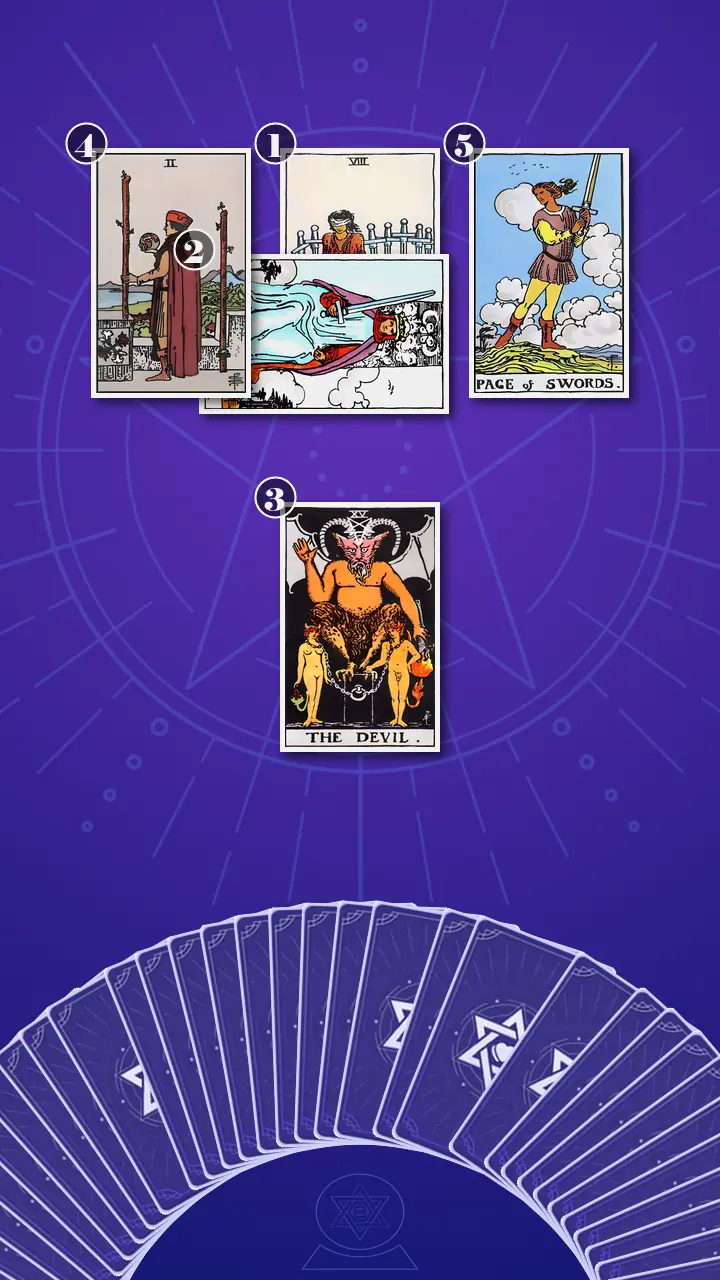
Reading the Map: The Moment You Go Quiet
Position 1 — The shutdown pattern in the moment
“Now we turn over the card that represents the shutdown pattern in the moment: what you do and feel right after hearing ‘be strategic.’”
Eight of Swords, upright.
I didn’t need to dramatize it. The image does its own work: a blindfold, a narrow corridor of swords, bindings that look tighter than they really are.
And the modern translation landed immediately: Right after the words “be more strategic,” you stop offering opinions in the meeting. You nod, take more notes than anyone, and tell yourself you’ll ‘send something later.’ Back at your desk you open a doc, stare at the word “Recommendation,” and suddenly can’t write a sentence—so you add context, alternatives, and disclaimers until the decision disappears.
That’s Air energy—thinking, framing, speaking—gone into a kind of internal airplane mode. Not a lack of intelligence. A blockage: perception narrowing until it feels safer to be invisible than to be specific.
Jordan made a small, dry sound that was half laugh, half flinch. “That’s… wow. Yeah. That’s exactly it. It’s so accurate it’s kind of cruel.”
I watched the micro-sequence: their breath paused, fingers hovered near the mug, then their shoulders loosened by a millimeter—as if being seen precisely was safer than being seen generally. “It’s not cruel,” I said gently. “It’s specific. And specific means workable.”
“An unsent message is still a choice—just a hidden one,” I added, because Eight of Swords loves hidden choices.
Position 2 — The immediate pressure
“Now we turn over the card that represents the immediate pressure: what the workplace is asking for, and how it clashes with your coping style.”
King of Swords, upright.
The modern scenario was almost too on the nose: Your manager is asking for executive-style clarity: a frame, a priority, and a decision they can repeat to someone else. In practice, it’s the moment they want you to say, ‘Given our goal is X, I recommend Y, and the tradeoff is Z,’ even if you can’t answer every edge-case live.
This card isn’t “be more strategic” as a vibe. It’s “be more strategic” as a format. The King is balanced Air: decisive communication, clean structure, judgment that doesn’t apologize for existing.
My mind flashed to my work at the planetarium—the way a constellation looks like random dots until you draw the line that matters. Strategy is that line. Not more stars. Not more slides. The line.
“Here’s the reframe,” I told Jordan. “Your boss isn’t necessarily asking you to become omniscient. They’re asking you to be repeatable. A clear frame, a call, a rationale. So instead of absorbing ‘be strategic’ like a foggy insult, translate it into something verifiable you can ask: ‘Which metric or tradeoff should I optimize for in my recommendation?’”
Jordan nodded slowly, like the word verifiable gave them something solid to hold.
Position 3 — The underlying driver
“Now we turn over the card that represents the underlying driver: the belief and fear that turns feedback into threat and causes silence or over-prep.”
The Devil, upright.
The modern scenario arrived with a sting: One subjective comment becomes a full identity verdict in your head. You hear ‘be strategic’ and instantly translate it into ‘you’re not leadership material,’ so you try to outwork the shame: more research, more slides, more caveats, less voice. The trap isn’t your capability—it’s the rule that being challenged equals being exposed.
In a London corporate context, the Devil doesn’t show up with horns. It shows up as calendar blocks you keep accepting. Comment notifications you can’t ignore. Revision loops that feel like “being responsible” while they quietly keep you from being seen choosing.
Jordan’s eyes dropped to the table. Their mouth tightened, then loosened. A three-beat reaction chain: (1) a brief freeze in the face, (2) a distant look like they were replaying a meeting in their head, (3) a long exhale that finally made sound.
“It really does feel like a verdict,” they said. “Like… if I’m challenged, I’m done.”
I kept my voice steady. “Clarity isn’t arrogance. It’s a hypothesis you’re willing to test out loud.”
And because I study celestial mechanics as much as symbols, I named the physics of it: “This is shame-driven gravity. It pulls your worth into the moment. Suddenly one sentence from your manager feels like it outweighs ten months of competence.”
Jordan swallowed. “Yeah.”
When the Two of Wands Held the Globe
Position 4 — The strategic reframe (Key Card)
“Now we turn over the card that represents the strategic reframe: the skillful way to relate to ‘be strategic’ without collapsing or overcompensating.”
The room felt quieter as I flipped it—like the air itself wanted to listen.
Two of Wands, upright.
The life translation was a window shot: Instead of trying to pre-answer every objection, you choose a lens and own a tradeoff. You draft two options, then write the sentence you’ve been avoiding: ‘If we optimise for speed, we accept X risk; if we optimise for quality, we accept Y delay—my recommendation is A because our priority is B.’ You’re not proving you’re right forever—you’re making a clear move that can be refined.
Setup: I could feel exactly where Jordan lived: late at night, laptop fan loud, reformatting the same slide again while a half-written Slack to their boss sat there unsent—because choosing one clean recommendation felt like stepping into exposure.
Delivery:
Stop treating “strategic” like a hidden exam and start holding the globe—pick a direction, name the tradeoff, and let the plan be something you refine in motion.
Reinforcement: Jordan’s reaction wasn’t cinematic. It was human. First, their breath caught high in the chest—as if the sentence had briefly removed the floor. Then their eyes went slightly unfocused, like they were watching themselves in that glass meeting room, hearing “So what’s the recommendation?” and feeling their throat lock. Then—slowly—their shoulders dropped, and something in their face softened, not into confidence, but into permission.
“But if I pick,” Jordan said, and there was a flash of irritation, “doesn’t that mean I can be wrong?”
“Yes,” I said, without flinching. “And that’s the point. Strategy is not a courtroom confession. It’s a navigation decision.”
This is where I used my signature diagnostic lens—Orbital Resonance. “In work systems, every stakeholder has a gravitational pull: speed, risk, cost, quality, reputation. When you try to satisfy every orbit at once, you get dragged into the centre and freeze. The Two of Wands is you stepping back far enough to see the orbit you’re in and choosing the resonance you want: ‘Today, we optimize for speed.’ That’s not arrogance. That’s alignment.”
I let that sit, then asked the question the card always demands: “Now, with this new lens, can you think of one moment last week when you could’ve said a 70% recommendation out loud—before your throat locked?”
Jordan blinked twice, as if coming back from far away. “In steerco. I started with ‘It depends…’ and then I hid in the background.” They exhaled again, smaller this time. “I could’ve said: ‘Given our goal is speed, I recommend A. The tradeoff is risk.’ Even if it wasn’t perfect.”
That was the visible pivot—from shame-driven shutdown and self-censoring to calm ownership of a clear, testable recommendation. Not a personality transplant. A directional choice.
Position 5 — Integration and next step
“Now we turn over the card that represents integration and next step: one practical communication move to practice strategic presence this week.”
Page of Swords, upright.
The Page doesn’t wait until the wind stops. The Page speaks while the trees are still moving.
And the modern scenario made it behavioural: You practise strategic presence through conversation, not private perfection. In your next 1:1 you say, ‘Here’s my current recommendation and tradeoff—when you say strategic, do you want more prioritisation, clearer tradeoffs, or a crisper recommendation?’ Then you reflect back the criteria you heard, so you can iterate in public instead of hiding until it’s ‘perfect.’
This is balanced Air again, but younger: curiosity as credibility. A “v0” shipped with a clean question.
Jordan’s mouth twitched into the first real smile of the session—small, but there. “I can do a small version of that,” they said. “Like… say it before my throat locks.”
“Exactly,” I replied. “Ask for criteria like you belong in the room—because you do your best work when the goal is defined.”
The One-Page Path: Actionable Advice for Strategic Clarity
I pulled the whole cross together for Jordan in plain language. Here’s the story the cards told:
You’re not freezing because you’re incapable. You’re freezing because a vague comment (“be strategic”) triggers a learned protection: don’t risk being pinned to one opinion. That protection looks like Eight of Swords silence. Your workplace, however, is asking for King of Swords structure: a frame, a call, a tradeoff. The Devil underneath turns that reasonable request into a survival trial—so you over-prepare to earn safety. Two of Wands breaks the spell by making “strategic” a doable move: choose one lens, name one tradeoff. Page of Swords makes it visible: speak early, ask clean questions, iterate in public.
The cognitive blind spot was sharp: Jordan was treating clarifying as “looking junior,” when in reality, clarifying is a leadership behaviour. The transformation direction was equally clear: from trying to sound flawless to making one clear, testable recommendation and treating feedback as iteration—not a verdict.
Then I gave them three small, realistic moves—designed for a real London week, not an imaginary one with unlimited bandwidth:
- The 3-Line “Lens + Call + Tradeoff” Note (10 minutes)Before your next meeting, write three lines on paper: (1) “Goal: we’re optimising for ___ (speed/risk/cost/quality).” (2) “Recommendation: we should ___.” (3) “Tradeoff: this means we accept ___.” Keep it beside your notebook so you’re not hunting for words on-screen.If your body tenses, stop at 70%. Label the remaining 30% as “open questions,” not “proof I’m unready.”
- The Definition Request Script (one sentence in your next 1:1)Ask verbatim: “When you say ‘more strategic,’ what do you want to hear more of from me—priorities, tradeoffs, or a clearer recommendation?” Then repeat back what you heard in one line: “Got it—so for you, strategic means ___.”No apology preface. Treat it like clarifying acceptance criteria on an ambiguous Jira ticket.
- The Curiosity Buffer Draft (send earlier than you want)Send one early draft where the first paragraph includes: “My current recommendation is A because we’re optimising for B; the tradeoff is C. Which constraint matters most to you?” This turns challenge into collaboration instead of ambush.If sending feels too exposed, paste it into a private Slack DM to yourself first. Let it exist in daylight before it goes to anyone else.
To make the next morning easier, I added one of my own grounding tools—what I call an Earth-rotation perspective. “Before a high-visibility 9 a.m. meeting,” I told Jordan, “take ten seconds and remember the planet is literally rotating under your feet. This room is not a tribunal. It’s a moving system. Your job is to make a call that can be updated as the system moves.”

A Week Later: Ownership, Not Certainty
Six days later, Jordan messaged me. Not a paragraph. One line: “I asked the question in my 1:1. They said they want tradeoffs and a clearer call. I wrote the three lines on paper and actually said my recommendation out loud.”
They added, after a minute: “I still felt my throat tighten. But it didn’t stop me.”
That’s what a real Journey to Clarity looks like. Not a permanent glow-up. A quieter, steadier ownership: choosing a lens, naming a tradeoff, and letting your recommendation be testable—alive—rather than hidden and untouchable.
They didn’t celebrate with fireworks. They told me they sent the draft, then sat alone in a Pret for an hour, staring out at the rain and letting their nervous system catch up to the fact that nothing terrible happened.
When someone says “be strategic” and your chest drops, it’s not because you lack a point of view—it’s because you’ve learned to treat being clear as being exposed.
If you let “strategic” be one small choice instead of a full-body test, what’s the gentlest version of a recommendation you could try saying out loud this week—just once?
This story is adapted from psychological research, written so that those in a similar struggle can see their own pattern in it — and find their next step clearly.These insights are not a substitute for professional psychological, medical, legal, or financial advice.
Learn more about our Journey to Clarity.
How did this insight land for you?
🫂 This Resonates Deeply
🌀 Living This Story
✨ Now I See Clearly
🌱 Seeing New Possibilities
🧰 Useful Framework
🔮 The Confirmation I Needed
💪 Feeling Empowered
🚀 Ready for My Next Step
Author Profile
 AI
AI“After a decade of guiding people through the stars, I’ve come to see life much like the orbits of planets: everything has its inevitable cycles. When you feel lost, please don't blame yourself; you might just be in a natural low tide. I’m here to sit under the night sky with you, offering a gentle cosmic perspective to distinguish temporary pain from the beautiful breakthroughs just around the corner.”
In this Career Tarot Reading :
Core Expertise
- Career Cycle Phase Identification: Determining if your current bottleneck is a personal skill gap or an inevitable industry-wide macro contraction.
- Promotion Window Calibration: Mapping the trajectory of organizational shifts to locate the path of least resistance for advancement.
Service Features
- The Micro-Orbit Observation: A 30-day tracking strategy to detect subtle organizational 'blueshifts' (opportunities) and 'redshifts' (layoff risks).
Also specializes in :
Explore Related Patterns:
Analysis ParalysisJordan's late-night loop around the same slide, the extra chart added "just in case," and the unsent Slack message show the mind trying to earn safety through more information. The task is not actually to collect another detail; the blocked move is choosing a recommendation and letting it be visible. The defensive logic is precise: if no clear call is made, there is no clear call to challenge. Analysis becomes a shield against exposure, and the blank document titled "Recommendation" turns into a place where context, alternatives, and disclaimers can bury the decision before anyone else sees it. That is why Analysis Paralysis fits the story so tightly. You are not failing because you cannot think; you are overthinking because choosing feels socially dangerous. The pattern makes extra preparation feel responsible while quietly protecting you from the vulnerable act of saying, "Given the goal, I recommend this."
CatastrophizingJordan's manager asks for something concrete: executive-style clarity, a frame, a priority, and a decision. Inside Jordan, that request mutates into a high-stakes oral exam where one imperfect answer could expose them as unfit. The cognitive distortion is the escalation from feedback to catastrophe. A vague phrase becomes a full identity verdict, and the nervous system reacts accordingly: throat tight, stomach dropping, breath paused, field of view narrowed. The actual risk is a conversation about tradeoffs, but the felt risk is professional humiliation. Catastrophizing is the pattern because the mind is not simply noticing danger; it is inflating ambiguity into a worst-case outcome. You are reacting to the imagined consequences of being challenged more than to the manager's actual request, which is why translating "strategic" into a verifiable format matters so much.
Certainty SeekingJordan keeps adding charts, alternatives, edge cases, and disclaimers, but each addition moves them further away from the sentence they need to write. The avoided move is simple and exposed: "My recommendation is A because our priority is B." The underlying mechanism is the search for enough certainty to make the recommendation feel untouchable. If every objection can be pre-answered, maybe the choice will not feel risky. But strategy requires a tradeoff, and tradeoffs cannot be made perfectly safe before they are spoken. Certainty Seeking fits because the pattern tries to remove the vulnerability from judgment before allowing judgment to exist. You are not preparing because preparation is bad; you are preparing past the point of usefulness because uncertainty has been coded as danger.
Imposter SyndromeJordan hears a manager say "be strategic" and the phrase does not land as a request for a clearer frame. It becomes "you're not leadership material," as if one subjective comment can cancel out ten months of demonstrated competence. That leap reveals the core cognitive mechanism: feedback is being processed as exposure. The mind treats a challenge as evidence that the whole professional self may be found fraudulent, so the body freezes and the behaviour shifts into overpreparation. More slides, more caveats, and less voice become ways to outrun the shame of being seen as not enough. Imposter Syndrome fits because the story is organized around the fear of being revealed, not around actual incompetence. You are capable of running the programme, but the moment the work asks for visible judgment, competence stops feeling like something you own and starts feeling like something you must defend.
Self-SilencingJordan can explain every operational detail, but when the meeting asks for "the recommendation," their voice disappears. They nod, take notes, and promise themselves they will send something later, which keeps their point of view technically alive but socially hidden. The psychological defense is not ignorance; it is self-protection through silence. If the opinion stays private, it cannot be challenged in real time. If it stays in draft form, it cannot expose the person behind it. The body participates in the pattern too: tight throat, sinking stomach, breath held, words inaccessible. Self-Silencing names that exact mechanism. You are not choosing quiet because you have nothing to say; you are using quiet to avoid the vulnerability of being pinned to a visible judgment. The exit begins when your voice is allowed to carry a 70% recommendation before the defensive shutdown takes over.
Feedback IntegrationJordan's practical shift is asking the manager what "strategic" should mean in observable terms: priorities, tradeoffs, or a clearer recommendation. That one question changes the whole field because it moves the issue out of private threat interpretation and into shared criteria. The psychological mechanism is integration rather than defense. Instead of absorbing feedback as an identity verdict, Jordan converts it into data they can use. The question creates a boundary between what the manager actually wants and what Jordan's shame predicts they must be thinking. Feedback Integration fits because the pattern turns evaluation into iteration. You are still allowed to feel the throat tighten, but the feedback no longer has to stay vague, global, and frightening; it can become a workable next move.
Visibility AvoidanceJordan is not avoiding work; they are avoiding the moment their judgment becomes visible. They can run the programme smoothly, explain the details, and prepare the materials, but the room changes when someone asks, "So what's the recommendation?" The defense is a retreat from being seen choosing. Notes, drafts, and delayed follow-up reduce the immediate risk of scrutiny, but they also keep Jordan's strategic point of view offstage. The belief underneath is that clarity makes them exposed rather than useful. Visibility Avoidance fits because the feared object is not the task itself; it is public ownership of a call. You are protecting yourself from the vulnerability of being legible, even when that same visibility is what the role is asking you to practice.
Feedback DefensivenessJordan's shutdown begins at the moment feedback arrives. The phrase "be strategic" is not received as a workable prompt; it hits the nervous system like an exam question with their professional identity on the line. The mechanism is defensive filtering around feedback. The manager may be asking for a frame, a call, and a tradeoff, but Jordan's mind hears a threat to status and competence. That threat response makes the body go quiet before the thinking self can ask, "What exactly do you mean by strategic?" Feedback Defensiveness fits because the pattern is not open rejection of feedback; it is a protective contraction around it. You are trying to survive the feeling of being evaluated, which makes it harder to convert feedback into usable information.
Secure VisibilityJordan's later message matters because the body still reacts: their throat tightens, but it does not stop them. They ask the question in the 1:1, write the three lines on paper, and say the recommendation out loud before perfect certainty arrives. The mechanism is not sudden confidence; it is increased tolerance for visible imperfection. A recommendation becomes a testable hypothesis rather than a courtroom confession. That shift lets Jordan stay present while being seen, instead of waiting until all risk has been removed. Secure Visibility fits because the goal is not to become untouchable. It is to let your thinking be visible enough to be refined. You can own a point of view without making that point of view the total measure of your worth.
Defensive OverfunctioningJordan's reformatting, extra charts, and repeated revisions look productive from the outside. Inside the pattern, the work is doing a second job: it keeps them occupied enough to avoid the visible risk of making a clean recommendation. The defense is overfunctioning as protection. By doing more, Jordan can feel responsible, diligent, and prepared, while the central act of leadership remains deferred. The extra labour becomes a socially acceptable hiding place because nobody can easily criticize someone who appears to be working hard. Defensive Overfunctioning fits because the effort is real, but it is not fully free. You are using competence as cover, trying to work your way out of a shame trigger that actually requires a clearer boundary between useful preparation and avoidance.
Explore Related Struggles:
Clarity-Exposure SplitWhen your boss says 'be more strategic', you are not just asked for a cleaner frame. You move from steady programme management to a blank screen, a fifth slide rewrite, and a Slack reply that stays unsent while the cursor keeps blinking. The visible pattern is that clarity starts to feel like exposure. One recommendation seems to pin you to a single position, so your system reaches for more detail, more caveats, and more context instead of one public call. That is the shutdown here: not lack of judgment, but the cost of making choice visible.
Explore Related Emotions:
Exposure DreadWhen Jordan is asked for the recommendation, their voice disappears even though they can explain every detail. The clean sentence is the part they keep avoiding, because naming one direction makes them visible in a way that extra context never does. Exposure Dread fits because specificity feels like stepping into a lit area where one choice can be pinned to you. You are not avoiding strategy itself; you are trying to avoid the exposed feeling that comes with having a clear point of view before everyone agrees it is flawless.
Performance FreezeRight after 'be more strategic,' Jordan stops offering opinions, nods, takes more notes than anyone, and promises themselves they will send something later. The body sequence is just as precise: blank mind, locked throat, paused breath, and a hand hovering near the mug instead of a recommendation entering the room. You are watching a state where competence stays present but access to it narrows under visibility. Performance Freeze fits because the shutdown is not lack of knowledge; it is the inner weather of being asked to perform clarity while your system tries to keep you unpinned, unspecific, and out of the spotlight.
Verdict DreadOne subjective comment from the manager becomes 'you're not leadership material' inside Jordan's head. A normal request for a clearer frame stops being information and starts carrying the weight of ten months of competence, as if one sentence could overrule the whole record. Verdict Dread is the drop that happens when feedback feels less like input and more like a ruling on your place in the room. You are not simply preparing a recommendation; you are bracing against the possibility that being challenged will be treated as evidence against you.
Cognitive OverwhelmThe slide keeps absorbing more material, one more chart, more context, more alternatives, more disclaimers. Jordan has enough information to speak, but the moment a recommendation is required, the extra material stops being support and starts burying the call. Cognitive Overwhelm fits because the mind is trying to solve a visibility problem by increasing information density. You get more data and less usable direction, until the recommendation disappears under the material meant to protect it.
Inner StaticAt 11:33 p.m., the same slide is being reformatted for the fifth time while the laptop fan whirs and Slack holds a half-written message. The room looks still, but the mind is crowded with context, backup charts, possible objections, and a cursor that keeps demanding a choice. Inner Static names the noise that appears when thought cannot become speech. You can explain every detail, but the channel between knowing and recommending fills with blinking-cursor pressure, so the decision stays trapped behind information that was meant to protect it.
Quiet ShameJordan tells the story as if it is just another Tuesday, but the jaw, throat, and small half-laugh tell a more compressed version. The voice stays controlled while the body quietly registers how costly it feels to be seen around this pattern. Quiet Shame is the weather under that restraint. You are not broadcasting collapse; you are carrying the sense that being challenged reveals something unacceptable, then trying to earn cover through extra slides, extra research, and a smaller voice.
Cautious Self-TrustIn the week after the session, Jordan asks the question in their 1:1, writes the three lines on paper, and says the recommendation out loud while the throat still tightens. The body has not become perfectly calm, but the action no longer waits for perfect calm to arrive. Cautious Self-Trust fits because the confidence here is not flashy or complete. You move with the body still braced, letting a 70 percent recommendation exist in daylight and discovering that imperfect clarity can survive contact with another person.
Clarity ReliefJordan's shoulders loosen by a millimeter when the vague phrase is translated into something verifiable, a frame, a call, and a tradeoff. The word 'strategic' stops floating as a foggy insult and becomes a format that can be checked. Clarity Relief enters when the threat-shaped fog becomes an ask you can name. You do not have to become a different person overnight; the room becomes easier to navigate because the demand can be defined, repeated, and turned into one clean next sentence.
Grounded AgencyThe reframe gives Jordan a concrete motion: choose the lens, name the tradeoff, make the recommendation testable, and refine it in public. Strategy becomes a navigational decision instead of a courtroom-style confession. Grounded Agency fits because the story shifts from hidden choice to owned choice. You are no longer waiting for perfect certainty before speaking; you are claiming a workable position and leaving room for it to be updated.
Hard-Won ComposureAfter sending the draft, Jordan sits alone in a Pret for an hour, watching the rain and letting their body catch up to the fact that nothing terrible happened. The visible act is over, but the system still needs time to register that exposure did not become collapse. Hard-Won Composure is the quiet steadiness after a move that used to feel too exposed. You are not untouched by the pressure; you are learning that a tightened throat does not have to command the next move.
Explore Related Contexts:
Executive Presence TestYour manager is asking for executive-style clarity: a frame, a priority, and a decision another stakeholder can repeat. The pressure shows up in steerco when "So what's the recommendation?" pulls you toward "It depends" and the background instead of a clean call. This is a workplace test of visible judgment under imperfect information. The role is no longer just programme control and detail coverage; the room is asking you to choose an optimization lens and own the tradeoff out loud. You do not have to become certain to pass that test. A 70% recommendation with a named risk is enough to create leadership signal because it gives the room a direction it can challenge, refine, and use.
Hidden Curriculum GapYou already know how to run the programme, explain the details, and manage the moving parts. The shutdown begins when the workplace shifts into an unwritten leadership code, where "strategic" means choosing priorities and tradeoffs but nobody says that clearly at first. That gap is a hidden curriculum: the skill being tested is not more effort, but knowing the format senior rooms expect. Without that translation, you treat clarifying as looking junior and overproduce detail to compensate for a rule that was never made explicit. Once the hidden rule is named, the path changes. "Strategic" becomes a repeatable structure you can learn and ask about, not a mysterious standard that silently decides whether your work is ready for the next level of the room.
Performance Criteria Black BoxYou can run a programme smoothly, but the phrase "be more strategic" arrives without a usable definition. At 11:33 p.m., that missing definition becomes more slides, more charts, a half-written Slack message, and a recommendation that never gets sent. The structure is not a lack of competence; it is an evaluative standard that has not been translated into observable criteria. When "strategic" stays vague, you try to cover every edge case instead of choosing the tradeoff the workplace actually wants to hear. The useful boundary is to turn the black box into acceptance criteria: priorities, tradeoffs, or a clearer call. Once the boss names tradeoffs and a clearer recommendation, the request becomes something you can test in public rather than a foggy performance judgment.
Authority Approval BottleneckAt 11:33 p.m., Slack is open with a half-written message to your boss, the cursor blinking while the slide deck gets revised again. The decision is not moving because the next step feels dependent on how the authority in the system will judge the recommendation. That bottleneck compresses action into waiting: more charts, more caveats, more private drafting, less visible choice. When the boss's standard is unclear, approval becomes the gate your work has to pass before your own point of view can become public. The route out is a cleaner authority exchange. Asking which constraint matters most gives the manager a concrete role, and it gives you a way to move from hidden preparation into a visible recommendation.
Upward Management TrialIn the next 1:1, you ask what "more strategic" should sound like: prioritisation, tradeoffs, or a clearer recommendation. That one sentence changes the workplace exchange from guessing your boss's standard to negotiating the criteria directly. The external structure here is a manager relationship where the standard exists but has to be pulled into language. Upward management is not pleasing the boss; it is turning vague feedback into a shared operating definition before you spend another night building extra evidence. The follow-up message confirms the trial worked: they wanted tradeoffs and a clearer call, and you could write the three lines on paper and say the recommendation out loud. The authority relationship becomes easier to navigate once you ask for the rule of the room.