The Cursor That Wouldn’t Stop Blinking
“If ‘Save’ feels like a press conference, it’s not because you’re dramatic—it’s because you’re doing belonging-math in public.”
Jordan said that was exactly it—two words, and yet their body treated it like a podium moment. They were 27, Toronto, corporate/tech-adjacent, the kind of person who could ship a deck by Friday but somehow couldn’t ship a pronouns line without reopening the editor five times.
They told me they kept circling the same loop: they wanted to add pronouns so they weren’t hiding, but they kept deleting them because they were scared it would “turn into a whole thing.” They cared about inclusion. They also cared about professionalism and ease. And they were exhausted by how much weight this tiny field seemed to carry.
I could picture the moment before they even described it—because it has a specific texture. The after-work couch-scroll window, when the condo is quiet but your phone is loud. LinkedIn open on a screen that’s just bright enough to make your eyes feel slightly gritty. The device warming your palm. The cursor blinking like a metronome, keeping time with a throat that tightens as soon as you hover over “Save.”
Jordan said, “It’s two words, why does it feel like a press conference.” And then, softer: “I want to be seen accurately. I’m just… scared of being targeted or misunderstood.”
The contradiction was clear and brutally human: torn between being accurately seen vs being socially targeted or reduced to a label.
The apprehension didn’t look like “panic.” It looked like a swallow that didn’t fully land, like a subtle stomach drop when their thumb paused over the button—like their nervous system had poured cold water down their spine the second visibility became real.
I nodded, slow and steady. “We’re not going to force certainty today. Let’s map what’s actually happening—on the screen, in the mind, and in the body—so you can take one step that feels both true and safe enough. That’s our Journey to Clarity.”

Choosing the Compass: The Four-Layer Insight Ladder
I asked Jordan to take one breath that was just for them—not to “calm down,” but to come back into the room. While they held their question in mind, I shuffled slowly. The point wasn’t mystique; it was focus. A clean transition from doom-scroll simulations to an honest look at what’s underneath.
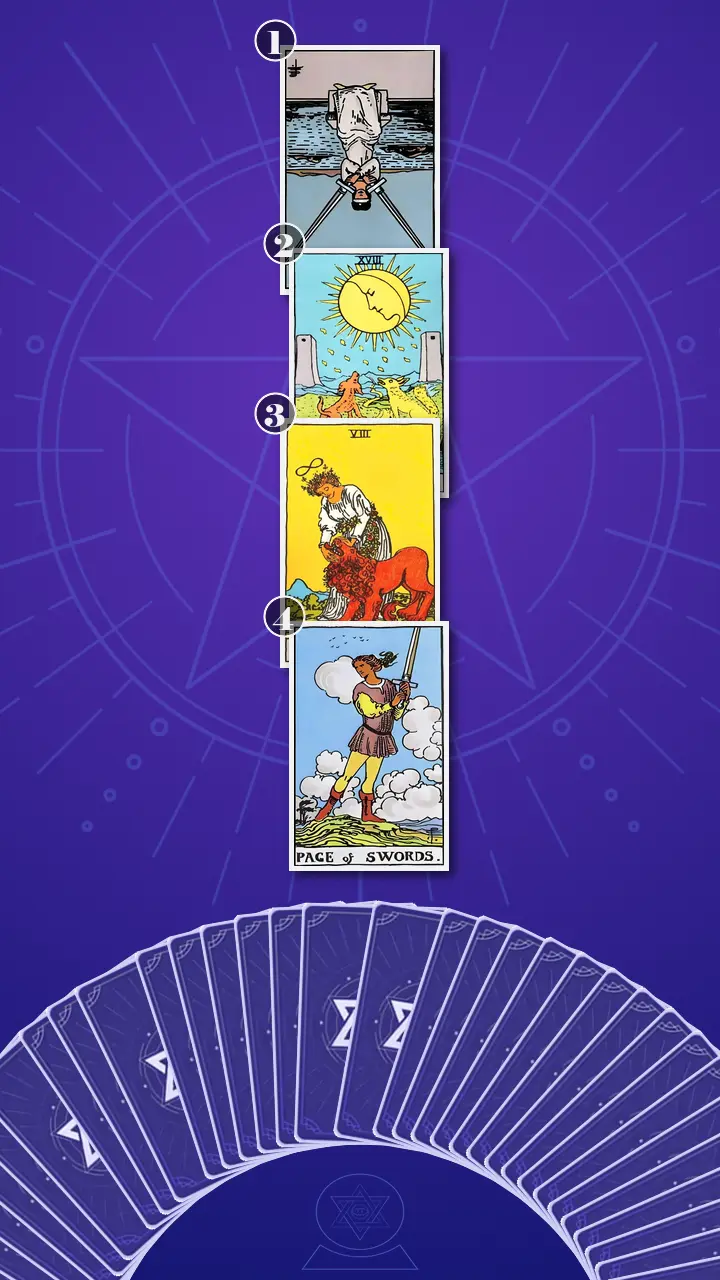
“For this,” I said, “I’m using the Four-Layer Insight Ladder · Context Edition—a four card tarot spread for identity-linked micro-decisions, like pronouns in your bio.”
To you reading this: I like this spread because the real question isn’t Which option is correct? It’s What fear is driving my hesitation, and what’s one step forward? The ladder gives us that sequence—surface behavior → root fear → inner pivot → one-step action—without turning it into a dramatic “final answer.”
I showed Jordan the layout: a simple vertical line, like descending out of a noisy headspace.
“The first card will name the observable loop—what you literally do in the editor. The second card goes underneath that: the identity fear being projected onto a tiny line of text. The third is the pivot—what inner capacity loosens the grip enough to choose without needing perfect certainty. And the last card is one small step this week, something testable.”
Reading the Map: The Loop and the Night-Walk
Position 1 — The observable loop: what you keep doing around pronouns
“Now we turn over the card that represents the observable loop—what you keep doing around pronouns in your bio and how it keeps you stuck in indecision.”
Two of Swords, reversed.
I tapped the image gently. “This is the edit-delete loop in a single frame. The blindfold says, ‘I’m trying not to feel this.’ The crossed swords over the chest say, ‘I’m holding two opposing arguments right here—protecting my heart with logic.’ And the still water behind her? That’s the frozen emotional movement underneath the ‘it’s just two words’ story.”
Then I translated it the only way it matters—into the exact modern-life scenario: “You open LinkedIn after work, tap ‘Edit intro,’ type ‘they/them,’ then delete it. You try ‘they/she,’ delete that too. You’re not undecided about grammar—you’re bracing for what each choice might trigger socially. The cursor blinking becomes its own pressure, and exiting without saving feels like the only way to stop the tight-throat, stomach-drop moment.”
I watched Jordan’s shoulders lift a fraction, almost as if they were bracing against an invisible comment section.
“This reversed Two of Swords isn’t ‘you’re indecisive,’” I said. “It’s protective indecision. Your nervous system is trying to keep you safe by not choosing. Short-term, it works: no immediate questions, no DMs, no awkward ‘Hey, quick question…’ in Slack. Long-term, the cost is that you keep reopening the editor—type → hover → backspace → scroll—like the cursor is counting down your right to belong.”
Jordan let out a quiet laugh, but it had a bitter edge. “That’s… kind of cruelly accurate.”
“I know,” I said, keeping my voice soft. “But accuracy is kind. It means we’re not lost—we can see the loop.”
Position 2 — The identity fear underneath: what uncertainty is inflating the stakes
“Now we turn over the card that represents the identity fear underneath—the deeper meaning you’re projecting onto a tiny piece of text.”
The Moon, upright.
“Of course,” I murmured, almost to myself. The Moon always shows up when the mind is trying to survive on partial information—and turns that into a full cinematic universe.
I pointed to the path between the towers. “This is the bio field: a narrow walkway where you can’t fully see who’s watching. Online, the audience is mixed—coworkers, recruiters, friends, acquaintances, strangers. Your brain hates not knowing what any of them will make it mean.”
I used the modern-life translation exactly as it lived in Jordan’s world: “You’re not just thinking about pronouns—you’re thinking about the unknown audience. A coworker you like, a manager you haven’t clocked yet, a recruiter, an old classmate, a stranger on the internet. In your head, their reactions play simultaneously, and because you can’t verify any of it, your brain treats every imagined outcome as equally probable—and equally risky.”
“The Moon is projection,” I added, “and it’s also ambiguity. It’s like reading tone into a ‘Seen 9:41 PM’ timestamp and building a whole story from it. There’s no data, so the mind fills in the blanks.”
Jordan’s reaction came in three small beats: their breathing paused; their gaze unfocused as if they’d opened three tabs behind their eyes; then they swallowed—hard—and nodded once.
“Yeah,” they said. “It’s not just ‘what will they think.’ It’s… being discussed without me there. Like I’m not even in the room.”
“Exactly,” I said. “The fear isn’t only being seen. It’s being reduced. It’s being corrected or managed. It’s being turned into a workplace conversation.”
I leaned in slightly. “Let’s name the cleanest version: you’re scared a label will replace your belonging.”
Jordan’s jaw flexed. “And I hate that I’m thinking this hard. I keep checking other people’s bios like it’s market research.”
“Comparison isn’t clarity,” I said. “It’s just a way to borrow safety for ten seconds.”
When Strength Held the Lion at “Save”
Position 3 — The pivot: the inner capacity that dissolves the fear’s grip
I let the room get quieter on purpose. The city sounds outside—distant traffic, the faint hush of a building vent—felt like they stepped back. “Now we turn over the card that represents the pivot—the inner capacity that dissolves the fear’s grip enough to choose without needing perfect certainty.”
Strength, upright.
Jordan stared at the card, and I could feel how badly they wanted it to mean: Tell me the correct answer. Tell me which pronouns are safe. Tell me what will happen.
Setup. In my mind, I saw the exact scene: after work, LinkedIn open, cursor blinking in the bio field—pronouns typed, deleted, typed again—while their throat tightened like they were about to give a statement to a room they didn’t agree to walk into. They were stuck inside a rule: if they couldn’t be 100% sure forever, they didn’t deserve to be visible today.
Delivery.
Stop treating your bio like a verdict and start treating it like gentle courage—Strength is the calm hand that hits “Save” without wrestling the lion of other people’s opinions.
I didn’t rush to fill the silence after that. I let the sentence sit between us the way moonlight sits on water—long enough for the nervous system to decide if it’s safe to believe it.
Reinforcement. Jordan’s body answered before their mouth did. First, their eyebrows lifted—an almost disbelieving “wait, really?” Then their lips pressed together, not in resistance but in containment, like they were holding back something tender. Their shoulders dropped a millimeter, then another, as if they’d been wearing a backpack they forgot they put on. I watched their throat move as they took in air—slowly this time—and their hand went to the base of their neck in a protective, familiar gesture.
This is where my work is partly tarot and partly what I learned on long voyages: energy always tells the truth first. I’ve trained thousands of people—travelers, staff, executives—to notice the moment their body contracts before their brain starts negotiating. And I’m also careful here: “I’m not giving medical advice,” I told Jordan, “but in an energy lens, throat tightness often shows up when your truth wants to speak and your system is bracing for consequences.”
“Strength isn’t dominance over fear,” I continued. “It’s staying present while fear exists. The lion is that surge: the urge to over-explain, to pre-empt, to control interpretation so no one can misread you. Strength says: regulate first, then choose.”
Jordan exhaled—long, shaky, real. Then they frowned, like a second wave arrived. “But if I change later… won’t that prove I was performing?”
I didn’t brush past it. “That question is the whole knot. And Strength answers it with a reframe: pronouns don’t have to be a verdict. They can be a ‘right now’ preference.”
I asked gently, “Now, with this new lens—can you think of a moment last week when you hovered over Save, and this would have changed how it felt in your body?”
Jordan blinked, then nodded, eyes glossy but steady. “Monday morning. Slack. I almost added them. I pictured my manager DMing me and I froze.”
“That’s the shift,” I said. “From cursor-blink anxiety to steady self-trust. Not perfect confidence—just enough steadiness to be seen without turning it into a trial.”
The Page’s One-Week Experiment
Position 4 — One step this week: a small communication move that creates real feedback
“Now we turn over the card that represents one step this week—a small, concrete communication move that reduces rumination by creating real-world information.”
Page of Swords, upright.
I smiled. “This is the part of you that can treat communication like a skill—not a final exam.”
I anchored the meaning in their life exactly: “You post a straightforward pronouns line (pronouns only), then treat the next week as a small experiment: you notice what actually happens in real conversations, what shifts inside your body, and whether anyone even comments. If it needs changing later, you update it the way you’d update any profile detail—quietly, clearly, without making it a spectacle.”
“The Page doesn’t over-announce,” I said. “They test. They learn. They adjust.”
Jordan’s shoulders stayed down this time. Their voice sounded more practical. “Okay. That feels… doable. But what if I still spike when I go to actually do it?”
“Then we plan for the spike,” I said. “We don’t shame it. We work with it.”
The One-Platform Test: Actionable Advice for Pronouns-in-Bio Anxiety
I threaded the cards back into a single story for Jordan—because clarity isn’t four separate meanings; it’s one coherent pattern.
“Here’s what this spread is saying,” I told them. “You’re not stuck because you lack information. You’re stuck because you’ve been treating a tiny line of text like it has to carry a permanent identity verdict. The Two of Swords reversed shows the protective loop—type, delete, scroll—because choosing feels like stepping into exposure. The Moon shows why exposure feels dangerous: your mind is running worst-case audience simulations in the dark, especially in mixed workplace contexts. Strength is the turning point: you regulate your system and choose what’s true today without demanding forever-certainty. And the Page of Swords turns that into a low-drama experiment—simple, testable communication that gives you real feedback instead of imagined feedback.”
“The blind spot,” I added, “is that you’ve been trying to become un-criticizable instead of simply clear. And the transformation direction is straightforward: shift from treating pronouns as a verdict to treating them as a current communication preference you’re allowed to revisit.”
Then I gave them a plan that matched the cards and their actual life—small steps, time-boxed, and respectful of safety.
- The “Good-for-Now” Pronouns Line (One Platform Only)Pick a pronouns-only line for one platform you use most (LinkedIn or Instagram). Example template: “Jordan | Product Ops | they/them” (or your chosen set). Save it there—don’t do all platforms at once.If you feel the urge to keep tweaking, remind yourself: consistency is not the same thing as honesty. Your job is “good-for-now,” not “perfect forever.”
- The 7-Day Pronouns Check-In ReminderSchedule a calendar reminder titled “Pronouns check-in (7 days).” Until that date, no bio edits—only noticing what actually happens (in conversations, in your body, in your mood).If posting feels unsafe, your valid smallest version is “draft in Notes.” You still set the 7-day check-in, so your nervous system learns: we can revisit without spiraling.
- A 3-Minute Energy Reset Before You Hit SaveBefore you open the bio field, do a quick body scan (throat, jaw, shoulders). Put one hand on your chest or throat, take two slow breaths, and drop your shoulders on the exhale—like releasing a backpack strap.I call this my Energy Flow Diagnosis moment: if your shoulders are up by your ears, your “visibility channel” is basically kinked. Think of Venice: water has to circulate. If you force it, it floods; if you guide it, it moves.
I also offered Jordan a boundary line—simple, no speech required, straight from the Page of Swords energy: “These are the pronouns I’m using right now.”
“Make it simple. Make it testable,” I said. “Let reality give you the next piece of information.”

A Week Later: The Quiet Proof
Eight days later, I got a message from Jordan: “I did the one-platform test. LinkedIn only. I set the 7-day reminder. No one said anything. Two people used they/them in a comment thread without making it weird. I didn’t realize how much energy the loop was taking.”
They added one more line: “I still had a ‘what if I’m wrong’ thought the next morning. But I didn’t spiral. I just… left it. And went to work.”
That’s what a real Journey to Clarity often looks like: not fireworks, but a quieter nervous system. Not a final identity contract, but low-drama, updateable visibility built on self-trust.
When a two-word line in your bio feels like it could decide whether you belong, it makes sense that your body braces—because you’re not just choosing pronouns, you’re trying to avoid being misunderstood or turned into a conversation.
If you treated pronouns as a ‘right now’ clarity tool—not a forever verdict—what’s the smallest version of visibility you’d be willing to test this week?
This story is adapted from psychological research, written so that those in a similar struggle can see their own pattern in it — and find their next step clearly.These insights are not a substitute for professional psychological, medical, legal, or financial advice.
Learn more about our Journey to Clarity.
How did this insight land for you?
🫂 This Resonates Deeply
🌀 Living This Story
✨ Now I See Clearly
🌱 Seeing New Possibilities
🧰 Useful Framework
🔮 The Confirmation I Needed
💪 Feeling Empowered
🚀 Ready for My Next Step
Author Profile
 AI
AI“Having traveled across cultures... I've learned that what we often lack isn't a simple answer, but a moment of being truly understood. I use a Jungian psychological lens to help you deconstruct your subconscious patterns—not to prove anything, but to be the gentle companion who helps you unravel your knots, free of judgment, so you can reconnect with your inner wisdom.”
In this Introspection Tarot Reading :
Core Expertise
- Shadow Integration Audit: Objectively mapping suppressed emotions (anger, shame, grief) that are covertly draining your psychological bandwidth.
- Inner-Critic Neutralization: Deconstructing the harsh, subconscious self-judgment loop that masquerades as 'self-discipline'.
Service Features
- The Active Imagination Protocol: A structured psychological journaling technique to safely dialogue with your 'Shadow', turning internal friction into deep self-compassion.
Also specializes in :
Explore Related Patterns:
CatastrophizingJordan is thinking about a coworker, a manager, a recruiter, an old classmate, and strangers on the internet before any of them have actually responded. The bio field becomes crowded with imagined reactions, and because none of those reactions can be verified, each one starts to feel equally possible and equally threatening. That is why Catastrophizing fits this story. The mind is not simply evaluating risk; it is converting ambiguity into a chain of worst-case social outcomes. A two-word profile update gets inflated into being targeted, misunderstood, corrected, managed, or turned into a workplace conversation, so the nervous system reacts as if the consequence has already arrived. For You, the pattern to notice is the jump from incomplete data to full social forecast. The shift is not to pretend nothing could happen; it is to stop treating imagined audience simulations as evidence, then take one bounded step that lets reality provide the next piece of information.
Certainty SeekingJordan keeps trying to make the pronouns line safe by making it final, future-proof, and impossible to misread. The story names the rule directly: if they cannot be 100% sure forever, they do not deserve to be visible today. Certainty Seeking fits because the hesitation is driven by the demand for total internal and social assurance before taking a small public step. The mind asks for guarantees it cannot get: that no one will misunderstand, that no one will make it a workplace topic, and that no future change will be used as evidence against the present choice. That demand keeps the editor loop alive. For You, the useful distinction is between clarity and certainty. Clarity can be current, specific, and revisable; certainty tries to eliminate every future risk before You move. The story's one-platform test works because it lowers the certainty requirement and lets lived feedback replace endless prediction.
Secure VisibilityJordan's practical step is intentionally bounded: one platform, pronouns only, a seven-day reminder, and no pressure to update every profile at once. That boundary changes the psychological meaning of visibility from a public trial into a controlled communication experiment. Secure Visibility fits because the story does not push exposure for its own sake. It builds a way to be seen accurately while still respecting pacing, context, and the right to revise. The line 'These are the pronouns I'm using right now' protects the difference between self-expression and over-explanation. For You, the insight is that visibility does not have to be either hidden or overexposed. It can be specific, current, and held inside a boundary. That is why the later update matters: Jordan still had a 'what if I'm wrong' thought, but did not spiral, because the decision had become workable rather than absolute.
Visibility AvoidanceJordan keeps opening the profile editor, typing a pronouns line, hovering over Save, and deleting it because the small act of visibility starts to feel like a public announcement. The behavior is specific and observable: the cursor blinks, the body tightens, and exiting without saving becomes the fastest way to stop the exposure spike. That loop points to Visibility Avoidance because the fear is not about the words themselves. The pronouns line becomes a trigger for being watched, misunderstood, targeted, or reduced to a label, so the mind protects belonging by postponing visibility. The avoidance works in the short term because it prevents immediate questions or awkward messages, but it also keeps the decision alive and drains energy through repeated editing. For You, the useful audit is that safety has been confused with disappearance. The one-step experiment in the story matters because it separates visibility from a forever verdict: one platform, pronouns only, a seven-day check-in, and real-world feedback instead of imagined social fallout.
Analysis ParalysisJordan can ship a work deck by Friday, but the pronouns field keeps reopening because the decision is loaded with more meaning than the task can hold. Type, hover, delete, scroll, and return is not a lack of intelligence; it is a stalled action cycle where thinking becomes a substitute for choosing. Analysis Paralysis is the right pattern because the story shows too much mental simulation around a decision that is deliberately small and revisable. Jordan is trying to think their way into total social certainty before acting, but each extra scenario only creates more pressure around the Save button. The body then treats non-action as relief, which reinforces the loop. For You, the leverage point is to reduce the decision's scope instead of increasing the analysis. The one-platform test works because it turns the question from 'What does this mean forever?' into 'What happens if I try one clear line for seven days?' That keeps reflection useful without letting it become the place where action goes to freeze.
Black-and-White ThinkingJordan asks whether changing pronouns later would prove they were performing, and that question exposes the pressure underneath the hesitation. The bio line is no longer just a current communication preference; it starts to function like a permanent verdict on whether they are authentic enough to be seen. Black-and-White Thinking fits because the story splits the choice into two rigid categories: either the pronouns are certain forever and therefore valid, or they might change later and therefore become suspect. That all-or-nothing frame makes a normal update feel like a test of identity integrity, which intensifies the fear around saving. For You, the pivot is to make room for accuracy without demanding permanence. A current truth does not have to become a lifetime contract to be real, and updateability does not automatically mean performance. The practical step is to write what is true enough now, then give yourself a structured time to revisit instead of trying to solve every future version of yourself before clicking Save.
Explore Related Struggles:
Visibility-Safety SplitJordan keeps opening the editor after work, typing a pronouns line, hovering near Save, and deleting it before the choice becomes public. The action is small on the screen, but the story keeps showing the same body-level interruption: throat tightening, stomach dropping, shoulders bracing as if a mixed audience has already entered the room. You are watching a split between the wish to be accurately visible and the need to stay socially safe. Pronouns would make the profile clearer, yet clarity also feels like an invitation for coworkers, managers, recruiters, old classmates, and strangers to interpret you without your control. The struggle is not simple indecision. It is the pressure of trying to be seen without becoming exposed, trying to stop hiding without handing the room a version of you they might reduce, question, or manage. The one step forward has to respect both sides: enough truth to stop erasing yourself, and enough containment that visibility does not become a public trial.
All-or-Nothing BelongingJordan names the cleanest fear when they say a label might replace belonging. The story keeps compressing connection into a tiny public field: either the line is accepted and they remain included, or it becomes a workplace conversation where they are reduced to the label. You are trying to stay inside the group without handing the group total power over your self-definition. That is why the profile edit feels bigger than grammar; it seems to ask whether being accurate will cost ease, professionalism, and social room to move. The struggle is an all-or-nothing belonging equation. The bio line becomes a membership test instead of a communication tool, so the smallest visible truth feels like it could decide whether there is still a place for you. A small, time-boxed experiment matters because it lets belonging gather real evidence instead of being decided by imagined rejection.
Identity Verdict LockJordan says two words feel like a press conference, then names the hidden rule: if they cannot be 100% sure forever, they do not deserve to be visible today. The bio field stops functioning like a profile detail and starts carrying the weight of a final identity contract. You are not just choosing a line of text; you are being pulled into a verdict frame where changing later would seem to prove you were performing or wrong. That frame makes every temporary preference feel legally binding, so the safer move becomes deleting, reopening, and waiting for a certainty no living identity can provide. The underlying fear is that visibility will freeze you into one public version of yourself. Treating pronouns as a right-now communication preference loosens the lock because it returns the decision to scale: clear enough for today, updateable enough for real life.
Monitoring-Safety FusionJordan keeps checking other people's bios like market research and running the whole audience in their head: a manager, a coworker, a recruiter, an old classmate, strangers online. Before anyone responds, every imagined reaction is treated as data. You are trying to borrow safety from surveillance. The more you scan, compare, and simulate, the more the unknown audience expands, because monitoring cannot answer a question that only real feedback can answer. The struggle forms when safety becomes dependent on pre-reading everyone else's interpretation. The one-platform test interrupts that fusion by replacing imagined feedback with limited, observable feedback: what actually happens this week, what your body does after Save, and whether the world responds as loudly as your mind predicted.
Privacy-Consent SplitJordan's fear sharpens around being discussed without being in the room. A pronouns line is technically voluntary and public, yet the audience is mixed and invisible, which makes the profile feel less like self-expression and more like information released into a room with no walls. You are not only asking whether to be seen; you are asking who gets to make meaning from what they see. The bio can communicate clearly, but it cannot guarantee that coworkers, recruiters, or acquaintances will handle that clarity with context, care, or consent. The struggle sits in the gap between public visibility and personal ownership. You want accurate language available, but you do not want your identity turned into casual workplace material. A contained test respects that boundary by choosing where the information goes first instead of pretending public exposure and personal consent are the same thing.
Explore Related Emotions:
Ambiguity DreadJordan keeps reopening the editor because the audience is real but unreadable. A coworker, a manager, a recruiter, an old classmate, and a stranger can all exist behind the same profile view, and none of their reactions can be verified from the couch at night. Ambiguity Dread grows in that missing data. You are trying to make a clear choice inside an unclear room, so the mind starts treating every imagined reaction as equally possible. The less information you have, the more the blank space becomes filled with risk. The loop is a way to pause the uncertainty, but it also keeps the uncertainty alive. Type, delete, hover, and scroll becomes a ritual for managing an invisible audience. Naming the dread helps you see that the problem is not lack of grammar clarity; it is the strain of trying to predict social meaning before reality has given you any evidence.
Conditional Belonging FearJordan says they want to be seen accurately, then names the sharper fear: being targeted, misunderstood, or discussed without being in the room. The pronouns field becomes more than a profile detail because it seems to ask whether ordinary belonging will still be available after the self becomes more legible. Conditional Belonging Fear sits underneath that calculation. You are not asking only, "Will people notice?" You are asking, "If they notice, will they still treat me as fully included, competent, and easy to be around?" That fear makes a tiny field carry the emotional weight of social access. The story keeps returning to the same pressure point: a label might replace the person. When belonging feels conditional, visibility stops feeling like expression and starts feeling like a test you did not consent to take. Naming this fear separates your need for safety from the imagined demand to make yourself universally digestible.
Exposure DreadJordan hovers over Save with their throat tightening and their stomach dropping, while a two-word pronouns line starts to feel like a public statement. The screen is small, but the imagined room around it is huge: coworkers, managers, recruiters, old classmates, and strangers all become possible witnesses before anyone has actually reacted. That is the emotional logic of Exposure Dread. You are not simply nervous about editing a profile; you are standing at the edge of being visible without knowing how the room will handle what it sees. The body braces because the action feels less like communication and more like stepping into evaluation. The dread is strongest where visibility and control split apart. You want to be seen accurately, but you cannot script the audience, soften every possible interpretation, or stay present in conversations that might happen without you. Naming this dread makes the fear more specific: the threat is not the pronouns line itself, but the sudden feeling of being placed under public interpretation.
Label Trap DreadJordan's fear sharpens when the pronouns line stops being a way to be seen and starts feeling like something other people could use to simplify them. They are not afraid of the words in isolation; they are afraid of what might happen once those words travel through Slack, LinkedIn, workplace assumptions, and private conversations. That is Label Trap Dread. You want accuracy, but you do not want accuracy to become a cage. The dread appears when a practical identity marker feels like it could invite people to reduce you, manage you, or treat one detail as the whole story. The strongest emotional knot is the possibility of being named without being known. Once that fear is visible, the next step can become smaller and cleaner: choosing what communicates the present truth without handing over the right to define your whole self.
Cautious Self-TrustJordan sets a seven-day check-in and leaves the line alone instead of reopening the editor again and again. The structure gives them a way to revisit the choice without letting doubt take over the whole week. Cautious Self-Trust is not total certainty. It is the quieter ability to let a good-for-now choice stand while a "what if I'm wrong" thought passes through. You still hear the doubt, but it no longer gets full control of your hand on the keyboard. The week-later message is the proof of that shift. Jordan notices the thought, does not spiral, and goes to work. That is self-trust in a realistic form: updateable, grounded, and strong enough to exist without a guarantee.
Verdict DreadJordan worries that if they change later, it will prove they were performing. That one question turns a current preference into something much heavier: a final statement that must remain stable enough to survive future scrutiny. Verdict Dread is what happens when Save stops feeling like an update and starts feeling like a ruling. You are not just choosing a line for today; you are imagining that the choice will define whether you were honest, consistent, or legitimate. That imagined finality makes the button feel far bigger than the field itself. The story loosens when the pronouns line becomes a right-now clarity tool instead of a permanent identity contract. Naming the dread helps separate visibility from sentencing. You can make a clear choice without turning the choice into the last word on your whole self.
Identity PR FatigueJordan checks other people's bios like market research, trying to borrow safety from how everyone else has packaged themselves. The pronouns line becomes a brand decision, a workplace signal, an inclusion cue, and a risk calculation all at once. Identity PR Fatigue is the tiredness of having to manage the optics of being yourself. You are not only choosing words; you are pre-editing for professionalism, ease, possible misunderstanding, and the imagined politics of every platform. That much self-presentation work turns a small field into a public relations task. The exhaustion matters because it shows how much energy the loop has been taking. When identity has to be made palatable before it can be expressed, even a tiny update can feel overproduced. Naming the fatigue gives you permission to stop treating every possible audience as a stakeholder in your self-definition.
Performance FreezeJordan's thumb pauses over Save, their throat tightens, and their stomach drops. The body stalls at the exact point where the private edit would become publicly readable. Performance Freeze is the held breath before being evaluated. You are not frozen because you lack a preference; you are frozen because the moment has been staged internally as a performance, complete with an invisible audience and possible commentary. Backing out gives immediate relief because it closes the imagined room. This label matters because it moves the focus from character judgment to body-level protection. The freeze is a signal that the stakes have been inflated, not proof that the choice is wrong. Once the performance frame is named, the next step can be smaller: regulate the body, reduce the audience, and make one testable update.
Grounded AgencyJordan moves from couch-scroll simulations to one platform, one pronouns line, and one seven-day check-in. The action is deliberately small, which is what makes it usable. Grounded Agency is the feeling of having a handle again. You stop trying to control every possible interpretation and start creating real information through a contained choice. The step does not erase uncertainty, but it gives you a way to move inside it. The power of the plan is that it returns authorship without demanding a grand declaration. You can test, notice, adjust, and stay clear. That is agency built from evidence, not from pressure to be perfectly certain before you begin.
Regulated CourageJordan is asked to notice the throat, jaw, and shoulders before opening the bio field. The action begins with returning to the body, not forcing certainty or demanding instant confidence. Regulated Courage is the steadiness that appears when you can act while fear is still in the room. You do not have to become unbothered before you choose; you only need enough internal space to make one clear, contained move. The one-platform test gives that courage a shape small enough to hold. The boundary line, "These are the pronouns I'm using right now," keeps the step simple. It lets you communicate without over-explaining, defend less, and stay connected to your own present truth. This is courage with a nervous system, not courage as performance.
Self-Audit AnxietyJordan reopens the editor five times, checks other bios, and then judges themselves for thinking this hard. Even before anyone else responds, an internal review board is already active, asking whether the wording is accurate enough, safe enough, consistent enough, and defensible enough. Self-Audit Anxiety is the feeling of being cross-examined by your own need for certainty. You are trying to protect yourself by checking every angle, but the checking becomes another source of pressure. The choice starts to feel like evidence that could later be used to question your sincerity. The fear about changing later shows the real weight of the audit. A present-tense preference becomes tangled with the demand to prove a stable identity forever. Naming this anxiety makes room for a more humane standard: clear enough for now, revisable without self-punishment, and not required to satisfy every imagined future objection.
Visibility ReliefEight days later, two people use they/them in a comment thread without making it weird. No spectacle arrives, no public debate forms around the line, and the ordinary use of the pronouns gives Jordan real feedback instead of imagined feedback. Visibility Relief is the release that comes when being seen does not become the event you feared. You get evidence that accuracy can be met with normalcy. The body does not have to keep spending energy on a reaction that never happened. The relief is quiet because the story never becomes a dramatic transformation. It is simply less heavy. Jordan realizes how much energy the loop was taking, and the profile line becomes something livable rather than something constantly defended.
Explore Related Contexts:
Conditional Belonging PressureJordan names the core tension directly: they want to be seen accurately, but they are scared of being targeted, misunderstood, or reduced to a label. The fear is not that pronouns are complicated; it is that visibility might change how belonging is granted in the social and professional spaces around them. That is Conditional Belonging Pressure: the environment makes acceptance feel dependent on staying easy to interpret, easy to manage, and not too visible. You are not only choosing wording for a bio; you are checking whether the people around you can let accuracy exist without turning it into a debate, a private conversation, or a workplace story about you. The story's one-step logic matters because it protects agency inside that pressure. A one-platform test lets you stop treating belonging as something you must secure from every possible audience at once and start gathering real evidence from a smaller, more manageable field.
Public Identity AuditJordan is not facing a private wording problem; they are staring at a public profile field where two words can be interpreted by coworkers, managers, recruiters, old classmates, friends, and strangers at the same time. Save feels like a press conference because the audience is mixed, mostly invisible, and professionally consequential. That turns a small identity marker into a public audit surface. You are trying to communicate something accurate, but the platform structure invites other people to read it as a signal, a label, a workplace topic, or a reputational detail. The pressure comes from having your identity made legible in a space where you cannot control who is watching or what they will project onto it. The practical clarity is that the pronouns line does not need to carry a full identity defense. It can be treated as a current communication preference placed inside a bounded experiment, so visibility becomes something you can structure rather than a stage where you must perform certainty.
Workplace Identity FreezeJordan can deliver corporate work, ship a deck by Friday, and function inside a tech-adjacent professional environment, but a pronouns line in LinkedIn or Slack gets typed, deleted, typed again, and abandoned. The block appears exactly where identity visibility meets the workplace audience. The freeze is produced by the structure around the update. A manager might DM, a coworker might ask an awkward question, a recruiter might silently interpret it, and a profile field that should be simple starts to feel like an HR-adjacent spotlight. You are not frozen because the action is technically hard; you are frozen because the workplace context gives the action social consequences before anyone has even responded. Naming this as Workplace Identity Freeze makes the next move smaller and cleaner. The task is not to solve every possible workplace interpretation in advance; it is to create a limited, reversible visibility step that gives you real information about the environment you are actually in.
Safe Visibility TrialJordan eventually chooses the smallest public version: LinkedIn only, pronouns only, with a seven-day reminder instead of constant editing. Eight days later, no one turns it into a spectacle, and two people use they/them in a comment thread without making it weird. That is Safe Visibility Trial in action. You are not forcing a permanent identity announcement or asking the whole internet to validate you at once; you are placing one clear signal inside a defined container and letting reality produce usable feedback. The protection comes from scale, timing, and reversibility. This context answers the one-step part of the question. The next move is not maximum disclosure, perfect certainty, or endless preparation; it is a bounded test that lets you be seen accurately enough while keeping your agency intact.