Public-Persona Burnout: Letting One Honest Draft Stay Intact

The 11:40 p.m. Scroll: Public-Persona Burnout in Toronto
I recognize the late-twenties creative professional in Toronto who can write a clear brand voice for anyone except her changing self; public-persona burnout can hit hardest when LinkedIn asks uncertainty to dress as a confident update.
Maya sat on the edge of her bed in the shared apartment she rented because Toronto rent had made living alone an expensive fantasy. It was 11:40 p.m. The radiator clicked beside her, wet tires hissed along the street below, and her phone warmed one palm while the screen stung both eyes. She deleted the sentence, 'My priorities have changed,' replaced it with a polished career update, and checked the preview three times.
She worked as a social media strategist at a mid-sized creative agency, where being responsive, composed, and consistently on brand was treated as professional fluency. Her Instagram audience held coworkers, clients, old friends, dates, and people from university, so even a personal caption felt like a press release sent to five incompatible rooms. She said, 'I know how to sound like me, but I do not know whether it is me anymore.' She wanted a public self that felt real, yet feared that dropping the performed version would cost her the acceptance it had earned.
Her self-alienation was not an empty abstraction. It was the sensation of staying onstage after the role had ended, with the applause still sounding safer than ordinary light. Her throat tightened during visible conversations, her jaw set while she chose the acceptable version, and the fatigue arrived heavily when she came home and no audience remained to manage.
I told her that I understood why a skill that had protected her professionally could begin to feel like a locked door. I am Esmeralda Glen, the seventh generation of a Highland healing family, and after sixty-seven years of lived seasons, I have learned not to push a person out of a pattern before they can see what the pattern has been doing for them. I use tarot as a structured mirror, never as a verdict. We would make a map together and let Maya decide what the map meant for her life.

The Compass for a Self That Has Gone Quiet
I asked Maya to place both feet on the floor, take one slower breath than usual, and hold the question without trying to solve it. I shuffled gradually, giving the small sounds of the cards and the radiator a chance to interrupt the mental review process. The point was not to summon certainty. It was to create a clean transition from performing an answer to observing an experience.
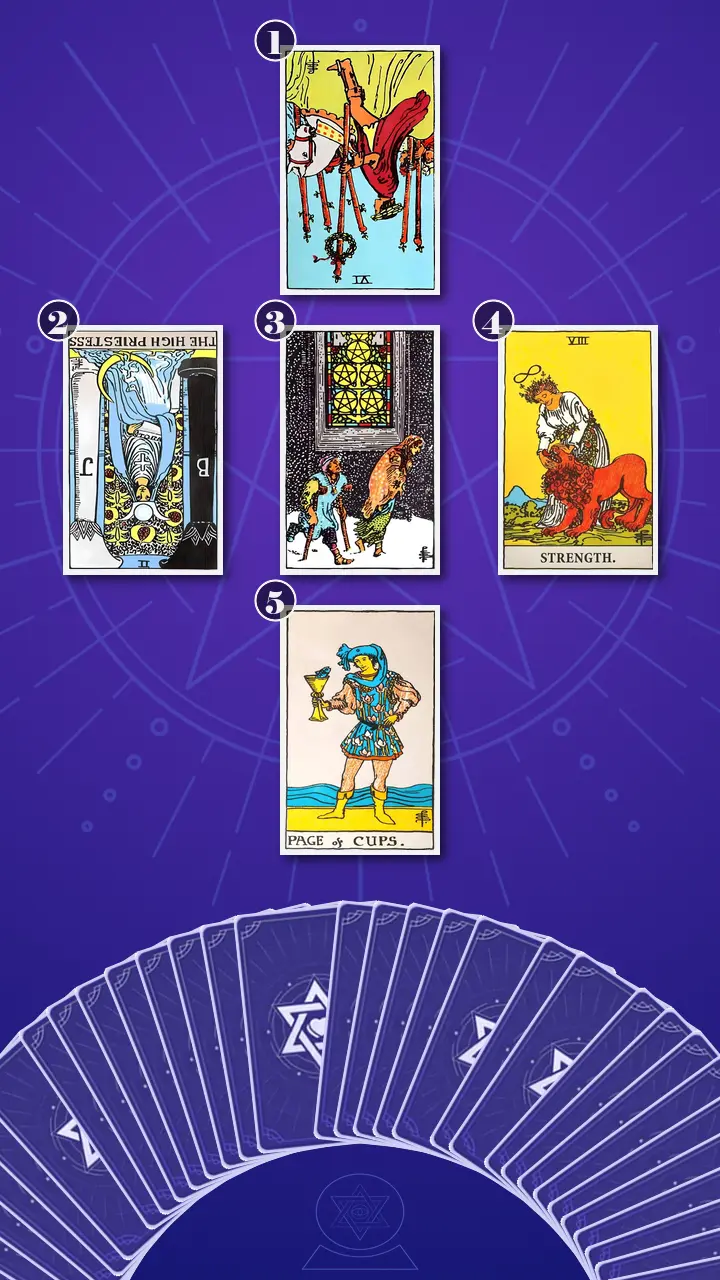
Today, I used The Shadow Spread, a five-card cross designed for questions about a public mask, blocked self-recognition, belonging fear, and the first practical movement toward integration. For anyone wondering how tarot works in a reading like this, the cards function as visual prompts: their symbols give us a disciplined way to examine behaviour, body signals, assumptions, and choices that are otherwise easy to blur together.
This spread suited Maya because it was an inner excavation, not a forecast or a test of whether she should disappear from public life. A larger spread would have added more positions without improving the central inquiry. The five cards followed a precise path: the first revealed the observable presenting problem; the second showed the inner knowledge being edited out; the third identified the fear that kept the split in place; the fourth offered an integrating capacity; and the fifth translated insight into a small, values-aligned expression.
I placed the first card above the centre, the second to the left, the third in the middle, the fourth to the right, and the fifth below. The cross looked, to me, like a person stepping down from a stage, passing through an inner doorway, and arriving on ordinary ground.
The Stage Light and the Missing Person
Position 1: The Applause That Did Not Reach Her
Now I turned over the card representing the observable presenting problem: the polished public persona Maya continued to perform even though its recognition no longer produced an internally real sense of self.
The Six of Wands, in reversed position.
The laurel-crowned rider stood above the crowd, but I focused on the weight of the wreath-topped wand in his raised hand. The image held the exact tension Maya had brought into the room: visibility was working. She could publish a coherent career update, receive supportive comments from coworkers and old friends, and still wonder whether anyone had responded to the person behind the presentation.
She described refreshing the engagement dashboard after posting, even when the comments were kind. The reversed fire was not a lack of competence. It was recognition becoming overextended, until applause had more authority than her own response. The more she checked what had earned approval, the more she shaped the next message toward that reaction, even when it no longer matched her changing values. The performance brought short-term relief, but it did not bring her back to herself.
I said, 'Applause can confirm the performance without confirming the person. The useful question is not whether you are allowed to be visible. It is whether this visible choice is being shaped by a value you hold or by the reaction you hope to secure.'
Maya did not nod. She gave a short, bitter laugh and pressed her thumb against the side of her phone. 'That is too accurate,' she said. 'A little cruel, honestly. People think I am confident, but I keep wondering whether they like me or just the version I know how to deliver.'
I let the reaction stand. 'The card is not accusing you of being fake. It is showing a successful adaptation that has become expensive. We can respect the skill and still ask whether it is managing the whole account now.'
Her thumb moved away from the phone. The first card had separated being noticed from being known, and that distinction gave us somewhere precise to continue.
Position 2: The Draft Behind Six Rewrites
Now I turned over the card representing the private reactions, preferences, needs, and inner knowledge Maya edited out before public expression.
The High Priestess, in reversed position.
The veiled threshold and the partly concealed scroll brought me to the Notes app on Maya's phone. Before a Monday meeting, she had typed, 'I do not think this strategy is right.' Then she had converted the sentence into six stakeholder-friendly talking points, removing the emotional and ethical concern that had created the original objection. By the end of the meeting, she could remember the positioning logic more clearly than the inner no that had started it.
The reversal showed a blockage of inner knowing. Her private information was not missing; it was consulted and then overruled. She kept placing polished interpretation over direct feeling until a preference had to pass so many internal reviews that its original shape became difficult to recover. The honest draft did not disappear; it lost every internal review round.
I asked, 'What did you know before you started making it acceptable?'
Maya's throat tightened. Her eyes lowered to the card, and one hand closed around the edge of her sleeve. She remembered a candid draft she had deleted before anyone else could see it. 'I knew what I meant before I started making it acceptable,' she said quietly.
I did not tell her to publish the first draft or reveal every private reaction. The High Priestess reversed was not a command to overshare. It was an invitation to restore access to the original signal before deciding what deserved a public form. Selective privacy could be a boundary. Automatic self-erasure was something else.
Position 3: The Door She Thought Was Locked
Now I turned over the card representing the underlying fear about worth and belonging that made the split between Maya's public and private selves feel protective.
The Five of Pentacles, in upright position.
Two figures moved through snow beneath an illuminated window containing five pentacles. I brought the scene into Maya's crowded westbound streetcar. At 6:52 p.m., after she had posted a mildly uncertain career reflection, a former colleague viewed it without reacting. The brakes squealed, damp wool pressed close around her, and her stomach dropped before any negative response had occurred. Her thumb was already drafting a clarifying comment.
The card did not predict rejection, professional loss, or social exile. It showed the fear that treated reduced enthusiasm as proof of exclusion. A slower reply became a locked door. A lower like count became social demotion. A changed preference became evidence that she was difficult, inconsistent, or no longer worthy of the warm room of belonging.
I asked her to separate the forecast from the evidence. She wrote, 'If they are less enthusiastic, I am already being pushed out,' and underneath it, 'They replied three hours later and asked a neutral question.' The upright earth of the Five of Pentacles had hardened into a rule: approval must be maintained to remain inside. Making the rule visible did not make the fear vanish, but it made the fear testable.
First, Maya's shoulders dropped by less than an inch. Then her eyes unfocused, as if she were replaying the streetcar, the silent view, and the comment she had almost added. Finally, she let out a breath that seemed to come from behind her ribs. 'I keep treating a neutral response like an eviction notice,' she said.
I answered, 'A reaction is data, not a verdict on your right to belong. We still pay attention to real risk, power differences, and unsafe environments. We are simply refusing to let an imagined ending present itself as evidence.'
When Strength Met the Lion with Open Hands
Position 4: The Bridge Between Silence and Broadcast
Before I turned the fourth card, the room seemed to quiet around us. The Toronto traffic thinned to a distant hush, and a pale reflection from the window crossed the spread like a line between the cold outside and the table where Maya had begun to stay present.
Now I turned over the card representing the key internal capacity that could challenge Maya's approval-or-rejection binary and reconnect public choice with private truth.
Strength, in upright position.
The woman on the card did not conquer the lion. Her hands rested calmly at its mouth. I read that as compassionate self-regulation: not humiliating the uncertain, emotional, or unfinished parts of herself, and not handing them the entire room either. In a safe one-to-one conversation, Maya could notice the familiar impulse to package uncertainty as a confident recommendation, name the truthful core, and choose a proportionate amount to communicate.
This was where I used my signature Somatic Shadow Sensing. I do not treat the body as proof of what a card means, and I never diagnose from a jaw or a throat. I ask what the body is reporting before the mind turns the report into a public-relations brief. Maya felt the tightness at the base of her throat, the small clench behind her molars, and the pressure in her chest that arrived whenever she considered saying, 'My view has changed.' Those sensations gave us a location for the shadow, not a command to expose it.
Then Maya's brow tightened. 'But does that not mean I was wrong all along?' she asked. The question carried a quick flare of anger before it softened into fear. I said, 'No. It means the persona was a useful skill, and usefulness is not the same as permanent truth. You are not required to punish the version of you who learned how to belong.'
For a moment, Maya was still inside the old calculation: if she stopped polishing, someone would find the inconsistency, withdraw approval, and prove that the composed version was the only version worth keeping. She looked at the lion as though it had asked for a public confession.
You do not have to keep the lion hidden to remain acceptable; meet it with a steady hand, and let courage make your public voice more truthful.
The sentence stayed between us. I then made the distinction plain: Authenticity is not full exposure. It is staying in contact with what is true, then choosing an honest amount to share without abandoning either your boundaries or yourself.
First, Maya's breath stopped. Her index finger hovered above the corner of the card, and her face held still, the way it had in the meeting room before she replaced an objection with a smoother phrase. Then her gaze moved past me and lost focus; I could see her replaying the deleted caption, the delayed reply, and the many moments when she had mistaken control for safety. Her pupils widened slightly, and a thin shine gathered along her lower eyelids. Finally, her clenched hands opened one finger at a time. Her shoulders lowered, and a shaky exhale left her with a quiet, almost surprised, 'Oh.' Relief arrived first, but it brought a brief light-headedness with it. The path was clearer, which meant the choice now belonged to her. She was not suddenly certain. She was no longer carrying the entire lion alone.
I asked, 'Now, use this new angle to remember last week. Was there a moment when staying in contact with your real response, while sharing only a safe and relevant amount, could have made the interaction feel different?'
I named the movement carefully: this was one step from alienated self-monitoring and approval-or-exile thinking toward grounded confidence in a flexible, bounded, truthful public self. It was not a finished identity. It was a relationship with her own information beginning again.
Position 5: The Small Fish Before the Rebrand
Now I turned over the card representing the conscious action that could begin incorporating the insight into daily life.
The Page of Cups, in upright position.
A small fish rose unexpectedly from the Page's cup. Nothing about the image demanded a rebrand, a public correction, or a dramatic declaration. The fish was an unpolished preference appearing before Maya's content-strategy reflex could turn it into a coherent identity claim.
I connected it to a low-stakes conversation with a close friend: 'I know I have called myself ambitious in this specific way for years, but I am not sure that version fits now.' Maya would not need to defend the change, explain its entire history, or predict what it meant. She could let the sentence remain unfinished and receive the response as information rather than a referendum on who she was.
The Page restored water as curiosity. Its upright energy was open but not reckless, emotionally honest but still beginner-sized. I said, 'This might be new, unfinished, and still worth noticing. A first honest sentence is not a new personal brand. It is a small beta release of information from your own life.'
Maya smiled, then looked down at her hands. She did not look transformed. She looked less determined to convert every feeling into a final position. That was enough for the card to do its work.
The Volume Control Between Mute and Broadcast
I read the five-card Shadow Spread as one story. Maya's work had trained her to make any message coherent, and praise had rewarded the polished version. The reversed High Priestess showed how the honest source material was then hidden behind revisions. The Five of Pentacles revealed the fear beneath the editing: a drop in approval felt like being sent outside. Strength offered the missing middle ground, where she could stay in contact with a difficult response without either suppressing it or unleashing it. The Page of Cups gave that capacity somewhere small and real to go.
The core metaphor was simple: her public profile had become the admin account for her identity, polished and consistent, with more authority than the person using it. The blind spot was believing that privacy and authenticity were opposites, leaving only two choices: manage every impression perfectly or expose everything and risk losing control. The cards pointed in a different direction: bounded authenticity, proportionate honesty, and a flexible public voice with conscious limits.
I also explained my wider framework of Ecosystem Bandwidth Restoration. After sixty-seven years of watching Highland weather clear in cycles rather than all at once, I think of an overstimulated mind as receiving too many audience signals and too few quiet intervals in which its own signal can return. We were not trying to eliminate visibility. We were restoring a small clearing between feeling, editing, and checking the response.
The key shift was from polishing every public expression for approval to making one low-stakes, values-aligned disclosure before managing the audience response. That was the practical centre of finding clarity: preserve the private signal, choose the amount that is safe to share, and let the next step stay revisable.
The Private-Draft-First Check
I gave Maya actionable advice in small pieces. None of it was a tarot command, and none of it required her to disclose anything in a situation that threatened her safety, housing, immigration status, employment, or privacy.
- Private-Draft-First CheckBefore one Instagram, LinkedIn, Slack, or meeting contribution this week, open Notes and write the unedited version for five minutes. Underline one phrase and label it as a value, need, preference, or boundary. Save the private draft before creating the public version.Use fragments if full sentences trigger another editing cycle. If five minutes feels too exposed, use ninety seconds. The note is not a confession, content draft, or promise to share it.
- The One-Sentence BetaIn one low-stakes setting with a trusted person, say one bounded sentence such as, 'I used to say I liked that, but I think my preference has changed,' or, 'My view is different now, and I am still working out why.' Stop before building a defence brief.Before speaking, use my Grounding Transmutation Ritual for ninety seconds: place both feet on the floor, notice the pressure beneath your heels, name three sounds, release your jaw on a longer exhale, and let the physical sensations bring you back from mental rumination. If your body feels flooded, keep the sentence private and return later with a smaller topic.
- The Approval-or-Evidence PauseAfter one safe, honest expression, wait ten minutes before clarifying it only because a reply is slow or neutral. If it feels manageable, mute notifications or leave the phone in another room for up to two hours. Then make two phone-note columns: What I predicted and What actually happened.Record observable behaviour in the evidence column, not inferred motives. You can archive or delete a post for privacy or safety. The practice interrupts automatic reaction management; it does not require you to remain exposed.
I told Maya that a changing goal or opinion did not make her earlier self fraudulent. It meant her identity was still alive enough to update. She could remain strategic, private, and professionally capable without making every visible moment prove her worth. The next steps were not about securing universal approval. They were about collecting more accurate evidence of what felt like hers.

A Small Sentence in Ordinary Light
Four days later, I received a message from Maya: 'I told a friend I might not want the career path I have been posting about.' She had sat alone with tea afterward, not celebrating. The next morning, 'What if I am wrong?' arrived first. She smiled anyway, saved the draft, and went to work without editing it into certainty.
I held that as the first quiet proof of her Journey to Clarity. She had not solved her career or redesigned her public identity. She had allowed one unfinished truth to exist, kept her boundaries intact, and discovered that a small honest expression could produce information without becoming a verdict.
When applause feels safer than ordinary light, even a tight throat and exhausted jaw can seem like a reasonable price for protecting the belonging you are afraid the unedited version might lose. Seeing that bargain clearly is already a small return to yourself.
If one unfinished but honest sentence did not have to become a confession or a new identity, where might you feel curious enough to let it exist this week?