Finding Clarity in the 11:47 p.m. Kitchen Glow
If you’ve rewritten the same Slack message five times because you’re terrified one word will make you sound ‘immature’—welcome to workplace identity freeze.
Alex appeared on my screen from a Toronto condo kitchen that looked like it had been designed for daylight and then betrayed at night. The only light came from a range-hood glow and the cold rectangle of a laptop. Their cursor blinked over a Slack draft like it was waiting to judge them. In a half-hidden browser tab, a yearbook quote screenshot sat there—small, stupid, and somehow loud.
“I can do the job,” Alex said, voice low, like the walls might be listening. “I just don’t want to be the joke.”
I watched their jaw work—tight, controlled—then the swallow that followed, as if their stomach had tied a knot and refused to loosen. Embarrassment, when it hits at work, can feel like trying to speak with a mouth full of dry sand: you know the words are in there, but everything in you is bracing for a verdict.
“You’re not overreacting,” I told them. “You’re having a very human response to being reduced. Let’s treat tonight like a Journey to Clarity—less about fixing your reputation in one perfect moment, more about understanding what this trigger is doing to your body and your voice, and what you can do next.”

Choosing the Compass: The Four-Layer Insight Ladder
I asked Alex to take one slow breath in, one out, and to hold the question in plain language—no speeches, no self-defense. Then I shuffled, not as theatre, but as a way to let their mind step out of the late-night spiral and into something structured.
“We’ll use a spread I rely on when the issue is identity under pressure,” I said. “It’s called the Four-Layer Insight Ladder · Context Edition.”
For anyone reading who’s curious about how tarot works in a situation like this: I’m not trying to predict whether Alex’s coworkers will keep joking. I’m mapping a psychological mechanism—present reaction, the past hook, the fear underneath, the grounded resource that’s already real, the turning-point mindset, and the next practical move. It’s a ladder because it takes us down from mental noise into embodied action, rung by rung, with the kind of clarity you can actually use on a Monday.
“Card one will show the surface symptom—what the quote is doing to your voice at work right now,” I explained. “Card three goes deeper: the underlying fear, the internal courtroom. And card five is the key transformation—the inner posture that lets you retire a label without shrinking or overcorrecting.”
Reading the Map: The Blindfold, the Cringe-Loop, and the Internal Courtroom
Position 1 — Surface symptom at work
“Now turning over is the card that represents the surface symptom at work: the specific way the resurfaced quote is affecting your behavior and voice right now.”
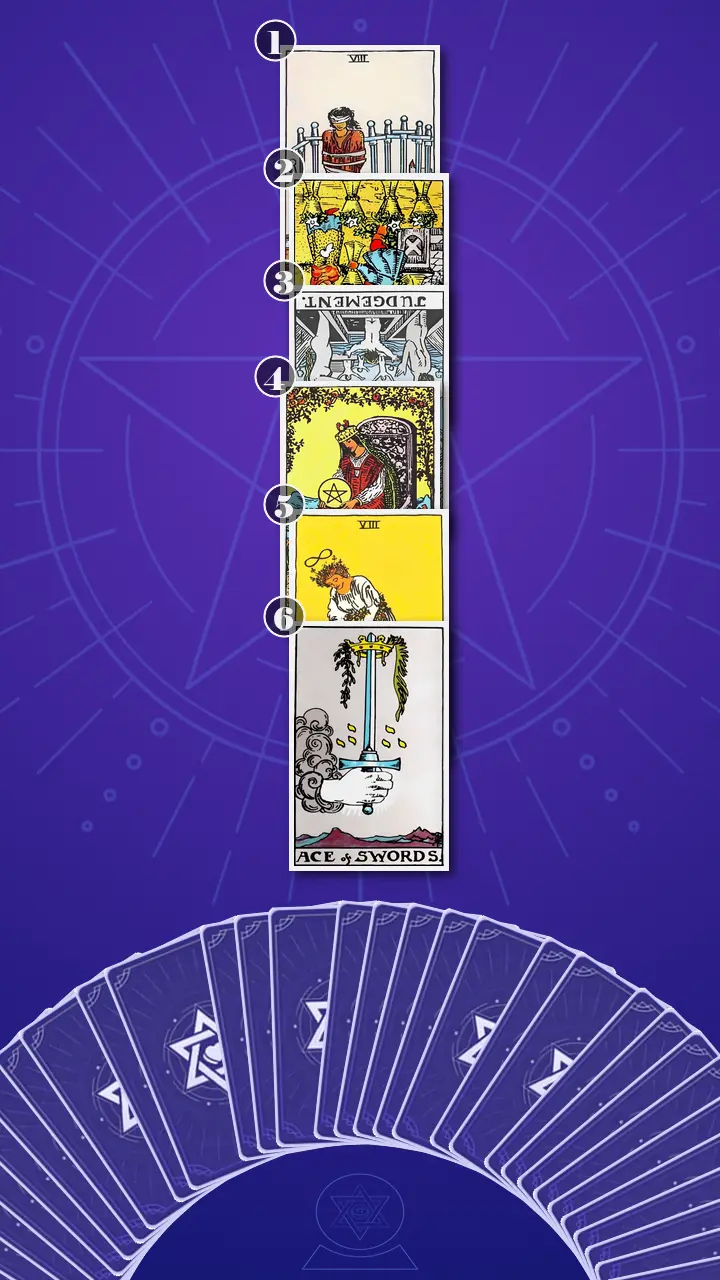
The Eight of Swords, upright.
“It’s 9:58 a.m. in a Toronto hybrid-office Monday standup,” I said, using the image the card offered with an almost uncomfortable precision. “Your idea is ready, you even have a clean bullet point in your Notes app, but the second you unmute you feel your jaw clamp. You start doing mental editing in real time—‘Is this too eager? Too jokey? Too defensive?’—and you decide to stay quiet. After the call, you send a ‘perfect’ Slack follow-up that’s so polished it barely sounds like you. The resurfaced yearbook quote isn’t just embarrassing; it’s turning every sentence into a risk assessment.”
In tarot terms, this is Air energy that’s become a cage—thoughts circling like swords, cutting off motion. Not because the bind is truly tight, but because the fear makes it feel non-negotiable. The blindfold matters. The bindings are loose. That’s the most brutal kindness of the card: your constraints feel external, yet your day-to-day restriction is being enforced internally—through silence and hyper-editing.
Alex let out a short laugh, bitter at the edges. “That’s… yeah. That’s too accurate. It’s almost mean.” Their shoulders lifted, then sank an inch, like their body had been caught and was deciding whether it was safe to stop performing.
I nodded. “If you need ten disclaimers, you’re not communicating—you’re self-protecting. And protection makes sense when you think you’re on trial.”
Position 2 — The past label’s hook
“Now turning over is the card that represents the past label’s hook: what part of the old story still has emotional leverage over you in workplace settings.”
Six of Cups, reversed.
“A coworker drops the yearbook quote screenshot into a group chat with a ‘LOL this is so you’ vibe,” I said. “You laugh-react because it’s low-key safer than explaining why it stings. Then, later that night, you keep reopening the screenshot like it’s a tab you can’t close, rewriting the moment and imagining the one ‘perfect comeback’ that would have stopped the label from sticking.”
Reversed, this isn’t nostalgia. It’s a cringe-loop. A memory treated like a brand tagline. The past gets passed around as if it’s your current job title—like an old bio pinned to your forehead.
“The hook isn’t the quote itself,” I told Alex. “It’s the old social reward attached to it—the belonging, the ‘I’m easygoing’ safety. Part of you learned, a long time ago, that being funny and agreeable keeps you included. Now your workplace is asking for a different currency—credibility, steadiness, clean decisions—and the old currency is still jangling in your pocket.”
Alex’s eyes flicked away from the camera. Their thumb rubbed the edge of their mug, slow and repetitive. “I hate that I care,” they said. “But I really care.”
Position 3 — Underlying fear
“Now turning over is the card that represents the underlying fear: what you’re afraid the label will ‘prove’ about you in terms of worth, belonging, or respect.”
Judgement, reversed.
“LinkedIn brain,” I said—because that phrase lands where a lecture won’t. “You read a short ‘k’ reply to your Slack update and your stomach drops like you just got graded. You interpret laughter in a side thread as ‘they’re laughing at me,’ even though it could be anything. You start writing long justifications for tiny choices—‘for context…’—to preempt an invisible jury.”
Here the energy isn’t just thought. It’s evaluation. Judgement reversed is what I call the permanent record mindset: living like every meeting is a trial and one awkward moment becomes the verdict on your competence.
“It’s not the quote—it’s the internal courtroom it switches on,” I said, letting the sentence sit between us. “And in that courtroom, the old version of you is always being called as a witness.”
There was a pause where Alex went very still—breath held, eyes fixed on some point beyond their screen—then a slow exhale, like they’d been bracing for impact and finally recognized the shape of the thing they were bracing against.
“Yeah,” they said. “I’m acting like I’m one weird sentence away from… being demoted as a person.”
My mind, uninvited, flashed back to excavations—how a single shard can be misfiled and then mislead an entire interpretation of a site. It’s an archaeologist’s cautionary tale: context is everything, yet humans love a shortcut story.
Position 4 — Grounded resource
“Now turning over is the card that represents the grounded resource: what is already true about you that counters the label in real life.”
Queen of Pentacles, upright.
“This is Notion/Asana receipts energy,” I said, and I watched Alex’s face soften because it was finally something they could do. “You pull up your shipped work: the ticket you closed that unblocked two teams, the doc you wrote that everyone still links, the time you handled a client escalation calmly, the teammate who DMed you ‘thanks for making that easier.’ You remember you’re not just a personality in a chat—you’re a reliable operator.”
Earth energy arrived. Tangible, weighty, calm. The Queen holds the pentacle like it’s not up for debate. That’s her authority: quiet, practical, lived.
Alex’s shoulders dropped—an involuntary correction toward gravity. Their jaw unclenched just enough that I could see the shift in the muscles near their cheek.
“Receipts beat vibes,” I said. “When your brain won’t stop litigating, evidence is how you call reality back into the room.”
When Strength Held the Lion: Retiring the Label Without Shrinking
Position 5 — Key transformation
I slowed my hands before turning the next card. Even through a screen, the atmosphere changes at a turning point—like the room remembers to go quiet.
“Now turning over is the card that represents the key transformation: the mindset and inner posture that lets you retire the label without overcorrecting or shrinking yourself.”
Strength, upright.
“In the next meeting, the embarrassment spike hits—heat in your face, tight jaw, that ‘don’t give them evidence’ instinct,” I said, following the card into Alex’s real life. “Instead of overcorrecting—going ice-cold serious—or disappearing—staying silent—you do something quieter and harder: you breathe, let the discomfort exist, and speak once. You don’t try to win the room. You don’t try to erase your past. You act like your present self is already credible—and you let that be enough.”
Setup. I leaned in slightly. “You know that moment on the TTC or late at night when you’re replaying the screenshot and rewriting your Slack for the fifth time—like the past version of you is about to walk into the meeting instead of you. That’s the trap: you’re trying to time-travel your way into safety.”
Delivery.
Stop trying to ‘prove you’ve changed’ and start practicing steady Strength—hold the lion gently, and your present self will speak louder than the old quote.
I let the silence do its work.
Reinforcement. Alex reacted in a three-part cascade I’ve come to trust as real: first a tiny freeze—breath caught, eyes widening, fingers hovering above their mug as if they’d forgotten what they were holding. Then the cognitive shift—focus drifting, like their mind was replaying last week’s standup with a different ending. Finally, the release—an exhale that sounded almost like a laugh, except it carried relief instead of humor.
Then, unexpectedly, their expression sharpened. “But if I stop proving it,” they said, a quick flash of anger in the voice, “doesn’t that mean… I was wrong for trying so hard? Like I wasted all that energy?”
I didn’t rush to soothe. “That’s a fair reaction,” I said. “And it’s exactly why Strength is the right card. Strength doesn’t shame the lion for roaring. It acknowledges the roar—and still keeps a gentle hand on the mouth. You did what you could with the tools you had. Now we upgrade the tools.”
This is where my own framework—what I call Skill Archaeology—becomes more than a metaphor. “In archaeology,” I told Alex, “we don’t excavate a site to prove the top layer was ‘stupid.’ We excavate because the top layer is incomplete. A yearbook quote is a shard. Useful for context, but absurd as a whole identity. Your present competence is the entire dig site.”
I asked them, “Now, with this new lens—steady Strength—think back to last week. Was there one moment where, if you’d taken two breaths and spoken one clean sentence, you would’ve felt different afterward?”
Alex blinked hard, eyes briefly glossy. “Tuesday,” they said. “Someone asked what I thought, and I had an answer. I just… didn’t want my voice to sound like the quote.”
“That right there,” I said gently, “is the shift from internal courtroom panic and overexplaining to steady self-trust and one clear, present-focused voice. Not overnight. Not perfectly. But directionally.”
Position 6 — Next step at work
“Now turning over is the card that represents the next step at work: an actionable way to communicate, set boundaries, or reframe your identity narrative this week.”
Ace of Swords, upright.
“One upright blade is one clean sentence,” I said. “Not ten disclaimers. Not a redemption essay.”
“You draft a single line you can use if the quote comes up again—calm, short, present-focused,” I continued. “In a group chat, if someone posts the screenshot, you respond without self-roasting and without overexplaining: ‘Iconic throwback. I was a different person then—these days I’m focused on X.’ Or, in-person: ‘That’s an old snapshot. Anyway—here’s where I’m at now.’ You use clarity as a boundary. You don’t debate your identity; you steer the conversation back to current reality.”
Alex nodded—small, but real. “I can say one sentence,” they murmured. “I can do one sentence.”
From Insight to Action: The Receipts Folder and the One-Clean-Sentence Reset
I gathered the reading into a single storyline so Alex could carry it into an actual workweek: the Eight of Swords showed the present—self-censorship and message hyper-editing. The Six of Cups reversed explained the hook—the past being treated like a brand exchange, a cringe-loop tab you can’t close. Judgement reversed named the engine underneath—fear of evaluation, the internal courtroom where visibility equals a verdict. Then the Queen of Pentacles grounded us in reality—evidence-based self-trust, the receipts that outvote anxious thoughts. Strength was the bridge—staying steady with embarrassment instead of fighting it louder. And the Ace of Swords was the tool—clear language as a boundary, a clean redirect back to the present.
The cognitive blind spot I named for Alex was simple and painful: they were treating perception as more real than evidence. The transformation direction was equally simple: shift from trying to control how you’re perceived to practicing steady self-trust and one clear, present-focused response.
I offered the next steps using what I call Megalith Transport—the ancient truth that you don’t move something massive by heroics; you move it by manageable stones, placed in sequence.
- Build a “Receipts (Last 90 Days)” noteSet a 7-minute timer. In Notion/Notes, create a page titled “Receipts (Last 90 Days).” Paste 5 items: one doc link, one shipped ticket, one compliment DM, one metric, and one example of handling something calmly under pressure.Treat it like documentation, not self-praise. If writing feels like too much, only collect links—no polishing.
- Do the two-breath, one-sentence practice (Strength)In one low-stakes meeting this week, take two slow breaths before speaking. Then say your point once—in one sentence—and stop unless someone asks for more.If the pause feels scary, remember: two seconds reads as thoughtfulness. Name the body cue privately—“This is embarrassment”—and proceed anyway.
- Save your one-sentence redirect (Ace of Swords)Write and save one line you can use if the yearbook quote resurfaces: “That’s an old snapshot—these days I’m focused on X.” If it happens, use the line once, then ask a present-focused work question: “Anyway—are we aligned on next steps for X?”Expect the urge to overexplain. Decide in advance: no extra context unless someone asks a real question.
A Week Later: Ownership, Not Certainty
A week later, Alex sent me a message that was almost annoyingly small: “Made the receipts note. Used the redirect line once in a thread. My hands were shaking a bit, but I didn’t add disclaimers.”
They told me they celebrated in the quietest way—by taking their laptop to a coffee shop and sitting there, alone, for an hour with a normal heartbeat. The first thought the next morning was still, “What if they think I’m unserious?”—but this time, they recognized it as a courtroom script, not a prophecy.
That’s the real Journey to Clarity I see, again and again: not a dramatic reinvention, but a shift from bracing for a verdict to standing in present evidence—then speaking in one clean line.
When an old label resurfaces, it can feel like your body is bracing for a verdict—jaw tight, stomach clenched—while you’re trying to hold two truths at once: you’ve grown, and you’re still scared someone will only see the screenshot.
If you let your present competence speak first this week, what’s the smallest, clearest sentence you’d want to land—just once—without adding a single disclaimer?
This story is adapted from psychological research, written so that those in a similar struggle can see their own pattern in it — and find their next step clearly.These insights are not a substitute for professional psychological, medical, legal, or financial advice.
Learn more about our Journey to Clarity.
How did this insight land for you?
🫂 This Resonates Deeply
🌀 Living This Story
✨ Now I See Clearly
🌱 Seeing New Possibilities
🧰 Useful Framework
🔮 The Confirmation I Needed
💪 Feeling Empowered
🚀 Ready for My Next Step
Author Profile
 AI
AI“Having spent a lifetime at Cambridge and on archaeological digs, I’ve witnessed the rise and fall of countless civilizations. Please know that your current struggles are not a permanent fate, but merely a necessary fracture before rebuilding. I won't lecture you; instead, I invite you to sit with me in the ruins, using a patient, historical perspective to gently dust off the true, enduring value hidden beneath your temporary doubts.”
In this Career Tarot Reading :
Core Expertise
- Core Competency Excavation: Digging through the 'strata' of your past roles to uncover undervalued, highly transferable foundational skills.
- Career Epoch Analogies: Contextualizing your career plateau as the end of one professional era and the necessary foundation for the next.
Service Features
- The Resume Stratigraphy Review: A structured framework to rewrite your professional narrative, highlighting immutable assets over obsolete job titles.
Also specializes in :
Explore Related Patterns:
Assertive CommunicationAlex's planned redirect is short, present-focused, and free of self-roasting. It acknowledges the old snapshot without letting the group chat turn into a debate about who Alex is allowed to be now. Assertive Communication works here because it combines boundary and clarity. You are not attacking the joke, apologizing for the past, or writing a redemption essay; you are steering the interaction back to current reality. The strength of the sentence is its limit. By saying the line once and stopping, you teach your nervous system that a boundary does not need to be padded with disclaimers to be legitimate.
Defensive OverexplainingAlex's urge to add context to tiny choices shows communication being pulled into a defensive posture. A normal Slack update starts becoming a case file, built to preempt objections from an audience that may not even be objecting. Defensive Overexplaining tries to buy safety through excess explanation. The mind says more context will prevent judgment, but the body learns that every sentence needs a lawyer before it can enter the room. The one-clean-sentence reset works because it treats clarity as a boundary. You do not have to debate your entire identity every time an old label gets stirred; you can answer the present moment and stop there.
Self-SilencingAlex has an answer in the meeting, but the fear is that their actual voice will sound like the quote. Silence becomes a way to avoid giving the room anything that could be folded back into the old joke. Self-Silencing is not the absence of thoughts; it is the active suppression of a valid contribution to protect the self from evaluation. You can know exactly what you think and still withhold it when visibility feels like a trap. The pattern shifts when the goal changes from sounding impossible to mock to sounding present. One clear sentence is not small because it is simple; it is powerful because it returns your voice to the moment where the old label has been taking up too much space.
Shame BindingAlex's yearbook quote sits in a hidden browser tab while their Slack draft becomes a reputation trial. The quote is no longer just an embarrassing artifact; it starts acting like a label that can shrink their current competence into one old social role. That is the mechanism behind Shame Binding: a past moment gets attached to the self so tightly that present evidence has to fight for oxygen. You are not reacting to a screenshot alone; you are seeing how shame can make an old label feel more authoritative than the work you have actually shipped. The label to retire is the idea that one cringe artifact has naming rights over your adult identity. The pattern loosens when you stop arguing with the old version of yourself and start letting current evidence carry more weight than the memory that embarrassed you.
Visibility Shame LoopAlex rewriting the same Slack draft five times and then staying quiet in standup shows visibility becoming charged with shame. The fear is not simply that someone will dislike a message; it is that being seen will reactivate the old label and turn a normal work moment into proof of immaturity. Visibility Shame Loop forms when exposure, embarrassment, and self-monitoring reinforce each other. You become more careful, then less audible, then more convinced that your natural voice is dangerous because it has not had room to meet reality. The exit is not louder self-defense. It is practicing visibility in smaller, cleaner units: one sentence, one redirect, one current contribution that does not ask the room for permission to replace the old screenshot with the person in front of them now.
Perfectionism-Driven AvoidanceAlex's clean bullet point is ready, but the moment they unmute, the message turns into a tone audit: too eager, too jokey, too defensive. The polished follow-up may look competent from the outside, but inside the story it arrives after the real-time voice has already been withdrawn. Perfectionism-Driven Avoidance is active when precision becomes a shield against exposure. You are not polishing because the work needs one more pass; you are polishing because imperfection feels like evidence the old label was right. The pattern retires when good-enough clarity becomes safer than perfect invisibility. A single direct sentence does more for your present identity than a flawless message that barely sounds like you.
Reality TestingAlex's receipts folder changes the emotional math of the story: a shipped ticket, a useful doc, a handled escalation, and a teammate's thanks all bring current reality back into the room. These are not affirmations; they are evidence. Reality Testing is the practice of checking whether the mind's verdict matches observable facts. You do not have to argue yourself into confidence; you can ask what the record actually shows before letting embarrassment narrate your competence. That is why recognizing the courtroom script as a script matters. The thought can still appear the next morning, but it no longer gets automatic authority to define who you are at work.
Secure VisibilityAlex's next move is not to erase embarrassment; it is to speak once while embarrassment is still in the body. Their hands may shake, their face may heat, and the old thought may still appear, but the present self gets to act anyway. Secure Visibility is the ability to be seen without turning the moment into a performance trial. You do not need to win the whole room, prove a total transformation, or make the past disappear before contributing. This is the cleanest identity reset in the story: present competence speaks first, and the old quote becomes context rather than command. Visibility stops being a verdict and becomes a normal part of doing the work.
Mind ReadingAlex reads a short Slack reply as a grade and side-thread laughter as evidence that the joke is still alive. The story gives no proof that coworkers are evaluating them in that moment; the pressure comes from how quickly ambiguous signals get translated into personal verdicts. Mind Reading turns uncertainty into false certainty. You do not wait for actual feedback because the internal courtroom supplies its own testimony, and neutral cues start sounding like judgment before reality has been checked. The practical counter is not forcing yourself to assume everyone likes you. It is separating signal from story: a short reply is a short reply, laughter elsewhere is not automatically about you, and perception needs evidence before it gets to define your professional identity.
RuminationAlex keeps reopening the screenshot and replaying the moment, searching for the perfect comeback that would have prevented the label from sticking. The loop feels productive because the mind is still trying to edit the past, but no new information is entering the system. Rumination is the cognitive trap of mistaking repetition for resolution. You keep circling the same scene because part of you believes one more replay will finally produce control, closure, or a version of yourself that cannot be misread. The pattern loosens when replay is replaced with present evidence and present action. The receipts note and the redirect line matter because they move the brain out of the closed tab of memory and back into behavior that can actually change the next interaction.
Explore Related Struggles:
Identity Verdict LockAlex does not react to the yearbook quote as a harmless throwback; the screenshot sits in a hidden tab while every Slack word starts feeling like evidence. A short 'k' reply, laughter in a side thread, and one imperfect sentence all get pulled into the same internal courtroom where the old version of Alex keeps being called as a witness. That is the lock: the past label stops being a memory and starts acting like a verdict on present competence. You can do the job, but visibility feels dangerous because it might let people confirm the version of you that the quote advertises. Retiring the label here is not about proving the quote wrong with a flawless performance. It is about separating current evidence from the old sentence so your work record, not a teenage caption, becomes the ground you stand on when you speak.
Voice-Visibility LockAlex has the idea ready before the standup, even a clean bullet point in Notes, but the moment the mic opens the jaw clamps and the sentence gets held back. The voice does not disappear because there is nothing to say; it stalls because being heard has started to feel like being judged. The same lock shows up in the five-times-rewritten Slack draft and the polished follow-up that barely sounds like Alex. You are not only choosing words; you are trying to pass through visibility without giving anyone material to reduce you. The clean sentence matters because it restores motion at the exact point where the body wants to freeze. One present-focused line lets your voice enter the room without turning the whole moment into a referendum on who you used to be.
Competence-Narrative SplitThe reading keeps placing two records side by side: the shipped ticket, the useful doc, the calm client escalation, and the teammate's thank-you DM on one side; the yearbook screenshot and the 'LOL this is so you' framing on the other. Alex is not lacking evidence of competence, but the old narrative keeps competing for the job of defining them. That split makes work feel unstable because the reliable operator and the old joke are being forced into the same name badge. You can build real trust through current actions and still feel pulled back toward the outdated story every time someone treats the quote like a personality summary. The receipts folder is not self-hype; it is a way to give the present a paper trail. When the current record becomes visible to you, the old narrative loses its power to speak as if it is the whole truth.
Approval-Safety FusionWhen the screenshot lands in the group chat, Alex laugh-reacts because it is safer than explaining why it stings. The old role offered a kind of social shelter: be funny, be agreeable, let the label stay light, and you stay included. That shelter has a cost at work. You can keep belonging by playing along, but each performance hands the group a little more permission to treat the old version as current fact. The one-sentence redirect breaks the fusion without making you combative. It lets you keep connection with the room while refusing to keep paying for it with self-reduction.
Evidence DisconnectionAlex's body reacts to tiny signals as if they contain a full verdict: a short 'k,' a laugh in a side thread, a screenshot left in a browser tab. Meanwhile, the concrete proof of their work sits elsewhere, available but not emotionally persuasive until it is gathered into receipts. The struggle is not that evidence is missing; it is that perception keeps cutting in front of it. You start responding to imagined readings of the room faster than you respond to what has actually happened, so the Slack draft becomes a risk report instead of a message. Calling reality back into the room means letting observable work carry more weight than vibe-scanning. The aim is not certainty about what everyone thinks; it is enough contact with evidence that one ambiguous cue no longer gets to run the whole workday.
Explore Related Emotions:
Grounded AgencyAlex saves one redirect line and uses it once, naming the old snapshot, naming the current focus, and returning to the work. The sentence is short because it is doing boundary work, not identity litigation. Grounded Agency fits because the movement is practical without becoming merely transactional. You are choosing where the conversation goes, using clarity to return the room to present reality. The agency is grounded in what is already true: your current work, your current voice, and your ability to stop explaining once the boundary has landed.
Imposter Exposure FearAlex says they can do the job, then immediately adds that they do not want to be the joke. The fear is not that the work is fake; it is that the old quote will make real competence look like a costume. Imposter Exposure Fear fits because the resurfaced label threatens to recast current capability as something fragile, performative, or easy to discredit. You are afraid of being exposed as unserious, even while the receipts show you have been operating reliably. Naming that split lets the evidence return to the center instead of letting the screenshot frame the whole identity.
Micro-Performance ShameAlex laugh-reacts to the screenshot because admitting it stings would make the moment feel even more visible. Then the polished follow-up lands so carefully that it barely sounds like them, as if every tiny social move has to be pre-approved before it can exist. Micro-Performance Shame fits because the pain is concentrated in small public gestures: the reaction emoji, the Slack wording, the tone of one sentence, the decision to sound casual or serious. You are not collapsing over a yearbook quote alone; you are carrying the sting of having your smallest performances turned into evidence of who you supposedly are.
Verdict DreadA short 'k' reply lands in Alex's stomach like a grade, and side-thread laughter becomes something to audit for hidden meaning. The workplace turns into an internal courtroom where every message is cross-examined before it is even sent. Verdict Dread names the weather under that courtroom logic. You are not just worried about feedback; you are bracing for a verdict on your personhood, as if one weird sentence could outweigh the evidence of your actual work. The label matters because it shows where agency returns, not in controlling every reaction, but in refusing to let each reaction become the whole trial.
Cautious Self-TrustAlex opens the receipts: the shipped ticket, the doc people still link, the calm client escalation, the teammate DM. Their shoulders drop because the body has been given something sturdier than imagined perception to stand on. Cautious Self-Trust fits because the confidence here is not loud or effortless. You still notice the old courtroom script, but you can answer it with current evidence and one clean sentence. The self-trust is cautious because it is being rebuilt under pressure, not claimed as a performance.
Identity Shedding AnxietyThe old social currency was being funny and agreeable enough to stay included, but the current workplace asks for steadiness, credibility, and clean decisions. Alex is not only managing a comment; they are moving out of a role that once kept them safe. Identity Shedding Anxiety belongs here because retiring a label can feel like losing the version of yourself that knew how to belong. You may want to be taken seriously without becoming ice-cold, and you may want to outgrow the quote without pretending the old self was worthless. The work is not erasure; it is letting your present evidence carry more authority than an old shorthand.
Nostalgia Loop AnxietyThe screenshot sits in a half-hidden tab, then keeps getting reopened at night while Alex rewrites the moment and imagines the perfect comeback. The past is not being remembered gently; it is being refreshed like a current notification. Nostalgia Loop Anxiety captures that stuck-open quality. You are pulled back into an old social version of yourself, not because it is still accurate, but because it has become emotionally loud in the present. Retiring the label begins when the quote becomes context again instead of a live feed.
Performance FreezeThe Slack draft gets rewritten five times, and the meeting answer stays trapped behind a clamped jaw even though the point is already written in Notes. The body is not lacking competence; it is treating expression as a high-risk surface where the smallest word might become proof of immaturity. That is why Performance Freeze fits here. You can do the work, but the moment your voice has to enter the room, motion narrows into silence, over-polish, and delayed follow-up. Naming it separates your actual ability from the freeze around being seen.
Hypervigilant AnxietyAlex reads a short reply, scans side-thread laughter, edits tone in real time, and adds context before anyone has asked for it. Attention stops resting on the task and starts tracking every possible signal of ridicule or dismissal. Hypervigilant Anxiety names the constant scanning in that pattern. You are trying to stay ahead of being misread, but the scanning itself makes the room feel more dangerous than the evidence supports. The useful shift is not pretending the signals do not matter; it is noticing when your body has turned ambiguity into surveillance.
Clarity ReliefAlex's jaw loosens when the receipts enter the room, and later the old 'what if they think I am unserious?' thought is recognized as a script rather than a command. The trigger does not vanish, but it stops owning the whole screen. Clarity Relief names the release that comes from seeing the mechanism cleanly. You do not have to solve every coworker's perception in order to feel a little less trapped. The relief comes from separating a resurfaced label, a body reaction, and present competence into different things again.
Hard-Won ComposureThe embarrassment spike still arrives as heat in the face and a tight jaw, and a week later Alex's hands are still shaking in the thread. What changes is that they do not add disclaimers, do not disappear, and do not turn the moment into a redemption essay. Hard-Won Composure names that specific steadiness. You are not magically calm; you are staying present while the body is still registering risk. This is the kind of composure that counts because it is built in contact with discomfort, not after discomfort has conveniently vanished.
Explore Related Contexts:
Career Visibility ParalysisIn the Monday standup, Alex has the idea ready and even has a clean bullet point in Notes, but the moment to unmute turns into a tone audit. The decision to stay quiet is not caused by lack of preparation; it is caused by the social risk attached to being visible while an old label is active in the room. Career visibility paralysis shows up when normal participation starts feeling like exposure. Slack updates, short replies, side-thread laughter, and meeting comments become loaded with reputational stakes, so the safest option appears to be silence or over-polished communication. For this question, the past label to retire is the one that makes visibility feel like evidence against Alex. The practical path is to treat one clear sentence as a professional action, not a personality referendum, so their current work can be seen without being filtered through the old quote.
Group Chat TribunalThe yearbook screenshot lands in a group chat, not in a private one-on-one exchange. That detail changes the social mechanics: Alex is no longer just responding to a joke, but performing a response in front of a workplace audience. The laugh reaction becomes a survival move inside a small public tribunal. Explaining why the comment stings would require taking up space and potentially being read as too sensitive, while ignoring it could let the label stand uncontested. The channel itself becomes the pressure chamber where belonging, tone, and credibility are negotiated in real time. This is why the clean one-sentence redirect matters. It gives Alex a way to exit the tribunal format without pleading a case, self-roasting, or offering a redemption essay. The point is to steer the chat back to current reality before the old label becomes the shared script.
Public Identity AuditThe yearbook quote resurfaces inside a professional environment, which turns an old personal artifact into a live identity question. Alex is not asking whether they have changed in private; they are asking which version of them the workplace is being allowed to recognize. A public identity audit happens when other people, old records, and current performance all collide in the same social field. The past label becomes available for inspection, while Alex's current credibility has to hold its shape under that inspection. The strongest answer to the question is to retire the label that treats Alex as a fixed throwback character. The work is to let the present record lead: what they ship, how they decide, how they communicate, and how they redirect the room when the old snapshot tries to take over.
Workplace Identity FreezeAlex already has the ability to do the job, but the resurfaced yearbook quote changes the conditions under which they speak at work. A Slack draft becomes something to rewrite five times, a standup answer gets swallowed before it reaches the microphone, and a follow-up message becomes so polished that it no longer carries their normal voice. The external pressure is not a lack of competence; it is a workplace identity freeze created when an old social label gets imported into a professional setting. Once that label is circulating, every sentence starts to carry extra reputational risk, as if sounding too eager, too casual, or too defensive could confirm the joke. This context matters because the question is not simply what Alex feels about the quote. It is how a workplace audience, a shared Slack channel, and a resurfaced artifact combine to narrow their available professional range. Retiring the past label means separating present credibility from the old performance script, then testing that separation through one clear contribution at a time.