The 9:38 p.m. Cursor Spotlight
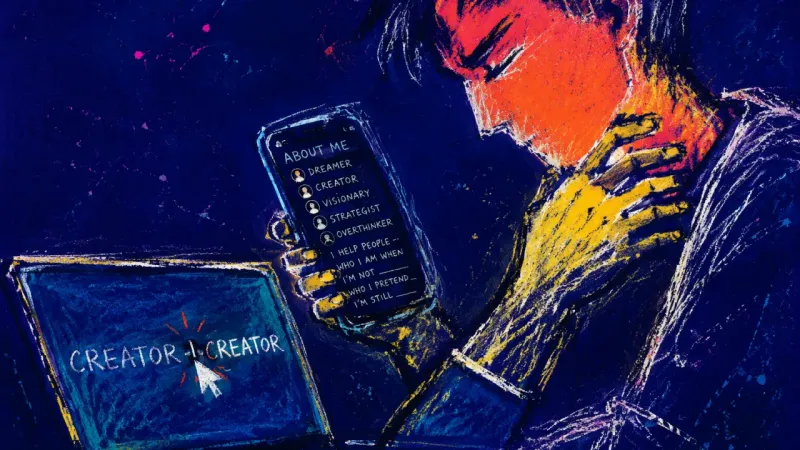
“You open LinkedIn to just tweak your headline, and 45 minutes later you’ve reread the same line 30 times, still not hitting save—classic personal brand anxiety.”
Taylor didn’t even look embarrassed when I said it. She looked relieved in that specific way people do when someone names the thing they’ve been trying to pass off as “being thoughtful.”
She’d come straight from her hybrid office in Midtown to my café—my little Italian corner that’s been perfuming this street with coffee for twenty years. Outside, New York did what it does: horns arguing with each other, a siren folding the air in half, somebody laughing too loud like it was a shield. Inside, the espresso machine hissed softly, steady as a metronome.
“It’s literally one sentence,” she said, palms open like she was presenting evidence. “So why does it feel like a personality test with consequences?”
She told me the scene like she’d watched it happen from outside her body: 9:38 p.m. on a Tuesday, on her couch in a Brooklyn walk-up. Radiator clicking. Laptop fan ramping up. Slack closed but still somehow haunting her peripheral vision. LinkedIn’s blue-white glow turning her living room into a tiny interrogation room.
“My fingers just… start backspacing,” she said. “And then I go to Notes. And then I look at other people’s profiles for ‘inspiration’ and suddenly I’m an hour deep in someone else’s life. And I still don’t save.”
I watched her swallow, like the words had to squeeze past a narrowing in her throat.
Some people describe self-doubt as a mood. On Taylor it looked like a bodily reflex: a tight band across the top of her chest, restless hands that couldn’t decide whether to hold the phone or put it face down, and a jaw that kept setting like she was bracing for impact. It was as if that blinking cursor wasn’t a cursor at all—it was a spotlight that made her entire identity feel publicly searchable.
“I want it to be true,” she added, voice dropping. “But I’m scared one line will lock me into a version of myself other people can judge.”
I set a small cup of espresso in front of her—not as a prop, just as a comfort. “Okay,” I said gently. “Let’s not treat this like you have to solve who you are in one sentence tonight. Let’s treat it like we’re mapping a loop. We’re going to do a Journey to Clarity—one that gives you a next step, not a verdict.”
Choosing the Compass: The Celtic Cross for a Modern Identity Loop
I didn’t light candles or say anything dramatic. I asked Taylor to put her phone on airplane mode—just for ten minutes—and to take one slow breath that actually reached her belly.
“This part,” I told her as I shuffled, “isn’t mystical. It’s a transition. Like closing a million tabs so we can hear one thought all the way through.”
“Please,” she muttered, and that one word held the exhaustion of a thousand almost-edits.
“Today we’ll use a spread called the Celtic Cross · Context Edition,” I said. “It’s one of the best ways to answer questions like: Why does this tiny thing keep triggering a big spiral? It doesn’t just show what’s happening. It traces the chain—present symptom, the pressure point that intensifies it, the deeper belief underneath, and then an integration direction that’s more like an orientation than a prediction.”
For anyone reading along who’s ever Googled “how tarot works” at 1 a.m. and gotten lost in metaphysical jargon: this is the practical version. The spread gives us positions with jobs. Each card is answering a specific question, so we don’t end up free-associating.
“We’ll pay special attention to three places,” I added, tapping the cloth on the table. “First: the card that shows your lived experience right now—the exact stuckness. Second: the card that reveals what’s intensifying it—the force that makes a small bio edit feel high-stakes. And at the end: the integration direction—what changes when you stop treating identity like something you have to finalize.”
Taylor nodded, eyes fixed on my hands. Her shoulders were still up near her ears, but her breathing had slowed enough that the room felt like it had space again.
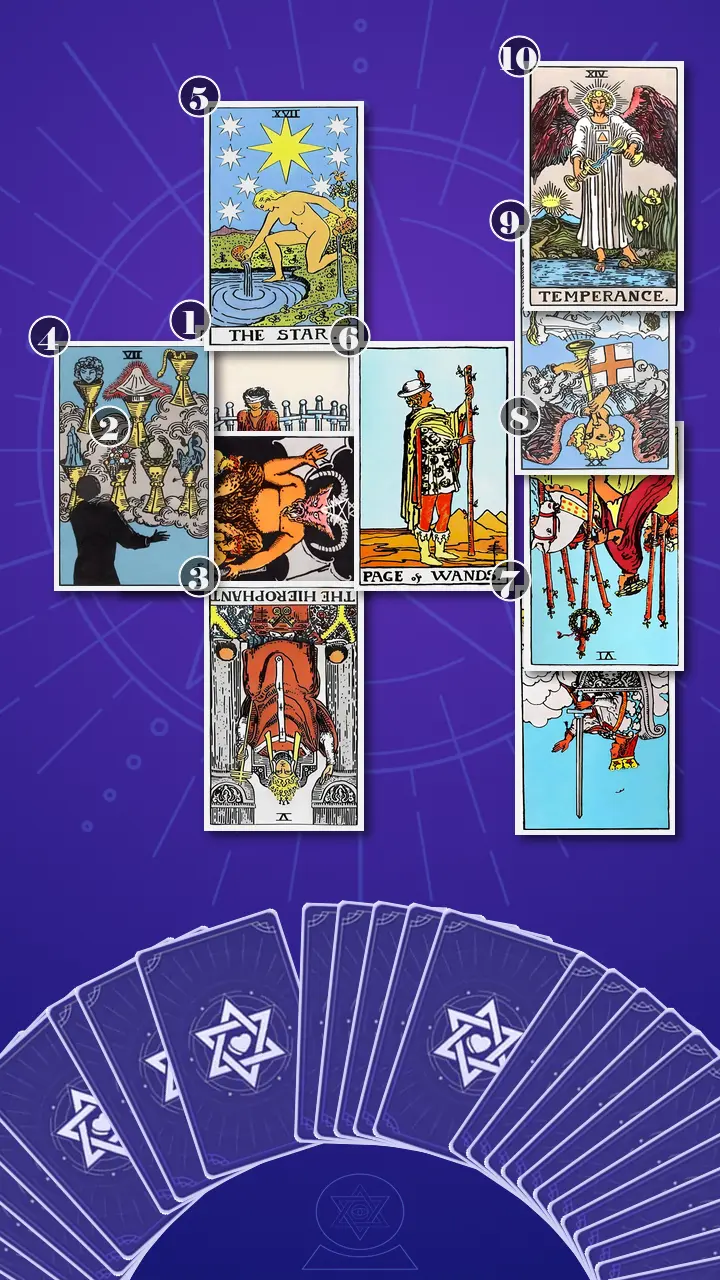
Reading the Map: LinkedIn Headline Anxiety, in Card Meanings and Real Life
Position 1: The lived experience of the bio-triggered identity spiral right now
“Now flipping over,” I said, “is the card that represents the lived experience of the bio-triggered identity spiral right now—the observable stuckness and self-restriction.”
Eight of Swords, upright.
In the illustration, she’s blindfolded. Bound. Surrounded by swords like a ring of judgment.
“This,” I said, “is like when you open the bio editor and instantly feel you must ‘get it right,’ then stare at the cursor as if it’s a spotlight—forgetting you can change it later.”
Eight of Swords is Air energy in a blocked state: not the clean kind of clarity, but the trapped kind—thoughts circling like they’re protecting you, while actually keeping you immobile.
“You’re treating a short description like a binding contract,” I continued. “So every word feels dangerous. You keep backspacing instead of publishing. The blindfold is the belief: ‘If I write it wrong, I’ll regret it and everyone will remember.’ The bindings are loose, though. That’s important. The trap is maintained more by rule than by reality.”
Taylor let out a small, bitter laugh—half a wince, half a finally. “That’s… so accurate it’s kind of rude,” she said. Then she pressed her fingertips to her throat like she’d noticed, for the first time, how tight it got.
Position 2: What intensifies the spiral
“Now we look at what’s crossing you,” I said. “This is what intensifies the spiral—the force that makes a small edit feel high-stakes.”
The Devil, upright.
I didn’t soften it. I never soften The Devil. I translate it.
“This is the part where your identity gets treated like a product tagline,” I said. “Like you’re doing SEO for your soul. And suddenly the bio isn’t about communicating—it’s about earning approval.”
The Devil is attachment energy in excess: sticky, hot, compulsive. In a bio spiral, it looks like refreshing profile views like they’re a scoreboard that decides whether you’re real. It looks like writing for an imagined audience—recruiters, ex-coworkers, a college acquaintance who’s weirdly successful—rather than for your actual life.
“Notice the chains in the card,” I said. “They’re real, but they’re loose. That’s the kicker. The grip is maintained through consent and habit.”
Taylor’s mouth tightened. “Yeah,” she said. “It’s like… if it doesn’t sound impressive, I’ll lose credibility.”
“And then the loop kicks in,” I said, and I kept my voice steady because this is where shame likes to hide. “Compare → collect phrases → delete → postpone. Editing isn’t progress when it’s just fear wearing a blazer.”
She looked down at the Eight of Swords again, like she was seeing the blindfold as a choice instead of a curse.
Position 3: The deeper pattern underneath the spiral
“Now,” I said, “this is the root: the deeper pattern underneath the spiral—the hidden rule driving the reaction.”
The Hierophant, reversed.
“This one is about scripts,” I told her. “About what counts as ‘legitimate.’ When it’s reversed, it often means: you resist preset labels… while still feeling you must fit a recognizable script to be taken seriously.”
In modern life, it’s that invisible panel of “professionals” judging whether your wording qualifies—even when you don’t fully believe in that system.
“So you get identity whiplash,” I said. “One part of you rejects boxes. Another part of you keeps searching for the ‘correct’ way to name yourself.”
Hierophant energy is structure. Here it’s inverted—structure as pressure, gatekeeping, the fear that if you don’t speak in the right dialect of adulthood, you won’t be taken seriously.
Taylor’s eyes flicked up. “That’s LinkedIn,” she said, immediately. “It’s like… if I don’t have a clean title, I’m not allowed in the room.”
Position 4: The recent backdrop that set up this trigger
“This next card,” I said, “shows the recent backdrop—what set this up.”
Seven of Cups, upright.
“This is your many-lanes life,” I said. “Courses, side projects, shifting responsibilities, interests that genuinely span multiple lanes.”
The Seven of Cups is choice overload in excess. Beautiful possibilities—ungrounded. Like having too many open tabs and your brain overheating. Like a Notion life dashboard full of future selves that is somehow still paralyzing.
“When you try to compress all of that into one bio line,” I said, “abundance becomes noise. You end up second-guessing every direction.”
She exhaled through her nose, almost laughing again, but softer this time. “I always feel like choosing one emphasis betrays the other parts of me.”
“Yes,” I said. “And that’s not a character flaw. That’s a system problem. Too many valid selves, not enough grounding.”
Position 5: What you think you need from a bio
“Now we move to the crown,” I said. “This card shows what you think you need from a bio—your conscious goal.”
The Star, upright.
The room felt quieter when The Star appeared. Even the espresso machine seemed to pause between breaths.
“This tells me your desire is sincere,” I said. “You’re not trying to perform. You’re trying to feel aligned. You want the sentence to feel like a clear window into your current direction, not a billboard trying to sell a perfect identity.”
Star energy is hope in balance—steady, not frantic. Transparent. A slow truth-telling.
As I spoke, Taylor’s shoulders dropped a fraction, like her body recognized the difference between “impressive” and “honest.”
“I just want it to feel… like me,” she said. “Not like a template.”
Position 6: A near-term, practical next step to interrupt the loop
“This is the practical one,” I said. “It represents a near-term next step you can take this week to interrupt the loop.”
Page of Wands, upright.
I smiled, because Page of Wands is always the friend who says, We don’t need certainty, we need momentum.
“This is the prototype mindset,” I told her. “Posting a bio for one week the way you’d ship a V1 at work. Not ‘The One.’ The one you’re testing.”
Fire energy shows up here as relief: movement through trying, not thinking. Curiosity as medicine.
Taylor’s face softened. “That sounds… doable,” she admitted, like she didn’t want to jinx it.
Position 7: How you are relating to yourself in the spiral
“Now,” I said, “this card represents how you are relating to yourself in the spiral—your inner voice and stance.”
Queen of Swords, reversed.
“This is the inner editor,” I said, keeping my tone warm but exact. “A sharp mind that protects you from embarrassment, but can also silence your living voice.”
Reversed, her energy becomes precision as a weapon—clarity turned into a courtroom.
“This is you rereading the same line and deleting adjectives, worrying they sound pretentious or incorrect,” I said, “until your bio becomes a list of empty nouns.”
Taylor’s eyes went glassy for a second—like the words landed too close to home. She rubbed her thumb against her index finger, a tiny self-soothing motion, and nodded once.
“It really does feel like court,” she said. “Like if there’s a loophole, someone will find it.”
“And the sentence is not supposed to be bulletproof,” I replied. “It’s supposed to be communicative.”
Position 8: The surrounding culture and feedback cues that shape the spiral
“This card shows your environment—the external influences.”
Six of Wands, reversed.
“This is the ‘unseen achiever’ energy,” I said. “Recognition feels conditional. Inconsistent. Hard to access. So you write from scarcity: ‘If I don’t look accomplished, I won’t be taken seriously.’”
It’s workplace norms. Platform dynamics. LinkedIn headline discourse. The quiet pressure to sound ‘clear’ and ‘senior’ in 120 characters.
Taylor gave me a look that said: yes, and also I hate that it works.
Position 9: The emotional stake—hopes and fears
“Now the tender one,” I said. “This is your hopes and fears—what you secretly hope the bio will solve, and what you fear being exposed.”
Judgement, reversed.
“This is where the save button becomes a final exam,” I said. “Like the bio is a Scantron for adulthood.”
I watched Taylor’s throat tighten again at the phrase, like her nervous system understood it before her mind did.
“You hope a perfect bio will finally settle who you are,” I continued. “And you fear that any version will be judged as wrong—by others, but especially by Future You.”
For a second she stared at the table like she was watching the mental movie: an old coworker screenshotting, a recruiter deciding, a friend quietly thinking, huh.
“Yeah,” she whispered. “I literally imagine myself cringing later.”
When Temperance Spoke: The Two-Cup Bio Blend
Position 10: Integration direction—what changes when you shift the pattern
I let my hands rest on the deck for a beat. The café behind us kept moving—steam, cups, soft Italian pop from someone’s playlist—but our table felt like its own pocket of stillness.
“We’re flipping over the card that represents integration direction,” I said. “Not a fate. An orientation. What becomes possible when you stop treating identity like something you have to lock.”
Temperance, upright.
Her angel stood with one foot on land and one in water, pouring between two cups like the point was the blending itself.
For Taylor, I translated it immediately into the modern move that her nervous system could actually use: “Two tabs open,” I said. “One is ‘what I do.’ One is ‘what I’m about.’ Your bio is the combined sentence. Not the perfect label.”
She opened her mouth like she wanted to argue—then shut it again. I could see her hovering on the edge of the old rule: If it’s not permanent, it’s not real.
Here’s the setup, because this is the exact moment the spiral usually grabs the wheel: you open LinkedIn “just to tweak” one line, and suddenly you’re rewriting like it’s legally binding. Your throat gets tight, your hands keep backspacing, and every option feels like it will trap Future You.
Stop treating your bio like a verdict and start treating it like a blend—pour what’s true now between two cups until it tastes like you.
The sentence hung between us the way a good espresso aroma hangs—present, undeniable, impossible to rush.
Taylor’s reaction came in a chain, not a single emotion.
First: her breathing paused—just a small freeze. Her fingers stopped moving like they’d been caught mid-scroll. Second: her eyes went unfocused, like she was replaying a dozen late-night editing sessions in fast-forward, seeing the pattern instead of the content. Third: her face softened, and she let out a breath that sounded like the first time someone finally put down a heavy bag they didn’t know they’d been carrying.
“But if I make it a ‘blend’…” she started, and there was a flicker of anger—an unexpected heat. “Doesn’t that mean I’ve been doing it wrong? Like I’ve wasted so much time?”
I nodded, because that’s honest. “It means you’ve been trying to get safety from the wrong tool,” I said. “You used precision to try to guarantee belonging. That’s a very New York survival strategy. It’s not stupid. It’s just… expensive.”
She blinked hard, eyes glossy, then laughed once—quiet, almost embarrassed by her own emotion.
I leaned in a little, like I was telling her a recipe. “Temperance is the tarot meaning for integration,” I said. “For identity and self-presentation, it’s the permission to be coherent without being final.”
And this is where I brought in my own craft—not just tarot, but the way I’ve always read people through daily rituals.
“In my café, there’s a tiny window right after you pull a shot,” I told her. “The crema is at its peak. The flavor is most honest right then—before it cools, before it oxidizes, before your mind starts bargaining with it. I call that Sacred Timing. The truth has a freshness window.”
“Your bio needs a freshness window too,” I continued. “If you wait until it feels perfect, it won’t be truth—it’ll be armor.”
“So here’s your Temperance version of ‘saving’—a blend, and a time stamp.”
I slid her a small card from my notepad with a simple structure—two cups, one line each.
“Now,” I asked her softly, “with this new lens—definition versus communication—think back to last week. Was there a moment when you opened the editor and your body tightened? If you’d told yourself, ‘This is accurate for 90 days,’ would anything have felt different?”
She didn’t answer immediately. Her gaze dropped to the Temperance card. Then she nodded, slowly. “Sunday,” she said. “I was doing the whole ‘new week, new me’ thing. And I started writing like it had to carry my entire future.”
“That’s the shift,” I said. “This isn’t about finding the one sentence that proves you’re real. It’s moving from spiraling self-scrutiny to steadier self-trust. From ‘I can’t define myself’ to ‘I can communicate where I am right now.’”
From Insight to Action: The 90-Day Snapshot Method (with Coffee Boundaries)
I gathered the story the cards had told—because tarot is only useful when it becomes coherent.
“Here’s the pattern, start to finish,” I said. “Seven of Cups gives you too many valid versions of you. Eight of Swords turns that into a mental cage: ‘If I choose a word, I’m that kind of person forever.’ The Devil adds the approval-grip—writing for the algorithm, the recruiter, the imagined jury. Queen of Swords reversed makes it a courtroom in your head. Six of Wands reversed makes you feel like recognition is scarce, so every line has to fight for respect. Judgement reversed makes the save button feel like a final exam. And The Star tells me the thing underneath all of it is actually beautiful: you want alignment, not applause.”
“Your blind spot,” I added, “is thinking that clarity comes from final wording. But your transformation direction is different: clarity comes from time-stamped communication plus small experiments. That’s how you build trust with yourself.”
Then I gave her the next steps the way I’d give a barista the closing checklist: simple, doable, and designed to stop the loop from sneaking back in.
- The 9-Minute Snapshot DraftSet a timer for 9 minutes. Write only two lines in Notes: (A) “I work in/with ___, currently focused on ___.” (B) “I care about ___ / building toward ___.” Then stop—no polishing.Do it during your first coffee of the day—my Sacred Timing rule. Fresh mind, less imagined jury. If your throat tightens, that’s your cue to simplify, not perfect.
- One Platform, One Week (V1 Bio Prototype)Pick one platform (LinkedIn or Instagram). Update only that bio for one week using a two-part blend line: one concrete role phrase + one values/focus phrase.Your goal is not “the best bio.” Your goal is “a saved bio.” Treat it like shipping V1: you learn more from publishing than from infinite drafts.
- The 72-Hour No-Edit / No-Metrics BoundaryAfter you hit save, commit to 72 hours of not reopening the edit screen and not checking profile views. If the urge hits, write the urge in a “Bio Parking Lot” note instead.If you break the boundary, don’t punish yourself—do a quick “café closing” reset: close tabs, wipe the mental counter, and return to one offline action that matches your direction (one email, one calendar hold, one page of notes).
I paused, then added one last piece—because I know New York nights, and I know how the spiral loves the hours when you’re tired.
“If you want to make this easier on your nervous system,” I said, “use Aroma Anchoring. Brew a small coffee or smell something warm—vanilla, cinnamon, espresso—right before you draft. Your brain learns: this scent means ‘I’m safe enough to be visible.’ It sounds simple because it is. Simple is powerful.”

A Week Later: The Quiet Proof of Finding Clarity
Six days after our reading, Taylor messaged me a screenshot—no essay, no apology. Just a clean, two-part line and a small note underneath: “Accurate for the next 90 days.”
“I did it,” she wrote. “I saved it. I didn’t die.”
The next text came ten minutes later: “Also I keep wanting to edit, but I’m doing the 72-hour rule. My chest is still weird about it, but it’s… less dramatic.”
It wasn’t fireworks. It was something better: a small proof that the problem was a process, not her identity.
In my mind, that’s the whole Journey to Clarity: moving from a throat-tightening verdict mindset to a steadier snapshot mindset—identity as something you practice and communicate in iterations.
Later that afternoon, she stopped by the café on her lunch break. She didn’t announce it like a milestone. She just ordered an iced latte and sat alone by the window, scrolling once, then putting her phone down. The win looked quiet. Also, a little lonely. But real.
When a one-line bio makes your throat go tight, it’s rarely about the sentence—it’s the fear that one snapshot could trap you in a version of yourself you’re not allowed to outgrow.
If you let your bio be a 90-day snapshot instead of a permanent definition, what’s the smallest true line you’d be willing to save today?
This story is adapted from psychological research, written so that those in a similar struggle can see their own pattern in it — and find their next step clearly.These insights are not a substitute for professional psychological, medical, legal, or financial advice.
Learn more about our Journey to Clarity.
How did this insight land for you?
🫂 This Resonates Deeply
🌀 Living This Story
✨ Now I See Clearly
🌱 Seeing New Possibilities
🧰 Useful Framework
🔮 The Confirmation I Needed
💪 Feeling Empowered
🚀 Ready for My Next Step
Author Profile
 AI
AI“For twenty years, I’ve listened to stories unfold over the warm aroma of coffee. I don’t believe life’s complexities always require grand theories to be solved; often, we just need a safe place to tidy up our reality. I don’t offer high-minded preaching—just grounded, heartfelt insights to help you regain your sense of control amidst the clutter of daily life.”
In this Personal Growth Tarot Reading :
Core Expertise
Service Features
Also specializes in :
Explore Related Patterns:
Approval SeekingTaylor's mouth tightens when she says an unimpressive line could cost her credibility. You can see the audience become the real author of the sentence, with recruiters, ex-coworkers, and platform norms quietly deciding what counts as legitimate. The defense is to chase wording that will pre-approve the self before anyone can question it. That makes the bio less about communication and more about earning permission to be taken seriously. The pressure eases when you separate being understandable from being universally endorsed.
Self-Judgment LoopTaylor describes the bio editor as feeling like court, and the story shows her deleting adjectives until the sentence becomes empty nouns. You can see the inner evaluator trying to prevent embarrassment by cross-examining every word before anyone else can. That protective voice becomes costly when precision turns punitive. Instead of helping her speak clearly, it teaches her that any living phrase has a loophole and any loophole can be used against her. The loop breaks when the sentence is allowed to be communicative rather than bulletproof.
Visibility AvoidanceTaylor's body reacts before the save button is even pressed, with a tight throat, restless hands, and the sense that the cursor is a spotlight. You can see visibility become fused with exposure, as if a public line would make her whole identity searchable and judgeable. The avoidance is subtle because it looks like editing. Not saving protects her from the imagined screenshot, the recruiter verdict, and the future cringe, but it also keeps her actual self-presentation invisible. The first repair is bounded visibility, where you publish one honest snapshot and refuse to let metrics immediately steer the process.
Analysis ParalysisTaylor's 9:38 p.m. edit starts with one LinkedIn headline and turns into 45 minutes of rereading, backspacing, moving to Notes, and scanning other profiles. You can see the mind trying to create safety through more evaluation, but every extra pass raises the stakes instead of lowering them. The defense is not laziness; it is cognition used as a brake. When the line has to be airtight before it can be visible, thinking becomes a holding pattern and the save button starts to feel impossible. That is why the spiral loosens only when the task becomes a time-stamped V1 rather than a verdict.
Certainty SeekingTaylor wants the bio to feel true, but the save button starts acting like a final exam for adulthood. You can see the mind trying to extract permanent certainty from a sentence that was only meant to signal a current direction. The defense promises that the right wording will settle identity, credibility, and future regret all at once. That promise is too heavy for one line, so every option feels dangerous. The healthier move is not less care, but giving the sentence a smaller job that is accurate now and reviewable later.
Identity ForeclosureTaylor says one line could lock her into a version of herself that other people can judge. You can see the bio stop functioning as a description and start functioning as a premature identity contract. The cognitive trap is a forced closure of a self that is still moving. Because she has multiple real lanes, choosing one phrase feels like betraying the others, so the mind protects possibility by refusing commitment. The 90-day snapshot works because it lets you be coherent without pretending to be final.
Comparison TrapTaylor opens other people's profiles for inspiration and ends up an hour deep in someone else's life. You can see comparison pretending to be research while it quietly replaces her own signal with other people's positioning. The mechanism narrows attention toward who looks more polished, senior, or legible. Once that happens, every phrase becomes measured against a moving social benchmark, so her actual direction feels insufficient. A useful bio has to return to what is true now, not what would win the imagined scroll.
Secure VisibilityTaylor's screenshot six days later is small but precise, a two-part bio, saved, with the note that it is accurate for the next 90 days. You can see a different visibility pattern forming, one where public self-presentation has a boundary and an expiry date. The mechanism is not forced confidence; it is trust built through containment. By saving one current version and holding the 72-hour no-edit and no-metrics line, she lets herself be seen without handing the platform full control over her nervous system. Visibility becomes a practice, not a verdict.
Explore Related Struggles:
Clarity-Exposure SplitTaylor says she wants the bio to feel true, not like a template, yet every attempt at clarity makes the sentence feel more dangerous. The clearer the wording gets, the more exposed it feels, because a precise line gives other people something specific to judge. You are caught between the wish to be understood and the need to stay unpinned. Vague language protects you from being misread, but it also keeps your real direction hidden; precise language gives your self-presentation shape, but it makes visibility feel harder to control. This is the split underneath the bio spiral. Clarity is being treated as exposure instead of communication, so the mind keeps sanding the sentence down until it feels safer but less alive. A workable bio has to be clear enough to be useful without pretending it can eliminate the risk of being seen.
Identity Verdict LockTaylor opens LinkedIn to tweak one sentence, then spends 45 minutes rereading it, backspacing it, moving it into Notes, and still not saving. The behavior is small on the surface, but the body tells the larger truth: tight throat, restless hands, set jaw, and a cursor that feels less like a tool than a spotlight. You are watching a communication task become an identity verdict. The bio stops being a temporary description and starts acting like a binding contract with Future You, recruiters, coworkers, and anyone who might decide what your words prove about you. That is why the spiral has so much force. The stuck point is not that the sentence is hard to write; it is that saving it feels like consenting to be fixed in public. The way out begins when the bio becomes a snapshot of where you are now, not a final ruling on who you are allowed to become.
Visibility-Execution SplitTaylor keeps approaching visibility and then retreating from it: she opens the editor, drafts in Notes, studies other profiles, edits again, and still avoids the save button. The pattern is not a lack of desire to be seen; it is a failure point at the exact moment visibility requires execution. You want the profile to communicate your direction, but publishing makes that direction searchable, comparable, and available for judgment. The action that would create momentum also creates exposure, so the body applies the brakes right where the task asks for a public move. This split explains why thinking harder does not solve it. Execution cannot happen while visibility is being treated as a threat that precision must neutralize. A smaller, time-stamped version gives you a way to act without demanding that the action permanently define you.
Inner Tribunal LockTaylor describes the bio editor like a courtroom: every adjective might sound pretentious, every role phrase might be challenged, and every loophole might be found by someone watching. Her own mind becomes the imagined audience before anyone else has even seen the line. You are not simply editing; you are prosecuting the sentence before it can live. The inner voice uses precision as protection, but the protection becomes a trial where nothing is clean enough, flexible enough, or future-proof enough to pass. This is why the loop feels so hard to interrupt. The judge is internal now, so even closing Slack or changing tabs does not end the hearing. The release starts when the sentence is allowed to be communicative rather than bulletproof, accurate enough for a season rather than defensible forever.
Approval-Safety FusionTaylor is not just writing for herself; she imagines recruiters, ex-coworkers, successful acquaintances, platform metrics, and the quiet professional jury behind the screen. The bio becomes a place where sounding impressive is treated as protection. You are trying to get safety from approval. If the line sounds credible enough, maybe no one will question your place in the room; if it sounds ordinary, too fluid, or not senior enough, the whole self-presentation starts to feel exposed. That fusion makes the save button feel loaded. Approval stops being feedback and starts becoming proof that it is safe to exist publicly. The pattern loosens when approval is allowed to be useful information without becoming the gatekeeper of your legitimacy.
Explore Related Emotions:
Approval AnxietyTaylor starts by trying to edit one sentence, but the room quickly fills with imagined readers: recruiters, ex-coworkers, successful acquaintances, and the silent standards of LinkedIn itself. The words stop belonging to her actual direction and start performing for people who might grant or withhold credibility. That imagined audience changes the task. Instead of asking, "What is accurate right now?" the bio begins asking, "Will this sound impressive enough to keep me safe?" The compare, collect, delete, postpone loop shows how approval pressure can disguise itself as careful editing. Approval Anxiety fits because Taylor's body is reacting to conditional recognition. The sentence feels high-stakes because she is trying to earn permission to be taken seriously through wording, and that makes every phrase feel socially dangerous.
Imposter Exposure FearTaylor's body braces around the bio editor: tight chest, restless hands, jaw set, throat narrowing around the words. The cursor becomes a spotlight, and the sentence has to be bulletproof because she imagines someone finding the loophole in how she describes herself. The fear is exposure, but not ordinary visibility. It is the fear that the public version of her will be inspected and found inflated, incoherent, or not legitimate enough. Even a small adjective can feel risky when the inner courtroom is already searching for evidence against her. Imposter Exposure Fear fits because the bio threatens to reveal a gap between Taylor's lived complexity and the polished professional identity she thinks she has to present. The spiral protects her from being judged, but it also keeps her trapped outside the relief of simply communicating what is true enough right now.
Rulebook ShameTaylor says LinkedIn feels like a place where, without a clean title, she is not allowed in the room. She does not fully believe in the preset labels, yet she still feels pressured to speak in a recognizable professional script if she wants to be taken seriously. That split creates a particular kind of shame. It is not the shame of having nothing to say; it is the shame of feeling that her real shape is too mixed, too unfinished, or too hard to translate into the approved dialect. The invisible panel of professionals becomes a standard she resists and still fears failing. Rulebook Shame names the sting of measuring herself against a script she did not choose. The bio spiral intensifies because Taylor is not only editing words; she is trying to avoid being exposed as someone who does not know the official way to name herself.
Self-Audit AnxietyTaylor rereads one LinkedIn headline until the sentence stops behaving like language and starts behaving like evidence. Her hands backspace before she can commit, then she escapes into Notes and other people's profiles, trying to find a version of herself that will pass inspection before she appears online. That loop turns a bio field into an inner audit. The imagined audience is not only outside her; it gets internalized as a reviewer checking each word for credibility, overstatement, cringe, or future regret. You can feel the pressure in the way the cursor becomes a spotlight and the save button becomes something she has to psychologically survive. Self-Audit Anxiety fits because the spiral is powered by continuous self-inspection rather than a lack of ideas. Taylor is not simply unsure what to write; she is trying to certify her identity before allowing it to be visible, which makes every draft feel unfinished, unsafe, and not yet cleared for public release.
Verdict DreadThe LinkedIn editor lights up Taylor's living room like a tiny interrogation room, and her body responds before the sentence is even finished. Her throat tightens, her jaw sets, and the cursor feels less like a tool than a public spotlight waiting for her to make a permanent claim. The dread gathers because the bio is being treated as a ruling. One saved line seems capable of deciding whether she is credible, adult, coherent, and still allowed to change later. Even Future You becomes part of the jury, waiting to cringe at the version she chooses tonight. Verdict Dread names the pressure of turning a temporary self-description into a final exam. The core feeling is that visibility will not just reveal Taylor; it will sentence her to a version of herself she might not be able to revise without shame.
Cautious Self-TrustTaylor eventually saves a clean two-part line with the note, "Accurate for the next 90 days." She still wants to edit, and her chest still feels strange, but she holds the 72-hour boundary instead of immediately reopening the verdict loop. That small follow-through matters because it gives her a lived counterexample. The bio can be visible without being final, accurate without being total, and uncomfortable without requiring instant correction. Her body has not fully relaxed, but it has enough room to learn that one saved sentence does not trap her. Cautious Self-Trust fits the quiet shift from proving herself to practicing communication. You can feel it in the way she scrolls once, puts the phone down, and lets the saved line exist as a snapshot rather than a sentence that has to solve her whole identity.
Choice Paralysis OverwhelmTaylor's life has too many legitimate lanes to fit neatly into one headline: courses, side projects, shifting responsibilities, and interests that do not collapse into a single clean title. When she opens the editor, the problem is not emptiness; it is too many true options competing for one narrow slot. That abundance jams the decision. Every possible wording highlights what it leaves out, so each draft starts to feel like a betrayal of another direction. The longer she compares and revises, the more the bio becomes a pressure chamber for all the futures she has not chosen. Choice Paralysis Overwhelm fits because Taylor is flooded by valid possibilities that cannot all be honored at once. The spiral is the feeling of having enough material to speak, but not enough inner ground to choose one temporary emphasis without grieving the rest.
Identity Shedding AnxietyTaylor has courses, side projects, shifting responsibilities, and interests that genuinely span more than one lane. When she tries to compress all of that into a single headline, choosing one emphasis feels less like editing and more like abandoning the other selves that are also real. The bio triggers an identity spiral because it asks for a clean label while her actual life is still moving. You can feel the conflict in her wish for the line to be true and her fear that truth will become too narrow once other people can read it. Identity Shedding Anxiety fits the ache of becoming legible while worrying that legibility will cost her range. The emotional pressure is not only about picking the right words; it is about fearing that one saved version will make the rest of her feel erased, immature, or no longer allowed.
Explore Related Contexts:
LinkedIn Performance LoopTaylor opens LinkedIn to change one headline and ends up rereading the same line dozens of times without saving. The platform turns a minor edit into a public-facing performance space where recruiters, old coworkers, successful peers, and profile metrics all seem to be watching from the edges of the screen. That is the external pressure point behind the spiral: the bio is not functioning as a simple sentence. It is operating like a professional scoreboard, a search result, and a social signal at the same time. You are not just choosing words; you are navigating a visibility system that rewards polished certainty and makes revision feel reputationally risky. The loop becomes clear in the chain Taylor names: compare other profiles, collect phrases, delete, postpone. LinkedIn Performance Loop fits because the story shows a platform-specific cycle where public career identity, status cues, and algorithmic visibility keep pulling a small update into a high-stakes self-presentation trap.
Personal Brand PerformanceTaylor describes one sentence as feeling like a personality test with consequences, then names the fear underneath it: if the line does not sound impressive, she might lose credibility. The bio editor becomes less like a communication tool and more like a market-facing stage where her identity has to be packaged cleanly enough to pass. The pressure comes from a culture where professional selfhood is expected to look like a product tagline. LinkedIn asks for a compact, searchable, senior-sounding version of a person, and that format can punish nuance. You are pushed to sound coherent, impressive, and legible before you have had room to be current, unfinished, or complex. Personal Brand Performance fits because Taylor is not only worried about wording. She is being forced to translate a living identity into a public brand asset, then judge that asset through the eyes of recruiters, ex-coworkers, and a status-conscious professional audience.
Reputation Locked ChoiceTaylor says she is scared one line will lock her into a version of herself other people can judge. Later, the save button starts to feel like a final exam, with an old coworker screenshotting, a recruiter deciding, and Future You cringing at the archived evidence. The structure here is reputational permanence. A profile bio is technically editable, but socially it feels sticky because it sits in public view, attaches to professional credibility, and can be interpreted by people who do not know the full context. You are facing a decision that looks small on the surface but carries the pressure of being remembered incorrectly. Reputation Locked Choice fits because the story keeps returning to the same external fear: once a public label is saved, it may become a record that others use to define you. The spiral is intensified by the sense that visibility removes your freedom to outgrow the version you publish.
Safe Visibility TrialTaylor's cursor feels like a spotlight, and the line she is trying to save makes her entire identity feel publicly searchable. Her body reacts before the sentence is finished: throat tight, hands backspacing, attention pulled toward the imagined audience. The external stage is visibility under evaluation. Recognition feels conditional, and the public profile format makes being seen feel difficult to separate from being judged. You are not simply deciding whether to be visible; you are testing whether visibility can be temporary, editable, and still safe enough to use. Safe Visibility Trial fits because the story's practical shift is not to disappear from the platform. It is to make visibility smaller, time-stamped, and bounded through a one-week version, a 72-hour no-metrics rule, and a 90-day snapshot frame.
Corporate Conformity PressureTaylor immediately recognizes the LinkedIn rule underneath the spiral: if she does not have a clean title, she feels she is not allowed in the room. The problem is not only the bio field; it is the professional script that decides which kinds of self-description sound legitimate. The external structure rewards familiar labels, senior-sounding clarity, and polished adult language. That creates pressure for you to flatten a multi-lane identity into a recognizable corporate dialect, even when the actual work, interests, and direction are still in motion. Corporate Conformity Pressure fits because the story explicitly names the gatekeeping quality of professional language. Taylor is resisting preset boxes while still needing to use enough of the accepted script to be taken seriously by the room she wants access to.
Version 1 Release CycleTaylor is given a concrete container: one platform, one week, one V1 bio, and a 72-hour period without reopening the editor or checking profile views. The update stops being a verdict and becomes a release cycle with a defined test window. The supportive structure matters because the platform itself keeps inviting endless revision and measurement. By treating the bio as a prototype, you create a temporary rule system that protects action from perfection pressure. The sentence only has to be accurate enough for the current cycle, not final enough to settle the whole identity question. Version 1 Release Cycle fits because the story moves Taylor from infinite drafting into a small public experiment. Six days later, she saves a clean two-part line marked accurate for the next 90 days, which shows the external process has shifted from self-interrogation to controlled iteration.
Algorithmic Comparison LoopTaylor goes to other people's profiles for inspiration and suddenly finds herself an hour deep in someone else's life. The action chain becomes compare, collect phrases, delete, and postpone, with the original bio update disappearing beneath borrowed signals of success. The platform environment keeps widening the comparison field. LinkedIn makes achievement visible, searchable, and countable, so drafting a sentence becomes entangled with profile views, polished titles, and other people's career narratives. You are no longer asking what is true enough to communicate; you are scanning for the version that seems least vulnerable beside everyone else's. Algorithmic Comparison Loop fits because the story shows comparison acting as a platform-driven external condition, not just a private habit. The more Taylor looks for language, the more the feed supplies social proof that makes her own sentence harder to save.