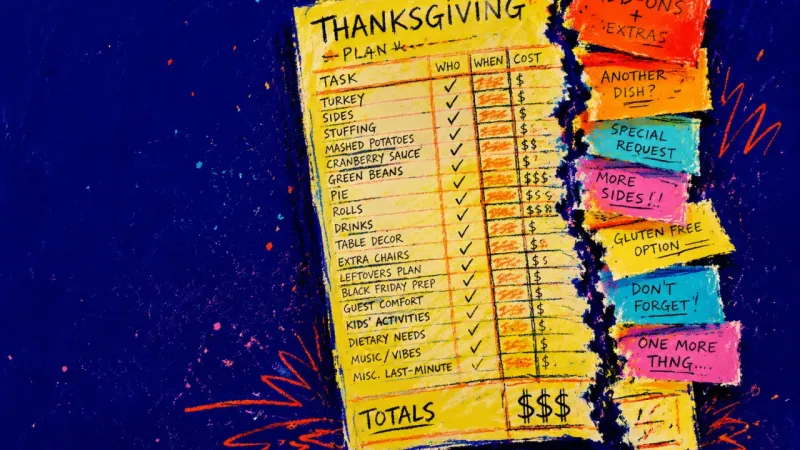
The 👍 That Became a Verdict
“So you can host, right?” followed by a cascade of 👍 reactions—before you’ve even replied—has a way of turning your stomach into a dropped elevator.
Taylor joined my Zoom call from her Brooklyn walk-up with the kind of posture I recognize instantly: shoulders lifted like they were trying to become earrings, jaw set as if her teeth were holding a secret together. The laptop glow lit her face from below, and behind her I could hear it—radiator clicks, that dry apartment air, the tiny background soundtrack of a city winter gearing up.
She didn’t waste time. “I didn’t even say yes,” she said, and her voice had that careful calm people use when they’ve already been furious in their head for hours. “But I’m… already doing it. I opened a spreadsheet. I have tabs. Groceries, timeline, allergies. And my phone keeps buzzing with ‘quick add-ons’ like it’s a work project.”
I watched her eyes flick to the side—where her group chat likely lived—then back to me, like she was hoping I’d confirm she wasn’t imagining the whole thing.
“I want a shared, supportive Thanksgiving plan,” she said, and then her breath hitched on the next sentence. “And I’m terrified that a clean ‘I can’t host’ will make me seem selfish. Like… I’ll cost myself connection.”
It wasn’t just stress. It was the very specific flavor of resentment that happens when you’re quietly assigned emotional labor and logistical labor, and then told you’re “so good at this” as if that’s a compliment and not a trap.
In her body, it looked like this: a tight collar of muscle around her neck, a heavy chest when she opened the chat, and a restless urge to just get it handled—like she was trying to outrun awkwardness with Google Sheets.
“Okay,” I said gently. “We’re going to treat this like a Journey to Clarity. Not ‘how do I host perfectly,’ but ‘what boundary stops me from being volunteered in the first place.’ We’ll make a map you can actually use before the next thumbs-up turns into a legally binding contract.”

Choosing the Compass: The Transformation Path Grid (6) for Consent-Based Boundaries
I asked Taylor to take one slow breath and hold her question in her mind—not like a spell, more like closing the browser tabs you didn’t realize were running. While I shuffled, I could hear her exhale through her nose, that small sound of someone trying not to brace.
“For this,” I told her, “I’m using a spread I rely on for group dynamics and people-pleasing boundaries: the Transformation Path Grid (6) · Context Edition.”
For anyone reading along who’s ever Googled how do I stop getting volunteered to host Thanksgiving or group chat decided I’m hosting and I panicked: this situation isn’t a simple two-option decision. It’s a repeating pattern—an external dynamic (assumptions in the chat) plus an internal belief (that belonging has to be earned through usefulness). This grid works because it separates the layers cleanly: what’s happening on the surface, the exact moment the boundary collapses, the deeper fear underneath, and then the turning point that converts insight into a practical script.
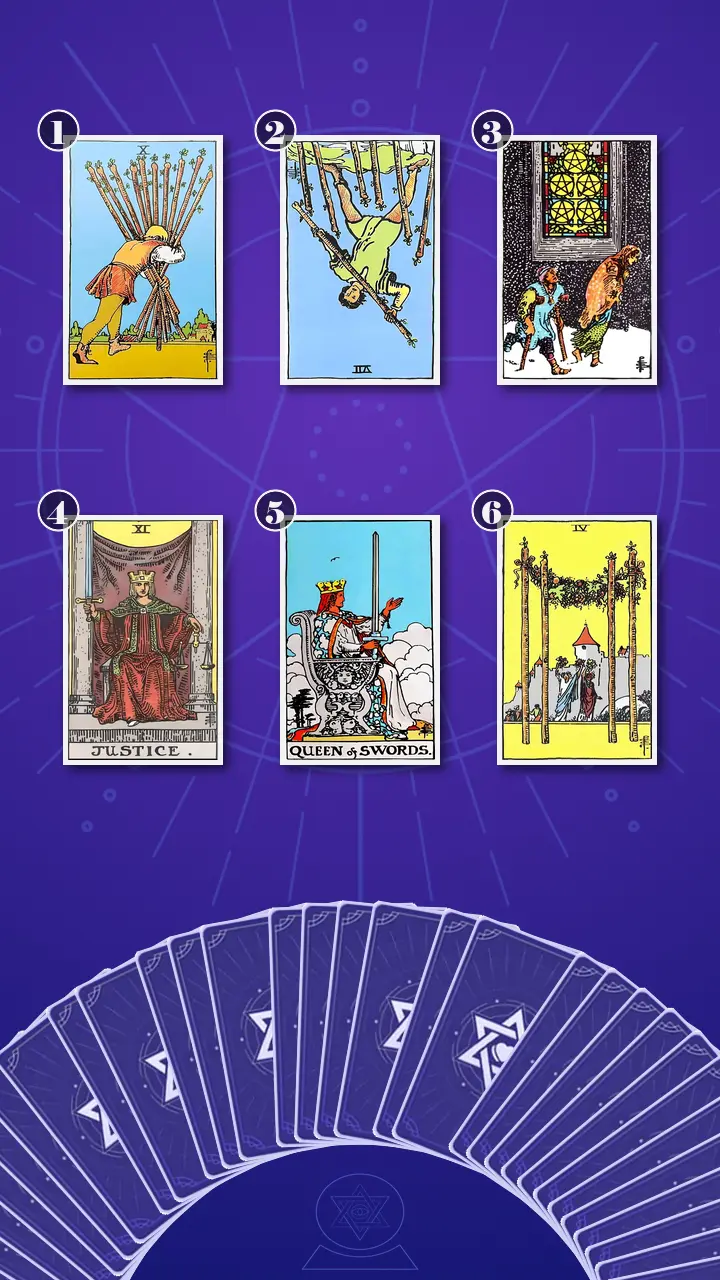
“Here’s how we’ll read it,” I said, laying the cards into a 2x3 grid like a tiny project board. “The top row shows the build-up: your current reality, the blockage moment, and the root driver. Then we drop to the bottom-left for the pivot—the boundary principle that flips the whole dynamic. After that, we move into what you say and do, and what the holiday can feel like if you hold the line.”
I paused. “And one more thing, Taylor—because you’re a project coordinator and your brain is good at turning everything into a plan: in this reading, we’re going to keep asking, ‘Is this consent… or just momentum?’”
Reading the Map: The Burden You’re Already Carrying
Position 1 — What you’re carrying in concrete terms
“Now we’re opening the card that represents The visible ‘Thanksgiving host spreadsheet’ reality: what you are currently carrying and doing in concrete terms,” I said, and turned the first card over.
Ten of Wands, upright.
I didn’t need to dramatize it. The image does the work: a figure bent forward beneath a bundle that’s technically carryable… until you notice how far they still have to go.
“This is exactly the week-before-Thanksgiving vibe,” I told her. “You’re running your friend group like a client project: tracking dietary restrictions, arrival times, who’s bringing what, backup plans, and the vibe—all from a small apartment. You meant to ‘just coordinate,’ but now you’re the only person holding the whole system, and the spreadsheet has quietly become a contract nobody signed but you.”
In terms of energy, the Ten of Wands is excess—competence turned up so high it becomes a burden. It’s not that you can’t do it. It’s that your ability is functioning like an open door: everything walks in.
Taylor let out a short laugh that had a bitter edge to it. “That’s… yeah. That’s actually brutal.” She rubbed her jaw like it was sore from holding back words. “It starts as ‘I’ll just organize,’ and then suddenly I’m buying oat milk I didn’t plan for because someone texted ‘vegan gravy option?’ like I’m a catering company.”
“And here’s the line I want you to remember early,” I said, because it’s the hinge of this whole story: A spreadsheet can’t replace consent.
Position 2 — Where your stance collapses in real time
“Now we’re opening the card that represents The specific boundary failure point: how you get socially ‘volunteered’ and where your stance collapses in real time,” I said.
Seven of Wands, reversed.
“This is the exact moment on the L train,” I said, “where the group chat pings, someone assumes you’ll host, others react with ✅👍, and you feel watched. Instead of holding your ground, you soften—‘I think I can make it work’—and the social momentum locks you in. By the time you want to push back, it feels ‘too late,’ so you over-function to avoid friction.”
The Seven of Wands is normally boundary defense—holding your ground even when you feel outnumbered. Reversed, that energy is blocked. Not because you don’t have a spine. Because your nervous system reads the moment as socially dangerous.
I saw her swallow, throat bobbing. So I slowed down and let the inner loop play out, exactly as it happens.
“You type: I can’t host this year.” I mimicked the rhythm of texting. “Your face gets hot. Your shoulders climb. You imagine silence in the chat, or someone replying, ‘Oh… okay.’ Your thumb hovers. You delete it. Then you send: I think I can make it work?”
“Because ‘maybe’ feels like it buys you belonging,” I added, “even though it sells you out later.”
Taylor’s eyes flicked down and away, like she was watching a replay. “It’s like… stepping onto an escalator,” she said quietly. “I didn’t choose to get on. But once I’m on it, it’s moving, and I’m like, ‘Well, I guess we’re doing this.’”
“Exactly,” I said. “And I want to put this in plain English: A thumbs-up reaction isn’t an agreement you made. The Seven of Wands reversed is the part of you that treats reactions as commitments.”
Position 3 — The fear underneath the spreadsheet
“Now we’re opening the card that represents The deeper driver under the pattern: the insecurity or need that makes over-functioning feel safer than saying no,” I said, and turned the third card.
Five of Pentacles, upright.
“Under the hosting stress is a fear that’s not really about turkey,” I told her. “It’s about belonging. You worry that if you don’t provide the warm apartment, the plan, the emotional smoothing, you’ll be quietly demoted in the group. So you choose usefulness over uncertainty: you’d rather be exhausted inside the event than risk feeling ‘outside’ it.”
The Five of Pentacles carries scarcity—a deficiency of felt support. It’s the warm window you can see but don’t feel entitled to enter unless you’ve earned it.
Taylor’s fingers tightened around her mug, then loosened. “It’s embarrassing,” she said. “Like I’m 28 and I’m still acting like friendship is… a subscription I have to keep paying for with premium features.”
“It’s not embarrassing,” I said. “It’s human. And it explains why your boundary collapses. If your brain believes ‘a clean no risks exclusion,’ then the spreadsheet becomes your workaround. It turns a terrifying social moment into a task list you can control.”
As I spoke, I had one of those small, private flashes of my other life: standing under the planetarium dome in Tokyo, pointing out how objects with more mass pull other bodies into orbit. Gravity is not a moral judgment. It’s a force. If you become the most reliable mass in a group, people will begin to revolve around you—without anyone consciously deciding that’s what’s happening.
“Taylor,” I said, “this is where we shift from blaming yourself to understanding the physics of the pattern.”
When Justice Spoke: The Fairness Rule That Stops You Being Volunteered
Position 4 — The boundary principle that flips the dynamic
I held my hand over the next card for a beat, because I could feel the pivot in the spread the way I feel a planetarium audience go quiet when the stars fully appear.
“Now we’re opening the card that represents The boundary principle that flips the dynamic: the rule or standard that makes consent and fairness explicit,” I said.
Justice, upright.
“This is the boundary that stops you from being volunteered,” I told her. “You stop treating implied expectations as agreements and you set one clean standard: no one is assigned a role—host, shopper, cook, cleanup—unless they explicitly agree.”
Justice is balance through structure. The scales are your spreadsheet instinct—measuring, allocating, making things fair. But the sword is what your spreadsheet can’t do: one clean sentence. It’s consent. It’s accountability. It’s a boundary as policy, not as a mood.
And this is where I brought in my own lens—my Galactic Gravity Analysis, the tool I use when someone is being pulled into a role by invisible forces.
“Right now,” I said, “you’re the gravitational center of the holiday. Not because you asked to be. Because you’re competent, responsive, and you care. In orbit models, the heaviest body dictates everyone else’s path. In friend groups, the most reliable person becomes the ‘default host’ the same way—everyone’s plans curve around you.”
“Justice changes the mass distribution,” I continued. “It says: we are not letting gravity decide. We are choosing terms. And terms are neutral. They’re not an argument about who’s generous enough.”
Taylor’s eyebrows snapped together. Her chin lifted a fraction—almost defensive.
“But if I do that,” she said, a sharpness coming through, “doesn’t it mean I’ve basically been… letting this happen? Like I’ve been the problem?”
Here was the “unexpected reaction” I always watch for: not relief, but the sting of self-blame masquerading as honesty.
I kept my voice steady. “No. It means you’ve been using the tools that worked at work—over-responsibility, smoothing, planning—to survive social uncertainty. That’s not a character flaw. It’s a strategy that’s costing you more than it used to.”
The Aha Moment — Setup
You could see it on her face: that midnight moment where the spreadsheet feels like relief—until the phone lights up with one more “can we add…” and her chest goes heavy, because she realizes she’s hosting by default, not by choice. She wants warmth and connection, and she’s trapped in decision fatigue, rehearsing messages until the moment passes.
Delivery
Stop trying to earn belonging by carrying the whole load; choose fairness with the scales and say it plainly with the sword.
Reinforcement
The room went quiet in the way Zoom calls sometimes do when both people stop performing at the same time.
Taylor’s breath froze—just for a second. Her fingers paused mid-fidget on the mug handle. Her eyes unfocused, like she was replaying every “I can probably make it work” she’d ever sent. Then her shoulders dropped, slowly, almost reluctantly, as if they didn’t fully trust they were allowed to move. She blinked hard once, and her mouth pressed into a thin line that wasn’t anger so much as grief: the grief of realizing how much work she’d been doing to avoid thirty seconds of awkwardness.
“I feel… dizzy,” she admitted, and let out a shaky exhale. “Like if I stop carrying it, something will… happen.”
“That’s your nervous system expecting backlash,” I said. “Not a prophecy. Just a pattern.”
I leaned in slightly. “Now, with this new lens—fairness as policy—think about last week. Was there a moment in the group chat where this would’ve changed how you felt?”
She didn’t even have to search. “Monday. On the train,” she said. “If I’d just said it. If I’d made it a rule instead of… a vibe.”
“Exactly,” I said. “This is the shift from tight resentment and hyper-planning to calm self-respect and explicit reciprocity. Not because you became tougher. Because you became clearer.”
The Queen’s Two Sentences: Clean Language That Doesn’t Barter for Approval
Position 5 — What to say and do to hold the boundary
“Now we’re opening the card that represents The communication and behavior move: what to say and do to hold the boundary without over-explaining,” I said.
Queen of Swords, upright.
“This is the script,” I told her. “You send a boundary that doesn’t barter for approval: two sentences, no apology spiral. ‘I’m not hosting this year. I can bring a main dish and arrive at 3.’ Then you let the group respond without rushing to manage their emotions. You stay kind, but you stop being pliable.”
The Queen of Swords is clarity in balance. Not coldness—precision. In energy terms, it’s the antidote to the Seven of Wands reversed. Where that card deletes itself, the Queen stays posted.
“You can be kind without being collapsible,” I said, and I watched Taylor’s mouth twitch—half relief, half disbelief, like she couldn’t imagine being both at the same time.
“I always want to add a paragraph,” she said. “Like, ‘It’s been crazy at work and my apartment is small and—’”
“That paragraph is you trying to manage their perception,” I said. “The Queen of Swords doesn’t do PR. She gives information.”
The Garlanded Doorway: A Holiday That Doesn’t Feel Like a Performance Review
Position 6 — Integration, if you hold the line early
“Now we’re opening the card that represents Integration: what the holiday experience can feel like when responsibilities are shared and your role is chosen, not assumed,” I said, and turned the final card.
Four of Wands, upright.
“This is the payoff,” I told her. “Thanksgiving becomes a shared container instead of your personal project. You show up with what you offered, someone else hosts or the plan shifts, and the warmth is real because it’s mutual. You’re not tracking who did what in your head—you’re actually there.”
The Four of Wands is healthy structure—a container for joy that doesn’t require one person to become the scaffolding. The difference between the Ten of Wands and the Four of Wands is everything: in one, you carry the structure on your back; in the other, the structure holds you too.
Taylor’s eyes softened. “I want that,” she said, and it came out almost like a surprise.
The Consent-First Rule: Actionable Next Steps for “Being Volunteered to Host”
I pulled the whole grid together for her, the way I’d summarize a sky chart at the end of a planetarium show.
“Here’s the story your cards told,” I said. “You start with the Ten of Wands: you’re already carrying too much, because competence has become the group’s default plan. Then the Seven of Wands reversed shows the exact failure point: the moment you need to defend your limit, you soften—your ‘soft yes’ becomes their assumption. Underneath, the Five of Pentacles reveals why that moment feels so loaded: a fear that belonging is conditional, like you have to earn your seat by hosting. Justice is the pivot: fairness and consent made explicit—no roles assigned without agreement. The Queen of Swords turns that principle into clean language. And the Four of Wands shows what becomes possible: connection without scorekeeping.”
“Your cognitive blind spot,” I added gently, “is thinking the spreadsheet is neutral. In this pattern, the spreadsheet is a coping mechanism that quietly turns uncertainty into obligation. The transformation direction is simple but brave: move from implied agreement to explicit reciprocity—state one clear hosting boundary early, before you organize anything.”
Then I offered the next steps, tight and doable. I didn’t want her leaving with inspiration and no leverage.
- The Two-Sentence Text (Limit + Offer)Before you open any planning doc, send one message in the group chat: “I’m not able to host this year. I can bring dessert and arrive at 3—tell me what’s most helpful.” (Swap in your real offer: a dish, a $25 grocery contribution, or cleanup from 6–6:30.)Copy/paste it from Notes and send it as-is. If your body spikes, shorten it by half. Information is enough.
- No Spreadsheet Before Yes (Consent-First Rule)Make it your personal policy: no spreadsheet, no shopping list, no timeline until the host is explicitly confirmed by the host (in writing, in the chat).If your fingers itch to “just get it handled,” open Notes instead and write one line: “A spreadsheet can’t replace consent.” Wait 10 minutes, then decide.
- Solar Eclipse Mediation (3-Step Awkwardness Plan)If someone pushes back, use my Solar Eclipse Mediation sequence: (1) State the boundary once (the moon covers the sun—clear line). (2) Pause: mute the chat for 20 minutes (totality—no negotiating with yourself). (3) Re-emerge by repeating the same sentence once, with no new reasons.Silence isn’t a verdict; it’s a pause. Don’t rush to “fix the vibe” with extra explaining.
“If nobody hosts,” I added, “Justice also gives you a neutral fallback: restaurant reservation, potluck at someone else’s place, or even a park walk + pie meetup. Your connection doesn’t have to be built on one person’s apartment and one person’s budget.”

A Week Later: Ownership, Not Certainty
Six days later, Taylor messaged me a screenshot. It was almost comically short, like a mic-drop in Arial: “I’m not able to host this year. I can bring dessert and arrive at 3—tell me what’s most helpful.”
Under it: “Muted the chat. Walked around the block. Came back and nobody died.”
She told me one friend volunteered their place, another offered to coordinate mains, and the plan shifted—less aesthetic, more real. She still felt a flicker of vulnerability the next morning, that old thought—what if they think I’m selfish?—but it didn’t own her the way it used to. Her shoulders were lower when she wrote it. That was the proof.
In my work, this is what finding clarity often looks like: not a perfect outcome, but a clean internal click from “I have to earn belonging” to “I can participate by choice.”
We’ve all had that moment where your shoulders tense as the group chat assumes you’ll host, and you say a soft maybe because a clean no feels like risking your place with people you actually care about.
Your contribution can be a choice, not a test. If you didn’t have to earn your seat at the table this year, what’s one small, specific way you’d want to show up—by choice, not by default?
This story is adapted from psychological research, written so that those in a similar struggle can see their own pattern in it — and find their next step clearly.These insights are not a substitute for professional psychological, medical, legal, or financial advice.
Learn more about our Journey to Clarity.
How did this insight land for you?
🫂 This Resonates Deeply
🌀 Living This Story
✨ Now I See Clearly
🌱 Seeing New Possibilities
🧰 Useful Framework
🔮 The Confirmation I Needed
💪 Feeling Empowered
🚀 Ready for My Next Step
Author Profile
 AI
AI“After a decade of guiding people through the stars, I’ve come to see life much like the orbits of planets: everything has its inevitable cycles. When you feel lost, please don't blame yourself; you might just be in a natural low tide. I’m here to sit under the night sky with you, offering a gentle cosmic perspective to distinguish temporary pain from the beautiful breakthroughs just around the corner.”
In this Family Tarot Reading :
Core Expertise
Service Features
Also specializes in :
Explore Related Patterns:
Boundary DiffusionThe group chat assigns Taylor the host role through a cascade of thumbs-up reactions before she has replied, and her body starts reacting as if those reactions have already settled the issue. You can see the boundary blur in the gap between 'I didn't even say yes' and the fact that she is already building tabs for groceries, timeline, and allergies. The mechanism is not confusion about logistics. It is treating social momentum as consent. When a reaction, a quick add-on, or a soft maybe starts functioning like an agreement, your nervous system tries to preserve belonging by absorbing the role before you have actually chosen it. Boundary Diffusion shows up because the same collapse point keeps repeating: the group assumes, Taylor adjusts, and her own yes becomes hard to locate. The boundary that changes the pattern is explicit consent before coordination, because clarity has to happen before the spreadsheet starts agreeing on your behalf.
Conflict AvoidanceTaylor types 'I can't host this year,' feels her face get hot, deletes it, and sends 'I think I can make it work?' instead. The conflict is not dramatic on the outside, but internally the moment is loud enough that softening the message feels like relief. Conflict Avoidance is doing its job in the short term. It helps you dodge the imagined silence, the awkward reply, and the possibility that someone will be disappointed. The problem is that the avoided conflict does not disappear; it gets relocated into your body, your resentment, and your spreadsheet. In Taylor's case, the no she avoids becomes a week of invisible labor. The boundary that stops the pattern has to arrive early, before avoidance has time to disguise itself as being easygoing.
Defensive OverfunctioningTaylor opens a spreadsheet with groceries, timeline, and allergy tabs before she has actually agreed to host. The planning gives her something concrete to do while the social uncertainty is still unresolved, and that competence briefly lowers the discomfort of being put on the spot. Defensive Overfunctioning is the move of using capability as emotional armor. When you can make a plan faster than you can tolerate awkwardness, the task list becomes a pressure valve, but it also makes the unwanted role look more official to everyone else. The cost is that every quick add-on pulls Taylor deeper into the job she never consented to. The spreadsheet starts as a way to regain control, then becomes the machinery that keeps the over-responsibility running.
Guilt-Driven People-PleasingTaylor says a clean 'I can't host' feels like it could make her seem selfish or cost her connection. That fear turns a practical hosting boundary into a moral test, where saying no feels less like information and more like proof that she is failing the group. Guilt-Driven People-Pleasing works by making short-term approval feel safer than honest capacity. You soften the no, offer more than you meant to, and hope usefulness will protect your place with people you care about. The pattern becomes visible when Taylor chooses being exhausted inside the event over risking the feeling of being outside it. Her soft maybe buys a moment of belonging, but it charges her later in resentment, labor, and the sense that her own consent disappeared.
Assertive CommunicationTaylor's two-sentence text says she is not able to host and names what she can bring instead. The message is brief, specific, and kind, but it does not barter for approval or invite the group to audit whether her no is justified. Assertive Communication works here because it gives information without taking responsibility for everyone else's feelings about it. You stay connected by being clear, not by becoming endlessly flexible. When Taylor later sends the message, mutes the chat, and walks around the block, the communication becomes a behavior rather than a theory. She lets the group respond without rushing back in to manage the vibe, and that is what keeps the boundary intact.
Boundary DiscernmentTaylor's turning point is the consent-first rule: no spreadsheet, no shopping list, and no timeline until the host has explicitly agreed. That rule separates a reaction from an agreement and stops the group from converting momentum into an assignment. Boundary Discernment is the capacity to tell the difference between being generous and being silently conscripted. You can still care, contribute, and be warm, but you do not let competence become an open door for every unclaimed responsibility. The question 'Is this consent or just momentum?' gives Taylor a usable internal checkpoint. It moves the boundary from a mood she has to defend under pressure into a policy she can apply before the pressure takes over.
Rejection SensitivityTaylor imagines the chat going silent or someone replying 'Oh... okay' before anyone has actually rejected her. Her body responds to that imagined pause as if it already contains a verdict about her selfishness and her place in the group. Rejection Sensitivity turns ambiguous social cues into high-stakes evidence. You are not just reading the chat; you are scanning for signs that one boundary might cost you belonging, warmth, or status with people you care about. That is why hosting becomes emotionally bigger than hosting. Taylor is not only deciding where Thanksgiving happens; she is trying to prevent a feared demotion by making herself useful before the group has a chance to be disappointed.
Explore Related Struggles:
Agreement-Agency SplitTaylor keeps repeating one concrete fact: she did not say yes, yet she is already building tabs, answering add-ons, and moving like the host. The thumbs-up reactions create a social verdict before her own agreement has entered the room. Agreement-Agency Split names the break between what appears to be decided and what she has actually chosen. You are watching a role get activated by group momentum while the person inside that role has not had a clean consent point. The body knows the difference, which is why the spreadsheet feels heavy instead of helpful. This is the boundary that stops her from being volunteered: no implied reaction gets to stand in for explicit agreement. When agency is restored to the front of the process, the question changes from "How do I manage what they already decided?" to "What have I actually consented to do?"
Approval-Safety FusionTaylor types the clean refusal, feels her body spike, imagines the chat going quiet, deletes it, and sends a softer maybe. That tiny sequence is the whole struggle in miniature: the boundary exists, but the need for approval rushes in before it can be posted. Approval-Safety Fusion shows up when social reassurance starts feeling like the condition for emotional safety. A thumbs-up, a warm reply, or an absence of awkwardness becomes the signal that she is still okay with the group. Without that signal, the safer move appears to be hosting by default. The practical boundary has to protect the vulnerable pause after the no. You do not need to manage the group's first reaction in order for your limit to be valid. Muting the chat, waiting, and repeating the same sentence once keeps approval from taking over the role that consent should hold.
Boundary Ambiguity LockThe spreadsheet looks practical on the surface: groceries, timeline, allergies, backup plans. Underneath, it is doing something more dangerous for Taylor. It makes an unconfirmed role look organized enough to feel real. Boundary Ambiguity Lock appears when the plan becomes clearer while consent stays blurry. You can keep adding structure to the holiday and still never answer the central question of who actually agreed to carry which part. That is why every new tab and every quick add-on tightens the trap instead of relieving it. The way out is not a better spreadsheet. It is a sharper consent line placed before coordination begins. Once the host, shopper, cook, and cleanup roles require explicit agreement, the group can still have warmth, but the warmth no longer depends on Taylor absorbing every unspoken expectation.
Systemic DepletionTaylor is not only carrying tasks; she is carrying the holiday's stability. Groceries, allergies, timeline, vibe, last-minute add-ons, and emotional smoothing all collect around her until Thanksgiving feels less like a shared celebration and more like a system she has to keep from falling apart. Systemic Depletion fits because the drain comes from the structure, not from a single errand. Every attempt to make things easier creates more intake for her to process. The tool meant to coordinate the group becomes the place where the group's undefined responsibility keeps landing. For you, the insight is that exhaustion is not proof that you are bad at boundaries or bad at hosting. It is evidence that the system is drawing from one person without a matching channel of consent, reciprocity, and relief. A consent-first rule matters because it stops the depletion before the whole event is built on your unpaid capacity.
Utility-Belonging FusionTaylor describes friendship like a subscription she has to keep paying for with premium features, and that line exposes the real pressure under the Thanksgiving spreadsheet. The hosting role is not only a logistical assignment; it becomes a way to prove she is still wanted, generous, and safe to keep in the group. You can see Utility-Belonging Fusion in the way usefulness starts replacing direct connection. Instead of asking whether she actually wants to host, her system moves toward planning, smoothing, and accommodating because those actions feel like a more controllable route to belonging than a clean no. The struggle is not that she cares too much about her friends. It is that care has been fused with utility so tightly that participation starts to feel like a test. The boundary that matters is the one that separates chosen contribution from earned inclusion: you can bring something to the table without making your place at the table depend on carrying the whole event.
Self-Erasure ReliabilityTaylor is competent, responsive, and good at making messy plans legible. In the group chat, those strengths turn into an open door: one person asks, another reacts, someone adds a dietary need, and suddenly her reliability is being used as the plan. Self-Erasure Reliability captures the moment when being dependable stops being a chosen contribution and starts swallowing the person who contributes. The group may not be trying to erase her, but the structure does it anyway when every uncertainty gets routed to the person most likely to solve it. The repair is to make reliability conditional on consent. You can still be organized, helpful, and generous, but those traits do not have to be permanently available infrastructure. A clear limit lets your competence remain yours instead of becoming the group's default setting.
Explore Related Emotions:
Approval AnxietyTaylor's shoulders lift, her jaw locks, and the group chat keeps buzzing before she has even agreed to anything. You can see the approval pressure moving through the body before it becomes a sentence: heat in the face, a hovering thumb, a deleted boundary, then a softer message that sounds safer than the truth. The emotional logic is that clarity feels socially expensive. A clean 'I can't host' does not register as simple information; it feels like a test of whether people will still see you as kind, useful, and welcome when you stop absorbing the group's assumptions. Approval Anxiety fits because the fear is not really about groceries or timing. It is the charged inner weather of trying to stay accepted while your own limit is asking to be named.
Conditional Belonging FearTaylor describes friendship like something she has to keep paying for with premium features: the apartment, the plan, the emotional smoothing, the oat milk, the last-minute add-ons. You can hear the hidden contract underneath the holiday logistics: if she stops being useful, she might lose her place. That turns a hosting boundary into a belonging threat. Saying no is no longer just declining a task; it becomes the imagined moment where the group quietly decides she is less generous, less central, or less worth including. Conditional Belonging Fear names the specific emotional atmosphere under the spreadsheet. It is the fear that connection is not stable enough to survive a clean limit, so usefulness starts feeling like the price of admission.
Grounded AgencyTaylor's shoulders drop when the boundary becomes a rule instead of a mood: no one is assigned a role unless they explicitly agree. The body does not become instantly relaxed, but it stops carrying the whole group as if that were the only way to stay connected. Grounded Agency comes from turning vague social pressure into a clear standard. The question changes from 'How do I make everyone okay with me?' to 'What have I actually agreed to, and what am I freely offering?' This emotion matters because it shows the repair side of the story. You are not withdrawing from connection; you are reclaiming the right to participate by choice rather than by default.
Resentful ExhaustionTaylor is told she is 'so good at this' while the spreadsheet quietly becomes a contract she never signed. The compliment does not land as warmth; it lands as another way her competence gets converted into unpaid responsibility. Her body tells the truth before the chat does: tight neck, heavy chest, jaw held shut, the restless need to just get it handled. The exhaustion is physical, but the resentment comes from the missing consent inside the workload. Resentful Exhaustion captures the double bind of this story. You are tired because you are carrying too much, and you are resentful because the carrying has been treated as natural instead of negotiated.
Self-Betrayal AcheTaylor knows the sentence she needs: 'I can't host this year.' Then the body spikes, the thumb hovers, the sentence disappears, and a softer maybe takes its place. The painful part is that she can feel the substitution happening in real time. That moment creates an inner split. One part of her wants the clean boundary; another part tries to protect connection by making herself easier to agree with, even when that agreement will become resentment later. Self-Betrayal Ache is the quiet hurt of watching yourself trade your own limit for temporary social safety. It is not self-blame; it is the body registering the cost of disappearing from your own decision.
Social Exclusion DreadTaylor does not only imagine people being inconvenienced; she imagines being quietly moved to the edge of the circle. The feared reply is small, maybe just silence or an awkward 'Oh... okay,' but in her body it carries the threat of being less included. That is why exhaustion can feel safer than uncertainty. Hosting keeps her inside the event, inside the chat, inside the visible role, while refusal opens a social unknown she does not fully trust. Social Exclusion Dread names the background alarm beneath the boundary collapse. The fear is not that Thanksgiving will be imperfect; it is that choosing herself might make her feel outside the warmth she wants to belong to.
Cautious AutonomyTaylor sends the two-sentence text, mutes the chat, and walks around the block instead of staying available for immediate emotional cleanup. The action is small, but it interrupts the old reflex to negotiate against herself the moment discomfort appears. The next morning, the old question still flickers: what if they think she is selfish? The difference is that the thought no longer owns the whole room. She can feel it without obeying it. Cautious Autonomy captures that exact middle place. You are not suddenly fearless; you are newly able to let a boundary stand while the vulnerable feeling moves through you.
Message DreadTaylor's boundary exists first as a draft message: short, clear, and immediately frightening. Her face gets hot, her shoulders climb, and the blank space before sending starts to feel louder than the actual group chat. The dread gathers around the imagined response. Silence, a clipped 'Oh... okay,' or a shift in tone all become emotionally oversized because the message seems to carry more than information; it seems to carry her social standing. Message Dread fits because the text itself becomes the pressure point. The fear is concentrated in the seconds before sending, when clarity feels possible and socially dangerous at the same time.
Reciprocal WarmthWhen someone else offers their place and another person coordinates mains, the holiday stops depending on Taylor becoming the entire structure. The warmth changes because it is no longer extracted from one person's over-functioning. Reciprocal Warmth is the feeling of being in a shared container instead of performing generosity from inside a private workload. You can bring dessert, arrive at 3, and still belong without tracking every invisible debt in your head. This emotion connects directly to the boundary question because the goal is not isolation. The goal is a form of togetherness where contribution is mutual, explicit, and chosen.
Clarity ShockTaylor's breath freezes when she realizes how much work she has been doing to avoid thirty seconds of awkwardness. The insight lands before it comforts her: shoulders dropping slowly, fingers pausing on the mug, mouth tightening around something closer to grief than anger. Clarity Shock is the jolt that comes when the pattern becomes visible all at once. The spreadsheet was never just a spreadsheet; it was a way to turn social uncertainty into obligation before anyone had to name what was happening. This emotion belongs because the boundary cannot hold until the old trade becomes conscious. You are seeing the cost clearly enough to stop calling it generosity when it has become self-erasure.
Decision FatigueTaylor opens the spreadsheet before consent is clear, then keeps adding tabs for groceries, timelines, allergies, and backup plans while the phone buzzes with more requests. The planning system looks organized from the outside, but inside it keeps multiplying decisions she never fully chose to own. The exhaustion comes from using logistics to outrun a social boundary. Every small add-on forces another micro-decision, and every micro-decision delays the one decision that would actually change the structure: whether she is hosting at all. Decision Fatigue belongs here because the mental drain is not random busyness. It is the specific tiredness of having your attention turned into a group resource before your agreement has been secured.
Explore Related Contexts:
Conditional Belonging PressureTaylor says a clean no might make her seem selfish and cost her connection. That sentence turns the hosting question into something larger than food or apartment space: it makes usefulness feel like the price of staying securely inside the group. Conditional Belonging Pressure is an external social setup where access to warmth appears tied to what you provide. You can want connection and still notice that the group dynamic rewards the person who plans, smooths, hosts, and says yes quickly. The boundary interrupts that social contract. Your place with people should not depend on becoming the infrastructure for the event, and a chosen contribution gives you a way to participate without paying for belonging through overwork.
Designated Organizer BurdenTaylor is tracking groceries, allergies, arrival times, backup plans, and the vibe before she has even agreed to host. The spreadsheet starts as coordination, but the group treats it as evidence that she can hold the whole plan. That is the external logic of Designated Organizer Burden: competence becomes a social assignment. You are not only doing tasks; you are being positioned as the person who notices gaps, absorbs add-ons, and prevents friction before anyone else has to step in. The boundary that matters here is not a better spreadsheet. It is the moment before planning begins, where you stop the organizer role from being assigned through usefulness and require an explicit yes.
Emotional Labor ImbalanceTaylor is not only managing food and timing; she is also managing the vibe, the awkwardness, the dietary needs, and the warm feeling everyone wants the holiday to have. The compliment that she is so good at this makes the imbalance harder to challenge because it turns unpaid smoothing into praise. Emotional Labor Imbalance is the external setup where one person becomes responsible for everyone else's comfort while the group still experiences the event as casual. You are carrying the invisible work that makes the gathering feel effortless to people who are not doing it. The boundary here is not a refusal of care. It is a redistribution of care, so warmth is not produced by one person's over-functioning and then mistaken for group harmony.
Friend Group Logistics ResetAfter Taylor sends the short message, one friend volunteers their place and another offers to coordinate mains. The plan becomes less polished but more shared, which is exactly the structural shift the original spreadsheet could not create. Friend Group Logistics Reset is the external reorganization of the holiday system. Roles become visible, contributions move across more than one person, and the group has to function through actual offers rather than silent reliance on the most responsive friend. This is the boundary's practical payoff. You are not asking the group to care less; you are requiring the logistics of care to become explicit and distributed.
Friendship Boundary CreepTaylor starts with something that sounds small: she will just coordinate. Then the role expands into groceries, allergies, timing, hosting space, vegan gravy, and keeping the whole thing feeling smooth. Friendship Boundary Creep shows up when a casual contribution quietly becomes an assumed obligation. The external problem is not one dramatic request; it is the slow expansion of access to your home, time, planning brain, and social care. A working boundary has to name the scope early. It is not enough to say what you can help with; you also have to close the door on the parts that are not yours to carry.
Friendship Boundary ResetTaylor sends a clear limit before opening another planning doc: she is not hosting this year, and she can bring dessert and arrive at 3. The message defines participation without handing over her apartment, labor, and evening to the group by default. Friendship Boundary Reset is the point where the access rules change. Your friends can still ask, respond, adjust, and make a plan, but they no longer get to turn your competence into automatic availability. The reset works because it is specific. It does not debate whether you are generous enough; it states what you are offering and what you are not offering before the group dynamic can recruit you into the old role.
Group Chat MomentumThe hosting assumption lands in the group chat, then the thumbs-up reactions start piling up before Taylor has answered. By the time her phone is buzzing with add-ons, the chat is behaving as if the decision has already been made. Group Chat Momentum turns social proof into pressure. Nobody has to openly demand that you host; the speed of reactions, silence, and small requests creates a moving current that makes refusal feel late before you have even had a real chance to respond. The practical boundary is a pause that interrupts momentum. You need a line that says reactions are not consent, and no role becomes real until the person being assigned has clearly agreed.
Responsibility Without AuthorityTaylor is holding the plan, but the terms were never chosen together. The spreadsheet starts acting like an agreement even though no one has confirmed the host, the roles, or the decision process. Responsibility Without Authority is what happens when you become accountable for an outcome without being given the power to set the rules. You are expected to absorb add-ons, prevent confusion, and keep the event moving, while the group keeps the freedom to treat it as informal. The consent-first rule repairs that mismatch. No spreadsheet, shopping list, or timeline starts until the person carrying the role has the authority that comes with a clear yes.
Unspoken Expectations GapThe thumbs-up reactions arrive before Taylor has replied, and the group begins behaving as if the hosting question is settled. A reaction is being allowed to stand in for an agreement. Unspoken Expectations Gap is the space between what people assume and what has actually been said. In that gap, you can end up carrying a role that was never clearly offered, accepted, or negotiated. The boundary that closes the gap is explicit language. No one is assigned host, shopper, cook, or cleanup unless they say yes, and silence or emoji reactions do not get to become a contract.
Single Point of Failure RoleTaylor becomes the person holding groceries, timeline, allergies, backup plans, and the event vibe at once. If she stops moving, the holiday plan appears to lose its central support. Single Point of Failure Role names the external fragility of a group system built around one reliable person. The issue is not that you are capable; it is that everyone else's convenience has started depending on your availability. A healthier plan has redundancy. Someone else hosts, someone else coordinates mains, and your contribution becomes one part of the structure rather than the piece that keeps the entire gathering upright.