Finding Clarity in the Netflix Profile You Didn’t Create
If you’re the kind of person who drafts a perfectly reasonable boundary text—then deletes it and sends “lol I’ll check” because boundary guilt hits like a jump-scare, you’re exactly who I had in mind when Jordan booked with me.
She showed up on video from Toronto in the soft-blue light of her living room, hoodie pulled up like armor. Behind her, the TV was paused on a streaming home screen—one of those bright, too-cheerful carousels that somehow feels accusatory when you’re exhausted.
“It’s 8:47 on a Tuesday,” she said, half-laughing like she couldn’t believe her own life. “I finally sit down. Radiator’s clicking. I open the app to decompress and there’s… a brand-new profile. Not mine. And my recommendations are all action movies now. My phone feels warm from my hand and my jaw just—locks.”
She swallowed, and I watched that familiar, small spike of heat rise in her cheeks—like her nervous system had already decided the next message would be a social threat.
“They keep asking for my streaming password,” she said. “And I keep… stalling. Hinting. Giving in. I don’t want to be stingy, I just want it to stop being assumed.”
The guilt she carried didn’t feel abstract. It sat in her body like a tight elastic band across her chest—stretching every time her group chat lit up. Like holding a door halfway shut while smiling, trying to keep everyone comfortable while your arm gets tired.
I nodded. “If it keeps recurring, it’s not ‘small’—it’s a pattern. And patterns are exactly what tarot is good at making visible.”
“Because right now,” I added gently, “you’re doing two jobs: paying for the subscription, and managing everyone’s feelings about it.”
Her eyes softened in that way that said thank you for naming it.
“Let’s make this a Journey to Clarity,” I told her. “Not to win a conversation. To get you a clean next step you can actually use the next time someone texts, ‘send me your login real quick.’”

Choosing the Compass: How Tarot Works with a Celtic Cross Spread
I was calling from Tokyo, after my last planetarium show of the night. The building was quiet in that post-crowd hush—just the low hum of projectors cooling down, like the room itself exhaling. I keep my tarot deck in the same bag as my star charts, because in my mind they’re both maps: different languages for the same human question—where am I, and what’s the rhythm here?
I asked Jordan to take one slow inhale, then a longer exhale. Not as a ritual for luck—just as a gear shift. When we’re about to set a boundary, the body often thinks we’re about to be rejected. Exhaling tells the nervous system, “We’re here. We’re safe. We can choose.”
“Today, we’re using the Celtic Cross,” I said, angling the camera so she could see the cards as I shuffled.
For anyone reading: the Celtic Cross is a strong fit when the issue isn’t a single decision, but a repeating interpersonal loop. It tracks a chain that boundary problems tend to follow in real life—present friction → deeper root fear → you vs. your social environment → hopes and fears → an integration direction. It’s less about a perfect script, more about clarity, repetition, and rebalancing the relational contract.
I also previewed the three positions I wanted us to listen for: the card that shows the everyday pattern, the card that reveals what blocks you in the moment, and the card that points to the clearest lever for change—your guiding principle.
“Think of it like stepping out of a cramped doorway into a clearer hallway,” I told Jordan. “We’re not forcing anyone to behave. We’re updating the system.”
Reading the Map: The Door Half-Closed, the Jaw Half-Clenched
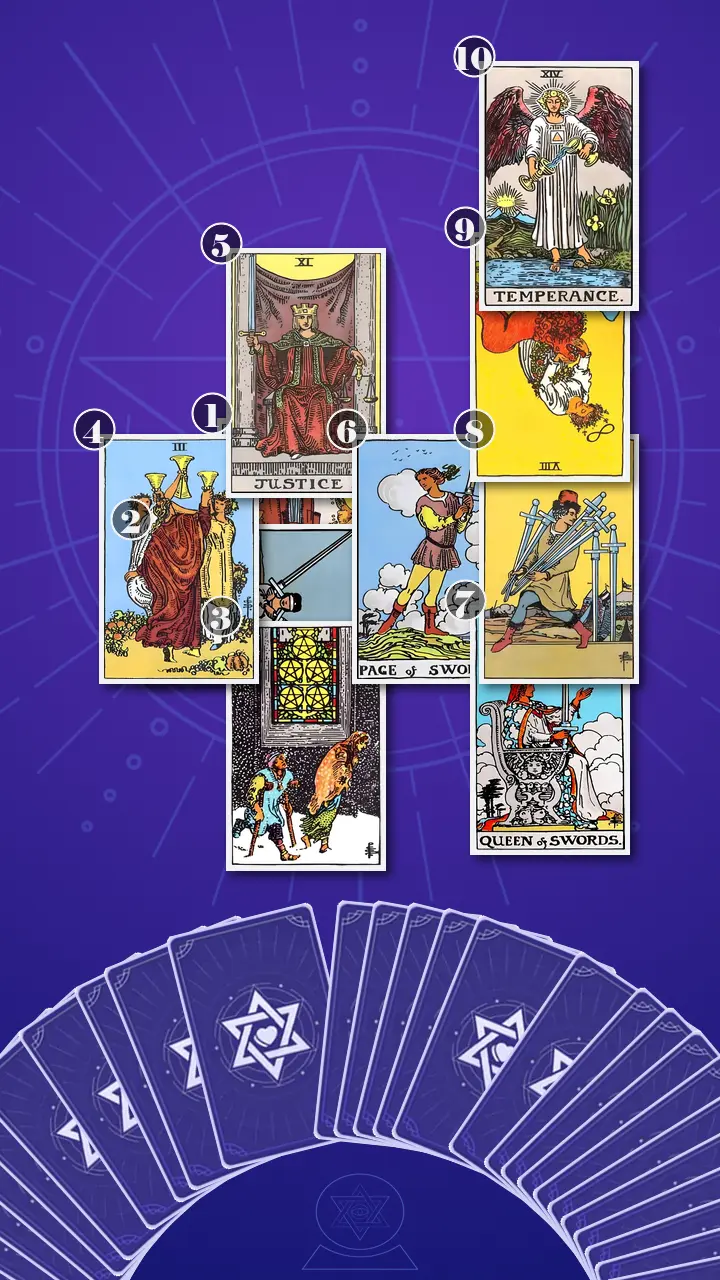
Position 1: The immediate situation — Six of Pentacles (reversed)
“Now flipping over,” I said, “is the card representing the immediate situation: how the boundary problem shows up day-to-day.”
Six of Pentacles, reversed.
This is the card of giving and receiving—but reversed, it’s the moment generosity quietly turns into entitlement. In Jordan’s life, it was painfully literal: she’s paying for the subscription, but the account is being treated like a shared household utility. The receipts show up as unfamiliar profiles, changed settings, and a ‘Continue Watching’ row that isn’t hers—while she eats the monthly cost and the mental load.
“Yeah,” she said, and then she let out a small laugh that sounded like it had teeth. “That’s… too accurate. Even kind of brutal.”
I kept my voice steady. “It’s not judging you. It’s showing the imbalance. Reversed, this card also warns about the swing you’re tempted to make: going from ‘sure, whatever’ to ‘password change in silence’—which would turn this into a tone fight instead of a boundary.”
I watched her fingers tighten around her mug. “This is where resentment breeds,” I said, “because the giving isn’t a choice anymore—it’s a default.”
Position 2: The primary challenge — Two of Swords (upright)
“Now flipping over,” I said, “is the card representing the primary challenge: what blocks clear boundary-setting in the moment.”
Two of Swords, upright.
This card is the freeze. The blindfold. The stalemate between two priorities: harmony vs. self-respect. In modern terms, it’s the TTC moment—your phone vibrates, group chat energy hits, and your thumb hovers while you draft and delete like your life depends on tone.
I reflected it back to Jordan in her own language. “You freeze at the request and try to find the least awkward response, so you send something vague—‘I’ll check,’ ‘it’s being weird’—that avoids tension now, but keeps the door open for them to ask again tomorrow.”
Her eyes went unfocused for a second, like she was watching her own typing bubble anxiety in real time.
“The Two of Swords is like leaving a calendar invite on ‘Maybe’ forever,” I said. “So the decision still owns your time. ‘Keep it smooth now’ turns into ‘pay for it later.’”
She exhaled through her nose. “I hate how true that is.”
“Clarity isn’t cruelty—it’s how resentment stops breeding in silence,” I added, because I wanted her to feel how practical this was. Not moral. Not dramatic. Mechanical.
Position 3: The root driver — Five of Pentacles (upright)
“Now flipping over,” I said, “is the card representing the root driver: the deeper fear or belief underneath the pattern.”
Five of Pentacles, upright.
There’s a stained-glass window in this card—warmth inside, cold outside. And the root fear is exactly that: If I say no, I’ll be outside the group.
I put it plainly. “Under the password request is a deeper fear: that saying no equals being iced out—left out of plans, labeled uptight, treated differently in your own friend circle. The ask starts feeling like a belonging test, not a simple preference.”
Jordan’s shoulders rose slightly, then dropped. That tiny movement told me the card had found its mark.
“It’s stupid,” she murmured. “But when I imagine saying ‘I’m not sharing logins’ my brain immediately goes: okay, cool, now you’re the petty one.”
“Not stupid,” I corrected softly. “Just learned.”
In the planetarium, I spend my life explaining gravity: how bodies pull on each other without meaning to. This fear is like that—quiet, constant, shaping your orbit unless you notice it.
Position 4: The recent past — Three of Cups (upright)
“Now flipping over,” I said, “is the card representing the recent past: what has been reinforcing the dynamic up to now.”
Three of Cups, upright.
This is the bonding card. The ‘we’re close’ vibe. The stage where sharing logins can feel like sharing snacks—just part of being in the circle.
“This started as friendliness,” I told her. “A casual social glue. The issue isn’t that you were generous—it’s that what began as a warm gesture never got updated into an actual agreement.”
Jordan nodded, but her mouth tightened at the corner. “It was like… a roommate thing at first,” she said. “Then it became normal.”
“Exactly,” I said. “And a container still needs edges to hold anything.”
When Justice Spoke: The Policy That Ends the Negotiation
Position 5: The conscious aim — Justice (upright)
I let the room get quieter before I turned the next card. Even over video, you can feel when the reading reaches its hinge—like the moment the planetarium lights dim and the first stars appear. Everything slows down because something important is about to be visible.
“Now flipping over,” I said, “is the card representing the conscious aim: what you’re trying to create—the boundary you want and the principle behind it.”
Justice, upright.
Justice is scales and sword: emotional fairness plus practical language. In Jordan’s modern life scenario, it’s simple and almost boring—and that’s the point: instead of renegotiating every time, she chooses a policy she can live with. “I don’t share streaming logins anymore.” Not punishment. Terms.
Here’s where my work in astronomy always flashes through me. In a binary star system, two stars can get “tidally locked”—one side always facing the other, stuck in a fixed pattern. In relationships, that can look like one person always being the giver, always managing comfort, always rotating to keep the other person’s experience smooth.
“Jordan,” I said, “this is your Binary Star System moment. Right now, you’re tidally locked into being ‘the easy one.’ Justice is you changing the orbit. Not by pushing them away—by setting a law that gravity can respect.”
Her eyebrows pulled together. “But if I do that,” she said, and her voice sharpened with a flash of anger that surprised even her, “doesn’t it mean I’ve been… letting it happen? Like I’m the problem?”
Her reaction came in a chain, quick and human: her breath stopped for half a beat; her gaze slid off-camera like she was replaying every time she’d sent “I’ll check”; then she gripped her mug harder, as if bracing for shame.
I didn’t rush to soothe it away. “It doesn’t mean you were wrong,” I said. “It means you were prioritizing belonging. That’s not a character flaw. It’s a strategy. And strategies can be updated.”
Then I leaned into the key insight—the one that turns this from a vibe problem into a solvable system problem. I could hear the TTC fluorescent buzz in her earlier story, the way a casual ask can make your body feel cornered.
Setup—I said it slowly: “You know that moment on the TTC when the ‘send your login’ text hits and your chest tightens—because you’re already calculating how to say no without losing the vibe.”
Delivery—I let it land as its own clean line, the way Justice likes things to be clean:
Stop trying to justify your no; choose a fair rule and let the scales of Justice hold the line.
I paused. In the quiet after, Jordan’s face changed in layers. First: stillness, like her mind froze on the words. Then: her eyes widened a fraction, as if she’d been given permission she didn’t know she was allowed to have. Then: a shaky exhale, shoulders dropping as though her body realized it could stop holding the door half-closed.
“That’s…” she whispered. Her lips pressed together, then softened. “That’s exactly it. I keep trying to make them understand. Like if I explain it perfectly, they won’t be mad.”
“And Justice says: you don’t need permission,” I told her. “You need a rule you can repeat.”
I watched her jaw unclench a little, and there it was—the shift from contracted guilt to grounded clarity. Not certainty. Clarity.
“Fairness is a boundary: access is a choice, not a negotiation,” I said, because sometimes you need the sentence that holds you when your chest gets tight.
Then I asked the question that turns insight into memory. “Now,” I said, “with this new lens—can you think of a moment last week where this would have changed how you felt? Even by ten percent?”
Jordan blinked fast. “Wednesday,” she said immediately. “On Line 1. The message popped up and I sent ‘I’ll check.’ If I’d had a rule… I wouldn’t have spiraled for two days.”
That was the emotional transformation beginning: from overthinking and rehearsing toward calm self-respect, one sentence at a time.
Position 6: The near-future opening — Page of Swords (upright)
“Now flipping over,” I said, “is the card representing the near-future opening: what kind of conversation or action is available next.”
Page of Swords, upright.
This is the first attempt energy: slightly shaky, still honest. The Page doesn’t wait to feel perfectly confident. She speaks in the wind.
“A near-future moment where you send the clean text,” I said, “even if your hands feel a little shaky. Short, factual, not designed to manage their feelings. You hit send, and then you put the phone down instead of hovering.”
Jordan’s mouth lifted, just barely. “I can picture that,” she said. “The putting the phone down part feels… like witchcraft.”
I smiled. “No magic. Just nervous system boundaries.”
Position 7: Your stance — Queen of Swords (upright)
“Now flipping over,” I said, “is the card representing your stance: how you’re showing up internally and what skill you can embody to hold the boundary.”
Queen of Swords, upright.
This is the adult version of you. Calm tone. Direct words. No apology tour. The Queen’s power isn’t volume—it’s precision.
“You can be warm without being porous,” I told Jordan. “And direct without being harsh. If they push, you repeat the same line without adding new reasons—because your boundary isn’t a debate prompt.”
She nodded slowly, like she was trying the posture on. “That’s who I want to be,” she said.
Position 8: Their side and the social context — Seven of Swords (upright)
“Now flipping over,” I said, “is the card representing their side and the social context: what the environment is incentivizing or normalizing.”
Seven of Swords, upright.
Not villain energy. Convenience energy. This is the context where people will take a shortcut if there’s a shortcut. If there’s a loophole, they’ll take it. And if your “no” is fuzzy, the asking continues because the system still works for them.
“This is the glance over the shoulder,” I said. “Not to be evil—just to see if the boundary is real.”
Jordan made a face. “So the more vague I am…”
“The more this keeps happening,” I finished. “Clarity isn’t cruelty—it’s how resentment stops breeding in silence.”
Position 9: Hopes and fears — Strength (reversed)
“Now flipping over,” I said, “is the card representing your hopes and fears: what you’re afraid will happen if you say no.”
Strength, reversed.
This is the fear that you won’t hold steady. That you’ll either cave and people-please, or snap and come in too hot. It’s the tight jaw, the face heat, the shallow breath the moment the request appears—your body registering social risk.
“Your growth edge isn’t being tougher,” I told her. “It’s being steadier. A calm line, repeated. Discomfort isn’t proof you did something wrong.”
Jordan’s throat bobbed. “I always think if it’s awkward, I failed.”
“What if the awkwardness is just the new boundary installing,” I said, “not a sign you did something wrong?”
Position 10: Integration direction — Temperance (upright)
“Now flipping over,” I said, “is the card representing integration direction: the likely tone of the resolution if you follow the key shift.”
Temperance, upright.
Temperance isn’t a light switch. It’s a thermostat. It’s a sustainable temperature: warmth and limits at the same time.
“This is a balanced outcome,” I said. “The relationship can stay civil—maybe even warm—but access is clearly defined. You can offer one alternative—watch night, suggesting a cheaper plan—without becoming responsible for their discomfort. Over time, the asking slows because the rule is consistent.”
Jordan looked relieved and oddly tender. “I like that,” she said. “I don’t want to blow up my friendships over TV.”
“And you don’t have to,” I said. “You can keep the relationship warm without keeping the account open.”
From Insight to Action: A One-Line Policy and Two Small Moves
I pulled the whole story together for her, the way I’d summarize a sky for a first-time stargazer: not every star, just the constellations that matter.
“Here’s what the Celtic Cross is showing,” I said. “This started as friendship warmth (Three of Cups). But the present is imbalanced (Six of Pentacles reversed), and the loop keeps running because you freeze and send mixed signals (Two of Swords). Underneath is a belonging fear (Five of Pentacles): your body treats a password request like a social acceptance test. Justice is the antidote—choose a fair rule. Page of Swords is the first clear message. Queen of Swords is you holding it without over-explaining. Seven of Swords is the environment: loopholes get used. Strength reversed is the self-trust test. And Temperance is the direction: calmer relationships with clearer expectations.”
Then I named the blind spot, gently but directly. “Your cognitive blind spot is thinking you need the right explanation to avoid fallout. But your transformation direction is different: shifting from hinting and hoping they’ll ‘get it’ to stating one simple boundary line—and repeating it.”
Jordan made a face that was half-laugh, half-groan. “But I never have time,” she said. “Like, the ask hits when I’m commuting or in the middle of something. I can’t have a whole boundary TED Talk.”
“Perfect,” I said, “because we’re not doing a TED Talk.”
I offered her actionable advice—small, repeatable, and designed for real life.
- Write the policy (one sentence only)Open Notes and type exactly: “I’m not sharing streaming logins anymore.” Save it as-is—no extra sentence, no explanation. This is your Justice rule.If you feel the urge to add reasons, pause for 10 seconds, re-read the one line, and stop. Soft face. Firm sentence. No bonus paragraph.
- Install it into your phone (so you don’t reinvent it)Create a Text Replacement shortcut (iPhone Keyboard settings) like “/nologin” → “I’m not sharing streaming logins anymore.” Use it the next time the group chat pings.This reduces decision fatigue. Your boundary works because it’s repeatable, not because you’re persuasive.
- Choose one calm window and send it firstBefore 8 PM tonight, send the line to the person who asks most (or drop it once in the group chat). Don’t wait for the next request. You’re setting terms, not reacting.Use my “Social Star Map” approach: pick one weekly social focus point—one message, one boundary, one clean follow-through. Treat it like a scheduled transit, not an emergency.
“And if you still want to be generous,” I added, “offer one alternative that doesn’t create ongoing access—like ‘Want to do a watch night at mine this week?’—and then stop there. That’s Temperance: warmth, without an open account.”

A Week Later: The Quiet Proof
A week later, I got a message from Jordan.
“I did it,” she wrote. “Sent the one line. No explanation. My face was on fire for like two minutes, then it passed. They replied ‘lol ok’ and that was… it.”
She added, “Also I changed my password and signed out devices after. Zero drama. I’m mad I spent months rehearsing this.”
I pictured her on a winter morning in Toronto—sleeping a full night, then waking up with the first thought still trying to reach for old panic: What if they think I’m difficult? Only this time, she’d exhale, feel her shoulders drop, and remember she’d already proven she could survive the awkwardness.
That’s the real Journey to Clarity I watch over and over in my work: not a single heroic moment, but a new rhythm. Justice sets the rule. The Page sends the first message. The Queen repeats it. Temperance makes it livable.
When a casual “send me your login” makes your chest tighten, it’s not because you’re dramatic—it’s because you’re trying to stay liked while your own fairness line keeps getting crossed.
If you didn’t have to earn belonging by being endlessly ‘easy,’ what would your one calm, repeatable boundary sentence be?

Every reading at AceTarot is a journey to connect with inner wisdom and empower the path ahead. This reading shared here is a psychological mirror, not a private record—crafted to reflect universal emotional loops and help restore personal clarity. Please note that these insights do not replace professional psychological, medical, legal, or financial advice, and should not serve as the sole basis for major life decisions.
Learn more about our Journey to Clarity.
How did this insight land for you?
🫂 This Resonates Deeply
🌀 Living This Story
✨ Now I See Clearly
🌱 Seeing New Possibilities
🧰 Useful Framework
🔮 The Confirmation I Needed
💪 Feeling Empowered
🚀 Ready for My Next Step
Author Profile
AI Laila Hoshino
829 readings | 533 reviews
“After a decade of guiding people through the stars, I’ve come to see life much like the orbits of planets: everything has its inevitable cycles. When you feel lost, please don't blame yourself; you might just be in a natural low tide. I’m here to sit under the night sky with you, offering a gentle cosmic perspective to distinguish temporary pain from the beautiful breakthroughs just around the corner.”
In this Friendship Tarot Reading :
Core Expertise
- Orbital Drift Recognition: Objectively mapping how personal cognitive upgrades naturally lead to mismatched frequencies with old friends, removing the guilt of outgrowing them.
- Gravity De-linking Analysis: Identifying the painful friction that occurs when two friends try to force an alignment despite moving into completely different life phases.
Service Features
- The Constellation Release Protocol: A psychological closure technique to peacefully accept the natural fading of a friendship, leaving them in their orbit while you transition to your next.
Also specializes in :
Explore Related Patterns:
Boundary DiffusionJordan's account sharing began as a friendly roommate gesture, but it was never updated when the context changed. An unfamiliar profile, altered recommendations, and continued requests now sit inside an arrangement where other people experience access as normal while Jordan experiences it as an intrusion she has not clearly named. When a temporary favor has no explicit endpoint, the line between generosity and entitlement can become difficult to locate. Boundary Diffusion fits because your no remains implicit while other people's access stays concrete, leaving you responsible for absorbing the cost and hoping they infer a limit that the arrangement itself does not communicate.
Conflict AvoidanceEach password request sends Jordan into a draft-delete cycle, followed by a vague reply about checking the login or the app behaving strangely. The message avoids a tense moment, but it never closes the question, so her friends have no clear reason to stop asking. When you protect yourself from one uncomfortable exchange by leaving your answer ambiguous, the avoided conflict returns as another request. Conflict Avoidance names this tradeoff because short-term smoothness repeatedly produces longer-term pressure, resentment, and more conversations to manage.
Defensive OverexplainingJordan explicitly says she keeps trying to make her friends understand, as though the perfect explanation could guarantee that nobody becomes annoyed. Her drafting and deleting are therefore doing more than refining a sentence; they are attempts to engineer a reaction that makes the boundary feel socially risk-free. When you assume a no is valid only after it has been perfectly defended, explanation becomes a safety behavior. Defensive Overexplaining fits because the extra reasoning is meant to prevent judgment, but it also turns your personal limit into a case that other people appear entitled to review.
Guilt ConditioningJordan labels herself stingy or petty when she imagines refusing access, and she treats awkwardness as evidence that she has handled the interaction badly. The guilt arrives before any actual complaint, then pushes her away from the boundary she has already decided is fair. When discomfort is interpreted as moral proof that your no is wrong, guilt becomes a conditioning signal rather than useful information. Guilt Conditioning fits because your body learns to reward compliance with immediate relief and to punish self-assertion with tension, even when the limit protects something that is legitimately yours.
People-PleasingJordan repeatedly stalls, hints, gives in, and sends "I'll check" even though she wants the account sharing to stop. She is covering both the subscription cost and the emotional work of keeping everyone comfortable, so each accommodation buys a brief reduction in social tension while preserving the arrangement she resents. When you make continued access part of the price of being easy to like, accommodation becomes a defense against disapproval. People-Pleasing fits because your immediate relief comes from protecting other people's comfort, while your own preference is deferred and the unspoken resentment keeps accumulating.
Rejection SensitivityA group-chat notification makes Jordan's jaw lock and chest tighten before anyone has rejected or criticized her. Her mind immediately moves from a practical password question to images of being iced out, left out of plans, or recast as the petty friend. When you interpret an ordinary request as a test of whether you will remain accepted, the anticipated rejection can shape your response before reality has supplied any evidence. Rejection Sensitivity fits because the social threat forecast drives the freezing and accommodation, while the eventual "lol ok" reply shows how much larger the predicted fallout had become than the actual interaction.
Boundary DiscernmentJordan eventually sends one factual sentence, changes the password, and signs out the connected devices. She does not insult anyone, build a case against her friends, or make continued friendship conditional on their agreement; she simply separates ownership of the account from warmth in the relationship. When you can distinguish generosity from permanent access, a boundary stops functioning as punishment or a referendum on belonging. Boundary Discernment is the shift toward a proportionate rule you can repeat, with practical follow-through that does not require hostility, permission, or a new explanation every time.
RuminationAfter replying "I'll check" to one request on the subway, Jordan spends two days spiraling, and she later recognizes that she has rehearsed the same feared conversation for months. The external exchange remains brief, but her mind keeps reopening it to test different wording and forecast different reactions. When you repeatedly replay a boundary conversation to manufacture certainty, thinking begins to substitute for choosing. Rumination fits because the mental review promises protection from a social mistake, yet it extends the stress without producing a clearer answer than the simple policy Jordan eventually sends.
Explore Related Struggles:
Autonomy Guilt BindJordan's chest tightens before she has even answered, and a straightforward decision about her own account is immediately translated into accusations she expects to face: stingy, uptight, petty, difficult. The practical right to withdraw access remains intact, but using that right feels like committing a social offense. When guilt becomes the admission price for making your own choice, autonomy is available only in theory. Autonomy Guilt Bind describes the internal lock in which saying no is treated as evidence of bad character, making surrender feel morally safer than self-direction even when the arrangement is no longer freely chosen.
Dignity-Belonging SplitJordan drafts a reasonable refusal, deletes it, and sends "I'll check" because the password request has stopped functioning as a simple account question. It has become a test of whether she can protect what is hers without losing her place as the easy, welcome person in the group. When an act of self-respect appears to endanger belonging, you are forced to spend dignity to preserve connection or risk connection to preserve dignity. Dignity-Belonging Split names that live collision: the boundary is already clear in principle, but enacting it feels socially expensive enough to keep you standing in the doorway.
Fairness-Agency SplitJordan pays for the subscription, finds unfamiliar profiles and changed recommendations, and can plainly state that she wants the assumed access to stop. Yet when the next request appears, the fair standard she recognizes does not become a decision she can immediately enforce; it dissolves into stalling, explanation, and another attempt to keep everyone comfortable. You can know exactly what a fair arrangement would be and still feel unable to make that fairness operational. Fairness-Agency Split identifies the gap between possessing a valid standard and experiencing enough authority to act on it when another person's convenience is at stake.
Permission ParalysisJordan says she keeps trying to make the others understand, as though the right explanation could guarantee that nobody becomes annoyed. That search turns one sentence into months of rehearsal because the refusal is not permitted to stand until it has also produced the desired reaction. You are no longer deciding access solely from your own limits when other people's anticipated approval must authorize the decision. Permission Paralysis names this transfer of authority: your no remains suspended while you search for wording that will make it feel acceptable to everyone who benefits from your yes.
Boundary Ambiguity LockEach time the group chat asks for the login, Jordan stalls, hints, or replies "I'll check." Those words lower the temperature for a moment, but they communicate possibility rather than closure, so the same people retain a reason to ask again. You then carry a decision that was never allowed to finish: the request remains active, the anticipated conversation follows you, and resentment accumulates behind language designed to sound harmless. Boundary Ambiguity Lock captures how uncertainty can protect immediate harmony while trapping everyone inside a recurring negotiation.
Relational Boundary DriftSharing the password began as a casual roommate gesture, but nobody defined how long it would last or whether continued access required a new yes. Repetition did the contracting instead: the favor became normal, and normal gradually became assumed. You are then left trying to enforce a line after the relationship has quietly rewritten it for you. Relational Boundary Drift captures that slow displacement, where silence is treated as continuing consent and a voluntary gesture hardens into an unofficial condition of closeness.
Explore Related Emotions:
Approval AnxietyJordan's cheeks heat before she has even answered, and her mind immediately starts searching for the least awkward wording. She is not only deciding whether to share a password; she is trying to engineer a response that prevents anyone from being disappointed with her. Approval Anxiety is present in the pressure to make your no understandable enough that nobody can judge it. The story exposes the cost of that impossible standard: other people's imagined approval begins to govern your choices before they have actually said or done anything.
Boundary GuiltJordan drafts a reasonable boundary, deletes it, and replaces it with "lol I'll check" while her chest tightens and her jaw locks. A simple statement of preference becomes loaded with responsibility for how everyone else might interpret it. You can recognize Boundary Guilt in the sense that protecting something of your own might make you selfish, petty, or less welcome. Naming that pressure separates the feeling from the decision, allowing a boundary to remain valid even while the discomfort is still present.
Grounded AgencyJordan saves the sentence, sends it without an explanation, changes the password, and signs out the other devices. Each action brings her stated preference and the actual account arrangement back into the same line. Grounded Agency appears as the felt knowledge that you can make a clear choice without controlling the other person's response. Jordan does not need her friends to agree that the rule is ideal; she discovers that her own decision can be calm, practical, and complete enough to act on.
Social Exclusion DreadWhen Jordan imagines saying, "I'm not sharing logins," her mind jumps to being iced out, excluded from plans, and recast as the petty friend. The account request therefore stops feeling like a minor preference and starts functioning as a test of whether she still belongs. Social Exclusion Dread captures the cold edge beneath her hesitation. You can feel how the possibility of losing group warmth enlarges the stakes of one small no, even though the eventual "lol ok" response shows that the anticipated exile was not the same as the actual outcome.
Clarity ReliefJordan's shoulders drop when the entire problem is reduced to one repeatable sentence, and a week later she reports that the heat in her face passed after two minutes. The clear rule ends the exhausting requirement to invent a new excuse whenever another request arrives. Clarity Relief is the release that comes when your preference no longer has to survive an internal courtroom before it can be spoken. The story locates that release in concrete alignment: the sentence is clear, the account settings match it, and there is no longer an open negotiation running in the background.
Suppressed ResentmentJordan's jaw locks when she sees another profile, her laugh comes out with an edge, and her grip tightens around the mug when the imbalance is named. She has continued appearing easygoing while paying both the subscription cost and the emotional cost of keeping the arrangement smooth. Suppressed Resentment grows where generosity is no longer experienced as a choice. You can hear it in the gap between the friendly replies she sends and the sharper reaction her body is already expressing, making the feeling useful evidence that an unspoken limit has been crossed repeatedly.
Hard-Won ComposureA week later, Jordan describes sending the line while her face burned, waiting through two uncomfortable minutes, and discovering that the sensation passed. She did not obtain steadiness by eliminating the awkwardness; she obtained it by staying aligned with her decision while the awkwardness moved through. Hard-Won Composure captures the calm available after you stop treating discomfort as proof that you have acted badly. The friends' brief reply matters because it gives Jordan concrete evidence that she can hold a limit, tolerate the immediate social heat, and remain connected to herself throughout the exchange.
Explore Related Contexts:
Friendship Boundary CreepJordan keeps receiving the same casual request for her streaming password, and the account shows the proof: a profile she did not create, recommendations she did not choose, and a shared-access norm she never clearly agreed to maintain. The problem is not the size of the subscription; it is the way a small favor has turned into an assumed entitlement. That is the structure of Friendship Boundary Creep. The original friendliness gave people a door, and the lack of a clean rule let the door stay half-open. Each vague reply, like "I'll check" or "it's being weird," protects the mood in the moment while leaving the same access point available for the next ask. You are dealing with a friendship dynamic where the boundary has to be updated out loud because the old informal arrangement is now costing you privacy, attention, and social energy. The useful move is not to prove that your no is reasonable; it is to replace a drifting expectation with a repeatable line that makes the new terms clear.
Unspoken Expectations GapThe account sharing began as warmth, not as a contract. Jordan describes it almost like a roommate-style favor at first, but the story shows that the favor was never updated into a clear agreement once it became recurring. Unspoken Expectations Gap is the social mechanics underneath the conflict. Her friends appear to be operating from the expectation that access is normal now, while Jordan is operating from the need to stop having her account treated as available by default. Because the expectation was never spoken, every request becomes a fresh negotiation. You do not need a long explanation to close this gap. You need a rule that converts the invisible expectation into visible terms: "I'm not sharing streaming logins anymore." Once the rule exists, the relationship has something clearer to organize around than hints, pauses, and awkward guesses.
Direct Communication TrialJordan's old response pattern is to draft, delete, soften, stall, and leave the request unresolved. The practical shift is much smaller and cleaner: send one factual sentence, stop adding reasons, and let the message stand without hovering over the reaction. Direct Communication Trial names the first real test of that new behavior. The trial is not about becoming harsh or perfectly confident. It is about using a clear line in the exact channel where the old pattern used to take over. You set the boundary by making the communication repeatable before the next pressure moment arrives. A saved sentence or text replacement removes the need to improvise under social heat, which makes the boundary easier to hold when the group chat pings again.
Friendship Boundary ResetJordan eventually sends the one line with no explanation, then changes the password and signs out devices. That sequence matters because it updates both sides of the situation: the social contract is named, and the account access is technically closed. Friendship Boundary Reset fits the resolution because the goal is not to punish the group or blow up the friendship. The reset is a new operating rule: the relationship can stay warm, but the account is no longer open. The old arrangement relied on hinting and hoping; the new one relies on consistent terms. You are not trying to win a debate over whether the request is fair. You are changing the default setting of the friendship so the same ask no longer has to be processed from scratch every time. A reset works when the sentence, the behavior, and the account settings all point in the same direction.
Streaming Password Boundary PressureJordan is paying for a streaming service that other people have started treating like a shared household utility. The unfamiliar profile and changed recommendations make the boundary visible in a concrete way: someone else's convenience is now occupying space inside an account that she funds and manages. Streaming Password Boundary Pressure names the specific modern version of this conflict. It is not just "friends asking for a favor"; it is repeated pressure around digital access, where a password becomes a social shortcut and a private account becomes open territory unless the owner actively closes it. You have leverage here because the boundary is practical and definable. The account has settings, devices, passwords, and access rules, which means the social rule can be paired with a technical action. A clean sentence plus a password reset turns the situation from an ongoing negotiation into a clear access decision.
Emotional Labor ImbalanceJordan is not only covering the subscription; she is also carrying the job of keeping the exchange from feeling uncomfortable. The story names it directly: she is paying for the account and managing everyone's feelings about the account at the same time. That is why the request feels heavier than a password text should. The visible resource is the login, but the hidden resource is Jordan's effort to stay pleasant, soften the refusal, and prevent anyone from reading her boundary as stingy or petty. Her friends receive ease while she absorbs the friction. Emotional Labor Imbalance matters here because a sustainable boundary has to remove both costs. You are not just stopping access to a streaming account; you are stepping out of the unpaid role of making the denial feel perfectly comfortable for everyone else.