The Line 1 Ride Where Keeping the Friend Group Together Became a Second Shift
I have learned that when an early-career city worker spends all day closing project gaps and then spends the commute home repairing the group chat, friend-group emotional labor can feel less like a concept than a second shift. Jamie, a 27-year-old non-binary project coordinator at a small Toronto nonprofit, came to me because they were tired of feeling responsible for keeping their entire friend group together.
I asked what had brought the pattern into focus. Jamie took me back to 8:47 on a Tuesday evening, on a southbound Line 1 train pulling away from Bloor-Yonge. Two friends had traded clipped WhatsApp replies. The brakes squealed, a damp wool coat brushed Jamie's arm, and the phone had grown warm in their palm as they reopened the thread for the sixth time. They wanted one quiet ride home, but the silence made them draft separate messages to both friends before anyone had asked them to mediate.
“If I leave it alone, everyone will quietly drift,” Jamie said. “I know I'm tired, but I can't be the person who lets the group fall apart.” What they called relational anxiety felt like a smoke alarm wired to typing indicators: every pause set off a metallic pressure in their chest, pulled their shoulders toward their ears, and sent their hands back to the phone.
I could hear resentment under the urgency, guilt under the resentment, and loneliness under both. I told them, “You can love the group and still resent the job you've taken on inside it. Neither feeling cancels the other. Let's use the cards to map where care became compulsory management, then find one place where you can return responsibility without disappearing.”

Choosing a Map for the Air Between Friends
I invited Jamie to place both feet on the floor, take one slower breath, and hold the question without trying to solve it: “Why am I always the one keeping my friend group from falling apart?” I shuffled slowly. I use this pause as a transition for attention, not as a mystical performance.
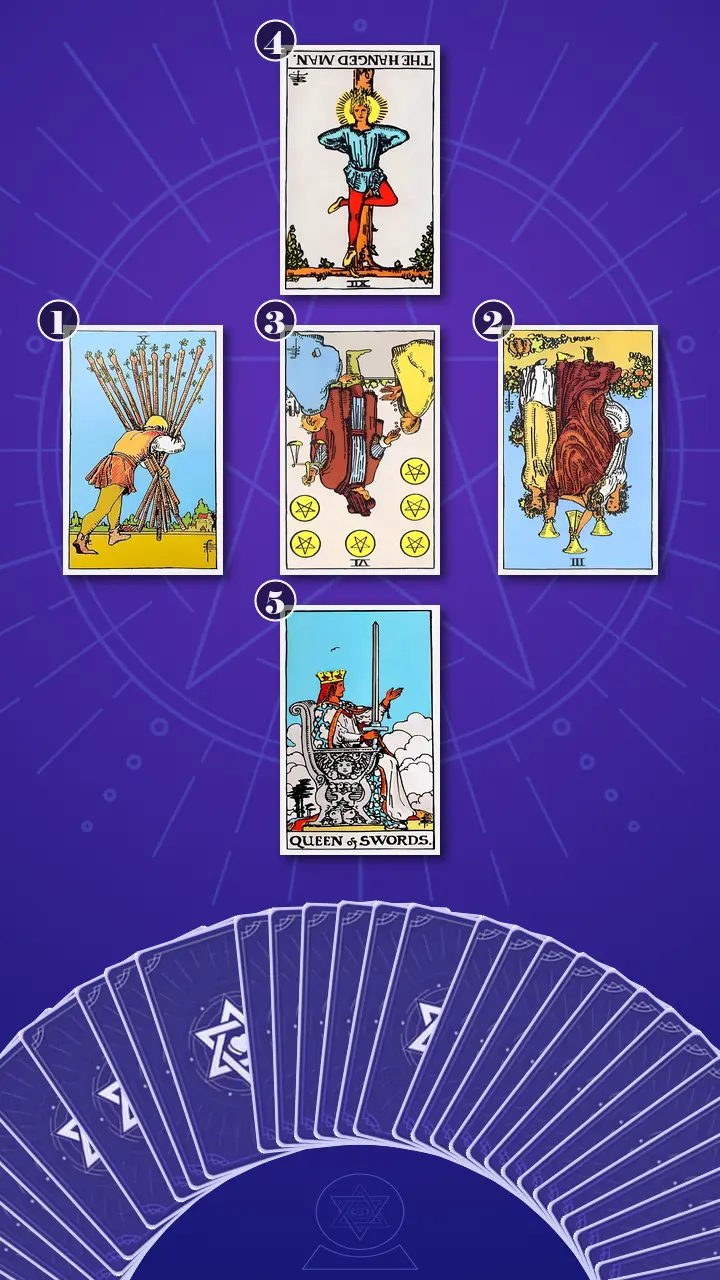
I chose the Relationship Spread · Context Edition, a five-card contextualized relationship tarot spread for friendship boundaries, reciprocity, and group roles. For anyone wondering how tarot works in my practice, I do not use it to predict whether a group will survive. I use its positions and images to separate facts, interpretations, habits, and available choices. Card meanings in context can make a social system visible without pretending that cardboard controls it.
This spread suited Jamie's question because the issue involved more than one difficult friend. It involved a whole relational field. The left position would show the role Jamie had taken; the right would show what the group was collectively contributing. The center would reveal the actual exchange of care and repair. Above it, the challenge card would expose why pausing felt unsafe. Below it, the guidance card would turn the reading into a one-week boundary experiment.
I arranged the cards in a cross. It resembled a shared table with one person deciding whether to keep serving everyone or finally place a limit at the center. That structure allowed me to examine personal burden, fragmented participation, unequal emotional labor, the blocked pause, and a practical next step without inflating the reading into a verdict.
The Bundle, the Group Photo, and the Unpaid Bill
Position One: The Role That Followed Jamie Home
The card I turned over first represented the observable role Jamie had taken in the friendship system: organizer, translator, mediator, and carrier of group cohesion. It was the Ten of Wands, upright.
I pointed to the figure bent beneath ten staffs, with the bundle blocking the road ahead. “This is your nonprofit shift continuing after hours,” I said. “You leave work with your attention already spent, then carry the friend group home as another project. You reopen WhatsApp on Line 1, draft two private check-ins, start a Doodle poll, remember who felt excluded last month, and monitor who has replied. The distant town is the imagined moment when everyone will finally be okay enough for you to rest.”
I read the card's Fire as Excess. Care had acquired so many tasks that effort itself was obscuring perspective. Jamie was treating every change in group energy like a ticket in The Bear: notice it, call it, handle it, never let it sit. But the wands blocking the figure's view asked a practical question. How could Jamie tell which responsibility belonged to them while holding all of them at once?
“Inside this card, I hear a sentence,” I continued. “I am tired, but if I put this down, something important might break. The problem is not that you care. The problem is that care has been converted into duty before anyone else has a chance to act.”
Jamie gave a short laugh, but there was no amusement in it. Their mouth tightened at one corner and their eyes stayed on the card. “That's too accurate. Kind of brutal, actually.”
I did not rush to soften the recognition. “The card isn't accusing you of causing the pattern,” I said. “It is making the workload visible. When labor stays invisible, you can only judge yourself by whether the group looks calm. So let me ask something smaller: which one wand could be returned this week?”
Jamie rubbed their thumb across the edge of the table. “Planning. I wish someone would choose a date without me building the whole path.” Their shoulders lowered slightly, as though naming one item had redistributed the weight by a fraction.
Position Two: The Circle Behind the Instagram Photo
The next card represented the friend group's collective stance, including the fragmented participation that made Jamie feel compelled to keep everyone connected. I turned over the Three of Cups, in reversed position.
I told Jamie that the reversal did not mean the friendships were fake. The group still held affection, shared history, birthdays, old university jokes, and genuinely good nights out. Yet those raised cups had become a polished group photo concealing separate DMs, uneven replies, unresolved friction, and smaller plans glimpsed on Instagram Stories. Jamie kept trying to rebuild the full-circle feeling through another brunch, but visible togetherness could not prove that conflict had been addressed or effort shared.
I read its communal Water as Blockage and dispersal. The connection existed, but it was no longer flowing through the whole circle evenly. Some friends preferred direct messages. Some avoided tension. Some enjoyed plans without initiating them. That did not make them villains, but it did mean Jamie could not manufacture collective participation through greater personal effort.
“Over the past month,” I asked, “who initiated a plan, addressed tension directly, checked on someone who went quiet, or followed through without a reminder?”
Jamie began to answer quickly, then stopped. Their fingers counted two names and stalled. “People do care,” they said. “But I keep translating that care into action for them.”
“Exactly,” I replied. “The reversal asks you to separate affection from capacity and participation. A boundary here is not a punishment, and it does not require abruptly leaving the chat or refusing every repair conversation. Stepping back is not the same as disappearing.”
Position Three: When One Friend Pays the Maintenance Cost
The center card represented the actual exchange of care, attention, planning, and repair between Jamie and the group. It was the Six of Pentacles, in reversed position.
I traced the scale held above the exchange. Jamie noticed a missing reply, supplied the follow-up, remembered each person's emotional context, and restored enough contact for the group to continue. Everyone received the practical benefit of connection, while the cost remained off-screen. It was like one friend continually fronting a shared bill, except the currency was time, memory, late-night availability, and conflict repair.
I read the reversal as an Imbalance: an Excess of volunteered giving paired with a Deficiency of named reciprocity. The issue was not that every friend had to contribute identically. Healthy relationships rarely balance interaction by interaction. The issue was that Jamie offered resources before support had been requested, then silently hoped somebody would recognize the cost.
“Visible harmony can be built on invisible exhaustion,” I said. “The group chat becomes lively again, but you are still booking the table, checking dietary needs, and following up with the person who went quiet. Everybody sees the shared calendar. Only you feel every reminder, update, and cancellation attached to it.”
Jamie's breathing paused. Their eyes moved from the scale to their own hands, and one palm pressed lightly against their chest. “Nobody asked me,” they said, almost under their breath. “But nobody else was doing it. Then once I did it, nobody could see that it needed doing.”
I asked them to recall the most recent meetup without scoring anyone's character. “What did you provide, what did other people provide, and which missing steps did you quietly cover?” As Jamie listed observable actions, I watched the imbalance become data rather than a fog of guilt. That distinction mattered. Freely chosen generosity could remain; unspoken obligation needed examination.
When the Loading Spinner Stopped Being a Command
Position Four: The Pause That Felt Like Failure
The fourth card represented the central defense and underlying fear keeping Jamie in the mediator role, especially the belief that pausing could prove they lacked belonging or worth. I turned over The Hanged Man, in reversed position.
I asked Jamie to return, in memory, to 10:36 on a Wednesday night in their small apartment near Bloor Street. The nonprofit spreadsheet was still open beside two private message drafts. The radiator clicked, cold tea left a bitter film on their tongue, and blue screen light filled the room while their fingers revised the same sentence. Jamie supplied the loop for me: “One more edit, one more check, then I can stop.”
In the card's reversed energy, suspension had become a Blockage. The Hanged Man usually invites a deliberate pause and a different perspective. Here, Jamie remained mentally tied to the conflict while waiting for the perfect wording to control its outcome. A typing indicator had become a live incident alert, and the loading spinner had been mistaken for a command.
“The difficult experiment is not to stop caring,” I said. “It is to wait long enough to discover whether the people involved speak directly, whether another friend steps forward, or whether the silence simply remains silence for a while. The urge is real, but it is not an assignment.”
I invited Jamie to imagine placing the phone face-down and asking two questions: “Was support requested?” and “Who owns the next move?”
Their hand tightened around their mug. “But I'll spend the whole ten minutes thinking about it. I'll probably check after thirty seconds.”
“Then thirty seconds is our honest starting point,” I replied. “This is not an endurance test. Try the length of one song, or two minutes with the phone in a drawer. You can stop. You can still respond afterward. The pause does not apply to immediate safety concerns, harassment, or a direct request you freely choose to accept. We are gathering information about the impulse, not proving that you can tolerate unlimited discomfort.”
Jamie's grip loosened. They looked again at the inverted figure and said, “So the silence might be space for them to act, not evidence that I've failed.”
“Yes,” I said. “That is where the blockage becomes a catalyst. Pausing lets you see what the system does when you do not immediately hold it in one position.”
When One Upright Sword Cleared the Air
Position Five: A Boundary That Did Not Close the Door
The final card represented the small communication experiment that could let Jamie remain caring without taking ownership of everyone else's choices. This was the bridge between insight and practice. I turned over the Queen of Swords, upright.
The Queen held one sword in a steady vertical line while extending her other hand openly. I read her Air as Balance: discernment without coldness, direct speech without punishment, and care with clearly scoped responsibility. In Jamie's life, she sounded like one concise message: “I care about both of you, but I am not able to mediate this. Please speak directly, and let me know if you want a specific kind of support later.” No five-paragraph apology. No compensatory brunch poll. No attempt to manage the response.
When I saw the upright blade, my mind flashed to fifteen years at a perfume bench. A fragrance needs diffusion, but it also needs proportion. If one potent material bleeds into every layer of an accord, the notes become difficult to distinguish. More intensity does not clear the composition. Space does.
I call the relational version of this my Boundary Permeability Diagnosis. I was not labelling any friend as toxic or negative. I was noticing that the group's unspoken expectations, clipped replies, and shifting moods had been granted almost unlimited access to Jamie's inner atmosphere. Their personal boundary had become so permeable that every social change entered as an obligation. In digital terms, Jamie had given themselves admin access to everyone else's conflict, then treated every notification as an emergency permission request.
The Queen offered a different calibration. Her sword separated what Jamie noticed from what Jamie owned. Her open hand preserved warmth. The goal was not emotional armour; it was enough breathable space to identify where Jamie ended and another adult's choice began.
At my invitation, Jamie returned once more to 10:36 p.m.: paid work finished, group chat open, two private messages being rewritten beside cold tea while the radiator clicked. Their problem was no longer finding the perfect wording. It was believing that silence itself could revoke their place.
You do not need to carry the whole circle to belong; use the Queen's upright sword to name what is yours, request reciprocal effort, and let each friend own their response.
The rain against my studio window thinned. I let the sentence remain in the quieter air before making its center even plainer: “Noticing the tension first does not make it yours to resolve; belonging does not require you to become the group's emergency infrastructure.”
For a second, Jamie's breath stopped. Their right hand froze above the mug, fingers curved but not touching it, and their pupils widened as if the room had shifted half an inch. Then their gaze slipped past the cards. I watched recognition arrive in layers: the train ride, the cold dinners, the private DMs, the brunch polls. Their jaw tightened before their eyes reddened.
“But doesn't that mean I've been doing friendship wrong this whole time?” they asked. The words came out low and sharp. “Or that I trained everyone to depend on me?” Their shoulders remained rigid, but the anger in the question carried grief as well.
“No,” I said. “It means this strategy protected something important. It gave you usefulness when belonging felt uncertain. Now it costs more than it gives. Insight is not a conviction against your past self. It is information your present self can use.”
Their fist slowly opened against their knee. Their shoulders dropped, then rose once with a shaky inhale. A long breath left them with a faint tremor. Relief did not arrive as certainty; it came with a moment of almost dizzy blankness, the vulnerable realization that if the group was not solely theirs to maintain, they would have to let other people reveal what they were willing to carry.
I asked, “Now, with this new perspective, think back: was there a moment last week when this insight could have made you feel different?”
Jamie stared at the Queen's open hand. “Friday,” they said. “I sent three messages after two friends argued. If I'd waited, I might have felt awful, but I also would have found out whether they were willing to talk to each other. I never gave them the chance.” Their voice was quieter now, not defeated, just newly precise.
I named the crossing I had witnessed: this was not merely a better group-chat tactic. It was a first movement from hypervigilant caretaking and belonging-through-usefulness toward direct boundaries, reciprocal friendship, and steadier belonging. Jamie was shifting from asking, “How do I make everyone okay?” to asking, “What is mine to say, and what belongs to them?”
The Space Calibration Ritual: Ten Minutes of Breathable Air
I drew the five cards back into one story. The Ten of Wands showed how Jamie's perceptiveness had hardened into a personal workload. The reversed Three of Cups showed real affection without reliable collective participation. The reversed Six of Pentacles exposed the mechanism beneath the exhaustion: Jamie volunteered emotional resources, visible calm returned, and nobody else had to confront the missing ownership. The reversed Hanged Man showed why the loop repeated. Pausing felt like risking belonging. The Queen of Swords brought the way through: one clear limit, one direct request, and room for other people to answer.
The cognitive blind spot was simple but powerful: Jamie had been treating early awareness as automatic ownership. They had also been using visible group activity as proof of security, even when that activity depended on invisible labor. The transformation was not from caring to indifference. It was from emergency responder to equal participant, from ten obstructing responsibilities to one precise sentence.
I turned that insight into what I call The Space Calibration Ritual. When I evaluate fragrance, I leave clean air between blotters so one scent does not contaminate my perception of the next. Jamie needed the same kind of digital and physical blank space between noticing tension and acting on it. I offered two deliberately small next steps:
- The Notice-Is-Not-Ownership Pause.At the next non-urgent tense moment in the group chat, open Notes before replying. Write one-line answers to “Was I asked to mediate?” and “Who owns the next step?” Set a 10-minute timer, mute the thread, and place the phone in a drawer, bag, or another room. If support still seems useful afterward, ask in the existing chat: “Do you want support from me, or would you rather talk to each other directly?”Start with two minutes or the length of one song if ten minutes feels too sharp. This pause is for ordinary social tension, never an immediate safety concern, and its purpose is information rather than self-denial.
- The One-Sentence Queen Handoff.The next time the group says “We should hang out,” draft this in Notes: “I can join, but I can't organize this one. Can someone choose the time and place by Thursday?” Edit it once for accuracy, post it in the group chat, and do not create a backup poll for 24 hours. Let the unanswered task remain visible long enough for another person to own it.If the full message feels difficult, use the five-second version: “I can't coordinate this one; who can take it?” Keep the boundary about your capacity, not anyone else's character, and do not add apologetic paragraphs to control every possible reaction.
Jamie chose the meetup handoff first because it was specific, low-risk, and easy to observe. I reminded them that the experiment could reveal several outcomes. Someone might volunteer. The plan might happen differently. It might not happen at all. None of those outcomes would determine Jamie's worth. Tarot had not guaranteed a harmonious ending; it had helped Jamie identify the part of the system they could actually change.
“Care can stay,” I told them. “Compulsory management can go.”

A Week Later, the Chat Stayed Quiet for Thirty-Eight Minutes
Six days later, I received a message from Jamie: “I sent it. No apology paragraph.” They had posted the meetup handoff, put their phone in a kitchen drawer, and made tea. For thirty-eight minutes, nobody answered. Jamie reached toward the drawer twice, noticed the movement, and let their hand fall back to the counter.
Then another friend suggested two dates and asked someone else to choose a restaurant. The significance was not that the group had rewarded Jamie for setting a boundary. It was that Jamie had left a real opening for shared ownership and remained present long enough to see what someone else might do with it.
That night, they slept through. Their first thought in the morning was still, “What if the group drifts?” This time, they smiled at the thought, left the phone facedown, and made coffee before checking.
I did not call that a solved life. I called it the first piece of evidence in a Journey to Clarity: Jamie could feel the old alarm without automatically obeying it. The steadier belonging they wanted would be built through repeated pauses, direct communication, reciprocal effort, and their own choices, not through the supposed magic of a card.
I know that when the group chat goes quiet and your shoulders rise before you have even unlocked the phone, it can feel as though keeping your place in the circle depends on finding exactly the right words to hold everyone else there. If that is your evening, simply noticing the pull creates the first breathable space between perception and responsibility.
If noticing tension first no longer gave every flicker in the group emergency access to your inner air, what is one small part of the friendship you would feel curious about letting someone else carry?
This story is adapted from psychological research, written so that those in a similar struggle can see their own pattern in it — and find their next step clearly.These insights are not a substitute for professional psychological, medical, legal, or financial advice.
Learn more about our Journey to Clarity.
How did this insight land for you?
🫂 This Resonates Deeply
🌀 Living This Story
✨ Now I See Clearly
🌱 Seeing New Possibilities
🧰 Useful Framework
🔮 The Confirmation I Needed
💪 Feeling Empowered
🚀 Ready for My Next Step
Author Profile
 AI
AI“As a perfumer for fifteen years, I’ve learned to perceive human boundaries through the delicate metaphor of scent. Relationships need the right amount of space to breathe, and I've seen too many kind souls exhaust themselves trying to please everyone. I’m here with warmth and understanding—not to teach you to be guarded, but to help you gently clear the air and rediscover the comforting, safe boundaries that are rightfully yours.”
In this Friendship Tarot Reading :
Core Expertise
- Boundary Permeability Diagnosis: Identifying friends whose lack of limits is metaphorically 'bleeding into your space' and causing emotional suffocation.
- Vibe Contamination Auditing: Recognizing when a highly sensitive or negative friend is unconsciously polluting your personal psychological atmosphere.
Service Features
- The Space Calibration Ritual: A behavioral directive to implement specific 'digital and physical blank spaces', preventing enmeshment and restoring breathable boundaries.
Also specializes in :
Explore Related Patterns:
Boundary DiffusionEvery shift in the group chat enters Jamie's evening as a personal obligation, from tense replies to unanswered planning tasks. Because noticing, caring, and owning are fused together, other adults' choices cross into Jamie's workload before anyone has made a direct request. You experience Boundary Diffusion when another person's unfinished emotional task becomes difficult to distinguish from your own responsibility. The issue is not excessive empathy by itself. It is the missing checkpoint between receiving a social signal and granting it access to your time, attention, and identity. Reintroducing that checkpoint lets care remain available without making ownership automatic.
Defensive OverfunctioningJamie's sixth reopening of the chat leads to two unsolicited private messages, another round of editing, and the familiar possibility of organizing the next plan. These actions restore movement quickly, but they also conceal the original gap in participation. Once Jamie supplies every missing step, the group benefits from connection without having to confront who was willing to initiate, repair, or follow through. You may overfunction when doing more feels safer than waiting for shared responsibility to emerge. The extra labor temporarily reduces uncertainty, which makes the strategy self-reinforcing even as resentment and exhaustion build. The pattern changes when you leave one non-urgent task genuinely unclaimed long enough to learn whether someone else will own it.
Personalization BiasJamie notices the tense exchange first and sends separate messages to both friends before either person asks for mediation. Early awareness is treated as proof of personal responsibility, so a conflict between two adults becomes a test of whether Jamie will protect the whole group. You activate Personalization Bias when being present for a problem starts to feel equivalent to causing, permitting, or owning its outcome. That attribution makes non-intervention feel like failure even when responsibility is distributed across several people. Asking who initiated the conflict, who was directly involved, and who has explicitly requested support can return the problem to its actual scale.
Relational HypervigilanceClipped WhatsApp replies, typing indicators, and stretches of silence repeatedly pull Jamie's attention back to the phone. The cues are real, but Jamie's monitoring system assigns them emergency significance before the people involved have requested help or the situation has had time to develop. You enter Relational Hypervigilance when ambiguous interpersonal signals become possible warnings of rejection, rupture, or exclusion. Attention then narrows around every pause, making intervention feel necessary even when the available evidence is incomplete. Naming the alarm as an interpretation rather than an assignment creates room to check what has actually happened and who owns the next move.
Rescuer IdentityJamie has become the group's organizer, translator, mediator, and carrier of cohesion, moving automatically toward whatever social task is unclaimed. Because the role is familiar and useful, each successful repair confirms that Jamie is the person who keeps the circle intact, even when nobody explicitly assigned that responsibility. You develop a Rescuer Identity when helping shifts from a chosen contribution into the role that explains why you belong. The role can provide competence and temporary security while making other people's autonomy difficult to tolerate. Returning one responsibility is therefore more than delegation; it tests whether you can remain a full participant without being the group's emergency infrastructure.
Boundary DiscernmentJamie's one-sentence handoff says they can join the meetup but cannot organize it, then asks someone else to choose the time and place. The message neither closes the door nor absorbs the unfinished task. It separates participation from management and gives the other friends a real opportunity to reveal what they are willing to carry. You practice Boundary Discernment when you separate what you notice, what you care about, and what you actually own. This distinction allows you to stay connected without granting every shift in someone else's mood or behavior automatic access to your time. A boundary becomes evidence of accurate responsibility, not evidence that you are abandoning the relationship.
CatastrophizingJamie moves from two clipped replies to the prediction that everyone will quietly drift if the exchange is left alone. The feared outcome is not treated as one possibility among several. It becomes the practical premise for reopening the thread, editing messages, and intervening before either friend asks for support. You catastrophize when an ambiguous pause is mentally extended into the worst relational ending and then treated as if it is already unfolding. The forecast creates urgency, while urgent action prevents you from discovering whether the feared outcome was likely. A short pause restores alternative explanations without requiring you to deny that relationships can sometimes change or end.
Conditional Self-WorthJamie's statement that they cannot be the person who lets the group fall apart turns group maintenance into a measure of personal worth. When the role is challenged, Jamie does not merely wonder whether the new boundary will work. They wonder whether they have been doing friendship wrong and whether stepping back could cost them their place. You experience Conditional Self-Worth when belonging seems available only while you remain useful, responsive, or indispensable. Under that rule, rest and limits can feel morally dangerous because they remove the behavior that has been supplying proof of value. The deeper experiment is to let your presence count even when you are not organizing, translating, or repairing for everyone else.
Reflective DistanceJamie puts the phone in a drawer after handing off the meetup plan, reaches toward it twice, and leaves it there for thirty-eight minutes. That pause does more than delay a reply. It interrupts the automatic conversion of social discomfort into repair work and allows new evidence to enter: another friend can notice the opening and take a turn. You create Reflective Distance when you recognize that an urgent feeling can be observed without being obeyed immediately. The purpose is not to suppress care or tolerate unlimited discomfort. It is to give yourself enough time to distinguish an internal alarm from an actual request, then choose your response with more information.
Explore Related Struggles:
Boundary CollapseThe group's clipped replies follow Jamie out of work, onto the train, and into their apartment, where a spreadsheet remains open beside two private-message drafts. No one has requested mediation, yet the change in social atmosphere enters Jamie's evening as work that must be completed. A boundary has collapsed when noticing another person's tension and owning that tension become almost the same event. You may still know intellectually that your friends are responsible for their choices, while your attention, time, and body respond as though every shift in the group has direct access to you. Restoring a boundary means preserving warmth while rebuilding the practical distance between what reaches your awareness and what becomes your job.
Caretaker Role LockJamie leaves their nonprofit shift with their attention already spent, yet the organizer, translator, and mediator roles follow them onto Line 1 and into the evening. They want one quiet ride home while also reaching for the phone to keep the group from drifting, so care and withdrawal remain active at the same time. You can become locked inside a caretaker role when contributing to a friendship no longer feels like one choice among many, but like the position you must keep occupying for the relationship to remain intact. The struggle is not that you care too much; it is that the group gives you little evidence of who you are within it when you are not carrying its coordination and repair.
False Responsibility LoopA pause appears in WhatsApp, Jamie reads it as a problem, and messages or plans quickly fill the gap. The group becomes active again, but because Jamie acted before anyone else had to decide what to do, the intervention produces no evidence about whether another friend would have stepped forward. You can become trapped in a loop where taking responsibility prevents shared responsibility from becoming visible. Each successful rescue appears to confirm that you were necessary, even though your speed helped create the conditions under which no alternative could emerge. A deliberate pause matters because it allows reality, rather than the old assumption, to show you who is willing to carry the next step.
Responsibility-Authority SplitJamie notices clipped replies, drafts messages to both friends, and searches for wording that might prevent the disagreement from spreading. Those actions give them responsibility for the outcome without giving them control over whether either friend communicates honestly, responds, or changes course. You are placed in an impossible position when you feel accountable for keeping a relationship system stable but the decisive choices still belong to other people. More effort cannot close that gap. Clarity begins with separating what you can offer from the responses, conversations, and follow-through that only your friends can provide.
Utility-Belonging FusionJamie says they cannot be the person who lets the group fall apart, and silence begins to feel as though it could revoke their place in the circle. Organizing, translating, and repairing therefore provide more than practical help; they repeatedly produce evidence that Jamie is still needed. When usefulness becomes fused with belonging, stepping back does not feel like reducing a workload. It feels like removing the reason other people might keep you close. You regain room to choose when care can remain generous without being used as a constant test of whether you deserve your place among friends.
Reciprocity DeficitJamie remembers who felt excluded, checks on whoever went quiet, starts the poll, books the table, and repairs enough contact for the group to continue. Their friends still bring affection and shared history, but that care is not consistently converted into initiation, planning, or direct conflict repair. You can feel connected to people and still be caught in an exchange where the maintenance cost falls mostly to you. The deficit is not a demand for identical effort from every friend; it is the absence of a reliable return channel through which other people notice needs, take initiative, and share responsibility without requiring you to activate them first.
Unseen Cost BindThe chat becomes lively again, the brunch reaches the calendar, and the next group photo shows everyone together. What remains outside the frame is Jamie's private check-ins, dietary reminders, sentence revisions, cancellation management, and late-night availability. When your labor repeatedly disappears inside the harmony it creates, other people receive the result without encountering the work or its cost. You can then feel compelled to continue because the need is obvious to you but largely invisible to everyone benefiting from your response. Making a task visible, naming its owner, or allowing it to remain temporarily undone gives the group a chance to recognize what the polished surface has been concealing.
Monitoring-Safety FusionAt 8:47 on Line 1, Jamie reopens the thread for the sixth time; at 10:36 the next night, they are still revising a private message beside cold tea. Typing indicators, delayed replies, and loading spinners become the signals through which they repeatedly check whether the group is still intact. When monitoring becomes fused with safety, not checking can feel more dangerous than the exhaustion created by constant attention. You are left trying to verify belonging through live digital movement, even though activity cannot prove that conflict has been resolved or connection is secure. The task is to let a pause remain long enough for new information to arrive without treating every silence as an assignment.
Explore Related Emotions:
Conditional Belonging FearOn the Line 1 ride, you wanted one quiet trip home, yet the silence between two clipped replies sent you into separate messages before anyone asked you to mediate. You had linked leaving the thread alone with everyone drifting, so the group's uncertainty became a threat to your place in it rather than a situation other adults might also address. The same link returned in the apartment, where the typing indicator became an alert and the thought that silence could revoke your place kept you revising one sentence. Conditional Belonging Fear names the pressure to stay useful in order to feel securely included, letting you ask who owns the next move without treating a pause as a verdict on your place.
Enmeshed ResentmentYou noticed each missing reply, remembered every person's context, and translated other people's care into action for them. You kept the connection warm by entering the space between their choices, then felt anger rise because the same access to the group's tension had become an expectation no one explicitly agreed to. That mix of devotion and irritation is not a contradiction. Enmeshed Resentment describes what happens when another person's mood crosses into your responsibility before you have chosen to take it on. A clear handoff lets you preserve affection while returning each friend's direct conversation and response to them.
Invisible Labor DreadAfter a full day closing project gaps, you carried the group home as another assignment, reopening WhatsApp, drafting check-ins, building polls, and tracking replies. The work was concrete, but its cost remained off-screen, which left every new gap feeling like something you had to catch before it became visible. When a shared calendar looked calm while only you felt each reminder and cancellation, the dread was attached to the labor nobody had named. Invisible Labor Dread captures the fear that if you stop supplying the hidden maintenance, the whole social structure will fail. Naming it separates your care from the unpaid workload you have been silently absorbing.
Mutuality HungerYou said you wished someone would choose a date without you building the whole path, then counted who had initiated, addressed tension, checked in, or followed through without a reminder. The pause in your answer showed how much of the group's movement had been routed through you. When another friend later offered two dates and asked someone else to choose a restaurant, the opening for shared ownership became visible. Mutuality Hunger names the longing to be met by other people's voluntary effort, not merely appreciated after you have done the work. Letting that longing be explicit gives you a basis for requesting reciprocity instead of manufacturing it.
Boundary GuiltWhen you imagined putting the phone face-down, you predicted that the pause would prove you lacked belonging, and later you asked whether you had been doing friendship wrong by setting a limit. The guilt did not arrive because the boundary was cruel; it arrived because you had learned to measure your place by how much you carried. Boundary Guilt names the sharp self-questioning that appears when you stop rescuing a shared process. The thirty-eight minutes in the drawer gave you evidence that a limit can leave the door open, so you can let the discomfort speak without allowing it to make the decision.
Grounded AgencyYou posted that you could join but could not organize the meetup, placed your phone in a drawer, and stayed with the silence long enough for another friend to suggest dates. Your choice changed the available information without forcing an outcome, because someone else finally had room to take a step. Grounded Agency is visible here as responsibility with a boundary around it. You did not disappear or punish the group; you made one accurate offer and left the next move open. That gives your care a deliberate shape and returns decision-making to the people who share the relationship.
Unseen Effort GriefThe group still had affection, birthdays, old jokes, and good nights out, but clipped replies, uneven participation, and unresolved friction kept the present exchange from matching that history. When you said nobody could see that the missing work needed doing, the sadness was tied to giving care that left no visible trace. Unseen Effort Grief holds the loss of being accompanied in the work you were doing alone. It does not require you to dismiss the friendship or declare anyone a villain. It asks you to notice what the group receives from your effort, what you receive back, and whether the relationship can hold the truth without requiring you to cover it.
Cautious Self-TrustYou reached toward the kitchen drawer twice during the thirty-eight minutes and let your hand fall back, even though the old thought about the group drifting was still present. The next morning you made coffee before checking the chat, which showed that the alarm could be noticed without becoming an instruction. Cautious Self-Trust grows through that kind of evidence rather than a dramatic promise that you will never feel pulled again. You are learning that you can tolerate not knowing, respond later, and remain part of the circle while other adults reveal what they are willing to carry.
Clarity ReliefYou listed what you provided, what others provided, and which missing steps you had quietly covered, and the fog of guilt became observable data. The Queen's sword then gave a clean distinction between what you noticed and what you owned, allowing one precise sentence to replace the search for perfect wording. Clarity Relief arrives here as a grounded easing, not a guarantee that the group will stay intact. You can see the exchange more accurately, keep the care that is freely chosen, and use the new information to decide where your responsibility ends.
Explore Related Contexts:
Designated Peacekeeper BurdenJamie finishes a nonprofit workday and then reopens WhatsApp six times, drafts private messages to both sides, tracks previous exclusions, and starts plans no one else has claimed. The group's ordinary friction is routed through one member as an unofficial second shift, even though that role has never been formally assigned or collectively supported. You are looking at a social system that has learned to depend on one person's early awareness as its repair infrastructure. Visible calm returns after Jamie intervenes, while the missing ownership of the other adults stays out of view, allowing the peacekeeper assignment to reproduce itself.
Emotional Labor ImbalanceJamie remembers who felt excluded, follows up with whoever went quiet, checks dietary needs, manages cancellations, and restores enough contact for the group to continue. Everyone can see the revived chat or completed meetup, but the time, memory, and late-night availability used to create that result remain largely private. You can identify the imbalance by separating affection from enacted participation. The group may care genuinely, yet Jamie is still converting that care into practical outcomes for other people, leaving one friend to pay most of the maintenance cost while the collective benefit appears shared.
Friend Group TriangulationTwo friends exchange clipped WhatsApp replies, but Jamie responds by drafting separate messages to each person before either has requested mediation. The original conflict remains between those friends, while its communication burden is redirected through a third person who becomes responsible for translating, softening, and reconnecting both sides. You can see how this structure protects the people in conflict from owning the next move. Every private repair may restore short-term contact, but it also keeps direct communication optional and reinforces Jamie's position as the route through which unresolved tension must travel.
Single Point of Failure RoleJamie monitors replies, remembers exclusions, initiates plans, follows up on silence, and repairs disputes as one combined function. Because they cover each gap quickly, the group rarely has to encounter an unresolved task long enough to redistribute it. You are seeing a fragile social arrangement in which continuity depends disproportionately on one member remaining available. The problem is larger than having a busy group chat because planning, repair, and follow-through have all converged on the same person, leaving the wider circle with little demonstrated capacity to operate when Jamie pauses.
Planning Labor ImbalanceJamie turns vague statements about meeting up into Doodle polls, selected dates, booked tables, dietary checks, reminders, updates, and cancellation management. The eventual gathering belongs to the whole group, while the chain of decisions required to make it happen belongs mainly to Jamie. You can distinguish shared socializing from shared planning by tracking who carries the unfinished steps. This imbalance keeps Jamie working after everyone else has expressed interest, and each rescued task prevents the group from seeing how much coordination its togetherness actually requires.
Care Reciprocity TestJamie's review of the previous month initially identifies only two friends who initiated, addressed tension, checked on someone, or followed through without a reminder. Six days after the reading, Jamie leaves one planning task unrescued and another member responds with dates and a request for further help from the group. You are not being asked to measure friendship through perfectly equal transactions. The test makes reciprocity visible by creating enough space to observe who notices, initiates, and completes a concrete step when Jamie does not translate everyone's care into action for them.
Friendship Boundary ResetJamie prepares a concise message that preserves care while declining mediation, asks the friends involved to speak directly, and offers specifically scoped support later. They also post the meetup handoff without an apology paragraph or a backup poll, allowing the stated limit to remain visible. You can read this as a change in the group's operating boundary rather than a withdrawal from friendship. Jamie stays connected, but access to their time and attention is no longer automatic, giving every member clearer information about which responsibilities remain available for someone else to claim.