Friendship Jealousy Moves Past "Have Fun" With a Coffee Invite
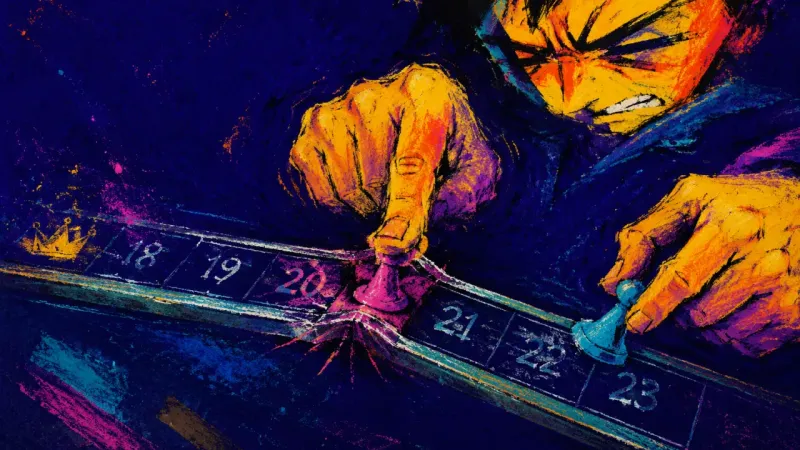
Finding Clarity in the 11:40 p.m. Friendship Leaderboard
I have seen the brutal whiplash of spending all day making evidence-based decisions, then building a replacement theory from one unfamiliar inside joke and almost no evidence. Friendship jealousy can turn an otherwise ordinary Tuesday into a private emergency.
Jordan was twenty-seven, non-binary, and working as a product designer in Toronto when they settled into the chair opposite me. Their voice was measured, but their shoulders sat close to their ears, as if they had been carrying an invisible backpack through every meeting, commute, and group chat of the week.
Jordan told me the latest spiral had begun at 11:40 p.m. in their apartment. The blue light of an Instagram Story filled the dark bedroom while the radiator clicked beside them and the phone grew hot in their palm. Onscreen, their closest friend was laughing with someone new.
They opened their message thread, compared reply times, checked the new person's public profile, and drafted Looks like you've found my replacement. Then they deleted it and sent the flatter, safer version: Have fun.
“I know they're allowed other friends,” Jordan said. “I genuinely want that for them. But my body reacts like I've already been replaced. Then I turn one delayed reply into a whole story, and if I ask for reassurance, I'm scared I'll sound controlling.”
I heard the core contradiction immediately: Jordan wanted a close bond spacious enough to coexist with other friendships, yet each newcomer felt like an eviction notice slipped under the door. The fear of replacement moved through their body like a condo lift dropping half a floor without warning: stomach falling, chest locking, thumb reaching for the screen before thought could catch up.
“Nothing about that reaction makes you ridiculous or too much,” I said. “The alarm is real, even when the conclusion attached to it is still unverified. I won't use tarot to tell you who your friend secretly prefers or what will happen next. I want us to understand why social change is landing as personal displacement, then find a response that protects both closeness and autonomy. Let's draw a map through the fog.”

Choosing the Bridge: The Five-Card Shadow Spread
I invited Jordan to place their phone face down, take one slow breath, and hold the question in plain language: Why does every new friend feel like a threat to my closest bond? I shuffled slowly. The pause was not a mystical performance; it was a transition from reacting to observing.
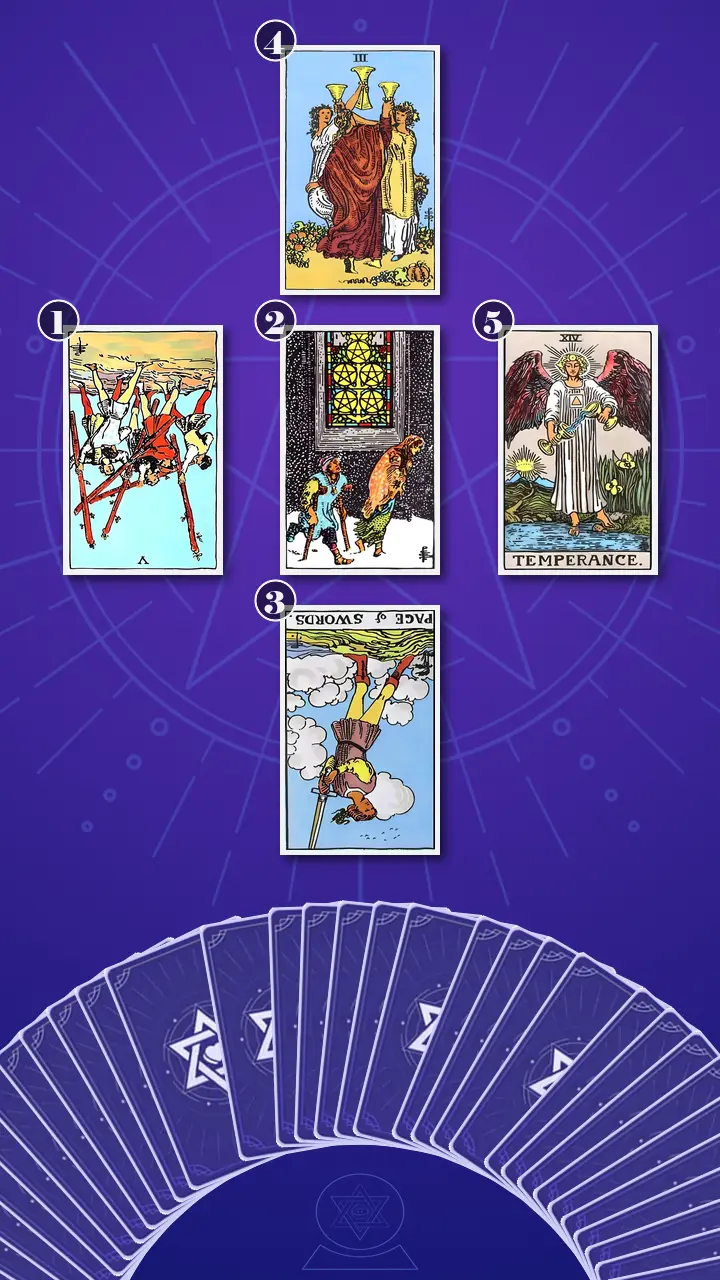
I chose the five-card Shadow Spread. For anyone wondering how tarot works in a situation like this, I use the cards as a structured mirror rather than a surveillance device. This question concerned Jordan's visible reaction, hidden fear, protective behavior, overlooked resource, and available next step. The spread could examine all five without pretending to access another person's private motives.
I arranged the cards as a cross. The hidden belonging fear would sit at the center. The visible threat response would go to its left, the defensive strategy below, the wider corrective truth above, and practical integration to the right. I saw the shape as a bridge crossing a fault line: before Jordan could move toward a different response, I needed to understand what was shifting underneath.
The first position would show what other people could actually observe after a trigger: comparison, withdrawal, and indirect tests. The center would reveal what the jealousy was protecting. The lower card would expose why more checking produced less clarity, while the upper card would show the capacity Jordan had not yet trusted. The final card would turn that insight into proportionate action.
That positional structure matters because card meanings in context are more useful than isolated dictionary definitions. A reversed card is not automatically bad, and an upright card is not automatically a promise. I read each image according to the role it was performing in Jordan's specific pattern.
The Leaderboard, the Snow, and the Open Tabs
Position One: The Contest No One Announced
The first card I turned over represented Jordan's observable threat response: comparison, internal competition, withdrawal, and indirect testing whenever a new friend appeared. It was the Five of Wands, reversed.
I pointed to the five figures whose staves crossed without any shared direction. Upright, the image can show visible rivalry or friction. Reversed in this position, I read the fire as blocked and redirected inward. No argument had happened in the outside world, but Jordan's attention was already hosting a competition.
“This is the private friendship leaderboard,” I said. “You see one Story, open three apps, and begin scoring who received the faster reply, warmer caption, better invitation, or more visible affection. No one has declared a contest, but your evening becomes one. Then, because you do not want to look jealous, you send something curt enough to remove an opportunity for the closeness you actually want.”
I traced the reversal with one finger. The energy was not merely deficient; it was also overcorrected. Jordan suppressed the understandable impulse to name discomfort, then performed coolness so thoroughly that the bond received distance instead of information.
I watched Jordan's breathing pause. Their eyes stayed on the crossing staves, then drifted toward their face-down phone. A short, bitter laugh escaped them.
“That is so accurate it feels a bit brutal,” they said.
“Accurate does not have to mean condemning,” I replied. “The card is showing a strategy, not your character. What connection did the message Have fun actually create?”
Jordan rubbed their thumb along the cup's rim. “None. I wanted them to notice I was off and ask if I was okay.”
I nodded. The first card had made the contradiction visible: Jordan wanted reassurance, but the behavior available to their friend looked like disinterest.
Position Two: Outside a Room That Is Still Lit
The next card represented the underlying belonging fear: the possibility that closeness was scarce, revocable, and vulnerable to replacement. At the center of the spread lay the Five of Pentacles, upright.
Two figures moved through snow beneath an illuminated stained-glass window. I asked Jordan to notice the contrast before assigning any conclusion: cold outside, warmth visible, separation felt. The card did not prove that shelter was secure or that nothing could change. It showed how exclusion could dominate attention until every other piece of evidence disappeared from view.
Jordan told me about the previous Sunday at the cafe they had visited with this friend for years. The espresso grinder had roared, cinnamon hung in the air, and the damp cuff of Jordan's coat clung to their wrist. Their friend repeated an inside joke involving a new coworker. Jordan was physically sitting inside a familiar ritual, yet their stomach went hollow and their mind supplied the sentence: I am already outside; they just have not told me.
I read the earth energy here as contracted into deficiency. The deficiency was not necessarily a lack of friendship; it was a felt lack of secure belonging. One bright group photo or unfamiliar joke became a sold-out sign, and Jordan assumed their existing reservation had been canceled too.
“When your stomach dropped, what ending did you think you were seeing?” I asked. “Less time together, less emotional intimacy, or discovering that you no longer belonged?”
Jordan's fingers stopped moving. Their gaze lost focus for a moment, as if the noisy cafe had reappeared between us. Then their chest released a small, involuntary breath.
“Discovering everyone else could already see I had been replaced, and I was the last person to know,” they said.
The repeated Fives mattered. I did not read them as an omen of unavoidable loss. I read them as a pattern in which disruption itself had acquired the emotional meaning of exclusion. The first Five showed the imagined contest; the second revealed why winning that contest felt necessary.
“A social change is not automatically a personal displacement,” I said. “That does not mean change never affects a friendship. It means a new name is not enough evidence, by itself, to prove that your place has vanished.”
Position Three: When Curiosity Becomes an Investigation
The third card represented the defense strategy maintaining the cycle: monitoring public evidence, overinterpreting fragments, and communicating through tests rather than direct requests. I turned over the Page of Swords, reversed.
The Page looked sideways while holding a raised sword in a windblown landscape. In this position, the reversal changed alert curiosity into excess and communication into blockage. Air energy was moving everywhere except toward the one question Jordan actually wanted answered.
I brought the card into Jordan's modern life: 11:40 p.m., the Story reopened, the new person's profile checked, recent messages reread, timestamps compared, punctuation inspected. More data promised protection from surprise. Instead, every clue opened another browser tab in the mind, while the real question remained untouched: Can we make time for the connection I miss?
“You are collecting clues because asking feels riskier,” I said.
Jordan looked up sharply, then gave one slow nod.
I felt an old Wall Street memory flicker through me: banks of monitors, prices moving by the second, and people mistaking an increase in information for an increase in understanding. I had learned there that a badly framed question could turn an entire terminal into noise. Jordan was doing the emotional equivalent of analyzing a dashboard after every single user action and calling each fluctuation a product verdict.
“This card does not confirm deception, gossip, or replacement,” I said. “In the protective-strategy position, it describes your own attention becoming overused. You are trying to solve a belonging question with public fragments that cannot reliably answer it. The checking briefly feels like control, but certainty remains one refresh away.”
Jordan's hand moved toward their phone and stopped midway. Their eyes settled on that small movement before returning to the card.
“I always think one more clue will keep me from being blindsided,” they said. “But no, there is no amount of Instagram data that can tell me whether I still matter. It just gives me something to do instead of asking.”
I let the admission sit without rushing to turn it into an instruction. The Page was a novice messenger in shadow form: gathering information quickly, but not yet converting it into clear, proportionate language. Recognizing that pattern did not obligate Jordan to disclose anything before they had capacity. It simply made the hidden question visible.
When the Three of Cups Opened the Circle
Position Four: What the Shadow Had Hidden
The radiator in my room clicked off just as I reached for the card above the center. Traffic softened outside, and the table seemed to hold a brief, unusual stillness. This was the corrective truth and available resource, the antidote around which the reading turned.
I revealed the Three of Cups, upright.
Three figures raised three distinct cups inside one connected circle. No cup had to become the only vessel. I read the water energy as available and balanced: friendship could be plural, mutually supportive, and differentiated without making every person interchangeable.
I asked Jordan to name what was actually distinctive about the closest bond. They mentioned years of voice notes, the usual Sunday cafe, the private context contained in a single look, and the ease of speaking after a hard workday without first explaining the entire backstory. I then asked them to look again at the new friendship without turning it into an audition for Jordan's role. Another person might add a different kind of support to the wider circle without reproducing or deleting any of those qualities.
I brought Jordan back to 11:40 p.m.: the laughing Story, the stomach drop, the timestamps, and the deleted replacement joke. They had been trying to choose between perfect vigilance and humiliating vulnerability, as if those were the only positions available to them.
Closeness is not secured by treating every newcomer as a rival; it grows when you make room for more than one cup in the circle and clearly ask for the connection you value.
I stopped speaking. The sentence remained between us while a band of light from the window moved across the three raised cups.
The first response was not relief. I watched Jordan's inhale stop halfway. Their fingers froze above the cup, and their pupils widened before their gaze slipped past the table, as if Tuesday night's Story were replaying on the wall behind me. Their jaw tightened. Then came the reaction I had not expected: “But doesn't that mean I've been wrong this whole time? That I created the problem?” The question came out sharper than the rest of our conversation, with anger protecting something much softer. “No,” I said. “It means a real need for connection recruited a strategy that could never satisfy it. Recognition is not a guilty verdict.” Their eyes reddened at the edges. The fist in their lap loosened one finger at a time, and their shoulders dropped on a long, unsteady exhale. Relief arrived, but so did a brief, almost dizzy silence: without the leaderboard, they would have to choose what to ask for.
“Now, with this new perspective, think back to last week,” I said. “Was there a moment when this insight might have made you feel different?”
Jordan thought about a genuine Saturday invitation they had left unanswered for three hours because they wanted their friend to insist. “I might have accepted it,” they said quietly. “Or at least admitted I wanted to go. Maybe their connection with someone else was not an audition for my role.”
Reciprocity Beyond the Feed
I wanted to reinforce the insight without replacing Jordan's frightening certainty with easy reassurance, so I used one of my core diagnostic tools: Reciprocity ROI Analysis. Whenever I use that language, I make the boundary explicit. People are not portfolios, affection is not a trade, and no friendship should be reduced to a profit-and-loss sheet. The useful part of the metaphor is the distinction between noisy public movement and underlying exchange.
I asked Jordan to set aside Story visibility and examine the present relationship through observable reciprocity: Who initiated? Who followed through? Did care, honesty, repair, and curiosity move in both directions? Could each person make a request or say no without punishment? From Jordan's own account, their friend still sent voice notes, maintained familiar rituals, and had recently offered a real invitation. Jordan also contributed care and attention. Those exchanges were more meaningful indicators than caption warmth, but they were not a lifetime guarantee.
I paired that analysis with Sunk-Cost Decoupling in Loyalty. Years of history counted as context, not collateral. A long friendship should not be defended solely because it is old, and one new group photo should not be treated as proof that its current value has collapsed. I wanted Jordan looking at the bond as it existed now: neither romanticizing the past nor liquidating the relationship during one night of social-media volatility.
The conclusion was deliberately modest. Current reciprocity existed. The bond had distinctive qualities. Future changes would still need to be evaluated through real exchanges, not tarot predictions or accumulated history alone. That was how the Three of Cups invoked relational abundance without slipping into false reassurance.
“What is distinctive does not have to be exclusive,” I said.
Jordan repeated the sentence under their breath. I heard the first movement from hypervigilant social ranking and fear of replacement toward differentiated belonging: a close bond could remain specific and valuable while both people retained wider social lives. The shift did not remove vulnerability. It gave vulnerability somewhere more honest to go.
Temperance and the Message Jordan Meant to Send
Position Five: Closeness With Room Around It
The final card represented integration in practice: balancing a direct request for connection with respect for both people's broader social autonomy. I turned over Temperance, upright.
The figure poured water between two cups while standing with one foot on land and one in water. I read the energy as balance through active adjustment, not a frozen state of perfect security. Temperance did not ask Jordan to suppress jealousy, tolerate every disappointment, or compromise at any cost. It asked them to hold two valid truths at once: This bond matters to me, and neither of us has to shrink our social world to prove it.
I translated the image into the message Jordan had meant to send all along. Instead of a replacement joke, an interrogation about the new person, or a flat response designed to trigger pursuit, the card suggested one specific first-person invitation.
Jordan opened Notes rather than Instagram and typed: “I've missed our one-on-one time. Are you free for coffee at our usual place Sunday?”
They read it aloud. Their shoulders stayed lower, although one knee began to bounce under the table.
“That feels embarrassingly direct,” they said.
“Direct can feel exposed when coolness has been your armor,” I replied. “But notice what the message does not do. It does not rank anyone, accuse your friend, or restrict another relationship. It names your experience and offers one voluntary point of connection.”
I reminded Jordan that their friend remained free to decline, suggest another time, or respond in a way Jordan did not prefer. Jordan remained equally free to decide what that response meant for their own participation in the friendship. Temperance was not a promise that honesty would preserve the bond. It was a way to replace suspense with proportionate, usable information.
“A request gives you real information; a test gives you more suspense,” I said. “Ask for a point of connection, not proof of your rank.”
Jordan looked from the two cups in Temperance to the three cups above it. Then they saved the draft without sending it. I considered that a complete choice for the moment. Agency included the right to pause.
Facts Before Rankings: Two Next Steps
The Pattern Beneath the Pattern
I drew the reading together as one coherent sequence. The Five of Wands reversed showed Jordan turning several independent relationships into an internal contest. The Five of Pentacles revealed why: change activated the fear of being left outside. The Page of Swords reversed showed the protective response, with attention overactivated and communication blocked. The Three of Cups opened a non-zero-sum model of belonging, and Temperance converted that model into a specific request that preserved autonomy.
The elemental movement was just as clear to me: blocked fire became contracted earth, contracted earth drove restless air, open water restored emotional plurality, and Temperance blended feeling with practical choice. Jordan had not been lacking intelligence or collecting too little evidence. Their internal algorithm had been trained to surface threat, so every pause became stronger evidence because pauses were what it knew how to find.
The central blind spot was the assumption that another person's inclusion required Jordan's exclusion, combined with the belief that public visibility could measure private relational value. That belief made monitoring feel safer than vulnerability, even as monitoring kept the desired connection indirect.
The transformation direction was not from caring to indifference. It was from silently monitoring every new friendship for signs of replacement to naming one specific point of connection while preserving room for both people's wider social lives. I turned that direction into two small pieces of actionable advice rather than a demand for a life-changing conversation.
The Seven-Minute Clarity Plan
- Use the Facts Before Rankings note.At the next Story, group photo, unfamiliar joke, or delayed reply, open Notes and divide one page into Facts, Ranking Story, and Connection I Want. Set a seven-minute timer. Record three observable facts, one unverified competitive story, and one small connection you would value. Then use Focus mode and wait twenty minutes before replying.If the exercise makes the checking more intense, stop and close the app. The minimum version is one fact, one story, and a ten-minute pause; nothing has to be sent.
- Make one Temperance request.Before Friday, draft no more than two sentences to the friend involved. Name one thing you miss and offer one bounded plan: I've missed our one-on-one time. Would coffee Sunday, a Wednesday call, or a twenty-minute walk after work suit you? Ask once, then move into a preselected activity while you wait.Lower the difficulty by sending only the invitation. Keep the message about your experience, avoid mentioning anyone's rank, and treat the response as information rather than a verdict on your worth.
I told Jordan these practices were experiments, not loyalty tests and not rules imposed by the cards. They could keep the note private, delay the message, change the wording, or decide the relationship required a different boundary after observing real patterns over time. Tarot had clarified the variables; Jordan still owned the decision.

A Week Later: The Quiet Proof
Six days later, Jordan sent me a message. Another tagged photo had appeared while they were riding Line 1, and their chest had tightened before the train reached the next stop. This time, they opened the three-column note instead of the new person's profile.
They wrote three facts: one photo had been posted, their friend had sent a voice note the previous day, and no existing plan had been canceled. The ranking story was: They are becoming closer, so I am becoming less important. The connection Jordan wanted was simple: time together without a hidden test.
Jordan sent the coffee invitation. Their friend could not do Sunday, but suggested a Wednesday call and a walk the following weekend. It was not unlimited reassurance, and Jordan did not pretend it was. It was a real response to a real request.
That night, Jordan slept through until morning. Their first thought was still What if I am wrong? They told me they smiled, left the phone face down, and made coffee before opening Instagram.
I did not see tarot solve Jordan's friendship, erase jealousy, or guarantee where the bond would go. I saw it do something more grounded: expose an invisible ranking system, identify the fear powering it, and return the next choice to the person actually living the story. Jordan's clarity was not certainty. It was ownership.
I know how quickly a new name can make the stomach drop, as if you must hide how much a bond matters while quietly guarding one chair in a crowded room. I also know that noticing the private leaderboard is already a change: once the score is visible as a story, it no longer has to pass unnoticed as truth.
So I will leave you with the image Jordan carried out of the room: several distinct cups, raised inside one circle. If closeness did not need exclusivity as proof, what small point of connection, shared ritual, or honest invitation would you feel comfortable placing back in that circle this week?