Two Friends, Two Private Chats at 11:40 p.m.—A Boundary, Not a Verdict

The 11:40 p.m. Loyalty Test: Why I Kept Mediating Between Two Friends
“You are the Toronto project coordinator who gets an 11:40 p.m. ‘Whose side are you on?’ text, opens both private threads, and starts editing a neutral reply before admitting this is loyalty-test pressure, not just a difficult conversation,” I said.
Riley sat across from me with their phone face-up between us. The blue screen warmed their palm while the radiator clicked in the Toronto apartment, and their restless fingers kept opening an Apple Notes timeline, deleting every sentence that sounded like a personal opinion.
They had two private iMessage threads open beside a silent group chat. One friend had sent a voice note asking for visible loyalty; the other had followed with a carefully worded account of why that loyalty belonged with them. Riley had softened both stories, offered to carry an update, and postponed saying what they could or could not participate in.
“I can see both sides so clearly that I forget I am also in the room,” Riley told me. “I want to stay close to both, but if I stop translating, I am scared there will be nothing left holding us together.”
I heard guilt first, with fear of rejection, confusion, and resentment gathering underneath it. Riley wanted to preserve intimacy with both friends by mediating, but feared that stopping or refusing a loyalty demand would cost closeness with one of them. You call it keeping the peace, I told them, but your body experiences it as a bridge being pulled from both ends: chest tight, hands busy, and no safe place to put your own weight.
I am Lucas Voss. After years in the high-stakes world of Wall Street, I know how uncertainty can make the night feel larger than it is. I also know that analysis should protect a person's agency, not replace it. “We are not here to decide which friend wins,” I said. “We are here to draw a map of what is yours to carry, what belongs to them, and where your voice can come back into the conversation. That is our journey to clarity.”

A Map for a Three-Person Storm
I asked Riley to put the phone face down, take one slow breath, and hold the question in mind without trying to solve it. I shuffled at an even pace. The point was not to summon a fixed future; it was to create a deliberate pause between the notification and the old messenger reflex.
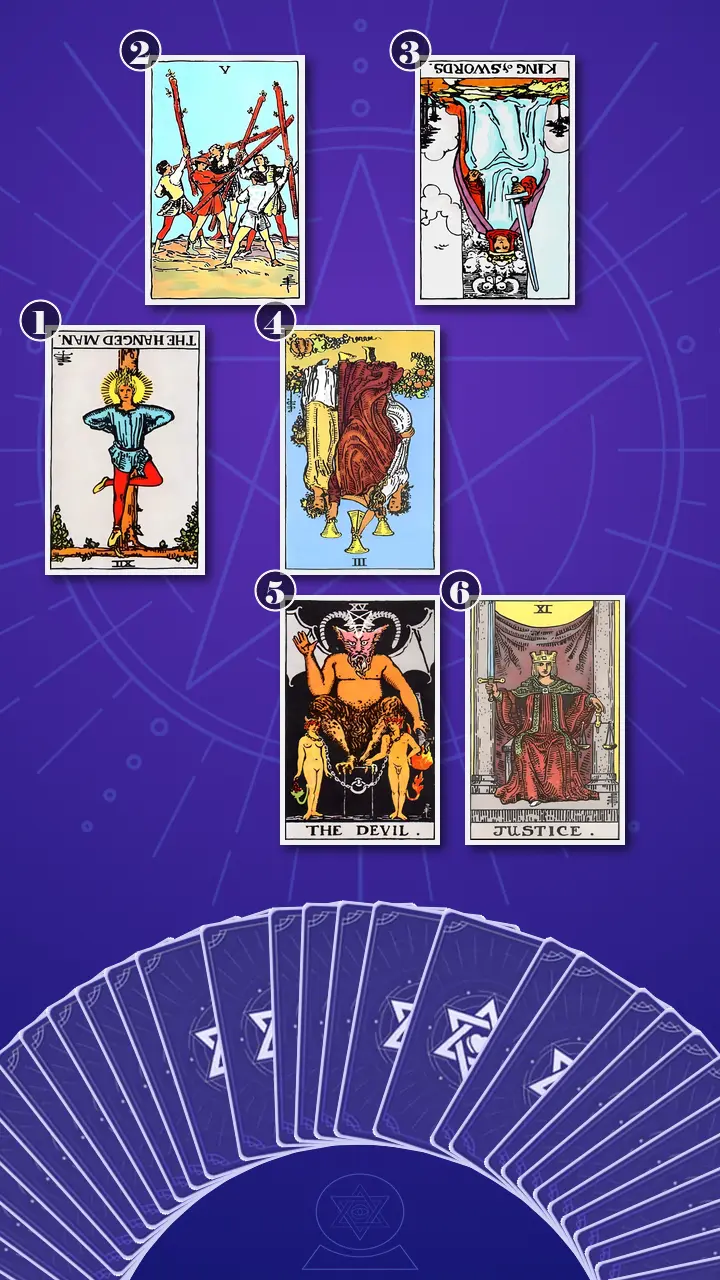
For this reading, I chose the Relationship Spread · Context Edition, a custom six-position triangular cross. For anyone wondering how tarot works in a friendship conflict, I use the cards as a structured cognitive mirror: the images help us notice patterns, while the querent remains responsible for interpretation and choice.
This spread fits a friendship triangle better than a decision spread because Riley was not choosing between two life options. The real question involved power, intimacy, triangulation, and boundaries. Position 1 would show Riley's stance inside the triangle. Positions 2 and 3 would mirror the two loyalty demands. Position 4 would reveal the shared relational field, position 5 the hidden challenge sustaining the pattern, and position 6 a self-authored boundary rather than a predicted outcome.
I explained the route to Riley and to the reader following along: we would move from suspended agency, through competing demands and a disrupted friendship circle, into the attachment underneath the mediation, and finally toward Justice as a repeatable standard of fair participation. This is what card meanings in context can offer: not a verdict about another person's character, but a clearer view of one's own available response.
The Role Hidden in the Messages
Position 1: The Hanged Man Reversed and the Unsent Draft
Now I turned over the card for the querent's stance inside the triangle: what Riley does when both friends demand loyalty. It was The Hanged Man, in reversed position.
The upside-down figure and the bound foot gave me an immediate visual map of delayed agency. In Riley's modern life, the bound foot was an unsent draft: they were technically free to speak, but kept one relational step suspended until both friends approved the wording. Riley kept both private chat threads open all night, translating each person's feelings into a neutral summary and calling the delay considerate. The reversed Hanged Man showed agency held upside down; the longer Riley waited for perfect language, the more their own opinion disappeared.
This was a blockage, not a moral failure. The pause that might have offered perspective had become self-sacrifice disguised as neutrality. I asked, “What personal truth becomes available if being close to both friends does not require you to remain the messenger?” I also made the corrective practical: the answer was not to ghost both friends or send a harsh final message. It was to make one small, deliberate choice before the old pattern took over.
Riley gave a short, bitter laugh. “That is almost cruel,” they said. “It is exactly what I do.” Their thumb stopped above the screen, then lowered into their lap. I let the recognition stand without turning it into pressure; seeing the pattern was already different from obeying it.
Position 2: The Five of Wands and the First Loyalty Demand
Now I turned over the card for Friend A's loyalty demand as Riley experienced it, separating Friend A's stated claim from the extra job Riley feared they had to take on. It was the Five of Wands, upright.
The five figures raised their wands in different directions, each engaged in a separate struggle without shared rhythm or agreed ground. The modern translation was immediate: Friend A and Friend B had sent separate voice notes within minutes, each presenting their version as the one that deserved immediate agreement. Riley experienced the overlapping claims as a contest and started translating instead of asking which part of the conflict actually belonged to them.
The energy here was an excess of visible friction. It did not make Friend A the villain, and it did not prove that Friend A's account was false. It showed how a live disagreement had become a loyalty test in Riley's nervous system. “Which part belongs to Friend A,” I asked, “and which part are you volunteering to manage because silence feels dangerous?”
Riley's shoulders lifted as if bracing for another notification. They nodded once, then looked away from the card. “I keep thinking I have to make the two stories compatible before I am allowed to respond,” they said. I wrote that sentence down as evidence of the role, not evidence that they had to keep performing it.
Position 3: The Reversed King of Swords and the Moral Test
Now I turned over the card for Friend B's loyalty demand as Riley experienced it, with attention to how certainty and intimacy had become linked in the conversation. It was the King of Swords, in reversed position.
The upright sword, rigid throne, and direct gaze suggested judgment and authority, but reversed, that mental power had become rigid or controlling. Friend B's detailed message sounded less like an invitation to talk and more like a test of whether Riley was a morally loyal friend. Riley built a private timeline, compared timestamps and screenshots, and edited the reply until it contained no preference at all.
This was a blockage created by an excess of certainty. Riley was responding to the strongest argument instead of checking whether the request respected their independent judgment. The card did not diagnose Friend B; it showed the power position Riley was afraid to challenge. “Can you write one sentence that describes your limit without arguing about who is right?” I asked.
Riley's eyes moved over the message history as if searching for a clause that would release them. Their jaw tightened. Then they turned the phone over. “A boundary feels like a ruling,” they said. “Like if I do not agree, I have used power against them.” I told them that refusing to issue a verdict could be the first way to keep their judgment independent.
Position 4: The Reversed Three of Cups and the Rerouted Circle
Now I turned over the card for the shared relational field and the Mutual Friend Neutrality Trap: how the three-way friendship pattern rewarded mediation and obscured direct accountability. It was the Three of Cups, in reversed position.
The three raised cups and linked arms had become a broken circle. In Riley's daily life, the shared group chat appeared connected, but every difficult feeling arrived in Riley's private inbox first. Riley sent a softened summary, checked both replies, watched read receipts, and rearranged plans around discomfort. If every difficult conversation travels through your inbox, I told them, the friendship circle is connected through you, not with you.
The energy was a blockage in the shared field. Mediation reduced immediate tension, but it also kept the two friends from carrying their direct conversation and responsibility. The group remained technically intact while Riley became its emotional infrastructure. I asked, “Did the two friends speak directly in the last tense exchange, or did every update pass through your phone? What did that arrangement reward you for doing?”
Riley stared at the silent group chat. First, their fingers froze over the screen; then their eyes lost focus as if replaying the last cancelled dinner; finally, a long breath left their chest. “Everyone is still connected,” they said, “so why am I the one carrying the whole connection?” The question loosened something important: the pattern was a rerouted group dynamic, not proof that Riley had personally failed.
Position 5: The Devil and the Subscription Riley Never Chose
Now I turned over the card for the hidden challenge sustaining the mediator role: co-dependency and the Power-Intimacy Split, especially the belief that setting a boundary threatens closeness. It was The Devil, upright.
The chains around the two figures and the shared pedestal showed an invisible agreement that felt chosen but could still be examined. In Riley's modern life, it looked like an emotional subscription they had never consciously signed up for. Each time the phone lit up, a new emergency renewed automatically. Riley stayed available, useful, and conflict-absorbing in exchange for the hope of feeling secure in both friendships.
The energy was attachment maintained by a fear-based bargain. The card did not condemn either friend. It named the belief underneath the helpfulness: if Riley stopped mediating, one or both friends might withdraw, and that withdrawal might seem to prove Riley was not worth keeping close unless they remained useful.
I used the inner script slowly: “If I stop doing this, then they will...” Riley began, then stopped. I followed with the quieter question, “What are you afraid that would prove about your place in the friendship?” Then I gave them the sentence I wanted them to keep: Being needed is not the same thing as being close. Care and usefulness could overlap, but they were not identical.
Riley's breath caught first, and their hand froze above the deck. Their gaze went unfocused as if the last ten years of friendship had started replaying in small scenes: late-night calls, softened explanations, cancelled plans, and the relief that arrived whenever someone said, “You are the only person who understands.” Then their shoulders dropped, their jaw released, and a quiet “Oh” came from somewhere below the argument. After a pause, they said, “But if usefulness is not closeness, I do not know what I have been offering.” I told them that the question could be sad without being a sentence. A friendship history could matter deeply without requiring Riley to keep paying for it with their nervous system.
When Justice Put the Phone Down
Position 6: Justice and the Boundary Without a Verdict
The room changed when I reached the guidance position. The radiator made one sharp click and went quiet. I turned over Justice, in upright position, for a self-authored boundary and the next conversational step that answered Riley's question without deciding which friend was right.
The balanced scales and upright sword offered a practical image of fair participation. Justice was not asking Riley to become the judge of the friendship conflict. It was asking them to define their own responsibility, return each friend to direct communication, and let a clear standard hold even when someone felt disappointed. The energy was balance: proportionate judgment, shared accountability, and self-trust instead of guilt-driven neutrality.
At that point I used my signature Reciprocity ROI Analysis. I did not ask Riley to score either friend or calculate anyone's worth. We measured the emotional give-and-take in the core friendships: who was requesting time, translation, reassurance, and proof of loyalty, and whether direct responsibility was being returned. The imbalance was not proof that anyone was bad. It was evidence that Riley's labor had become high-drain and asymmetrical.
I paired that with my Sunk-Cost Decoupling in Loyalty lens. Ten years of history could be honored without treating it as a contract for endless mediation. History told Riley why the bonds mattered; it could not decide what Riley owed in the current conversation. As I watched the scales, I remembered an old Wall Street lesson: exposure and responsibility are not the same line on a ledger. The same distinction could protect a friendship. Riley could be emotionally affected by the conflict without being responsible for its outcome.
I asked Riley to picture the familiar scene: two private chat threads open at 11:40 p.m., the phone warm in one hand, a neutral summary blinking in the other. Every sentence protected both friendships, but Riley's own opinion had been edited out. This was the moment to name the role, not perfect the message.
You do not have to prove intimacy by absorbing both friends' conflict; you can measure your own responsibility with Justice's scales and speak one clear boundary with its upright sword.
I let the sentence settle, then added the practical version: “You do not have to prove intimacy by absorbing both friends' conflict. Fairness can mean naming what you will carry, declining the messenger role, and letting each person own the conversation that belongs to them.”
Riley did not nod immediately. First, their breath paused and their fingers tightened around the edge of the chair. Then their eyes widened slightly, moving from the sword to the phone as the idea entered the place where the old loyalty rule had lived. Their mouth opened, closed, and finally formed a small, strained question: “But does that mean I was wrong all those years?” The question carried anger, grief, and relief at once. I watched the tension travel through their shoulders, saw their fists loosen, and heard the next breath arrive with a faint tremor. “No,” I said. “It means mediation was a strategy that once helped you survive uncertainty. You are allowed to update the strategy when the cost becomes clear.” Riley leaned back, still pale with the responsibility of having a choice, and released a longer breath. The relief was real, but so was the brief dizziness of no longer having a role to hide inside.
“Now use this new view to remember last week,” I said. “Was there a moment when knowing what was yours to carry might have let you feel even slightly different?”
This was the first bridge from guilt-driven mediation, hypervigilant social scanning, and fear of rejection toward self-trust, fair participation, direct responsibility, and clear friendship boundaries. Justice did not promise that either friend would respond perfectly. It gave Riley a way to remain caring without becoming the friendship's transport system.
Fairness With a Return Address
When I laid the six cards side by side, the story became coherent. The reversed Hanged Man showed Riley suspending their own agency. The Five of Wands and reversed King of Swords showed competing accounts hardening into visible loyalty pressure and moral tests. The reversed Three of Cups showed a friendship circle whose difficult messages had been rerouted through one private inbox. The Devil exposed the hidden bargain beneath the pattern: being indispensable had started to feel like the admission price for belonging. Justice answered with a different structure, one in which Riley carried their own words, time, and capacity while each friend carried their direct relationship.
The cognitive blind spot was not a lack of information. Riley had too much information, too many screenshots, timelines, voice notes, and carefully balanced summaries. The blind spot was suspended agency: the assumption that more analysis would make it safe to state a boundary. Over-functioning created temporary relief, but it also kept the triangulation alive. Fairness is not making everyone comfortable; it is carrying your own share and returning the rest.
The key shift was from proving intimacy by absorbing and managing both friends' conflict to naming a clear boundary, declining the messenger role, and allowing each person to speak for themselves. This was not a command to choose themselves in a dramatic, absolute way, and it was not a prediction that the friendship circle would either heal or collapse. It was a small change in participation that Riley could repeat.
I gave Riley three low-stakes experiments. Each one was designed to be useful on a real Toronto evening, in a live iMessage thread, when guilt was loud and the hands wanted to start drafting.
- One-sentence messenger exitWithin the next week, when either friend asks you to choose sides, send or say: “I care about you, but I will not carry messages, evaluate the conflict, or choose sides. Please speak to them directly.” After sending it, wait ten minutes before adding an explanation, apology, or reassurance.Keep the sentence in an Apple Notes template or phone shortcut. A boundary is information about your participation, not a verdict about either friend.
- Direct-route friendship checkWhen a message is meant for the other person, reply: “I hear that this matters to you. I am not going to pass it on, so please send it directly to them if you want them to receive it.” For the next shared plan, make one ordinary invitation to everyone instead of separate emotional briefings. If the same requests continue, use my Friendship Downgrade Strategy: answer at a normal pace, decline private conflict debriefs, keep low-maintenance contact possible, and stop providing translation.This is gradual de-escalation, not ghosting, punishment, or a hidden friendship verdict. Keep the redirect specific, and let each person choose what direct conversation they want.
- Ten-minute no-repair pauseThe next time a loyalty request arrives, put the phone face down and set a ten-minute timer. Write two columns: “What is mine to say” and “What belongs to them.” Choose one sentence from the first column and leave the second column untouched rather than turning it into a message for either friend.If ten minutes feels impossible, begin with two. Notice guilt, fear, resentment, tightness, or restless hands without turning the sensation into another task. You may stop whenever you need to.
Riley asked whether refusing to carry a message would make them uncaring. I answered with the line I wanted them to test in real life: “You can care about both people without becoming the place where their conflict lands.” The purpose of the exercise was not to force a reunion, expose a villain, or make discomfort disappear. It was to make responsibility visible enough for Riley to choose their share.

A Week Later, the Quiet Proof
Four days later, I received a message from Riley while I was making coffee. They had used the one-sentence messenger exit after Friend B asked for a private summary. Riley's chest tightened, their fingers hovered over the reply box, and they waited ten minutes anyway. Friend B eventually asked whether they could speak directly to Friend A. Nothing was magically resolved, but Riley had stopped treating the first wave of discomfort as an emergency.
That evening, Riley sent the boundary and sat alone in a cafe near Dundas West. They felt lighter and strangely lonely, watched rain stripe the window, and resisted reopening the chat for three full minutes.
That was the proof I trusted: not a perfect friendship circle, but one clear action that placed Riley back in the room. The tarot had not chosen a friend or made the boundary safe. Riley had used the cards to notice the old bargain, claim their own words, and return the rest of the conflict to the people who owned it.
Our journey to clarity ended with uncertainty still present, but no longer in charge. Self-trust began as a fair-share responsibility check, then became a sentence Riley could repeat without turning it into a courtroom argument. Intimacy could remain possible, now with direct communication and a boundary that was chosen rather than imposed by guilt.
If two people you care about are still tugging at the same conversation, the tightness in your chest is not proof that you have failed; noticing the pull may be the first sign that your own voice is back in the room.
When the next loyalty request lights up your phone, what one short boundary-without-verdict sentence could you let your body hear first, before deciding whether to send it?