Friendship People-Pleasing: When One Honest Text Stayed Standing
Finding Clarity in the 10:47 p.m. Friendship People-Pleasing Spiral
I recognise the "low-maintenance" friend who can manage a London commute, a junior-strategy deadline, and everyone else's crisis, yet feels a stomach drop after naming one small preference. When a crisis text arrives beside unfinished work, her first reflex is not to check her capacity. It is to keep the bond comfortable. That is often where friendship people-pleasing hides in plain sight.
Maya sat across from me on a rain-heavy Saturday afternoon, her phone face down beside the tarot cloth and both hands wrapped around a mug she had barely touched. I could hear tyres moving through wet streets below my studio window. Her jaw tightened when she said, "I know what she needs before I know what I need."
I asked her to take me to the most recent moment when that happened. As she spoke, I pictured Tuesday at 10:47 p.m. in her London flat: blue laptop light across an unfinished presentation, cold tea beside the trackpad, and the radiator humming into an otherwise quiet room. Maya had deleted "I can't talk tonight" from WhatsApp three times. Her chest had tightened; her stomach had dipped. Then she had typed, "Of course, call me," and closed the deck she needed for work.
"It was easier to change my night than deal with the weirdness of saying no," she told me. "I felt relieved as soon as I sent it. Then I was annoyed with her before the call had even started."
I heard relational apprehension in its physical form: a tripwire running from the WhatsApp bubble through her sternum to her stomach, ready to pull tight at the slightest sign of distance. Underneath it were longing, guilt, and resentment. Maya wanted the friendship to feel safe, but she feared that allowing one visible need into the bond might threaten it.
"You are not low-maintenance if the maintenance is happening silently inside you," I said. "And I am not going to use these cards to decide whether your friend is good, bad, or secretly thinking something. I want us to map what happens inside your participation: what you notice, what you give, what you fear, and where you still have choice. Let's give this fog a structure."
Choosing the Suspension Bridge: A Five-Card Relationship Spread
I invited Maya to take one slow breath while holding the question, "Why do I keep centring my friend's needs to make our bond feel safe?" I shuffled without theatre. For me, the brief ritual is a transition from reacting to observing, not a promise that something outside us will dictate the answer.
I chose the Relationship Spread · Context Edition, a five-card relationship tarot spread designed for boundaries, unequal emotional labour, and blurred roles. I want to pause here for anyone wondering how tarot works in a situation like this: I use the images as an objective relational systems map. They help separate observable behaviour from feared meaning and turn a vague emotional pattern into specific questions. No card can read a friend's private motives or predict whether a friendship will last.
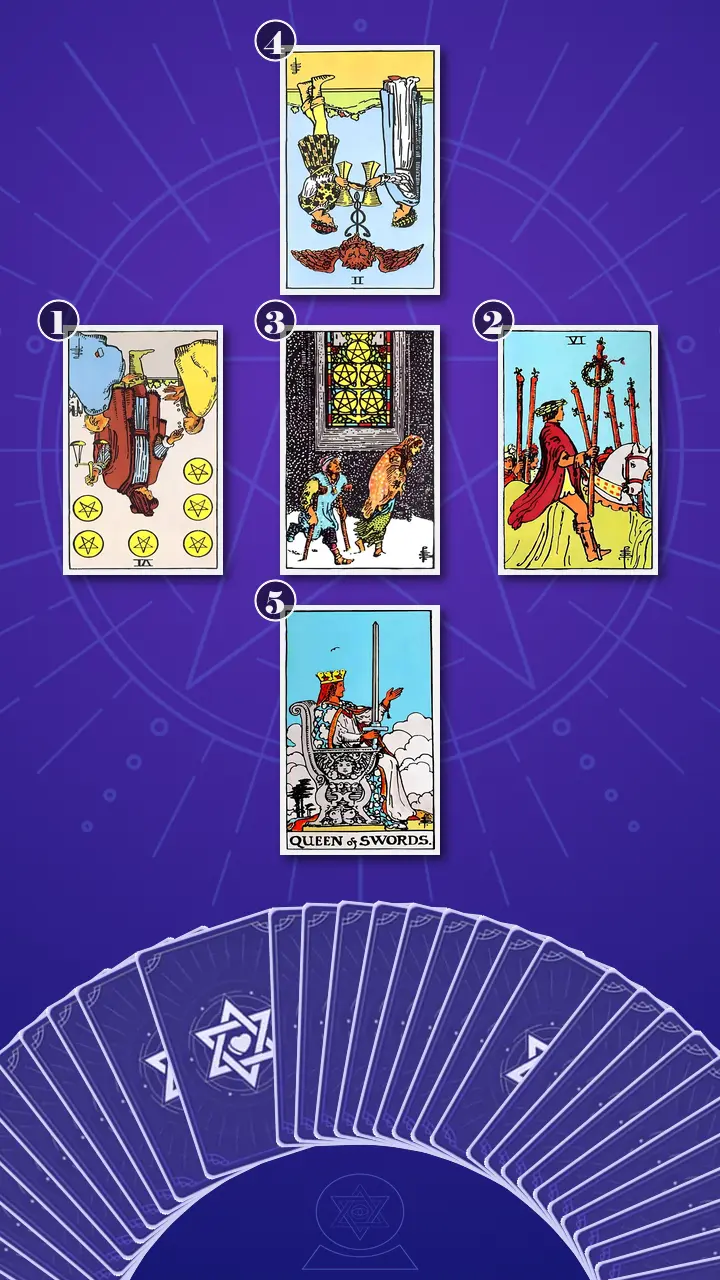
I arranged the cards like a suspension bridge. The first card would show how Maya was participating through time, attention, and flexibility. The second would show the friend's observable social role as Maya experienced it, without claiming access to her inner character. The centre card would hold the bond's load-bearing belief. Above it, the fourth would reveal the feedback loop preventing reciprocity. Below it, the fifth would become the grounding bridge forward: something Maya herself could practise.
This spread suited Maya's question because it followed a complete chain without overcomplicating it: Maya's automatic giving, the attention pattern around her friend, the belonging fear beneath both, the active communication blockage, and a boundary practice that could keep warmth and difference in the same relationship.
When Care Becomes the Price of Admission
Position 1: The Scales Maya Never Consulted
I began with the card representing Maya's observable self-centering sacrifice: the ways she gave time, attention, and flexibility before checking her own needs. I turned over the Six of Pentacles, in reversed position.
I pointed to the scales and the coins being distributed from one figure's hand. "These coins are not only favours," I said. "They are your evening, your concentration, your commute energy, your money, your sleep, and your emotional attention. They are finite resources, even when you are generous with them."
The card returned us directly to 10:47 p.m. Maya had offered the late call while her work deck glowed beside her. No one had reviewed her capacity because she had made that capacity invisible. She gave the evening first, then studied her friend's warmth for evidence that the sacrifice had kept the bond secure.
I described the reversal as an excess of outward giving paired with a deficiency of inward consultation. The natural balance of generosity had become blocked. Before Maya asked whether she could help, she was asking, "What will keep her close?" That did not make her care fake or manipulative. It meant freely chosen care and safety-seeking usefulness had become tangled together.
Maya gave one short, bitter laugh. "That's so accurate it's almost cruel." Her thumb rubbed the mug handle, then stopped. "I keep calling it loyalty, but I am starting to feel invisible."
I let the sentence settle before asking, "Before you accepted that call, did you check your calendar, energy, or interest? Or did you check the imagined risk of disappointing her?"
"The risk," she said. "I didn't even consider myself part of the decision."
I also named the reversal's overcorrection risk. "The answer is not to score every favour or demand instant one-for-one reciprocity. Friendships can be uneven for a while and still be real. The question is whether you are choosing what you give and whether your actual capacity is allowed to exist in the exchange."
Position 2: The Group Chat Finds Its Headline
I moved to the card representing the friend's observable main-character role as Maya experienced it, including the way attention and group momentum gathered around the friend without claiming anything about her private motives. I revealed the Six of Wands, upright.
The rider was elevated above a validating crowd, a victory wreath visible above the other figures. In Maya's life, the image looked like a promotion, crisis, or venue change landing in WhatsApp and immediately becoming the group's headline. Maya would confirm the emotion, volunteer to make the booking, collect everyone's availability, and leave her own update unsent.
"Last month, I was going to tell them that my campaign concept got picked," Maya said. "Then she announced her promotion. I organised the drinks instead."
Here, the upright fire of recognition was not blocked. It flowed strongly, and at the system level it could become excessive because so much of the group's attention organised around one visible centre. The card did not tell me the friend intended to dominate. It showed the social arrangement Maya repeatedly encountered and helped maintain.
I reached for a diagnostic lens I call Clique Power Dynamics. I do not use it to invent jealousy, micro-aggressions, or malice where none has been observed. I chart the traffic: whose news becomes the headline, whose preferences become the default, who validates, who performs the logistics, and who makes herself smaller when attention briefly turns her way.
"The main-character friendship label can be useful shorthand," I told Maya, "but only if we use it to describe the staging, not diagnose the actor. The sharper question is this: when someone else becomes visible, why do you respond by making yourself less visible?"
Maya's gaze moved from the crowned rider to the unsent-message screen she had described. Her fingers loosened around the mug. "Because being the audience means I still have a seat," she said quietly.
As an artist, I thought of a film set where everyone learns their mark so thoroughly that the blocking begins to look inevitable. A familiar position can feel safe even after the story has outgrown it. Maya did not need to compete for the lead; she needed to become authoritative about whether and how she participated in the scene.
The Lit Window Behind a Silent Phone
Position 3: When Distance Feels Like Exile
I returned to the centre and turned over the card representing the Survival-Bond Fusion beneath the friendship: the belief that this connection functioned as essential protection from exclusion or loss of belonging. It was the Five of Pentacles, upright.
Two figures moved through snow beneath an illuminated stained-glass window. The image did not tell me Maya had been abandoned. It showed a deficiency of felt support, a scarcity state in which nearby warmth becomes difficult to perceive because the body is braced for exclusion.
I asked Maya about a recent delayed reply. She described standing in a fluorescent supermarket queue at 6:34 p.m., the checkout scanner beeping while freezer air caught the damp sleeve of her coat. Her friend had not replied for four hours but had posted an Instagram Story from another table. Maya's stomach dropped, and restless energy moved into her thumbs as she drafted a brighter follow-up.
"The actual event was a quiet phone," I said. "But your body experienced a lit window closing in winter."
Maya nodded once, then went very still. I watched her eyes lose focus as if she were replaying the supermarket scene. Her next breath came slowly, and when it left her, her shoulders lowered by a fraction.
"This is only a delayed reply, but my body is reading it as the door closing," she said, testing the words aloud.
I asked when the friendship had started to feel like shelter rather than simply one valued connection. Maya told me it had deepened during a period when she felt detached from other social circles. Her friend had become the person who called, included her, and gave the week emotional shape. The bond mattered. I had no interest in minimising that. The card asked whether the fear of losing shelter had made ordinary difference feel dangerous.
"Survival-Bond Fusion is what I call the moment a relationship carries so much of your belonging that preserving access begins to outrank honest self-expression," I explained. "The friendship may be important without being your only lit window. A delayed reply can activate an old season of isolation without proving that isolation is happening again now."
I asked what else disappeared from Maya's awareness when the belonging alarm sounded. She named two colleagues who had invited her to a film night, a cousin she liked but rarely called, a quiet Saturday routine, and the fact that her friend had responded warmly many times before. The Five of Pentacles did not ask her to downgrade the friendship. It asked her to notice when one uncertain moment was being promoted above every other piece of available information, like a notification algorithm trained only on possible rejection.
Position 4: Two Cups, One Edited Voice
I turned to the card representing the co-dependent feedback loop that converted care into self-silencing and prevented transparent reciprocity. The card was the Two of Cups, in reversed position.
In the upright image, two people bring separate cups into an exchange. Reversed, the water of honest connection was in blockage. Maya's cup appeared empty of its own preference because she edited its contents before anyone else could see them.
I brought up a Saturday group plan. A friend changed brunch from a quiet café near Maya to a loud venue across London. Before checking Citymapper, the cost, the seventy-minute journey, or her depleted energy, Maya typed, "Perfect! Anything works for me." Her jaw tightened on the long commute. She later resented an agreement that had looked unanimous on screen.
"I said yes, then resented an agreement she never knew I didn't want," Maya said. The words came out slowly, each one sounding less like blame and more like newly visible data.
"Exactly," I replied. "The card is not saying there is no love. It is showing that the relationship cannot respond to information it never receives. Your friend has often been given the accommodating version of you, then both of you are left living with an agreement that was never fully mutual."
I thought of a shared document in which one person's edits remain visible while the other person deletes every comment before anyone can answer. The page may look clean and conflict-free, but it is not truly collaborative.
"Smoothness is not the same thing as mutuality," I told her. "If one participant mutes herself before the vote, the meeting can look unanimous without being safe."
Maya's chest lifted on a shallow inhale. She looked at the two inverted cups, frowned, and then nodded. "I thought I was protecting the friendship from conflict. But I was also protecting it from meeting me."
I agreed, while keeping the distinction precise. "And that does not mean you must unload every stored grievance, cancel without explanation, or turn boundaries into punishment. Abrupt withdrawal would be another way of keeping your real, present-tense preference out of the conversation. The experiment is smaller: let one honest piece of information enter before you smooth it away."
When the Queen of Swords Kept Her Hand Open
Position 5: The Sentence That Could Remain Standing
The rain against my studio window softened as I reached for the final card. I turned over the position identifying a boundary practice that could preserve warmth while restoring Maya's voice, capacity, and separate point of view. This was the reading's bridge card: the Queen of Swords, upright.
I showed Maya the Queen's vertical sword and her extended left hand. The sword offered accurate language; the open hand kept receptivity in the same frame. Upright air appeared in balance: naming, asking, scheduling, and stating capacity could do what over-distributed labour and mind-reading had not.
In ordinary life, the Queen looked like Maya receiving a non-urgent crisis text, checking the unfinished presentation and her actual energy, then sending one concise statement: "I can't talk tonight, but I can check in tomorrow after work." If tomorrow was not genuinely available, the sentence could stop after "I can't talk tonight." An open hand was an option, not an obligation.
This was where I used my Sidekick Syndrome Diagnosis. Maya's friend group had learned to recognise her as the reliable one, the therapist, the organiser, and the person who could make anything work. Those roles may once have helped her belong, but repeated performance had turned them into a restrictive character brief. I told Maya that a role can be familiar, socially rewarded, and still be too small for the whole person playing it.
My mind flashed to a production call sheet with one actor permanently listed as "supporting." As an artist, I know how easy it is to keep protecting a painful scene because it once held the film together. But Maya did not need to destroy the set or recast her friend as a villain. She needed to stop surrendering her voice as the admission price for closeness.
I brought us back to the exact pressure point. At 10:47 p.m., the work deck was still open while Maya deleted "I can't talk tonight" for the third time. The tea was cold, her chest was tight, and being available felt safer than discovering whether a no would be tolerated.
I said, "Safety is not proof that you kept her comfortable. It is what becomes visible when one honest need enters the friendship and both people are still allowed to exist." Then I gave her the sentence at the centre of the reading.
Safety is not earned by disappearing; it grows when you bring one honest need into the open, like the Queen of Swords raising a clear blade while keeping her other hand open.
I left a pause around it. For a moment, even the traffic below seemed to thin.
First, Maya's breath stopped. Her fingers hovered above the table, and her pupils widened as though the cards had moved closer without being touched. Then her attention seemed to turn inward; her gaze slipped past the Queen, replaying messages, changed plans, unsent achievements, and all the times she had made herself useful before making herself visible. Her mouth tightened. "But doesn't that mean I've been doing friendship wrong?" she asked, with a flash of anger that sounded partly like grief. I told her no. The pattern had been protective before it became costly, and recognising its cost did not invalidate the care she had given. Her eyes reddened. She pressed both feet into the floor, released one hand from the other, and let out a shaky breath from deep in her chest. Her shoulders dropped, but the relief was followed by a brief, almost dizzy blankness. I could see the new responsibility arriving with the clarity: if her need was legitimate before anyone approved it, she would have to decide what she actually wanted.
I asked, "Now, using this new perspective, think back to last week. Was there a moment when this insight could have made you feel different?"
Maya remembered a message arriving two minutes before a work presentation. She had opened WhatsApp under the conference table while her Teams notification flashed. "I could have thought, 'Her reaction is information; it is not the verdict on whether my need was legitimate,'" she said. "I still might have felt guilty. But I could have presented first."
I named the crossing we had just witnessed: from hypervigilant, capacity-blind caretaking to clear, compassionate differentiation and steadier mutuality. It was not a leap into certainty. It was one step from automatic anticipation toward curiosity about what the relationship would actually do with a difference.
I set a five-minute timer and invited Maya to draft one sentence for a real, low-stakes situation. She did not have to send it. She could stop, save only the first four words, or practise with an imaginary plan. She wrote, "I'd prefer the café near me; what works for you?" Then she read it once without adding "but honestly, anything is fine."
Her jaw tightened. She noticed it and kept the sentence unchanged.
"A preference is information, not an ultimatum," I said. "Clarity is not cruelty. The Queen's sword is upright, but her other hand remains open."
We imagined the thirty seconds after sending such a message. The typing indicator might appear and disappear. No reply might arrive immediately. Her friend could accept, negotiate, sound disappointed, misunderstand, apply pressure, or simply need time. Maya's task was not to predict or control the response. It was to leave the sentence standing long enough to learn what the friendship actually did with honest information.
The Pattern Was a System, Not a Personality Flaw
I gathered the five cards into one story. The Five of Pentacles showed why the friendship had started carrying the emotional weight of shelter. From that scarcity root, Maya had tried to make safety concrete through earth: time, labour, bookings, commute energy, and constant availability. The reversed Six of Pentacles revealed that those resources were distributed before she consulted herself. The Six of Wands showed attention flowing visibly towards her friend while Maya became audience, organiser, and support crew. The reversed Two of Cups exposed the result: apparent harmony without two legible participants. Then the Queen of Swords brought in the missing element, air, through one accurate sentence.
The central contradiction had never been "friendship or independence." Maya wanted closeness, but she feared visible needs would make the friend withdraw. Her blind spot was treating smoothness as proof of safety and discomfort as proof that she had done something wrong. In reality, a smooth interaction could simply mean her side of the difference never entered the room.
I used the film metaphor Maya had already been living. She had served as stage manager in someone else's story, hoping backstage access would guarantee belonging. The next act did not require her to seize the spotlight. It required her to become visible on her own call sheet: a person with time, limits, preferences, warmth, and the authority to decide what she could freely offer.
That made the transformation direction practical: state one personal preference before offering flexibility or support. The tarot spread could not promise reciprocity, but it could give Maya a method for observing it. Her friend's response would become information rather than a predetermined verdict, and Maya would remain free to decide what that information meant over time.
The Role Resignation Act and Two Smaller Experiments
When I suggested practising this during the week, Maya frowned. "But when I'm at work, I don't have five minutes to compose the perfect boundary."
"Then perfection is not part of the assignment," I said. "We prepare one reusable sentence now. The minimum practice is only noticing your preference before it disappears. Sending anything remains your choice."
- The Role Resignation Act In the next low-stakes WhatsApp plan, open Notes before rereading everyone else's preferences. Write one line beginning, "My first choice is..." If you choose to send it, use: "I'd prefer X; what works for you?" This resigns from the automatic "anything works" character without resigning from the friendship. Minimum version: write the first choice privately and send nothing. Do not add an apology or self-deprecating joke unless it reflects what you genuinely want to say.
- Clear Sentence, Open Hand For the next non-urgent support request during work, check your calendar and energy for one slow breath. State the real capacity: "I can't talk during the day. I can check in after 6 for twenty minutes," but include the later offer only if it genuinely fits. Save a reusable version in Notes for moments when your focus is already stretched. Draft it, wait two minutes if useful, and remove every sentence that argues your case for being allowed a limit. You may choose not to send it, and warmth never requires offering future access.
- Fact Before Repair After sending one honest preference, place the phone face down for ten minutes. On paper, in Notes, or mentally, separate "What happened" from "What my fear predicts." For example: "No reply for four hours" is observable; "I am being replaced" is a prediction. The reduced version is sixty seconds and one named body sensation. This is an observation window, not a test for trapping the friend, and you can stop whenever the exercise no longer fits your capacity.
I reminded Maya that none of these practices required a confrontation, an abrupt cut-off, or a friendship verdict. The success threshold was one new piece of information: what she preferred, what capacity she actually had, what her fear predicted, or what the relationship did after a small difference became visible.

A Week Later: The Message That Stayed Standing
Six days later, I received a message from Maya. At 10:43 p.m., another non-urgent "Are you awake?" had appeared while she was finishing a deck. The radiator hummed beside her, almost recreating the first scene. This time she checked the deadline, felt her chest tighten, and typed, "I can't talk tonight, but I can check in tomorrow after work."
She put the phone face down before she could add "so sorry" or offer to abandon the next morning instead. The typing indicator appeared, vanished, and returned. Fourteen minutes later, her friend replied, "Tomorrow works. Hope the deck goes okay x."
I did not treat that reply as proof that every boundary would be welcomed or that the friendship was now fixed. It was simply one piece of real evidence where Maya had previously relied on prediction. More importantly, she had allowed her work, energy, and honest capacity to occupy one line without rushing to erase them.
That night she slept through. In the morning, her first thought was still, "Was that cold?" She told me she smiled at the old alarm, then made coffee without sending a repair. Clear, but still tender. That was the proof.
I saw the change for what it was: not independence from friendship, but the first movement towards differentiated belonging. Tarot had not taken control of Maya's story or guaranteed its ending. It had helped her see the production notes, recognise the role she had been repeating, and put the pen back in her own hand.
When one friendship has become your safest shelter, even typing "I can't tonight" can tighten your chest as if letting your own life take up one line might risk the whole bond. I hope Maya's reading makes room for a quieter possibility: merely noticing the line you usually delete means you are no longer completely hidden from yourself.
If you could leave one small comment undeleted in the shared document of a close friendship, with the Queen's clear sword in one hand and her open gesture in the other, which preference would you be curious to let remain visible?