The Warm Phone at 11:40 p.m.: Where Peacekeeper Burnout Begins
You are a 28-year-old product designer in Toronto, and when two friends fall out, you become the person who receives both private voice notes, rewrites the difficult sentence, and watches the group chat until everyone sounds calm. That was the pattern Jordan brought to my table.
At 11:40 p.m. on a Tuesday, I watched Jordan sit on the edge of her small apartment bed with two private message threads open. She copied one friend's sentence into Notes, softened it three times, and held the warm phone against her palm while the radiator clicked beside the window. Her jaw was locked, her early client meeting was waiting in the morning, and her hands kept reaching for the screen.
'Why am I always the peacekeeper when my friends fall out?' she asked. 'I know both sides, so somehow it becomes my job.' She wanted to stay close by keeping the peace, but she also needed to give her friends responsibility for their own disagreement, direct conversation, and repair. Every possible choice seemed to threaten something: stepping in exhausted her, while stepping back felt dangerously close to being left out.
I could see relational apprehension in the way her shoulders lifted whenever a notification appeared. Her nervous system treated each new message like a fire alarm wired to a room she did not own. You can say you are only helping, but your body may already be paying for the role. Being needed can feel a lot like being close until you are exhausted.
I rested my hands beside the deck and said, 'You are not doing anything wrong by caring. Today, we can look at where caring turns into carrying, and we can give the responsibility back without making you cold. Let us draw a map through the fog so you can decide what belongs to you and what does not.'

Choosing a Map for a Friendship Conflict
I asked Jordan to take one slow breath and name the question exactly as she had brought it. Then I shuffled at an ordinary pace. The preparation was not a supernatural test; it was a small transition from reacting to observing, a way to let the phone, the imagined replies, and the night's urgency sit outside the reading for a moment.
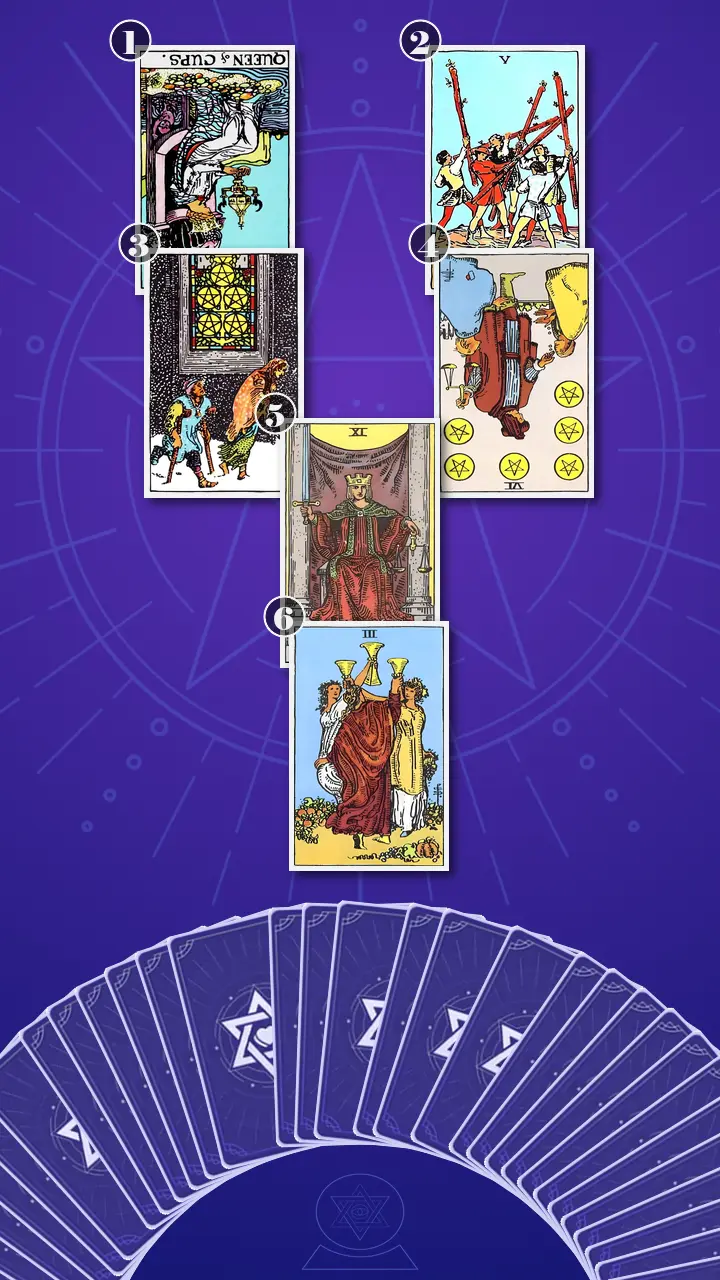
For this friendship-boundary question, I chose the Relationship Spread: Context Edition. It is a six-card structure designed to compare Jordan's role with her friends' visible behavior, uncover the belonging fear beneath the pattern, identify the emotional labor being delegated to her, and arrive at a healthier form of connection. This is how tarot works in a reading like this: the cards provide an objective sequence of images and questions, while the person across from me supplies the lived evidence and makes the decisions.
I explained the route to her and to anyone following along. The first card would show Jordan's conscious peacekeeper role. The second would show what the friends were visibly bringing into the system. The third would uncover the less visible fear beneath her overfunctioning, and the fourth would name what the group had quietly handed to her. The fifth would offer the central fairness principle, while the sixth would point toward friendship participation without compulsory mediation.
The Cards Begin Where the Messages Pile Up
The Closed Cup at the Edge of the Water
I turned over the first card, the position that presents the diagnosis-level behavior of becoming the emotional translator and shows how Jordan currently performs the designated peacekeeper role. It was the Queen of Cups, in reversed position.
The card showed the ornate, closed cup held in both hands at the edge of a vast body of water. In Jordan's modern life, it was 11:40 p.m. with two private threads open, one friend's sharp sentence going into Notes, and a gentler version going back to the other person. Her emotional sensitivity was real, but it had become a full-time monitoring system. She was containing everyone else's reactions so carefully that her own opinion, rest, and preferences had almost disappeared.
Reversed Water here was not an absence of empathy. It was empathy in excess and self-reference in blockage. Jordan was trying to hold an entire friendship group's feelings inside one carefully managed vessel. Before replying, I asked her to distinguish two different actions: offering support, or assuming ownership of another person's repair work. The first could be caring. The second was keeping the whole system dependent on her.
Jordan gave a small, bitter laugh. 'That is almost too accurate. I call it being level-headed, but it feels a little cruel when you say it like that.'
I did not ask her to agree quickly. First, her breath caught and her thumb froze above the message box. Next, her eyes moved between the two threads as though replaying a dozen conversations. Then she let out a low breath and rubbed the hinge of her jaw. 'I do not mind helping,' she said, though the sentence sounded less certain now. 'I mind that I cannot stop.'
'That distinction matters,' I said. 'A boundary does not have to arrive as a sudden mute, a sharp ultimatum, or another dramatic task for you to manage. It can begin with one clear sentence.'
The Crossed Staves of the Group Chat
I turned over the second card, the position showing the friends' visible contribution: unresolved disagreement, competing accounts, and the expectation that conflict can be routed through Jordan. The card was the Five of Wands, in upright position.
In the RWS image, five raised staves cross at competing angles. No single person directs the movement, and no shared destination has been agreed. In present-day terms, this was the group chat filling with paragraphs after dinner, followed by separate voice notes asking Jordan to decide what each person really meant. One friend wanted confirmation that they were right; the other wanted an explanation of their intentions.
The energy was active Fire in excess: loud, urgent, and poorly coordinated. It created friction, but it did not make the disagreement Jordan's responsibility. The card showed why the peacekeeper role kept getting activated, not why she had to keep accepting it. More input could make the story longer without making the owners of the conflict any more direct.
Jordan looked at the crossed staves and said, 'I can see how I keep trying to turn five different angles into one acceptable story. But if I do not, someone may say I am taking sides.'
I nodded. 'You can refuse the role of translator without declaring a winner. The next question is not, How do I make this collision disappear? It is, Who is responsible for the next conversation?'
The Lit Window She Thought She Had to Earn
I turned over the third card, the catalyst beneath the visible behavior and the position revealing the psychological root of overfunctioning, especially the fear that refusing mediation could threaten belonging. The card was the Five of Pentacles, in upright position.
I drew her attention to the two figures moving through snow beneath an illuminated window. The image did not ask me to predict exclusion. It gave me a picture of the fear: watching warmth from the outside and wondering whether the door would open if she stopped being useful. In Toronto, that could look like checking the group chat from a TTC platform, seeing friends make plans without resolving the argument, and feeling a drop in the stomach before any actual exclusion had occurred.
The private sentence underneath the mediation sounded like this: 'If I stop being useful here, will I still get invited?' I let the question remain open. A tarot card could help Jordan separate today's message from an older rule that had become loud, but it could not promise that every friend would respond perfectly to a boundary. Clearer responsibility was not a guarantee of a particular social outcome; it was a way to stop confusing usefulness with proof of belonging.
Jordan's thumb stopped moving. Her eyes went slightly unfocused, and I watched her breathing slow as if she were listening for an answer beneath the radiator and the traffic outside. 'I think I am protecting myself from finding out,' she said. 'If I keep everyone calm, I never have to learn whether they want me when I am just there.'
The Lunch-Break Ledger
I turned over the fourth card, the contextualized position identifying what the friend group delegates to Jordan and how that delegated emotional labor maintains the power-intimacy split. It was the Six of Pentacles, in reversed position.
The standing figure in the RWS image controls the scales and the coins while two people kneel below. Reversed, the hierarchy became immediately recognizable. I could see Jordan at her downtown agency during lunch, two screenshot-heavy threads open beside a half-finished coffee, one friend asking her to soften a message while the other waited for an explanation. The actual friends remained free to avoid the direct conversation, while Jordan supplied the context, translation, and emotional regulation.
This was blocked Earth: support had hardened into an unequal exchange. She gained temporary centrality and the relief of feeling necessary, but she paid with sleep, attention, personal plans, and freedom from the dispute. 'They keep asking because I am good at this,' Jordan said. 'So refusing must mean I am letting them down.'
I placed the card beside the Five of Pentacles. 'You are not the friendship group's conflict infrastructure,' I said. 'The fact that you can do this work does not mean it was assigned to you, and the fact that someone is disappointed by a limit does not prove that you have abandoned them. A boundary can be clear without becoming a punishment.'
She looked down at the six coins. Her expression held fatigue, guilt, and a thin edge of irritation that she had usually edited out of her messages. I asked her to name one form of support she genuinely chose and one form of repair she had been providing because no one else would. For the first time that night, she wrote two separate headings in her Notes app: support I am choosing and repair that belongs to them.
When Justice Put One Sword in the Group Chat
The Boundary That Does Not Take Sides
The room became unusually quiet before I turned the fifth card. Even the radiator paused between clicks, and a single streetcar bell sounded from the avenue below. This was the contextualized position identifying the key principle that can interrupt codependency by redistributing accountability and separating intimacy from mediation power.
The card was Justice, in upright position. I pointed to the level scales in one hand and the upright, double-edged sword in the other. The scales did not demand that everyone feel equally pleased. They asked for proportionate responsibility. The sword did not attack either friend; it cut through the endless revisions and made one clear statement possible.
I use a diagnostic lens I call Orbital Drift Recognition for moments like this. I map the old role against the person's newer understanding and look for a mismatch in frequency without treating that mismatch as evidence that anyone is bad or that a friendship is doomed. Jordan had learned to see care, responsibility, and belonging as separate things. The group's old orbit still expected her to absorb every unfinished conversation. The friction was information about a changing role, not a verdict on her capacity to love.
Before I turned it, Jordan was still inside the old calculation: If I find the perfect wording, no one can accuse me of choosing a side. At 11:40 p.m., her phone had been warm in her palm; preserving closeness had left her alone, awake, and out of the conversation.
You do not keep friendship fair by carrying both sides; fairness begins when each person holds their own words, as Justice holds the sword beside balanced scales.
For a moment, Jordan's face went still. Her breath paused, and her fingers, which had been worrying the edge of her phone, stopped mid-motion. Her eyes moved from the card to the screen as if the crowded chat and the single sword were suddenly the same problem. Then her gaze unfocused, and I could almost see the old sentence replay: 'If I explain this perfectly, nobody can accuse me of choosing a side.' Her jaw tightened. 'But does that mean I was wrong all this time?' she asked, with anger brightening the question before tears did. I let the anger stay; it was evidence that a role was being challenged, not proof of failure. Her fist closed, opened, and settled on her knee. A long breath came out of her chest. Her shoulders lowered, though the new space seemed to make her briefly dizzy. I asked her to take ten minutes before the next request to relay or soften a message, write one sentence she could send, and choose whether to offer fifteen minutes of listening or no further involvement. 'Now,' I said, 'use this new view to remember last week. Was there a moment when this boundary could have let you feel different?'
We wrote the sentence together: 'I care about you, but I cannot carry messages between you. Please tell them directly.' I told her that the boundary could remain caring because it did not argue either friend's case. This was the first small movement from fear-driven peacekeeping and unequal emotional labor toward caring, differentiated responsibility and reciprocal friendship. Jordan was not being asked to stop loving people. She was being asked to let each person hold their own words, choices, and repair work.
Three Cups and the Seat Beside the Circle
The Friend, Not the Referee
I turned over the sixth card, the position translating the insight into a healthier friendship role in which Jordan could participate, care, and belong without carrying messages or managing repair. It was the Three of Cups, in upright position.
Three figures raise their cups together in a circle. No single person holds the group's emotional container. In modern life, this could be a café meet-up where Jordan talks about her own work, dating life, or weekend plans, enjoys the people who are present, and lets unresolved friends decide whether to speak to each other. The conflict might not disappear, and this card did not promise that it would. Its gift was more practical: Jordan could bring her cup without carrying the whole table.
The energy had returned to Water, but in a reciprocal form. Connection was no longer something she earned by creating a perfect emotional climate. It was something she could receive and contribute to as a participant. Jordan touched the three cards at the bottom of the spread and gave a small nod. 'I could still go to dinner,' she said. 'I just would not have to spend the whole day making sure everyone was ready to be there.'
The One-Line Ownership Reset: Finding Clarity in Friendship Conflict
With all six cards visible, I told Jordan the story in one pass. The reversed Queen of Cups showed empathy recruited into containment. The Five of Wands showed the friends' real disagreement, with several accounts crossing but no shared owner for repair. The Five of Pentacles revealed why Jordan kept stepping in: usefulness had begun to feel safer than belonging. The reversed Six of Pentacles showed the cost, an unequal exchange in which she gave translation and regulation while others kept control of the next move. Justice returned proportion, and the Three of Cups showed connection becoming shared participation.
The blind spot was not that Jordan cared too much. It was that she had been using neutrality to manage everyone's distress, then treating any discomfort caused by a boundary as evidence that the boundary was unkind. The direction of change was from relaying messages between friends to naming one consistent limit and directing each person to speak to the other. That is how friendship boundary burnout begins to loosen: not through a perfect group outcome, but through a clearer division of responsibility.
I also used my Gravity De-linking Analysis to name the friction. When people in a friendship system move through different emotional phases, forcing old alignment can make every difference feel like a crisis. Jordan did not have to pull everyone back into one orbit. She could allow each person to carry their own choices while deciding what kind of connection she had the capacity to offer.
Then I introduced my Constellation Release Protocol, adapted here to release a role rather than a person. I asked her to acknowledge the care she had given, return the unfinished conversation to its owners, and choose one genuine form of contact for the next interaction. It was not a dramatic goodbye or an instruction to cut anyone off. It was a peaceful way to leave each person in their own orbit while Jordan moved toward a friendship role that did not require constant emotional labor.
- The One-Line Ownership ResetBefore the next friend asks you to relay, soften, or interpret a message, save and send this in the existing thread: 'I care about you, but I cannot carry messages between you. Please tell them directly.' Then put your phone face down for ten minutes and notice what happens in your jaw, chest, breath, and hands.Save the sentence before the next conflict. If you feel compelled to add a second paragraph, repeat the same boundary instead of building a case. The smallest version is simply, 'Please tell them directly.'
- The Fifteen-Minute Support MenuWhen either friend contacts you about the fallout, choose one form of support before replying: listen for fifteen minutes, help them identify what they want to say, or acknowledge that the situation hurts. Decline one task that belongs to them, such as forwarding screenshots, checking the other person's mood, or rewriting the message.Set a phone timer so the limit is held by a tool rather than by willpower. You can end with, 'I need to stop here, and I hope you speak to them directly.' If you have no capacity, no call is also a valid option.
- The Open-Cup Friendship PracticeThis week, accept or make one low-stakes social plan that is not organized around repair: coffee after work, a walk, or a meal where the unresolved friends are not both present. Bring one topic from your own life and, if the absent friend becomes the focus, say, 'I care, but I do not want to be the messenger tonight.'Choose an exit time before you go. The goal is participation, not a successful group outcome. You are allowed to enjoy the plan while another conversation remains unfinished.
A Week Later: The Quiet Proof
Six days later, Jordan texted me from a café near Queen Street: she had used the boundary and accepted coffee with one friend. She slept through the night afterward, though she woke thinking, 'What if I am wrong?' This time, she smiled and put her phone face down.
I reminded her that the cards had not decided whether her friends would reconcile. They had given her a language for responsibility, a pause before reacting, and permission to choose her next move. She remained the person shaping her relationships, not a passenger waiting for tarot to settle them.
When a friend-group conflict still makes your chest tighten, you may recognize the old bargain: holding both sides calm can feel safer than discovering whether you are wanted when you put down the warm phone. Noticing that bargain is already a change in position.
If you could remain part of the group without carrying this one conversation, what small moment of being a friend rather than a referee would you want to notice first, bringing your own cup to the table and letting the others hold theirs?
This story is adapted from psychological research, written so that those in a similar struggle can see their own pattern in it — and find their next step clearly.These insights are not a substitute for professional psychological, medical, legal, or financial advice.
Learn more about our Journey to Clarity.
How did this insight land for you?
🫂 This Resonates Deeply
🌀 Living This Story
✨ Now I See Clearly
🌱 Seeing New Possibilities
🧰 Useful Framework
🔮 The Confirmation I Needed
💪 Feeling Empowered
🚀 Ready for My Next Step
Author Profile
 AI
AI“After a decade of guiding people through the stars, I’ve come to see life much like the orbits of planets: everything has its inevitable cycles. When you feel lost, please don't blame yourself; you might just be in a natural low tide. I’m here to sit under the night sky with you, offering a gentle cosmic perspective to distinguish temporary pain from the beautiful breakthroughs just around the corner.”
In this Friendship Tarot Reading :
Core Expertise
- Orbital Drift Recognition: Objectively mapping how personal cognitive upgrades naturally lead to mismatched frequencies with old friends, removing the guilt of outgrowing them.
- Gravity De-linking Analysis: Identifying the painful friction that occurs when two friends try to force an alignment despite moving into completely different life phases.
Service Features
- The Constellation Release Protocol: A psychological closure technique to peacefully accept the natural fading of a friendship, leaving them in their orbit while you transition to your next.
Also specializes in :
Explore Related Patterns:
Boundary DiffusionYou already name the distinction between offering support and assuming ownership of another person's repair, yet your thumb freezes when a limit is needed. Stepping back feels dangerously close to being left out, so the line between your responsibility and theirs becomes hard to locate. In practice, their messages, intentions, and emotional reactions enter the space where your own opinion, rest, and preferences should also be present. That blurred boundary does not mean you lack care. It shows how caring has become fused with carrying, and how a normal request for direct conversation is experienced as a possible rejection. The clear sentence you wrote creates a middle position between total mediation and a dramatic cutoff. By naming what you will not carry while still acknowledging that you care, you preserve connection without surrendering ownership of your time, words, or emotional space.
Friendship OverfunctioningAt lunch, you have screenshot-heavy threads beside a half-finished coffee, one friend asking for softened wording while the other waits for an explanation. You supply the context, translation, and emotional regulation that let the friends keep their own distance from the hard conversation. The visible competence of the role hides its cost, because sleep, attention, personal plans, and freedom from the dispute are the resources you spend. When you say they ask because you are good at this, ability begins to masquerade as obligation. The role gives temporary centrality and the relief of feeling necessary, so continuing can feel safer than testing whether connection survives without your labor. A fifteen-minute listening limit or a refusal to relay messages separates genuine support from repair work you have been doing for other people. You can participate in the friendship without becoming its conflict manager.
Compulsive PeacekeepingThe two private message threads open at 11:40 p.m., the sentence softened three times, and your hands still reaching for the screen before an early client meeting show an action that has stopped being a freely chosen kindness. You use rewriting, checking, and emotional containment to lower the group's tension, but the short-term calm reinforces the next round of monitoring. When you say, "I mind that I cannot stop," the behavior is no longer guided by capacity; it is running on urgency and the fear that any unfinished conflict will become your responsibility. The deeper loop appears when perfect wording becomes a way to avoid being accused of taking sides. You are not simply helping friends communicate; you are trying to make every reaction safe enough that nobody can object to your position. That turns neutrality into a compulsion and leaves your own rest, preferences, and direct participation outside the frame. The one-line boundary interrupts the loop by replacing endless emotional management with a deliberate choice about what support you can actually offer.
TriangulationWhen both friends send private voice notes, ask you to decide what the other meant, and wait for you to soften the next message, the disagreement is moving through a third person instead of between its owners. You become the communication channel, carrying context and translation while each friend avoids the direct conversation. That arrangement can look like neutrality because you are not choosing a winner, but it still gives the conflict a stable route through you. The cost is that you are pulled into a position where every sentence can be treated as evidence of taking sides. Monitoring the group chat and searching for perfect wording keeps the triangle intact because your intervention absorbs the pressure that might otherwise push the friends toward direct repair. Saying, "Please tell them directly" changes the structure without punishing anyone. It returns the next conversation to the people who created it and lets you remain a friend rather than the system's translator.
Usefulness-Based Self-WorthYour private sentence, "If I stop being useful here, will I still get invited?" reveals the rule underneath the late-night work. The fear appears before any actual exclusion, while being needed feels like closeness and gives temporary relief. By checking the chat, calming both sides, and keeping the group functional, you can postpone the more vulnerable question of whether people want you when you are simply present. That rule turns belonging into a performance measured by usefulness. It also explains why a friend's disappointment at your boundary can feel like proof that you have abandoned them, even when you have only returned their conversation to them. The boundary and the coffee you accepted with one friend offer a different test. You can be wanted as a participant with your own work, plans, and topics, not only as the person who makes the emotional climate safe.
Exclusion SpiralChecking the group chat while friends make plans, feeling a drop in your stomach before any exclusion has happened, and waking with "What if I am wrong?" show how a possible social loss becomes an immediate signal to act. Each notification is treated like a fire alarm in a room you do not own, so monitoring and mediation temporarily reduce uncertainty. The relief keeps attention locked on the next message instead of on the evidence that the conflict belongs to the friends. The loop intensifies when stepping back is interpreted as being left out rather than as a change in responsibility. You then use perfect wording and continued availability to prevent an outcome that has not occurred, which makes the fear harder to test. Putting the phone face down for ten minutes creates observable space between the prediction and the decision. You can notice the fear without letting it assign you another repair task.
Explore Related Struggles:
Accountability-Ownership FusionJordan says, "I know both sides, so somehow it becomes my job," and then rewrites messages so neither friend feels accused. You are placed between two people who retain the right to avoid direct conversation while you absorb responsibility for making the exchange acceptable. The friction is that fairness asks each person to hold their own words, while the peacekeeper role treats carrying those words as the price of not taking sides. That fusion can make any limit look like a verdict. You may spend more time finding neutral wording than asking who owns the next conversation, and exhaustion becomes the cost of appearing fair. Naming the split lets you offer listening without accepting authorship of the conflict. A boundary can redistribute responsibility without choosing a winner.
Caretaker Role LockAt 11:40 p.m., Jordan has two private threads open, copies one friend's sentence into Notes, softens it three times, and keeps watching the group chat while an early client meeting waits. You can recognize the role lock in the way care has become a standing position where one person translates, regulates, and stays available even when the body says stop. Because the role keeps the group calm, stepping out can feel like abandoning the connection rather than changing your participation. When your own opinion, sleep, and plans disappear behind other people's repair work, the problem is not a lack of kindness. It is a role that has become harder to put down than to perform. Seeing the lock separates chosen support from compulsory mediation, so you can remain a friend without becoming the infrastructure of every disagreement.
Triangulated BelongingTwo friends send Jordan separate accounts and ask her to translate, soften, or interpret what the other meant. You become the middle point through which conflict, reassurance, and access to the group travel. The position can feel central and connected while also keeping the two people with the disagreement from carrying their own conversation. When belonging is secured by staying in the middle, leaving the middle can feel like leaving the circle. That is why a direct sentence such as "I care about you, but I cannot carry messages between you" can change the shape of participation without ending the friendship. You can take a seat beside the circle, bring your own life to dinner, and allow unresolved friends to decide whether and how to speak.
Utility-Belonging FusionWhen Jordan imagines stepping back, it feels dangerously close to being left out. The question beneath the mediation is whether she will still be invited if she stops being useful. You can see how usefulness becomes a social credential, giving immediate proof of closeness while ordinary presence leaves belonging untested. The warm phone therefore does two jobs at once. It carries messages between friends and protects you from discovering whether you are wanted without performing repair. That makes peacekeeping difficult to release even after it costs sleep and attention. Separating contribution from belonging gives you a way to bring your own cup to the table, let a disagreement remain theirs, and still participate in the friendship.
Reciprocity DeficitAt lunch, Jordan supplies context, translation, and emotional regulation while each friend remains free to avoid direct conversation. Later, she pays with sleep, attention, personal plans, and freedom from the dispute. You can recognize the unequal exchange in that geometry, where one side receives a functioning emotional bridge while the person building it carries the ongoing cost. The exchange may look caring because your help is voluntary in each individual message, yet its repeated pattern leaves little room for your needs to enter the account. A reciprocal friendship can include support without making one person the permanent repair resource. Seeing the deficit helps you distinguish a chosen fifteen-minute listening window from an open-ended obligation to stabilize everyone else.
Explore Related Emotions:
Peacekeeper GuiltJordan says that refusing the work must mean she is letting her friends down, even while she knows that the disagreement and its repair belong to them. Because caring and carrying have become fused, another person's disappointment can register as evidence that she has failed the friendship. Peacekeeper Guilt is the heavy inner accusation that appears when you consider leaving a conflict with its actual owners. Recognizing it does not require you to become cold; it allows you to care without treating every unsettled reaction as a responsibility you must absorb.
Perfect Composure AnxietyJordan softens one sentence three times and watches the chat until everyone sounds calm, while her shoulders rise and her jaw remains locked. The hoped-for perfect wording is doing more than improving communication; it is being asked to prevent blame, side-taking, and any social consequence she cannot control. Perfect Composure Anxiety feels like having to remain endlessly measured while your body stays braced for the next mistake. You can question the impossible standard without abandoning kindness, because a carefully managed tone cannot guarantee how other people interpret a limit or whether they take ownership of their conflict.
Usefulness-Based Belonging FearAt 11:40 p.m., Jordan keeps two private threads open, and later names the question underneath the work: if she stops being useful, will she still be invited? Mediation has become more than a favor; it is the recurring test through which she tries to confirm that she still has a place in the group. When you experience Usefulness-Based Belonging Fear, declining a task can feel like risking your seat in the friendship. Naming that bargain separates care from admission and lets you examine whether the connection has room for you when you are simply present, with nothing to fix or translate.
Cautious ReliefAfter the boundary is written, Jordan's fist opens, her shoulders lower, and a long breath leaves her chest. Six days later she has slept through the night, yet she still wakes with the thought that she may be wrong before smiling and putting the phone face down. Cautious Relief makes room for easing without pretending that the old alarm has vanished. You do not need complete certainty to register that your body is no longer holding the entire friendship overnight, and that small release can coexist with unanswered questions.
Clarity ReliefJordan creates two headings in Notes: support she is choosing, and repair that belongs to her friends. The single sentence she writes then turns an indistinct obligation into separate categories of care, ownership, and direct communication. Clarity Relief arrives when you no longer have to solve the whole relationship before knowing what your part is. The distinction does not control whether the friends reconcile, but it gives you enough internal order to make your next decision without carrying every possible outcome at once.
Compassion FatigueJordan is still editing messages at 11:40 p.m. before an early client meeting, and the same work follows her into lunch beside a half-finished coffee. Her sensitivity is genuine, but it is being used repeatedly to contain reactions that the people in conflict have not taken responsibility for addressing directly. Compassion Fatigue names the drained inner weather that develops when empathy remains active after your usable attention has been spent. Treating that depletion as information can help you choose what support you freely offer instead of measuring your care by how much exhaustion you can tolerate.
Protective AngerWhen Jordan sees the cost of the old role, her jaw tightens and her fist closes before opening again. The force in that moment appears alongside a precise boundary, not a demand to punish either friend or decide who is right. Protective Anger can tell you that a line has been crossed long before you have found calm language for it. Allowing the feeling to identify where caring became compulsory carrying gives you usable information while leaving you free to choose a proportionate response.
Cautious Self-TrustJordan sends the boundary, accepts coffee, and later notices the thought, 'What if I am wrong?' without reopening the mediation loop. She is not acting from perfect confidence; she is allowing a considered decision to remain in place while uncertainty is still present. Cautious Self-Trust is the feeling that your own judgment can carry some weight before everyone else has approved it. Each pause and consistent sentence gives you evidence that doubt does not have to revoke a boundary or decide your next move.
Group Chat AnxietyEvery notification lifts Jordan's shoulders, locks her jaw, and pulls her hands back toward two open threads. The group chat has stopped functioning as a neutral communication channel and become a live gauge of whether the friendship system is settled enough for her to disengage. Group Chat Anxiety is the persistent alarm-like feeling that makes silence, typing indicators, and new messages seem to demand immediate interpretation. You can notice that activation without accepting the assignment it implies; a message arriving is not the same thing as responsibility becoming yours.
Suppressed ResentmentJordan gives a bitter laugh, edits the irritation out of her messages, and later closes her fist when the old role is challenged. Her neutrality has required more than careful language; it has repeatedly removed her own protest from the conversation while preserving space for everyone else's reactions. Suppressed Resentment builds when you keep performing willingness after your participation has stopped feeling freely chosen. Letting that feeling become legible does not require an attack or ultimatum; it can help you identify the exact task you no longer consent to carry.
Explore Related Contexts:
Designated Peacekeeper BurdenAt 11:40 p.m., you have two private message threads open, soften one friend's sentence three times, and keep reaching for the screen before an early client meeting. When both friends ask you to interpret what the other meant, caring has been converted into a job with no clear end or shared handoff. That arrangement makes your place in the group depend on absorbing unfinished conversations while the friends remain free to avoid the direct exchange. You can examine the role as an external assignment rather than proof that you owe the group constant availability, then return each person's words to them with a clearer limit around your participation.
Emotional Labor ImbalanceAt the agency during lunch, you have screenshot-heavy threads beside a half-finished coffee while one friend asks for softer wording and the other waits for an explanation. Your time, attention, and calming work are carrying responsibilities that the two friends have not divided between themselves. The exchange is uneven because you gain temporary centrality while paying with sleep, personal plans, and freedom from the dispute. Separating the listening you choose from the repair you decline gives care a more reciprocal shape without requiring you to solve the group's conflict.
Friend Group TriangulationOne friend wants confirmation that they are right while the other wants an explanation of their intentions, and each uses you as the route between separate accounts. The disagreement becomes a three-person communication structure in which the original conflict can keep moving without either friend owning the next direct conversation. When you rewrite a difficult sentence, you reduce immediate friction but also keep the route through you available. Naming who needs to speak next lets you remain neutral without becoming the group's communications channel, returning the conflict to the relationship where it began.
Friendship Mediation Second ShiftBoth friends send private voice notes, one asks you to soften a message, and the other waits for an explanation while your client meeting approaches. Work that would normally belong to the people in the disagreement is moved into your late-night phone time and your attention at the agency. Because you supply translation, context, and calming language, the arrangement can look like closeness while consuming sleep, personal plans, and freedom from the dispute. You can keep a bounded form of support and decline the relay work, so friendship is not measured by how much unfinished conflict you can process after hours.
Friendship Role Lock-InWhenever two friends fall out, you become the person who receives both accounts, watches the chat, and tries to make every angle sound acceptable. The word "always" is matched by an arrangement that keeps directing the next unfinished conversation toward you, so the same social position reappears. Within that arrangement, usefulness becomes the visible proof of your place in the circle, making a step back seem to threaten participation. You can renegotiate the position by attending as a friend, bringing your own life into the conversation, and letting an unresolved disagreement remain with its owners.
Friendship Boundary ResetBefore the next request to relay or soften a message, you save one sentence, send it in the existing thread, and place the phone face down for ten minutes. The later coffee near Queen Street gives that boundary a real-life setting because you stay in contact without organizing the interaction around repair. Your limit does not punish either friend or require a dramatic cutoff; it clarifies what support you can offer and what conversation must move between them. Repeating the same sentence creates a stable edge around friendship participation, so closeness no longer depends on managing every response.
Care Reciprocity TestYou separate "support I am choosing" from "repair that belongs to them," then imagine joining dinner with your own work, dating life, and weekend plans still present. The Three of Cups places you beside the circle, where you can contribute and receive without holding the group's entire unfinished conversation. The test is whether contact remains possible when you are not translating, checking, or smoothing the disagreement. A reciprocal friendship can make room for your cup and each friend's responsibility at the same time, allowing connection to be measured by participation rather than unpaid mediation.
Direct Communication TrialYou write, "I care about you, but I cannot carry messages between you. Please tell them directly," after distinguishing chosen listening from repair that belongs to the two friends. The sentence creates a concrete next step without deciding who is right or requiring the whole group to sound calm. The level scales and sword establish a workable social experiment: you can remain connected while each person carries their own words. This trial tests a different participation role in real conversations, with your time and attention no longer serving as the default route to repair.
Friendship Role RenegotiationYour old position asks you to absorb every unfinished conversation, while the reading separates care, responsibility, and belonging. The change is from a fixed referee position to a friend role in which you can talk about your own life and let the two people involved decide whether to speak directly. The later coffee shows that renegotiation does not require leaving the group or forcing a reconciliation. You can remain present while changing what your presence is used for, making room for friendship that does not depend on constant emotional translation.