Waiting Ten Minutes Before "I Can Drive": From Guilt to Choice

The Text I Deleted at 4:38 p.m.
At 4:38 p.m. on a Friday, Jordan (name changed for privacy), a 27-year-old junior product designer in Toronto, showed me the group-chat moment that had started the whole spiral. The screen was filling with bar and late-dinner plans; she typed "I can drive, it is probably easier" before anyone had finished typing, then deleted the sentence about wanting one drink and leaving by 11. The kettle clicked off behind us, the phone felt warm in her palm, and I watched her shoulders climb toward her ears.
When Jordan described 12:41 a.m. on the residential side street, I could almost hear the heater humming against the windshield. She had been sitting alone in the parked car, seatbelt pressing across her chest, while a rideshare notification glowed on the dashboard and the last friend searched for their keys. Everyone else had received the relaxed version of the night; Jordan had received the route.
"Why do I keep giving up my nights to drive everyone home?" she asked. "I volunteer before anyone asks. I stay sober, track the drop-offs, and tell myself it is fine. Then I get home exhausted and kind of angry, which makes me feel even worse."
I saw the dependable-friend trap as more than a transportation problem. Guilt sat in Jordan's body like a car idling in a locked garage: heavy, hot, and impossible to forget, even when nobody had asked her to start the engine. Her jaw was tight, her eyes looked rubbed with sand, and her attention kept racing ahead to every possible way the night might go wrong.
"You can be grateful to be trusted and still notice that trust has started taking your entire night," I said. "We do not have to decide that anyone is bad or that you must stop caring. We can look closely at the moment a request becomes an assignment. Our Journey to Clarity is to make that moment visible, then give you a choice inside it."

Choosing a Map Through the Loop
I asked Jordan to put her phone face down, take three slow breaths, and name the question exactly as it was. I shuffled while she focused on the practical scene rather than trying to force a perfect answer. For me, the preparation was a psychological transition: a way to move from the speed of a group chat into deliberate observation.
I chose the Transformation Path Grid (6) · Context Edition because the question was not simply which of two choices Jordan should make. It was a recurring people-pleasing pattern: a ride concern appeared, Jordan took over, immediate relief arrived, and the long-term cost appeared later as lost sleep, resentment, and designated-driver burnout. This six-position tarot spread lets me trace that whole sequence without treating the cards as a prediction or an external authority.
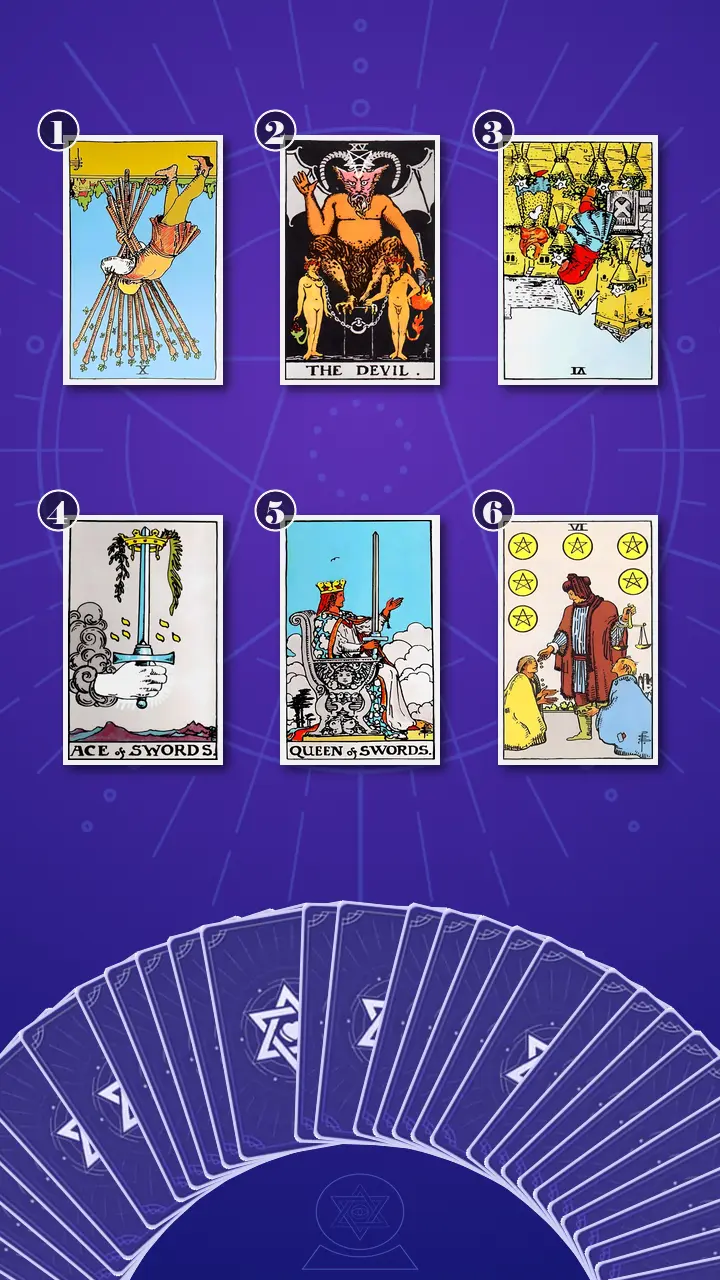
The six cards form a route map rather than a verdict. The top row shows the visible loop, the immediate block, and the repetition root. The lower row identifies the key interruption, the action experiment, and the integrated form of reciprocal care. I told Jordan, and I want to make this clear to anyone reading, that how tarot works in this setting is through structured reflection: the images give shape to patterns that ordinary urgency tends to hide.
"The first card will show what you are doing in the moment," I explained. "The second asks what turns another person's need into your automatic duty. The third looks at the familiar emotional script underneath. Then the Ace of Swords marks the smallest interruption point, followed by a boundary and a shared plan."
The Route That Explains the Pattern
The Load That Filled the Whole Screen
"Now I am turning over the card representing the Presenting loop: the observable behavior of giving up your personal nights, staying sober, and carrying every final drop-off," I said.
The card was the Ten of Wands, in reversed position.
In the Rider-Waite-Smith image, the figure's bowed body is almost hidden behind ten staffs. I connected that blocked view directly to Jordan at a downtown bar, technically present but checking the time, watching the route, and mentally assigning every passenger while her friends ordered another round. The night had become a city map with every destination pinned to one phone. There was no room left on the screen for her own evening.
Reversed, the fire of action has become overextended and blocked. The burden is ready to be released, but it cannot simply be dropped without a plan for redistribution. I asked Jordan to separate the part of the ride plan she had explicitly agreed to from the parts she had picked up because an unassigned detail felt unbearable. The card was not telling her to refuse every favor. It was showing the cost of making availability equal ownership.
Jordan gave a short, bitter laugh instead of nodding. "That is painfully accurate," she said. "Almost rude."
"I hear the sting," I replied. "The card is naming a behavior, not judging your character. Your ability to help is real. The question is whether that ability has quietly become a one-person load." Her hand fell from her phone to her knee, but her shoulders stayed lifted, as if the bundle in the card had briefly become physical.
The Loose Chain Around a Casual Request
"Now I am turning over the card representing the Immediate block: the force that converts another person's transportation need into your automatic responsibility and keeps the burden in place."
The card was The Devil, in upright position.
I brought us to the scene Jordan had described from 11:56 p.m. outside a crowded downtown bar. A friend had said, "I have no idea how I am getting home," and Jordan's stomach had dropped before anyone assigned her the job. She offered the ride, felt an immediate wave of relief, and then spent the rest of the night attached to the driver's seat. The Devil's chains are loose enough to step out of, but the emotional consequence arrives so quickly that choice can be hard to remember.
"This is not a bad omen, and it is not evidence that your friends are secretly malicious," I said. "It is the shape of an attachment. A vague request gets converted into a signed project brief inside your head, complete with scope, deadline, and cost, even though the group never agreed to any of those terms. The driver role has become an auto-renewing subscription."
Jordan's breath stopped first, and her thumb froze above the edge of her phone. Then her eyes lost focus; I could see her replaying the bright venue sign, the cold air slipping through her jacket, and the thought she had carried into the car: "If I do not solve this, they will remember I made the night harder." Finally, her fingers loosened and a long breath moved through her chest.
"The relief after I say yes always tricks me," she said. "It feels like proof that I made the right call."
"It is proof that uncertainty became quieter," I said. "That is different. Short-term relief can reinforce a pattern even when the pattern costs you sleep and freedom. A request is not an assignment, and a gap in the plan is not automatically yours to fill."
The Old Saved Template
"Now I am turning over the card representing the Repetition root: the emotional script behind the recurring pattern, without assuming one specific past event."
The card was the Six of Cups, in reversed position.
The image shows a child offering a flower-filled cup to another child in a quiet village. Reversed, the cup becomes a familiar care script being pasted into a present-day situation before Jordan checks what she actually wants. A friend asks for help, the old saved template for being a good friend opens automatically, and usefulness arrives before preference. Even a thank-you message can carry more emotional weight than the current request can honestly support.
"I am not asking you to excavate your childhood or invent a reason," I said. "I am asking what rule feels familiar before it feels chosen. Does the request become a test of whether you are dependable enough to belong?"
Jordan looked down at the card and rubbed her thumb along the rim of her coffee cup. Her expression softened, then tightened again. "I give care easily," she said. "But asking for a ride, or asking someone else to help plan, feels weirdly excessive. Like I am making the night inconvenient."
I let the silence stay gentle. The reversed Six of Cups was not saying that Jordan's care was false. It was showing that an old emotional shortcut could speak before the present relationship had a chance to answer. The pattern was familiar, not inevitable.
When the Ace of Swords Cut the Route Open
A Clean Decision Point in the Group Chat
The room grew quiet when I moved to the lower-left card. Outside my window, a streetcar bell sounded once, clear and brief, as though Toronto itself had marked a turn in the route.
"Now I am turning over the card representing the Key interruption: the smallest point where you can pause the automatic offer and recover clarity about what is actually yours to manage."
The card was the Ace of Swords, in upright position.
The hand emerging from the cloud held one upright blade, its crown balanced at the tip. The modern-life version was the few seconds before Jordan typed "I can drive." The facts were simpler than the fear: the group needed a return plan; Jordan could do one drop-off; nobody had agreed that she owned the entire route. This was Air entering a spread that had been crowded with overloaded Fire, attachment, and familiar Water. The energy was clarity, direct speech, and self-trust.
I reached for my signature lens, Micro-Cycle Energy Mapping. I asked Jordan to map a typical night across four points: the Friday planning surge, the social middle, the final-venue vigilance, and the recovery phase after the last drop-off. She could see that her workweek already consumed her strongest focus, while the hours meant for enjoyment and rest were repeatedly handed over to route management. The map did not dictate whether she should drive. It made the cost visible at the exact point where she usually called the sacrifice efficient.
It was 12:41 a.m. on a Toronto side street. Jordan was still in the parked car, heater humming, phone glowing, waiting for the last friend to find their keys. Everyone got home safely, but Jordan's own night disappeared into the route.
The answer is not to keep carrying the whole route to prove you care; let the Ace of Swords cut through the automatic role with one clear boundary and a shared plan.
Jordan's face went still. For one beat, her breath stopped and her thumb hovered over the edge of the card. Then her eyes lost focus; I could almost see the side street replaying, the missing keys, the engine waiting, and the message she had deleted before the night began. Her jaw worked once, and her hands tightened in her lap. Finally, her fingers unclenched, her shoulders dropped a fraction, and she released a shaky breath that sounded less like agreement than permission. Her eyes shone, but she did not look magically certain. She looked briefly unmoored, as if the map had removed a road she had followed for years and left a blank space where responsibility used to be. "So if I do not fix it immediately, that does not mean I do not care," she said. "It means the group has a problem to solve." I nodded. The relief carried a thin edge of grief for the nights she had missed, and a new responsibility: she would have to choose. I invited her to set a ten-minute timer and draft three lines in Notes, with permission to send, revise, or leave the draft unsent.
"Now, use this new perspective to revisit last week," I said. "Was there a moment when separating the actual request from the responsibility you added could have made the night feel different?"
This was the first visible movement from guilt-driven hypervigilance toward self-trust. It was not certainty and it was not a dramatic escape from friendship. It was one clean distinction: care could remain, while total responsibility no longer had to come along with it.
The Sentence That Did Not Ask Permission
The Queen's Acceptance Criteria
"Now I am turning over the card representing the Action experiment: the early, concrete communication that lets you contribute without silently agreeing to own the entire route."
The card was the Queen of Swords, in upright position.
Her raised sword and open hand held two truths at once: discernment and willingness. I connected her to Thursday evening, before the next outing had gathered momentum, when Jordan could write, "I am happy to do one drop-off, but I need to leave by 11 and cannot be the only ride plan." The sentence was direct, not punitive. It stated what was available, what was unavailable, and what needed to be shared.
The Queen's energy was balanced Air. She did not wait until resentment made the message sharp, and she did not wrap a clear limit in three paragraphs of apology. I told Jordan, "You can offer one ride without offering your whole evening. A boundary is information about access to your time; it is not a punishment for needing time."
"But what if it sounds cold?" Jordan asked. Her hand moved toward her phone, then stopped before touching it.
"Then let it sound clear," I said. "Warmth does not require you to make the limit disappear. You can be respectful and still let other adults solve their part." Her eyes moved from the raised sword to the open hand. I watched the tightness around her mouth ease, though she still held the phone as if it might deliver a verdict.
When Care Became a Shared Route
The Scales at the End of the Night
"Now I am turning over the card representing Integration: the way transportation, time, and responsibility can become reciprocal rather than privately absorbed by you."
The card was the Six of Pentacles, in upright position.
The balanced scales and deliberate exchange of coins gave the night a different material shape. Before the outing, one friend could check the late-night TTC route, another could drive a leg, and the remaining rideshare cost could be split through Splitwise. Jordan could contribute one agreed drop-off and leave at the chosen time. This was not a demand that everyone contribute identically. It was a request that the resources become visible.
I pointed out the repeated six. The reversed Six of Cups had shown a familiar emotional exchange in which giving first seemed to secure belonging. The upright Six of Pentacles showed present-day practical exchange: drivers, routes, money, departure preferences, and time moving between people. The spread had traveled from overloaded Fire into the clean Air of the swords and finally into grounded Earth. The night belonged to everyone when the route did too.
Jordan drew a slow breath and looked at the six cards as a route map rather than a sentence about her personality. "I think I have been treating transportation like a test," she said. "If I pass, everyone gets home and I get to belong. If I do not, I have failed."
"The cards cannot certify your belonging," I said. "They can help you see the structure you are participating in. Your friends may respond well, awkwardly, or imperfectly. None of those responses turns your limit into a moral failure. The next choice remains yours."
From Insight to Action: The Shared Route Pause
The six cards told one coherent story. The Ten of Wands showed the visible burden: Jordan entered the night as a participant but carried its ending in her head. The Devil showed why the burden persisted: volunteering quieted the fear of disappointing people. The reversed Six of Cups showed the familiar script underneath, where usefulness had begun to stand in for belonging. The Ace of Swords supplied the interruption, the Queen of Swords gave it language, and the Six of Pentacles showed care becoming a shared logistical practice.
The blind spot was not that Jordan cared too much. It was that she mistook immediate relief for evidence that taking over was the healthiest choice. By solving every gap before the group could respond, she never gave anyone else a chance to own part of the plan, and she never gave herself evidence that a limit could survive an ordinary night out.
The transformation direction was precise: pause before agreeing to drive, identify the actual request, name one honest limit, and allow transportation to become a group problem. The aim was not to care less. It was to stop funding care privately with Jordan's sleep, attention, and entire evening.
I also brought in two practices from my own orbit-based work. Rest Phase Legitimacy meant treating recovery as a necessary phase rather than an unproductive failure. A low-energy evening after a demanding design week was not proof that Jordan was selfish or unreliable. It was information about what her body could sustainably offer.
Then I shaped the experiment through The Lunar Routine Sync, my one-week method for adjusting daily output expectations to a person's natural energy tide. Jordan would notice whether her capacity was low, medium, or high before making a social commitment. That information would not dictate her choice, but it would stop a depleted version of her from making an automatic promise on behalf of the fully rested version.
Small Logistics, Real Agency
I gave Jordan three low-pressure action steps. Each one was deliberately small enough to begin before confidence arrived.
- The ten-minute pre-offer pauseWhen a ride concern appears in the next Friday group chat, wait ten minutes before replying. In the Notes app, write three lines: What was actually asked? What am I willing to do? What belongs to the group? Then send: "What are our options for getting home? I am not automatically driving the whole group tonight."If your chest tightens or your jaw lifts, draft the message without sending it and take three slow breaths. A pause is not a promise to solve the problem.
- The one-drop-off boundaryBy Thursday evening, before plans are final, send one sentence to the group: "I can do one drop-off and need to leave by 11; I cannot be the only ride plan." If someone asks you to extend the night, repeat the same sentence without adding a long explanation or apology.Keep the wording in Notes so pressure does not make you negotiate against yourself. After sending it, put the phone face down for fifteen minutes and let another person answer.
- The reciprocal night planFor one outing this week, ask each person to name a driver, a TTC route, a rideshare contribution, or a preferred departure time before you commit. Use The Lunar Routine Sync to match your contribution to your actual energy: on a low-tide day, protect recovery or choose no driving; on a higher-energy day, offer only the part you genuinely want to give.Use the group thread or Splitwise and spend two minutes checking the route before leaving the venue. The next morning, record what you contributed and what the group contributed as facts, not as a rating of anyone's goodness.
I reminded Jordan that the experiment could be revised. She could choose no driving, one limited ride, transit, or a shared rideshare. If a conversation became unsafe or openly disrespectful, protecting her boundary came before completing the exercise. Small steps were not a trick to make her tolerate more. They were a way to gather honest evidence about reciprocity while keeping the decision in her hands.

The First Night That Included Her
A week later, Jordan slept through the night after one outing. At breakfast, the first thought was still, "What if I got it wrong?" This time, she smiled, opened the chat, and saw that everyone had got home safely without her owning the ending.
Four days after our session, she sent me a message: "I waited ten minutes. I asked for options. I did one drop-off and left at 11:05. It felt weird, but nobody acted like I had ruined anything." The old reflex had not vanished; her pulse had still jumped when the group chat went quiet. The difference was that she had noticed the jump without handing it the keys.
I held that as the first small proof, not a promise that every friend would always respond perfectly. Jordan had kept a chosen part of the night, let the group practice shared responsibility, and learned that discomfort could rise without becoming an emergency. That is what finding clarity looked like here: not a final answer delivered by the cards, but a clearer relationship with her own capacity.
When the group chat goes quiet after "who is driving?" and your jaw tightens before anyone has asked you directly, giving away the whole night can feel safer than risking the moment someone decides you are not dependable enough to belong.
The cards did not ask Jordan to abandon generosity. They helped her distinguish care from self-erasure, then return the next decision to the person living it. A request can remain a request long enough for a shared route, a clear boundary, and a little breathing room to appear.
If you paused before typing "I can drive," what small part of the night would you want to keep for yourself, and what shared option would feel honest to name?