The 11:30 p.m. Google Sheet Glow
Jordan didn’t open our call by saying, “Hi.” She opened it by tilting her laptop slightly so I could see the blue-white grid on her screen—rows of appointments, color-coded blocks, little notes in parentheses like “confirm ride” and “bring health card.”
“I know this is… ridiculous,” she said, and I watched her mouth tighten as if she’d been holding her jaw in place all day. “But if I don’t keep it perfect, something gets missed. And then what?”
In Toronto it was late—one of those weeknights where the condo is quiet but your nervous system isn’t. You can hear the fridge click on. You can feel the laptop heat under your palms. And every time the phone buzzes, the chest does that wired, alert spike like your body is trying to stand up before you do.
She described her routine like she was reading a script she hated: TTC ride home, one last portal check, dinner that doesn’t taste like anything, and then—11:30 p.m.—the Sheet again. Cross-checking dates against her calendar. Drafting reminder texts she won’t send until morning. Waking up and checking again before her first meeting.
“I’m not controlling,” she told me. “I’m just making sure nothing falls through the cracks.”
I nodded, letting the silence hold for a second—because I’ve learned that the pause is where people tell the truth they’ve been dodging.
“It makes sense that you’re doing this,” I said. “Your brain thinks it’s building safety. But I also hear the cost.”
Her eyes flicked down to the spreadsheet again, like it was a live wire.
“It’s never ‘one task.’ It’s the mental tab that never closes,” I said, gently naming the loop. “And underneath the organization, I hear the real question you came in with: what role loop am I reenacting? Because you want your dad’s care to be handled—and at the same time, loosening control feels like inviting blame… or inviting that ‘bad daughter’ story to rush in.”
Jordan’s shoulders rose almost imperceptibly, like her body was bracing for a verdict. In my work, that bracing is always the first clue: not just what you’re doing, but what you’re trying to prevent.

Choosing the Compass: The Celtic Cross for a Care System That Doesn’t Collapse
I asked Jordan to do something that sounded almost too simple to matter: “Before we touch the cards—15 seconds. Unclench your jaw. Drop your shoulders. Notice what your chest does when you imagine your phone buzzing.”
She exhaled like she’d been holding her breath since Tuesday.
I shuffled slowly, not as a performance, but as a transition—like dimming the lights in my planetarium before a show. It tells the mind, we’re moving from reacting to observing.
“Today, I’m going to use the Celtic Cross,” I said. “It’s a classic spread, but it’s especially good for a role-loop question like yours. It separates what’s happening on the surface—your checking, reminding, coordinating—from the deeper roots: the family script under it, the old template you’re unconsciously stepping into, and the decision point that could change the pattern.”
For you reading this: that’s why this spread works so well for caregiving boundaries. It doesn’t blame you for being the reliable one. It shows why the loop formed—and where a practical interruption can happen without drama.
“The first card will show the present situation—the most visible way this is playing out,” I told Jordan. “The crossing card shows what intensifies it. And the final card—the integration—points to the growth direction. Not a prediction. A trajectory.”
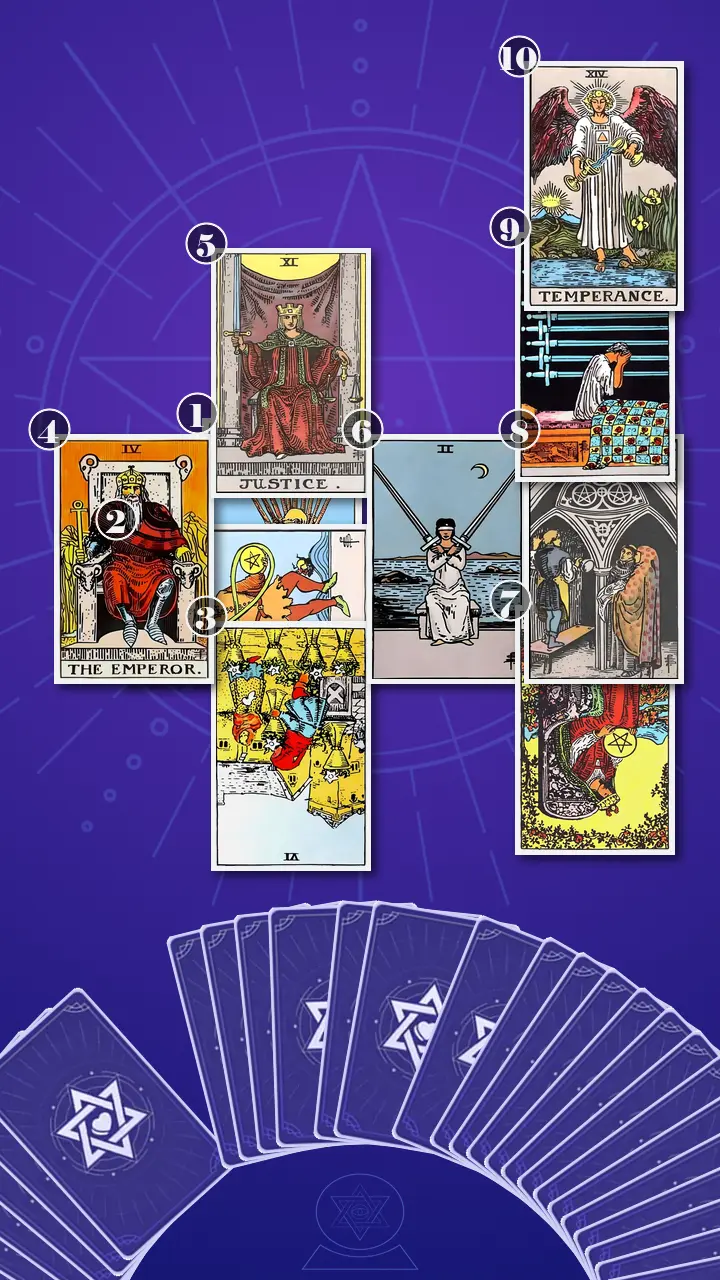
Reading the Map: Card Meanings in Context (Not in the Abstract)
Position 1 — Present situation: what the loop looks like right now
“Now we turn over the card representing your present situation: the most visible way the role loop is playing out right now,” I said.
Ten of Wands, upright.
“This lands exactly in your modern-life scene,” I told her. “You’re on the TTC after work, one hand on the pole and the other on your phone, re-reading the appointment row you already checked this morning—because the smallest doubt feels like a personal emergency. Your week is technically organized, but you’re carrying it so close you can’t see your own plans without the spreadsheet blocking the view.”
I pointed to the image: the figure bent forward under ten wands, vision blocked, town in the distance.
“Energy-wise, this is excess—too much responsibility held by one person. Not because you’re weak. Because the load is physically and emotionally unrealistic. The Sheet looks like organization, but it’s also a bundle you’re holding so close it steals your peripheral vision.”
Jordan let out a small laugh that wasn’t amused. It was the kind that comes out when someone nails the truth a little too cleanly.
“That’s… brutal,” she said. “Like, yes. It’s accurate. But it’s brutal.”
“I’m with you,” I replied. “And the brutality isn’t you. It’s the system asking you to be the only safety net.”
Position 2 — Crossing challenge: what intensifies the loop
“Now we turn over the card representing the crossing challenge: what makes it feel hard to change,” I said.
Two of Pentacles, reversed.
“A clinic voicemail hits during a meeting and you feel compelled to deal with it immediately,” I said, using the translation we’d built from her life. “You alt-tab between Slack, Google Calendar, and the Sheet like you’re doing live crisis triage—fixing conflicts that haven’t happened yet. The juggling isn’t just busy; it’s the infinity-loop feeling of: ‘If I stop checking, the whole thing drops.’”
In reversed position, that balancing energy is a blockage. “The tool that should reduce anxiety becomes the thing that feeds it,” I said. “You keep toggling because your nervous system is trying to buy certainty the way people keep checking a thread they don’t trust to stay settled.”
I watched her swallow. Her gaze went slightly unfocused—like she could feel the loop in her body.
“That’s the pressure point,” I added. “Not just that there are a lot of tasks. It’s that the tasks are paced like emergencies.”
Position 3 — Root cause: the deeper family script underneath
“Now we turn over the card representing the root cause: the family-of-origin script the spreadsheet is trying to manage,” I said.
Six of Cups, reversed.
“A new appointment gets added and suddenly you’re not 29—you’re the ‘responsible kid’ again,” I said. “You start smoothing the emotional weather: pre-writing texts so no one gets stressed, making it ‘nice,’ anticipating reactions, trying to prevent disappointment before it exists.”
Reversed, this card isn’t nostalgia—it’s a pull backward. An old role reactivated. “The spreadsheet isn’t only for logistics,” I said. “It’s a way to replay an old identity where being helpful meant being safe.”
Jordan’s fingers tightened around her mug. Then loosened. A tiny, involuntary release.
“What age do you emotionally feel when the clinic calls?” I asked her.
She blinked fast. “Like… thirteen. Like I have to be the competent one because if I’m not, everything gets messy.”
That answer wasn’t a diagnosis. It was a map pin.
Position 4 — Past imprint: the earlier template of authority
“Now we turn over the card representing your past imprint: the earlier template that shaped your automatic response,” I said.
The Emperor, upright.
“You remember your dad as the person who handled decisions—appointments, timing, direction,” I reflected. “Now that his health logistics are messier, it feels like someone has to sit in the ‘authority chair,’ and you slid into it without a formal conversation.”
This card carries structure in a balanced form. But it can also become a rigid expectation: someone must be in charge. “Part of what hurts,” I said, “is that you didn’t apply for this role. You just found yourself in it.”
In my head, a planetarium memory flashed—standing beneath a dome of stars, watching kids point at Saturn’s rings. Structure is beautiful when it’s shared. It’s crushing when it becomes a single pillar holding up the ceiling.
Position 5 — Conscious aim: the story you’re telling yourself about being “good enough”
“Now we turn over the card representing your conscious aim: what you think you have to do to be ‘good enough’ here,” I said.
Justice, upright.
“You treat the Google Sheet like a moral scoreboard,” I said. “Accurate sheet = good daughter; messy sheet = failure. You weigh every detail like evidence—who confirmed, who forgot, what time, what’s missing—and the pressure isn’t just practical. It’s ethical.”
Justice is usually a stabilizing energy—balance and clear consequences. But in your context, it’s flirting with self-punishment: “If I’m flawless, no one can accuse me.”
I tapped the scales in the image. “Fairness includes you. Not as a bonus—as a requirement.”
Jordan’s eyes went shiny for a second, like the idea of including herself felt both obvious and forbidden.
Position 6 — Near-term trajectory: the decision point that interrupts the loop
“Now we turn over the card representing your near-term trajectory: the next boundary moment that changes the pattern if you act on it,” I said.
Two of Swords, upright.
“This is you holding a decision in your throat,” I said. “You draft a text like: ‘I can’t take clinic calls during work hours—can you handle scheduling this month?’ then delete it, because conflict feels scarier than exhaustion.”
In this card, the blindfold isn’t ignorance. It’s emotional self-protection—avoiding guilt, not avoiding logic. The energy here is a stalemate.
“A boundary isn’t abandonment—it’s load-sharing with a spine,” I said. “This card says the loop doesn’t break when you find the perfect app. It breaks when you make one clean choice and let it be real.”
She didn’t answer right away. Her thumb hovered near her phone on the desk as if she could feel the unsent message waiting.
Position 7 — Self-position: who you become in this role, and what it costs you
“Now we turn over the card representing your self-position: how you’re showing up, and what it’s doing to your body and time,” I said.
Queen of Pentacles, reversed.
“You’re doing care admin while starving,” I said softly. “Skipping lunch, pushing bedtime, calling it ‘just being practical.’ You’re the capable one, the nurturer, the fixer… and your own routines get treated like optional extras.”
Reversed, the Queen’s nurturing becomes a deficiency toward the self. “Your competence is real,” I told her. “But it’s being used as a proof-of-worth system. And your body is paying the bill.”
This is where the stacked-tabs scene became almost visual in the air between us: mid-Slack at work, clinic call, portal email, spreadsheet, calendar, group chat—like keeping twelve browser tabs open while telling yourself you’re fine, until the laptop fan sounds like it’s about to lift off.
I said the line I needed her to hear as a systems truth, not a judgement: “If the system only works when you’re anxious, it’s asking too much of you.”
Jordan’s breath left her in a sharp exhale. “Oh… yeah,” she whispered. Not agreement. Recognition.
Position 8 — Environment: where support and structure can actually come from
“Now we turn over the card representing your environment: who or what could share the load if you stop doing it alone,” I said.
Three of Pentacles, upright.
“There’s a version of this where the spreadsheet is a shared plan, not your private burden,” I said. “A simple care ‘team’ with visible roles. One person calls the clinic, one person manages transportation, one person updates the sheet, and your dad confirms what he can.”
I saw Jordan flinch at the idea—like watching someone else drive your car for the first time in years. Then, just as quickly, a small loosening in her chest.
“It’s not perfect,” I added. “But it’s resilient. And it doesn’t require you to be on-call 24/7 for the system to keep functioning.”
For a beat, her face changed—curiosity replacing dread. “Maybe I don’t have to be the only one holding this,” she said, almost like she didn’t want to jinx it.
Position 9 — Hopes & fears: what you’re afraid will happen if you step back
“Now we turn over the card representing your hopes and fears: the worst-case story and the quieter hope under it,” I said.
Nine of Swords, upright.
“You wake up at 3:07 a.m. and your brain starts running worst-case scenarios like a playlist you didn’t choose,” I said. “Missed reminder → missed appointment → something goes wrong → it’s your fault. You reach for your phone, the screen brightness burns your eyes, and you open the Sheet like it can absolve you.”
This is the mind in excess—thoughts as self-punishment. “The fear isn’t just ‘a mistake,’” I said. “It’s ‘a moral indictment.’”
Jordan’s eyes flicked away from the camera, as if she was looking at the ceiling where those thoughts usually line up. She nodded once, tight and tired.
When Temperance Poured Between Two Cups
I let my hands still on the deck for a moment. “We’re turning over the most important card in this reading,” I said, and I could feel the room quiet—even through a screen, even across time zones.
Position 10 — Integration: the growth direction if you follow the guidance
“Now we turn over the card representing integration: the most likely growth direction if you build from what we’ve seen,” I said.
Temperance, upright.
“This is the outcome I want for you,” I told her. “Not you doing less because you don’t care. You doing differently because you do.”
In the Temperance image, the angel pours water between two cups—measured, patient. One foot on land, one in water. A path leading to a glowing horizon.
“Here’s the thing,” I said, and I shifted into the tool I’m known for—what I call Galactic Gravity Analysis. “Right now, your family system is orbiting like there’s only one stable planet: you. You became the central mass. Everyone else’s decisions—clinic calls, transportation, confirmations—get pulled into your gravity by default.”
“Temperance isn’t asking you to fly out of the system,” I continued. “It’s asking you to change the orbit. To redistribute mass. To make the system stable without one body doing all the holding.”
Jordan’s face tightened. I could see the old fear preparing its argument: If I step back, something goes wrong. If something goes wrong, it proves I’m not good enough.
And this was the moment the reading needed to pivot—not into hype, but into clarity.
Stop proving love by over-managing every detail, and start building a calmer rhythm by pouring responsibility in measured doses—like Temperance mixing two cups into one steady stream.
I let the sentence sit there, like a star held in focus. No rushing past it.
Jordan’s reaction came in a chain—three small movements that told the whole story: first a freeze, her breath catching as if she’d been called out; then her eyes went distant, like she was replaying every midnight check and every “just to be safe” text; then a flare of anger flickered across her face.
“But if I stop…,” she said, voice sharper than before. “Doesn’t that basically mean I was doing it wrong this whole time?”
I stayed with her. “No,” I said. “It means you were doing what worked when you had no shared system and no clear agreement. It kept things from falling apart. That’s not wrong. That’s survival plus love. Temperance is about upgrading the system so it doesn’t require you to burn.”
I added the other line she needed—clean and simple: “Love isn’t the same thing as flawless management.”
Her shoulders dropped a fraction, like a strap sliding off a sore muscle. Then she breathed out, longer this time. And with that exhale, her eyes went wet—not dramatic, just honest.
“It’s 11:30 p.m. in your Toronto apartment,” I said, anchoring us back into the exact scene she’d described. “The laptop fan is humming, the sheet is open again, and your jaw tightens as you cross-check dates—because part of you believes certainty equals safety.”
Then I named the core truth underneath it, the one her body already knew: “Sustainable care comes from balance and shared systems—not from you carrying the entire load alone.”
I watched her swallow, and for the first time all session, her eyes didn’t dart back to the spreadsheet. She stayed with me.
“Try one 10-minute ‘care admin window’ once a day for a week,” I said, keeping it practical. “Set a timer. Update the Sheet only inside that window unless it’s a same-day emergency. If you feel your anxiety spike, pause and write one line: ‘What I’m afraid will happen if I don’t check right now.’ You can stop anytime—this is an experiment, not a rule.”
Then I asked the question that turns insight into self-recognition: “Now, with this new lens—think back to last week. Was there a moment when this idea could’ve changed how you felt? Even a little?”
Jordan stared at the corner of her desk for a second, as if the memory was projected there. “Sunday night,” she said. “I was ‘prepping’ my week, but I was really… spiraling. If I’d had a window—ten minutes—and a stop point… I could’ve slept.”
“That’s the shift,” I told her. “From hyper-vigilant urgency toward steadier trust. Not in everyone being perfect—just in you not having to be the entire system.”
From Spreadsheet Courtroom to Shared Kitchen Recipe
When I stepped back and looked at the whole spread, the story was almost architectural. In the past, there was The Emperor: one throne, one pillar of stability. In the present, Ten of Wands plus Two of Pentacles reversed: the load is heavy and unstable, and it only stays upright because you keep catching it. Inside you, Queen of Pentacles reversed shows the cost: your nourishment gets postponed indefinitely. And in your conscious mind, Justice turns logistics into morality.
Temperance offers the new build: not a heroic caretaker, but a shared structure. A system that works on tired days, not just your best days.
Your cognitive blind spot—so common for the default manager—is this: you’ve been treating your anxiety as proof of responsibility. But the cards are showing a different truth: responsibility can be distributed without being abandoned. The transformation direction is clear: shifting from “love equals control and flawless management” to “love equals clear boundaries, shared responsibility, and realistic follow-through.”
Here are your next steps—small, specific, and designed to interrupt the loop without detonating your family dynamics. I’ll weave in one of my go-to tools, a conflict approach I call Solar Eclipse Mediation: name what’s true, define what’s changing, and agree on the next observable action.
- The 10-Minute Care Admin WindowOnce a day (pick a consistent time like 6:10–6:20 p.m.), set a timer and only update Dad’s appointment Google Sheet inside that window unless there’s a same-day emergency.If you want to check outside the window, pause and ask: “Is this an actual same-day need, or is this my nervous system trying to buy certainty?”
- The One-Task Handoff Text (Three of Pentacles move)Send a group text to one specific person (sibling, aunt, Dad—whoever is realistic) assigning one concrete task for the next 2 weeks: “Can you handle calling the clinic for scheduling this month? Please update the Sheet after you book it.”Make it frictionless: include the link to the Sheet, and ask them to confirm with a thumbs-up so your brain doesn’t fill the silence with worst-case stories.
- The Boundary Sentence You Actually Send (Two of Swords decision)Draft one calm, non-apology boundary and send it during business hours: “I can’t take clinic calls during work meetings. If the clinic calls, please let it go to voicemail and then you call them back.”Use Solar Eclipse Mediation in 3 beats: (1) “Here’s what’s true,” (2) “Here’s what’s changing,” (3) “Here’s the next action.” Keep it short enough that you can’t over-explain it.

A Week Later: Ownership, Not Certainty
Six days later, Jordan messaged me a screenshot—not of a perfectly updated spreadsheet, but of a group text thread.
“I did it,” she wrote. “I asked my brother to handle calling the clinic for scheduling next month. He said yes. I felt sick hitting send, but… it’s done.”
She added one more line: “Also I’m doing the 10-minute window. The first night I still wanted to check at 11:30, but I wrote the fear down instead. I fell asleep.”
Her change wasn’t cinematic. It was real. She hadn’t solved elder care. She’d stopped being the single point of failure.
She told me she celebrated in a way that felt both light and a little lonely: she sat alone in a coffee shop after work, phone face-down, and let herself be unreachable for one whole hour—then admitted the next morning, her first thought was still, “What if I missed something?” Only this time, she exhaled and didn’t reach for the Sheet.
When your phone buzzes and your chest goes tight, it’s not just an appointment you’re protecting—it’s the fear that one missed detail will be used as proof you weren’t ‘good enough.’
And if you’re in a similar caregiver loop—default manager, parentified adult child energy, the one who “just handles it”—I want you to know this: clarity doesn’t always arrive as certainty. Sometimes it arrives as one measured pour, one shared task, one boundary sentence that makes the system less dependent on your anxiety.
If love didn’t have to look like perfect control this week, what would ‘shared responsibility’ look like in one tiny, realistic detail?
This story is adapted from psychological research, written so that those in a similar struggle can see their own pattern in it — and find their next step clearly.These insights are not a substitute for professional psychological, medical, legal, or financial advice.
Learn more about our Journey to Clarity.
How did this insight land for you?
🫂 This Resonates Deeply
🌀 Living This Story
✨ Now I See Clearly
🌱 Seeing New Possibilities
🧰 Useful Framework
🔮 The Confirmation I Needed
💪 Feeling Empowered
🚀 Ready for My Next Step
Author Profile
 AI
AI“After a decade of guiding people through the stars, I’ve come to see life much like the orbits of planets: everything has its inevitable cycles. When you feel lost, please don't blame yourself; you might just be in a natural low tide. I’m here to sit under the night sky with you, offering a gentle cosmic perspective to distinguish temporary pain from the beautiful breakthroughs just around the corner.”
In this Family Tarot Reading :
Core Expertise
Service Features
Also specializes in :
Explore Related Patterns:
Boundary DiffusionClinic calls during meetings, spreadsheet checks at night, and unsent boundary texts show the care role leaking across every part of Jordan's life. You can see work time, rest time, and family logistics collapsing into one open mental tab. Boundary Diffusion fits because the problem is not that Jordan lacks compassion; it is that the system has no clear edges. Without explicit ownership, everything defaults to You. The pattern keeps You available enough to prevent immediate conflict, but it also trains everyone, including Your own nervous system, to treat Your limits as flexible.
Defensive OverfunctioningJordan holding the Sheet, calendar, portal, clinic calls, ride confirmations, and reminders all at once shows competence turning into a defensive system. You can see the mind trying to prevent chaos by doing more, tracking more, and becoming the person who catches every dropped detail. Defensive Overfunctioning fits because the extra functioning is not neutral productivity; it is a coping mechanism against blame, uncertainty, and family-system collapse. You become the safety net so no one has to confront the missing shared structure. The cost is that the system only looks stable because Your body and time are absorbing the instability.
Family Role RegressionA new appointment pulling Jordan emotionally back to being the responsible kid shows a role loop reactivating in real time. The adult context is health admin, but the internal script is older: if things get messy, You become the competent one before anyone has to ask. Family Role Regression names that shift from present-day choice into old-position reflex. You are not just deciding whether to update a Google Sheet; You are stepping back into a familiar family identity where stability depends on Your vigilance. Seeing the regression creates a gap between the current task and the inherited role, which is where a new boundary can begin.
Guilt-Driven People-PleasingJordan treating the Sheet like a moral scoreboard makes every appointment detail feel like evidence in a private trial. You are not simply trying to be helpful; You are trying to avoid the verdict that a missed detail would make You a bad daughter. Guilt-Driven People-Pleasing fits because the pleasing is organized around prevention: prevent stress, prevent disappointment, prevent accusation, prevent conflict. The deleted boundary text matters because it shows the tradeoff. You absorb exhaustion in order to avoid guilt, which keeps the family system comfortable while Your needs remain negotiable.
ParentificationJordan feeling like she is thirteen when the clinic calls is the clearest sign that the spreadsheet is carrying more than appointment logistics. You are watching an adult task activate an older role: be competent, anticipate the mess, keep everyone regulated, and prevent the system from falling apart. Parentification fits because the care loop turns reliability into identity. The Sheet becomes a place where You prove safety through responsibility, not just a tool for coordination. That is why stepping back feels so emotionally loaded; it is not only a task handoff, it threatens the old belief that being useful is how You stay safe and good.
Certainty SeekingJordan returning to the Sheet because part of her believes certainty equals safety shows the cognitive engine underneath the checking. You are not only trying to know the appointment time; You are trying to eliminate the emotional possibility of blame, failure, or being caught unprepared. Certainty Seeking fits because the mind treats total information control as the price of safety. The problem is that family-care systems always contain moving parts, so the need for certainty keeps regenerating. The pattern is not a lack of care; it is a nervous-system strategy that mistakes perfect visibility for real security.
Boundary DiscernmentJordan setting a 10-minute care admin window and asking her brother to handle clinic scheduling shows the pattern beginning to change through structure, not withdrawal. You are still caring, but the care now has edges: time limits, task ownership, and observable handoffs. Boundary Discernment fits because the new move is not cold detachment; it is accurate separation. You identify what belongs to You, what belongs to someone else, and what needs a shared system instead of private vigilance. That discernment lets responsibility become sustainable rather than proof that You can carry everything alone.
Compulsive CheckingJordan checking the Sheet after work, at 11:30 p.m., before her first meeting, and again at 3:07 a.m. makes the loop visible. The behavior is not just careful planning; it is repeated verification that never produces a lasting sense of safety. Compulsive Checking fits because each return to the Sheet briefly reduces uncertainty while also teaching the nervous system that relief only comes through another check. You get trapped in a short-term reassurance cycle: the more the Sheet is used to settle fear, the less the mind trusts anything to stay settled without it.
Self-AbandonmentJordan skipping lunch, pushing bedtime, and calling it practical shows self-care being downgraded into something optional. You are watching the care system get protected by quietly spending Your own body, sleep, and recovery time. Self-Abandonment fits because the pattern is not simply being busy; it is deciding that Your needs can wait whenever someone else's logistics become uncertain. The hidden belief is that Your stability matters less than the system's stability. Naming that tradeoff brings the cost back into view, which makes boundaries feel less selfish and more accurate.
Assertive CommunicationJordan sending the group text to ask her brother to handle clinic scheduling turns an internal loop into an external agreement. You can see the shift from silently carrying the task to making a clear, specific request that another person can answer. Assertive Communication fits because the change happens through a sentence that names reality without overexplaining it. You do not need to justify having limits for three paragraphs or make the request emotionally perfect. The pattern becomes healthier when care is spoken into the relationship field instead of managed privately through anxiety.
Explore Related Struggles:
Autonomy Guilt BindJordan drafts the text that would protect her workday, then deletes it. The boundary itself is simple: she cannot take clinic calls during meetings. The charge around it is not simple, because conflict feels scarier than the exhaustion she is already living with. You can know a limit is reasonable and still feel your body brace as if the limit will be used as evidence against you. Stepping back from the Sheet, the phone, or the on-call role touches the fear that autonomy will be misread as abandonment. Autonomy Guilt Bind names that collision between adult self-protection and the old demand to prove care through constant availability. The bind loosens when a boundary becomes a real shared structure, not a confession that you stopped caring.
Earned Love BindJustice turns the Google Sheet into a quiet courtroom: accurate sheet equals good daughter, messy sheet equals failure. The appointment times, confirmations, rides, and missing details stop being only logistics and start behaving like evidence. You get caught in a care equation where love has to be proven through flawless management. That makes every small uncertainty feel bigger than a task; it becomes a possible verdict on whether you cared enough, paid enough attention, or earned the right not to be blamed. Earned Love Bind names the pressure under that moral scoreboard. The bind is not that you love your dad too much; it is that love has been routed through performance, so being human with limits starts to feel like failing a test you never agreed to take.
Inherited Role LockA new appointment does not land in Jordan's life as a neutral calendar item. It pulls her from being a 29-year-old with work, food, sleep, and limits into the responsible kid position, the one who has to smooth the weather before anyone else gets stressed. You can feel the old role in the way she pre-writes texts, anticipates reactions, and treats competence as the only thing keeping the room from getting messy. The spreadsheet is current, but the posture is older: jaw held tight, body braced, attention already scanning for what might go wrong. Inherited Role Lock names the loop where present-day care reactivates a role that was never fully chosen. You are not simply helping a parent; you are being pulled back into a family template where being useful feels like being safe, and stepping out of that template feels like risking the whole system.
Monitoring-Safety FusionThe Sheet is open at 11:30 p.m., then checked again before the first meeting, then pulled back into view when a clinic voicemail or portal update appears. Each check promises a little certainty, but the relief does not hold; the system keeps asking for one more look. You are not using monitoring as neutral organization anymore. The Sheet, calendar, phone, and portal start functioning like a safety circuit, where checking becomes the action that briefly tells the body nothing has fallen through the cracks. Monitoring-Safety Fusion captures the moment a practical tool becomes emotionally load-bearing. You keep reaching for the grid because it feels like protection, yet the same act that calms one spike also trains the next one to arrive faster.
Systemic DepletionCare admin happens while Jordan is skipping lunch, pushing bedtime, eating dinner that does not taste like anything, and opening the Sheet again in the quiet of her Toronto apartment. The system stays upright, but it keeps borrowing from the person maintaining it. You are not simply tired because there are many tasks. The depletion comes from a structure where every weak point in the care plan gets patched with your attention, your sleep, your work focus, and your body. Systemic Depletion names the cost of being the hidden infrastructure. When a system only works because one person stays anxious, available, and overextended, the problem is not personal weakness; it is a care structure that has mistaken your depletion for stability.
Responsibility-Authority SplitJordan remembers her dad as the person who handled decisions, timing, and direction. When his health logistics become messier, the authority chair does not disappear; it moves, and she finds herself sitting in it without a clear agreement. You can carry responsibility without actually being given a clean mandate. That is the friction here: clinic calls, transport details, confirmations, and Sheet updates flow toward you, but the role distribution was never named, negotiated, or made shared. Responsibility-Authority Split points to the structural unfairness inside the loop. You are treated as the stabilizing center of the system, while the authority to redesign that system has to be claimed through boundaries, handoffs, and visible agreements.
Explore Related Emotions:
Adult Child PanicWhen a new appointment appears, Jordan says she suddenly feels thirteen, like she has to become the competent one before everything gets messy. That sentence makes the spreadsheet bigger than its rows and dates. It becomes a doorway back into an old emotional position where being useful meant staying safe. Adult Child Panic names the specific inner weather of being pulled out of your current age and back into an old family role. Her shoulders brace for a verdict, her fingers tighten around the mug, and the adult task of coordinating care carries the pressure of a younger self trying to prevent disappointment before it happens. This is central to the question of what role loop she is reenacting. The loop is not only manager or helper; it is the child who learned to stabilize the room by becoming competent early. You can see why loosening control feels so charged: it does not feel like one less task, it feels like stepping away from the identity that once kept the emotional mess contained.
Boundary GuiltJordan drafts the text asking someone else to handle scheduling, then deletes it because the boundary feels more dangerous than the exhaustion. The action itself is small, but her body treats it like a rupture: a simple handoff starts to feel like proof that she is failing the role she never formally agreed to hold. That is the emotional signature of Boundary Guilt. The guilt is attached not to harm she has caused, but to the moment she stops being endlessly available. Her nervous system has learned to read stepping back as inviting blame, disappointment, or the old bad-daughter story. This connects directly to the role loop she is reenacting because the boundary is where the loop fights hardest to survive. You can feel the bind: she wants shared responsibility, but the act of sharing it makes her feel as if she is abandoning the system. Naming this guilt gives the pattern a shape, which is the first step toward choosing a boundary without letting guilt write the entire script.
Cautious AutonomyJordan asks her brother to handle clinic scheduling next month and feels sick hitting send, but the message is sent. She also practices the shape of a boundary around clinic calls during work meetings, then later sits with her phone face-down for an hour instead of staying immediately reachable. Cautious Autonomy fits because her independence is not loud or effortless. It arrives in small, slightly shaky actions that separate her from the role without pretending the old fear has disappeared. She is testing the feeling of not being the entire system. This is the growth edge inside the story. You can see agency returning through specific choices rather than a sudden emotional overhaul: one handoff, one boundary sentence, one hour offline. The autonomy is cautious because her body still expects consequences, but it is real because she acts anyway and lets the system absorb a little more weight.
Grounded AgencyJordan does not wait to feel perfectly calm before changing the loop. She uses a 10-minute care admin window, writes down the fear instead of reopening the Sheet, and turns the unsent boundary into a sentence that can actually be shared. Grounded Agency names the steadier kind of power that appears when emotion is acknowledged without being allowed to run the entire system. The point is not to erase anxiety; it is to give the checking loop a container and give responsibility a more realistic path through other people. This emotion links strongly to the role-loop question because it shows the exit route from automatic over-functioning. You can see Jordan moving from private vigilance to observable structure. The shift is practical, but it is also psychological: she starts acting from chosen limits instead of from the fear that everything depends on her constant control.
Hypervigilant AnxietyEvery phone buzz makes Jordan’s chest spike before she has even decided what to do, and the Google Sheet keeps pulling her back at 11:30 p.m., before work, and in the middle of meetings. The spreadsheet is not just a planning tool in her body; it has become an alarm system that treats ordinary uncertainty like an immediate threat. That creates Hypervigilant Anxiety because her attention is always scanning for what could go wrong next. She is not simply being organized. She is living inside a loop where safety seems to depend on catching every detail before anyone else notices a gap. The role loop becomes visible in the way her nervous system confuses responsibility with constant readiness. You can see the emotional logic clearly: if she stops watching, something might fall through; if something falls through, the blame could land on her. The anxiety is therefore not random stress, but the body-level cost of being positioned as the care system’s emergency sensor.
Not-Enough PanicJordan treats the Google Sheet like a moral scoreboard: accurate sheet equals good daughter, messy sheet equals failure. A missed reminder does not stay a missed reminder in her mind. It becomes the beginning of a chain where something goes wrong and the final verdict is that she was not good enough. Not-Enough Panic captures the sharp emotional escalation underneath the admin loop. The fear is not only that an appointment might be missed; it is that a missed detail could become evidence against her love, competence, and worth. That is why the Sheet glows so loudly at night, even when the apartment is quiet. The role loop is held together by this panic because perfection becomes a defense against accusation. You can see how exhausting that is: every detail has to be managed not just for practical safety, but to prevent an imagined moral indictment. Once that emotional math is visible, the question shifts from how to make the Sheet flawless to why flawlessness became the price of feeling acceptable.
Control FatigueJordan’s routine repeats with a drained precision: TTC home, portal check, dinner that does not taste like anything, the Sheet again at 11:30 p.m., then another check before her first meeting. The system looks organized from the outside, but inside her it behaves like a mental tab that never closes. Control Fatigue names the exhaustion that comes from using control as the main source of emotional safety. She is not tired because she lacks discipline. She is tired because the care system keeps asking her attention to remain open after the day should have ended. This emotion matters because the role loop is sustained by an expensive kind of competence. You can feel the cost in the tasteless dinner, the pushed bedtime, the laptop heat under her palms. The fatigue is her body’s evidence that the current structure only appears stable because she is spending herself to keep it that way.
Rest GuiltJordan sits alone in a coffee shop after work with her phone face-down and lets herself be unreachable for one whole hour. The moment is light, but it is also lonely; by the next morning, the old thought is still there: what if I missed something? Rest Guilt shows how deeply the care role has entered her sense of permission. Even when she creates a reasonable pause, part of her treats rest as a risky absence from duty. Her own needs feel allowed only after the system has been checked, confirmed, and made safe enough. This emotion reveals the quieter edge of the role loop. The loop does not only push her to do more; it makes not doing feel morally suspicious. You can see why including herself in fairness feels both obvious and forbidden: rest asks her to believe that care can continue even when she is not proving it every minute.
Explore Related Contexts:
Emotional Labor ImbalanceJordan is not only tracking appointments; she is pre-writing texts so no one gets stressed, making the logistics feel nice, and trying to prevent disappointment before it exists. The scheduling work carries an extra layer of social smoothing that is not evenly distributed. You can see the imbalance because the care system asks her to manage both the task list and the emotional weather around the task list. That makes the role loop more than organization: it becomes a demand to absorb friction for everyone else while still appearing calm, competent, and available.
Family Calendar Boundary CreepDad's appointment Sheet follows Jordan from the TTC ride home into the 11:30 p.m. condo scene, then back into her morning before the first meeting. A clinic voicemail can hit during work and instantly pull her into Slack, Google Calendar, and the Sheet as if scheduling has become live triage. You can identify the boundary creep because the calendar is no longer contained inside a care admin window. Family logistics are leaking into work hours, sleep hours, meals, and recovery time, turning ordinary appointment management into a system that keeps expanding until it occupies every available gap.
Family Support RenegotiationThe shift begins when Jordan asks her brother to handle clinic scheduling next month and gets an actual yes in the group thread. The spreadsheet starts to change from a private burden into a shared plan, with roles that can be seen, confirmed, and followed through. You can see why this is a renegotiation rather than a quick fix. The family system is learning a new operating model: one task handed off, one care admin window, one boundary around work calls, and one concrete sign that responsibility can be distributed without being abandoned.
Invisible WorkloadThe color-coded Google Sheet shows rows, blocks, and notes, but the real workload sits behind the grid: checking the portal, cross-referencing calendars, drafting reminders, anticipating missed rides, and reviewing everything again before work. What looks like neat admin from the outside is actually a private operating system running in the background of Jordan's day. You can feel the weight of this context because the work does not end when the task is technically done. It becomes a mental tab that stays open across the TTC ride, dinner, late-night laptop glow, and the next morning's first meeting, making the invisible coordination work more demanding than the visible spreadsheet suggests.
Parentified Adult Child RoleA new appointment gets added and Jordan is suddenly back in the responsible kid position, pre-writing texts, anticipating reactions, and trying to keep the whole scene from getting messy. The spreadsheet is not just a scheduling tool; it is the modern interface for an older family role where being competent became the way to keep the room stable. You can see the role loop in how quickly practical care turns into identity pressure. Dad's care needs are real, but the structure around them pulls Jordan into proving she is good enough through flawless management, which makes the external family system feel dependent on her vigilance rather than on shared responsibility.
Responsibility Without AuthorityHer dad used to be the person who handled decisions, timing, and direction, and now that the logistics are messier, Jordan has slid into the authority chair without anyone formally naming the role. She is accountable for the details, but the story shows no clear agreement that gives her clean authority, shared decision rights, or protected limits. You can see the trap in the gap between blame and power. Jordan is carrying the consequences if something gets missed, yet the family structure has not clearly redistributed ownership, which leaves her managing outcomes she did not formally agree to own alone.
Single Point of Failure RoleThe care system only stays upright because Jordan keeps catching every loose piece: clinic calls, transportation notes, confirmation texts, calendar conflicts, and the Sheet itself. When she stops checking, the structure feels like it could drop, which is the defining pressure of being made into the single point of failure. You are looking at a family system with too much dependence concentrated in one person. The problem is not that Jordan is organized; the problem is that the system has been built so her constant attention substitutes for actual redundancy, visible ownership, and a shared plan that can survive a tired day.
Always On AvailabilityA clinic voicemail lands during a meeting and Jordan feels pulled to handle it immediately; a phone buzz in the quiet condo can make her body prepare before she has even looked at the screen. The care role is not confined to one task or one time slot; it reaches her through notifications, portals, calendars, and late-night checks. You are seeing an availability system disguised as family responsibility. The external pressure is the expectation that she can be reached, interrupted, and reactivated at any point, which makes care coordination feel urgent even when the actual task could be contained by shared rules and response windows.