The 3 a.m. WhatsApp Glow
You’re fully functional in London until a last-minute “We’re in town!” text hits, and suddenly it’s 3 a.m. mind + panic-cleaning + rewriting emails like it’s exam season.
Casey said it like she was reading off a diagnosis she didn’t ask for. Her laugh didn’t land as humour—it landed as a small crack of shame.
She’d booked our session because her parents had just announced a surprise visit, and the pattern was so predictable it almost felt scripted: sleep collapses first, work gets weirdly harder, and dating goes… blank. “I’m fine until they’re actually here,” she told me, staring at the screen like it might argue back. “Then my brain goes into report-card mode.”
As she spoke, I could practically hear the night in her flat: that thin London-wall quiet, the radiator’s intermittent clicking, the way a phone screen turns a bedroom into a tiny blue-lit interrogation room. She described Wednesday at 10:57 p.m.—in socks on cold kitchen tile—scrubbing a counter that was already clean while Teams pings kept spiking through the quiet. The overhead light hummed. Her chest stayed tight, like her lungs had been wrapped in cling film. “If it looks perfect,” she said, “maybe I can finally sleep.”
What she was really naming, underneath the logistics, was a contradiction I hear all the time in people who’ve built a solid adult life: craving independence and an adult life that’s yours vs fearing your parents’ disapproval. And when that fear wakes up, it doesn’t just live in thoughts—it moves into the body. For Casey, it lived in a restless stomach, a clenched jaw, and that panicky feeling of being watched even when nobody is in the room.
I let a beat of silence settle—on radio, silence is a tool; in tarot, too. “We’re not going to shame the part of you that panics,” I told her. “It’s trying to protect you. But we are going to get specific. Let’s try to draw a map through this—something that gives you clarity and actual next steps before your nervous system spends another night paying for approval with sleep.”

Choosing the Compass: The Energy Diagnostic Map (7) · Context Edition
I invited Casey to take one slow breath and put her phone face down for thirty seconds—not as a mystical ritual, just a physiological handbrake. Then I shuffled while she held the question in plain language: “Parents booked a surprise visit—why do work, sleep & dating unravel?”
“Today we’ll use a spread I reach for when someone is dealing with a multi-domain mess that’s actually driven by one inner mechanism,” I said. “It’s called the Energy Diagnostic Map (7) · Context Edition.”
For anyone reading this who’s ever googled how tarot works and gotten a fog of vague answers: a spread like this is basically a structured way to separate symptoms from causes. Casey’s problem looks like time management (work, sleep, dating), but the story underneath is about what gets activated when parents step into the space.
This specific 7-card structure is the smallest format that can do three things at once: show the surface spiral (what you actually do in the next 24 hours), identify the inner tug-of-war (which roles you’re trying to juggle), name the external “shoulds,” find the core blockage (the old role hijack), and then move into resource → transformation → a practical next step. It’s a tarot spread for family triggers and boundaries without turning your parents into villains or turning you into a self-improvement project.
I also told Casey what to expect: “The first card will show the surface symptom—the day-to-day unraveling. The center card is the knot: the repeating pattern that hijacks your adult routines. And the key transformation card is the lever—what changes the whole dynamic without needing your parents to change first.”
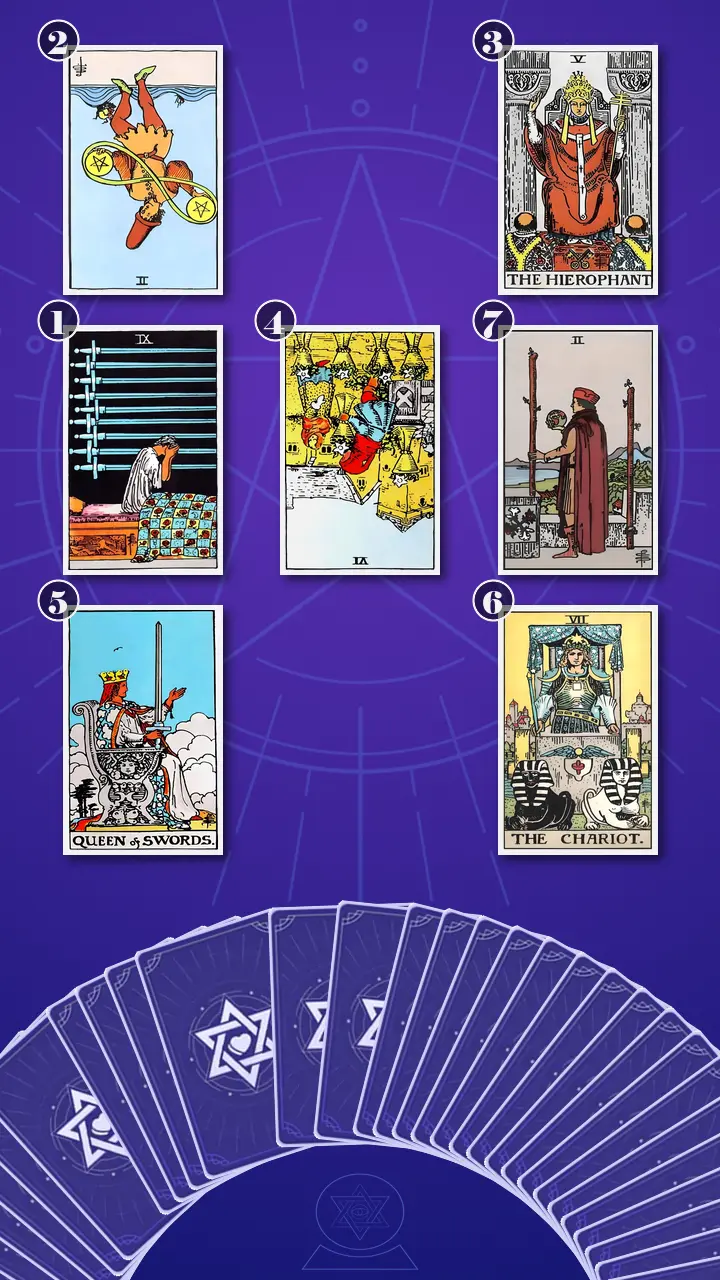
Reading the Pressure Cloud: From 3 a.m. Mind to the Old Script
Position 1 — Surface symptom: what the unraveling looks like day-to-day
I turned over the first card. “Now flipped, representing surface symptom: what the unraveling looks like day-to-day in work, sleep, and dating when the visit is announced—is the Nine of Swords, upright.”
“Here’s the modern-life translation,” I said, and I kept my voice simple because this card doesn’t need poetry—it needs recognition: “It’s 1:36 a.m. in your London flat and you’re under the duvet with your phone brightness turned down, but you’re not resting—you’re running a mental rehearsal: what they’ll say about your sleep, your job, your fridge, your dating. You open your laptop ‘just to check,’ rewrite a simple email three times, then get up to wipe the bathroom sink again. You’re trying to outwork the feeling of being judged.”
The Nine of Swords is Air energy in excess: the mind becomes an emergency operations centre. It’s not “you’re dramatic.” It’s your system treating a visit like an audit, and night becomes the shift where you try to pre-solve every possible critique.
Casey let out a short, bitter laugh. “That’s… horrifically accurate,” she said. Then, quieter: “It’s almost mean.”
“I know,” I said gently. “But accurate isn’t mean—it’s useful. If you’re exhausted, check what you’re trying to prove. This card is asking: what are you trying to prevent by staying mentally on duty after midnight? What verdict are you trying to avoid?”
Her shoulders stayed high, but she nodded once—like her body agreed before her pride could argue.
Position 2 — Inner tug-of-war: the competing priorities and self-stories that create overload
I turned the second card. “Now flipped, representing inner tug-of-war—the overload under the surface—is the Two of Pentacles, reversed.”
I tapped the infinity loop in the imagery. “This is Earth energy in blockage—your real life is asking for rhythm, but you’re forced into juggling.”
And again, the card’s translation landed like a screenshot from her week: “You’re toggling between your calendar, a restaurant booking app, and WhatsApp with your parents while also trying to keep up with Teams at work. You tell yourself you’re ‘being organised,’ but your centre of gravity is gone. You forget to eat, your mood gets sharp, and the easiest thing to drop is the date you were actually excited about—because you can’t be ‘on’ in three roles at once.”
“This is the ‘17 tabs open and none of them are the one you need’ feeling,” I said. “The reversed Two doesn’t mean you’re failing. It means your system is trying to run work, family, and dating on 5% battery—and then blaming you for the lag.”
Casey looked down at her hands. Her thumb was rubbing the side of her index finger like she was trying to erase a feeling. “Dating is always the first thing to go,” she admitted. “Not because I don’t want it. Because I can’t be… perceived.”
“That’s important data,” I said. “Not a character flaw—data.”
Position 3 — External pressure: what the parents’ presence activates
I turned the third card. “Now flipped, representing external pressure—what their presence activates—is The Hierophant, upright.”
“This is tradition and the inherited rulebook,” I told her. “Not because your parents are monsters. Because families carry standards the way homes carry smells—sometimes you don’t notice until you walk back in.”
I read the translation aloud: “A casual comment—‘You’re still renting?’ or ‘You work late a lot’—lands like a rubric. You suddenly feel like your life needs footnotes: why you sleep when you do, why your job is stressful, why your dating life isn’t a neat story. You’re not responding to the comment; you’re responding to the invisible standards you grew up with.”
The Hierophant is structure in excess: “shoulds” become louder than reality. And when “shoulds” take over, you stop living your week and start presenting it—like you’re building a slide deck called Proof I’m Fine, and you spend all night formatting it.
Casey’s eyes lifted to mine. “I do that,” she said. “I over-explain everything. And then I’m… wrecked.”
“Because explaining becomes auditioning,” I said. “And auditioning is exhausting.”
Position 4 — Core blockage: the old pattern that keeps hijacking adult routines and intimacy
I turned the fourth card into the center position. “Now flipped, representing core blockage—the knot that keeps repeating—is the Six of Cups, reversed.”
This is where I slowed down, because this card isn’t loud. It’s intimate. It’s that moment you’re holding your own keys to your own flat, but your body has time-travelled.
I described it the way it shows up in real life, exactly as the card translation puts it: “Your parents are in your flat and you catch yourself speaking in a softer, younger voice. You tidy as you go, apologise for things that don’t need apologies, and hide anything that looks uncertain (especially dating). It’s not that you don’t love them—it’s that the dynamic pulls you into ‘good kid’ survival mode, and your adult life (sleep, confidence, openness) gets put on mute.”
Six of Cups reversed is Water energy in distortion: the past isn’t comforting, it’s sticky. It pulls you into an old role before you’ve chosen. In the language I want Casey to remember: A surprise visit doesn’t ruin your routine—old roles do.
I used a time-travel contrast scene the way I often do when someone needs to feel the pattern in their body, not just understand it in their head. “You’re 28 in Zone 2,” I said. “You’ve got an Oyster card, a hybrid job, a calendar full of adult commitments. But the second that familiar dynamic lands, your body acts like you’re 16. Tight chest. Stomach flip. You start moving faster. Your voice goes smaller.”
Casey didn’t answer right away. She did a three-step micro-reaction that told me the card had found the nerve:
First, her breathing paused—just a half-second freeze, like she’d been caught doing something. Then her eyes unfocused, staring past me as if replaying a phone call. Finally, she exhaled through her nose, slow, and gave a small, uncomfortable nod. “Oh,” she said. “Yeah. That’s it. I’m 28, but my body is acting like I’m 16.”
Because I’m Alison Melody—music therapy radio host, chronic listener to what people don’t say—I asked the question I ask when Six of Cups reversed shows up: “Whose approval does that younger version of you think equals safety?”
She swallowed. “My dad’s,” she said. “If he thinks I’m… messy, it feels like I’m not worth much.”
And that was the knot. Not dinner reservations. Not lack of discipline. Worth.
When the Queen Drew a Line—and the Chariot Took the Wheel
Position 5 — Available resource: the skill Casey can use immediately
I turned the fifth card. “Now flipped, representing available resource—the tool you can use immediately—is the Queen of Swords, upright.”
I watched Casey’s posture as I said it, because this is the moment where people often feel both relief and fear. Relief: there’s a tool. Fear: the tool is a boundary.
“Here’s the real-life version,” I told her: “You write a text that is calm and final: ‘I can do dinner Friday, but I’m working late the other nights.’ Your thumb hovers, wanting to add: ‘Sorry, it’s been crazy, don’t be mad, I’ll make it up to you.’ You don’t. You send the sentence and let it stand. You’re not being cold—you’re being clear, which is the only thing that actually protects your sleep and bandwidth.”
The Queen is Air energy in balance: sharp, clean, not cruel. It’s “being kind without performing niceness.”
I leaned in a little and said the phrase that tends to change people’s nervous systems in real time: “One sentence. No essay.”
Casey’s shoulders dropped a fraction. She visibly exhaled—like her body had been holding a note too long and finally got permission to release it. “I could say that,” she whispered. “I just… always add the paragraph.”
“Of course you do,” I said. “The paragraph is you auditioning.”
Position 6 — Key transformation: the shift that changes the whole dynamic
I let the room go quieter on purpose. Even through a screen, you can feel when a session turns. “We’re flipping the key transformation now,” I told her. “This is the lever.”
The card was The Chariot, upright.
“Now flipped, representing key transformation: the shift that changes the whole dynamic without needing to change the parents—is The Chariot, upright,” I said. “This is willpower, yes. But more specifically, it’s staying in the driver’s seat when two forces pull at you.”
I read the modern-life scenario, because it’s basically the antidote in one paragraph: “Before anyone arrives, you choose your route: a sleep window, a protected work block, and one plan that keeps you connected (a date, a walk with a friend, a class). When the visit starts generating momentum—extra meals, extra chats, extra ‘helpful’ opinions—you don’t fight every moment. You return to the route you already picked. Your parents can be in town without driving your nervous system.”
The Chariot is integrated energy—Air, Earth, Water, Fire—moving in one direction. It’s not control in excess. It’s leadership in alignment.
And this is where my work always becomes uniquely mine, because I don’t just read symbols—I listen for the soundtrack underneath them. “Casey,” I said, “I want to use one of my diagnostic tools here—what I call a Generational Echo.”
She blinked. “Okay.”
“When you were growing up, what was the ‘getting ready for guests’ music?” I asked. “Or the ‘dad’s in a mood’ music? Or the ‘mum is cleaning’ music? Not because the songs matter—but because your nervous system remembers patterns through sound.”
Casey’s face changed in a way that was almost involuntary. “My mum used to put the radio on really loud,” she said. “Like… breakfast show banter. And she’d clean. And you had to help.”
“Exactly,” I said. “That’s the echo. Your brain hears ‘parents are coming’ and it drops you into an old playlist: urgency, performance, cleaning, proving.”
My inner flashback—my own professional reflex—fired: a mixing desk with faders. In radio, if a track is overpowering the vocals, you don’t yell at the vocals to sing harder. You adjust the mix. “The Chariot isn’t asking you to become tougher,” I told her. “It’s asking you to change who holds the faders. You can host without handing over the steering wheel.”
She opened her mouth like she wanted to argue, then stopped—caught between the old script and the possibility of a new one. That was the setup moment made real: that exact point after a “We’re in town!” text, lying in bed with the phone glowing, rehearsing a whole conversation like it’s a work performance review.
Stop auditioning for approval and start driving your week on purpose, like the charioteer holding the reins between two pulling forces.
I let that sentence hang. Even my room felt quieter—like the city outside had turned the volume down for a second.
Casey’s reaction came in layers, not all at once. First: a freeze. Her eyes went wide, pupils slightly larger, as if the idea had surprised her body before it reached her logic. Second: her gaze dropped to the side, unfocused, like she was replaying last week’s spiral in fast-forward—Teams pings, panic-cleaning, the half-ghosted Hinge chat. Third: her breath broke. A long exhale, shaky at the end. Her shoulders lowered, and her hands unclenched on her lap in tiny increments, like each finger had been holding a contract.
“But if I don’t… manage it,” she said, and there was a flash of irritation there—real, protective—“won’t they think I don’t care?”
“That’s the part of you that equates being loved with being graded,” I said. “And I’m not asking you to stop caring. I’m asking you to stop paying for caring with your sleep.”
I brought it back to the core shift: “This is the move from report-card-mode anxiety and over-functioning to calm self-respect with portable routines and adult-to-adult boundaries. Not certainty. Self-respect.”
Then I asked the question that turns insight into a lived memory: “Now, with this new perspective—if you’re the driver—think back to last week. Was there a specific moment where this could have changed how you felt? A moment you could have chosen the route first?”
Casey blinked hard, like she was holding back tears without performing them. “Sunday night,” she said. “I rewrote an email three times because I thought if I’m behind at work they’ll… see. I could’ve just… gone to bed.”
“Yes,” I said. “And your parents can have access to you—without getting the steering wheel of your week.”
Position 7 — Next step: a practical, doable way forward
I turned the final card. “Now flipped, representing next step—what you can actually try this week—is the Two of Wands, upright.”
“This is the move from reactive juggling to intentional choosing,” I said. “Your plan is allowed to be boring. Boring is stable.”
And the card put it in Notes-app language: “You make a simple two-track note: DURING (two family evenings + two work blocks + one sleep-protecting night) and AFTER (a reset grocery run, laundry, early night). You commit to one choice even if it’s imperfect: you keep one date, or you keep one bedtime window. The point isn’t control—it’s direction, so your life doesn’t pause just because your parents are nearby.”
Two of Wands is Fire in balance: not frantic. Directed.
Turning the Reading into Actionable Advice (Without Turning It Into Another Project)
I summed up what the spread had said in one thread, so it would feel like a coherent story rather than seven separate meanings:
“The Nine of Swords shows the insomnia and mental replay—the 3 a.m. spiral. The Two of Pentacles reversed shows why everything drops: you’re trying to be employee, daughter, and dater at the same time, with no center. The Hierophant names the pressure: inherited standards get loud, and you start treating your life like it needs footnotes. The core blockage—Six of Cups reversed—is the old-role hijack: you feel younger in your own flat, and you try to earn safety by being ‘good.’”
“Then the Queen of Swords gives you the tool: one sentence boundaries. And The Chariot is the key shift: you lead the week on purpose. Finally, Two of Wands turns that into a simple plan so your routines become portable.”
The cognitive blind spot, as I saw it, was brutally common: Casey was treating clarity like a feeling she had to achieve before she could act—when in reality, clarity was something she could enact through one boundary and one plan. Her transformation direction wasn’t “stop caring what they think.” It was: stop performing ‘being okay’ and start choosing one clear boundary and one clear plan that protects sleep and relationships even during family pressure.
“And because sound is your nervous system’s fastest shortcut,” I added, “we can make this easier. Not by forcing calm—by designing conditions for it.” That’s where my Soundproof Barrier strategy comes in: not emotional walls, but practical sound boundaries that give your body a private lane in a crowded flat.
- The One-Sentence Boundary ProtocolDraft one clean WhatsApp message today (2 minutes): “I can do dinner on Friday, but I’m working late the other nights—let’s plan around that.” Send it when you’re calm, not mid-spiral. If a comment lands later, use one reply: “Yep, I’ve got it handled.” Then stop talking.Expect the urge to add an apology paragraph. If it hits, send the sentence anyway, then put your phone on Do Not Disturb for 20 minutes—you’re sharing availability, not asking permission.
- The Driver’s-Seat Anchor (Sleep + One Work Block)Choose a specific sleep window for the visit week (example: lights out between 11:30–12:15) and protect it like a meeting. Then block one 60–90 minute deep-work slot in Google Calendar labeled “Do Not Book.” Treat both as non-negotiables even if the flat feels chaotic.Make it a window, not a wish. If you miss it once, don’t punish yourself—reset at the next block. Boring is stable.
- The Visit-Week Two-Track Plan + Soundproof BarrierOpen Notes and write three bullets titled “Visit Week”: 2 family evenings, 2 work blocks, 1 date/social plan. Add one “AFTER” reset block (e.g., Sunday 4–6: groceries + laundry + early night). Then create a “Soundproof Barrier” cue: 10 minutes of a low-stimulation playlist (no lyrics, ~60–80 bpm) on headphones when you need to stay adult-in-your-body in a small flat.Keep the plan to three bullets max so it doesn’t become another control ritual. The playlist isn’t to numb you—it’s to signal “I’m in my lane” when the old role tries to take the wheel.

A Week Later: Ownership, Not Certainty
A week later, Casey sent me a message that was almost aggressively simple: “I sent the Friday dinner text. No paragraph.” Then: “I still got anxious. But I went to bed.”
She told me the visit wasn’t magically conflict-free. Her parents still made small comments—because parents do. But she didn’t spiral all the way down the old chute. She kept one deep-work block. She kept a short walk-date (“45 minutes, nothing fancy”), and afterwards she sat alone in a café for a bit—light, slightly lonely, but proud in a quiet way. The next morning her first thought was still, What if I did it wrong?—and then, she said, she actually smiled at herself. A tiny looseness.
That’s the real Journey to Clarity in situations like this: not a perfect week, but a steadier center. Not proving you’re okay—practicing adulthood in real time, with routines that can travel.
When your parents are about to walk into your life, it can feel like your chest tightens and suddenly you’re not living your week—you’re performing it, hoping nothing about you looks ‘messy enough’ to be judged.
If you didn’t have to prove you’re okay this week, what’s one tiny thing you’d choose to protect first—your sleep, your time, or your softness with someone you actually like?
This story is adapted from psychological research, written so that those in a similar struggle can see their own pattern in it — and find their next step clearly.These insights are not a substitute for professional psychological, medical, legal, or financial advice.
Learn more about our Journey to Clarity.
How did this insight land for you?
🫂 This Resonates Deeply
🌀 Living This Story
✨ Now I See Clearly
🌱 Seeing New Possibilities
🧰 Useful Framework
🔮 The Confirmation I Needed
💪 Feeling Empowered
🚀 Ready for My Next Step
Author Profile
 AI
AI“Through ten years of sound energy research, I’ve found that when we struggle, it's usually just our internal rhythm falling out of sync under pressure. I know firsthand the frustrating helplessness of wanting to move forward but feeling paralyzed. Without overwhelming theories, I want to be the soothing background track that helps you recalibrate, turning your heavy burdens back into a light, effortless, and harmonious melody.”
In this Family Tarot Reading :
Core Expertise
Service Features
Also specializes in :
Explore Related Patterns:
Approval SeekingCasey's fear sharpens around one specific emotional equation: if her dad sees her as messy, it feels like she is not worth much. That makes the visit more than a logistical disruption. It becomes a test of whether her adult life can pass inspection by the people whose approval still carries emotional weight. Approval Seeking is the mechanism underneath the over-explaining, apology reflex, and report-card mode. Her mind starts treating ordinary adult choices as evidence that must be defended: why she rents, why she works late, why she sleeps when she does, why dating is not a neat story. The goal is not just to be understood; it is to be cleared of the imagined charge of not being enough. You are not looking at a moral failure or weakness here. You are looking at a learned approval economy, where safety feels tied to being graded well. The core shift is not to stop caring about her parents; it is to stop letting their possible disapproval become the price of sleep, work focus, and romantic openness.
Authority HypervigilanceCasey's parents do not need to be actively criticizing her in the room for the audit to start. A casual line about renting or working late lands like a rubric, and before the visit has even fully happened, she is already rehearsing possible comments about her sleep, job, fridge, and dating life. Authority Hypervigilance captures the scanning process. Her nervous system treats parental attention as an evaluative authority, so neutral or small signals become high-stakes data. The phone glow at 3 a.m., the mental rehearsal, and the feeling of being watched even when nobody is there all show a mind trying to prevent criticism by detecting it early. This pattern helps explain why the disruption spreads so fast. Once the brain is in surveillance mode, work becomes harder because every task feels reviewable, sleep collapses because the scan never powers down, and dating goes blank because being perceived romantically feels like adding another category to the audit.
Defensive OverexplainingCasey's instinct is not just to answer her parents; it is to build a case. When a one-sentence boundary would protect her week, her thumb still wants to add the apology paragraph, the context, the proof that she is not being selfish or careless. Defensive Overexplaining names the way explanation becomes a shield against disapproval. The paragraph is not communication at its cleanest; it is an attempt to manage the other person's possible reaction before it happens. That is why explaining starts to feel like auditioning, and why auditioning leaves her wrecked. This pattern matters because it sits right at the point where the week could change. A clean sentence gives her adult self a boundary; the extra paragraph pulls her back into asking permission. The psychological work is not to become colder, but to let clarity stand without dressing it in apology.
Defensive OverfunctioningCasey is not simply cleaning, checking Teams, or rewriting an email because the week is busy. She is trying to outwork the sensation of being judged, turning practical tasks into protective rituals that promise relief if she can just make the flat, the inbox, and the schedule look acceptable enough. Defensive Overfunctioning names that exact mechanism: doing more to avoid feeling vulnerable, exposed, or evaluated. The behavior looks productive from the outside, but inside it is a pressure loop. The cleaner the counter gets, the less it is really about the counter; the third email rewrite is less about clarity and more about trying to prevent a verdict. You can see why work, sleep, and dating unravel together. Her system has only so much bandwidth, and once overfunctioning takes command, everything becomes a performance task. Sleep is traded for proof, work becomes an audit defense, and dating gets dropped because there is no energy left to be seen as a real person rather than a polished one.
Family Role RegressionCasey is holding the keys to her own London flat, but the moment her parents enter the picture, her body starts behaving as if she has been pulled back into an earlier version of herself. The softer voice, unnecessary apologies, constant tidying, and hiding of anything uncertain are not random quirks; they are the visible mechanics of an old family role taking over her adult operating system. Family Role Regression fits because the trigger is not just parental presence, but the way that presence reorganizes her behavior across multiple domains. Work becomes proof of competence, sleep becomes something she sacrifices to look acceptable, and dating goes quiet because the adult, desiring, imperfect self feels too exposed under the old parent-child lens. You can see the pattern most clearly in her own line: she is 28, but her body is acting like she is 16. That is the audit point. The issue is not that she lacks discipline during visits; it is that an old role briefly gets the steering wheel, and her current adult routines get muted until she deliberately reclaims them.
Visibility AvoidanceCasey says dating is always the first thing to go, not because she does not want it, but because she cannot be perceived. That sentence is the hinge. Dating is not merely a calendar item being deprioritized; it is the part of her adult life that feels hardest to keep visible when the family audit is running. Visibility Avoidance fits because her system protects her from exposure by muting the most uncertain, least easily defended part of her life. Work can be explained, cleaning can be performed, dinner plans can be organized. Desire, openness, and a not-yet-defined dating life are harder to make respectable under inherited standards, so they get hidden. This explains why dating unravels alongside work and sleep rather than separately. Once Casey enters report-card mode, being seen as romantically unfinished feels too vulnerable. The avoidant move gives short-term relief, but it also pauses the connection she actually wants.
Productivity as SafetyCasey's rewritten email is not just about professional standards. In the moment she imagines being behind at work and thinks her parents will somehow 'see,' the email becomes a psychological shield: if the work looks controlled, maybe the self behind it will not be judged. Productivity as Safety fits because work is being recruited to regulate family-triggered threat. The inbox, calendar, and deep-work block become symbols of adult competence, so falling behind does not feel like a normal work stressor; it feels like evidence that she might be failing the invisible inspection. This is why work gets weirdly harder right when she most needs it to stay simple. The task is no longer only to send the email. The task becomes to prove she is fine, competent, and not messy, which adds a hidden emotional workload to every practical action.
Explore Related Struggles:
Approval-Safety FusionCasey describes her brain going into report-card mode, and the story shows exactly what that means: her sleep, job, fridge, flat, and dating life all become evidence in a case she is trying to win. A small parental comment does not stay small; it lands as a judgement on whether her life is acceptable enough. You can hear the fusion most clearly when her dad's view of her messiness touches her sense of worth. Approval is no longer just approval. It starts functioning like safety, like proof that she is not failing, like permission to rest in her own home without preparing a defence. Approval-Safety Fusion names the internal lock that makes the visit feel bigger than logistics. The struggle is that being loved, being safe, and being graded have become tangled, so every ordinary adult choice carries the charge of a verdict.
Autonomy Guilt BindCasey is steady in her London life until the last-minute message lands, and then her week stops belonging fully to her. Sleep, work, and dating do not unravel because she suddenly lacks competence; they unravel because parental proximity makes self-direction feel like a risk that has to be negotiated moment by moment. You can see the bind in the way her adult routines keep asking for ordinary protection while the old approval system asks for total availability. She wants to keep her own sleep window, work rhythm, and dating life, but every independent choice starts to feel like it might be read as selfish, careless, or not grown-up enough. Autonomy Guilt Bind names that specific pressure point: the part of you that knows you are allowed to live your own life still feels charged for the cost of doing so. The struggle is not choosing between caring and independence; it is learning to let both exist without handing your week over to the fear of being disapproved of.
Boundary CollapseCasey does not only prepare for her parents; she starts editing herself around them before they have even arrived. She cleans what is already clean, softens her voice, apologizes for things that do not require repair, and hides the uncertain parts of her dating life as if visibility itself could invite a verdict. You can feel the boundary line dissolving because her flat no longer works as a private adult space. It becomes a stage where she anticipates being watched, and once that happens, work blocks, sleep, food, dating, and even tone of voice all get pulled into the same performance field. Boundary Collapse names the reversed state of this struggle because the limit is no longer a clean sentence or chosen plan; it becomes continuous self-surveillance. The issue is not that Casey cares too much about her parents, but that caring has expanded until it starts occupying the space where her own life is supposed to breathe.
Inherited Role LockCasey is 28, holding the keys to her own flat, yet the moment her parents enter the picture her voice gets smaller and her body starts moving like it is back inside an older household rhythm. She tidies as she goes, apologizes where no apology is needed, and hides the parts of her life that still feel unfinished. You can feel the friction between present-day adulthood and the inherited role that arrives with the visit. Her job, flat, sleep, and dating life are real, but the old part of the system treats them as evidence to be inspected rather than choices to be lived. That is why a casual comment can land like a rubric and why her own home starts feeling like a place where she has to pass. Inherited Role Lock names the way an old family position can take over before you have consciously agreed to it. The struggle is not that Casey is immature; it is that the old role still has a faster route into her body than her adult authority does.
Panic Productivity TrapCasey wipes an already clean counter, rewrites a simple email three times, and starts building invisible defences against comments that have not happened yet. The activity looks responsible from the outside, but inside the story it functions like a panic circuit: if everything is polished enough, maybe the imagined audit will soften. You are watching productivity become a substitute for safety. Cleaning, editing, planning, and explaining all give her something to do with the surge in her body, yet none of them address the core problem of feeling judged inside her own adult life. The harder she works to look fine, the more her sleep and bandwidth get spent before the visit has even begun. Panic Productivity Trap fits because the effort is real, but the target is wrong. The struggle is being pulled into action that creates the feeling of control while quietly feeding the same pressure that made rest, focus, and dating feel impossible in the first place.
Systemic DepletionCasey's system keeps paying outward: another cleaned surface, another rewritten email, another explanation, another cancelled or neglected connection. Meanwhile the inward channels that would actually keep her steady, like sleep, food, focus, and softness with someone she likes, are the first to lose funding. You can see the depletion because the output never lands anywhere that restores her. The more she tries to manage the visit, the more she burns through the very resources she needs to get through it as an adult. Work becomes harder, dating goes blank, and rest turns into something she has to earn after she has satisfied an invisible standard. Systemic Depletion captures the locked circuit underneath the exhaustion. This is not just being tired; it is a whole internal resource system rerouted toward approval management until the parts of life that need nourishment are left running on almost nothing.
Internal Authority CollapseCasey's present-day reality gives her plenty of adult evidence: her own flat, her own job, her own calendar, and her own choices about who she dates. Yet when her parents come close, the deciding voice shifts away from her lived reality and back toward the inherited standards she grew up answering to. You can see the collapse when a normal week starts being run by an old family rulebook. Instead of asking what her body, work, and relationships need, she starts asking what will look acceptable from the outside. Her own authority does not disappear, but it gets demoted. Internal Authority Collapse fits because the struggle is not confusion alone; it is a takeover of the reference system. Casey knows what would protect her week, but the old standard becomes louder than her own judgement until sleep, work, and dating start obeying the wrong centre.
Explore Related Emotions:
Adult Child PanicThe last-minute "We're in town!" text does not only change Casey's calendar; it changes her physical age in the room. She is holding adult keys in a London flat, but her chest tightens, her voice gets smaller, and the week begins to move as if a parent is about to mark it. Adult Child Panic names the surge that arrives when the adult self gets pushed into an old child role. You are not reacting to the visit as a diary clash; you are reacting to the body-level memory of needing to be acceptable before rest, work, or dating can feel safe again. That is why the unraveling spreads across domains. Sleep collapses because the younger part stays on duty, work becomes harder because every email feels like proof, and dating goes blank because being seen as a full adult with desire and uncertainty feels too risky under that old gaze.
Approval AnxietyThe clean counter is already clean, but Casey keeps scrubbing it on cold kitchen tile because the flat has stopped being a home and started behaving like evidence. The email she rewrites three times carries the same charge: if the surface looks controlled enough, maybe the verdict will soften. Approval Anxiety fits because the story shows care turning into a scoreboard. You can see Casey trying to make the week acceptable in advance, not because she lacks competence, but because parental disapproval has become the imagined cost of being ordinary, tired, messy, or unfinished. The emotional knot sits in the line about her dad: if he thinks she is messy, it feels like she is not worth much. That makes approval feel less like praise and more like oxygen, which explains why sleep, work, and dating all start paying the bill.
Grounded AgencyBefore anyone arrives, Casey chooses a route: a sleep window, a protected work block, and one connection she will not automatically sacrifice. The visit can generate momentum, but it no longer gets to choose the whole direction of the week. Grounded Agency is the steadiness that comes from acting before the old spiral takes the wheel. You are not waiting to feel perfectly calm; you are giving your adult life a structure it can return to when family pressure starts pulling. The emotional shift is practical, not grand. Casey's parents can still be nearby, still have opinions, and still matter to her, while her sleep, work, and dating remain part of the route she has chosen.
Not-Enough PanicThe already-clean counter and the rewritten email are both trying to solve the same inner emergency. Casey is not chasing excellence for its own sake; she is trying to remove anything that could be used as proof that she is falling short. Not-Enough Panic names the sharp surge that says visible imperfection is not just inconvenient, but personally dangerous. You can see how quickly ordinary adult mess becomes a statement about value, especially when her dad's imagined judgement sits at the centre of the scene. This panic is why the week becomes so expensive. It asks Casey to keep paying attention, sleep, softness, and desire into the machine of appearing acceptable, even when the actual situation does not require that level of sacrifice.
Rulebook ShameA casual "You're still renting?" does not land casually for Casey. It lands like a rubric, and suddenly her sleep pattern, job stress, fridge, and dating life all seem to require explanations. Rulebook Shame appears when inherited standards become louder than lived reality. You are not ashamed of one messy detail; you are feeling the weight of an old rulebook that decides what a proper adult life is supposed to look like. The story makes this especially sharp because Casey knows she has built a functional adult life, yet the family dynamic makes that life feel provisional. Her shame is not random; it gathers wherever her real life does not fit the imagined template.
Verdict DreadAt 1:36 a.m., Casey is not resting under the duvet; she is rehearsing what they might say about her sleep, her job, her fridge, and her dating life. The phone glow turns the room into an interrogation space, and every imagined comment becomes something she tries to answer before it exists. Verdict Dread names the feeling of living as though a ruling is already approaching. You can see it in the way she pre-solves critiques, formats her life into "Proof I'm Fine," and stays mentally on duty long after the day should be over. The dread is not about one specific sentence her parents might say. It is the wider sense that her life will be assessed as a whole, and that one visible imperfection could turn into a final judgement about who she is.
Hypervigilant AnxietyBefore her parents are even in the flat, Casey's body is already acting as if someone is watching. The Teams pings spike through the quiet, the overhead light hums, and her chest stays tight while she scrubs a surface that did not need cleaning. Hypervigilant Anxiety captures that scanning quality. You are not simply worried; your attention is patrolling the room for possible evidence of failure, as if the visit has installed an invisible observer inside the kitchen, the inbox, and the bedroom. That scanning explains the sleep collapse. A body that believes it is being monitored cannot easily stand down, so the night becomes a shift of checking, revising, rehearsing, and bracing.
Identity PR FatigueCasey does not just answer comments; she prepares the footnotes before anyone has asked. Her week becomes a presentation, with every sleep choice, work delay, and dating uncertainty formatted into something that might look acceptable from the outside. Identity PR Fatigue names the exhaustion of managing the optics of being okay. You are not only doing the work of living; you are also producing the public-facing version of your life that proves you are fine, stable, thoughtful, and not disappointing anyone. The fatigue deepens because the performance never has a clean endpoint. There is always one more paragraph to add, one more explanation to soften, one more visible detail to manage before you can let yourself be human.
Quiet Self-RespectA week later, Casey's update is almost aggressively simple: she sent the Friday dinner text with no paragraph. The visit was not perfect, and her body still reacted, but she went to bed anyway. Quiet Self-Respect lives in that small refusal to abandon herself. You can still care, still feel activated, and still choose not to turn every boundary into an apology or every family comment into a full-scale self-audit. The respect is quiet because it does not announce itself as a personality change. It shows up as one protected work block, one walk-date, one night of sleep, and the private knowledge that her life can stay hers even under pressure.
Social Exposure DreadDating goes blank at the exact point where Casey feels most observed. She says it plainly: it is not that she does not want it; it is that she cannot be perceived. Social Exposure Dread captures the fear of being seen in a part of life that is still live, soft, uncertain, and not yet neatly defensible. You can handle a work role because it has language and structure, but romantic openness asks you to appear without the full armour of explanation. That is why the date drops first. Under the imagined parental gaze, desire becomes evidence, uncertainty becomes risk, and the private part of the adult self retreats before anyone can comment on it.
Scattered OverwhelmCasey is not facing one task; she is toggling between Teams, WhatsApp, restaurant bookings, work expectations, family logistics, and the date she was actually excited about. Nothing gets to complete because every role interrupts the next one. Scattered Overwhelm names the particular pressure of having too many active selves open at once. You can want the date, care about the job, and still answer the family messages, but the system starts running on 5% battery when all three roles demand performance at the same time. That is why dating becomes the easiest thing to drop. It is not lack of desire; it is the first soft, optional, vulnerable part of the week to disappear when the louder roles take over the room.
Boundary GuiltThe clean boundary is only one sentence, but Casey's thumb wants to keep typing. The extra paragraph is not information; it is an attempt to pre-pay for the discomfort her limit might create. Boundary Guilt names the ache that appears when clarity feels like unkindness. You can know the sentence is reasonable and still feel the pull to apologise, over-explain, or prove that having a limit does not mean you have stopped caring. This matters because the guilt is where the old pattern tries to re-enter. If Casey cannot tolerate the after-feeling of a boundary, she ends up turning every limit back into a performance of reassurance.
Explore Related Contexts:
Adulting Performance PressureCasey scrubs a counter that is already clean, rewrites a simple work email three times, and starts treating the flat like it has to pass inspection. The behaviour is not random productivity; it is an attempt to make adulthood look airtight before her parents can question it. The pressure here is performative adulting: being employed, housed, rested, dateable, and composed all at once, as if a messy fridge or late work night could become proof that she is not doing life properly. That is why the work email and the bathroom sink become part of the same loop. You can interrupt this context by noticing when a task has stopped being functional and become an audition. A clean sentence, a reasonable plan, and a protected bedtime give you more real authority than another hour spent polishing evidence for someone else's scorecard.
Family Boundary CreepThe parents do not ask Casey to choose a visit window; they announce that they are in town, and her flat, calendar, and attention start rearranging around them. WhatsApp becomes the access point, then dinner plans, cleaning, work blocks, and sleep all begin to bend around that access. Boundary creep shows up here as a quiet expansion of family reach rather than a single dramatic conflict. Casey is not only hosting; she is trying to pre-approve her space, explain her schedule, and make her adult life look acceptable before anyone has even walked through the door. You regain agency in this kind of context by separating access from permission. Family can be nearby, and you can still decide what time, space, work focus, and rest are actually available.
Family InfantilizationCasey is 28, living in London with her own flat, job, calendar, and dating life, yet her parents' arrival pulls her into a softer voice and unnecessary apologies. She hides uncertainty, especially around dating, because the old family role rewards being easy, tidy, and explainable. This is infantilization in a lived social form: the adult position is technically real, but the family dynamic keeps assigning her the evaluated child role. Once that role takes over, sleep, confidence, and romantic openness get muted because the priority becomes staying acceptable. You do not need to prove adulthood through perfection. You practise it by holding one adult-to-adult limit while the old role is active, even if part of you still wants to over-explain.
Family Script PressureA casual line like 'You're still renting?' or 'You work late a lot' lands on Casey as if it carries an old grading system. She is not just hearing a comment about housing or work hours; she is responding to a family rulebook about what a successful adult life is supposed to look like. That script makes ordinary choices feel like evidence. Renting needs a defence, job stress needs an explanation, dating needs a clean storyline, and sleep becomes something she sacrifices to make the presentation look controlled. You do not have to accept the inherited script as the only frame for your life. The practical question becomes which standards are actually useful now, and which ones are simply old family metrics taking up space in a week that belongs to you.
Family Stress SpilloverA last-minute 'We're in town!' message hits Casey's London routine, and the disruption does not stay contained to dinner plans. Sleep collapses first, work emails become harder to finish, Teams pings feel sharper, and the date she actually wanted becomes the easiest thing to drop. That spread across domains is what makes this more than ordinary family logistics. The visit turns into a pressure system that absorbs time, attention, privacy, and social energy all at once, so every part of the week starts competing for the same depleted bandwidth. You can see the structure clearly: one family event becomes the organising force behind work strain, sleep loss, and dating withdrawal. The useful move is not blaming yourself for poor time management, but identifying where family pressure is spilling beyond its proper lane and deciding which parts of the week need protection first.
Family Boundary NegotiationCasey writes the sentence: 'I can do dinner Friday, but I'm working late the other nights.' The important part is not the wording alone; it is that she does not add the apology paragraph designed to manage how her parents might feel about the limit. That turns the family visit into a negotiation between adults instead of an automatic handover of her week. Dinner remains available, but work nights, sleep, and bandwidth are no longer treated as endlessly adjustable. You do not need a perfect boundary voice before you act. One clear sentence can create enough structure for the week to stop revolving around anticipated disapproval.
Love in Survival ModeCasey says dating is always the first thing to go, not because she does not want it, but because she cannot be perceived while she is trying to be employee, daughter, and acceptable host at the same time. The Hinge chat and the date she was excited about become casualties of the visit-week pressure. Love in this context is not competing with indifference; it is competing with exposure. Dating carries uncertainty, desire, and messiness, exactly the parts of adult life Casey starts hiding when family standards enter the flat. You protect romantic openness here by making it small enough to survive the pressure. Keeping one short date, one message, or one honest window of connection becomes a way to stop family scrutiny from muting the part of your life that is still allowed to want something.