The 9:46 p.m. Like That Hijacks Your Night
You’re a late-20s Toronto marketing girlie with a packed calendar, and somehow one Instagram like can hijack your whole night—hello, post-breakup social media triangulation.
Taylor appeared on my screen with that specific, composed exhaustion I’ve seen on a thousand faces—passengers on ocean crossings and clients in city condos alike. Her living room was lit by a bluish TV glow, the kind that makes everything feel a little unreal. Somewhere off-camera, an HVAC unit hummed like a steady sigh.
“It’s so stupid,” she said, and I heard the irritation before I saw it. Her jaw shifted as if she was trying to unclench it without admitting she’d been clenching. “My mom keeps liking my ex’s posts. And I don’t want to police my mom… but it makes me feel like she’s not on my team.”
She told me the loop in a rush—how she’ll be half-scrolling Instagram, half-dooming TikTok, and there it is: her mom’s profile photo under his polished carousel. Phone warm in her palm. Stomach pulling tight like a drawstring. A sentence rising to her tongue…and then staying there, bitten down.
“I’ll close the app,” she admitted, eyes flicking away from the camera like she was confessing to a minor crime. “Reopen it three minutes later. Check again. Sometimes I screenshot the likes like… like I’m collecting evidence for a trial I’m never going to bring.”
What she didn’t call it—what her body already had—was a kind of decision fatigue. Not about him. About how to exist around her mom without being flooded by a breakup that still had teeth.
Her irritation wasn’t a vague mood. It was physical: a tight jaw like a locked hinge, a clenched stomach like she’d swallowed a stone that kept turning over whenever the algorithm forced unwanted closeness.
“We can work with this,” I told her, warm and direct. “Not by trying to control anyone’s clicks—but by finding clarity. Let’s make a map for the moment you see the ‘like,’ and for what you can actually do next.”

Choosing the Compass: The Celtic Cross Spread
I asked Taylor to take one slow breath—not as a mystical ritual, but as a nervous system handoff. A tiny cue to her body: we’re not scrolling now; we’re looking. I shuffled in my studio with my window cracked open to the sound of water against stone—Venice never lets me forget that emotions, like tides, don’t obey our preferred timelines.
“Today, we’ll use the Celtic Cross,” I said.
For readers who wonder how tarot works in a situation like this: the Celtic Cross is useful because the question isn’t only “what should I text my mom?” It has layers—breakup residue, social-media meaning-making, family dynamics, and what sustainable boundaries look like. This spread moves from the observable symptom (the trigger and the checking loop) to the unconscious driver (what you fear the ‘like’ means), then toward a clear standard (what you want to live by), and finally into the embodied follow-through that keeps you out of spirals.
I previewed the bones of our map: “The first card will show what happens in your body and mind the moment you notice the like. The crossing card will name the habit that keeps the issue alive. Higher up, we’ll find the standard you actually want—your ‘terms of service’ for emotional space. And the final card will show what it looks like to hold the boundary kindly over time.”
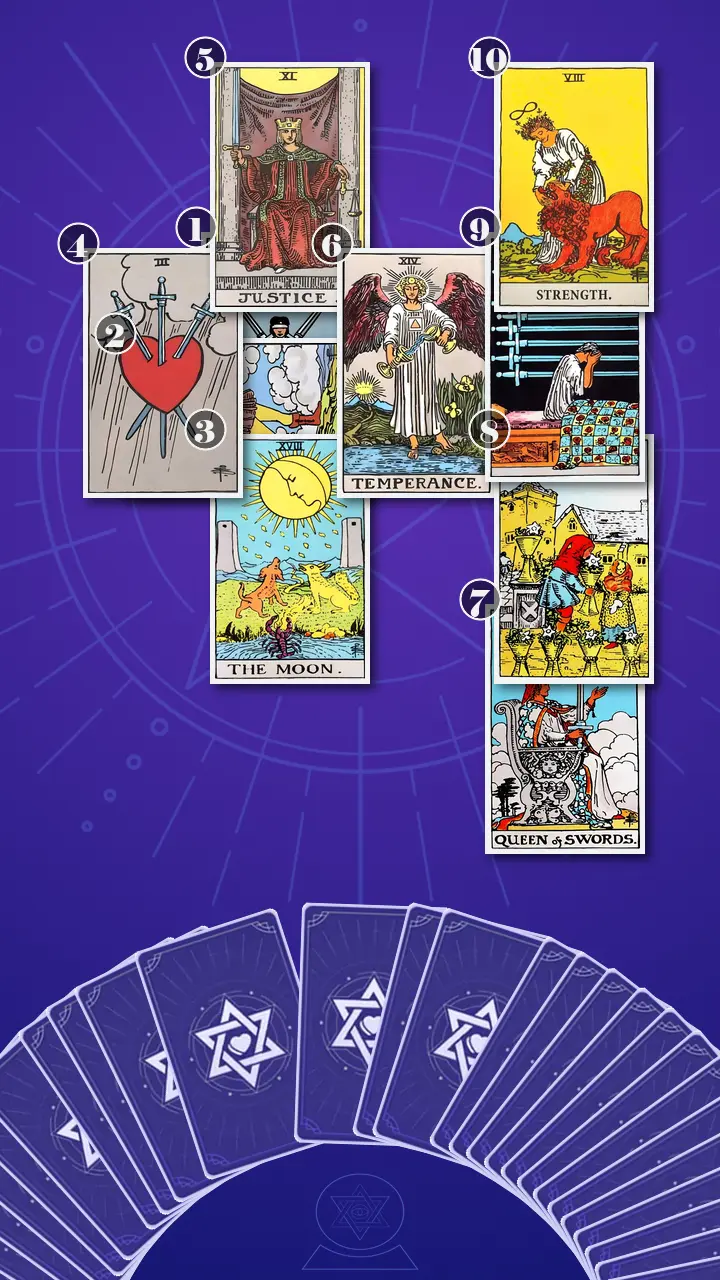
Reading the Map: Swords, Screens, and Silence
Position 1: The immediate loop you’re in
“Now flipped, is the card that represents the immediate moment-by-moment experience—what happens when you see your mom liking your ex’s posts, and what you’re currently doing instead of setting a boundary.”
Two of Swords, upright.
I tapped the blindfold in the image with my fingertip. “This is the stalemate card. It’s emotional self-protection disguised as being ‘reasonable.’”
In modern life, it looks exactly like Taylor described: telling yourself you’re being mature while you’re holding your breath—keeping your feelings behind a mental wall and waiting for the situation to magically resolve.
“Two of Swords is a boundary that exists internally,” I said, “but hasn’t been spoken out loud. Your arms are crossed over your chest in the card. Your jaw does the same thing. It’s not ‘no boundary.’ It’s unvoiced boundary.”
Energetically, this is blockage: the part of you that can be clear gets stuck behind the fear of looking controlling or ungrateful. So your body enforces the boundary by clenching… while your life stays exposed.
Taylor let out a short laugh—one of those half-snorts that’s basically a flinch. “Okay, wow,” she said, and her eyes narrowed with a kind of bitter amusement. “That’s… accurate. Brutal, actually.”
I nodded. “It’s only brutal because it’s precise. The card isn’t judging you. It’s showing you where the energy is trapped.”
Position 2: The habit that keeps it alive
“Now flipped, is the card that represents the main behavior or mental habit that keeps the trigger repeating.”
Page of Swords, reversed.
“This,” I said, “is your late-night investigative journalist.”
In modern life, it’s scanning likes, rereading comments for subtext, and building a whole loyalty narrative from one tiny tap. It’s doing OSINT on your own feelings: screenshots, timelines, theories.
Energetically, reversed Page of Swords is excess—too much vigilance with not enough grounding. The mind won’t land. It keeps looking over its shoulder for the next piece of data that will finally make you feel safe.
I leaned in a little. “Taylor, what are you trying to get from checking—certainty, control, or comfort?”
Her mouth opened, then closed. She swallowed. “Certainty,” she said finally. “Like… if I could just understand what it means, I’d know how to feel.”
“That makes sense,” I said. “But this card also shows why it’s draining you: the more you monitor, the more your nervous system treats Instagram like a stock ticker for your belonging.”
She exhaled through her nose, a tight sound, like steam escaping a kettle that’s been ignored.
Position 3: The deeper driver underneath
“Now flipped, is the card that represents the deeper emotional driver beneath the reaction—what the ‘like’ symbolizes under the surface.”
The Moon, upright.
The Moon is ambiguity, projection, and fear rising in the dark. In modern life, it’s: you can’t tell what your mom intends, can’t tell what your ex intends, and your brain fills the silence with worst-case explanations.
Energetically, The Moon is deficiency of clear information, which invites excess story-making. Your mind tries to create certainty because not knowing feels like danger.
“Here’s the Jungian truth,” I told her, keeping it simple. “When there’s not enough data, we don’t stay blank. We project. The ‘like’ becomes a screen your fears can play on.”
Her fingers moved to her jaw again, rubbing right where the hinge meets the cheek. “So it’s not even about the like,” she said, quieter now.
“Not entirely,” I answered. “If the like wasn’t about him, what would it be symbolizing about you and your mom—being chosen, being protected, being taken seriously?”
She didn’t answer right away. Her eyes unfocused for a second, like she was replaying a commute scene on the TTC—tunnel lights flickering past—then she whispered, “Chosen.”
Position 4: The tender chapter that’s still influencing you
“Now flipped, is the card that represents the breakup context—what’s still tender or unresolved.”
Three of Swords, upright.
In modern life, it’s the sharp drop in your stomach when you see the like and your breakup story snaps back into the present as if it just happened. It’s the public feeling of being exposed—like your pain is being quietly co-signed online.
Energetically, this is balance in a strange way: it validates reality. The wound is real. You’re not being dramatic. A boundary conversation coming from protection of a wound is not the same thing as starting drama.
Taylor’s shoulders lifted, then fell—like she’d been bracing against her own feelings and finally got permission to stop resisting.
Position 5: Your conscious standard (your north star)
“Now flipped, is the card that represents what you want this situation to represent about respect, loyalty, and self-protection—your desired standard.”
Justice, upright.
Justice is the clean daylight after Moonlight. It’s measured and direct—scales and sword. In modern life, it’s when you stop trying to decode and instead decide what respectful behavior looks like for you, then communicate it plainly.
Energetically, Justice is balance: no over-explaining, no receipts, no vibe-based pleading. Something specific and measurable. Like a product requirement instead of a feelings essay.
I heard my own cruise-ship past in my head—those moments when a storm changed the itinerary and thousands of passengers wanted certainty I couldn’t provide. What worked wasn’t promising perfect outcomes. It was clear structure: what’s true, what’s next, what’s within your control.
“Taylor,” I said, “you don’t need more proof. You need a standard. Justice says: define ‘respect’ here in one measurable sentence.”
She blinked, and I saw the first hint of relief—small, but real. “Like… ‘please don’t like or comment on his posts,’” she said.
“Exactly.”
Position 6: The near-future tone that helps you speak without escalation
“Now flipped, is the card that represents the most supportive near-term approach for initiating the conversation.”
Temperance, upright.
Temperance is calm blending: honesty poured into restraint, restraint poured into honesty. In modern life, it’s planning the conversation at a regulated time—not 11 p.m. when you’re already triggered—and keeping the request simple instead of escalating into a debate about the entire relationship history.
Energetically, Temperance is balance: not suppressing, not exploding. Integration.
I modeled the structure out loud, like the angel’s two cups became two sentences: warm opener + clear request. “This isn’t an indictment,” I said. “It’s impact-not-intent language.”
Position 7: The part of you who can do this well
“Now flipped, is the card that represents your stance—what skill you’re being asked to embody.”
Queen of Swords, upright.
In modern life, it’s saying, calmly and once: “Please don’t like or comment on his posts where it shows up publicly, and please don’t update me about him,” then not defending the boundary like you’re on trial.
Energetically, Queen of Swords is balance with a hint of deficiency you’ve been compensating for: you have the clarity, but you’ve been withholding the voice. This card says your cleanest boundary is your strength—not your cruelty.
Taylor nodded, but her mouth tightened again. “I can hear myself sounding… cold,” she said.
“Cold is what it feels like when you’re used to cushioning everyone else,” I said gently. “Direct isn’t cruel.”
Position 8: Your environment (your mom’s likely stance)
“Now flipped, is the card that represents your mom’s likely energy and the relational atmosphere.”
Six of Cups, upright.
Six of Cups is nostalgia, familiarity, gentle friendliness. In modern life, it’s your mom relating to him as “a nice person from a time we remember,” while you experience him as a current boundary problem that keeps reopening your healing.
Energetically, it’s balance in her—she may not be trying to send a message at all. She may be casually friendly, algorithmically nudged, living in the past-tense version of your relationship.
This is where one of my signature lenses clicks into place: Generational Echo Mapping. In Venice, sound bounces in canals—you can call once and hear your own voice return from a different wall, altered. Families do that too. Your mom may be repeating an older script—keep things sweet, stay connected, don’t “make it awkward”—without realizing the echo lands sharply in your body now.
“This card is why debate won’t help,” I told Taylor. “Not because your mom is bad, but because she may genuinely interpret this differently.”
I looked straight into the camera. “Impact is enough. You don’t have to prove intent. You can say: ‘I’m not questioning your intent—I’m telling you the impact on me.’”
Her eyes softened. The jaw stayed tight, but the shame eased a fraction—like someone loosened a knot without untying it yet.
Position 9: The late-night courtroom in your head
“Now flipped, is the card that represents your hopes and fears—what you’re afraid will happen if you speak up, and what you’re hoping will resolve without confrontation.”
Nine of Swords, upright.
In modern life, it’s 2:07 a.m. under the duvet, brightness low, phone warm, mind running a full courtroom simulation: your mom saying you’re ridiculous, you crying, you regretting everything. Then the Notes app draft—the perfect paragraph—deleted because it feels too needy.
Energetically, Nine of Swords is excess thought turned inward—thoughts becoming weapons against the self. The fear here isn’t only conflict. It’s being judged for having feelings. It’s the terror of looking “too much.”
“This card shrinks something for us,” I said. “The conversation you’re imagining is longer than the conversation you need. Your spiral is doing hours of emotional labor to avoid ten minutes of clarity.”
Taylor’s throat bobbed as she swallowed. She didn’t cry—but her eyes glistened like she was trying not to blink too slowly.
When Strength Held the Lion’s Mouth
Position 10: The guiding energy for holding the boundary over time
“We’re turning over the most integrating card now,” I said, and the room—both rooms, hers and mine—felt suddenly quieter, as if even the HVAC had decided to listen.
Strength, upright.
Strength isn’t domination. It’s regulated courage. In modern life, it’s speaking to your mom with warmth and steadiness, repeating the boundary once if needed, then protecting your peace through follow-through—muting, unfollowing, not re-litigating the breakup online.
Setup: I could feel how Taylor’s mind wanted to grab this card and turn it into another perfection project: Say it flawlessly. Don’t shake. Don’t look petty. Make sure she understands. Make sure she agrees. The old loop—trying to win emotional safety through control—was right there, hovering.
Delivery:
Stop trying to win certainty by monitoring, and start holding your boundary with steady Strength—calm voice, clear limit, consistent follow-through.
Reinforcement: Taylor’s reaction came in layers, like a wave arriving in sets. First: her breath caught, a micro-freeze—shoulders slightly up, eyes wide, hands very still in her lap. Second: her gaze drifted off-camera, unfocused, like she was seeing her own bed at 10:58 p.m., thumb hovering over her ex’s profile, searching for her mom’s name like it was going to finally tell her where she stood. Third: the release—her shoulders dropped, and her jaw loosened just enough that she pressed her tongue to the back of her teeth, as if testing a new shape for her mouth.
Then—unexpectedly—she frowned, and a flash of anger crossed her face. “But if I do that,” she said, voice sharper, “doesn’t it basically admit I’m not over him? Like… I’m proving my own point that I’m being petty.”
I didn’t rush to soothe it away. “That’s a smart fear,” I said. “And it’s also your old contract talking—the one that says being ‘mature’ means being unbothered. Strength doesn’t require you to be over him. Strength asks you to be honest about what your nervous system can handle right now.”
I held her gaze through the screen. “Now, with this new perspective, think back: last week, was there a moment—seeing the like, screenshotting it, lying in bed rehearsing—where this would have changed how you felt, even by five percent?”
Taylor blinked hard. “On Tuesday,” she said, quieter again. “On the TTC. I saw it and I went straight into the story: she likes him, so she thinks I’m dramatic, so I’m alone. If I had… if I had a standard instead of a story…” She trailed off, swallowing the rest.
“Exactly,” I said. “This is the shift from being yanked by the trigger to choosing your next step. It’s not about controlling your mom. It’s moving from vigilance and self-doubt to grounded self-respect—still tender, but clearer.”
And here is where I brought in my own most practical boundary tool—born, honestly, from living around water my entire life. “In Venice we don’t control the tide,” I told her. “We mark our boats to a bollard. The tide rises, the water moves, people pass by—but the boat knows where it’s tied. I call it my Bollard Marking Method: one clear tie-point sentence, and one follow-through line. No extra knots.”
Taylor nodded slowly, like she could feel the relief of something finally being moored.
Close the Tab: A Two-Sentence Boundary + Follow-Through Plan
When I looked at the whole spread together, the story was clean: a real wound (Three of Swords) is being reactivated by ambiguity (The Moon) and kept alive by surveillance (Page of Swords reversed) while you sit in silence (Two of Swords). The way out isn’t more proof or better detective work. It’s a standard (Justice), delivered with calm tone (Temperance), spoken from your already-capable self (Queen of Swords), with compassion for your mom’s nostalgia (Six of Cups), and held through embodied follow-through (Strength).
The cognitive blind spot here is subtle: you’ve been treating having a boundary as if it automatically makes you controlling or petty. But the cards are very clear—especially Justice and Strength—about the difference between control and self-protection. Control tries to manage someone else’s behavior to calm your anxiety. A boundary names what you need and what you’ll do to protect your peace.
So I gave Taylor a plan that matched her life: phone-first, calendar-full, and allergic to drama.
A boundary isn’t a punishment. It’s an instruction for how to keep you okay.
- Write the Two-Sentence Boundary Script (Impact Line + Limit Line)In your Notes app, write exactly two sentences—no backstory. Example: “Hey Mom—when you like or comment on his posts, it pulls me right back into the breakup. Please don’t engage with his content publicly, and I’m not going to talk about him or look at updates about him right now.”If you feel the urge to add a third sentence, that’s the Nine of Swords. Stop at two. Read it out loud once in your bathroom mirror—even if your voice shakes.
- Choose a Calm Container (10 minutes, not midnight)Pick one regulated moment this week: a 10-minute phone call while walking, or a quick chat after dinner. Open with one warm line (“I love you, and I want to ask for something small”) and then say the script.If she gets defensive (“I didn’t mean anything by it”), use the Water Mirror Dialogue: “I hear you—and I’m not questioning your intent. I’m telling you the impact on me.” Then return to the request.
- Do the 7-Day No-Check Experiment + Pick Follow-ThroughMute or block your ex (temporary is allowed) and commit: “I will not open his profile for 7 days.” Decide ahead of time what you’ll do if your mom keeps engaging: you won’t re-argue; you’ll curate your feed (mute him, limit exposure, stop looking).Make the goal behavioral, not emotional. You’re not trying to feel “over it.” You’re trying to stop feeding the loop. Closing the app counts as follow-through.
I watched Taylor’s face while we reviewed the steps. The tightness didn’t vanish—but it became workable. Like she wasn’t trapped in the tab anymore. Like she could choose to close it.

A Week Later: Ownership, Not Certainty
A week later, Taylor messaged me: “I did it. I called her while I was walking to grab groceries. She got a little defensive at first, but I repeated it once and didn’t debate. And I muted him for the week. I slept.”
She added, almost as an afterthought: “This morning I still woke up with the thought, ‘What if I’m being ridiculous?’ But then I remembered the word standard and it was… quieter.”
This is what a real Journey to Clarity looks like in the wild: not a magical erasure of grief, but a steady return of self-respect. Less monitoring. More choosing. Less story. More structure.
And if tonight, your mom’s name shows up under his post, it’s not just a like—it’s that tight-jaw moment where you’re torn between protecting yourself and fearing you’ll look “too much” for needing to be chosen.
If you let yourself stop managing the clicks for a second, what would a kind, specific boundary sound like—one you could say once, calmly, and then trust yourself to follow through on?
This story is adapted from psychological research, written so that those in a similar struggle can see their own pattern in it — and find their next step clearly.These insights are not a substitute for professional psychological, medical, legal, or financial advice.
Learn more about our Journey to Clarity.
How did this insight land for you?
🫂 This Resonates Deeply
🌀 Living This Story
✨ Now I See Clearly
🌱 Seeing New Possibilities
🧰 Useful Framework
🔮 The Confirmation I Needed
💪 Feeling Empowered
🚀 Ready for My Next Step
Author Profile
 AI
AI“Having traveled across cultures... I've learned that what we often lack isn't a simple answer, but a moment of being truly understood. I use a Jungian psychological lens to help you deconstruct your subconscious patterns—not to prove anything, but to be the gentle companion who helps you unravel your knots, free of judgment, so you can reconnect with your inner wisdom.”
In this Family Tarot Reading :
Core Expertise
- Adult-Child Regression Auditing: Decrypting the specific environmental triggers that force you to regress into an anxious, defensive teenager around your parents.
- Emotional Blackmail Deconstruction: Identifying guilt-trips, silent treatments, and subconscious manipulation tactics used to enforce family loyalty.
Service Features
- The Regression Circuit Breaker: A cognitive grounding protocol to maintain your adult psychological sovereignty and objective reasoning during high-stress family interactions.
Also specializes in :
Explore Related Patterns:
Boundary DiffusionTaylor seeing her mom's profile photo under the ex's polished carousel turns one public like into a question about where the line actually is: what she can ask for, what she cannot control, and what she is allowed to protect on her own. The story shows that she does have a boundary, but it is trapped inside jaw tension, screenshots, and a sentence she keeps biting down. Boundary Diffusion fits because the line between control and self-protection keeps blurring. You can feel the confusion when she worries that asking her mom not to engage publicly will make her controlling, petty, or not over him. Once impact is separated from intent, the boundary becomes cleaner: a specific request, plus her own follow-through, instead of a trial about loyalty.
Self-SilencingTaylor's sentence rises to her tongue and then stays bitten down, while her jaw and stomach carry the pressure her voice is not allowed to release. Even the Notes app draft gets deleted because the request starts to feel too needy before anyone else has actually reacted. Self-Silencing fits because the protective strategy is to stay composed, reasonable, and low-maintenance at the cost of direct self-advocacy. You can see the defense mechanism clearly: if speaking might make you look controlling, cold, or too much, silence starts to feel safer than clarity. But the unsaid boundary does not disappear; it comes back as checking, clenching, and late-night self-judgment.
Boundary DiscernmentTaylor's relief begins when the request becomes measurable: please do not like or comment on his posts publicly, and please do not update me about him right now. That sentence changes the problem from an endless interpretation of her mom's clicks into a standard Taylor can actually live by. Boundary Discernment fits because the story keeps separating two things that were getting fused together: controlling someone else's behavior and protecting your own emotional space. You do not need to prove malicious intent to name impact. The healthier move is to make the request once, keep it specific, and decide ahead of time how you will curate your own feed if the pattern continues.
Certainty SeekingTaylor names the mechanism herself when she says that if she could just understand what the like means, she would know how to feel. That turns Instagram into an emotional evidence board, where every tap, timestamp, and screenshot seems like it might finally deliver the answer. Certainty Seeking fits because the mind is trying to solve a boundary problem with more information. You can keep checking for the perfect interpretation, but the relief does not last because the real question is not what the like secretly means. The real question is what standard protects you when the meaning stays ambiguous.
CatastrophizingTaylor's 2:07 a.m. courtroom simulation takes a short boundary conversation and turns it into a whole imagined collapse: her mom calling her ridiculous, Taylor crying, the request becoming proof that she is too needy. On the TTC, the thought chain moves just as fast: she likes him, so she thinks I am dramatic, so I am alone. Catastrophizing fits because the mind jumps from a specific trigger to a worst-case identity verdict. You are not simply thinking ahead; you are rehearsing rejection so intensely that the imagined conversation starts to feel more real than the one you could actually have. Naming the pattern shrinks the problem back to its workable size: one request, one calm moment, one follow-through plan.
Compulsive CheckingTaylor closes the app, reopens it three minutes later, checks again, and screenshots the like as if she is collecting evidence for a trial she never brings. The behavior is concrete, repetitive, and physically charged: phone warm, stomach tight, attention locked onto one small public signal. Compulsive Checking fits because the checking promises control but keeps the nervous system trained on threat. You are not checking because you are irrational; you are checking because the mind wants a quick dose of certainty when the relational signal feels ambiguous. The cost is that every check makes the ex, the breakup, and your mom's perceived loyalty feel present all over again.
ProjectionTaylor cannot know from one like exactly what her mom intends, but the visible engagement still lands as a loyalty signal. When she is asked what it symbolizes, the answer is not really about Instagram mechanics; it is about being chosen, protected, and taken seriously. Projection fits because ambiguous data becomes a screen for deeper fear. You are not making the hurt up, and the impact still matters, but the mind fills the blank space with meaning before reality has been checked. Seeing the projection clearly helps you stop arguing with the imagined subtext and start naming the actual boundary.
Rejection SensitivityTaylor's first interpretation is not just that her mom liked a post; it is that her mom might not be on her team. When the question goes deeper, the word that surfaces is chosen, which shows how much relational meaning has been loaded into a small public action. Rejection Sensitivity fits because the pain comes from a perceived withdrawal of loyalty and protection. You may know intellectually that your mom's intent could be casual, but your body reads the public like as a sign that your hurt is not being prioritized. The pattern becomes workable when you stop trying to prove the rejection and instead ask for the kind of support that would make the relationship feel safer right now.
Explore Related Struggles:
Boundary Ambiguity LockTaylor already has a boundary in her body before she has one in language. Her jaw locks, her stomach tightens, and the sentence reaches her tongue, but she bites it down because asking her mom to stop engaging with the ex's posts feels dangerously close to policing another adult. That is why the struggle is not simply about what words to use. You are caught at the point where self-protection and control look too similar, so clarity stays trapped inside while the feed keeps reopening the wound. The boundary becomes workable only when it is made specific enough to be a standard, not a verdict on your mom's character. The clean request is not an attempt to manage every click on the internet. It is a way to define what you need around public contact with your ex, then decide what you will do to protect your own exposure if the pattern continues.
Triangulated BelongingHer mom's tiny profile photo under the ex's polished carousel turns one Instagram post into a three-person stage. Taylor is not just seeing a like; she is watching the person she wants support from appear publicly connected to the person she is trying to get distance from. That triangle makes belonging feel unstable. You are pulled into measuring whether your mom is on your side through a signal that also belongs to your ex and the algorithm, which means your sense of support gets routed through the very space you need protection from. A useful boundary has to remove the ex's feed from the job of proving family loyalty. It can ask for no public engagement and no updates, while also giving you permission to curate what you see instead of waiting for the triangle to explain where you stand.
Intention-Impact SplitTaylor cannot know whether her mom's like is meant as a message, a habit, nostalgia, or nothing at all. Her mom may be relating to the ex as someone from a familiar past, while Taylor's body receives the same action as a current reopening of the breakup. The strain comes from trying to make intent settle the issue. You can get stuck believing the boundary is only valid if you prove your mom meant harm, but the story shows that impact is already enough information to act on. A clear boundary does not need to prosecute motivation. It can say what the engagement does to you, name the specific limit around public likes, comments, and updates, and keep the conversation anchored in impact instead of a debate no one can fully prove.
Chosen-Worth BindWhen Taylor whispers the word 'chosen,' the like stops being a tiny tap and becomes a test of whether her pain matters to her mom. The public gesture starts carrying a private question about protection, seriousness, and whether she is still someone her family will actively side with. That is a heavy job for a social media signal. You begin reading one visible interaction as a verdict on your place in the relationship, and the thought chain moves fast from 'she liked his post' to 'she thinks I’m dramatic' to 'I’m alone.' The boundary matters because it separates your worth from your mom's online behavior. You do not have to become unbothered to deserve care; you can ask for a concrete limit while letting the deeper need be seen without handing your value over to the feed.
Inner Tribunal LockTaylor screenshots the likes like evidence for a trial she never brings, then lies awake imagining the whole courtroom before a real conversation has happened. The draft in the Notes app has to become perfect because the imagined judgment already feels active. Inside that tribunal, the boundary has to defend itself against charges of being petty, needy, cold, or too much. You spend emotional labor preparing for a verdict instead of giving yourself permission to make a small, clear request. The way out is not a stronger case file. It is a shorter hearing. Two sentences, one impact line, one limit line, and one follow-through choice give you a structure that can hold up without needing to win an argument inside your own head first.
Monitoring-Safety FusionTaylor closes Instagram, reopens it three minutes later, checks again, and sometimes screenshots the likes as if a clearer emotional verdict might appear with enough evidence. The checking gives her something to do, but it also turns the feed into the place where safety is supposed to arrive. That fusion keeps the loop alive because every new scan makes the next scan feel more necessary. You are trying to win certainty from a public signal that can only produce more interpretation, so your night gets hijacked by data that cannot actually protect you. The shift comes from moving safety out of monitoring and into follow-through. A boundary script, a no-check experiment, muting the ex, and refusing to re-litigate the feed all return the control point to your own behavior instead of the next visible like.
Explore Related Emotions:
Betrayal AcheTaylor says the like makes her feel as if her mom is not on her team, and the detail matters because the gesture is public. The ex appears polished, Mom's profile sits underneath, and Taylor's private hurt suddenly looks like something her own family is lightly endorsing. Betrayal Ache fits the sting of watching a person who should feel close appear aligned with the person you are trying to heal from. The ache is not proof of malicious intent; it is the felt impact of having your support system touch the wound from the wrong side.
Boundary GuiltThe sentence rises to Taylor's tongue and gets bitten down because the request already feels like it might be controlling, petty, or ungrateful. Her body holds the limit before her voice can risk saying it. Boundary Guilt names that specific pressure where self-protection starts to feel like wrongdoing. You can need space from your ex's public orbit without turning your mom into an enemy, and the guilt is the static that makes that distinction hard to hear.
Grounded AgencyThe map becomes practical when Taylor moves from collecting proof to naming a standard, making the call while walking, repeating the request once, and muting him for the week. The story shifts from watching other people's clicks to choosing her own next move. Grounded Agency fits because the power returns through actions Taylor can actually control. You do not have to manage every public interaction to reclaim your footing; you need a clear limit and a follow-through you trust yourself to keep.
Hard-Won ComposureThe tightness does not vanish when the plan appears, but it becomes workable. Taylor can still feel the tenderness while choosing a calm container, a two-sentence script, and a steady follow-through. Hard-Won Composure names the steadiness that comes with effort, not the fantasy of being unaffected. You can speak with warmth and still hold the line, even if your voice shakes or the old urge to over-explain shows up.
Hypervigilant AnxietyThe phone gets closed, reopened three minutes later, and checked again while screenshots collect like receipts for a trial Taylor never plans to bring. You can see how the mind tries to make Instagram behave like a safety dashboard, turning one tiny public tap into data that has to be monitored. That is Hypervigilant Anxiety because the body is not simply curious; it is scanning for the next sign of whether you are protected, replaced, or left alone with the breakup. The emotion keeps you alert, but it also keeps the wound active every time the feed refreshes.
Invalidation AcheWhen asked what the like symbolizes beneath the surface, Taylor lands on chosen. The issue narrows from one Instagram interaction into the need to be protected, taken seriously, and not made ridiculous for still hurting. Invalidation Ache names the pain of feeling that your inner reality might be treated as too sensitive or inconvenient. You are not just asking for a click to stop; you are asking for your experience to count without having to prosecute it.
Shame SpiralUnder the duvet, Taylor imagines her mom calling her ridiculous, drafts the perfect paragraph, then deletes it because it feels too needy. The conversation becomes longer and harsher in her head than it needs to be in real life. Shame Spiral fits because the feeling turns inward and starts judging the need itself. You begin with a boundary request and end up on trial for having feelings, for not being over it, for possibly being too much.
Certainty HungerTaylor says that if she could just understand what the like means, she would know how to feel. The screenshoting and rereading become a search for one clean interpretation that could settle the body. Certainty Hunger fits because the craving is not for more content; it is for an answer solid enough to stop the inner courtroom. You are trying to replace an unreadable family signal with a standard you can actually stand on.
Ambiguity DreadMom's profile under the ex's polished carousel creates a signal with no clear caption, no stated intent, and too much room for interpretation. In that blank space, the mind starts filling in possible meanings before Taylor has spoken to anyone. Ambiguity Dread names the pressure of not knowing whether this is casual nostalgia, a loyalty failure, or proof that your feelings will be dismissed. The dread comes from being forced to live inside an unfinished sentence that keeps rewriting itself at night.
Emotional FloodingThe like does not stay on the screen; it moves into Taylor's jaw, stomach, shoulders, and late-night breathing. A breakup that should be at some distance snaps back into the present as if the feed has opened a side door. Emotional Flooding fits because the trigger brings too much relational meaning into the body at once. You are not overreacting to a tap; you are being hit with breakup residue, family loyalty, and public exposure in the same moment.
Clarity ReliefA week later, the thought that she might be ridiculous still appears, but the word standard makes it quieter. The relief is small and real because the loop has a shape now instead of endless interpretation. Clarity Relief fits the moment when the nervous checking loses some of its authority. You are not suddenly free of grief; you have a cleaner way to read the situation and a simpler way to act.
Explore Related Contexts:
Algorithmic Breakup ExposureTaylor is half-scrolling when her mother's profile appears under the ex's polished carousel, and the feed turns one small trace of engagement into the event that hijacks her night. The breakup is not arriving through a direct message or a planned conversation; it is being pushed into view by the architecture of the platform. That matters because algorithmic exposure removes timing, consent, and context. Taylor can be in her living room, on the TTC, or in bed, and the same public trace can drag the breakup back into the present before she has chosen to engage with it. You are dealing with a boundary problem that has both a family layer and a platform layer. The family conversation can name the public behavior, while the digital follow-through can reduce the feed's power to keep reopening the same wound on demand.
Family Boundary CreepTaylor keeps telling herself she does not want to police her mother, but the repeated likes still enter her breakup space every time they appear under the ex's posts. The boundary exists inside her body and behavior before it exists in the relationship: she closes the app, reopens it, screenshots, and stays silent. Family Boundary Creep fits because the issue is not one dramatic confrontation. It is a small, repeatable crossing where a parent continues a public connection to an ex while the adult child has not yet defined what respectful distance needs to look like. You do not need to prove that your mother meant harm before you are allowed to set a limit. The cleanest boundary here names the impact, names the request, and leaves room for follow-through without turning the conversation into a trial about intent.
Family Boundary NegotiationTaylor's eventual script is concrete: when her mother likes or comments on the ex's posts, it pulls her back into the breakup, so she asks her not to engage with his content publicly and not to update her about him. The boundary is short enough to say out loud and specific enough to be acted on. This context is important because the question is not whether Taylor is allowed to have feelings about the like. The real task is negotiating an adult family boundary that protects emotional space without demanding total control over another person's phone. You can read this as a move from evidence-gathering to standard-setting. A workable boundary gives your mother a clear request, gives you a follow-through plan, and keeps the conversation centered on impact instead of endless proof.
Post-Breakup Social Media TriangulationTaylor is not only seeing her ex online; she is seeing her mother publicly attached to his posts through likes that appear inside the feed. That turns a breakup into a three-person digital scene, where the platform, the ex, and the family relationship all collapse into one visible signal. The pressure point is structural because Taylor cannot resolve it by decoding the like. Her mother may read the action as casual friendliness, while Taylor experiences it as a public breach in the protective space she needs after the breakup. The conflict sits in the triangle itself, not in any single click. You can use this context to separate control from boundary-setting. The useful move is not to manage every interaction your mother has online, but to name the specific public behavior that pulls you back into the breakup and define what you will do to limit your exposure if it continues.