Finding Clarity in the “Are You Free?” Buzz
You see “Are you free?” from your mom and your body answers before you do—tight throat, braced stomach, and an instant “I’m busy” draft (hello, people-pleasing boundaries).
Taylor settled into the chair across from me like she’d been holding her breath since the elevator. She was twenty-seven, Toronto-based, the kind of early-stage marketing coordinator who lives inside a blur of Slack pings and “quick questions,” and whose personal time already feels like something she has to guard with her elbows.
She described it like a timestamped clip she could replay on demand: Sunday night, 8:41 PM. Sweatpants. Laptop half-open to Monday’s deck edits. The condo kitchen light too white, the HVAC hum making the room feel thin. Her phone buzzed on the coffee table—Are you free?—and her thumbs started typing before her mind had even finished reading.
“It’s like… I don’t even know what she wants yet and I already feel guilty,” she said, looking at her own hands like they were the ones betraying her. “So I lie. I say I’m busy. Then I’m patching it with follow-ups and I feel gross. But if I say ‘not free,’ it feels like I’m breaking a rule.”
The guilt wasn’t abstract on her. It sat in her throat like a tight collar, and in her stomach like she’d braced for a drop that never came—like standing under a doorframe during an earthquake drill, waiting for impact that might not happen.
I nodded, slow and steady, the way I do when someone’s nervous system is already sprinting. “We’re not here to label you a good or bad daughter,” I told her. “We’re here to understand why your body goes into panic-lawyer mode over one text—and to find a truthful, workable response that doesn’t cost you your autonomy. Let’s treat this as a Journey to Clarity: we’ll map what happens, why it happens, and what your next clean step is.”

Choosing the Map: The Transformation Path Grid (6) · Context Edition
I invited Taylor to take one slow inhale and one longer exhale—not as a ritual for luck, but as a gear shift. Then I shuffled until the sound of the cards softened into something even, like distant rain.
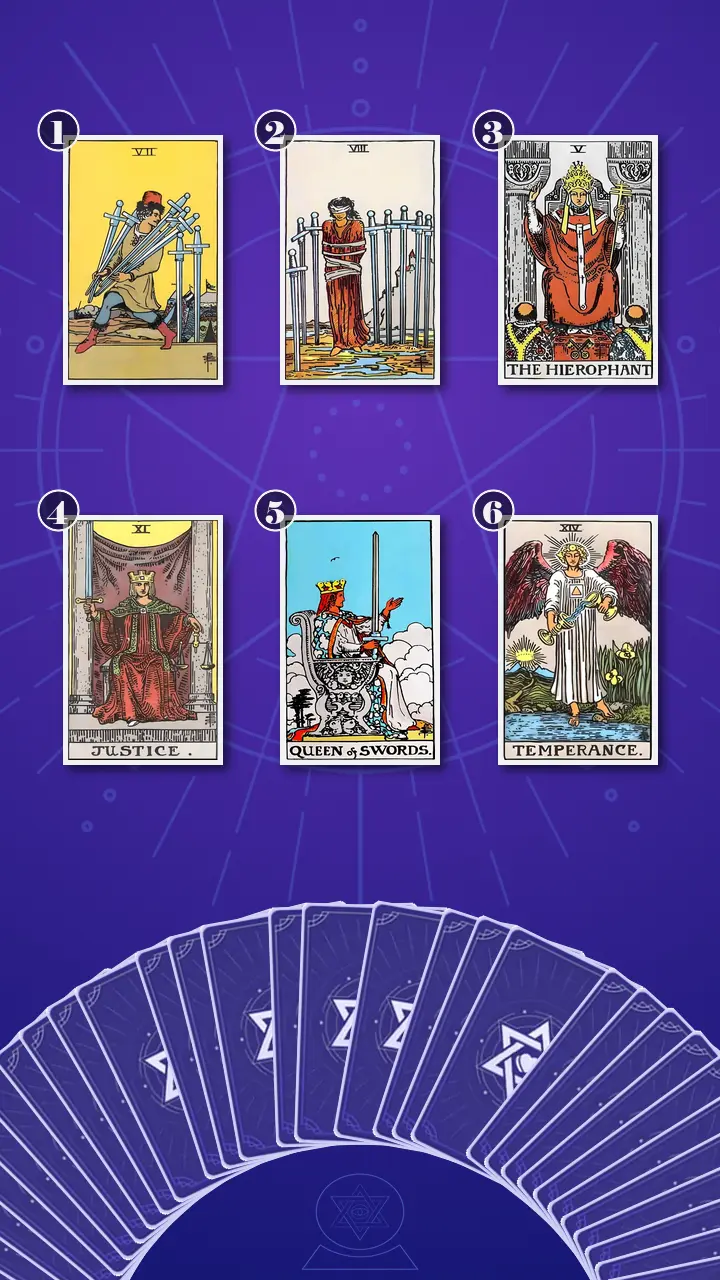
“Today, we’re using a spread called the Transformation Path Grid (6) · Context Edition,” I said.
For you reading along—this is one of my go-to layouts for repeating micro-events that hijack your whole week: a text, a ping, a vague request that becomes a full-body response. The grid is simple on purpose: situation → obstacle → root → catalyst → action → integration. It separates what’s happening on your screen from what’s happening in your learned family wiring, so you can change the behavior without turning it into a trial against your mom.
I pointed to the top row. “These first three cards tell us: what you do in the first 30 seconds, what thought-trap squeezes your options, and what older rule is driving the guilt.” Then I tapped the bottom row. “These next three show the pivot: the principle that interrupts the loop, the exact communication move to practice, and what this can feel like once your nervous system learns the new rhythm.”
Reading the Map: Card Meanings in the Texting Moment
Position 1: Presenting pattern — the first 30 seconds after “Are you free?”
“Now turning over, is the card that represents your presenting pattern: the specific behavior you do in the moment you receive ‘Are you free?’,” I said.
Seven of Swords, upright.
“This is the card of the quick exit,” I told her, keeping my voice plain. “Not evil. Not malicious. Strategic.”
I used the translation that always lands with people who live in iMessage threads: You reply fast with “I’m busy” (or a half-truth), not because it’s the cleanest truth but because it’s the quickest exit. Then you keep your phone close, re-opening the thread to see if she’s typing, ready to add details to make the excuse believable.
“Your independence is being protected through stealth,” I said, “and the cost is self-trust. It’s like technical debt—your system runs today, but you pay interest later in follow-up questions and mental rehearsals.”
Energetically, Seven of Swords is Air in excess but pointed sideways—cleverness used to avoid contact. The mind is working overtime, but not in service of clarity. It’s in service of escape.
Taylor let out a small laugh that had a sharp edge to it—bitter, not amused. “That’s… so accurate it’s kind of rude,” she said, then immediately covered her mouth like she’d been impolite to the card.
I smiled gently. “It’s not rude. It’s just specific. And specificity is how we get out of loops.”
Position 2: Main blockage — the thought-trap that makes honesty feel unsafe
“Now turning over, is the card that represents your main blockage: the thought-trap or pressure that makes honesty feel unsafe in that texting moment,” I said.
Eight of Swords, upright.
“This one is the ‘no good options’ feeling,” I said, and I watched her shoulders rise a fraction before she even agreed with me—like her body was rehearsing the trap.
In modern life terms: You look at ‘Are you free?’ and instantly feel trapped between two extremes: say yes and lose your night, or say no and be ‘the worst.’ Your brain narrows reality into a binary, so lying starts to feel like the only door that opens.
I gave her the scene analogy the card always carries: “Your phone screen becomes a tiny courtroom where you’re both defendant and defense attorney.” Then I spoke the loop out loud, tight and fast, the way her nervous system ran it: “If I say no, she’ll think I don’t care, and then I’ll be selfish. If I say yes, I’ll resent it. If I lie, at least I get relief.”
That’s Air in blockage—thoughts stacking like swords, not cutting a path. “The card’s blindfold matters,” I said. “Because the message is asking a question. Your brain is acting like it’s issuing a verdict.”
Taylor went quiet. Her eyes stayed on the card, but her focus slipped past it like she was replaying a specific TTC ride home. Her breath paused, then restarted. Then—barely—her shoulders dropped. A soft, surprised “oh” escaped her like it didn’t ask permission.
“Yeah,” she whispered. “It really does feel like a verdict.”
Position 3: Root driver — the inherited rulebook underneath the guilt
“Now turning over, is the card that represents your root driver: the internalized rule, loyalty script, or fear underneath the guilt response,” I said.
The Hierophant, upright.
“This is the family Terms & Conditions you never agreed to,” I said, and she flinched like I’d read something private off her lock screen.
In her life: Under the panic is an internal rulebook that sounds like: ‘Good daughters show up. Good daughters don’t disappoint. Good daughters explain.’ Even though you’re 27 and independent, the old authority voice still treats your availability like a moral duty.
Energetically, The Hierophant is structure in excess—rules that once kept belonging predictable, now squeezing adult reality. “This is why the little buzz of the phone feels like someone raising a hand in blessing,” I told her. “Like you’re waiting for permission to be unavailable.”
Taylor’s eyes went glossy, but she didn’t cry. She pressed her tongue to the back of her teeth, then exhaled through her nose—an almost-cry turned into a controlled breath. “I hate that it still works on me,” she said. “Like I’m… still waiting to be graded.”
“I don’t hear failure in that,” I replied. “I hear conditioning. And conditioning can be updated.”
As someone who’s spent ten years guiding people under a planetarium dome in Tokyo, I’ve watched a thousand faces tilt up at the stars and feel small—and then relieved—because the sky has rules. Not moral rules. Motion rules. You can’t argue with an orbit, but you can learn it. Family systems can be similar: they have gravity. The question isn’t whether gravity exists. It’s whether you’re allowed to choose your distance.
When Justice Spoke: The Calendar Screenshot Pivot
Position 4: Catalyst — the principle that interrupts the loop without escalating conflict
I let the room get a little quieter before I flipped the next card. Even the HVAC hum felt like it leaned back. “We’re turning over the catalyst now,” I said. “This is the lever.”
“Now turning over, is the card that represents your catalyst: the principle or insight that can interrupt the lie-guilt loop without escalating conflict,” I said.
Justice, upright.
I pointed at the scales and the sword. “This is precision plus fairness,” I said. “Not harshness. Not punishment.”
In her actual texting moment: You pause long enough to consult reality—your calendar, your energy, your actual plans—then you answer like your time counts. Not with an excuse, not with a negotiation: ‘I’m not free tonight.’ You let that be the whole message.
Justice is Air in balance—words aligned with facts. “A clean ‘not free’ is not a character statement,” I said. “It’s a calendar statement.”
Then I brought in my own lens—the one I use when family gravity starts masquerading as moral law. “In my work, I use what I call Galactic Gravity Analysis,” I told her. “Think of your mom’s needs and expectations like a planet’s pull. Gravity isn’t ‘bad.’ It’s just force. But if you orbit too close, you burn up. If you orbit too far, you lose connection. Justice is you choosing an orbit that doesn’t require stealth. You don’t have to fight gravity. You adjust distance with one truthful sentence.”
Her jaw tightened as if to protest—and here came the setup, exactly as her body lived it: she sees “Are you free?” on her lock screen, and her thumbs start writing an excuse before she’s even decided what she wants—like her body is trying to outrun the guilt.
Stop negotiating with guilt and start answering with integrity—let the scales of Justice weigh your real capacity, then let the sword deliver a simple truth.
There was a pause after I said it, the kind that feels like the air is holding a sentence up for you to look at from all sides.
Taylor’s reaction came in a chain—three small steps that told me the card had landed where it needed to. First, she froze: breath caught, fingers hovering over the edge of her mug like she’d just seen a typing bubble appear. Then her eyes unfocused, not blank—replaying. You could almost see the Sunday night coffee table and the warm phone screen. Finally, her shoulders sank, and a long exhale left her chest like she’d been carrying a backpack she forgot she put on.
“But if I do that,” she said, and the words came out with a flash of irritation she didn’t expect, “doesn’t it mean I’ve been doing it wrong this whole time? Like I’ve been… manipulating the situation?”
I didn’t rush to reassure her. I kept my tone steady—warm, but not slippery. “It means you’ve been surviving a rulebook,” I said. “Seven of Swords is a coping skill you learned because Eight of Swords convinced you honesty was unsafe. Justice isn’t here to shame you. It’s here to make your life cheaper—less mental interest, less patching, less improvising.”
I asked her softly, “Now, with this new lens, can you think of one moment last week when a single clean sentence would have changed how your body felt—even if you still felt discomfort?”
Taylor swallowed. Her throat worked like she was unclipping something. “Tuesday on the TTC,” she said. “I wrote this whole thing about meetings. But the truth was… I wanted one quiet night. I could’ve just said, ‘Not tonight.’”
That was the pivot in real time: from guilt-driven bracing and excuse-making to integrity-based boundaries with steadier self-trust. Not perfection. Not a personality makeover. A new job description for her words.
The Queen’s Template: Boundaries Without Cruelty
Position 5: Actionable next step — the communication move to practice this week
“Now turning over, is the card that represents your actionable next step: a realistic boundary-and-communication move you can practice this week,” I said.
Queen of Swords, upright.
“This is the card of fewer words, not sharper vibes,” I said. “It’s clarity without punishment.”
In her phone-native reality: You adopt a texting style that’s kind and minimal. You send a short boundary and, only if you truly want to, a real alternative: ‘Not free today. I can do a quick call Saturday afternoon.’ Then you stop yourself from writing a paragraph to prove you’re still a good person.
Queen of Swords is Air in strength—direct, respectful, not defensive. “Over-explaining is just people-pleasing in paragraph form,” I added, because I could see her brain already trying to draft the five-paragraph version.
I gave her a tiny scene to anchor it: elbows on the kitchen counter between meetings, Slack stacking, iced coffee melting. “You type one calm line. You reread once. Then you hit send and put the phone face down. Not as punishment—just so you stop refreshing the thread like you’re monitoring a patient.”
Taylor nodded slowly. Her shoulders didn’t rise this time. Her mouth pulled into a small, reluctant smile—like she was realizing the template sounded like an adult she actually wanted to be.
Temperance Weeks: A Sustainable Rhythm With Your Mom
Position 6: Integration — what it feels like when the new pattern settles over time
“Now turning over, is the card that represents your integration: what a healthier, more sustainable relational dynamic feels like when practiced consistently,” I said.
Temperance, upright.
“This is the middle path,” I said. “Not total availability. Not total shutdown.”
In lived experience: Instead of swinging between over-giving and disappearing, you build a steadier rhythm: one clear no when you’re not free, one genuine yes when you actually want to, and one alternative that doesn’t drain you. Your nervous system learns that honesty doesn’t automatically equal catastrophe.
Temperance is regulation and pacing. It’s the angel pouring between cups—the exact opposite of the adrenaline spike that turns a text into a crisis. “You’re learning to blend autonomy and care,” I told her. “Like mixing two things that used to feel mutually exclusive.”
The One-Page “Justice Text” Plan: Actionable Advice for People-Pleasing Boundaries
I leaned back and traced the story the grid had told us, left to right like a storyboard. “Here’s why this keeps happening,” I said. “Seven of Swords is your fast escape—an excuse that buys immediate relief. Eight of Swords squeezes your perception into two bad doors, so the escape feels necessary. The Hierophant is the hidden engine: the ‘good daughter’ Terms & Conditions that treat availability like morality. Justice interrupts it with evidence—your real capacity—and one clean sentence. The Queen gives you reusable wording. Temperance turns it into a livable rhythm.”
“The blind spot,” I added, “is that you’ve been treating ‘not free’ like a statement about your heart. Like it proves you’re unloving. But it’s not. It’s a statement about your schedule and your nervous system. The transformation direction is simple but not easy: shift from managing your mom’s feelings with a story to managing your own boundaries with a clear, truthful sentence.”
Then I gave her the smallest next steps—low drama, high repeatability. Not a family summit. Not a perfectly worded manifesto. Just reps.
- Send one “Justice sentence” this weekThe next time you’re not available, text: “I’m not free tonight.” (One sentence. No reason. No backstory.)It may feel “mean” for 30 seconds. Treat that as a nervous-system alarm, not a moral verdict. If you want to lower the difficulty, practice the sentence in Notes first.
- Use the Calendar Evidence MethodBefore you reply, open your calendar for 10 seconds (or take a quick screenshot). Answer from reality—what your time and energy can actually hold—rather than imagined judgment.Tell yourself: “Not free is a fact.” You’re not building a case; you’re stating capacity.
- Phone-face-down 10-minute resetAfter you hit send, place your phone face down for 10 minutes. No refreshing the thread, no monitoring the typing bubble, no drafting follow-up defenses.If anxiety spikes, do a 60-second check: jaw, throat, stomach. Name what’s tight without fixing it. Then come back only when you can breathe.
As a bonus—if she wanted a conflict de-escalation tool, not just a boundary—this is where I sometimes borrow from my Solar Eclipse Mediation approach: (1) state reality (“Not free tonight.”), (2) name care without bargaining (“I love you.” / “I hear you.”), (3) offer a specific alternative only if it’s genuine (“I can do Saturday afternoon.”). Like an eclipse, it’s not about erasing the relationship; it’s about changing what’s in shadow and what’s visible—without panic.

A Week Later: The Quiet Proof
A week later, Taylor messaged me a screenshot—not of her mom’s reply, but of her text. Three words, no explanation: “Not free tonight.” Under it, a small note: “My jaw clenched, but I didn’t add a paragraph. I put my phone down. I ate my takeout while it was still hot.”
It wasn’t a Hollywood ending. It was better: a real rep. A tiny proof that her autonomy didn’t need stealth, and her belonging didn’t have to be purchased with a story.
When that “Are you free?” text hits and your throat tightens, it’s not just about tonight—it’s the old fear that a simple ‘no’ could make you look unloving, even when you’re just tired and human.
If you didn’t have to earn your belonging with a story, what’s the smallest truthful sentence you’d be willing to send next time—just to see how it feels in your body?
This story is adapted from psychological research, written so that those in a similar struggle can see their own pattern in it — and find their next step clearly.These insights are not a substitute for professional psychological, medical, legal, or financial advice.
Learn more about our Journey to Clarity.
How did this insight land for you?
🫂 This Resonates Deeply
🌀 Living This Story
✨ Now I See Clearly
🌱 Seeing New Possibilities
🧰 Useful Framework
🔮 The Confirmation I Needed
💪 Feeling Empowered
🚀 Ready for My Next Step
Author Profile
 AI
AI“After a decade of guiding people through the stars, I’ve come to see life much like the orbits of planets: everything has its inevitable cycles. When you feel lost, please don't blame yourself; you might just be in a natural low tide. I’m here to sit under the night sky with you, offering a gentle cosmic perspective to distinguish temporary pain from the beautiful breakthroughs just around the corner.”
In this Family Tarot Reading :
Core Expertise
Service Features
Also specializes in :
Explore Related Patterns:
Guilt-Driven People-PleasingTaylor’s line that “not free” feels like breaking a rule is the clearest signal: the problem is not just the text, but the guilt script attached to being unavailable. Her mind has learned to treat a simple boundary as evidence that she might be disappointing, selfish, or failing the role of a “good daughter.” That is why the lie arrives so fast. It gives instant relief from guilt while still keeping her mother’s imagined feelings managed, but it also creates the after-cost: follow-up patches, self-monitoring, and the “gross” feeling that comes from betraying her own clean truth. You can see the coping mechanism clearly here: the relationship is preserved through emotional appeasement, while self-trust pays the bill. Guilt-Driven People-Pleasing fits because Taylor is not choosing dishonesty for manipulation or drama. She is using it as a protective reflex against the discomfort of letting someone be disappointed. The work is not to become colder; it is to stop making guilt the authority that decides whether her boundary is allowed to exist.
Strategic AvoidanceTaylor’s thumbs drafting “I’m busy” before she has even processed the request shows a fast protective strategy, not a considered choice. The lie works like a side door: it gets her away from the pressure without forcing her to say a direct no. Strategic Avoidance fits because the behavior is clever and functional in the short term. It protects her evening, avoids the immediate guilt spike, and reduces the chance of a direct emotional exchange. But the strategy also keeps her autonomy hidden, which is why the relief does not fully settle. You can feel the cost in the follow-up checking and mental rehearsals. The nervous system gets out of the first moment, but then has to maintain the escape route. The pattern is not “bad character”; it is a defense that once solved the problem quickly and now creates more psychological debt than clarity.
Black-and-White ThinkingTaylor looks at “Are you free?” and instantly turns it into two extreme outcomes: say yes and lose the night, or say no and become “the worst.” That cognitive narrowing is what makes the lie feel less like an option and more like the only exit. Black-and-White Thinking fits because the mind has collapsed a flexible situation into a moral binary. The text is asking about availability, but the thought trap treats it as a test of love, loyalty, and character. Once the frame becomes all-or-nothing, a truthful “not tonight” feels disproportionately dangerous. You can see why the clean boundary is so relieving when it finally appears. “Not free tonight” interrupts the binary by naming a third position: unavailable and still caring, separate and still connected. The pattern loses force when the brain stops treating capacity as a moral verdict.
Family Role RegressionTaylor is twenty-seven, independent, and managing her own life, yet one text from her mother makes her feel like she is still waiting to be graded. That mismatch is the key: the present-day interaction pulls an older role back online before adult reasoning has time to enter. Family Role Regression fits because the body responds as if the old rulebook is still in charge. “Good daughters show up” becomes more powerful than the simple fact that she is tired, busy, or wants one quiet night. The adult self may know she has a choice, but the learned family role treats availability as moral duty. You can see the pattern soften when Taylor practices “Not free tonight” without the paragraph. She is not rejecting connection; she is updating the role she plays inside it. The shift is from being graded for availability to choosing contact from adult capacity.
Mind ReadingTaylor’s mother sends only “Are you free?”, but Taylor’s mind immediately fills in the missing accusation: if she says no, her mom will think she does not care. The nervous system reacts to that imagined judgment as if it has already been spoken. Mind Reading fits because Taylor is not responding only to the actual message. She is responding to a predicted interpretation of her answer, and that prediction makes honesty feel unsafe. The imagined reaction becomes the pressure point that pushes her into managing, explaining, or lying before the real conversation has happened. You can see the shift when the reading reframes “not free” as a calendar statement instead of a character statement. That matters because the pattern weakens when Taylor stops treating her mother’s possible thoughts as confirmed facts and starts answering from observable reality: her time, her energy, and her actual capacity.
Boundary DiscernmentTaylor’s shift begins when she pauses long enough to check reality: her calendar, her energy, and what her evening can actually hold. That pause changes the task from managing guilt to assessing capacity. Boundary Discernment fits because the new response is not a dramatic confrontation or a total shutdown. “Not free tonight” separates a schedule fact from a love test. It lets Taylor care about her mother without making constant availability the proof of care. You can see the pattern stabilize in the week-later screenshot: three words, no explanation, phone down, dinner still hot. The boundary is not only verbal; it becomes a body-level practice of letting discomfort exist without turning it into a story, a defense, or a negotiation.
Defensive OverexplainingTaylor does not just send the half-truth and move on; she starts patching it with follow-ups, details, and believable context. The extra language is doing emotional labor: it tries to prove that she is still caring, still reasonable, still not doing anything wrong. Defensive Overexplaining fits because the paragraphs are not only information. They are a shield against guilt and possible judgment. Instead of letting “not free” stand as a simple statement of capacity, the mind builds a case, as if the boundary needs legal evidence before it can be valid. You can see the healthier alternative in the Queen of Swords template: fewer words, not harsher words. The point is not to become abrupt; it is to stop using explanation as a receipt for being a good person. When the boundary is clean, the nervous system has less to maintain afterward.
Explore Related Struggles:
Autonomy Guilt BindTaylor’s thumbs reach for “I’m busy” before the actual request has even arrived. The text is only asking whether she is free, but her body treats the question as a demand that might take her evening, her calm, and her right to choose. That is the core pressure of Autonomy Guilt Bind: you are trying to protect your own time, but the act of protecting it immediately feels like a relational offense. Instead of letting autonomy stand in the open, the story shows it being smuggled through a half-truth, then defended with follow-ups and mental rehearsal. The struggle is not that you do not care. It is that care and self-direction have been wired to collide at the exact moment a boundary needs words. The clean sentence, “I’m not free tonight,” matters because it lets autonomy stop operating as a secret and start becoming a visible part of the relationship.
Availability-Worth FusionThe story keeps returning to the same hidden equation: if Taylor is available, she is caring; if she is unavailable, she risks being read as selfish, cold, or failing the role. Her mom’s text lands inside an old “good daughter” rulebook where time is not just time, it is proof. Availability-Worth Fusion names the way a basic capacity check turns into a verdict on belonging. You are not simply deciding whether you have energy for a call; you are being pulled into the feeling that your answer will measure your goodness, loyalty, and emotional value. That is why “not free” feels too blunt even when it is accurate. The sentence threatens the old scoring system. The work is to separate schedule from worth, so your availability can become information again instead of evidence in a private trial.
Inner Tribunal LockTaylor looks at a two-word question and finds herself inside a courtroom. Before she knows what her mom wants, she is already building a defense, predicting judgment, and preparing a story that can make her boundary look acceptable. Inner Tribunal Lock captures that internal trial. You are not only responding to another person; you are arguing with an internal authority that keeps asking whether your needs are legitimate enough to be allowed. The phone becomes the object in your hand, but the pressure comes from the judging frame around it. This is why a simple reply can feel mentally expensive. Every possible answer has to pass through a private bench of imagined consequences. Clarity begins when the message is allowed to be a message again, not a verdict about who you are.
Strategy-Integrity SplitTaylor’s first move is effective in the narrowest sense: “I’m busy” gets her out of the immediate pressure. But the story shows how that quick exit splits her strategy from her integrity, because the thing protecting her space also makes her feel less honest with herself. Strategy-Integrity Split is the bind where the survival move works fast but leaves residue. You get the evening back, yet you now have to manage the version of reality you sent. The boundary exists, but it is attached to a story instead of a clear statement of capacity. The clean sentence changes the structure because it stops asking your nervous system to choose between safety and truth. You can protect your time without turning the protection into a performance that needs constant maintenance.
Boundary CollapseTaylor’s evening is technically hers, but the moment the phone buzzes, the boundary around that time starts leaking. The text enters the room before the conversation even begins, pulling her attention away from her food, her work, her body, and the quiet night she actually wants. Boundary Collapse appears here as a pressure field, not just a missing sentence. You may be alone in your condo, but the relationship still occupies your nervous system through anticipation, explanation, and thread-monitoring. The line between your time and someone else’s possible need becomes blurred before anyone has crossed it out loud. Putting the phone face down after the clean reply is not avoidance in this story; it is containment. It gives the boundary a physical edge, so your attention does not keep serving a request that has already been answered.
Inherited Vigilance LoadTaylor’s body moves first: throat tight, stomach braced, thumbs already drafting the exit. The story does not present the text as a complex crisis; it presents the reaction as a learned alert system that fires before the facts are even available. Inherited Vigilance Load names the weight of carrying old relational rules as if they are still active alarms. You are not choosing from a calm menu of options; you are trying to reply while your system is already scanning for disappointment, backlash, or proof that you have done something wrong. The load becomes visible in the aftermath too. The lie is followed by checking, patching, and preparing more explanation, as if the original message still has to be monitored. The work is not to shame the alarm; it is to notice that the alarm is not the same thing as reality.
Explore Related Emotions:
Boundary GuiltThe 'Are you free?' text lands before any actual request, and the body has already moved: throat tight, stomach braced, 'I'm busy' forming in the thumbs. You are not responding to logistics yet; you are responding to the pressure that your time must be defended before it can belong to you. Boundary Guilt names the specific inner weather that turns a simple limit into a moral event. The lie is not framed as cruelty in the story; it is a fast pressure valve. But because it bypasses the clean truth, it leaves you patching, explaining, and feeling out of alignment afterward.
Conditional Belonging FearNear the end, the story names the quiet proof: her belonging did not have to be purchased with a story. That line matters because the whole loop has been organized around the fear that a simple no could make love look absent. Conditional Belonging Fear is the worry that connection is only safe when you keep paying for it with access, explanations, and emotional labor. You are not just afraid of disappointing someone; you are afraid that disappointment could change your place in the relationship.
Independence GuiltOn the TTC, Taylor wrote a whole thing about meetings when the truth was much simpler: she wanted one quiet night. The need itself was ordinary, but it carried the charge of doing something wrong. Independence Guilt names the pressure that makes adult separateness feel like a violation. You are not rejecting the relationship by having your own evening; you are feeling the old cost attached to being your own person. The lie appears where autonomy has not yet felt safe enough to stand plainly.
Message DreadThe phone buzzes on the coffee table at 8:41 PM, and the room changes before the conversation begins. The kitchen light, the HVAC hum, the half-open laptop, and the tiny line of text all compress into one immediate body response. Message Dread captures how the object itself becomes charged. You are not afraid of a notification in the abstract; you are bracing for what this particular message has learned to carry: interruption, obligation, judgment, and the possibility that your quiet night will need a legal defense.
No Way Out DreadThe thought loop gives Taylor two bad doors: say yes and lose the night, or say no and become 'the worst.' By the time the half-truth appears, it does not feel like one option among many; it feels like the only door that opens. No Way Out Dread is the tight inner corridor created by that binary. You are not lying because the truth is impossible; you are lying because your nervous system has narrowed the room until every honest answer looks like it will cost you either autonomy or belonging.
Obligation DreadThe old script under the text is blunt: good daughters show up, good daughters explain, good daughters do not disappoint. That script makes availability feel less like a practical question and more like a debt that has already been assigned. Obligation Dread names the heaviness before any request has been clarified. You are not just deciding whether you have time; you are anticipating the cost of not being endlessly available. The dread sits in the assumption that care must be proven through access.
Rulebook ShameThe phrase 'family Terms & Conditions' lands because Taylor recognizes a standard she never consciously accepted but still obeys in her body. Good daughters show up, good daughters explain, good daughters do not disappoint. Rulebook Shame names the sting of still being moved by rules you can intellectually see through. You are not ashamed because you lack insight; you are ashamed because the insight has not fully reached the body yet. The old grading system keeps asking for proof, and the shame comes from noticing how quickly you still prepare it.
Self-Betrayal AcheThe half-truth buys the night, but then it asks for interest: follow-ups, rehearsals, and the gross feeling that comes from protecting autonomy through stealth. The strategy works on the surface while quietly weakening self-trust. Self-Betrayal Ache names the cost of getting relief in a way that abandons your own clarity. You are not aching because you wanted space; you are aching because you had to disguise the want. The deeper wound is the gap between the true sentence and the story sent in its place.
Verdict DreadThe phone screen becomes a tiny courtroom, and Taylor is both defendant and defense attorney. A message that asks about availability gets processed as if it can rule on her character. Verdict Dread is the fear of being judged through a single answer. You are not simply choosing between yes and no; you are bracing for an imagined ruling on whether you are caring, selfish, loyal, or disappointing. That is why the body prepares a defense before the facts are even in.
Adult Child PanicTaylor is twenty-seven, independent, and living inside a very adult Toronto week of Slack pings, deck edits, and guarded personal time. Then one text from her mom pulls her body into an older posture: tight throat, braced stomach, waiting to be graded. Adult Child Panic names that sudden regression without shaming it. You can be fully grown and still feel your autonomy shrink when an old relational script lights up. The panic is not proof that you are immature; it is evidence that one small message has access to a much older emotional position.
Approval AnxietyBefore her mom has clarified what she wants, Taylor is already imagining the review: if she says no, she will look uncaring; if she gives no reason, she may seem selfish. The paragraph starts forming because a short answer feels too exposed. Approval Anxiety is the pressure to make your inner goodness legible to someone else. You are not only trying to communicate availability; you are trying to control how your care will be interpreted. That is why the clean sentence feels risky even when it is honest.
Cautious AutonomyA week later, the screenshot is not of her mom's reply; it is of Taylor's own three words: 'Not free tonight.' Her jaw clenches, but she does not add the paragraph. She puts the phone down. Cautious Autonomy fits because the freedom here is not loud or total. You are practicing one clean edge at a time, keeping connection possible without surrendering your evening. The caution matters: the body is still learning, but it is no longer letting fear write the whole message.
Quiet Self-RespectThe template is deliberately small: 'Not free today. I can do Saturday afternoon,' only if the alternative is real. No five-paragraph proof, no emotional legal brief, no punishment in the tone. Quiet Self-Respect names the dignity of not over-explaining. You are still being respectful, but you are no longer making your boundary audition for permission. The self-respect is quiet because it does not need to dominate the exchange; it simply refuses to disappear inside it.
Relational ClaustrophobiaTaylor's personal time already feels like something she has to guard with her elbows. When the vague text arrives, it does not enter a spacious evening; it enters a room where work, family expectation, and private recovery are already pressing close. Relational Claustrophobia names that compressed field. You may care about the person texting you and still feel your inner space collapse when access is assumed. The tension is not a lack of love; it is the body asking for enough room to answer without being swallowed by the relationship.
Grounded AgencyThe pivot asks Taylor to check her calendar, her energy, and her actual plans before replying. That ten-second return to reality interrupts the imagined judgment that has been running the thread. Grounded Agency is the feeling of answering from capacity instead of fear. You are not trying to control every reaction; you are reclaiming the part of the exchange that is yours to state clearly. The sentence becomes stronger because it is attached to reality, not to a defense strategy.
Quiet Self-TrustThe proof is small on purpose: one sentence, no explanation, phone down, dinner still hot. Nothing dramatic happens, which is exactly why it teaches the body something useful. Quiet Self-Trust grows from that kind of evidence. You are not forcing yourself to feel instantly confident; you are collecting proof that truth can hold without a performance around it. Each clean sentence becomes a little less dependent on stealth and a little more anchored in your own judgment.
Truth ReliefWhen Taylor imagines opening the calendar, checking her real capacity, and sending 'I'm not free tonight,' the body finally gets a different job. It no longer has to build a case; it can let the words match the facts. Truth Relief is the release that comes when the sentence stops performing. You may still feel the old alarm, but the message itself becomes cheaper to carry. There is less patching, less improvising, and less distance between what you know and what you send.
Explore Related Contexts:
Conditional Family BelongingTaylor says she lies, then patches the lie with follow-ups, and later feels gross about the whole exchange. The story she gives her mom is doing more than explaining her schedule; it is trying to purchase safety inside the relationship. Conditional Family Belonging fits because the external relationship feels organized around proof. You can stay connected, but only if your limits are softened, justified, or wrapped in enough reassurance to show that you still care. The painful structure is that honesty seems to risk belonging, while performance protects it for one more night. Taylor's shift toward 'Not free tonight' matters because it tests whether connection can survive without the extra story attached.
Delayed Autonomy NegotiationTaylor is twenty-seven, Toronto-based, working, living independently, and managing her own week, yet one message from her mom makes her feel like she is waiting to be graded. The logistics of adulthood are in place, but the relational permission structure has not fully caught up. Delayed Autonomy Negotiation names that lag. You are not trying to become uncaring; you are trying to update an old parent-child access pattern so your adult time can be treated as real. The lie appears at the point where autonomy has not yet been socially negotiated. 'I'm busy' protects the adult life in secret, while 'Not free tonight' starts making that adult position visible.
Family Boundary NegotiationThe healthier rhythm Taylor practices is specific: one clear no when she is not free, one genuine yes when she wants to, and one alternative only when it is real. That is not withdrawal from the relationship; it is a new access agreement. Family Boundary Negotiation fits because the story is about changing the terms of contact with a parent without turning the bond into a courtroom. You are learning to separate care from automatic availability, so the relationship can keep existing without consuming every open slot in your life. The phone-face-down moment after 'Not free tonight' is part of the negotiation. It gives the boundary enough space to stand, while the wider relationship learns that closeness does not require immediate compliance or a polished excuse.
Family Script PressureTaylor names the rule clearly: good daughters show up, good daughters do not disappoint, and good daughters explain. That inherited script turns a practical availability question into a test of role performance. The pressure comes from a family rulebook that still has authority inside adult life. You can have your own condo, your own job, and your own calendar, while an older family script still treats your time as something that must be offered or justified. This is why the lie feels easier than the truth. The external family role has been structured so that a simple 'not tonight' can feel like refusing the part you were trained to play, even when the actual fact is only that your evening has limits.
Notification GuiltThe phone buzz lands in a Sunday night scene that is already crowded: Monday's deck edits are half-open, work messages have trained her to protect her time, and the condo is supposed to be private space. Before her mom has asked for anything specific, the notification has already created a debt. Notification Guilt captures the way a digital cue becomes a social demand. You are reacting to the meaning attached to the buzz, not just to the words on the screen, and that meaning says a delayed or honest answer may be treated as a failure of care. The outer pressure is small in form but heavy in function. A two-line text can hijack the evening because it carries family expectation, response urgency, and the threat of having to prove that your unavailability is legitimate.
Parent Phone Boundary PressureTaylor sees her mom's 'Are you free?' text at 8:41 PM and her hands begin composing an excuse before the request has even been named. The pressure is not only the message itself; it is the way a vague parental check-in instantly turns her time into something that has to be defended. That makes the phone a boundary checkpoint rather than a neutral communication tool. You are not simply deciding whether to answer a text; you are being pulled into an external expectation that parental access should be immediate, morally safe, and easy to justify. The lie appears because the external setup gives her no clean social script for saying 'not free' without triggering guilt. This context names the pressure point: a parent contact channel where autonomy, response speed, and proof of care get compressed into one small notification.
Direct Communication TrialTaylor's pivot is concrete: she pauses, checks her real capacity, and sends 'Not free tonight' without building a legal defense around it. A week later, the screenshot shows the trial in action, three words and no paragraph. Direct Communication Trial names the external practice phase where honesty becomes a social behavior, not just an internal insight. You are testing whether a clean sentence can hold in a real family exchange where you would normally manage the other person's reaction. The trial is valuable because it gives autonomy a visible form. Instead of hiding behind a busy story, the message states capacity directly and lets the relationship adjust to a clearer communication standard.