From Editing a Family Message Six Times to Holding a Steady Boundary

The Sixth Edit at 10:45 p.m.
I said it plainly: “You can run a cross-functional project meeting in London without blinking, but one ‘Have you really thought this through?’ in the family WhatsApp chat sends you straight into family role regression.”
Alex, a 31-year-old non-binary operations project manager, gave me a tired half-smile from the other side of our video consultation. They were sitting at the kitchen table in their small London flat. Through my headphones, I could hear the radiator ticking; beside their laptop, a mug of tea had gone cold, and the white light from their phone sharpened every shadow on the table.
It was 10:45 p.m. Alex showed me the family message they had edited six times. I watched them delete “I have decided” and replace it with “I was thinking maybe.” Beneath that, they had added three paragraphs of context and the familiar escape hatch: “But I’m happy to do whatever everyone thinks is best.”
“I know how to run a meeting until the meeting is with my family,” they said. “The second they question me, I start presenting evidence for my right to have an opinion. I don’t want to control everyone, but I also can’t keep disappearing from the decision.”
I could see the physical cost before Alex named it. Each imagined objection seemed to pull an invisible drawstring from their throat across their chest and shoulders, shortening the next breath before anyone had actually disagreed. Their resentment came later, usually after someone else had taken over and the immediate tension had dropped.
“Nothing about that reaction means your professional competence has vanished,” I told them. “It means an old family role is interrupting your access to it. I’m not going to use tarot to predict who will win the argument or tell you what your family secretly intends. Let’s use it as an objective reflection tool and draw a map through the fog: what activates the pattern, what keeps it going, and what you can do differently while remaining collaborative.”

Choosing a Map for the Family Table
I invited Alex to put both feet on the floor, take one ordinary breath, and hold a single question in mind: “How do I lead family decisions without becoming the child again?” I shuffled slowly. The pause was not a mystical performance; it gave their attention somewhere concrete to land before we examined a highly charged pattern.
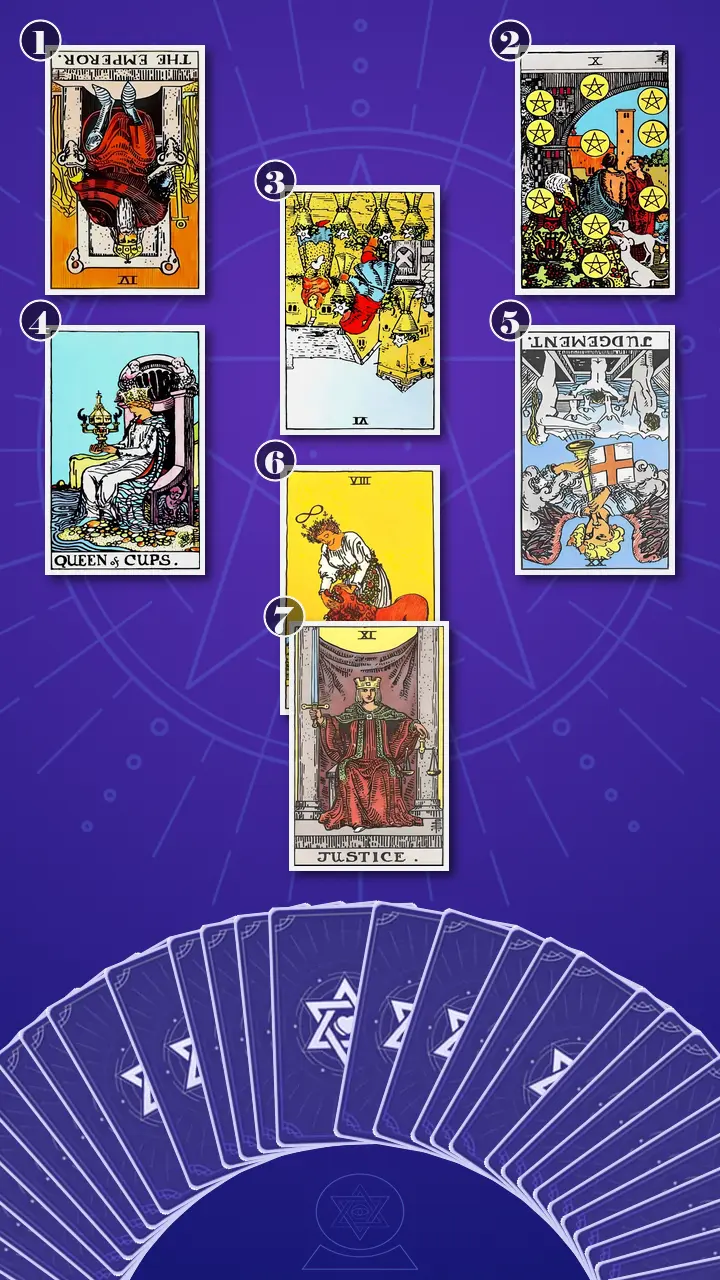
I chose the seven-card Relationship Spread · Context Edition. For anyone wondering how tarot works in a family-dynamics consultation, this spread keeps the card meanings in context. It does not treat the problem as an isolated confidence issue. It examines Alex’s stance, the family system meeting that stance, the shared history beneath both, the relationship’s genuine resource, the central obstacle, the practice that can interrupt the cycle, and the adult process that could emerge from integration.
A Celtic Cross would have added predictive and environmental layers we did not need. This smaller relationship tarot spread was precise enough to follow one coherent chain: present interaction, historical root, available strength, blockage, guidance, and accountable next steps.
I explained the three positions that would matter most. The first would show why Alex’s leadership kept swinging between control and surrender. The third would identify the childhood role being reactivated. The sixth, our key card, would show what Alex could practise in the exact five seconds after a relative challenged them. The seventh would translate that practice into a fair decision process rather than a promise about the future.
Where Adult Authority Starts to Wobble
Position One: A Throne Built Like a Bunker
I turned over the card representing Alex’s current stance in family decision-making, especially the shift between overcontrol, overexplaining, and surrendering the lead. It was The Emperor, reversed.
I pointed to the rigid stone throne, the ram heads, and the armour hidden beneath the red robe. Upright, the Emperor can organise responsibility and hold structure. Reversed here, authority was blocked. Its energy swung between excess and deficiency: Alex overbuilt the structure to protect themselves, then abandoned that structure as soon as approval was withheld.
I connected the card to the scene Alex knew well. They joined an evening family call with a polished schedule, a cost breakdown, and answers to every predicted objection. An older relative interrupted. Alex repeated the plan in a harder meeting-chair voice, heard the tension, and abruptly offered to scrap the whole proposal. Their internal equation was painfully efficient: “If I prepare every answer, they cannot reduce me. If I sound too firm, they will call me difficult.”
“The issue isn’t that you lack authority,” I said. “It’s that you’re trying to secure authority from their reaction. That creates two unstable settings: locked for editing or anyone can overwrite. Neither setting lets you calmly occupy the responsibility that is already yours.”
Alex let out a short laugh, but there was no amusement in it. Their mouth tightened before they said, “That’s so accurate it’s almost cruel. I thought the detailed agenda was the grown-up part.”
“The agenda is not the problem,” I replied. “The problem begins when preparation becomes armour against every possible reaction. Structure should help you make the decision clearer, not make disagreement impossible.”
I asked Alex to identify one responsibility that was genuinely theirs and one detail that was genuinely open to input. They answered slowly: “I can coordinate the booking. The date is shared.” That was already more stable than either a courtroom defence or an apology.
Position Two: The Operating System Already in the Room
I turned over the card representing the family system as the other party, including inherited expectations, shared resources, informal hierarchy, and the established response to Alex’s attempts to lead. It was the Ten of Pentacles, upright.
The card showed several generations beneath one archway, with ten pentacles distributed across the whole scene. Its earth energy was stable and potentially supportive. Family continuity, shared money, practical care, and long memory can all be real resources. Yet that same stability becomes excessive when precedent silently substitutes for discussion.
I described the modern version I could see in Alex’s story. Before they typed a word in WhatsApp, an inherited operating system was already running: the senior voice was expected to approve, the reliable person absorbed unowned tasks, and shared costs made familiarity feel like authority. Alex’s updated adult role entered the conversation as a proposal, while older roles entered as defaults.
This was where I used my Family Power Dynamic Decoding lens. I did not use it to assign villainous motives or assume that every relative was consciously trying to control Alex. I used it to audit structure: Who controls money, accommodation, transport, information, or access? Who performs the work? Whose opinion becomes final without that authority ever being discussed? Does practical support remain support when Alex disagrees, or does it become conditional?
The card could not prove that anyone was weaponising a resource. It did show Alex where to look for leverage instead of reducing the whole problem to tone. In this decision, the loudest senior voice carried informal rank, while Alex carried most of the organising work. Those were different forms of power, but only one was being acknowledged.
“This is a bit like Succession with lower stakes and more train bookings,” Alex said, smiling properly for the first time.
“Much lower stakes,” I said, “and with an important difference: we’re not writing anyone as a fixed character. We’re making the invisible job descriptions visible.”
I asked who had been treated as the final voice in the last shared decision, who had done the actual organising, and whether either role had been named aloud. Alex looked away from the screen for a moment. “No,” they said. “We act like it’s collaborative, but everyone knows who can end the conversation.”
I told them, “Competence does not vanish around family; access to it gets interrupted by an old role.” The next card would show us how quickly that interruption occurred.
Position Three: When the Adult System Boots into Legacy Mode
I turned over the card representing the shared historical foundation, specifically the childhood role that kept being reactivated inside present-day decisions. It was the Six of Cups, reversed.
I centred the two unequal child figures, the flower-filled cups, and the enclosed courtyard. Upright, the Six of Cups can hold memory, familiarity, and tenderness. Reversed here, that current was blocked and flowing backward. A present question was being auto-filled with an older meaning before Alex had time to evaluate it.
I brought Alex back to a Sunday afternoon in the family dining room. They had described the smell of roast potatoes lingering after lunch and the tap of cutlery against plates while a spreadsheet waited open beside them. A relative had said, “Let’s wait until someone has checked it properly.” Alex’s stomach dropped. Their shoulders contracted, their voice became quieter, and they closed the spreadsheet before anyone had actually examined it.
“I knew what I was doing,” Alex said. Their fingers tightened around the cold mug. “So why did I suddenly feel like I needed permission?”
“Because your body answered the history of the tone before your adult mind answered the present sentence,” I said. “It’s like the family system opened an outdated contact profile: ‘Alex, age sixteen,’ even though Alex, age thirty-one, was still sitting at the table with the relevant information.”
The card did not ask Alex to erase childhood memories or deny that the family bond contained genuine care. It asked them to stop letting memory chair the current meeting. The practical distinction was small but decisive: answer the question that was asked, not the entire historical accusation their nervous system supplied.
I asked, “What exact phrase or tone makes you feel younger, and what do you stop doing immediately afterward?”
Alex’s breathing paused. Their eyes lost focus as if they were replaying the dining room, then their grip loosened around the mug. “It’s ‘Let’s have someone check that,’” they said. “I stop explaining the actual criteria. I start explaining why I’m allowed to be involved at all.”
That recognition carried some grief. Alex had not imagined the bodily shift, and they had not chosen it. But recognition gave them a point of intervention: feet on the floor, one complete breath, and an answer to the present question only.
Position Four: The Queen Who Sits Beside the Water
I turned over the card representing the relationship’s principal strength, a resource Alex could use without becoming compliant. It was the Queen of Cups, upright.
I showed Alex the Queen studying her ornate cup while sitting beside moving water with her throne and feet on solid land. Her water energy was balanced. She could remain emotionally receptive without entering every current that passed beside her.
In Alex’s life, this looked like hearing a relative’s anxiety about cost and reflecting it accurately: “You want to know the maximum amount before we commit.” Alex could then return to the agreed criterion and confirm what they could cover. Care remained present, but it did not automatically rewrite the plan.
“You are good at understanding what people feel,” I said. “The difficulty is that you often convert understanding into responsibility for removing the feeling. That turns empathy into an instruction to make sure nobody stays disappointed.”
Alex nodded once, then stopped. Their expression held recognition and resistance at the same time. “If I understand why they’re upset, it feels harsh not to fix it.”
“You can understand their reaction without making it your instruction,” I replied. “Acknowledging concern is relational. Absorbing every consequence is optional. Calmness also does not require you to tolerate disrespect; you can name the wording, pause the conversation, or leave it when necessary.”
I asked Alex to imagine saying one sentence of understanding and one sentence of position. They tried: “I hear that the cost feels uncertain. I’m still only able to contribute this amount.” Their voice was quiet, but it did not shrink at the end.
Position Five: The Notification That Became a Verdict
I turned over the card representing the central obstacle, the point where disagreement became a judgement on Alex’s competence and belonging. It was Judgement, reversed.
The trumpet, raised figures, and narrow coffins usually describe awakening and honest review. Reversed, that air energy was blocked by excessive self-evaluation. Alex heard the call to leave an outdated identity, but every family response became another trial of whether they were entitled to stand up.
I pictured the scene Alex had described on the Victoria line after a difficult call. The carriage smelled of damp coats, the rails shrieked through a curve, and their phone felt hot in their palm. They reread one relative’s single-word reply, “Fine,” until the practical question disappeared beneath a false escalation: “They questioned the cost, therefore they question my judgement, therefore I may not belong if I proceed.”
Looking at the trumpet, I had a restrained flashback to my years on Wall Street. A red risk alert on a trading screen demanded examination, but it was not automatically a liquidation order or a verdict on the trader’s entire worth. Useful judgement separates a signal from the catastrophic meaning fear attaches to it.
“Your family chat has become an algorithm trained on disapproval,” I told Alex. “It promotes the one critical message and hides the five neutral ones. Then you postpone the next action while privately trying to prove you are still a good family member.”
The energy of Judgement was not asking Alex to ignore criticism. It was asking them to review it at the correct scale. I gave them three headings: fact, interpretation, next action. The fact might be, “Sam asked whether the quote includes transport.” The interpretation might be, “Sam thinks I’m incapable.” A neutral alternative might be, “Sam needs a cost detail.” The next action could then answer the fact.
Alex exhaled and rubbed one hand across their chest. “I can see how often I turn feedback into a performance review for my entire identity,” they said.
“Exactly,” I replied. “And when the review is that large, no amount of evidence can close it. Unanimous approval is not proof of adult authority.”
When Strength Let the Silence Stand
Position Six: Calm Hands, Clear Boundary
The radiator on Alex’s side had stopped ticking. For a few seconds, the laptop fan and a distant car on wet pavement were the only sounds I could hear. I turned over the card representing the key practice that could interrupt the old cycle and help Alex remain regulated while exercising adult authority.
It was Strength, upright, the key card and catalyst of the reading.
I pointed to the woman’s calm hands resting on the lion’s jaws, the flower garland linking softness with power, and the infinity symbol above her head. Strength was balanced fire: courage made usable through regulation. It did not silence intensity, submit to it, or pretend it was harmless. It remained in contact with power without using force.
I translated the image into a family video call. A relative preferred Sunday. Alex noticed heat rising into their face, let the person finish, placed both feet on the floor, and slowed the next sentence: “I hear that you prefer Sunday. I can coordinate Saturday; if the date changes, someone else will need to own the booking.” Then Alex allowed the silence to exist without apologising, escalating, or filling it with another dossier.
I brought us back to 10:45 p.m., the cold tea, and the message edited six times. Every softer sentence had promised safety, yet each edit made Alex’s actual decision harder to find. They were still trying to solve disagreement before permitting themselves to speak.
Adult authority is not proved by winning agreement; it is practised when disagreement can stay in the room without making you abandon yourself.
I let the sentence settle before giving Alex the card’s central message.
You do not have to become controlling or compliant to be taken seriously; meet the family's intensity with steady boundaries, as Strength meets the lion without using force.
I watched Alex’s breath stop. Their fingers froze above the phone, and their pupils widened slightly before their gaze moved beyond the screen, as though the last family call were replaying somewhere behind it. Then their jaw unclenched. Their shoulders dropped a fraction, and a long breath left their chest with a faint tremor. Relief did not arrive cleanly; I could also see the disorientation of setting down a burden that had doubled as protection. Their eyes reddened, and their first response carried more anger than ease. “But doesn’t that mean all that preparation and apologising was wrong? Like I’ve wasted years doing this badly?” I told them those strategies had reduced immediate tension when they needed protection, but they no longer had to run every adult conversation. Then I asked, “Now, with this new perspective, think back: was there a moment last week when this insight could have made you feel different?”
Alex looked down at the two versions of their message. “When my aunt asked if I’d checked the costs,” they said. “I could have answered with the figure. I didn’t need to prove I was a responsible person before giving her the number.”
“That’s the threshold,” I said. “Not perfect confidence, and not a family that never challenges you. It’s the movement from anticipatory anxiety and approval-seeking regression to calm, criteria-based adult leadership during disagreement. The first evidence is one present-tense answer.”
This was also where I used my Guilt-Debt Neutralization lens, a piece of language shaped by my former life in finance. Alex’s nervous system had booked an unverified liability: “If a relative is disappointed, I owe more explanation, more labour, or eventual surrender.” I asked what had actually been agreed, what responsibility Alex truly owned, and which charge had been generated by an old tone rather than a current commitment.
I explained that psychological bad debt can feel urgent without being valid. Alex did owe honesty about the booking, respectful consideration of relevant input, and follow-through on the work they accepted. They did not automatically owe unlimited access to their time, unanimous emotional comfort, or the abandonment of a sustainable boundary. Dismissing an invalid guilt-debt did not mean dismissing the people involved. It meant refusing to treat emotional pressure as proof of a contract.
I then set a ten-minute timer and asked Alex to draft two lines for the current decision: “The input I am inviting is...” and “The responsibility or boundary I can hold is...” They read each line once with both feet on the floor, shortened each to one sentence, and stopped before sending anything. The exercise was rehearsal, not an obligation to act before they were ready.
“Say it once, then let the silence belong to the room,” I told them.
The Scales Waiting Beyond the Lion
Position Seven: Fairness With a Closing Point
I turned over the final card, representing a non-predictive model of integrated leadership: a fair decision process with explicit criteria, accountability, and sustainable boundaries. It was Justice, upright.
I drew Alex’s attention to the balanced scales, the upright sword, the squared posture, and the pillars. Justice brought air into balance. The scales showed that relevant input deserved genuine consideration; the sword showed that consideration eventually had to become a decision, boundary, assignment, or honest acknowledgement that no shared agreement existed.
I translated the card into a one-page note in Notion, Google Docs, or Apple Notes. Alex would list the decision, three criteria, an input deadline, and an owner for every task. They could send one concise WhatsApp message: “Please flag any relevant information I have missed by Wednesday at 6 p.m.” After that point, they could incorporate new facts and record the outcome without reopening the whole issue simply because someone remained unhappy.
This was balanced rather than excessive Justice. It did not give Alex authority over decisions that genuinely belonged to the whole family. It clarified the consequences Alex could control: whether they would coordinate, fund, book, attend, or decline. If no agreement existed on a shared matter, Justice required Alex to name that accurately rather than manufacture authority.
“Fair input does not require endless reopening,” I said. “You can consider what is relevant without running the decision again until nobody is disappointed.”
Alex studied the scales and then glanced at their six-times-edited message. “At work, I’d never confuse stakeholder input with everyone having permanent veto power,” they said.
“Exactly. Strength keeps you present through the reaction. Justice decides which information belongs in the process. Regulation first, structure second.”
I made the boundary around tarot explicit. Justice was not predicting that the family would suddenly become orderly or approve Alex’s next decision. It showed a repeatable standard Alex could choose to practise. The cards had organised the pattern; Alex would decide what responsibilities to accept, what input was relevant, and what limits they could maintain.
The Strength-to-Justice Decision Path
I gathered the seven cards into one coherent story. The Ten of Pentacles and Six of Cups reversed showed the historical operating system: shared resources, familiar hierarchy, and a childhood profile that could overwrite Alex’s adult position. The Emperor reversed showed what happened next: Alex tried to compensate with an armoured plan, then surrendered when the armour failed to prevent disagreement. The Queen of Cups revealed the real resource beneath the struggle, an ability to listen with care. Judgement reversed exposed the choke point, where one comment became a verdict on competence and belonging. Strength restored regulated authority, and Justice converted that authority into criteria, ownership, and closure.
The cognitive blind spot was now visible: Alex had been treating family comfort as evidence that a process was fair, and family discomfort as evidence that their leadership was illegitimate. That made unanimous approval look like collaboration. It also made overexplaining feel responsible, even when the explanation erased their actual position.
The direction of change was not from softness to hardness or from family loyalty to isolation. It was from proving authority through universal approval to naming the criteria, inviting input once, and stating the responsibility or boundary Alex could uphold. Another person could disagree without automatically becoming correct, cruel, or responsible for Alex’s identity.
I organised the actionable advice through The Strategic Disengagement Plan. By disengagement, I did not mean dramatic estrangement or punishing silence. I meant stepping out of the specific regression loop that gave the family conversation unnecessary leverage: repeated explanations, side-channel approval seeking, automatic task absorption, and consequences Alex could not control.
We identified the leverage points without exaggerating them. Shared costs could blur who had decision rights. Alex’s organising skill made them the default owner of abandoned tasks. A senior relative’s confidence could be mistaken for formal authority. The plan was to reduce those openings with one invitation for relevant input, one clarification when needed, explicit task ownership, and a boundary linked only to Alex’s own money, time, attendance, or labour.
- Write the Two-Line Authority Note Before the next family call, Alex will open the Notes app and write two lines of fewer than 20 words: “I am responsible for...” and “The part open to input is...” At the start of the call, they will state both once. If challenged, they will place both feet on the floor, exhale, and answer: “I hear the concern about X; the criterion I am using is Y.” Keep an energy budget of one opening explanation and one clarification unless genuinely new information appears. After the boundary, allow five seconds of silence. If the body reaction becomes too strong, use: “I want to think about that and come back tomorrow.”
- Build the Four-Heading Justice Note For the current booking decision, Alex will spend ten minutes creating one page with four headings: decision, criteria, input deadline, and owner. They will use three criteria, send one concise WhatsApp request for missing information, and post the outcome when the response point passes. Any unassigned task will be marked “owner needed” instead of silently becoming theirs. Respond to relevant facts, not message volume or family seniority. Name only consequences Alex controls, such as whether they will book, pay, attend, coordinate, or decline. If the decision is genuinely shared and agreement does not exist, state that plainly.
I asked Alex to choose the smallest version, not the most impressive one. They chose the two-line note. It required less than three minutes and targeted the exact moment when their adult footing usually disappeared.

A Week Later, One Clear Sentence
Six days later, Alex sent me a brief update. During the next call, an older relative objected to the proposed Saturday booking and asked whether Sunday would be easier. Alex felt the familiar heat rise into their face. They put both feet on the floor and said, “I can coordinate Saturday. If the date changes, someone else will need to own the booking.”
They waited through the silence.
The family did not respond with unanimous approval. One person sighed. Another asked a relevant question about transport. Someone else agreed to take the booking if Sunday was chosen. Alex answered the transport question, recorded the new owner, and did not apologise for having a limit.
That night, Alex slept through until morning. Their first thought was still, “What if I handled it wrong?” They told me they smiled, made coffee, and did not reopen WhatsApp to seek a verdict.
I did not treat that as a magically resolved family pattern. I treated it as evidence. The throat had tightened, disagreement had remained in the room, and Alex had stayed present long enough to act from their current responsibility. The change was imperfect, repeatable, and theirs.
The seven-card Relationship Spread · Context Edition had provided a clear model for family power dynamics, boundaries, and adult leadership. It had not granted Alex authority or guaranteed a peaceful outcome. Tarot had functioned as a structured mirror, helping them separate inherited roles from present facts. Alex supplied the courage, the sentence, and the five seconds of silence.
I know that when one familiar family tone tightens your throat and makes a carefully considered position disappear, the deepest fear may not be disagreement itself. It may be that standing your ground could cost you your place in the family. Simply recognising that hidden price means the old family profile is no longer running unnoticed.
So, the next time the family chat opens “you, age sixteen” instead of the adult you are now, what is the one clear sentence you might allow yourself to say if unanimous approval were no longer the price of remaining in the room?