When "Whatever Works" Means Waiting: Making One Preference Visible

The Family Chat With No Safe First Reply
You can make a time-sensitive call for colleagues before lunch, but when a parent asks, 'What do you think?', your throat tightens and decision paralysis suddenly looks like being considerate, I told Maya.
She had described the scene to me in exact detail. At 9:40 p.m. on a Tuesday in her Toronto condo kitchen, she opened the family WhatsApp chat for the fourth time. The kettle clicked off behind her. Her phone felt warm against her palm as she typed a Saturday proposal, deleted it, checked the online dot beside her parent's name, and finally sent, Whatever works for everyone.
At work, Maya could choose under uncertainty. As a project coordinator at a Toronto nonprofit, she managed competing timelines, stakeholder requests, and last-minute changes without waiting for someone else to claim the decision. At home, uncertainty became a reason to wait. She would read the messages, hold back her preference, and then offer to book the reservation or organise the calendar after a parent had chosen the direction.
'I know what I think,' she said. 'I just want to hear what my parent says first. It feels easier to organise the plan than to be the person who chooses it. Why do I become twelve years old the moment everyone looks at me for an answer?'
I could see the apprehension in the physical pause she had described: a throat narrowed to a small doorway, a breath held behind it, the whole body briefly going still as if a family date poll had become a tribunal. Guilt pressed against one side of the silence, resentment against the other, while underneath both was a longing for reassurance.
'The pause makes sense,' I told her. 'It has protected connection before; it just no longer gets to make every decision. We do not need to turn your family into an enemy or force a dramatic confrontation. Let us use the cards as a map for this adult-child role lock, and see whether one clear preference can exist alongside closeness. That is our Journey to Clarity today.'

A Compass for Family Authority
I asked Maya to place her phone face down, take one ordinary breath, and name the question without trying to solve it. I shuffled slowly. For me, this was not a supernatural test or a request for the cards to issue a verdict. It was a transition from the speed of the group chat to a more deliberate way of noticing patterns.
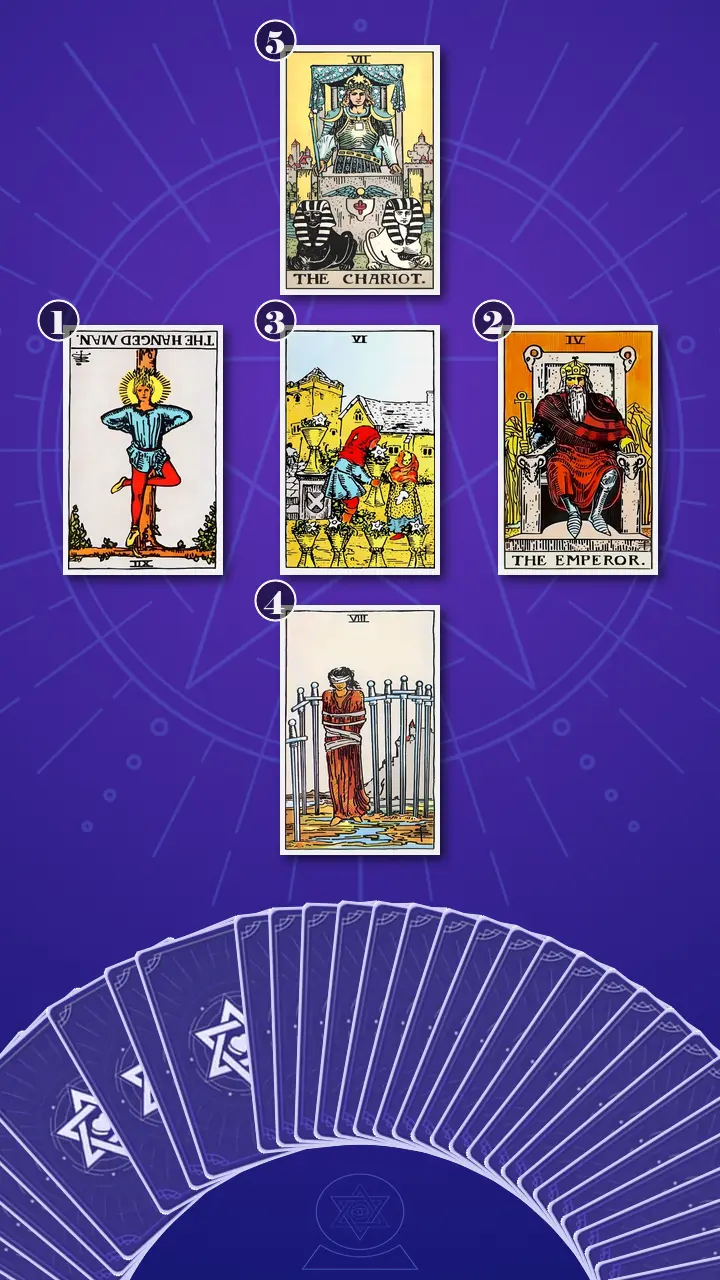
I chose a classic five-card Relationship Spread. For anyone wondering how tarot works in a family decision reading, this spread is useful because the question is relational at its centre: it separates Maya's present stance from the parental authority she experiences, the learned bond between them, the blockage that keeps the pattern in place, and a healthier form of shared adult leadership.
Five positions were enough. A larger spread might have added interesting context, but it could also have buried this focused question under more symbolism than she needed. I explained that the first card would show the observable waiting behaviour, the second the authority function Maya had internalised, and the third the childhood script connecting the two. The fourth would expose the Stagnation Lock, and the fifth would point toward self-directed participation without demanding emotional distance.
I arranged the cards like a small compass at a family crossroads: the first on the left, the second on the right, the third at the centre, the fourth below it, and the fifth above. The horizontal line showed where authority currently seemed to sit. The vertical line would show how an inherited orientation might become a consciously chosen direction.
Reading the Map, One Held Breath at a Time
Position 1: The Hanged Man Reversed and the Draft That Never Leaves
Now I turned over the card representing the presenting behavior in the diagnosis: Maya suspends her own response and waits for parental direction when a family choice is raised. The card was The Hanged Man, in reversed position.
Its modern scene was almost a mirror of the kitchen she had described. At 9:40 p.m., Maya kept the family chat open beside a fully formed Saturday proposal. She reread it, deleted it, checked whether her parent was online, and told herself that another ten minutes might reveal the safest answer. The extra waiting added no new information; it simply kept her outside the decision until someone else moved.
The Hanged Man's illuminated head showed that she was not short of awareness. The single suspended foot showed the problem: insight had become physically disconnected from action. In reversed position, the energy was blocked and overextended. Suspension that once created time for reflection had become a substitute for participation, like a message left in Drafts long after more editing had stopped improving it.
I also named the overcorrection risk. Maya did not need to prove her adulthood by announcing a complete family plan without consultation. That would turn self-direction into unilateral control and might recreate the very resistance she feared. The first useful experiment was smaller: answer one low-stakes family question within twenty-four hours, state one preference and one reason, then leave room for other people to respond.
Maya did not nod. She gave a short, bitter laugh. Her thumb stopped moving over the edge of her phone, her breath paused, and then her eyes went unfocused as if she were replaying several old message threads at once. Finally, her shoulders dropped on a slow exhale. 'That is almost painfully accurate,' she said. 'I already know X, but I am waiting for someone else to make Y safe.'
'That distinction matters,' I said. 'Your difficulty is not a lack of insight. It is the familiar pause that promises safety while quietly costing you practice. Before you check a parent's reply, what preference is already present in the first few seconds?'
Position 2: The Emperor and the Parent Whose Maybe Becomes a Ruling
Now I turned over the card representing the parental authority function as Maya experiences and internalises it, without claiming access to the parent's private thoughts or motives. The card was The Emperor, in upright position.
The modern translation was a parent writing, Maybe we should do Sunday? in a group chat that had asked everyone for ideas. Maya experienced the tentative sentence as the official plan, changed her calendar, and began assigning logistics before anyone had actually agreed. The stone throne reflected the way an ordinary parental opinion became fixed and institution-like in her mind. The armour reflected the protection she associated with letting that authority carry the risk.
The Emperor's upright energy was structure and legitimate authority, but it was concentrated outside Maya's adult self. I was not saying that her parent intended to command the family. I was showing how Maya encountered the parental role and gave it more decisional weight than the invitation for everyone to contribute. A parent could say one thing casually while Maya's nervous system translated it into a ruling.
'This is where the word efficient can become camouflage,' I said. 'You ask what your parent prefers, then you call agreement practicality. But being trusted with the booking is not the same as being included in the choice.'
Maya looked down at the Emperor's red robe and ran one finger along the card's edge. I saw recognition arrive with a little embarrassment, followed by a protective smile. She told me about peers who coordinated holidays with their parents as equals. She wanted that ease, she said, but feared that wanting it made her disloyal.
I asked her to consider one question: when a parent says, What do you think? without giving an opinion first, does the conversation actually require parental permission, or does an older role answer before anyone else has the chance?
Position 3: Six of Cups and the Smaller Version of Herself
Now I turned over the card identifying the familiar bond or learned relational script that connects Maya's present deference with her Inner Child Fixation. The card was Six of Cups, in upright position.
I brought in the family-call scene. A parent had once said, 'Maybe the following weekend would be easier.' Maya had privately preferred the earlier date, but her voice softened as if an official decision had been announced. She opened Google Calendar, started moving reservations, and replied, That probably makes more sense. Receiving direction still carried an echo of care and order. If she received the plan, she could stay close and avoid becoming difficult.
The Six of Cups was upright, so the energy was not simply harmful. It showed genuine familiarity, affection, and a role that may once have helped keep things predictable. Its imbalance appeared when the receiving child became the only acceptable position in an adult conversation. The offered cup could still represent care without requiring Maya to become smaller than her current capacity.
At archaeological digs, I have learned to respect the layer before deciding what belongs in the next structure. I used my signature lens, Generational Trauma Excavation, carefully here. I was not diagnosing trauma or assigning blame across generations. I was tracing how a behaviour might have travelled through a family system because it once protected closeness, order, or emotional safety. Understanding the origin could remove personal blame without turning history into destiny.
Then I used Inherited Belief Stratigraphy to separate the values Maya genuinely recognised as hers from the older fear-based rule beneath them. Care, responsiveness, and staying connected seemed authentic. The belief that a family choice became legitimate only after a parent led was an inherited layer to examine, not a permanent family law.
For several seconds, Maya's fingers curled around the mug between us. Her chest seemed to grow heavy, and her eyes moved from the smaller figure on the card to the larger one offering the cup. 'I do not want to treat being cared for as the problem,' she said.
'We will not,' I replied. 'We can preserve the care and retire the requirement that care must arrive through your silence. What familiar role did you step into the last time you became extra agreeable or helpful, and what kind of safety did that role seem to preserve?'
Position 4: The Eight of Swords and the Rule That Says No Safe Move
Now I turned over the card exposing the Stagnation Lock: the restrictive belief that initiating a decision risks blame, disapproval, or loss of belonging. The card was Eight of Swords, in upright position.
I returned to the TTC scene Maya had described. At 6:12 p.m., she saw a message asking everyone to choose between two weekends. Train brakes squealed. Wet wool and takeaway coffee filled the air. Her jaw locked while her mind ran the loop: If I say Saturday, they might say I am making things difficult, and that would mean I have overstepped my place in the family. She could have written, Saturday is easier for me; I can hold the booking until tomorrow, without deciding for anyone else. Yet her body registered the situation as if no safe move existed.
The Eight of Swords showed air turned into a closed review process. Anticipated criticism, imagined objections, and rehearsed replies had become so dense that a two-option poll felt like a board-level decision. The blindfold narrowed attention. The loose bindings suggested that the restriction was powerful but not absolute. The incomplete ring of swords left an opening.
'Your body says no safe move while the conversation still contains a small one,' I said. 'The small move is not guaranteeing that everyone agrees. It is making your preference visible without taking responsibility for the whole outcome.'
Maya's breath snagged. Her shoulders rose, her eyes fixed on the gap between the swords, and then her jaw loosened by a fraction. I watched her move from the imagined notification to the possibility of an actual sentence. 'I do not need to guarantee agreement,' she said slowly. 'I only need to make one visible move.'
That was the first believable opening. I asked her to imagine the next low-stakes family choice and identify only one action: vote, suggest, or ask for time. Not research indefinitely. Not solve the family history. One bounded act that could be observed and revised.
When The Chariot Put the Driver's Seat Within Reach
Position 5: The Chariot Upright, With Both Sphinxes on the Road
The room grew quieter before I touched the fifth card. I turned over the card representing the key transformation toward shared adult leadership: state one preference, choose a bounded direction, and remain open to input without surrendering agency. The card was The Chariot, in upright position.
The Chariot brought self-direction, disciplined movement, and coordinated will. Maya's modern version was simple: she could reply within twenty-four hours, Saturday is my preference because I can stay overnight. I can hold the reservation until 6 p.m.; what works for everyone else? A parent might prefer Sunday. Maya could acknowledge that response without deleting or disguising her original preference. She could remain connected, open to revision, and visibly present in the choice without taking control of everyone else's answer.
The black and white sphinxes faced different ways, just as Maya wanted both adult agency and family closeness. The Charioteer's task was not to eliminate one desire in favour of the other. It was to hold both tensions and choose a direction. I thought briefly of The Wizard of Oz: the journey changes when capacity is no longer treated as something an external authority can grant.
To make the distinction precise, I returned to my Inherited Belief Stratigraphy lens. The rule parental approval must come first belonged to an older layer. The value family connection matters belonged to the living structure Maya still wanted to keep. The Chariot did not ask her to demolish the whole building. It asked her to stop mistaking one old foundation stone for the only possible place to stand.
At 9:40 p.m., the family chat was open for the fourth time. Your Saturday preference disappears under your thumb, the phone warms your palm, and you wait for the online dot beside your parent's name before saying, Whatever works.
Waiting for a parent is not the price of family belonging; take one bounded turn in the driver's position and let the Chariot's paired sphinxes show that connection and self-direction can move together.
For a moment, Maya's thumb hovered above the invisible send button. Her breath stopped; her eyes widened and fixed on the card as if the two sphinxes had become a road sign she had somehow missed. I saw her replay the deleted Saturday sentence, the online dot, and every time a casual parental suggestion had turned into a final plan. Her hands tightened together, then slowly opened. Her shoulders lowered with a tremor, and the lower rims of her eyes warmed. She swallowed and said in a quiet, unsteady voice, 'So I can say what I want without making it a referendum on whether we are close?' I told her yes: a proposal can be clear without being controlling, and a different answer can be information rather than rejection. A fuller breath came out of her chest, followed by a brief, almost dizzy silence. I did not hurry to fill it. Relief had arrived beside responsibility; she could no longer outsource every difficult outcome. Then I asked, 'Now, use this new perspective and recall last week: was there a moment when this insight could have made your body feel even slightly different?'
Belonging does not require borrowed certainty. That was the bridge in the reading. Maya did not need to wait until fear disappeared, and she did not need to make a perfect choice. She needed to practise moving from waiting for parental approval and borrowed certainty toward self-directed participation with family connection intact.
Drawing a Route That Can Be Revised
When I placed the cards together, their story was clear. The Hanged Man reversed showed a capable woman suspended over an unsent message. The Emperor showed how authority had been placed outside her adult self. The Six of Cups explained why that arrangement still felt caring and familiar. The Eight of Swords turned possible disagreement into a mental enclosure. The Chariot gathered attachment, discernment, and initiative into a route Maya could choose rather than inherit.
I told her that the central cognitive blind spot was not simply indecision. She had mistaken avoiding control for avoiding initiative. Because she did not want to dominate the family, she had treated silence as the only ethical alternative. Because organising was useful, she had confused execution with influence. A preference can lead the next step without controlling the final answer.
The spread also showed why insight alone would not be enough. The cards carried water-like attachment, sword-like anticipation, and the fire of directed movement, but no Pentacles card supplied mundane repetition. Durable change would need earth: a reply deadline, a limited proposal, a defined responsibility, and a record of what actually happened instead of what Maya feared would happen.
I offered my Lineage Artifact Review, an intellectual exercise I developed for separating a family tradition from the obligation attached to it. On one page, Maya could write three headings: Preserve, Bury, and Test. Under Preserve, she might place care, warmth, and willingness to listen. Under Bury, the rule that a parent must speak first and the fear that disagreement proves disloyalty. Under Test, the adult practice of stating one preference and offering one bounded next step. We were burying an obsolete rule, not a person or a relationship.
- The Preference-Before-Permission ReplyWithin twenty-four hours of one low-stakes family question in WhatsApp, a date poll, or a shared Google Calendar thread, open the Notes app before checking your parent's answer. Write: 'My preference is Saturday because I can stay overnight. I can hold the reservation until 6 p.m.; what works for everyone else?' Send it as a proposal, not a command.Keep drafting to ten minutes and remove extra justification. The smallest version is selecting one option in a poll before looking at your parent's response. Do not use major health, safety, legal, or high-stakes financial decisions as practice material.
- The Twenty-Four-Hour First MoveWhen another family choice appears, put both feet on the floor, exhale once, and name the smallest available move: vote, suggest, or ask for time. Set a private twenty-four-hour reminder. In a one-line phone log, record the trigger, your preference, what you said, and what actually happened.The log is for comparing feared outcomes with observable outcomes, not grading your performance. If live conversation feels too intense, use a text. The minimum version is writing the preference privately before reopening the research loop.
- Connection Without ConsensusIf a parent or another relative prefers something different, say: 'I hear that Sunday works better for you. Saturday is still easier for me, so let's look at what each option affects.' If the group chat is too compressed, request a ten-minute call. Offer to handle booking only after the group has chosen together.Your responsibility is participation, not control of another person's reaction or agreement. The family dynamic may not change after one message. You can acknowledge someone else's view without withdrawing your own sentence.
I reminded Maya that the aim was not to perform perfect independence. It was to give her adult voice repeated, low-stakes contact with the family conversation. Every bounded proposal would become evidence that connection could survive a visible preference, even when the final plan changed.

The First Message Sent From the Adult Seat
Four days later, I received a message from Maya with a screenshot attached. A new family poll had appeared. She had selected Saturday first and written, Saturday is my preference because I can stay overnight. I can hold the reservation until 6 p.m.; what works for everyone else? Her parent preferred Sunday. Maya replied, I hear that Sunday works better. Saturday is still easier for me, so let's compare what each option affects. The conversation stayed ordinary. No one had been forced to agree, and Maya had not disappeared into the booking task.
That night she slept a full night, then woke with the old thought, What if I got it wrong? She smiled at it, not because it vanished, but because she had already spoken.
I saw that as the first evidence of transformation: not a solved family system, not certainty, and not a new obligation to lead every conversation. It was one adult preference, one bounded next step, and enough steadiness to remain connected when another person answered differently. The cards had not granted Maya authority. They had helped her notice the authority she could practise.
When the family chat asks what we want, some of us feel our throats close and our bodies go still, caught between already having an answer and fearing that saying it first could cost us our place. Seeing that pause clearly is already a small movement out of it.
If one preference could exist before anyone approved it, which small family choice would you be curious to meet from the adult seat, holding the two Chariot sphinxes together for one bounded turn?