When a Clear Preference Goes Soft at Decision Time
"You are a Toronto project coordinator who can write a clear recommendation in a Google Doc, then turn it into "I could go either way" the moment a meeting asks you to stand behind it." That was how I opened the session with Jordan.
At 10:12 a.m. on a Wednesday, I had watched her sit inside a glass meeting room near King Street, scrolling back to the sentence she had drafted: "I recommend Option A because it keeps the handoff simple." The coffee beside her had gone cold. The projector fan hummed beneath the fluorescent lights, and her jaw tightened when someone asked, "Which one do you recommend?" On her screen, the cursor moved backward, changing the sentence to "I could go either way."
She told me, "I know what I prefer until someone asks me to stand behind it. Then I start thinking I must be missing something obvious." Her clear choice was still there, but the need to make it visible collided with the impulse to soften it, reopen the comparison, and share the responsibility for how it might be received.
I could see the self-doubt in the physical details before she named it: lifted shoulders, shallow breaths, one hand pressed lightly against her chest. It was like keeping every browser tab open after already finding the article that answered the question, because closing the tabs felt more dangerous than staying overwhelmed.
"That makes sense," I said. "We do not have to shame the part of you that learned to stay flexible. We can simply find out what that flexibility is protecting. Today, we can let the cards help us draw a map through the fog, while you remain the person holding the pen."

Choosing a Map for the Fog
I invited Jordan to place both feet on the floor, take one slow breath, and keep the question specific: What am I missing when I soften my choice at decision time? I shuffled slowly while she focused on the difference between a genuine information gap and the discomfort of being seen choosing.
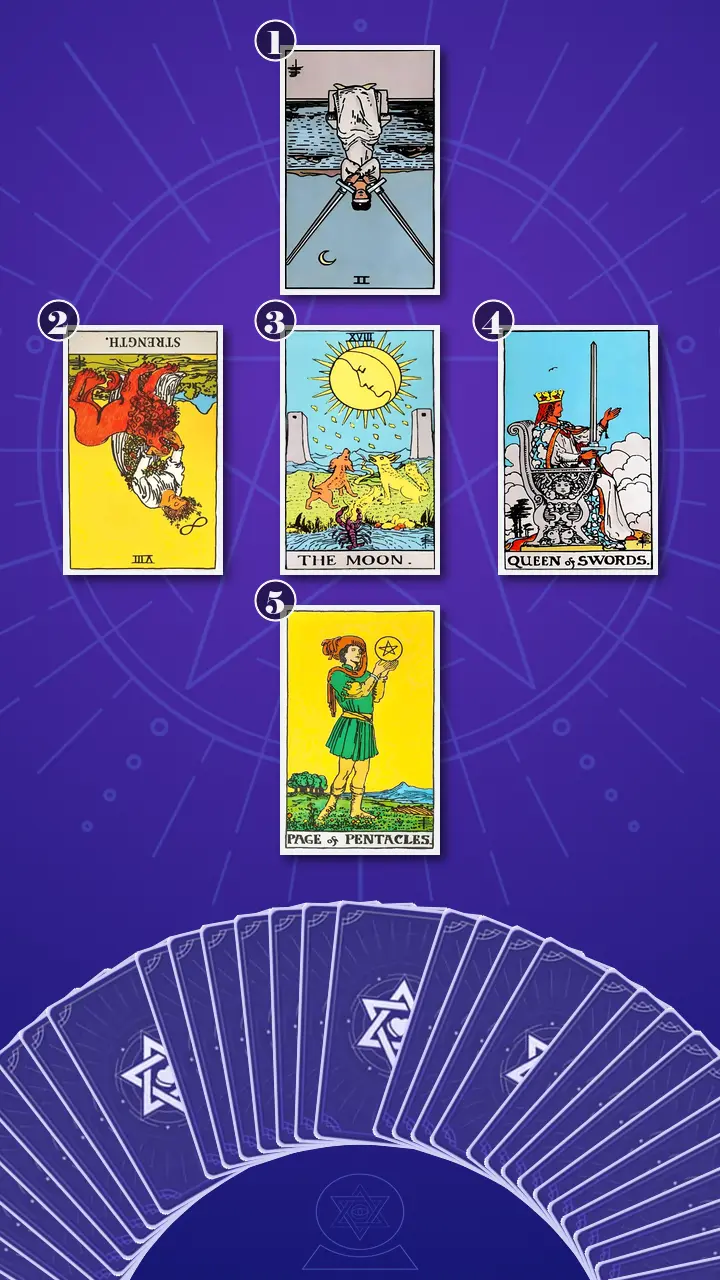
For this reading, I used The Shadow Spread, a five-position tarot spread for tracing a softened choice from visible pattern through hidden fear to grounded integration. This is how tarot works in my practice: the images give an external shape to a pattern that may be difficult to inspect from inside it. I read card meanings in context, alongside the details of a person's actual life, rather than treating a card as a prediction or a command.
The Shadow Spread suited Jordan because her question was not really a request to compare two outside options. It was an inner excavation. The five positions move from the conscious pattern at the point of choice, to the protective conflict around it, to the hidden material beneath the decision blind spot, then to the missing resource and a grounded integration step. It was compact enough for a real decision, but deep enough to explore choice paralysis disguised as flexibility and the fear of being judged for a recommendation.
I told her that I would begin with the behavior other people could see, move into the hidden fear that made it feel necessary, and finish with a clear but revisable next step. The cards would not choose her career move, project plan, restaurant, or boundary. They would help us notice where her own preference disappeared from the sentence.
Reading the Map: The Choice Kept in Suspension
The Blindfold and the Open Comparison Tab
"Now turning over the card that represents the conscious pattern at the point of choice," I said, "I have the Two of Swords, in reversed position."
The standard meaning is suspended judgment or blocked discernment, but the image made the pattern more specific. The blindfold became the moment Jordan kept both options equally available, even after one had begun to make more sense. The crossed swords became two open comparison tabs held across her chest, protecting her from having to feel the responsibility attached to one of them. The dark water behind the figure looked to me like the unease that more research could not settle.
At the Toronto project meeting, Jordan had already selected Option A because it kept the handoff simple. When the room shifted from brainstorming to the direct question, "Which one do you recommend?" she reopened the comparison sheet, added caveats, and turned a recommendation into a question. The reversed energy here was contracted Air: thought was working hard, but discernment could not move forward. It was not a lack of intelligence or information. It was a blockage around ownership.
I asked, "When the confident version becomes public, what does the softened version promise you?"
Jordan gave a short laugh that held no amusement. "That I can change my mind without disappointing anyone. Also that no one can say I made the wrong call, because I never really made one."
I did not rush to tell her she was being too hard on herself. Instead, I asked her to listen for the sentence beneath the decision: "I already know what I prefer, but what if I am missing something everyone else can see?" Her fingers paused over the edge of the card. She looked at the crossed swords, then down at her phone, where a comparison document was still open from that morning.
"That is a little too accurate," she said. "Almost rude, honestly."
I smiled gently. "Then we have found a protective strategy, not a character flaw. The question is not how to force yourself to decide faster. It is how to tell useful uncertainty from a reflex that keeps your preference from entering the room."
When Kindness Makes Itself Smaller
"The second position shows the protective conflict being managed by the softened choice," I said as I turned the next card. "This is Strength, in reversed position."
In the Rider-Waite-Smith image, Strength is patient courage and humane self-command. The woman's hand rests gently on the lion, showing influence without force. Reversed, that calm relationship with personal power is under strain. Jordan was trying so hard not to be demanding that she made her preference too small to guide anyone.
I brought the image into the meeting room she had described. Her voice lowered when she said, "I could go either way," even though she had a strong view. She added, "But I am happy to support whatever the team prefers," before anyone had disagreed. The intention was collaboration. The practical result was that the loudest opinion set the direction while her judgment vanished from the decision record.
I call this lens Persona Fatigue Diagnosis. I listen for the cost of maintaining an artificial social character, in this case the endlessly agreeable collaborator, when that character conflicts with the person's authentic preference. I was not asking Jordan to become forceful or to dominate a room. I was asking whether being kind had quietly become synonymous with being inaudible.
"Maybe being flexible is just being considerate," she said.
"It can be," I replied. "But softness can be kind without making your preference disappear. A calm sentence gives other people something real to respond to. It does not remove their agency, and it does not remove yours."
She rubbed her thumb over the seam of her sleeve, then let her hand rest in her lap. Her shoulders remained high, but her eyes stayed on the lion. I could sense the small resistance in that stillness: saying what she wanted no longer looked like a communication preference; it looked like a question about whether she was allowed to have influence.
The Slack Message and the Fog Behind It
"Now I am moving to the hidden material beneath the decision blind spot," I said. "The Moon, upright."
The Moon does not mean that every uneasy feeling is false. It shows how facts, projections, instinct, and imagined reception can become difficult to separate. Its winding path became the space between a neutral Slack reply and the story Jordan built around it. The dog and wolf looked like competing interpretations of the same uncertain light. The crayfish rising from the water suggested a fear arriving before she had found words for it.
At 9:03 p.m. on a Tuesday, a colleague had replied to Jordan's recommendation, "Sounds good, let's discuss." No criticism appeared in the message. Still, she imagined disappointment, reopened the comparison document, and drafted a follow-up explaining every alternative. The laptop fan hummed against the quiet apartment. Her jaw ached. The imagined reaction began to feel like new evidence.
I placed three questions between us. "What is the fact? What are you imagining they will think? And what preference was present before the fear arrived?"
For a moment, her breathing paused. Her eyes lost focus as if she were replaying the Slack message line by line. Then she looked at the Moon again and gave a slow, chest-deep exhale. "The fact is that they want to discuss it. The rest is me trying to prevent a reaction that has not happened."
That distinction mattered. The Moon was not asking her to distrust intuition or ignore genuine missing information. It was asking her to stop letting an unconfirmed interpretation take the same authority as an observable fact. More tabs, more opinions, and more comparison could not guarantee that nobody would ever disagree with her. They could only postpone the moment when she found out what the room actually thought.
When the Queen of Swords Raised the Boundary
The Missing Sentence About What She Knows
The room grew quiet when I reached the fourth position. "This is what is missing at decision time," I said. "The Queen of Swords, upright."
Her upright sword and direct gaze offered the antidote to the crossed blades and the Moon's shifting light. The Queen's clarity was not coldness. She represented independent judgment, honest language, and a boundary shaped by experience. I told Jordan that she could say, "I recommend Option A because it meets our main handoff criterion; I am open to revisiting this if new evidence changes that criterion." The sentence was clear, kind, and bounded. It did not ask her to control the room or pretend that revision would mean failure.
As I listened to the thought beneath her hesitation, I used my signature tool, Internal Monologue Auditing. I do not begin by asking whether an anxious inner sentence is true. I first ask what genre it is trying to produce. Jordan's private script sounded like a courtroom thriller: every recommendation was an exhibit, every disagreement a verdict, and every caveat an attempt to avoid being cross-examined. Once I named the genre, she could hear that the voice was not objective reality. It was a frightened editor cutting her own strongest line before anyone else had the chance.
"Your internal story keeps telling you that a clear recommendation will become a permanent identity claim," I said. "The Queen offers another structure. A current choice can be direct without becoming permanent. Revising later can still be responsible ownership."
I asked her to picture 10:12 a.m. in the Toronto meeting room: she had already written "I recommend Option A," but when someone asked her to stand behind it, her cursor moved back to "I could go either way." The coffee was cold, the fluorescent lights buzzed, and every caveat felt like protection.
Stop treating a softened answer as the safest answer; use the Queen's raised sword to state the clearest choice you can make now while keeping a humane boundary around future revision.
I let the sentence remain between us. Then I added, "You are not missing perfect certainty. You may be leaving out the clearest sentence about what you prefer and the criterion behind it. A current choice can be direct without becoming permanent, and revising later can still be part of responsible ownership."
For one beat, Jordan went completely still. Her breath stopped high in her chest, and the hand that had been gripping her sleeve hovered without moving. Then her eyes shifted away from the Queen and seemed to move through several old messages, meetings, and carefully softened recommendations. I watched recognition arrive before agreement: her mouth parted, her brow tightened, and her pupils widened as the distinction between being wrong and being visible began to separate. Finally, her fist loosened finger by finger. Her shoulders dropped with a faint tremor, and a long exhale moved through her like a door opening in a room that had been overpacked with possible outcomes. She looked relieved, but not triumphant. The space after the insight carried a brief dizziness, the responsibility of having a path when she had expected only fog. "So I can choose without promising I am infallible," she said, almost under her breath.
"Exactly," I said. "Now, use this new perspective to remember last week. Was there a moment when separating a current recommendation from a permanent verdict about you could have made the choice feel different?"
This was the key shift: a first movement from fear-driven self-monitoring and protective vagueness toward compassionate directness and grounded self-trust. The Queen did not take the decision from Jordan. She returned the decision to her in a form she could hold.
The Upright Sword and the Humane Revision Point
I stayed with the Queen for another moment because her resource was easy to overcorrect. Clear language did not mean saying, "This is the only acceptable answer forever." It meant naming the current best choice, the criterion supporting it, and the specific evidence that would justify a change.
I asked Jordan to compare two sentences aloud. First: "I could go either way, but maybe Option A, depending on what everyone thinks." Then: "I recommend Option A because it meets our main criterion. I will review it if new evidence changes that criterion."
Her first attempt came out thin and fast. The second was quieter, but it had a beginning and an edge. That edge was not a weapon. It was a boundary around the decision, so uncertainty no longer had to spread across every minute of the day. The open sky around the Queen's throne reminded me that directness and openness were not opposites.
The Apprentice Holds One Pentacle
"The final position is the grounded integration step," I said. "The Page of Pentacles, upright."
The Page held one pentacle at eye level in a cultivated field. I read him as a practical learner, not someone required to demonstrate instant mastery. In Jordan's life, the pentacle became one selected option and one observable measure. The field became a one-week pilot, not a five-year life plan disguised as a Monday task.
I connected the card to her next project recommendation. She could choose the shorter pilot, measure whether the main workflow moved through the handoff with fewer delays, and review the result at a scheduled time. Until then, new information could go into one note titled "Evidence for review" instead of reopening the entire comparison table every evening.
The energy moved from contracted Air, through the ambiguous Water of the Moon, back into the Queen's lucid Air, and finally into the Earth of the Page. No Wands appeared, so I did not frame action as a dramatic burst of confidence. The cards suggested something more dependable: a truthful criterion followed by patient observation.
Jordan looked at the single pentacle and nodded once. There was no rush of certainty. I saw a smaller release, the kind that makes it possible to send one clean sentence before closing a laptop. "I do not need to defend every possibility tonight," she said. "I need one honest criterion and a way to learn."
The One-Page Director's Cut for Finding Clarity
I laid the five cards in the cross so we could see the whole story. The reversed Two of Swords showed the visible pattern: Jordan had a preference, then kept every option in the room when commitment became visible. Strength reversed showed the protective conflict: she confused kindness with reducing her own influence. The Moon revealed the root: a neutral response became imagined judgment, and imagined judgment became a reason to distrust what she already knew.
The Queen of Swords supplied the missing resource, clear and humane discernment. The Page of Pentacles showed how to make it livable: choose a workable option, define one observable measure, and learn through follow-through. The story was not that Jordan lacked judgment. She had been using protective vagueness to keep her judgment from becoming a target.
Her cognitive blind spot was treating the physical feeling of exposure as proof that the preference itself was unreliable. She also treated more information as the only legitimate route to safety, even when the relevant facts were already present. The transformation direction was not from softness to harshness. It was from using softness to avoid ownership to using clear, bounded language that left room for revision.
"I want to give you something practical," I told her. "We will use The Director's Cut of Self-Compassion. When the inner spiral starts filming you as the defendant, pause the scene. Cut the punitive judge's voice. Then replay the moment through an objective, supportive observer who can name your preference, your reason, and the conditions for revision."
This was not forced confidence. It was mental editing. The goal was not to make the difficult scene disappear, but to stop giving the most punishing voice final cut. I asked Jordan to begin with small decisions where the cost of learning was manageable.
- Write one clean recommendationBefore one project meeting this week, open a note on your phone and write, "I recommend ___ because ___." Read it once before speaking. After you state it to the team, pause for three breaths without adding "but I could go either way" or asking whether everyone agrees.Use the smallest version if the sentence feels exposing: one preference and one reason. Collaboration can happen after your actual view is visible.
- Run a ten-minute, two-criteria decision checkChoose one open decision in your existing comparison document. Write only the two criteria that matter most, set a ten-minute timer, select the current best option, and add one review point, such as Friday at 3 p.m. Close the extra tabs when the timer ends.A review date is not a loophole. It is a container for uncertainty. Put genuinely new evidence in one note titled "Evidence for review" instead of restarting the comparison.
- Separate fact from the story around itWhen a neutral Slack reply triggers the urge to rewrite your recommendation, make three short notes: "fact," "story I am adding," and "question still unanswered." For one low-stakes group plan, send your real preference, such as "I would prefer the Ossington place because it is easier to reach after work."Notice your jaw, shoulders, and breathing for thirty seconds after sending. Record the sensation, but do not treat discomfort as an instruction to retract.
I reminded Jordan that these were experiments, not tests of character. She could stop, make the decision smaller, change the criteria, or postpone it with an explicit return time. The boundary was there to support her agency, not control it.

The First Clean Sentence
Four days later, I received a message from Jordan before her morning Slack check: "I wrote the recommendation, left it alone, and sent it before I could build another comparison table." She had chosen the shorter pilot, named the handoff criterion, and put Friday at 3 p.m. on the calendar for review.
At the review point, she recorded one observable result instead of rebuilding the entire decision. The pilot had created one delay she had not predicted and reduced two others. She did not need the outcome to prove she had been right. It gave her information she could use.
The choice still felt vulnerable, and the next morning her first thought was, "What if I got it wrong?" She told me she smiled at the thought, then made coffee and opened the evidence note. Clear, but not invincible. Steadier, but still human.
I consider that the first real proof of the Journey to Clarity. The cards had not predicted a perfect result, and I had not handed Jordan a verdict. The Shadow Spread had helped her see the protective pattern, name the missing sentence, and make a bounded choice that could teach her something. She was the one who chose the lane, set the review point, and kept the authority to revise.
That is the movement I want to leave with you: from fear-driven self-monitoring and protective vagueness to compassionate directness and grounded self-trust. A clear choice does not have to become a permanent identity claim. You can be considerate because your criteria are clear, not only because your preference disappears.
Do not make the choice harmless by making it vague. Give it one honest sentence, one humane boundary, and enough space for evidence to speak later.
If you know which way you lean but your jaw tightens when you imagine saying it out loud, softening the answer may feel like keeping your worth out of the line of fire, even while it leaves you holding every option alone. When your next decision becomes visible, what is one sentence you could let your own Queen's raised sword speak this week, with one small review point to keep the door open to new evidence?
This story is adapted from psychological research, written so that those in a similar struggle can see their own pattern in it — and find their next step clearly.These insights are not a substitute for professional psychological, medical, legal, or financial advice.
Learn more about our Journey to Clarity.
How did this insight land for you?
🫂 This Resonates Deeply
🌀 Living This Story
✨ Now I See Clearly
🌱 Seeing New Possibilities
🧰 Useful Framework
🔮 The Confirmation I Needed
💪 Feeling Empowered
🚀 Ready for My Next Step
Author Profile
 AI
AI“I’ve always felt our lives are films currently in production. As an artist, I know that when you feel stuck, it’s often because you’ve bravely stayed in a painful scene for just a little too long. I’m not here to coldly analyze you. I want to sit closely with you, look at those difficult moments with profound empathy, and gently hand you the pen so you have the courage to write your next beautiful act.”
In this Introspection Tarot Reading :
Core Expertise
- Internal Monologue Auditing: Identifying the destructive 'genre' (e.g., tragedy, horror) of your subconscious thoughts that constantly induces anxiety.
- Persona Fatigue Diagnosis: Assessing the heavy psychological toll of maintaining an artificial 'social character' that conflicts with your authentic self.
Service Features
- The Director's Cut of Self-Compassion: A mental editing technique to pause a spiral of self-hatred, reframing the internal narrative from a punitive judge to an objective, supportive observer.
Also specializes in :
Explore Related Patterns:
Approval-Driven Decision ParalysisAt 10:12 a.m., Jordan already has a reasoned recommendation on her screen, but the direct question from the room makes her replace it with "I could go either way." The change does not create better analysis. It converts a visible, attributable choice into shared ambiguity, reducing the immediate risk that anyone will judge or blame her for the outcome. Jordan later explains the protection clearly: if she never fully makes the call, no one can say she made the wrong one. When you use uncertainty this way, the apparent decision problem is partly an approval problem. The missing distinction is between information that could materially change your choice and discomfort generated by letting other people see that the choice is yours.
Mind ReadingAt 9:03 p.m., Jordan receives the neutral Slack reply, "Sounds good, let's discuss." No criticism appears in the message, yet she supplies disappointment, reopens the comparison, and starts explaining every alternative. An imagined reception has crossed into the evidence column without being tested. The same interpretive filter appears when she assumes that everyone else can see an obvious problem she has missed. When you treat an unconfirmed judgment as privileged information about another person's mind, your original preference must compete with a reaction that has not happened. Separating the fact, the story you are adding, and the genuinely unanswered question restores proportion without requiring you to dismiss real feedback when it arrives.
Secure VisibilityIn the meeting exercise, Jordan practices saying, "I recommend Option A because it meets our main criterion," followed by a specific condition for revision. Four days later, she sends the recommendation before another comparison table can hide it. Her preference is finally visible, but it is not presented as a demand or a claim of permanent correctness. When you allow a current judgment to be seen without tying your entire competence to its outcome, visibility becomes tolerable rather than all-or-nothing. The boundary around revision matters: it protects your right to update the choice without erasing your right to make one now. This turns directness into grounded participation, not domination.
Workplace Self-SilencingJordan says, "I am happy to support whatever the team prefers," before anyone has disagreed with her. That sentence sounds collaborative, but it removes the informed recommendation she was hired to contribute. The practical result is visible in the meeting: the loudest opinion gains influence while her judgment disappears from the record. When you preemptively lower your voice to avoid appearing demanding, consideration can become a form of self-censorship. The pattern is not simply being quiet. It is treating your influence as a relational threat and editing yourself before the relationship has actually required compromise. A bounded preference gives other people agency because it gives them something real to consider; it does not force them to agree.
Emotional ReasoningJordan's jaw tightens, her shoulders lift, and her breathing becomes shallow at the moment she is asked to stand behind Option A. Her cursor then weakens the recommendation. The bodily alarm is real, but the conclusion attached to it is not established: feeling exposed does not prove that the underlying judgment is unsound. The same conversion happens when an imagined reaction begins to feel like new evidence. When you use discomfort as a verdict about your choice, the nervous system quietly takes over a task that belongs to observable criteria. The useful audit is not whether the sensation should disappear; it is whether the sensation identifies a factual information gap or merely marks the moment your preference becomes visible.
Uncertainty ToleranceFour days later, Jordan sends the recommendation while the choice still feels vulnerable. The next morning, the thought "What if I got it wrong?" returns, but she makes coffee and opens the evidence note instead of retracting the choice. Uncertainty remains present without being given control of the workflow. When you tolerate uncertainty, you do not pretend that the outcome is guaranteed. You stop requiring that every possible objection be resolved before your current best judgment can enter the room. The scheduled review point gives doubt a legitimate container: new evidence can change the recommendation later, while discomfort alone no longer has to dissolve it now.
Values-Based Decision MakingJordan's original sentence already contains the relevant anchor: Option A keeps the handoff simple. Later, she chooses the shorter pilot, limits the check to the criteria that matter most, and schedules a review. The decision becomes organized around what the project needs rather than around the impossible task of preventing every negative reaction. When you name the criterion behind a preference, clarity no longer has to depend on feeling completely confident. A value or priority can guide the current choice while evidence remains capable of changing it later. This is the missing structure beneath Jordan's softened answer: not perfect certainty, but an honest reason that can hold the decision steady long enough to learn from it.
Defensive OverexplainingAfter the neutral Slack message, Jordan drafts a follow-up that explains every alternative. In the meeting, she adds caveats and reopens the comparison instead of stating the recommendation already supported by her handoff criterion. The extra language functions as protective padding around the part of the message that could be evaluated. When you explain every possible route before anyone has challenged the current one, detail can become a defense rather than clarification. It spreads responsibility across alternatives and makes your actual judgment difficult to locate. The pattern becomes easier to interrupt when you state one preference and one reason first, then reserve further explanation for questions or genuinely decision-changing evidence.
Reality TestingWhen Jordan revisits the Slack message, she identifies the fact that her colleague wants to discuss the recommendation and separates it from the disappointment she has imagined. At the later review, she records that the pilot created one unexpected delay and reduced two others. Neither fear nor a mixed result is allowed to become a total verdict. When you distinguish observation from projection, you do not have to dismiss intuition or pretend that uncertainty is harmless. You give each source of information the authority it has actually earned. A fact can update the decision, an unanswered question can be investigated, and an imagined reaction can be noticed without being promoted into proof.
Explore Related Struggles:
Approval-Safety FusionJordan says that an indefinite answer protects her from disappointing anyone and prevents others from saying she made the wrong call. She offers agreement before disagreement has even appeared, so an anticipated reaction begins controlling the choice before the room has provided real feedback. When you need a preference to be safely received before you can keep expressing it, approval stops functioning as feedback and starts functioning as permission. Your position remains available only while it appears unlikely to disturb anyone, leaving your sense of interpersonal safety tied to reactions you cannot fully predict or control.
Clarity-Exposure SplitJordan has already written a clear recommendation when the meeting asks her to say which option she supports. Her cursor then moves backward, and a usable conclusion becomes "I could go either way" precisely when her judgment becomes visible to other people. You can know what you prefer while still finding the exposure of owning that preference difficult to carry. The struggle sits between clarity and visibility: your reasoning can remain intact, yet the sentence expressing it becomes softer so the choice cannot place you fully in view.
Internal Authority CollapseOption A remains clear while Jordan is writing alone, but her own criterion loses authority as soon as the room asks her to own the conclusion. She does not receive new operational evidence; the possibility of another person's judgment is enough to displace what she already knows. You may have a functioning inner decision process that collapses at the point of social exposure. The problem is not an empty inner compass but a transfer of authority: your judgment becomes provisional the moment an imagined external viewpoint enters the room, even before anyone has offered a substantive objection.
Responsibility-Authority SplitThe meeting asks Jordan to provide a recommendation, and she has already done the work required to produce one. When she reopens the comparison and hands the conclusion back to the room, she keeps the responsibility for analysis and implementation while surrendering authority over the direction. You can end up carrying the consequences of a decision without allowing your own judgment to occupy its proper place in making that decision. The split keeps you accountable for helping the work succeed while making authority feel like something that must belong to the group, the loudest person, or whoever reacts most strongly.
Certainty-Safety FusionJordan keeps every comparison tab open after identifying the criterion that supports Option A. Each extra caveat appears to offer protection, but none can guarantee that colleagues will agree, that the pilot will be flawless, or that revision will never be needed. You can become caught between having enough evidence to choose and needing enough certainty to feel untouchable after choosing. When safety depends on eliminating every possible error or disagreement, research has no natural stopping point and a responsible current judgment remains suspended behind an impossible guarantee.
Evidence DisconnectionA colleague writes, "Sounds good, let's discuss," without including criticism, yet Jordan imagines disappointment and reopens the comparison document. The reaction she anticipates begins to function like new data even though nothing in the message has changed the handoff criterion supporting Option A. You can lose contact with the distinction between what has happened and what might be happening in someone else's mind. Once an imagined response receives the authority of observable evidence, additional analysis cannot settle the decision because it is being asked to answer a social prediction rather than a factual question.
Identity Verdict LockJordan's private script turns recommendations into exhibits and disagreement into a verdict. A project choice stops being a current judgment about a handoff and starts carrying the weight of a permanent statement about whether she is competent, considerate, or wrong. When a revisable decision becomes evidence about who you are, choosing exposes more than the option itself. The lock forms because changing course later no longer looks like responsible learning; it appears to confirm a personal verdict that the softened answer was designed to keep from being issued.
Explore Related Emotions:
Preference Exposure DreadAt 10:12 a.m. in the glass meeting room, you have already written "I recommend Option A," but your cursor moves backward when someone asks you to say the recommendation aloud. Your jaw tightens, your shoulders rise, and a clear private preference becomes a public non-answer. The preference has not disappeared; its visibility has changed what the choice seems to demand from you. Once being seen choosing feels like placing your judgment in the line of fire, softening the sentence offers temporary cover. Preference Exposure Dread names that inward contraction around letting other people witness what you actually want or think is best.
Verdict DreadAt 9:03 p.m., the Slack reply says only, "Sounds good, let's discuss," yet you reopen the comparison document and begin explaining every alternative. No criticism has appeared, but the possibility of discussion already carries the emotional weight of cross-examination. When a recommendation becomes an exhibit and disagreement becomes a verdict, an ordinary work choice can feel like a trial of your competence. The dread does not come from confirmed negative feedback; it grows from treating possible reception as a final judgment about who you are. That inner courtroom makes vagueness feel protective because no firm choice means no definite case can be made against you.
Agency ReliefWhen you say, "So I can choose without promising I am infallible," the recommendation stops functioning like an irreversible identity claim. You can state Option A, give the handoff criterion, and remain open to what the team or the pilot reveals next. Agency returns when ownership is separated from total control. You are responsible for making the clearest current choice you can support, but you do not have to guarantee every consequence or prevent every disagreement. Agency Relief is the release that follows when revision and self-authorship are allowed to coexist rather than cancel each other out.
Cautious Self-TrustFour days later, you send the recommendation before you can build another comparison table. The next morning, "What if I got it wrong?" still appears, but you make coffee, open the evidence note, and leave the original choice in place until the scheduled review. This trust is cautious because it does not depend on feeling invulnerable or completely certain. You give your judgment enough authority to guide one bounded action while preserving a clear route for learning and revision. Cautious Self-Trust is the inner steadiness of remaining beside your choice even when the old impulse to withdraw it has not fully disappeared.
Clarity ReliefWhen you separate the Slack message into the fact, the story added around it, and the question still unanswered, your breathing deepens and your shoulders begin to drop. The distinction between being wrong and merely being visible creates space where every imagined reaction had previously been treated as evidence. Clarity Relief arrives because the decision no longer has to solve uncertainty, social reception, and personal worth all at once. A direct sentence can describe the current best judgment, while a review boundary contains what remains unknown. The relief comes from seeing the structure accurately enough to stop asking vagueness to protect you from every possible outcome.
Intuitive Self-DoubtYou know what you prefer until someone asks you to stand behind it. At that point, the tightened jaw and shallow breath begin to look like evidence that the recommendation itself is flawed, and the thought "I must be missing something obvious" gains authority over the criterion you already examined. Your informed signal is not absent; it is being discredited by the physical sensation of exposure. Intuitive Self-Doubt captures the moment when discomfort is mistaken for informational deficiency and your own judgment loses status simply because it has become visible. Recovering clarity begins with separating what your body anticipates from what the available evidence actually shows.
Approval AnxietyBefore anyone disagrees, you lower your voice and add, "I am happy to support whatever the team prefers." The sentence arrives so early that collaboration has not yet been tested; your own position is reduced before anyone has had the chance to respond to it. Consideration becomes emotionally tied to pre-emptive approval seeking, so belonging appears safer when your influence stays small. Approval Anxiety is present in the urge to manage everyone's possible reaction before the room has offered any real reaction at all. The cost is that other people can accept your flexibility without ever encountering the judgment you brought to the decision.
Cognitive OverwhelmThe coffee beside you goes cold while the comparison tabs remain open, and the same document is still on your phone after the meeting. You have already found the criterion that supports Option A, yet each imagined response creates another alternative to inspect and another explanation to draft. Thought becomes crowded because observable information and predicted judgment are entering the same mental queue. Cognitive Overwhelm names the experience of carrying every possible branch at once, even after the options have stopped being equally persuasive. More analysis then feels necessary, but it cannot settle a question that has shifted from missing information to the discomfort of ownership.
Explore Related Contexts:
Bounded Commitment TrialJordan's working sentence names Option A, the handoff criterion supporting it, and the evidence condition that would justify a later review. The one-week pilot and Friday checkpoint turn the recommendation into a limited professional commitment with a visible beginning, measure, and revision point. When you frame a choice this way, you are accountable for the best judgment available now without presenting it as an irreversible promise. Bounded Commitment Trial captures the real-world practice of taking a position while preserving a legitimate route for learning, updating, and retaining your agency.
Career Visibility ParalysisAt 10:12 a.m. in the glass meeting room, Jordan has already written that she recommends Option A because it keeps the handoff simple. Once the team asks her to stand behind that sentence, the cursor moves backward and the documented recommendation becomes "I could go either way." The same sequence appears after a neutral Slack reply, when she reopens the comparison and drafts explanations for every alternative. The external pressure point is professional visibility. You may have completed the analysis and reached a defensible view, yet the workplace moment that attaches your name to the recommendation interrupts its entry into the decision record. Career Visibility Paralysis names the situation in which competent judgment remains available in private but becomes difficult to preserve when colleagues can publicly attribute, discuss, and evaluate it.
Decision Cliff EdgeJordan reaches Option A through a concrete handoff criterion, but the meeting's direct question changes the task from comparing options to owning one recommendation. At that threshold, she reopens the comparison sheet, adds caveats, and returns a supported choice to open status. A later request to discuss the recommendation produces the same return to alternatives despite adding no new project fact. You are encountering a Decision Cliff Edge when the decisive obstacle appears after the useful analysis has already been completed. The external process now requires an attributable position that other people can respond to, and that change in social exposure stalls the next step. Recognizing the threshold helps you stop treating renewed comparison as proof that the original evidence was inadequate.
Decision Criteria ResetJordan identifies handoff simplicity as the main criterion, selects the shorter pilot, and schedules Friday at 3 p.m. for reviewing one observable workflow result. These details create a decision rule that the project can actually use and make the boundary between relevant evidence and background noise explicit. For you, a Decision Criteria Reset means returning authority to the standard that the choice is meant to serve. A colleague's reaction can enter the discussion, but it does not automatically replace the criterion or restart the entire comparison. You gain a concrete basis for choosing now and a defined basis for revising later.
Safe Visibility TrialJordan sends the shorter-pilot recommendation, names the handoff criterion, and places a review point on the calendar. Her judgment enters the shared workplace record in a form that colleagues can inspect, discuss, and test without turning one project choice into a permanent statement about her competence. A Safe Visibility Trial gives you a contained way to be seen choosing. The pilot limits the practical stakes, the criterion explains your reasoning, and the review date protects your right to update the decision. Visibility becomes a structured professional experiment rather than an unlimited demand to defend every possible outcome.
Design by Committee TrapJordan says she is happy to support whatever the team prefers before anyone has challenged Option A. Her handoff analysis is therefore absent from the decision record as a clear professional recommendation, and the loudest opinion gains more directional weight than the person who examined the workflow. A Design by Committee Trap forms when collective participation loses the benefit of differentiated responsibility. You can remain collaborative while still supplying the judgment your role was asked to contribute. Without that contribution, shared decision-making becomes diffuse ownership, and influence follows volume or confidence rather than the stated criterion most relevant to the project.