Changing "I Have Decided" to "I Hope You Understand": Owning Limits

When the Family Chat Makes You Twelve: Family-Boundary Regression at the No-Contact Threshold
I opened our session with a recognition I have heard in different forms across many years of listening: If you are trusted to make product decisions at work but become twelve years old inside one family chat, you may recognise adult-child regression the second their name appears on your phone.
Casey sat across from me in the quiet corner of my Toronto study. At 11:40 p.m. on the previous Sunday, they had been at the shared apartment kitchen table between a humming laptop and a phone warm from constant checking. Cold peppermint tea had left a flat taste in their mouth; the overhead light buzzed while they deleted I have decided and typed I hope you can understand for the third time. Their shoulders had crept toward their ears, and their thumb kept returning to the family thread.
All week, Casey managed rent, groceries, deadlines, and a hybrid UX design role without family help. At work, they could defend a research-based product recommendation to a room of senior stakeholders. Yet the approach of a no-contact message pulled them toward a different rulebook. They wanted to make an autonomous adult decision about distance, but whenever that decision came close to becoming real, they felt the old pull to be their family's child again.
Casey said, I can make adult decisions everywhere except in this chat thread. I keep trying to write an explanation they cannot argue with. If I need their permission, then it is not really a boundary.
I could hear disorientation beneath the careful wording. It was not a vague cloud; it was more like trying to read a street sign through a moving snow globe while one hand kept turning the map. The throat tightened, the stomach dropped, the hands reached for the phone, and every new paragraph briefly promised relief before reopening the whole question.
I did not tell Casey what outcome the cards would produce, and I did not treat their guilt as a warning from the universe. I told them that we could sit with the grief, the apprehension, and the wish for distance without forcing an immediate verdict. Our work was to give the fog a map, so Casey could recognise the child feeling without handing it the final vote.

Choosing a Compass at the Border
I invited Casey to put the phone face down, take one slow breath, and name the question in present-tense language. Then I shuffled slowly. For me, this preparation is a psychological transition: it gathers attention from the old message thread and brings it back to the evidence in the room.
For this consultation, I used the Relationship Spread · Context Edition, a five-card family-boundary tarot spread designed for a focused relationship question. A relationship spread was appropriate because Casey's difficulty was organised around one relational threshold: the conflict between adult autonomy, inherited family roles, belonging, and the practical ownership of a boundary. The five cards gave us enough structure to examine the pattern without turning a precise question into a sprawling ten-card investigation.
This is also how tarot works most responsibly for me. The cards provide images and positions that help organise attention; they do not access a family's private motives, guarantee an outcome, or decide whether no-contact is correct. They make card meanings in context available for reflection, so observable experience and personal judgment can meet the symbols on the table.
I told Casey where I would take the reading. The first card would show the exact moment the adult boundary activated the child role. The second would reveal the internalised authority that judged the boundary before anyone had replied. The third would locate the belonging fear beneath the visible argument. The fourth would clarify the active challenge through evidence and accountability. The fifth would translate that clarity into a boundary practice Casey could choose, communicate, support, and review.
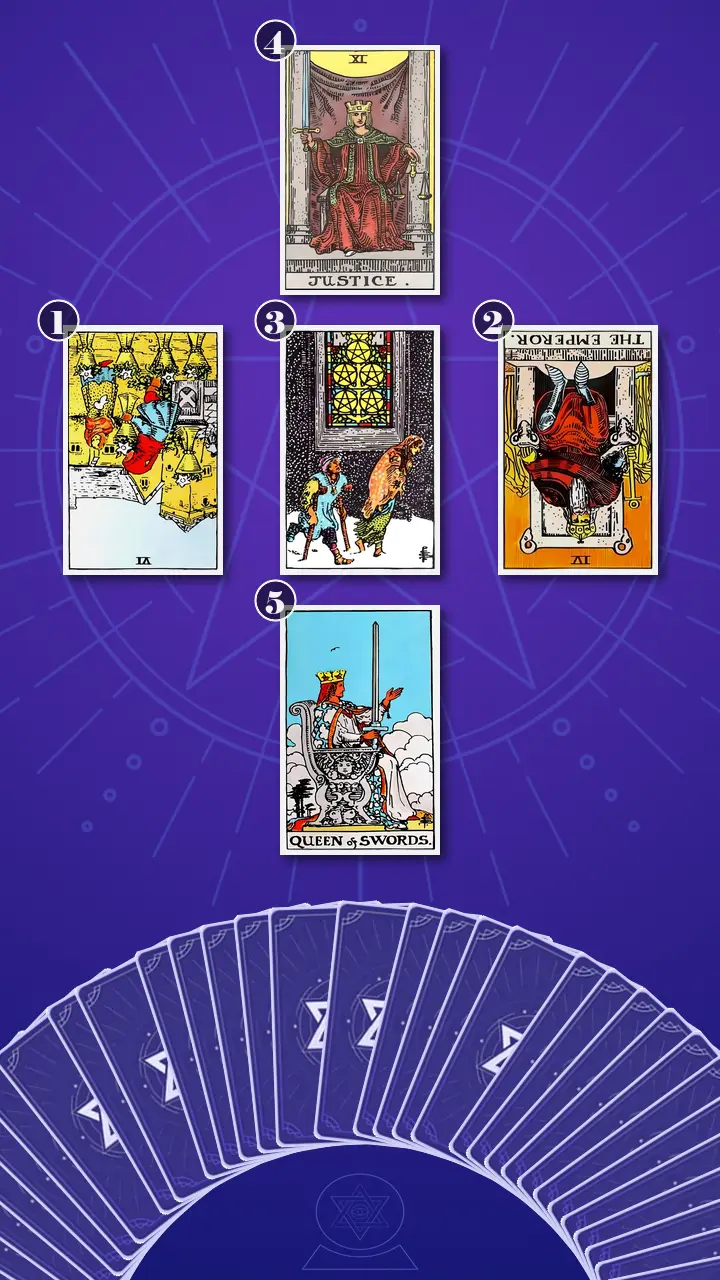
The Old Chat Thread Loads First
The Present Stance: Six of Cups, Reversed
I began at Position 1, which shows the presenting problem: the observable moment when Casey approaches no-contact and feels reduced from an autonomous adult to the family's child. The card was the Six of Cups, in reversed position.
I asked Casey to look at the smaller figure receiving the flower-filled cup in the enclosed old-town courtyard. The scene holds a familiar emotional world, one in which the available roles were established long ago. Reversed, the water of memory is not flowing freely between past and present; it is pulling the present backward. The old role becomes psychologically immediate.
I connected it to the scene Casey had described. They could leave a Thursday UX review having made a clear, evidence-based recommendation, then see a family notification before reaching the lift. The sentence I will not discuss this by phone could become I am sorry, and I hope you can understand why I might need some space before Casey had even decided whether to reply. It was like opening one old chat thread and having an adult account load with childhood permissions.
The reversed energy here was a blockage, not a deficiency. Casey's adult capacity had not vanished. The trigger simply overrode access to it for a few minutes, then invited a familiar defence: reread the old exchanges, gather screenshots, soften the limit, and make the explanation acceptable before trusting the need beneath it. I said, You can feel like their child without handing that feeling the final vote.
Casey gave a short laugh with a bitter edge. Their mouth tightened immediately afterward, as though they regretted letting the recognition show. They said, That is exactly what happens when their name appears. I thought I was indecisive, but this is the exact moment I stop sounding like myself. Their fingers, which had been worrying the edge of a card, went still.
I did not ask Casey to perform instant independence. I asked a narrower question: What changes first when the notification arrives: your words, your body, or your certainty? Casey touched their throat and answered, My body. Then the wording follows. That distinction mattered. A bodily return to an old relational state could be noticed before it became a long defence.
The Occupied Chair: The Emperor, Reversed
I moved to Position 2, which reveals the internalised parental authority Casey consults when judging whether a boundary is legitimate. This position does not claim to know what anyone in the family privately thinks. It shows the authority Casey experiences inside the decision. The card was The Emperor, in reversed position.
The stone throne was immovable, the red robe guarded by armour, and the mountains behind it were dry and difficult. I described an internal design review in which an absent stakeholder had been given permanent veto power. Before Casey could ask what they needed, the imagined family verdict was already sitting at the head of the meeting: dramatic, ungrateful, too sensitive, unreasonable.
At the kitchen table, Casey wrote a direct limit and then expanded it into a defence for that invisible judge. The Emperor reversed showed authority functioning as domination or unstable permission rather than responsible self-governance. It was like a legacy admin account still controlling a system after its rules had stopped serving the current user. The energy was rigid and borrowed, so every attempt to reclaim authority risked swinging into an equally rigid final message simply to prove that Casey could not be controlled.
I said, Before I ask what I need, I hear what they would say about it, and Casey finished the sentence quietly: Yes. And I treat that imagined answer as more real than what has actually happened.
I watched a brief three-part reaction move through them. First, their breath caught and one hand tightened around the phone even though no new notification had appeared. Then their eyes lost focus, as if the internal meeting had become visible and old conversations were replaying on the wall behind me. Finally, Casey exhaled through their nose and let their hand open. Their chest was still tight, but the family verdict no longer looked like an objective fact; it looked like a chair someone had installed inside the room.
I told Casey that the card was not an accusation against their family and not an instruction to reject every form of structure. The developmental question was whether structure could become self-governance: a way to make a careful choice, hold its consequences, and review it without asking an imagined authority to certify adulthood.
The Winter Window: Five of Pentacles, Upright
I returned inward to Position 3, which locates the foundation of the relationship pattern in the fear that leaving the child role could also mean losing belonging, identity, ritual, or support. The card was the Five of Pentacles, in upright position.
I placed the image of the two figures walking through falling snow beside the lit stained-glass window. One carried a crutch. The window was illuminated, but the figures' attention remained fixed on the cold path. Casey told me about imagining the first birthday or holiday after changing contact: no familiar call, no recognisable family role, and a social feed full of bright photographs that made complicated relationships look effortless.
They said, If I stop being the manageable child, I do not know who I am or what place I have in the family. Their voice dropped on the final word. The hesitation was not simple indecision, and I did not call it weakness. It was an attempt to protect against the possibility that stepping outside a painful role might also mean stepping outside belonging itself.
The Five of Pentacles brought the question down to earth. The fear was real emotional information, but it was not automatic proof that continued contact was sustainable, and it was not proof that estrangement was the only honest option. I asked Casey to name the losses each possible boundary might involve, then to name support already available: two friends who had offered holiday plans, a roommate, professional resources, and the daily competence they had been treating as irrelevant because it did not come from the family.
Casey stared at the lit window for several seconds. Their shoulders lifted as though bracing for a cold that had not entered the room, then lowered on a long breath. They did not look relieved. They looked less alone inside the dilemma. I said, Grief is evidence of a cost, not automatic evidence of a mistake.
The card's catalyst was simple and uncomfortable: if Casey could name the belonging fear directly, they would no longer have to disguise it as a wording problem. They could plan for loneliness, ask for support, and still evaluate contact by what it did to their present life.
When Justice Put the Scales in Casey's Hands
The Active Challenge: Justice, Upright
The room seemed to become quieter as I turned Position 4, the card that clarifies the current relational challenge: evaluating the no-contact threshold through present evidence, values, accountability, capacity, and support rather than anticipated family approval. The card was Justice, in upright position, and it was the key card of the reading.
I began with the practical image. I asked Casey to imagine closing the old message archive and opening a one-page review with four columns: what contact observably does to time and functioning, which values a limit would protect, what support is available, and which consequences Casey can realistically hold. Justice did not choose between a pause, reduced contact, channel limits, no-contact, or continued contact. Justice asked for a proportionate choice that Casey could understand and own.
At this point, I used my Generational Trauma Excavation lens. I use that phrase carefully. It is not a diagnosis, a declaration that I know the family's history, or an excuse to turn relatives into villains. It is a way of tracing repeated behavioural loops across generations so the person standing in the present does not mistake an inherited rule for a personal defect. In Casey's case, I was looking for the rule that said a good child must explain, soften, and obtain approval before taking distance. Naming a possible loop removed blame without removing responsibility for the next adult choice.
At 11:40 p.m., the boundary draft was still open beside the family thread. Casey had deleted I have decided and typed I hope you understand. I watched their throat tighten, as though one disputed sentence could revoke the adult life they already ran. They were not lacking information; they were trying to make disagreement impossible before allowing themselves to act.
I placed my finger beside Justice's scales and gave the central card its sentence:
You are not the child waiting to be declared reasonable; you are the adult who can weigh the evidence, name the consequence, and hold Justice's scales without handing them back.
I let the silence do some of the work. Then I offered the shorter formulation I wanted Casey to carry into the week:
Feeling like their child is an old relational state, not a present-day instruction. You do not need an unarguable case; you need a boundary you can evaluate, choose, and own.
For one beat, Casey stopped breathing. Their fingers hovered above the phone, and their face went blank except for a slight widening around the eyes. Then their gaze moved away from the card and settled somewhere beyond my shoulder, as if the sentence had opened a hallway through several old conversations. Their jaw tightened, and they said with sudden sharpness, But then does that mean I have been wrong all this time?
I did not rush to turn the anger into relief. I answered, No. It means you have been using the tools that once helped you stay connected: explaining, anticipating, and making yourself understandable. Those tools may now be costing more than they protect. Casey looked back at Justice. I saw their shoulders begin to descend, though one hand still held the phone as if it might issue a verdict. Their eyes grew wet. They pressed their lips together, released them, and let out a shaky breath that sounded almost like a laugh. The release brought a small, dizzying blankness with it. A clear path can feel vulnerable when no one else is standing at the front of it. Casey whispered, So they can disagree, and I can still ask what the evidence requires of me.
I invited them to look back at the previous week: Now, with this new perspective, can you remember one moment when separating grief from instruction might have changed what you did next? Casey remembered a message they had reread for two hours instead of finishing dinner. The new view did not erase the hurt. It gave the hurt a different job.
This was the first movement from contracted child-role disorientation and approval-seeking toward evidence-based adult self-trust and boundary ownership. It was not certainty, and it was not a prediction. It was the moment Casey's own criteria entered the room and remained there.
The Boundary That Does Not Need a Closing Argument: Queen of Swords, Upright
I turned to Position 5, which translates the reading into adult-self integration: a clear, self-owned boundary practice Casey could choose, communicate, support, and review. The card was the Queen of Swords, in upright position.
The Queen held her sword upright while her other hand remained open. I saw precision and receptivity together. Her sword did not require emotional numbness, and her open hand did not surrender the limit. In modern terms, this was like changing app permissions: the setting describes what access is available and what response Casey will make. The app does not have to agree with the setting for the setting to be real.
I returned to the six-paragraph draft. I asked Casey to reduce it to three fields: the limit, its scope or review period, and the action Casey controlled if the limit was crossed. A private draft might read: I am not available for phone calls until this date. I will not discuss this decision by phone. I will revisit contact on this date and decide what support I need before then. The wording could change according to Casey's actual choice. The point was that it described Casey's conduct instead of prosecuting the family's character.
The energy here was balanced Air: clear thought becoming clear communication. The Queen did not tell us to send the message immediately. She allowed a pause, reduced contact, channel limits, no-contact, or another reviewable choice to remain available. She also made room for support before communication, especially if a boundary carried housing, financial, legal, immigration, caregiving, or physical-safety consequences.
Casey's shoulders dropped farther. They rubbed their palms over their knees, then looked at the draft with a tired, almost practical expression. Clear does not mean cold, and sad does not mean uncertain, I said. Casey nodded once, not with the bright certainty of someone who had solved a life, but with the steadier recognition of someone who had found a sentence they could stand behind.
Finding Clarity in the Evidence Room
I read the five cards as one movement. The Six of Cups reversed showed the old emotional script loading into a present decision. The Emperor reversed showed why the script felt compulsory: an imagined family verdict had been given permanent veto power. The Five of Pentacles exposed the cost underneath the argument, the fear that leaving a familiar child role might also mean losing identity, ritual, and belonging. Justice then placed the question in Casey's hands, and the Queen of Swords offered language for carrying the answer without turning grief into a prosecution.
The elemental sequence supported that reading. Water began trapped in the past. Earth made the practical and relational fear visible. Air arrived through Justice and the Queen of Swords as proportionate reasoning and precise communication. There were no Wands in the spread, which told me that forceful action was not the first missing ingredient. Casey did not need to push harder. They needed to acknowledge the belonging wound, define their criteria, arrange support, and let action follow a decision that was actually theirs.
I described the core metaphor plainly: Casey had been standing at a border with an adult passport while waiting for the family to authorise departure. The passport was already evidence of a life they ran every day. The problem was not that the border guard possessed the truth; it was that Casey kept walking back to the counter with a longer explanation, hoping the guard would stamp their permission to leave.
The Layers Beneath the Message
My second diagnostic lens is Inherited Belief Stratigraphy. On an archaeological site, the surface layer may contain the newest debris, while deeper layers show older structures that still shape where people walk. I invited Casey to examine the boundary draft in the same way. The screenshots and recent messages were the top layer. Beneath them might sit older rules such as a good child explains everything, distance must be justified, or if someone disagrees, I have lost the right to choose.
I did not ask Casey to treat every family tradition as obsolete, nor did I ask them to erase affection or history. I asked which values were genuinely theirs: honesty, rest, reciprocity, emotional capacity, safety, dignity, or a wish for limited connection. Then I asked which fear-based rules had been handed down, repeated, or absorbed so early that they now sounded like common sense. Separating authentic values from inherited dogma was the work of becoming an adult authority without pretending the past had never mattered.
I called the practical exercise The Lineage Artifact Review. It was an intellectual exercise, not a mystical command. Casey could consciously preserve a tradition that still supported their values and permanently bury an obsolete rule that required self-abandonment or family approval. The review did not dictate no-contact. It simply made the decision criteria visible before another person had a vote.
The blind spot was now clear. Casey had been treating guilt, grief, and the possibility of disagreement as evidence that the boundary was invalid. They had also mistaken a more detailed explanation for a more accurate decision. I said, A boundary is not an argument you win; it is a limit you understand and own. The direction of change was from borrowed permission to accountable choice: weigh observable impact, values, current capacity, available support, and consequences the adult self can responsibly hold.
Small Steps Before Any Send Button
I offered Casey actionable advice in small pieces. Nothing on the list required an immediate final decision, and none of it required Casey to prove that a family member was bad. The purpose was to create a little room between the notification and the response.
- The Eight-Minute Adult Evidence / Child-Role Fear SplitOn one sheet of paper, set an eight-minute timer. On the left, write up to five brief observations about what contact has done to sleep, concentration, time, body tension, or daily capacity. On the right, complete once: If I stop being the manageable child, I fear... Then use The Lineage Artifact Review to mark one inherited rule you may want to bury and one authentic value you want to preserve. Do not send or revise a family message afterward; close the page for twenty-four hours.If eight minutes feels too large, write one observable fact and one child-role fear. Phrases are enough. The fears contain information about grief and support needs, but they do not have to function as instructions.
- The Five-Minute Contact Impact LedgerCreate a Notes app entry titled Contact Impact Ledger with four headings: observable effect, value at stake, current capacity, and available support. After the next family interaction or non-urgent notification, spend five minutes recording what happened and what followed over the next hour, without assigning motives. Choose a review date seven days away and collect no more than one dated entry per interaction.Include neutral or positive effects when they genuinely occur. The ledger is for discernment, not a prosecution. A single dated entry is the minimum version, and reviewing it does not obligate you toward no-contact, reconciliation, or any other outcome.
- The Preference-Before-Feedback PauseBefore deciding whether to answer one non-urgent family message or take one call, write in the Notes app: My current preference is... because... Wait ten minutes before asking a friend what they think. If you do ask, say: Can you help me notice practical consequences I may have missed? I am not asking you to decide for me.Disagreement does not automatically erase your preference. If the boundary could affect housing, money, legal status, immigration, caregiving, or physical safety, seek appropriate practical support before communicating.
After the review period, Casey could draft only the limit, scope, and response they were prepared to own. They could choose whether to send it, revise it, or keep it private while gathering more support. That was the difference between an approval-free boundary review and another attempt to write a perfect case. A boundary could be clear without being final forever, and reviewable without being uncertain.
I reminded Casey that tarot was not the source of their authority. The spread had helped us place images around a pattern that their body and daily life already knew. The decision would belong to Casey, and support could steady the decision without replacing it.

A Small Proof in the Morning Light
A week later, Casey texted me from a café near their studio. They had chosen a seven-day pause, told a trusted friend what support might help, and used the Contact Impact Ledger after the next notification. They had not sent the six-paragraph defence. They had written one private sentence and left it alone.
The change was small but visible. A family notification still tightened Casey's throat, and the first thought the next morning was still What if I am wrong? This time, they noticed the thought, smiled faintly, and opened the ledger instead of the family thread. The clarity was real because it did not require the fear to disappear first.
For me, that was the first evidence of the Journey to Clarity: not a perfect answer, not a dramatic severing, and not a promise that grief would end. It was Casey moving from contracted child-role disorientation and approval-seeking toward evidence-based self-trust, proportionate accountability, and an adult-owned boundary.
When their name lights up and your throat closes around a sentence you can say easily anywhere else, the hardest part is not only choosing distance; it is fearing that adult authority could cost you your place in the family. You can honour that fear without allowing it to write the whole future.
If your own evidence could hold Justice's scales for one quiet minute, what boundary would you be curious to name to yourself before anyone else gets a vote?