Shrinking Into the Child Role: Lead One Family Task Without Permission

The 8:47 PM Family Group Chat
You can run a nonprofit operations calendar from a Toronto coworking desk, but when a parent texts, "Can you organize the family plan?" you turn your clear call into six tentative options and feel the very specific panic of family leadership anxiety.
I met Jordan with that exact message still open on her phone. At 8:47 PM on a Tuesday, she had been riding the TTC Line 1 home, the phone warm against her palm while the fluorescent carriage lights buzzed overhead. She already had a plan typed in her Notes app, but her shoulders had curled inward before she answered, as if the family group chat had quietly transported her into an older version of herself.
She looked at me and said, "I can organize everyone else's pieces, but I freeze when they call it leadership." Then she gave a small, embarrassed laugh. "I keep waiting for permission to become the person they are already asking me to be."
I could see the contradiction in the way she held herself. At work, Jordan managed complex nonprofit logistics, ran meetings, and kept several moving parts from colliding. Around her family, a straightforward request for structure became a referendum on whether she was allowed to occupy an adult role. The desire to lead was present. So was the pull to shrink into the child role.
Her self-doubt did not look like an abstract cloud. It worked like a hidden hand lowering the volume on her own voice before anyone else had a chance to disagree. Her throat tightened, her breathing shortened, and each possible sentence seemed to require an older person's approval stamp.
I told her that I was not going to use tarot to declare what her family meant or predict how anyone would respond. I wanted to use the cards as an objective thinking tool, a way to separate the current responsibility from the old role being activated. "We can draw a map of the pattern," I said, "and then decide which part of the map you want to walk differently. That is our Journey to Clarity."

Choosing a Compass at the Family Crossroads
I asked Jordan to put her phone face down, take one unforced breath, and hold one question in mind: why did a family request to lead make her smaller? As I shuffled, I described the preparation as a focus exercise rather than a supernatural test. The pause gave her nervous system a clear beginning and gave both of us something concrete to examine.
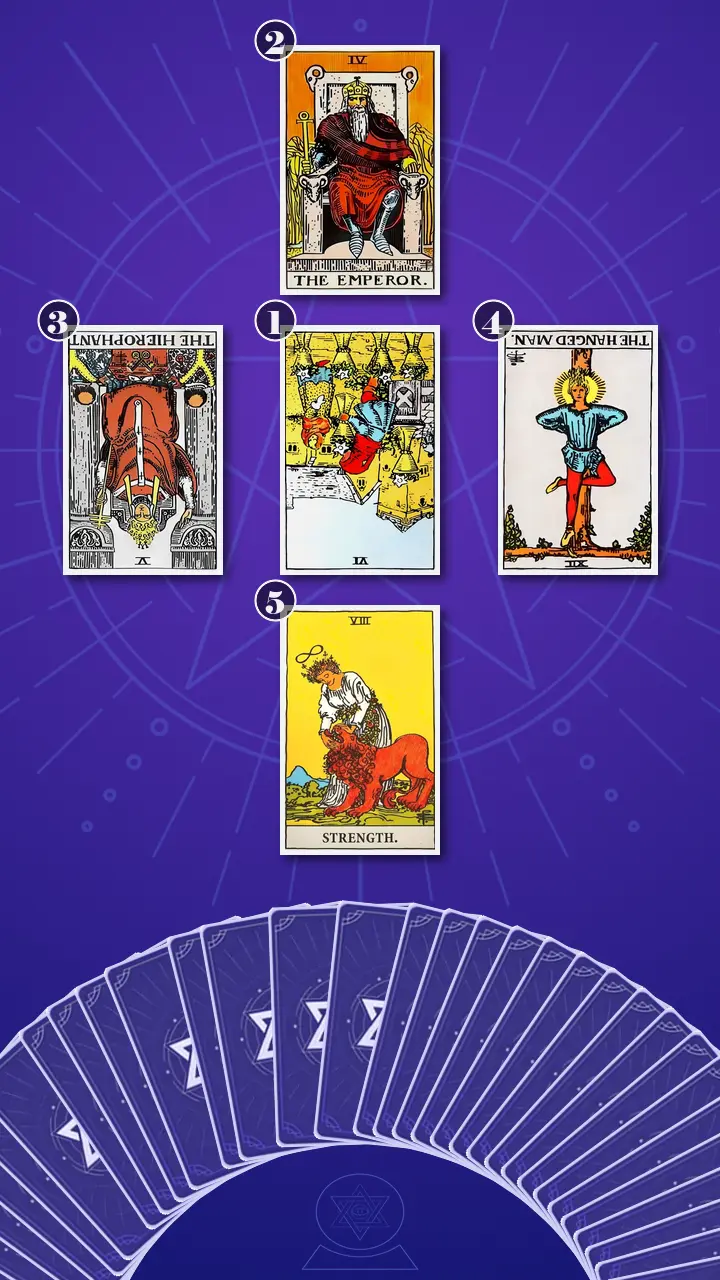
I chose the Relationship Spread · Context Edition, a five-position relationship tarot spread for family-role dynamics. This structure suited the question because the difficulty lived inside an interaction, not in a general prediction about Jordan's future. It could show her immediate response, the family leadership field, the inherited role script, the hidden mechanism that kept her suspended, and the constructive response available to her.
This is how tarot works in a reading like this: traditional card meanings provide the visual language, while the position and the real-life details provide context. The center would show the contraction itself. The card above it would show the family leadership trial. To the left, I would look at the rule Jordan had inherited; to the right, the pause that maintained the pattern. Below everything, one card would point toward actionable advice and practical next steps.
The layout was a crossroads with a stable center. I wanted Jordan to see that the family request could activate her identity without becoming the center of her identity. The cards could clarify the pressure, but Jordan would remain the person choosing what to do with that clarity.
The Role Is Familiar; the Responsibility Is Current
The Flower-Filled Cup That Pulled Backward
I began at the center. This position shows Jordan's immediate self-response to a family request for leadership, including the observable shrinking behavior and the contracted emotion identified in the diagnosis. I turned over the Six of Cups, in reversed position.
In the Rider-Waite-Smith image, one child offers another a flower-filled cup while a cloaked adult figure recedes toward a village in the background. Reversed in Jordan's Self position, the card showed her with a finished family plan open on her phone, searching old messages for clues about how an older relative usually decided things. The village became the familiar family hierarchy. The adult walking away became the part of her agency she temporarily left in the background.
The energy here was a backward-flowing emotional current, a blockage rather than a bad omen. When family attention turned toward Jordan, familiarity overpowered the present task. She softened a recommendation into, "Would it make sense if..." or wrote, "Whatever works for everyone," even when she knew which option was practical. The role was familiar; the responsibility was current. The first useful question was, "Which part of this response belongs to today's decision, and which part is replaying an earlier family position?"
I also named the card's overcorrection risk. Jordan did not need to prove she was no longer the child by taking over every detail, rejecting every suggestion, or becoming the only person allowed to decide. The invitation was smaller: notice the old permission cue without obeying it, then make one bounded recommendation.
For a beat, Jordan's breath stopped. Her fingers tightened around the edge of the chair. Then her eyes moved from the flower-filled cup to the screenshot on her phone, as if an old message had started playing again. Finally, she gave a dry, bittersweet laugh and said, "That's too accurate. Almost rude."
I smiled, but I did not push her toward a forced agreement. "We do not have to make the younger role wrong," I said. "It learned a way to lower tension. We are only checking whether that strategy still needs to run the meeting." Her shoulders remained lifted, but her gaze stayed on the card instead of escaping to the floor.
The Stone Throne Was Not a Crown
The position above the center represents the Family Leadership Trial: the relational field's request for structure and authority, without deciding what any relative intends or should do. I turned over The Emperor, in upright position.
The Emperor's stone throne, ram-headed armrests, squared posture, red robes, and distant mountains made authority visible. Jordan told me that a parent or sibling might write, "Can you organize this?" in the family chat, and she would hear something much larger: "Now prove you are the adult in charge." The upright energy could offer structure, but because it sat above the reversed Six of Cups, it also activated the hierarchy that made her body feel watched.
I compared the card with her nonprofit work. At the office, Jordan could set an agenda, name an owner, and clarify the next step without pretending to possess every answer. She was not the board of directors because she organized a meeting. She was the project owner for one defined piece. In the family field, she was adding an invisible crown to an ordinary coordinating task, then becoming afraid of the weight of it.
I asked her to listen for the two sentences underneath the hesitation: "If I take charge, they will judge me; if I wait, no one can say I chose wrong." The Emperor offered a more accurate translation of leadership: set the process, state the recommendation, make the scope visible, and let other people retain their own choices. Asking for input is not the same as handing back the wheel.
Jordan paused and nodded once. I watched her take out her phone and change the word authority in her notes to clear responsibility. The family request had not become harmless or magically simple, but the imagined role had become smaller. She said, "Maybe the task is smaller than the role I am trying to prove."
The Crossed Keys of an Inherited Rule
The position to the left reveals the role script between Jordan and her family, especially how familiar authority rules turn adult responsibility into suspended direction. I turned over The Hierophant, in reversed position.
The Hierophant's raised teaching hand, two kneeling acolytes, and crossed keys at the base of the throne formed an unmistakable image of permission and sanctioned knowledge. Reversed here, the card pointed to an inherited rule that Jordan was beginning to question: perhaps the oldest or most established relative should have the final say, or perhaps being respectful meant never making a visible call.
The energy was not a command to reject family tradition, and it was not evidence that every relative was trying to control her. It was a blockage in the family map. Jordan had been treating two options as if they were the only ones available: obey the old authority structure automatically or reject the whole structure and risk disconnection. The card opened a third possibility, one she could choose for herself: "I can lead my part and still hear other views."
I asked, "What adult value would you keep if you stopped borrowing the family's permission system?" Jordan looked down at the crossed keys. Her thumb traced the seam of her notebook, and she said, "Respect, but not automatic surrender. I want the conversation to stay mutual."
That answer mattered because it came from a chosen principle rather than a reaction. She was not trying to become an unquestionable authority. She was beginning to renegotiate what adult participation could mean while keeping connection and self-direction in the same room.
The Message Stuck Between Stations
The challenge position identifies the hidden mechanism that keeps Jordan suspended when the child role is activated. I turned over The Hanged Man, in reversed position.
The upside-down figure, bound foot, crossed leg, and calm halo usually suggest a deliberate pause that creates a new perspective. Reversed in this position, the pause had stopped producing perspective. It had become a family message left in draft mode while the cursor blinked and the list of possible replies kept growing.
Jordan described comparing restaurant options, transit times, weather, backup plans, and the perfect wording long after she had enough information to offer a next step. More browser tabs accumulated beside older family messages. She told herself, "I am still thinking, so I am being careful." Then the more uncomfortable question arrived: "But am I waiting for certainty so I do not have to be visibly responsible?"
I recognized the distinction from my years on Wall Street. A position can be held while information is gathered, but a hold needs a reason and a review time. Without those, waiting is not neutral; it quietly increases exposure. I brought that same strategic logic into the room with care. Preparation stops being support when it is used to postpone a visible choice.
Jordan's finger hovered over the family thread. First, her breathing paused and her shoulders lifted toward her ears. Then her eyes went unfocused, replaying the moment someone had asked, "So what do you think we should do?" Finally, her jaw loosened and she let out a low breath that sounded almost like a reluctant confession. "I thought the extra research was protecting everyone," she said. "But it may have been protecting me from finding out whether I could trust myself."
I told her that the card was exposing a protective pattern, not delivering a verdict about her character. A provisional recommendation would not be a permanent statement about her identity. It would be a small experiment that let action create information.
When Strength Put a Hand on the Lion
The room grew quiet as I reached the grounding position beneath the center. This advice and integration position translates the target shift into a bounded action: leading while remaining open to input, rather than asking permission to occupy the adult role. I turned over Strength, in upright position.
The Rider-Waite-Smith woman resting her gentle hand on the lion's jaw, the infinity symbol above her head, and the white robe threaded with roses offered a different picture of authority. It was not the Emperor's stone solidity or a demand to dominate the room. It was compassionate self-command. The lion could be the surge of family-role fear; the hand could be the calm sentence that lowers its volume without denying that it is there.
I used one of my most practical lenses, which I call Guilt-Debt Neutralization. I asked Jordan to audit the invisible invoice underneath the family request. If a relative felt disappointed by her recommendation, had Jordan actually agreed to pay for that feeling with her judgment? Had anyone asked her to surrender the decision, or had guilt simply been treated as proof that she owed the family obedience? I did not label anyone manipulative. I treated the imagined emotional debt as unverified bad debt, something to examine and dismiss when it was not supported by an actual agreement.
I translated the card into one ordinary sentence: "I recommend Saturday at 2 PM; let me know about conflicts by Thursday." That was the gentle hand. It acknowledged the younger part, held a clear boundary, and left a genuine opening for information.
I asked her to picture the exact moment that had brought her into my office. "Picture 8:47 PM on the TTC Line 1 train: your phone is warm in your hand, an unsent family message says "Can you take the lead?", and your shoulders curl before you have even answered. You already have the plan; what you are waiting for is permission."
Then I said, "Leadership can be a bounded contribution, not a performance of unquestionable adulthood. You can name one recommendation, hear the room, and keep responsibility for your part without asking your family to certify that you belong in it."
Do not treat leadership as proof that you have outgrown your child role; use Strength's gentle hand on the lion to acknowledge the younger part, state one clear boundary or recommendation, and let dialogue follow.
Jordan's finger remained suspended above the screen. Her pupils widened, and for a second her face held the stunned blankness of someone hearing an old rule from a new distance. Then her clenched hand opened against her knee; the muscles at the base of her neck softened, and a faint flush touched the corners of her eyes. Outside, a streetcar bell sounded once and faded. She swallowed, breathed in unevenly, and released the breath with a small tremor. The relief did not arrive as triumph. It arrived with a brief, dizzying emptiness, the strange responsibility of having a clear path where an excuse had been. "So I do not have to prove I am grown," she said quietly. "I can stay connected to the younger part without handing it the decision." I let the silence hold for another moment, then asked, "Now, use this new perspective to remember whether there was a moment last week when this insight might have let you feel different."
I gave her a ten-minute experiment. She could write one sentence beginning, "My recommendation is..." and a separate question beginning, "What am I missing?" She could keep both private, send them later, or stop if the exercise felt too activating. The boundary was simple: input could inform her part, but it did not decide whether she was allowed to have a part.
This was the first visible movement from role-triggered contraction, permission-seeking, and suspended agency toward compassionate bounded leadership and steadier adult self-trust. The younger role did not need to disappear. It only needed to stop being the person holding the steering wheel.
A Small Map for Bounded Authority
When I laid the five cards together, they told a coherent story. The reversed Six of Cups showed the old emotional current drawing Jordan backward. The Emperor showed the present family request for structure, which she had inflated into a demand for total authority. The reversed Hierophant revealed the inherited rule about who was permitted to have the final say. The reversed Hanged Man showed how over-preparation lowered immediate tension while keeping her outside visible participation. Strength offered the resource already available to her: patience, regulation, and one calm act of adult responsibility.
Jordan's cognitive blind spot was not a lack of leadership ability. She was mistaking a bounded choice for an identity trial. She believed that disagreement could prove she was pretending to be an adult, so she kept searching for a version of the plan that nobody could challenge. The transformation direction was therefore precise: separate leadership from permission by making one bounded recommendation, inviting specific input, and keeping responsibility for her defined part without asking her family to certify her adulthood.
I used my Family Power Dynamic Decoding lens to keep the reading grounded. I look at where authority becomes concrete and where resources or emotions might become leverage, but I do not invent hidden motives. Jordan had not described money, housing, inheritance, or deliberate financial pressure, so I did not project those dynamics onto her relatives. The observable leverage points were approval, guilt, silence, and vague ownership. Naming those points gave her a map without turning her family into an enemy.
For the practical next steps, I called my approach The Strategic Disengagement Plan. That name does not mean cutting contact or making independence a moral victory. It means creating clear financial and emotional boundaries when those subjects genuinely arise, reducing the points where an old role can pull Jordan back into permission-seeking, and defining exactly what she will coordinate. In this case, the plan was one task, one response window, one invitation for useful input, and a clear option to pause an overwhelming exchange without abandoning the whole relationship.
The One-Corner Leadership Practice
These were my actionable advice notes for Jordan. I kept them deliberately small because clarity becomes trustworthy when it survives contact with an actual family group chat.
- Write the permission-free recommendationBefore the next family planning message, use two minutes in the Notes app to write, "I recommend [specific option] because [one practical reason]." Post it in the relevant family chat or read it on the next call. Add one contained question, "What am I missing?" Invite information without asking an older relative to approve the entire decision.If disclaimers start multiplying, keep the recommendation to one sentence. Jordan could send it later or pause the exchange if it became too activating.
- Define the part I ownFor one upcoming family task, choose a narrow responsibility such as selecting a date, collecting responses, or setting the agenda. Write three lines: "I own," "I need input on," and "I do not own." State the boundary at the beginning of the conversation so everyone can see the scope.A family itinerary needs one person to coordinate the route, not one person to control every passenger. If the role expands without agreement, Jordan can say, "I can coordinate this part, but I cannot decide that part for everyone."
- Use a 20-minute provisional decisionChoose one family decision and compare the available options for 20 minutes using only the information already in hand. Send or prepare a recommendation with a review point: "This is my best call for now; we can revisit it Thursday if a real conflict comes up." Afterward, record what she chose, what input she received, and what she learned.Label the choice provisional, not permanent. The goal is to let action create information, not to grade Jordan on whether everyone agrees.
The point was not to become fearless, win a family power struggle, or solve adult-child role confusion in one message. It was to practice clear responsibility without control. Asking for input could remain part of the relationship while the responsibility stayed with the person who had agreed to hold that defined piece.

The Message That Stayed a Statement
Six days later, Jordan sent me a message from a Toronto cafe: "I recommended Saturday at 2 and asked for conflicts by Thursday." The family thread had not become magically easy; her stomach still fluttered. But she had left the sentence intact, then spent the afternoon alone with coffee, relieved and a little tender.
I read the message twice. The change was small enough to be believable and important enough to matter. Jordan had not solved her family history or guaranteed anyone's approval. She had participated as an adult in a defined way, listened for useful information, and kept the decision from becoming a verdict on her belonging. That was the quiet proof.
Tarot had not made the choice for her. The cards had helped her see the old algorithm autoplaying the child role, identify the moment preparation turned into postponement, and find a gentler way to hold the fear. Finding clarity meant moving from contraction to one repeatable act of self-trust.
When a family request tightens your throat and curls your shoulders, handing the decision back can feel safer than being seen choosing; the ache is wanting adult recognition while still waiting for an old hierarchy to tell you that you belong there.
If you could let one small family responsibility be yours without making it proof of adulthood, what part of your next conversation would you feel curious to claim: the first sentence, the time window, or the hand on the wheel that says, "My recommendation is..."?