The 10:47 p.m. Golden Cage
When I met Jordan, she was the senior operations manager in London who answered a Slack request at 10:47 p.m. because being reliable felt safer than saying she wanted company. Her career looked successful from the outside: a strong salary, a comfortable flat, professional respect, and the kind of competence people described as indispensable. Inside that success, however, she was living with golden-handcuffs loneliness: being needed constantly, but rarely feeling known.
She described the Tuesday evening that finally brought her to me. Dinner sat untouched on the kitchen counter while the extractor fan hummed above it. The laptop warmed her fingertips as she clicked between an approved report and Slack, changing three headings no one had asked her to change. Each time her phone vibrated against the wood, she hoped it was someone asking how she was. Each time it was work, her shoulders grew heavier.
Three personal messages remained unopened. One was from a friend who had written, “How are you, really?” Jordan knew she could answer a colleague’s operational question in under a minute. Answering her friend would mean admitting that she did not want to spend another evening alone.
“I know they value me,” she said, keeping her eyes on the edge of her mug, “but I’m not sure they know me. It feels irresponsible to be unhappy when everything looks this good. Why stay useful in a golden cage that leaves me lonely?”
I heard the resentment in the last sentence, followed almost immediately by the guilt that tried to take it back. Her loneliness seemed to occupy her chest like a brightly lit office after everyone had gone home: secure, functional, and built for people who were no longer there.
“You do not have to prove that the comfort is false before the loneliness becomes valid,” I told her. “A comfortable life can still contain an uncomfortable truth. We are not here to force a stay-or-leave verdict tonight. We are here to map what keeps repeating, what it protects, and where you still have choice.”
I asked her to hold both truths at once: the stability was real, and the loneliness was real. Our Journey to Clarity would begin there, without blaming her for needing either security or connection.

Choosing the Keyhole: The Five-Card Shadow Spread
I invited Jordan to close the report, turn her phone face down, and take one slow breath before I shuffled. I use this pause as a change of attention, not as a mystical performance. It helps a question move from the speed of Slack into a quieter space where its assumptions can be examined.
I chose the five-card Shadow Spread. In my practice, this is how tarot works best: not as a machine that predicts what someone must do, but as a structured mirror that makes an internal pattern visible. The card meanings in context help us distinguish behaviour, belief, protection, neglected capacity, and action.
This question sounded like a career crossroads, but Jordan had not brought me two concrete job offers to compare. A two-path reading could have reduced everything to staying or leaving before we understood why the arrangement remained so compelling. The Shadow Spread was better suited to the usefulness-for-worth pattern beneath the surface.
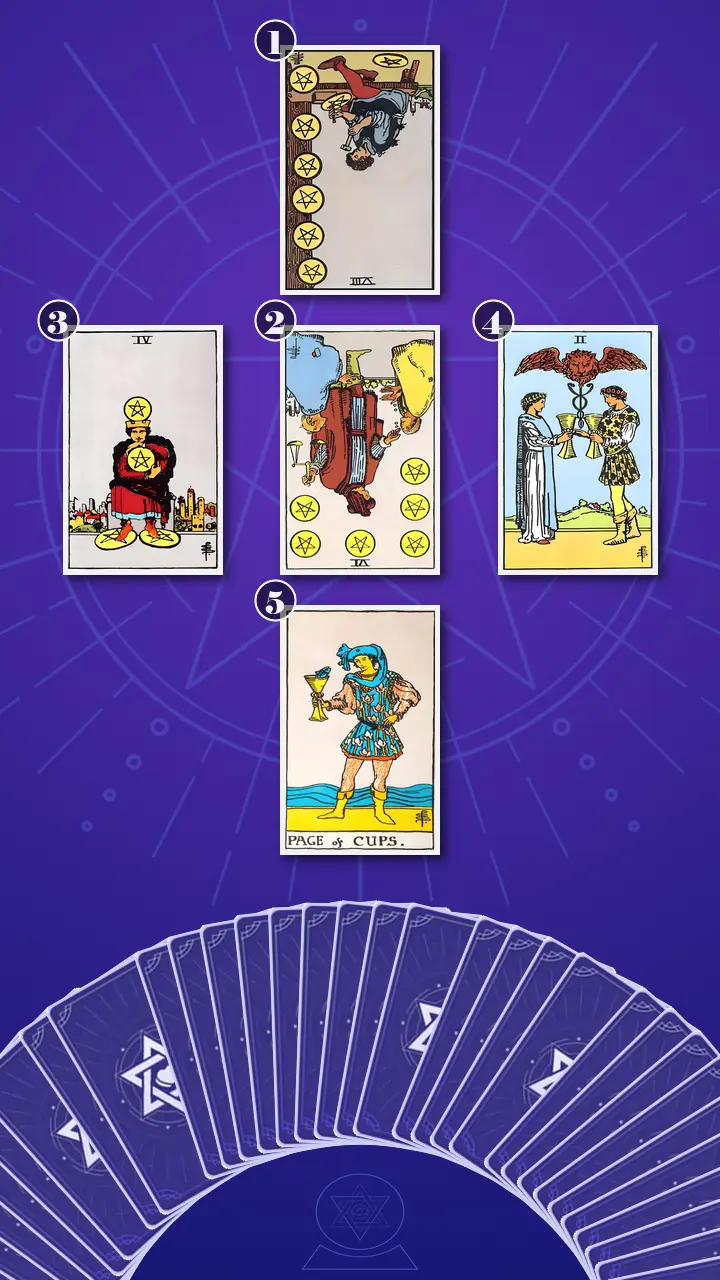
I laid the cards like a keyhole. The first would show the visible overfunctioning. Beneath it, the second would uncover the concealed bargain between usefulness and belonging. The third would name the security that made the pattern difficult to loosen. The fourth would reveal the integrating alternative, and the fifth would turn that insight into one small experiment.
I told Jordan that none of these cards could decide whether she should quit her job, change her friendships, or trust a particular person. They could help us ask a more useful question first: “What if the next honest step is neither leaving the cage nor defending it, but discovering whether one relationship can hold you without requiring a performance?”
Reading the Hands That Never Stop Working
Position 1: The Report That Was Already Finished
I turned over the card representing the observable symptom: Jordan repeatedly proving competence, accepting unnecessary work, and substituting productivity for emotional contact. It was the Eight of Pentacles, reversed.
In the image, the craftsperson’s head remains lowered toward the next pentacle while the town sits at a distance. I asked Jordan to notice the hands: skilled, disciplined, and always occupied. Her competence was not the problem. The reversed energy showed excess and blockage, with useful diligence spilling into compulsive refinement until no clear stopping point remained.
I brought the card directly into her London kitchen. At 10:47 p.m., she had reopened an approved report, changed three headings, and checked Slack for another request. The work was real and her skill was real, but the repeated polish postponed answering the friend whose message would require her to say she did not want another night alone.
“The inner script often sounds reasonable,” I said. “‘I’ll just finish this one thing.’ But underneath it, another question waits: ‘Why does finishing never bring the feeling of being finished?’”
The split had a familiar Severance quality: a highly capable work self remained active under the laptop glow while the person outside that role waited for permission to exist. I asked Jordan whether the next hour of work served the task itself or merely reassured her that she was still needed.
She gave a short, bitter laugh. “That’s so accurate it feels a bit cruel.” Her fingers tightened around the mug before she added, “I’m not working because the report needs me. I’m working because stopping leaves me alone with myself.”
“Then we will not make competence the villain,” I replied. “We will give it a boundary. The goal is not to become less capable. It is to stop asking capability to perform the job of company.”
Position 2: The Invisible Relationship Scorecard
I turned over the card representing the concealed root: the belief that care and belonging must be purchased by giving more than is received. It was the Six of Pentacles, reversed.
The scales above the exchange immediately changed the tone of the reading. Upright, this card can describe the circulation of resources. Reversed, its energy becomes imbalanced: generosity may contain an unspoken request, giving may preserve hierarchy, and the person who appears to need nothing may quietly measure whether anyone chooses them back.
I described a recent voice note from one of Jordan’s friends. The friend had been dealing with a breakup. Before Jordan said anything about her own evening, she had found a therapist directory, suggested a budget, and drafted a practical plan. Later, she watched the friend’s reply time and felt resentful when the gratitude did not feel like closeness.
“This card is the friendship version of an invisible expense tracker,” I said. “Advice given, introductions made, late messages answered, favours completed. The hidden line beneath the total reads, ‘If I make myself useful, they will notice that I need them.’ But did they ever receive a clear request they could freely answer?”
Jordan’s throat moved as she swallowed. “I don’t expect payment for helping people,” she said quickly. Then her gaze shifted away from the card. “But maybe I expect them to understand what the helping means.”
I told her that this did not make her generosity manipulative. It meant an intelligent protective strategy had become too indirect. If she solved the other person’s problem before naming her own need, they could respond to her labour, but they could not knowingly respond to the part of her asking to be accompanied.
“Being needed is not the same as being known,” I said. “And an unspoken need cannot become a fair test of reciprocity, because the other person has not been given the question.”
Position 3: What the Golden Cage Protects
I turned over the card representing the protective function of the pattern: material stability, predictability, control, and insulation from the risk of asking to be valued without performing. It was the Four of Pentacles, upright.
The figure holds one pentacle against the chest, pins two beneath the feet, and balances another above the head. The energy is stable, but its stability can become an excessive grip. What protects the body also blocks the heart; what secures the feet also prevents movement.
I pictured Jordan on a quiet Sunday, checking her bank balance and rehearsing every practical reason to stay exactly where she was: salary, title, pension, rent, benefits, promotion prospects. Those were not excuses. London rent did not become imaginary because she felt lonely. Financial security, professional identity, and routine were legitimate resources.
“This stability matters,” I said. “And this stability cannot answer every need.”
I could see her shoulders lower slightly when I refused to turn the card into an instruction to abandon everything. She had expected the reading to accuse her of cowardice or tell her that a dramatic leap was the only authentic choice.
After a decade of using the sky as a language for perspective, I have learned that a planet can appear almost motionless when its arc is larger than the observer’s frame. I thought of that as I looked at the Four of Pentacles. Jordan was not failing because she had not made a sudden career pivot. She was trying to protect resources that had taken years to build while lacking a smaller model for change.
“You do not need to smash the cage to test whether a door opens,” I told her. “First we separate what genuinely needs protection from what you are gripping because uncertainty feels personally exposing.”
When Two Cups Rose to Equal Height
Position 4: The Difference Between Being Needed and Being Known
The extractor fan clicked off, and the sudden quiet seemed to create the same open space I was about to show her in the card. I turned over the position representing the central integration: replacing usefulness-based belonging with mutual, equal, voluntarily offered connection. It was the Two of Cups, upright.
I asked Jordan to compare its hands with those in the previous cards. The Eight had worked. The Six had distributed from above. The Four had gripped. Here, two people faced one another and held their cups at equal height. Neither person stood as rescuer. Neither knelt for approval. The open space between them preserved both connection and choice.
The card’s Water energy brought balance into a spread dominated by Earth. It did not reject salary, skill, routine, or stability. It restored movement to a life in which feeling had been contained. In context, the Two of Cups was not a prediction of romance. It was a criterion for reciprocity: could Jordan state a need without first attaching a favour, a polished explanation, or a solution?
I brought her back to 10:47 p.m.: the approved report open, dinner untouched, three personal messages waiting. She had been trying to solve, “How do I make the correct life decision?” while avoiding the smaller, more exposed question, “Can I ask someone to stay?”
“Being useful can secure your role, but it cannot create intimacy on its own. Closeness begins when you name a need before offering a solution and let another person choose how to meet you.”
You do not have to earn closeness by carrying both sides of the exchange; hold out one honest cup at equal height and let reciprocity reveal itself.
I let the sentence remain between us without explaining it away.
I watched Jordan’s breath stop first. Her fingers froze above the mug, and for several seconds she seemed to be listening to something behind the room’s silence. Then her eyes lost their focus as if she were replaying a sequence of deleted WhatsApp drafts, cancelled pub plans, and conversations she had turned into advice sessions. Her brow tightened before any relief arrived. “But doesn’t that mean I’ve been doing it wrong for years?” she asked, her voice suddenly sharper. The anger passed through her face before her eyes began to shine. I told her no: it meant she had used a strategy that once made belonging feel safer, and now she was seeing its cost. Her fist loosened one finger at a time. Her shoulders dropped, but the release left her looking briefly unsteady, as though putting down a heavy bag had revealed how tired her arms were. “Then I would actually have to let people choose,” she whispered. The last word came with a trembling exhale, part relief and part fear.
“Now, with this new perspective, think back to last week,” I said. “Was there a moment when this insight could have made you feel different?”
Jordan remembered standing outside a Shoreditch pub on Friday. A friend had asked whether she was joining them. Jordan had typed that work was intense, deleted the sentence “I don’t want to go home alone,” and accepted a colleague’s spreadsheet request instead.
“What if asking is not a test of your worth?” I asked. “What if their response is information, not a verdict?”
This was where I used my Macro-Orbital Projection. I mapped the spread as a long trajectory rather than a single dramatic decision: three Pentacles cards had compressed Jordan’s world into labour, accounting, and protection; the Two of Cups opened a new orbit in which emotional information could participate. Her old orbit had taught her that usefulness was the price of admission. The next orbit did not require a resignation letter. It began with a direct bid for reciprocity.
I also identified the quiet between those orbits as a void phase. When Jordan stopped producing, distributing, or gripping, she met a blank space that felt like evidence of personal failure. Through Void Phase Identification, I reframed that blankness as a transitional interval: not proof that nobody wanted her, not a promise that every request would be met, but the necessary pause in which a new relational pattern could be tested.
No dramatic leap. No perfect explanation. No guarantee. Just two people finding out whether an honest exchange could happen.
I asked Jordan to choose one trusted person and write two messages within ten minutes. The first would be her polished version, complete with an apology, a useful update, or an offer to help. The second would simply say, “I’ve had a lonely week. I don’t need advice; would you stay on the phone with me for ten minutes?” She did not have to send either one. She could shorten the honest version, keep it in her notes, or stop if the exercise felt too exposed. The choice remained hers.
I named the shift clearly: this was the first step from proving personal worth through constant usefulness to trusting mutual care, honest needs, and freely chosen reciprocity. It was not certainty. It was relational self-trust beginning to replace performance-based belonging.
The Fish in the Unpolished Message
Position 5: One Honest Cup Is Enough
I turned over the card representing the first embodied action: expressing one honest feeling or request with curiosity before competence took control. It was the Page of Cups, upright.
The Page looks into a cup and discovers a fish emerging from it. I read that image as an underused Water energy beginning to move: an unexpected feeling appears in a space Jordan expected to manage, and she responds with attention instead of immediately making the feeling productive.
In modern life, this card looked like Jordan typing, “I have been feeling lonely and would like some company this week,” before adding a useful link, apologising for being difficult, or organising an elaborate plan. The sentence was unpolished, which was precisely why it mattered. It allowed another person to meet her experience rather than admire her presentation.
“The Page is a beginner,” I said. “It can use beginner language: ‘I am noticing...’, ‘I would like...’, or ‘Could we...?’ You do not need mastery before you are allowed to speak.”
Jordan smiled, but it was the nervous smile of someone who had just discovered that a six-word message felt more exposing than a six-page operational plan.
“Do not solve the feeling before you let someone hear it,” I told her. “One honest cup is enough to begin.”
The One-Week Redshift Map
When I drew the whole Shadow Spread together, its story was surprisingly economical. The Eight of Pentacles reversed showed Jordan maintaining her place through extra labour. The Six of Pentacles reversed revealed the hidden bargain: give first, need nothing aloud, and hope care arrives as repayment. The Four of Pentacles showed why the bargain endured, because salary, status, routine, and control offered genuine protection. The Two of Cups introduced the missing resource, equal reciprocity, and the Page of Cups reduced it to one beginner-sized message.
The cards even descended numerically from Eight to Six to Four to Two, removing layer after layer of repetition, accounting, and possession until only the simplest relational unit remained: two people meeting without a performance contract. The hands told the same story, moving from producing to distributing, gripping, offering, and finally receiving.
Jordan’s cognitive blind spot was not that she valued stability too much. It was that she treated direct need as the dangerous option while assuming indirect overgiving was safer. In reality, overgiving prevented other people from knowingly choosing reciprocity. It gave them access to her competence while keeping her actual request outside the conversation.
The transformation direction was therefore not from stability to recklessness. It was from usefulness as the price of admission to usefulness as one strength among many. Jordan could keep practical ground beneath her feet while allowing emotional truth into the decision-making system.
To make the insight observable, I gave her my Cosmic Redshift Observation. For one week, she would keep a plain note with two columns. “Redshift” would record interests, habits, and exchanges that seemed to be fading from genuine aliveness into obligation. “Blueshift” would record approaching signals of mutuality: an honest question, a respected boundary, an offered alternative, a moment when someone stayed without needing a solution. This was not a scorecard for judging people. It was data for recognising her next orbit.
- The One Honest CupBy the end of the week, choose one trusted friend or date and send: “I’ve had a lonely week. I don’t need advice; would you have ten minutes to sit on the phone with me tonight or tomorrow?” Before sending, remove any favour, apology, update, or solution attached to the request. Afterwards, record what you asked, what they freely offered, and what changed in your shoulders, throat, or chest.If sending feels too exposed, draft the polished version and the honest version in your notes first. A ten-minute call, short walk, or cup of tea is enough. Treat the response as information, not a final grade on the relationship or your worth.
- The Agreed-Standard StopChoose one routine report or deck with no safety or contractual consequence. Complete it to the agreed brief, send it by the stated deadline, and leave one optional polish pass undone. At 10:00 p.m., close Slack notifications and write one sentence about what you are doing instead, such as, “I am eating dinner while it is still warm.” The next morning, record whether respect, access, or connection actually disappeared.Run this as an observation experiment, not a confrontation. Keep the agreed brief nearby, and respond to genuine urgent issues according to your actual role. The aim is a stopping point, not sudden withdrawal.
I reminded Jordan that actionable advice should return choice, not create another task list she could use to prove herself. She was free to try one action, shorten it, postpone it, or decide that a particular person was not safe enough for the experiment. Reciprocity included her consent too.

A Week Later: Dinner Still Warm
Six days later, I received a message from Jordan. She had closed the approved report at the agreed deadline and sent one friend the honest version: “I’ve had a lonely week. Could you stay on the phone with me for ten minutes?”
The friend could not call that evening, but offered a breakfast walk the next morning. Jordan noticed the first sting of “I asked for too much,” then read the message again. It contained a limit, an alternative, and a freely chosen effort to meet her.
That night, she ate dinner while it was warm. She slept through until morning, although her first thought was still, “What if I’m getting this wrong?” This time, she smiled slightly before getting out of bed.
I did not treat the walk as proof that every relationship would become mutual or that Jordan’s career question had been solved. It was a smaller and more valuable proof: she could reveal a need without collapsing, another person could answer without being managed, and stability could remain intact while reciprocity became visible.
The cards had not created that change. Jordan had. The five-card Shadow Spread gave language and structure to a pattern, but she was the person who closed the laptop, tolerated the void, held out one honest cup, and allowed the answer to belong to someone else.
I think of clarity here not as a final verdict, but as the moment the fog thins enough to distinguish a role from a relationship. Sometimes we come home to a quiet flat with our shoulders still braced, tempted to earn one more proof of our worth through usefulness while secretly wishing someone would stay for the version of us with nothing to fix. Simply recognising that pull means we are no longer moving through it unconsciously.
If you let one honest need arrive before your next solution, what small “honest cup” would you be curious to send, and who would you trust to answer in their own way?
This story is adapted from psychological research, written so that those in a similar struggle can see their own pattern in it — and find their next step clearly.These insights are not a substitute for professional psychological, medical, legal, or financial advice.
Learn more about our Journey to Clarity.
How did this insight land for you?
🫂 This Resonates Deeply
🌀 Living This Story
✨ Now I See Clearly
🌱 Seeing New Possibilities
🧰 Useful Framework
🔮 The Confirmation I Needed
💪 Feeling Empowered
🚀 Ready for My Next Step
Author Profile
 AI
AI“After a decade of guiding people through the stars, I’ve come to see life much like the orbits of planets: everything has its inevitable cycles. When you feel lost, please don't blame yourself; you might just be in a natural low tide. I’m here to sit under the night sky with you, offering a gentle cosmic perspective to distinguish temporary pain from the beautiful breakthroughs just around the corner.”
In this Direction Tarot Reading :
Core Expertise
- Macro-Orbital Projection: Mapping your personal confusion and stagnation to inevitable long-term planetary cycles, removing personal guilt.
- Void Phase Identification: Locating the current 'void' or transitional phase in your life, recognizing it as a necessary prelude to the next major trajectory shift.
Service Features
- Cosmic Redshift Observation: A 1-week tracking exercise to log 'fading' interests (redshift) and 'approaching' signals (blueshift), bringing objective clarity to your next orbit.
Also specializes in :
Explore Related Patterns:
Cognitive FlexibilityJordan is invited to hold two facts at once: her stability is real, and her loneliness is real. She later applies the same wider frame to her friend's reply, recognizing that being unavailable that evening and offering a breakfast walk can coexist as a limit and a genuine effort to connect. When you stop forcing one fact to cancel another, the question expands beyond staying versus leaving or acceptance versus ingratitude. Work security, emotional need, personal boundaries, and another person's response can all become usable information. This flexibility creates smaller, observable choices where a binary verdict previously made every option feel either reckless or dishonest.
Emotional Self-CensorshipJordan leaves the message asking how she really is unopened, deletes the sentence saying she does not want to go home alone, and accepts a spreadsheet request instead. She is not lacking language; she is selectively removing the language that would make her emotional position visible. When you censor the vulnerable sentence before another person can receive it, silence protects you from a clear refusal but also blocks a clear possibility of care. People continue meeting the edited version of you: capable, useful, and apparently self-sufficient. The unpolished request matters because it gives your actual experience a place inside the relationship rather than asking competence to represent it indirectly.
Productivity as SafetyJordan reopens a report that has already been approved, changes three headings nobody requested, and checks Slack while a friend's personal message remains unopened. The additional work does not primarily protect the report; it protects her from the exposed interval between admitting she wants company and discovering how another person will respond. When you use productivity this way, completing the task never creates a felt sense of completion because the task is regulating something it cannot resolve. Each extra action briefly replaces loneliness with structure, control, and evidence that you are still needed. A stopping point therefore becomes psychologically important: it reveals whether the next task serves the work or simply keeps emotional uncertainty out of reach.
Transactional IntimacyJordan gives her friend a therapist directory, a budget, and a practical plan, then watches the reply time and feels resentful when gratitude does not feel like closeness. The help carries a concealed relational question: if she gives enough, will the other person recognize that she needs company without requiring her to ask? When you place an emotional need inside a favour, the exchange can look generous while functioning like an invisible contract. The other person can knowingly respond to your labour, but not to the request that was never spoken, so their gratitude cannot fairly measure reciprocity. Directly naming the need removes the hidden scorecard and lets you discover whether connection is freely available rather than indirectly purchased.
Usefulness-Based Self-WorthJordan answers Slack at 10:47 p.m., revises an approved report, and solves a friend's breakup before saying anything about her own evening. These choices make usefulness the safest available proof that she has a place in other people's lives: competence produces immediate confirmation, while an unadorned need leaves the answer outside her control. When you learn to secure belonging by being indispensable, being needed can feel close enough to being loved that the difference stays hidden. The cost appears exactly as it does for Jordan: people know what you can carry, but not what you need, so loneliness survives inside visible success. The pattern loosens when usefulness becomes one strength rather than the admission price for care.
Cognitive DissonanceJordan's salary, comfortable flat, status, and professional respect coexist with untouched dinner, unopened personal messages, and the admission that she is needed but rarely known. The resentment that names this cost is immediately followed by guilt because one belief says visible success should make unhappiness illegitimate while lived experience keeps supplying contradictory evidence. When you reduce that conflict by working harder or arguing yourself out of loneliness, the tension remains active rather than resolved. Clarity comes from allowing the two facts to coexist: security is valuable, and a secure life can still fail to meet a relational need. That fuller frame restores choice because it separates gratitude for what works from automatic consent to what no longer does.
Emotional ReciprocityJordan's friend cannot call that evening but offers a breakfast walk the next morning. The response contains neither instant compliance nor abandonment: Jordan names a need, the friend names a limit, and the friend voluntarily offers another form of contact. When you make the real request visible, reciprocity can be evaluated through mutual participation rather than perfect availability. You do not have to carry both sides of the exchange, and the other person does not have to erase their limits to demonstrate care. The relationship becomes more equal because each person contributes honest information, consent, and choice.
Secure VulnerabilityJordan sends one trusted friend a direct message saying she has had a lonely week and asking for ten minutes on the phone. She removes the apology, favour, polished update, and solution, but keeps the request specific and leaves the friend free to answer in their own way. When you reveal a bounded need without surrendering your judgment or demanding guaranteed reassurance, vulnerability becomes an informed relational choice rather than uncontrolled exposure. The friend's limit does not make the request a mistake, and the offered breakfast walk does not have to prove that every relationship is secure. The value lies in letting your real experience enter the exchange while keeping both people's agency intact.
Boundary DiscernmentJordan completes the report to the agreed brief, leaves an optional polish pass undone, and closes Slack rather than allowing every possible improvement to become an obligation. In the friendship exchange, she also accepts that a direct request can receive a limit and an alternative without becoming a personal rejection. When you distinguish genuine responsibility from automatic availability, a boundary stops being a dramatic withdrawal and becomes accurate classification. Work can receive the labour the role actually requires, personal time can remain yours, and another person's availability can remain theirs. This separation protects connection because neither usefulness nor closeness has to depend on silent overextension.
Receiving AvoidanceJordan can answer a colleague immediately and organize practical support for a friend, yet she stalls when a personal message invites her to reveal what she needs. Giving keeps her active and competent; receiving would require her to pause, ask, and let another person control the next move. When you remain in the provider position, you can reduce the uncertainty of dependence but cannot experience care that is freely chosen in response to the real you. Other people receive your solutions while your own need stays inaccessible. Receiving begins here as a bounded experiment, not passive dependence: you state one request, retain your own limits, and allow the answer to belong to someone else.
Explore Related Struggles:
Competence-Connection SplitAt 10:47 p.m., Jordan reopens an approved report and changes headings no one asked her to change while three personal messages remain unanswered. Her professional self stays active, responsive, and easy for others to reach; the person who wants company waits outside that role. You may recognize this split when competence keeps you visible but only through what you can fix, organize, or deliver. Skill is not the problem. The friction comes from asking performance to create intimacy, because every additional task postpones the unstructured contact you actually want, and the role can never announce that need on your behalf.
Golden Handcuff BindOn a quiet Sunday, Jordan rehearses the concrete reasons to remain where she is: salary, title, pension, rent, benefits, routine, and promotion prospects. None of those protections are imaginary, yet they coexist with late dinners, postponed friendships, and a life increasingly organized around remaining indispensable. You become caught in this bind when protecting resources you worked hard to build appears to require suspending every need those resources cannot meet. The tension is not resolved by pretending security is worthless or by forcing a dramatic exit. It becomes workable when you can preserve practical ground while testing whether connection, boundaries, and choice can occupy real space within your life.
Utility-Belonging FusionJordan answers a 10:47 p.m. Slack request, solves a friend's breakup before mentioning her own evening, and waits for gratitude to become closeness. The same bargain runs through work and friendship: provide value first, keep the need unspoken, and hope that being useful earns a place. When you rely on that bargain, people can genuinely appreciate what you do while remaining unable to respond to what you have not revealed. The cage is maintained by making belonging conditional on output, so the path toward clarity begins with separating the value you provide from your right to ask for company without first paying for it.
Control-Reciprocity LockBefore Jordan tells her friend anything about her own evening, she finds a therapist directory, suggests a budget, and drafts a practical plan. She then watches the reply time and hopes the gratitude will become evidence that the friend has recognized what her help was indirectly asking for. When you manage both the offer and the hoped-for response, the exchange can remain active without becoming mutual. Other people receive a finished solution instead of a clear invitation, so their freedom to meet you is unintentionally narrowed. The lock begins to loosen when you let a request stand without attaching labour to it and allow the response to provide information rather than a verdict on your value.
Vulnerability Containment StrainThree personal messages remain unopened while Jordan answers operational questions in under a minute. Outside the Shoreditch pub, she deletes the sentence saying she does not want to go home alone; later, a six-word request for company feels more exposing than a six-page operational plan. You carry this strain when a need must be contained, edited, or made useful before another person is allowed to see it. That containment preserves control, but it also keeps your actual experience outside the relationship. Naming one limited request does not guarantee the response you want; it restores your ability to discover which connections can hold honesty without requiring a polished performance.
Rest-Belonging SplitThe approved report is already finished, but Jordan reopens it while dinner waits on the counter. On another evening, she accepts a spreadsheet request after deleting an honest message to a friend. Continued activity fills the quiet with proof that someone still requires her. When rest removes the evidence that you are needed, stopping can feel less like recovery and more like losing your place. Work then continues beyond its practical function because it protects you from the blank interval before genuine contact begins. Seeing that split lets you test a stopping point without treating the resulting quiet as proof that you have become irrelevant or abandoned.
Explore Related Emotions:
Cautious VulnerabilityJordan drafts a simple message to one trusted person saying that she has had a lonely week and would like ten minutes of company. She is allowed to shorten it, keep it in her notes, or decide that the recipient is not right for the experiment. You can reveal something real while preserving consent, pace, and discernment. Cautious Vulnerability is openness with a boundary around it. The request is small enough to remain yours, yet honest enough to let another person meet your actual experience. Its courage lies in allowing an answer you cannot manage while remembering that exposure does not require abandoning self-protection.
Hollow RecognitionEach time Jordan's phone vibrates against the kitchen counter, she hopes someone is asking how she is; each notification is another work request. The salary, comfortable flat, title, and professional respect confirm that people value what you contribute, yet recognition can still fail to reach the person behind the contribution. Hollow Recognition is the strange emptiness of receiving proof that you matter professionally while remaining unsure whether you are personally known. The praise is real and the success is real, but neither automatically becomes companionship, mutual care, or a place where your unproductive self can be received.
Mutuality HungerJordan responds to her friend's breakup with a directory, a budget, and a practical plan, then watches the reply time to see whether gratitude will become closeness. You can give generously and still remain hungry for the one thing your labour cannot guarantee: another person's freely chosen presence. Mutuality Hunger is not a wish for better payment or more praise. It is the longing to meet someone at equal height, state what you need, and discover whether care can move in both directions without an invisible account of favours. The hunger intensifies when your request remains encoded inside everything you do for others.
Need Exposure DreadOutside the Shoreditch pub, Jordan types that she does not want to go home alone, deletes the sentence, and accepts a spreadsheet request instead. You may know exactly what you want to say and still experience the plain request as far more exposing than a complicated task. Competence lets you manage standards, timing, and outcomes; a stated need gives another person genuine freedom to respond. Need Exposure Dread is the inner drop that arrives when you consider being seen before you have made yourself useful, polished the wording, or protected your request with an apology.
Performative LonelinessJordan can answer a colleague's operational question in under a minute, yet she cannot open the message asking, “How are you, really?” You may be surrounded by communication while every available channel reaches only the organised, useful, composed version of you. That produces a loneliness sustained by performance rather than by a literal lack of people. Others can admire your reliability, depend on your labour, and contact you constantly without encountering the part of you that wants ordinary company. Performative Loneliness is the feeling of being highly visible as a role while remaining personally out of view.
Reciprocal WarmthJordan's friend cannot call that evening but offers a breakfast walk the next morning. The answer contains a limit, an alternative, and a freely chosen effort to meet her. You can feel cared for without receiving perfect compliance when the other person's response still makes your need visible and keeps connection moving. Reciprocal Warmth emerges when neither person has to rescue, perform, or surrender a boundary. Your request can remain honest, their capacity can remain real, and the relationship can hold both pieces at once. The warmth comes from being answered as a person, not rewarded as a provider.
Usefulness-Based Belonging FearAt 10:47 p.m., Jordan answers Slack, reopens an approved report, and changes headings no one asked her to change while three personal messages remain unopened. You can become exceptionally reliable because every completed task confirms that there is still a place for you in someone else's world. The fear appears when belonging feels less measurable outside usefulness. If you stop answering, fixing, or advising, you are left with the exposed question of whether anyone will choose your company when you have nothing productive to provide. Usefulness-Based Belonging Fear names that private uncertainty beneath the visible competence.
Agency ReliefSix days later, Jordan closes the approved report at its agreed deadline, sends the honest message, and eats dinner while it is still warm. Her friend's answer is imperfect but workable, and the salary, role, and routine she values remain intact. You can experience release when a feared change becomes a bounded action you are capable of choosing. Agency Relief is the easing that comes from discovering you do not need a dramatic verdict or guaranteed response before you can move. The cards did not close the laptop or send the message; Jordan did. The feeling grows as you recognise that clarity can return choice to you without demanding that you control every consequence.
Grounded AcceptanceJordan's shoulders lower when her salary, routine, and professional identity are acknowledged as legitimate resources instead of being turned into proof that she must stay or instructions that she must leave. You can let stability matter while also recognising that it cannot provide every form of connection you need. Grounded Acceptance allows both truths to remain intact long enough to become useful information. You do not have to discredit the life you built before naming its limits, and you do not have to produce a final verdict before taking one honest step. The steadiness comes from making room for complexity without surrendering your capacity to choose.
White-Knuckle SecurityOn a quiet Sunday, Jordan checks her bank balance and rehearses the salary, title, pension, rent, benefits, and promotion prospects that support her life. You may be protecting resources that genuinely matter while holding them so tightly that security is felt through braced shoulders, narrowed options, and constant vigilance. White-Knuckle Security names stability maintained through grip rather than settled trust. The prospect of loosening one part of the arrangement feels personally exposing, so staying and leaving begin to look like the only choices. The emotional pressure comes from believing that even a small experiment might threaten everything you have worked to secure.
Clarity ShockWhen Jordan hears that she does not have to earn closeness by carrying both sides of the exchange, her breath stops, her fingers freeze, and her voice sharpens before her fist begins to loosen. You may encounter an insight so accurate that the body registers disruption before the mind can organise it into reassurance. Clarity Shock is the exposed moment when a long-standing strategy becomes visible together with its cost. You can understand that usefulness once made belonging feel safer and still feel shaken by how much personal contact it postponed. The clarity is empowering because the pattern is now observable, even while its first arrival feels destabilising.
Abundance GuiltJordan has a strong salary, a comfortable flat, professional respect, and a role other people consider indispensable, yet she says it feels irresponsible to be unhappy when everything looks this good. You can begin using visible advantages as evidence against your own internal experience, as though comfort has cancelled your permission to name what remains unmet. Abundance Guilt is the pressure to treat dissatisfaction as ingratitude. It does not deny that the resources matter; it describes the self-reproach that appears when you believe those resources should satisfy every human need. Under that pressure, loneliness becomes something to prosecute instead of something you are allowed to examine.
Anger GuiltJordan says the golden cage leaves her lonely, and the resentment in the sentence is followed almost immediately by guilt that tries to take it back. You may recognise an unequal exchange clearly for one moment, only to judge your own protest because the surrounding life still looks comfortable or successful. Anger Guilt is the recoil that follows an honest internal objection. The anger says that being useful is no longer enough; the guilt argues that wanting more makes you unreasonable. Caught between them, you can keep serving the arrangement while distrusting the part of you that has accurately registered its emotional cost.
Explore Related Contexts:
Golden HandcuffsJordan's strong salary, senior title, pension, benefits, comfortable flat, and promotion prospects make the role materially protective, and the same employment arrangement keeps Slack active at 10:47 p.m. and dinner untouched. Housing, status, routine, and future progression are bundled into one professional position, so changing its terms appears to place several hard-won resources at risk together. You may recognize Golden Handcuffs when a job's rewards are real enough to make every boundary feel financially or professionally consequential. Naming the bundle helps you distinguish the resources that genuinely need protection from the availability habits attached to them, creating room to test smaller changes before making a major career decision.
Expert Rescuer Role Lock-InJordan can answer an operational question in under a minute, and a friend's breakup immediately prompts her to assemble a therapist directory, budget, and practical plan before saying anything about her own evening. Work and friendship both organize access to her around solving, planning, and stabilizing, giving the expert-helper role more social visibility than the person carrying an unresolved request. You may recognize Expert Rescuer Role Lock-In when people consistently encounter your capability first and your needs only through indirect signals. Seeing this as a social role arrangement lets you test whether selected colleagues and relationships can remain connected when you contribute within scope and state a need without packaging it as another solution.
Practicality Over IntimacyAt 10:47 p.m., an approved report receives more attention than three personal messages; outside a Shoreditch pub, a spreadsheet request replaces the sentence saying she does not want to go home alone; during a friend's breakup, personal conversation becomes a practical action plan. Across several settings, tasks and solutions occupy the channels through which companionship would otherwise be negotiated. You may recognize Practicality Over Intimacy when work, advice, logistics, and fixing become the default language of connection. Once that external arrangement is visible, you can observe whether a relationship offers presence, limits, alternatives, and follow-through during an exchange where there is no practical problem for you to solve.
Unspoken Expectations GapJordan leaves a friend's 'How are you, really?' message unopened, deletes the sentence saying she does not want to go home alone, and later watches reply time after providing extensive practical help. The other person receives useful action without receiving the underlying question, so the exchange cannot clearly reveal whether they would freely offer company. You may recognize an Unspoken Expectations Gap when reciprocity is evaluated against a request that never entered the conversation. A direct and bounded ask turns ambiguous social evidence into observable information: the other person can answer, set a limit, offer an alternative, or decline, and you can assess the relationship from what was actually exchanged.