Why Does Anger Turn Inward?

Name the hot-then-heavy feeling, see its related tarot cards, and browse reading insights that reflect how it enters a spread.

Anger Guilt
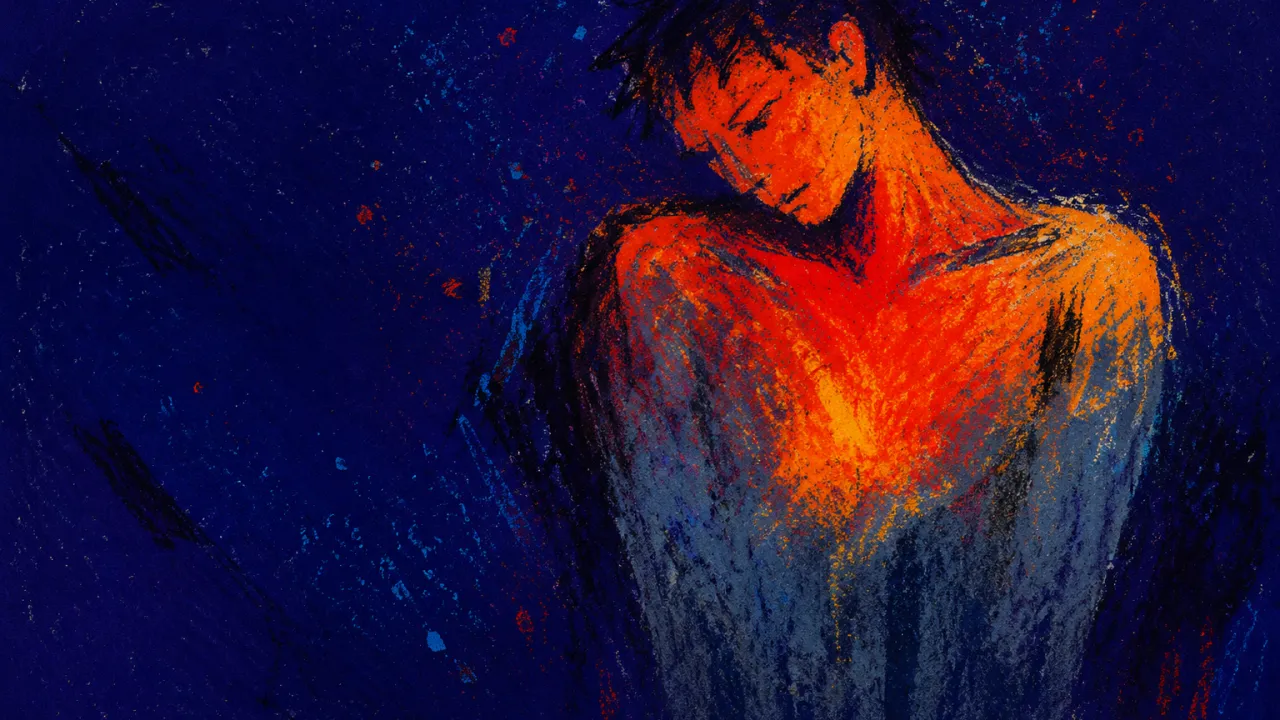
Solitary figure with raised shoulders, ember-red across the chest draining into slate blue within deep indigo space

What does this feel like?

Anger Guilt is the flash of heat that arrives first and the heavy inward drop that follows before your body has fully come down. Your chest still feels warm, your shoulders stay slightly raised, and your hands hold more still than usual, as if any extra movement might restart the whole moment. The room may look exactly the same, but everything in you feels too loud and then suddenly too quiet. You reread what you sent, replay your tone, or mentally edit the sentence you already said, catching on the same half-second where you sounded sharper than you meant to. Even ordinary tasks can feel coated in an aftertaste; you answer more carefully, soften yourself too quickly, or go silent because another wave of heat feels unacceptable. Inside, the questions loop: Was I allowed to feel that? Did I make myself impossible to be around? The anger may still be there, but guilt sits over it like cold ash over an ember, leaving you unsure whether to defend the feeling or apologize for having it, much like the figure in the Nine of Swords, sitting upright with their face in their hands while nine swords line the dark wall behind them.

Why you're feeling this?

Anger guilt is not proof that either feeling is wrong; the heat and the heaviness can exist at the same time. You are allowed to notice both without putting yourself on trial. The discomfort is still valid even when the two feelings seem to contradict each other.

Anger Guilt in Tarot Cards

Anger guilt is that hot-then-heavy shift: your chest stays warm while your shoulders remain slightly raised and the moment keeps echoing inward. It belongs to a universal emotional experience in which two feelings can occupy the same inner space without cancelling each other out. Tarot can mirror the shape of that shift without settling which feeling should win. Here are the Tarot Cards that reflect the heat, recoil, and inward weight of anger guilt.

Strength
Reversed
The infinity symbol, composed figure, and embodied lion present emotional strength as an ongoing relationship rather than a one-time conquest. Reversed, growth becomes distorted into a demand that the lion never move, make noise, or reveal how much force exists beneath the calm surface. You may believe personal evolution should have eliminated reactive anger, so guilt appears whenever intensity returns. Reversed Strength challenges that perfection-based model by showing the actual developmental task: making the relationship between awareness and force less brittle, without turning one rupture into proof of permanent failure.
Justice
Reversed
The scales, sword, and symmetrical pillars create a visual architecture for evaluation, responsibility, and proportion. Reversed, that architecture becomes rigid or uneven, mirroring a growth system in which any angry expression is treated as evidence that your values and behaviour are fundamentally misaligned. You may demand an impossible verdict of perfect innocence before allowing your anger to carry meaning. Reversed Justice exposes the cognitive distortion inside that demand, separating a proportionate review of conduct from a global sentence against your character or progress.
Five of Cups
Upright
The bowed figure stares at spilled cups while a bridge leads toward a distant home and two cups remain upright behind them. Within a family system, the image captures the heavy aftermath of breaking an emotional rule, where one heated exchange can feel like damage to the idea of home itself. You may grieve your tone, the look on someone's face, or the fear that you have repeated a painful family pattern. The upright Five of Cups holds that remorse while keeping the whole field visible: the anger's trigger, the impact, the inherited context, and the parts of connection not erased by one moment.
Two of Swords
Upright
A blindfolded figure sits between sea and stone with two swords crossed evenly over the chest, holding opposing directions in exact suspension. The image captures the choice embedded inside anger guilt: defend the truth carried by the anger, or apologise for the impact and risk making the original issue disappear. You may experience both options as self-betrayal, so stillness becomes a temporary shield against choosing wrongly. The upright Two of Swords contains the tension without forcing a false binary, revealing that accountability for expression and legitimacy of feeling are separate variables even when guilt has fused them together.
Five of Swords
Upright
The foreground figure's collected blades, the discarded swords, and the people walking away display an entire conflict system rather than a single bad feeling. The image asks which internal rule equates strength with domination, and which later rule equates remorse with making yourself entirely wrong. You may be trying to evolve beyond reactive conflict while fearing that every recurrence proves you have failed. The upright Five of Swords frames growth as a clearer reading of sequence and cost: what activated the anger, where choice narrowed, what impact followed, and why guilt does not have to become a permanent identity.
Nine of Swords
Upright
Nine identical swords form a rigid sequence above a person folded into self-confrontation, visually echoing an all-or-nothing belief system. One heated moment becomes nine repeated proofs that you are not as calm, healed, or self-aware as you expected yourself to be. You may interpret anger guilt as evidence that your growth has failed rather than as a signal that an old trigger and a newer value collided. The upright card makes that cognitive inflation visible, separating one behaviour worth examining from the global identity verdict built around it.
Knight of Swords
Reversed
The armoured rider enters a wind-torn landscape at full speed, sword lifted before any sign of slowing or listening. Reversed, the scene resembles a family argument where an old trigger collapses the distance between activation and attack, making inherited conflict language available faster than reflective choice. You may recognise a parent's tone in your own voice and feel guilt drop through the body as soon as you hear it. The reversed Knight of Swords reveals the family pattern inside the acceleration, distinguishing accountability for impact from the belief that repeating one familiar reaction makes you permanently identical to the pattern.

Anger Guilt in Tarot Card Reading Insights

When anger guilt leaves you caught between lingering heat and an inward drop, others bring that same conflict into their readings. The Tarot Reading Insights below show what surfaced when this feeling entered the spread.
Psychological emtions related to Anger Guilt