The Week That Looked Too Empty
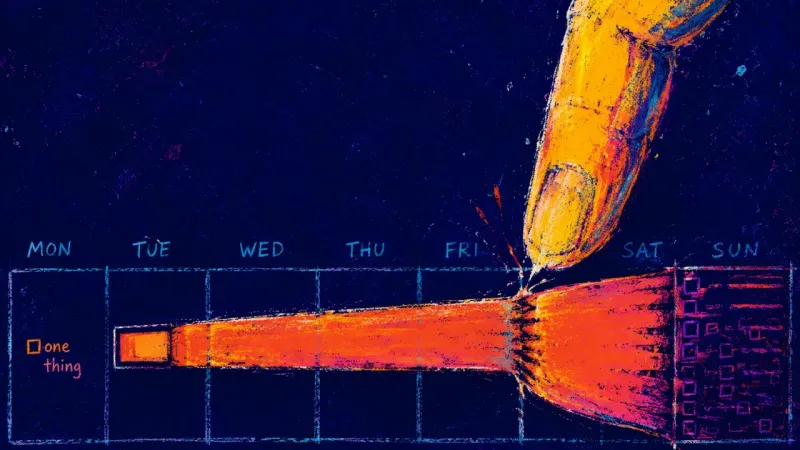
You see a surprisingly empty week in Google Calendar and feel more uneasy than relieved—like you missed a hidden assignment.
Jordan said it the moment we sat down on Zoom, camera angled toward their Toronto condo kitchen table: “It’s… quiet. And my brain treats quiet like evidence.”
It was 9:08 a.m. on a Wednesday for them. Their laptop was open beside a half-cold coffee. The fridge hum sounded louder than it had any right to, like the room itself was waiting for something to go wrong. On-screen, their calendar looked strangely pale—too much white space, not enough colored blocks. I watched their shoulders inch upward as their cursor “accidentally” drifted to Slack. Not to respond. Just to see. Their jaw worked once, as if chewing an invisible problem.
What they were describing wasn’t laziness. It was a particular kind of guilt—thick and sticky—like trying to walk through an office hallway that’s suddenly turned into airport security: you’re allowed to pass, but you feel like you need paperwork proving you deserve to be there.
And there it was, the contradiction driving the whole thing: Jordan wanted real rest and spaciousness, but feared that being less busy would expose them as replaceable.
I kept my voice gentle and plain. “An open calendar isn’t a moral test. Let’s treat today like a map-making session—so we can get you from ‘I keep trying to earn permission to breathe’ to something closer to clarity.”

Choosing the Compass: Celtic Cross · Context Edition
I asked Jordan to take one slow breath—not as a mystical ritual, just a clean transition. The kind you do before you hit ‘Send’ on a message that matters. While I shuffled, I invited them to hold a single question: When my schedule clears, why does my body panic—and what’s a kinder, practical next step?
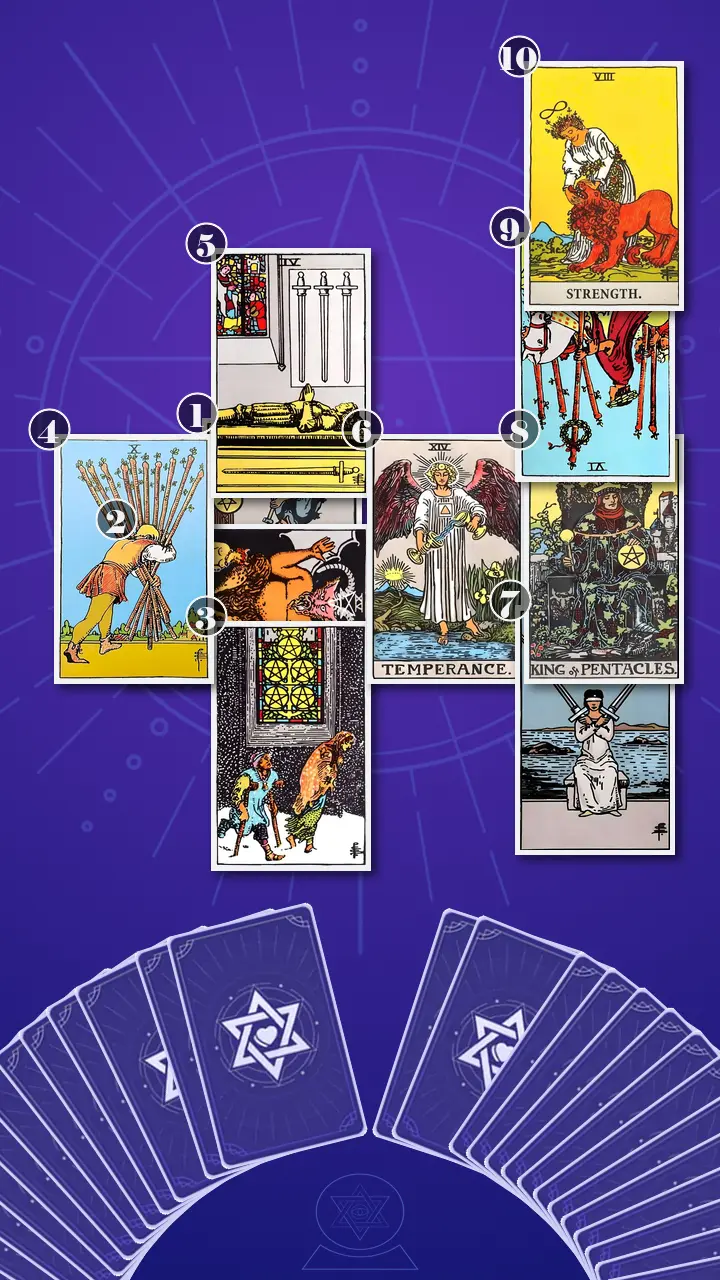
For this, I chose the Celtic Cross · Context Edition.
To a reader who’s wondered how tarot works in real life: this spread is useful when the problem is a loop. It doesn’t just describe the present—it traces the chain from visible behavior to root belief to the exact leverage point where a small experiment can change the pattern. And because Jordan wasn’t asking me to predict layoffs or a promotion, we aimed positions 6 and 10 toward something more grounded: a near-term boundary test and a realistic integrated rhythm.
I told Jordan—and, quietly, the part of them that didn’t trust good news—what to expect. “The first card shows the pattern you’re living. The next one shows what crosses it—the engine that keeps it running. The root card shows the belief underneath. And the final card shows the healthiest way through—what ‘integration’ actually looks like, not as a vibe, but as a practice.”
Reading the Map: Busywork, Chains, and the Scarcity Winter
Position 1: The visible pattern right now
“Now flipped,” I said, “is the card representing the visible pattern right now: how productivity guilt shows up in your day-to-day behavior when the calendar clears.”
Eight of Pentacles, reversed.
“This is like when you block off ‘focus time’ and then spend it perfecting formatting, rechecking messages, and refining minor details because finishing feels risky if it isn’t flawless,” I said. “A craftsman’s bench turned upside down—skill-building becomes endless tweaking. Not progress. Proof.”
In energy terms, it’s excess effort in the wrong places: motion as a safety behavior. The body gets a small hit of relief when the fingers are typing, even if the work doesn’t meaningfully move anything forward.
Jordan’s reaction came in a three-beat chain: their breathing paused for half a second, then their eyes flicked away from the camera like they’d just seen themselves in an unflattering reflection, and then they let out a short laugh—sharp at the edges. “That’s… too accurate,” they said. “Like, borderline rude.”
I nodded. “Tarot can be like that—an uncomfortably good mirror. The question this card asks is: if nobody could see you working, what would still be worth doing?”
Position 2: The core block
“Now flipped is the card representing the core block: what keeps the guilt loop running even when there’s objectively more space.”
The Devil, upright.
I didn’t soften it. I clarified it. “This isn’t ‘you’re bad.’ This is attachment. Worth and safety chained to constant productivity and visibility.”
“Modern translation?” I continued. “It’s treating your Slack green dot like a heart monitor. You keep checking it to confirm you’re still ‘alive’ at work—even when nothing is happening. If you stop moving, you’ll be found out. So you manufacture motion. And then you can breathe for three seconds.”
Energetically, this is blockage: the chains are loose enough to slip off, but familiar enough that you keep choosing them. And guilt—here’s the key—becomes loud, not wise.
Jordan winced, then gave me the exact response this card often pulls from smart, exhausted people: a tense laugh, a second of discomfort, then a small exhale. “Oh,” they said quietly. “That’s exactly the loop.”
Position 3: The root driver
“Now flipped is the card representing the root driver: the scarcity or security belief underneath the guilt reaction.”
Five of Pentacles, upright.
“This is the cold that starts the whole fire,” I said. “The snow. The feeling of being outside the warm window.”
In Jordan’s life, it looked like this: the calendar opens, and their mind jumps straight to worst-case—layoffs, performance doubts, being forgotten. Not because it’s true, but because quiet is unmeasured time, and unmeasured time feels like risk.
Energetically, this is deficiency: not a lack of competence, but a lack of felt security. It’s the story that says support can be withdrawn at any moment, so you’d better keep earning your place.
Jordan’s hands, resting around their mug, tightened once. “I don’t even tell anyone I’m thinking that,” they admitted. “I just… start producing.”
“Of course you do,” I said. “When the nervous system thinks it’s winter, it tries to gather firewood.”
Position 4: What conditioned the pattern
“Now flipped is the card representing what conditioned the pattern: the recent workload story that made constant motion feel necessary.”
Ten of Wands, upright.
“This is the last few months,” I said. “Carrying too much until ‘overload’ felt normal.”
Energetically it’s excess responsibility—so much that you stop seeing the horizon. The body learns: pressure equals safety. No wonder a light week doesn’t feel like relief. You’re not lazy. You’re deconditioning.
I felt my own archaeologist’s memory rise—an internal flashback I didn’t quite expect: a field season years ago, dawn light over a trench, everyone moving fast because the schedule was brutal. When the day off finally came, half of us wandered the camp like we’d lost our purpose. The body doesn’t instantly trust permission.
“Your system is still braced for the bundle,” I told Jordan. “Even if the meetings disappeared.”
Position 5: What you consciously want
“Now flipped is the card representing what you consciously want: the intention you’re trying to reach—rest, clarity, a new rhythm.”
Four of Swords, upright.
Jordan’s face changed at the image—so subtle it would be easy to miss if you weren’t watching for it. Their shoulders lowered a fraction. Their eyes softened. Not joy. Something closer to permission.
“This is strategic rest,” I said. “Not collapse. Not quitting. A protected block the way you’d protect a client meeting.”
And I made it sensory, because guilt lives in the body: the hush after closing a laptop, the fluorescent buzz in a hybrid office, the tiny spike when you don’t respond instantly. This card draws a line between rest as maintenance and rest as reward. You don’t have to earn maintenance. You schedule it because it keeps the whole system running.
Jordan swallowed. “I want that,” they said. “I just don’t trust it.”
Position 6: What becomes possible next
“Now flipped is the card representing what becomes possible next if you experiment with one boundary and a clearer definition of ‘done’.”
Temperance, upright.
“This is calibration,” I said. “The slow pour between cups. Not swinging from overwork to shutdown.”
In modern terms: a simple cadence—deep work first, messages later—and discovering that structure can feel safer than frantic availability. Energetically, Temperance is balance, but not the Instagram kind. The kind you can repeat on a Tuesday.
My professor’s mind reached for a historical analogy that’s never failed me: “Merchants on the old trade routes survived by pacing,” I said. “They didn’t sprint the whole Silk Road. They set check-in points, water points, rest points. That wasn’t indulgence. That was how the journey stayed possible.”
Jordan nodded once, slow. “So… batching messages isn’t ‘slacking,’” they said, testing the phrase.
“It’s logistics,” I replied. “And it’s how you stop your attention from being colonized.”
Position 7: Your self-position
“Now flipped is the card representing your current self-position: the inner stance and decision dynamic that keeps you stuck.”
Two of Swords, upright.
“This is the half-rest,” I said gently. “Lunch with one eye on Slack. Coffee that goes cold because you refreshed your inbox again. You don’t choose rest or work—you choose both halfway, and it never works.”
Energetically, it’s blockage: you’re holding the swords at your own chest, keeping the peace by not making a clean decision. I invited Jordan to name the two voices, out loud.
They surprised themselves. “The Protector says: stay visible,” they said. “The Human says: please pause.”
“Good,” I replied. “That’s not weakness—that’s self-awareness. The pivot is a both/and: one defined deliverable and one defined pause. Clean edges.”
Position 8: Workplace context
“Now flipped is the card representing your workplace context: the cultural cues and external expectations you’re responding to.”
King of Pentacles, upright.
“This is a culture that respects reliability,” I said. “Steady outcomes. Predictable updates. People who look grounded.”
Energetically, it’s balance in the environment—yet it can feel like pressure if you translate it into ‘I must be constantly online.’ The King doesn’t flap. He doesn’t perform. He delivers, consistently.
“If your manager values outcomes,” I told Jordan, “you can make your value legible without living inside Slack. Busy is an aesthetic. Outcomes are the job.”
Position 9: Hopes and fears
“Now flipped is the card representing the emotional hook: what recognition/failure story you secretly hope for or fear at work.”
Six of Wands, reversed.
Jordan’s cheeks flushed—fast, human, unmistakable. “I draft updates,” they admitted, “and then I delete them. And then I rewrite them. And then I watch the channel like… like reactions are a verdict.”
“That’s this card,” I said. “Fear of invisible effort. The part of you that needs applause to feel safe.”
Energetically, it’s deficiency of inner recognition, which makes external validation do too much work. And when work is quiet, there’s nothing to clap—so the nervous system panics and tries to manufacture a stage.
I kept it non-moralizing. “Wanting to be seen is normal. The trap is believing you only exist if you’re witnessed.”
When Strength Spoke: The Antidote to Productivity Guilt
Position 10: Integration outcome
When I turned the final card, the air in my office felt noticeably still—as if even the radiator decided to stop talking for a moment. “We’ve come to the integration point,” I said. “The healthiest long-term relationship to productivity and self-worth if you practice the key shift.”
Strength, upright.
Jordan had been caught in the exact scene I see so often in Slack culture: you finally see an empty week in Google Calendar—no back-to-backs, no fires. Instead of relief, your stomach does that little flutter, your jaw tightens, and your hand opens Slack again, like quiet time is a trap you have to outsmart.
Stop treating guilt like a boss you must obey, and start leading it with gentle strength—like closing the lion’s mouth with steady hands.
Jordan’s reaction arrived in layers. First: a freeze—their mouth parted slightly, breath held high in the chest. Second: recognition—their eyes unfocused for a beat, like an internal replay started running: late-night “just checking,” the green dot, the performative deck-polishing marathons. Third: release—a long exhale that softened their shoulders, followed immediately by a blink that made their eyes shine. Then, unexpectedly, a flicker of anger. “But if that’s true,” they said, voice tight, “doesn’t it mean I’ve been… obeying the wrong thing for years?”
I didn’t rush to soothe it away. “It means you were doing what worked to survive,” I said. “And now we’re doing what works to live.”
This is where my own Skill Archaeology comes in—the way I’m trained to look at a site and see not just what’s obvious, but what’s been buried by habit. “Strength isn’t about forcing yourself to relax,” I told them. “It’s about unearthing an overlooked talent: you can regulate. You can lead your attention. You’ve just been using that leadership to stay on-call to anxiety.”
I offered a single, contained practice—what I called a Quiet Tolerance Rep, not to ‘fix’ them, but to give their nervous system evidence. “Once this week,” I said, “set a 10-minute timer. Close Slack and email—Do Not Disturb if you can. Phone face-down. Write one sentence: ‘Today’s outcome that matters is ____.’ Choose one next action that supports it—15 minutes or less. When the timer ends, you can reopen Slack… unless you notice your body already de-escalated, and then you can extend by five minutes. If anxiety spikes hard, stop early. The point is practice, not white-knuckling.”
Then I asked the question that makes the insight land in real life: “Now, with this new lens—when, last week, did guilt act like a boss? Is there a moment you can replay where leading it gently would have changed how your body felt?”
Jordan looked down and nodded once. “Yesterday,” they said. “5:41 on the TTC. I refreshed email with no notifications. I could’ve… just let the quiet happen.”
That was the shift in miniature: from guilty vigilance toward calmer self-trust. Not because they ‘did more,’ but because they began to believe they could be valuable without being visibly busy.
The Megalith Plan: Actionable Next Steps Without the Self-Punishment
I pulled the whole spread into a single, coherent story—because clarity is often just the end of confusion-by-fragmentation.
“Here’s the arc,” I said. “You came out of overload (Ten of Wands), so your body learned that pressure equals safety. When the calendar opens, misdirected effort appears (Eight of Pentacles reversed) because motion feels like protection. The Devil shows why the loop is sticky: you’ve been living under an always-on identity contract, where being busy equals being safe. Under that contract is the Five of Pentacles fear—scarcity, replaceability, being outside the warm room. You consciously want recovery (Four of Swords), and Temperance shows the practical bridge: a repeatable cadence. Strength is the antidote: compassionate self-mastery—leading the urge instead of obeying it.”
The cognitive blind spot was clean once spoken: Jordan had been treating visibility as the only proof of value. The transformation direction was equally clear: shift from “my worth is measured by visible busyness” to “my value is measured by intentional outcomes and healthy pacing,” and prove it with one small boundary.
Jordan raised a practical obstacle right on time. “But I can’t just disappear for 30 minutes,” they said. “If someone pings me, I feel like I’ll look… unhelpful.”
“That’s a fair constraint,” I replied. “So we’ll do what archaeologists have always done when moving something too heavy: Megalith Transport—we break it into manageable hauls. We don’t drag the whole stone in one go.”
Then I gave them three small, work-legible experiments—Relic Authentication first (what’s actually expected), then Tool Evolution (upgrade your habits gradually), then the step-by-step carry.
- Defined Done Rule (15 minutes to start)Pick one deliverable for today and write a one-line “done rule” (e.g., “One review pass, then send”). Set a 25-minute timer and work only on what moves that deliverable forward—save formatting tweaks for the final 5 minutes.Expect your brain to call this “unprofessional.” Preempt it by putting the done rule on a sticky note or at the top of the doc so you can follow it like a spec, not a mood.
- Sanctuary Block (10–30 minutes, work-legible)Schedule one protected block this week labeled something neutral like “Planning / Deep Work.” Before it starts, post one sentence in Slack: “Heads down for 20—back at 11:10.” Close Slack/email during the block. Use the first 3 minutes to reset your body (water, stretch shoulders, unclench jaw) before thinking work.If 30 minutes feels impossible, do a 10-minute version. The goal is evidence that nothing breaks when you’re briefly unreachable.
- Two-Check Cadence (one light day experiment)Choose two message windows for one day (e.g., 11:30 a.m. and 4:00 p.m.). Between checks, keep Slack closed or minimized. If the urge to check hits early, write one sentence: “I’m afraid I’ll look idle,” then return to your task for five more minutes.Reduce the fear factor by keeping notifications only for DMs/mentions for a week—not every channel.

A Week Later: Ownership, Not Certainty
Six days later, Jordan emailed me a screenshot. It wasn’t dramatic. It was almost boring—which is exactly why it mattered: a calendar block labeled “Docs & Decisioning,” a Slack status reading “Heads down—back at 2:40,” and one line beneath it: “Outcome that matters today: send the stakeholder summary.”
They wrote, “I did the 10-minute Quiet Tolerance Rep. My chest did the flutter thing, and I still didn’t open Slack. After eight minutes my shoulders dropped without me trying. It felt… weirdly kind.”
Clear, but not perfect—just real: they slept a full night, then woke up and still had the first thought, What if I’m wrong? They paused, breathed once, and opened the document anyway—without opening Slack first.
That’s what a Journey to Clarity often looks like in modern work culture: not a personality transplant, not a rebellion, but a small boundary that teaches your body you’re safe. Strength isn’t loud. It’s steady.
When your calendar finally opens up, it can feel less like freedom and more like standing under a spotlight—your body wants real rest, but your mind panics that quiet will prove you’re replaceable.
If you didn’t have to earn permission to breathe this week, what’s one small boundary you’d try—just once—to let your value come from an outcome, not from staying visibly busy?
This story is adapted from psychological research, written so that those in a similar struggle can see their own pattern in it — and find their next step clearly.These insights are not a substitute for professional psychological, medical, legal, or financial advice.
Learn more about our Journey to Clarity.
How did this insight land for you?
🫂 This Resonates Deeply
🌀 Living This Story
✨ Now I See Clearly
🌱 Seeing New Possibilities
🧰 Useful Framework
🔮 The Confirmation I Needed
💪 Feeling Empowered
🚀 Ready for My Next Step
Author Profile
 AI
AI“Having spent a lifetime at Cambridge and on archaeological digs, I’ve witnessed the rise and fall of countless civilizations. Please know that your current struggles are not a permanent fate, but merely a necessary fracture before rebuilding. I won't lecture you; instead, I invite you to sit with me in the ruins, using a patient, historical perspective to gently dust off the true, enduring value hidden beneath your temporary doubts.”
In this Career Tarot Reading :
Core Expertise
- Core Competency Excavation: Digging through the 'strata' of your past roles to uncover undervalued, highly transferable foundational skills.
- Career Epoch Analogies: Contextualizing your career plateau as the end of one professional era and the necessary foundation for the next.
Service Features
- The Resume Stratigraphy Review: A structured framework to rewrite your professional narrative, highlighting immutable assets over obsolete job titles.
Also specializes in :
Explore Related Patterns:
Achievement FusionJordan names the contradiction directly: they want real rest and spaciousness, but they fear that being less busy will expose them as replaceable. The reading makes the mechanism sharper when it describes worth and safety as chained to productivity and visibility, then names the blind spot: Jordan has been treating visibility as the only proof of value. Achievement Fusion turns work output into identity evidence. You are not just completing tasks; you are trying to prove that you deserve your seat, your paycheck, and your right to breathe. The practical shift is not to care less about work, but to separate value from performance theater so outcomes can replace constant busyness as the real measure.
Strategic VisibilitySix days later, Jordan sends a screenshot with a calendar block labeled 'Docs & Decisioning,' a Slack status saying they are heads down and back at a specific time, and one outcome that matters for the day. The value is still visible, but it is no longer being performed through constant online presence. Strategic Visibility is the adaptive replacement for the guilt loop. You make your work legible through outcomes, boundaries, and predictable updates, instead of proving commitment through nonstop responsiveness. In this story, that is the practical bridge from productivity guilt to professional self-trust: visible enough to collaborate, boundaried enough to think.
Compulsive CheckingJordan's cursor drifts toward Slack when nothing is happening, not to answer a real message, but just to see. Later, the green dot becomes a heart monitor, lunch happens with one eye on Slack, and even a TTC ride gets interrupted by refreshing email with no notifications. Compulsive Checking works as a reassurance loop. You check to lower the discomfort of not knowing whether you are needed, seen, or safe, and the tiny relief teaches your brain to check again. The pattern keeps attention colonized by possibility instead of reality, which is why scheduled message windows and a visible return time become more than productivity hacks; they become exposure practice for self-trust.
Guilt ConditioningJordan sees a pale, open Google Calendar and feels more uneasy than relieved, as if quiet itself requires paperwork. Their body has been trained by recent overload to read pressure as proof of safety, so spaciousness does not land as recovery. It lands as a cue that guilt should start giving orders. That is the logic of Guilt Conditioning: a repeated pairing of rest with danger until downtime starts to feel morally suspicious. You untangle it by treating guilt as a conditioned signal to audit, not a boss to obey. The 10-minute Quiet Tolerance Rep gives the nervous system new evidence that value can exist without constant visible strain.
External ValidationJordan drafts updates, deletes them, rewrites them, and then watches the channel as if reactions are a verdict. The fear is not only that the work might be missed; it is that unseen effort might fail to confirm that Jordan exists as valuable in the workplace. External Validation makes witness and applause do too much emotional labor. You may be doing solid work, but if no one reacts, the nervous system reads the silence as absence of worth. Naming the pattern helps you move recognition back into proportion: useful feedback matters, but it cannot be the only source of safety.
Scarcity MindsetJordan's calendar opens and their mind jumps straight to layoffs, performance doubts, and being forgotten. The story frames this as the cold behind the whole reaction: not a lack of competence, but a lack of felt security, where support feels like something that could be withdrawn at any moment. Scarcity Mindset narrows the future until every quiet moment looks like a warning sign. You start gathering proof of usefulness before anyone has asked for it, because being prepared feels safer than being at ease. The healthier counter-pattern is not blind optimism; it is reality testing, where you separate actual workplace expectations from the old survival rule that says you must always keep earning your place.
Productive ProcrastinationJordan blocks off focus time and then spends it perfecting formatting, rechecking messages, and refining minor details because finishing feels risky if it is not flawless. The work looks responsible from the outside, but the story calls it motion as proof rather than progress. Productive Procrastination hides avoidance inside usefulness. You are not doing nothing; you are doing the safest visible thing, the thing that lets you feel active without crossing the vulnerable threshold of sending, finishing, or being judged. The defined done rule interrupts that loop by forcing the question back to outcome: what actually moves the work forward, and what is just anxiety wearing a professional outfit?
Explore Related Struggles:
Ease-Productivity SplitJordan sees white space in Google Calendar and does not meet it as relief. Their body reads the cleared week as exposure, as if fewer meetings might reveal that their place at work is conditional. That is the center of Ease-Productivity Split: ease is available, but it does not feel neutral. You can want real spaciousness and still feel pulled back toward visible effort because rest has been tangled with the threat of becoming replaceable. The struggle is not about needing better scheduling discipline. It is the deeper friction of trying to let your body recover while another part of you treats recovery as professional risk. Untangling it starts when you can separate a quiet calendar from a verdict on your worth.
Monitoring-Safety FusionJordan's hand keeps drifting to Slack even when there is no message to answer. The green dot, the inbox refresh, and the channel reaction become tiny instruments for checking whether they still register inside the workplace. Monitoring-Safety Fusion captures the way surveillance turns into self-soothing. You are not only monitoring work; you are using the act of monitoring to convince your body that you have not disappeared, fallen behind, or become forgettable. The trap is that safety becomes outsourced to live signals. When those signals go quiet, the body starts asking for another check, another refresh, another visible trace. Clarity begins when you can see the difference between being reachable and being safe.
Performance-Worth FusionJordan names the fear plainly: if they are less busy, they might be exposed as replaceable. The empty calendar does not simply change the week's rhythm; it presses on the question of whether their value exists when nobody is watching them produce. Performance-Worth Fusion is the deeper contract underneath the productivity guilt. You are not just measuring performance; you are letting performance carry the burden of proving that you matter, belong, and deserve your seat at the table. This makes quiet feel like a threat because quiet removes the stage. The story's healthier direction is not to stop caring about work, but to move value back toward intentional outcomes and steady pacing, where your worth does not have to be re-earned every time the calendar opens.
Productivity Shame BindJordan keeps turning open time into proof labor: polishing formatting, rewriting updates, checking Slack, and watching reactions as if each signal can temporarily clear the charge of guilt. The work may look active from the outside, but inside the loop it functions more like a receipt that says they still deserve to be there. Productivity Shame Bind names the lock created when not producing becomes morally loaded. You are not simply deciding what task matters next; you are trying to work off the discomfort of being unobserved, unmeasured, or momentarily unnecessary. That bind is especially sticky because every check gives a short hit of relief. The deeper cost is that guilt gets promoted into management, and your energy starts serving the need to prove effort instead of the need to create, recover, or finish.
Rest-Permission SplitJordan's rest keeps arriving with a work tab left open. Lunch has one eye on Slack, coffee goes cold beside another inbox refresh, and even a protected pause has to fight for clean edges. Rest-Permission Split points to the moment where recovery is desired but not yet authorized from the inside. You can know that rest is maintenance and still behave as if it needs to be earned, justified, labeled, or made legible to work before it is allowed to count. The practical struggle is the half-choice. Half-rest does not restore you, and half-work does not ground you. The next shift is not dramatic escape; it is giving one pause a clear boundary so your body can collect evidence that rest does not have to be purchased with constant availability.
Metric-Compass FusionJordan's workplace context is described as valuing reliability, steady outcomes, and predictable updates. Yet Jordan translates that environment into a demand for constant online presence, as if the most visible metric is automatically the truest compass. Metric-Compass Fusion names that distortion. You start using signals like response speed, Slack status, draft updates, and visible busyness to orient your value, even when the actual work asks for defined deliverables and consistent judgment. The result is a subtle misnavigation. You may feel productive because the metric is moving, while the deeper compass, the outcome that actually matters, gets crowded out. Untangling the guilt requires asking which proof is real: the signal that you are visibly active, or the result that makes your work meaningful and complete.
Explore Related Emotions:
Productivity GuiltThe empty Google Calendar, the half-cold coffee, and the cursor drifting toward Slack show a body trying to prove it is still doing enough. When you recognize yourself in that scene, the issue is not laziness; it is the way open time gets converted into a demand for visible proof. Productivity Guilt fits because work is being measured through motion before it is measured through meaningful outcomes. The label helps separate actual responsibility from the sticky feeling that you must keep producing evidence before you are allowed to breathe.
Replaceability DreadThe calendar opens and Jordan's mind jumps straight to layoffs, performance doubts, being forgotten, and looking unhelpful. Less busyness does not land as relief; it lands like a spotlight where someone might suddenly notice they are not needed. Replaceability Dread names the fear that value disappears the moment visible output drops. In this story, the dread is not treated as proof of actual workplace danger; it is a signal that quiet has become tangled with the fear of being erased.
Scarcity AnxietyThe pale calendar opens and Jordan's mind fills it with layoffs, performance doubts, and being forgotten. The blank space is not neutral; it becomes a cold room where support feels withdrawable unless more proof is produced. Scarcity Anxiety names the shortage of felt security beneath the guilt loop. It does not say Jordan lacks skill; it shows how a quiet week can trigger the belief that safety must be re-earned through visible effort.
Visibility PressureJordan treats the Slack green dot like a heart monitor and watches channel reactions as if they can confirm whether the work counts. Updates are drafted, deleted, rewritten, and watched because being visible has started to feel like being safe. Visibility Pressure names the strain of making your value legible through constant presence. The story's leverage point is not disappearing from work; it is replacing performative availability with clean outcomes, clear status signals, and a rhythm that does not require you to live inside Slack.
Cautious Self-TrustJordan still wakes up with the first thought, What if I'm wrong?, then pauses, breathes once, and opens the document without opening Slack first. The fear has not vanished, but it no longer gets the first command. Cautious Self-Trust fits because the shift is built through small evidence rather than instant certainty. You begin to trust your value by watching yourself keep one boundary, choose one meaningful action, and survive the quiet without rushing back into proof-making.
Grounded AgencyThe defined done rule, the sanctuary block, the two-check cadence, and the status reading Heads down, back at 2:40 turn a vague work panic into a set of clean edges. Jordan is not rebelling against work; they are making work navigable again. Grounded Agency names choice returning to attention. The power in the story is practical and ordinary: one outcome, one next action, one visible return time, and the decision to let value come from delivery rather than permanent availability.
Guilt-Free RestJordan protects a small block, closes Slack, turns the phone face-down, and writes one outcome that matters. After eight minutes, the shoulders drop without forcing it, and the quiet feels weirdly kind. Guilt-Free Rest names the emerging possibility that a pause can be maintenance, not a moral loophole. The feeling is still tentative, but it gives you a concrete alternative to earning breath through overwork.
Permission AnxietyThe story compares an ordinary workday to an office hallway that has turned into airport security: you can pass, but it feels like you need paperwork proving you deserve to be there. Jordan is not just managing a calendar; they are trying to earn permission to occupy quiet space. Permission Anxiety fits because the fear is organized around authorization. The question underneath becomes less about whether you are allowed to pause and more about what boundary, outcome, and communication make the pause clean enough for your body to tolerate.
Rest GuiltJordan's shoulders soften at the idea of protected rest, then the old pull returns: lunch with one eye on Slack, coffee going cold, the empty week reading like a hidden assignment. Even the wish to pause has to pass through an inner checkpoint. Rest Guilt fits the gap between the body needing maintenance and the inner rule that rest must be justified. Naming it lets you stop treating recovery like a reward for perfect output and start seeing it as part of the structure that keeps work sustainable.
Unseen Effort GriefJordan drafts updates, deletes them, rewrites them, and then watches the channel as if reactions can decide whether the work was real. When the week is quiet, there is nothing to clap for, so the system tries to manufacture a stage. Unseen Effort Grief fits because the pain is not vanity; it is the ache of believing effort disappears unless someone witnesses it. Naming that grief gives recognition its rightful place without letting applause become the only proof that you matter at work.
Hypervigilant AnxietyJordan's shoulders rise, breath pauses, jaw tightens, and the cursor moves toward Slack just to see. Later, even on the TTC with no notifications, the hand still wants to refresh email. Hypervigilant Anxiety names the scanning state that keeps every quiet pocket under surveillance. In this work context, it turns attention into a guard post, and the small boundary practice matters because it gives the body evidence that not checking immediately does not have to run the whole day.
Explore Related Contexts:
Always On AvailabilityJordan treats the Slack green dot like a heart monitor, checking it to confirm they are still alive at work even when nothing is happening. The empty calendar does not create freedom because the communication layer remains open in the background, pulling their attention back toward visibility. Always On Availability appears when reliability gets translated into constant reachability. The story does not show a manager directly demanding instant replies, but it does show a workplace signal system where email, Slack, status updates, and response timing carry social weight. You are dealing with an external work rhythm that keeps the body on call after the workload has already eased. The practical task is not to vanish from the team, but to build a work-legible availability rhythm where responsiveness has edges and deep work is allowed to exist without constant surveillance by chat.
Evaluation Pressure LoopJordan looks at white space in the calendar and reads it like evidence in an invisible performance review. No one has issued a warning in the story, yet the cleared week immediately becomes tied to layoffs, performance doubts, being forgotten, and the fear of looking unhelpful. Evaluation Pressure Loop names the external structure behind that reaction: modern knowledge work often turns ambiguous signals into performance data. Status lights, update cadence, response speed, and channel reactions can start to feel like informal metrics, even when the formal job is about steady outcomes. You are not simply trying to feel less guilty. You are trying to stop treating every quiet interval as a hidden audit. The useful move is to clarify what is actually expected, then make value visible through outcomes and predictable communication instead of constantly defending your place through availability.
Productivity TheaterJordan sees an unusually empty Google Calendar and almost immediately drifts toward Slack, not because there is a concrete request waiting, but because visible motion has become the easiest way to prove they are still legitimate at work. Focus time turns into formatting, rechecking messages, and polishing minor details because the activity itself starts to function like evidence. That is the structure of Productivity Theater: the workplace does not have to explicitly demand fake busyness for the system to reward it. When Slack presence, channel reactions, and visible updates become the signals of value, meaningful outcomes can get crowded out by performances of effort. You are not looking at a simple time management issue here. The story shows a worker trying to stay visible inside a culture where quiet can feel professionally dangerous, even when the actual job is measured by outcomes. The leverage point is to separate proof of work from the work itself, so your value can become legible through defined deliverables rather than constant motion.
Work Life Boundary CreepJordan's coffee goes cold, lunch happens with one eye on Slack, and even a commute becomes a moment to refresh email despite no notifications. The workday is no longer contained by meetings or deliverables; it leaks into pauses, body cues, and supposedly empty pockets of time. Work Life Boundary Creep fits because the pressure is not just about having too much to do. It is about work communication expanding into the spaces where recovery, thinking, and ordinary downtime should have boundaries. You can see the conflict clearly in the proposed experiments: Jordan has to label a block, post a return time, and practice being briefly unreachable. That means the real stage is a boundary negotiation inside modern digital work, where reclaiming ten quiet minutes requires making the boundary socially legible.
Safe Visibility TrialJordan is given a way to post one clear status, go heads down, and return at a stated time. That preserves workplace visibility without requiring them to live inside Slack or keep producing signals every few minutes. Safe Visibility Trial names the specific social test inside the story: can Jordan remain seen as reliable while becoming less performatively available? The workplace context respects steady delivery, so visibility does not have to come from frantic checking if outcomes and communication are clear. You are practicing a more grounded form of professional presence. Instead of disappearing or overexposing yourself, you create enough signal for others to trust the work while keeping enough boundary for your attention to function. That is the middle path between hiding and performing.
Work Life Integration TrialJordan is asked to try deep work first, messages later, with one defined deliverable and a clear return time in Slack. The experiment is small, but it directly tests whether work can remain reliable without constant online performance. Work Life Integration Trial is the constructive outer context because the workplace still values predictable updates and steady outcomes. That gives Jordan a realistic opening: they can make their value legible through delivery, status clarity, and message cadence rather than permanent availability. You are not being pushed toward withdrawal from work or a dramatic identity overhaul. The trial is to build a repeatable rhythm where focus, communication, and recovery all have defined places in the day. Integration becomes practical when your boundary is visible enough for work and firm enough to protect your attention.
Notification GuiltJordan drafts updates, deletes them, rewrites them, and watches the channel as if reactions are a verdict. Even when nothing urgent is happening, Slack remains a social stage where being seen appears to matter as much as doing the work. Notification Guilt captures the way digital workplace cues start carrying moral pressure. The ping, the green dot, the unread channel, and the absence of reactions all become signals that invite Jordan to prove they are responsive, helpful, and present. You are dealing with more than a bad checking habit. The external tool has become a recognition system, and the guilt spikes when there is no fresh signal to confirm value. A healthier rhythm needs message windows, notification limits, and outcome-based updates so the platform stops setting the emotional tempo of the workday.
Strategic Pause WindowJordan's calendar finally opens up, and the story turns that white space into a map-making session instead of leaving it as an undefined void. The cleared week creates a rare pocket where one outcome, one boundary, and one recovery block can be tested without the usual meeting crush. Strategic Pause Window fits because this is not passive downtime. It is a time-limited opening after overload, where Jordan can redesign the link between value, visibility, and pacing before the old rhythm rushes back in. You can use the pause as a structured reset rather than a moral test. A defined done rule, a protected block, and a simple message cadence give the quiet a job to do: helping you rebuild trust in spaciousness without needing to fill every open slot with proof of effort.