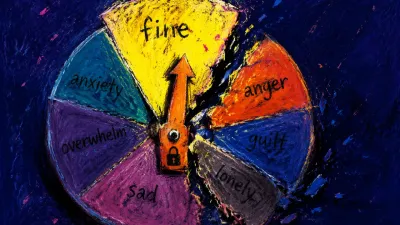
When the Positive Mask Slips: Naming Hurt Before Making It Useful

When the Positive Mask Slipped at 9:12
If you are the emotionally fluent one at work and in your group chat, you may know the panic of hearing your own upbeat voice stop working.
Alex, a 27-year-old social media coordinator in London, brought me one precise example. At 9:12 on a Monday morning, during a client video call at a small agency near Old Street, their voice went flat for half a sentence. The laptop fan hummed against the sudden silence. Yesterday’s coffee tasted metallic on their tongue, and a tight band drew across their chest.
Before the call window had fully closed, Alex opened Slack and typed: “All good, useful learning!” They added an extra exclamation mark, reread the message, and sent it before anyone could ask what had happened.
“The difficult part wasn’t just that I sounded upset,” they told me. “It was that people noticed before I could make it constructive.”
Later, Alex recorded a voice note about how angry and dismissed they had felt. They deleted it, recorded a calmer version about resilience, and wrote a lessons-learned list before dinner. The edit brought a few minutes of relief, but the original hurt returned as soon as their shared flat went quiet.
I could hear the core contradiction in the rhythm of their account. Alex wanted to face whatever emerged when the positive mask slipped, but they were afraid that looking underneath it would reveal pain too unresolved, inconvenient, or unpolished to be worthy of care. Shame moved through their body like a stage curtain dropping before the actor had reached the wings: throat closing, chest bracing, hands scrambling to restore the scene while the audience might still be watching.
“I should be further along than this,” Alex said. “I don’t know how to be seen when I’m not reassuring everyone.”
I let the sentence remain unfinished for a moment. “You don’t have to turn it into anything useful for me,” I said. “I think of our lives as films still in production. Sometimes feeling stuck means you’ve bravely stayed in a painful scene a little too long because you thought leaving it without a moral would make the whole story fail. We’re not here to judge the footage or predict the ending. We’re going to make a map of the moment between the crack and the edit, so you can decide what your next scene actually needs.”

Choosing a Staircase Into the Quiet
I invited Alex to put both feet on the floor and take one unforced breath while holding the consultation question in mind: “When my positive mask slips, how do I face what I’ve been avoiding?” I shuffled slowly, using the movement as a practical transition from performance into attention rather than as a mysterious test they had to pass.
I chose the Four-Layer Insight Ladder · Context Edition, an original six-card tarot spread for inner self-reflection. Its cards form a two-column, three-row grid that resembles a staircase leading from a public facade into a quieter interior room.
I want to pause here for anyone wondering how tarot works in a reading like this. I do not use the cards to announce hidden facts, diagnose a person, or forecast whether someone will reject them. I use tarot as a structured cognitive mirror. The images slow down an automatic pattern, separate its moving parts, and give us language for observations the querent can confirm, reject, or refine. Card meanings in context are useful because they help us compare a symbolic pattern with actual behaviour.
A larger Celtic Cross would have diffused Alex’s focused inward question across ten positions. A past-present-future spread could also have implied that clarity was waiting somewhere in a forecast. This six-card structure was compact enough to distinguish the visible crack, the feeling underneath it, the bypassing mechanism, the root fear, the honest turning point, and a practical form of compassionate integration.
I showed Alex the architecture before turning anything over. The first pair would examine what became visible and what was edited out. The middle pair would identify the protective habit and the fear giving that habit its force. The final pair would offer a bridge into self-honesty and a bounded next step. The cards would provide the map; Alex would remain the person choosing where, whether, and how to move.
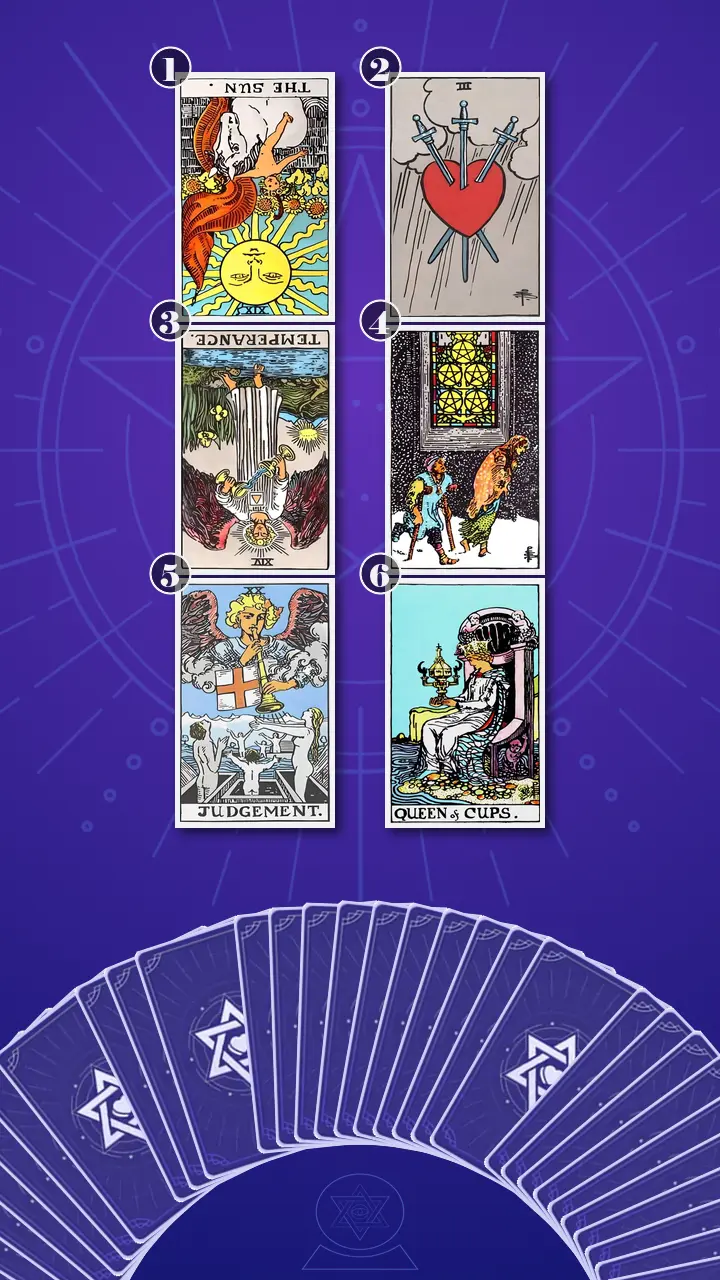
Reading the Bright Surface
Position 1: The Extra-Cheerful Follow-Up
The card I turned over first was the card representing the visible crack: the observable moment when Alex’s positive public mask slipped and the urge to smile, explain, or restore composure took over.
It was The Sun, in reversed position.
I kept Alex’s attention on the RWS child riding openly on the white horse, the exposed red banner, the sunflowers, and the enormous sun filling the sky. The image is intensely visible. Yet visibility cannot tell the whole emotional story, and a bright image cannot certify the weather underneath it.
Reversed in this position, The Sun returned us to the 9:12 client call. Alex’s usual warmth disappeared for half a sentence; their chest contracted; an extra-cheerful Slack message followed. I spoke the internal command chain aloud: “They noticed. Smile now. Explain it well. Restore the mood.”
In energy terms, I read this as a Deficiency of freely available Fire beneath an Excess of performed brightness. Alex’s warmth was not false. The strain came from treating uninterrupted warmth as proof of professional value and personal worth. It was like turning a phone’s brightness to maximum in a dark room: more visible light did not reveal what the room contained.
I used a lens I call Persona Fatigue Diagnosis. Despite the name, it is not a clinical diagnosis. It is a way of measuring the psychological cost of maintaining a social character that has become too narrow for the person living inside it. Alex’s “encouraging one” persona had begun as a genuine strength, but constant online visibility had turned it into a role with no off-hours. Their internal weather could change; the brand voice was never supposed to.
Alex gave a small, bitter laugh. “That’s so accurate it’s almost rude.” Their fingers tightened around their mug, then released. “I really do add the exclamation mark like it can erase the tone everyone just heard.”
I did not ask them to abandon positivity. “The question isn’t whether your brightness is real,” I said. “The question is whether brightness has become the only state you believe other people are allowed to see. What is true before you make it encouraging?”
Position 2: The Raw Audio Beneath the Caption
The card I turned over next was the one representing the avoided feeling: the specific hurt, grief, anger, disappointment, or exhaustion Alex converted into a lesson before allowing it to be felt.
It was the Three of Swords, upright.
I pointed to the red heart pierced by three clean blades beneath dark clouds and falling rain. I did not turn the rain into a promise of spring. In this position, its honesty mattered more than a reassuring ending. The card gave us emotional accuracy without asking the emotion to become useful.
I returned to the raw voice note Alex had deleted after the difficult call. Its unedited content could be held in three stark lines: “It hurt because my concern was dismissed. I am angry that I made it easy for them. I wish someone had asked what the call cost me.” Alex had recognised the truth, then replaced it with a calm reflection about resilience before anyone, including Alex, could listen to the original audio.
In energy terms, the Three of Swords brought Air into Balance through precise naming. Balance here did not mean comfort. It meant that the words matched the experience closely enough to carry information. The card was not telling Alex to remain inside the pain; it was interrupting the automatic edit that kept the pain unnamed.
“A feeling is not unfinished content,” I said. “It doesn’t need a caption, takeaway, or posting strategy before it is allowed to exist.”
Alex’s eyes lowered to the heart. Their breath paused, their gaze lost focus as if the deleted recording were playing again, and then a quiet exhale moved through their chest. “Disappointed,” they said. After another moment, they added, “And angry. I keep changing angry into grateful because grateful feels less likely to make anyone leave.”
I nodded. “That distinction is the work of this position. Emotional usefulness can come later. First, we let the word be accurate.”
The Kettle Clicked, but the Feeling Stayed
Position 3: When Alignment Became an Emergency Edit
The card I turned over now was the card representing the bypassing mechanism: the gratitude language, spiritualized reframing, productivity, or forced positivity that kept the avoided feeling outside direct awareness.
It was Temperance, in reversed position.
The RWS angel usually pours liquid patiently between two cups while keeping one foot on land and one in water. Reversed, that careful integration had become an over-fast blend. Fact, feeling, need, and meaning were poured together so quickly that the distinctions disappeared.
I brought Alex back to 11:38 on a Friday night in their shared-flat kitchen. The kettle had clicked off. Rain tapped the window, and the cold lino pressed through their socks while they changed “I felt rejected” into “I am learning alignment.” Then came the gratitude list, the podcast about detachment, and the idea for a seven-day reset.
The conditional bargain underneath the scene was simple: “If I can make this meaningful quickly, I will not have to stay with it.”
In energy terms, Temperance reversed showed a Blockage created by an Excess of premature integration. Alex was not lacking insight. They were trying to manufacture harmony before the Three of Swords had supplied its information. Sophisticated healing language had become an auto-caption tool replacing the original audio before it had been played.
“Meaning can wait; the feeling already happened,” I said.
I was careful not to mock the practices Alex valued. “Gratitude, meditation, podcasts, and routines are not inherently avoidance,” I told them. “The timing tells us what job the tool is doing. Gratitude after emotional contact may broaden perspective. Gratitude used within thirty seconds to remove anger from view is doing emergency reputation management.”
Alex’s thumb rubbed the edge of the table, stopped, and remained still. Their jaw shifted as the sequence became visible. “I thought I was processing faster,” they said. “But I’m actually moving the emotional task straight to Done because I attached a lesson to it.”
“Exactly,” I said. “The Notion card looks complete, but the underlying task is still open.”
Position 4: The Lit Window and the Imagined Admission Rule
The next card represented the root fear: the belief that visible unresolved pain could make Alex less worthy of care, belonging, professional credibility, or closeness.
It was the Five of Pentacles, upright.
I showed Alex the two figures moving through snow, one leaning on crutches, while an illuminated stained-glass window glowed above them. The image gave their fear a material form. Emotional composure had begun to feel like an access pass, and Alex imagined that the pass would be revoked if they arrived without a calm explanation.
The card returned us to a crowded café where a close friend had leaned across the table and asked, “No, really, what happened?” The espresso grinder had shrieked; Alex’s knees had locked beneath the table. They gave the useful version because the thought underneath was: “If I arrive without a calm explanation, will there still be room for me?”
In energy terms, the card showed a Deficiency in felt security and an Excess of certainty about exclusion. The body expected the cold before Alex had checked what kind of welcome, consent, or bounded support might actually be available.
I made the distinction explicit. “This is a felt expectation, not a prediction. The Five of Pentacles does not promise that every person will respond well, and I won’t make that promise either. It shows how quickly your nervous system interprets being unresolved as evidence that you are already outside.”
Alex’s shoulders pulled inward. Their lips parted, but no explanation arrived. After a long pause they said, “I don’t know how to be seen when I’m not reassuring everyone. I think being easy to hold is why people keep me close.”
I could hear grief beneath the sentence, but I did not rush to disprove it with a comforting claim about their friends. “That belief has been trying to protect connection,” I said. “We can respect the protective intention without treating its conclusion as fact. The mask slipping is information, not a verdict on your worth.”
When Judgement Sounded Like a Private Notification
Position 5: The Sentence That Did Not Need an Audience
The room changed as I reached the bottom-left card. Rain thinned against my window, and the radiator gave one clear click in the pause. The card I turned over represented the honest encounter: the inner shift that could let Alex face what had been avoided without converting it into a public performance of healing.
It was Judgement, upright, the key card and bridge of the reading.
I centered the angel’s trumpet and the figures rising from gray enclosures. I framed the trumpet as an internal signal, not an audience verdict. Judgement was not calling Alex to prosecute the past or confess everything publicly. It was calling them to hear what had become impossible to ignore.
In energy terms, Judgement restored Fire to Balance. The reversed Sun had used Fire to maintain an image; Judgement used it to illuminate a choice. Its energy was self-honesty, compassionate accountability, and the willingness to hear an unedited signal without submitting it to public approval.
I asked Alex to picture 8:47 p.m. on the Overground: replaying the voice note where their tone went flat, deleting the honest take, then opening Notes to write what the moment had taught them. Their throat tightened before the lesson even landed.
This was where I used Internal Monologue Auditing, my way of identifying the destructive genre into which the mind has cast a difficult scene. Alex’s inner film was not simply a tragedy or horror story. It was a compulsory redemption trailer. The wound appeared for three seconds, inspirational music began immediately, and the edit jumped to a lesson before the raw scene could speak.
I replaced that genre with three quieter beats: “Before what this means: what happened? What do I feel? What response is proportionate?” Then I gave Alex the line at the center of the reading.
Stop treating an instant growth lesson as proof that the pain is resolved; let Judgement's trumpet call you to acknowledge what is true before you decide what it means.
I let the sentence sit in the room.
You do not need a redemption arc on the same day as the wound. Name what is true first, then choose a response small enough to respect both the feeling and your boundaries.
For one beat, Alex stopped breathing. Their thumb hung over the dark phone screen, and their shoulders stayed high as if they were waiting for criticism. Then their gaze slid past the table. I watched them replay the call: pupils widening, jaw shifting, the quick smile arriving in memory. Their eyes shone, but the first feeling out was anger, not relief.
“But doesn’t that mean I’ve been doing it wrong this whole time? All the gratitude, all the growth stuff?”
I let the question stand for a breath. “No. It means a useful tool has sometimes been asked to do the wrong job. Gratitude can help you notice what matters; it cannot testify about a hurt it was never allowed to hear.”
Alex’s fingers curled once, then slowly opened against their knee. A rough exhale left their chest. Their shoulders dropped, and their face held the strange blankness that can follow clarity: lighter, but newly responsible for a choice no polished caption could make for them.
“Oh,” they said, almost inaudibly. “I can wait before I decide what it means.”
“Now, using this new view, think back to last week,” I said. “Was there a moment when this insight could have made you feel different?”
Alex remembered Sunday evening, sitting on the edge of their bed with a self-improvement video paused on the phone. Instead of pressing play, they imagined closing the app, setting the phone face-down, and opening a private note that would never be posted. I invited them to complete three plain lines: “What happened was…”, “I feel…”, and “Right now I need…”
“No lesson?” Alex asked.
“No positive conclusion during this check-in,” I said. “Set a timer for no more than ten minutes. The minimum version is one feeling word and one need. You decide later whether anything is revisited, shared, or discarded. If it becomes too uncomfortable or intense, stop, put the phone down, and return your attention to the room around you. Facing a feeling does not require overpowering yourself.”
This was the key crossing in the reading: a movement from performing instant healing and public reassurance toward private emotional honesty, compassionate containment, and proportionate choice. It was not a leap from pain to certainty. It was one small step from automatic editing to initial self-trust.
The Queen’s Cup Had a Lid
Position 6: Chosen Access, Not Compulsory Disclosure
The final card represented compassionate integration: a small, bounded action through which Alex could name a feeling and need, choose an appropriate boundary, and decide whether meaning or sharing was genuinely useful.
It was the Queen of Cups, upright.
I focused on the Queen’s attentive gaze, her throne at the water’s edge, and the ornate lidded cup held close to her body. The lid mattered. The emotional contents were respected, but access was chosen. The Queen stayed near the water without handing it control of every practical decision.
In modern life, I read this as Alex setting a ten-minute timer, placing the phone face-down, and writing one feeling, one need, and one boundary. They might then leave the note private, delay a reply, or ask one trusted person for ten minutes of listening. Honesty did not have to become either suppression or a full public disclosure.
In energy terms, the Queen of Cups brought Water into Balance. Receptivity was available without flooding; privacy was available without denial. The card offered emotional presence as a practice rather than demanding emotional display as proof of authenticity.
“This feeling can be real without becoming public, permanent, or in charge of every decision,” I said. “You do not owe the internet a same-day redemption arc.”
Alex’s shoulders lowered again. Their hands rested open in their lap. “A password-protected note instead of a Story,” they said. “Or one friend instead of Close Friends.”
“Exactly. Private, one trusted person, a selected audience, or public are separate permissions. They are not compulsory stages. The Queen of Cups doesn’t ask you to reveal more. She asks you to become trustworthy about who receives access, including when the answer is no one yet.”
The Director’s Cut Without a Same-Day Ending
What the Six Cards Were Actually Showing
I gathered the cards into one coherent sequence. Alex had spent long enough being rewarded for warmth, competence, and emotional fluency that the bright public role had begun to feel like the price of admission. When The Sun reversed exposed a flat tone, the Three of Swords tried to name the hurt. Temperance reversed hurried in to blend that hurt into gratitude, alignment, or productivity. Beneath the edit, the Five of Pentacles expected exclusion. Judgement interrupted the sequence with an internal call to acknowledge what was true, and the Queen of Cups offered a private container in which truth could be held without becoming content.
As an artist, I pictured raw footage on an editing monitor. A director who applies the final colour grade before watching the scene may make everything look consistent, but consistency can erase information. Alex’s positive language had become that premature colour grade. The task was not to destroy the bright palette. It was to watch the raw take before deciding how the scene belonged in the larger film.
The cognitive blind spot was the assumption that rapid reassurance preserved belonging. In practice, the edit also prevented Alex from learning what they felt, what they needed, and whether the imagined audience had actually demanded an inspirational ending. Privacy chosen as a boundary could protect them; concealment driven by shame left them alone with an experience they had not been permitted to name.
The transformation direction was therefore specific: pause the automatic growth narrative long enough to identify one uncomfortable feeling and one concrete need, then decide whether to share, act, set a boundary, or leave the meaning open. The goal was not to become perfectly vulnerable. It was to make conscious choice available where an automatic performance had previously taken over.
Three Small Edits for the Next Difficult Scene
I turned the reading into three low-pressure practices. I framed them through The Director’s Cut of Self-Compassion, my mental editing strategy for pausing the punitive voice-over and reviewing the scene as an objective, supportive observer. The supportive observer does not say, “You failed to stay positive.” She says, “Your tone changed after something landed badly. Let’s identify the information before choosing the response.”
- The Ten-Minute No-Lesson WindowAfter the next flat tone, tear, angry thought, or urge to send an extra-cheerful follow-up, wait ten minutes. Open a private note and answer with one sentence each: “What happened?”, “What do I feel?”, and “What response is proportionate today?” Do not add a lesson or positive conclusion during the timer.Keep the note private by default. The minimum version is “I feel [one word].” Stop early and return to your surroundings if the exercise becomes too intense.
- The Private Cup BoundaryChoose one feeling and write one boundary beside it, such as “I am not replying tonight” or “I am not posting this.” If support feels appropriate, text one trusted person: “Do you have ten minutes to listen later? I don’t need advice, and I may not have a neat conclusion.”Use consent, a time limit, and a clear request. The other person may decline, and you may stop or change the subject. Keeping the note private remains a complete option.
- The Twenty-Four-Hour Meaning DelayAfter one difficult event this week, make two columns titled “What happened” and “What I feel.” Leave “What it means” blank until a specific review time the next day. Facts, feelings, needs, and meaning are allowed to remain separate.When the urge to fill the blank arrives, label it “the instant growth edit” without arguing with it. The minimum version is one fact and one feeling, with the page closed after two minutes.
I reminded Alex that none of these actions was a test of honesty or courage. They could adapt, postpone, or decline any of them. Tarot had helped us make the pattern observable; it had not earned the right to overrule Alex’s capacity, privacy, relationships, or judgment.

A Week Later, One Sentence Stayed Unedited
Six days later, I received a short message from Alex. After another difficult agency call, they had drafted the usual “all good!” follow-up, noticed the extra exclamation mark, and left the message unsent for ten minutes.
In Notes, they wrote: “What happened was that my concern was dismissed. I feel angry and embarrassed. Right now I need to wait until tomorrow before I reply.” They did not turn the note into content. The next morning, they sent a neutral, professional message asking to revisit the concern in a scheduled conversation.
“I still wanted to add something about being grateful for the learning curve,” Alex wrote to me. “But I could tell that would be for their comfort, not because it was true yet.”
That night, they slept through, but their first thought in the morning was, “What if I handled it wrong?” They smiled at the question, left the note unedited, and made tea.
I did not read this as a solved life or a permanent release from shame. I read it as quiet proof of authorship. The cards had not rescued Alex, predicted an outcome, or made the difficult conversation safe. Alex had noticed the old script, paused it, named the raw material, and chosen a response proportionate to the actual scene.
That was the Journey to Clarity: not certainty, but the growing ability to distinguish a feeling from a verdict, privacy from disappearance, and genuine meaning from an emergency edit. The authority remained where it belonged, with the person living the story.
If your smile drops and your throat closes, it may feel as though one unedited feeling could cost you the closeness you earned by being the reassuring one. Yet noticing that fear already changes the scene: the raw track has reached you before the auto-caption can replace it.
If one feeling could be true without becoming useful yet, what small response could you place in your own private cup today: one unedited sentence, one concrete need, or one boundary that lets meaning wait?