Invisible-Labor Burnout: From Cold Tea to an Ownership Experiment

The Cold Tea Behind Invisible-Labor Burnout
I know the crossover well: a hybrid UX workday spent anticipating everyone else's needs, followed by an unpaid operations shift tracking groceries, cleaning, plans, and feelings. At 10:45 p.m., Maya (name changed for privacy), a 29-year-old UX designer in Toronto, joined our video reading from the narrow kitchen of the apartment she shared with her partner. She looked as though she had logged out of Figma without ever leaving problem-solving mode.
I watched her add oat milk and dish soap to a shared grocery app, move an overdue household reminder to the next day, and edit a weekend message from “I need you to decide” to “No pressure, but what do you feel like doing?” The refrigerator hummed through my headphones. Blue phone light shone against the sink, and when she tasted the tea beside her, she winced at its cold, tannic bitterness.
“I am tired of being the relationship's project manager,” she told me. “I do not want help only after I have assigned it. But if I stop reminding us, I am scared everything will just go quiet.”
I heard the contradiction immediately. Maya wanted a mutual, self-sustaining connection, but she kept coordinating both sides because an unfilled gap felt less like an ordinary unfinished task and more like the first loose thread in the whole relationship. Her resentful exhaustion seemed to sit in her body like invisible grocery bags: her arms were heavy, the handles were cutting into her palms, and nobody else could see that she was still carrying them.
“It makes sense that you feel angry and guilty at the same time,” I said. “You have been using competence to protect something you care about. I am not here to tell you whether to stay, leave, try harder, or predict what your partner thinks. Let us use the cards to map what you are carrying, what is actually reciprocal, and where your own choices begin.”

Choosing the Compass: A Five-Card Relationship Spread
I asked Maya to put her phone face down, release her jaw as much as she comfortably could, and take one unforced breath. I shuffled while she held one question in mind: “Why am I still doing all the invisible work to keep us connected?” I treat this small ritual as a transition into focused attention, not as a performance of certainty.
I chose the Relationship Spread · Context Edition, a five-card relationship tarot spread designed to examine invisible labor, unequal reciprocity, hidden attachment, and relational accountability. To me, this is how tarot works at its most useful: card meanings in context create an external map of a pattern, allowing me and the querent to inspect it without pretending that cardboard can read another person's private mind.
I placed the cards in a cross. The first position would show Maya's visible actions and invisible planning. The second would examine only her partner's observable participation: what was initiated and fully owned without her reminders, instructions, or emotional framing. The centre would reveal the connection those two contributions were producing. Above it, I placed the hidden pressure keeping the pattern active; below it, the self-directed response available to Maya.
I liked this layout because its horizontal line resembled a set of scales, while its vertical line moved from unconscious attachment toward grounded accountability. I did not need the extra layers of a Celtic Cross. Maya's question required a focused comparison, a view of the relational pattern, and practical next steps she could control.
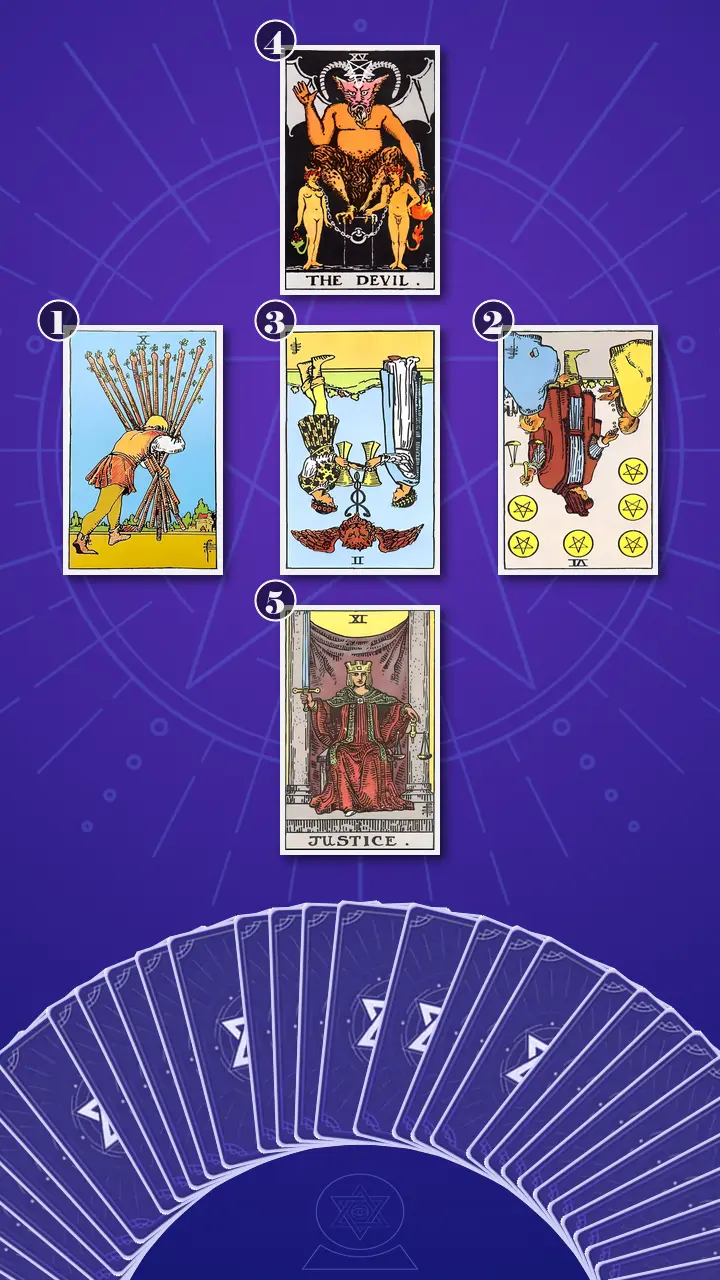
What the Cross Put on the Table
Position One: The Second Shift With No Log-Off Button
“The card I am turning now represents your current contribution: the visible actions and invisible planning through which role overload appears in daily domestic and emotional labor,” I said. “It is the Ten of Wands, upright.”
I pointed to the figure bent under ten bundled wands, carrying so much that the road ahead was almost completely obscured. I saw Maya's grocery bags in that bundle, but I also saw the shared calendar, the cleaning reminder, the Saturday reservation, and the conversation that had never resumed after the previous night's disagreement.
I asked what usually happened after she finished paid work. Maya described closing her laptop at the end of a hybrid UX day, carrying groceries upstairs, and mentally tracking the cleaning cycle, low dish soap, weekend plans, and an unfinished repair conversation before she had even taken off her coat. Her competence got everything through the door. It also left no clear line of sight toward rest, alternatives, or the question of whose responsibility each item actually was.
I read the upright Fire energy as excess: action, reliability, and follow-through had expanded beyond a sustainable share. The card was not calling Maya too capable or too caring. It was showing how those strengths had become a container for work that remained invisible precisely because she kept completing it.
“The internal line sounds something like, 'I can do it faster, but why am I always the one who has to notice it?'” I said. “A relationship can run smoothly and still leave one person carrying the whole operating system.”
Maya gave a short, bitter laugh and lowered her shoulders by a fraction. “That is so accurate it feels a little brutal.”
I did not rush past the reaction. “Then let us be precise about where the brutality belongs,” I said. “Not in blaming your competence. It belongs in seeing what that competence has been required to conceal. Yesterday, after your paid work ended, what did you notice, plan, remind someone about, complete, or check?”
She counted groceries, a birthday text, the recycling reminder, and the wording of a relationship check-in. I watched recognition replace self-criticism as she heard the list aloud. The burden was no longer a vague complaint. It had stages, timestamps, and weight.
Position Two: When Help Still Leaves You Holding the Scale
“The card I am turning now represents the other person's observable participation: what is initiated, owned, or completed without you supplying reminders, instructions, or emotional framing,” I said. “It is the Six of Pentacles, reversed.”
I showed Maya the scales in one hand and the coins distributed by the other. In reversal, I read their balanced exchange as blocked. The issue was not whether her partner ever contributed. The practical question was whether Maya still had to identify the need, define what “done” meant, allocate the task, and monitor the result.
I returned to the grocery app. Maya's partner might buy the groceries, but only after Maya checked the cupboards, created the list, selected the shop, flagged what was urgent, and sent a reminder. The final errand was visible. The management layer stayed with her.
“Technically, they helped,” Maya said, looking at the reversed scales. “So why do I still feel like the manager?”
“Because execution is only one part of ownership,” I replied. “Help you have to design, assign, and chase is not complete ownership.”
I saw her thumb stop moving against the side of her mug. Her gaze shifted from the card to the grocery app lying face down beside her. The distinction between assistance and ownership had turned a foggy sense of unfairness into something observable: noticing, planning, doing, reminding, and checking were separate forms of labor.
I also named the card's overcorrection risk. “Making the workload visible does not require a forensic audit of every dish and text from the last three years. That could turn a future agreement into a courtroom argument over historical accuracy. We can start with one recurring task and one clear definition of full ownership.”
Position Three: Two Cups, One Producer
“The card I am turning now represents the current connection pattern: how overfunctioning, unequal reciprocity, and the wish to stay connected reinforce one another,” I said. “It is the Two of Cups, reversed.”
I traced the mirrored figures and their equally raised cups. Upright, I associate this card with mutual offering. Reversed, its Water energy showed a blockage in the experience of being met. I did not read it as proof that love was absent. I read it as a warning that maintaining contact and experiencing mutual connection were no longer the same thing.
I asked Maya about the last Friday night that had looked like quality time from the outside. She told me she had chosen the restaurant, made the booking, checked the streetcar route, reopened an emotional conversation, and softened its first sentence so carefully that her own hurt almost disappeared from it. The date happened, but she had produced the entire interaction.
“I wanted to be met,” she said quietly. “I did not want to produce another successful evening.”
“Managed contact is not the same experience as mutual connection,” I said. “A full calendar can prove that events happened. It cannot, by itself, prove that two people spontaneously brought care to them.”
I watched her become very still. She did not cry or nod. She pressed her lips together and stared at the two inverted cups, as though she were finally allowing herself to feel the loneliness beneath the efficient surface. Her relationship had not necessarily lacked contact; she had lacked the experience of being invited into care she did not design first.
The Loose Chain Above the Relationship
Position Four: The Bargain Nobody Remembered Signing
“The card I am turning now represents the central challenge beneath the workload: the fear that reducing your effort will weaken the bond and expose whether you are valued without being indispensable,” I said. “It is The Devil, upright.”
I watched Maya's jaw tighten again as the chained figures appeared. I explained that I was not reading The Devil as danger, punishment, or a verdict about her partner. I read its energy as an excess of compulsive attachment combined with a blockage in perceived choice: a coping strategy repeated so often that it had begun to feel like an unavoidable contract.
I brought her back to 9:14 on a recent Thursday. She had been depleted and already resentful when she noticed that the recycling reminder had been ignored. She reached for her phone automatically. The bin itself was low stakes, but leaving it untouched felt disproportionately threatening because it might reveal whether anyone else would notice and whether the connection would keep moving without her coordination.
I used my Attachment Loop Diagnosis as a logical map, not as a clinical label and not as a claim about her partner's motives. I laid out the sequence: an unfinished task or emotional silence triggered the fear of disconnection; Maya intervened; the intervention produced brief relief; the resulting smoothness hid the unequal workload; the absence of spontaneous participation then seemed to confirm that she had to intervene again.
“The private sentence under the loop may be, 'If I do not step in, nothing will happen, and what would that say about us or about me?'” I said.
Maya placed one hand against her sternum. “It would say I am not important enough for someone to think ahead for me.”
I let the sentence rest without arguing with it. “That fear deserves compassion, but it is still a prediction, not evidence. I am interested in the chains on this card because they are loose enough to examine. I do not see a permanent sentence. I see an unspoken bargain that can be brought into consciousness.”
I compared the pattern to an auto-renewing subscription that charged Maya a fee in usefulness whenever uncertainty appeared. Every time she concealed a gap, the relationship's personal algorithm received the same training data: she would notice, soften, remind, and finish. Updating that algorithm did not require withdrawing care. It required interrupting automatic compensation long enough to see what else could happen.
“The gap is data, not a verdict on your worth,” I said. “The first freedom may be only a two-minute pause before you reach for the next reminder.”
I saw her inhale, hold the breath while memories moved across her face, and release it slowly. “I thought my choice was either keep everything running or stop caring,” she said.
“That is the false binary this card exposes,” I replied. “You can care and still stop hiding every low-stakes gap. You can communicate a boundary without turning silence into punishment or the experiment into a covert test.”
When Justice Faced Forward
Position Five: Evidence Instead of Endurance
The refrigerator compressor clicked off through my headphones as I reached for the final card. The sudden quiet made the narrow kitchen feel larger, and I deliberately slowed my hand.
“The card I am turning now represents a self-directed boundary experiment: how you can make labor visible, request complete ownership, and use observable follow-through to gain clarity,” I said. “It is Justice, upright.”
I read Justice as balance: fairness made concrete through proportion, direct language, and acknowledged cause and effect. Its scales measured the full cycle of labor. Its upright sword represented one plain sentence that did not apologize for the facts. This was not a prediction of what Maya's partner would do. It was an antidote that returned agency to the part of the situation Maya could actually govern.
I described the modern scene I saw in the card: Maya spending ten minutes naming three recurring forms of labor, requesting complete ownership of one low-stakes task, agreeing on a review date, and sending no interim reminders. The other person's observable response could then become information about reciprocity rather than another gap Maya had to explain, soften, or fill.
I brought us back to 10:45 p.m.: cold tea, the moved reminder, the grocery app, and the softened weekend text. I named the trap precisely. Maya had been trying to make the correct move inside a system where any unfilled gap tightened her jaw and made belonging feel uncertain.
You do not have to earn connection by carrying both sides; name the work, negotiate ownership, and let Justice's scales measure reciprocity instead of your endurance.
I let the sentence remain in the quiet.
I watched Maya's breath stop. The pad of her thumb, which had been circling the mug's rim, hovered in place. Her eyes widened, then slipped past the cards toward the dark window, as if the previous week's reminders were replaying against the glass. Colour rose along her cheekbones; her eyes shone, but she did not look relieved. She folded her arms and said, in a low, suddenly sharp voice, “But doesn't that mean I have been doing this wrong for years?” The anger landed first; then grief softened her mouth. Finally, she exhaled from deep in her chest. Her fists opened, her shoulders dropped, and she gave a tiny, disoriented laugh, the kind that comes when a heavy bag has left the hands but the muscles are still braced for it. I could see that clarity had arrived with relief and with the vulnerable responsibility of choosing what she would no longer carry.
“No,” I said. “It means a strategy that helped you preserve closeness has developed a cost. Seeing the cost now does not make your earlier self foolish. It gives your present self more choices.”
I leaned a little closer to the camera. “Now, with this new lens, think back: was there a moment last week when this insight could have made you feel different?”
Maya returned to the recycling reminder. “I could have noticed the panic without making the panic true,” she said. “I could have left the bin there until the time we had agreed on. If it still did not happen, that would tell me something. It would not automatically mean I was unlovable.”
“Exactly,” I said. “You are not discovering whether you can carry more. You are discovering whether the connection can carry its share when you stop hiding every gap.”
I then brought in my Shadow Projection Analysis, using Justice's scales as the structure. On one side, I asked Maya to place observable behaviour: “The recycling was not taken out by the agreed time.” On the other, I asked her to place the activated internal narrative: “If I do not manage this, the relationship will go quiet, and that will prove I matter only when I am useful.”
I explained that separating those columns did not excuse an unequal workload or make the missed task imaginary. It prevented an old fear from impersonating a complete interpretation of the present. Justice could then hold both truths: the behaviour mattered, and Maya's worth was not on trial. I saw her analytical instincts return, but this time she was using them on behalf of her own clarity rather than the household's smooth appearance.
I set an eight-minute timer and asked her to make three notes: “work I notice,” “who currently owns it,” and “what I am willing to stop coordinating.” She selected groceries as a recurring, low-stakes item and drafted one sentence: “I need you to take complete ownership of groceries this week, including noticing what is low, making the list, buying it, and putting it away. Can we review how that worked next Sunday?”
I reminded her that she did not have to send the message that night. I also drew a firm safety boundary around the experiment: no medication, rent, critical bills, tenancy, pets, dependants, security concerns, or anything with serious consequences could be left unattended. If the exercise became too activating, she could reduce it to privately naming one task and one feared prediction.
“Justice asks for evidence of reciprocity, not another demonstration of endurance,” I said. I named the emotional shift I had witnessed: from resentful overfunctioning and earning closeness through usefulness toward grounded self-respect and evidence-based relational clarity. It was not the final answer about the relationship. It was the first honest change in how Maya would gather that answer.
The Justice Ownership Map
I gathered the spread into one coherent story. The Ten of Wands showed the current overload. The Six of Pentacles reversed revealed why apparent help had not reduced the mental load. The Two of Cups reversed showed the emotional cost: Maya had preserved contact while losing the experience of being met. The Devil exposed the older, unspoken bargain that usefulness could purchase secure belonging. Justice reclaimed Maya's strongest resource, her ability to observe systems clearly, and redirected it from silent compensation toward explicit agreements.
I described the pattern as an invisible control room. Maya had been watching every dashboard, catching every alert, and resolving every incident before her partner had to see the system fail. Her cognitive blind spot was not that she cared too much. It was that she had sometimes mistaken the absence of visible disruption for evidence of mutuality. By fixing each gap immediately, she also removed the evidence she needed to assess reciprocity.
I made the transformation direction equally plain: name three recurring forms of invisible labor, request full-cycle ownership of one low-stakes responsibility, and observe the response without automatically taking the task back. The goal was not to manufacture a particular outcome. The goal was to stop editing reality before Maya had a chance to see it.
- The Eight-Minute Justice Ownership Map On one weekday evening, sit at the kitchen table and set an eight-minute phone timer. Name three recurring forms of invisible labor: one household task, one social-planning task, and one emotional-repair task. For each, mark who notices, plans, does, reminds, and checks it. Circle one recurring item that is low stakes enough for a seven-day ownership experiment. Keep the note private if that feels more useful. Do not build a historical case file; the minimum version is one task with its five stages written in a Notes app.
- The Projection Detachment Exercise and One-Task Request Before a 15-minute check-in with your partner, divide a page into “observable behaviour” and “triggered narrative.” Record the facts separately from the feared meaning. Then make one direct request: “I am overloaded by managing groceries. I need you to own the complete cycle this week, including planning and follow-through. Are you willing to do that?” Agree on one review time and send no interim reminders. State the experiment openly so it is not a covert test. Use only a low-consequence task, never safety, medication, rent, critical bills, pets, dependants, legal duties, or anything time-sensitive. Drafting the request without sending it is a valid minimum step.

A Week Later: The Quiet Proof
One week later, I received a message from Maya. “I made the map and asked for complete ownership of groceries. I did not add a tutorial. They were ordered a day later than I would have done it, and we ran out of oat milk for one morning, but I did not send a reminder.”
She told me that the Sunday review had not transformed the relationship in fifteen perfect minutes. Her partner became defensive at first, then admitted that buying groceries had felt like the whole task because Maya's backstage work had never been named. They agreed to repeat the experiment with a clearer standard. Maya noticed the defensiveness, the later accountability, and the follow-through as three separate pieces of information. She did not rush to turn them into either a happy ending or a catastrophe.
She added, “I slept through the night. My first thought in the morning was still, 'What if I am wrong?' I smiled, opened the ownership note, and did not send a reminder.”
I read that final line twice. The quiet proof was not that tarot had solved Maya's relationship or guaranteed reciprocity. The cards had helped make a hidden system visible; Maya had chosen the boundary, spoken the sentence, and tolerated enough uncertainty to observe what followed. The authority remained with her.
Ownership, Not Certainty
I think of this reading as a Journey to Clarity because Maya did not leave with certainty about every future choice. She left able to distinguish help from ownership, maintained contact from mutual connection, and a triggered prediction from observable evidence. That distinction gave her somewhere solid to stand.
I have learned that when your jaw tightens over one untouched reminder because part of you fears the quiet will prove you were valued mainly for being useful, keeping the connection alive can feel lonelier than letting it pause. Simply recognizing that bargain means you are no longer completely inside it.
I will leave you with Justice's scales, not as a verdict but as an invitation: if one small, low-stakes gap could become information rather than a verdict on your place in the relationship, which piece of coordination might you feel curious to leave visible for a little while?