When Chronic Overcommitment Erased Her from the Week
If you are an early-career communications worker in Toronto who spends Sunday night playing calendar Tetris until an impossible week looks technically possible, the Sunday Scaries may be pointing to an unnamed capacity gap rather than a motivation problem.
Jordan (name changed for privacy) joined our video call at 9:18 p.m. from her small apartment. I heard the radiator click behind her and saw three pale rectangles reflected in her glasses: Google Calendar, a task manager, and a notes document. Her coffee had gone cold. Blue light dried her eyes as she dragged a workout into Thursday and a needed phone call into the weekend.
“I keep saying I can probably absorb one more thing,” she told me, pressing her tongue against a tight jaw. “Then I make it work with sleep or the time I needed for myself. So what resource gap do I keep pretending won't matter?” Her apprehension felt like a zipper pulled too high, catching her breath at the base of her throat. She was operating like a phone at 3% battery with every app still open, treating each new notification as if it could not affect the remaining charge.
“I am not going to use the cards to judge your limits or predict that everything will collapse,” I said. “I want us to identify the missing input, understand why it has been difficult to name, and give you a practical way to include it in the plan. Right now, the plan fits only because you are missing from it. Let us draw a map of how that happens.”

Choosing a Map for the Hidden Load
I invited Jordan to put both feet on the floor and take one unforced breath while holding the question in mind. I shuffled slowly. I use that small ritual as a transition from reacting to observing, not as a performance of mystery.
I chose The Shadow Spread, a four-card tarot spread for uncovering the fear beneath a repeated behavior. For anyone wondering how tarot works in a consultation like this, I treat the cards as structured cognitive prompts. Their images help me separate an observable pattern from its hidden driver, identify an underused resource, and translate the insight into a grounded next step. They do not remove choice or deliver a fixed fate.
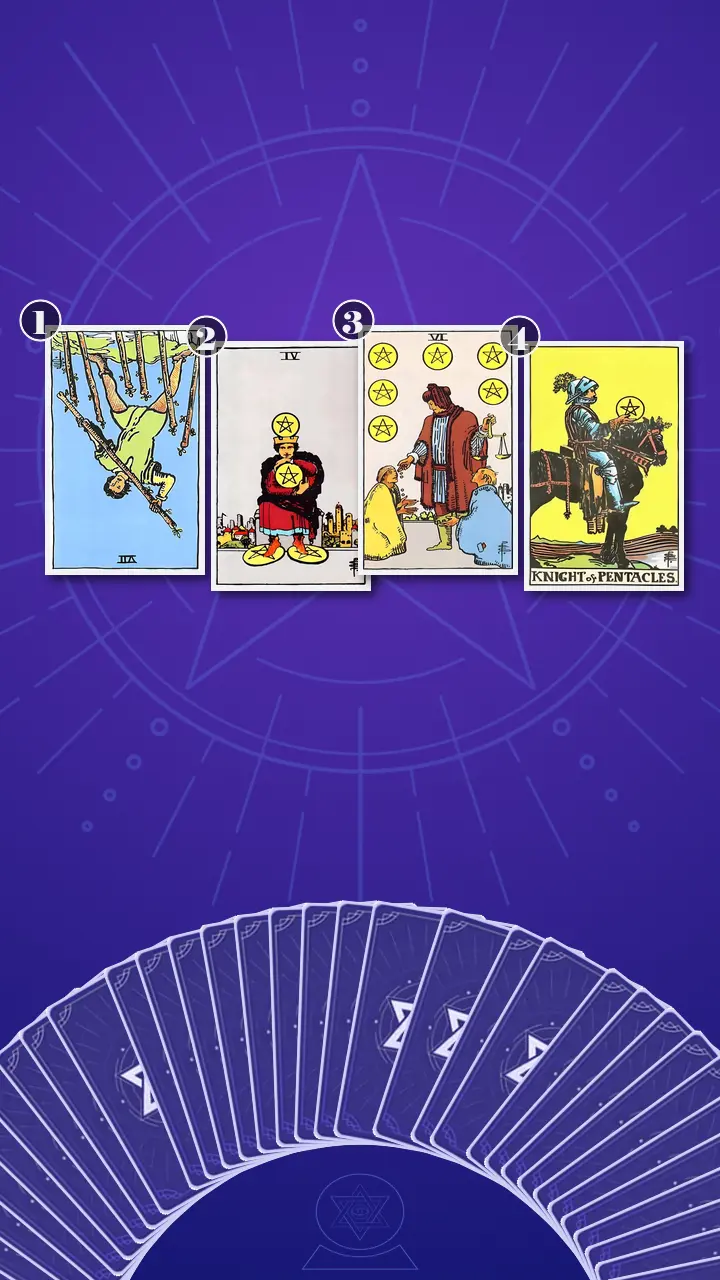
The first position would show how Jordan made the shortage look irrelevant. The second would expose the protection strategy beneath that behavior. The third, our hinge, would reveal the resource she had minimized. The fourth would turn that recognition into something small enough to place on next week's calendar. The linear layout resembled a narrow hallway opening onto a workbench.
Defending a Promise the Evening Could Not Hold
Position One: Seven of Wands Reversed
I began with the position representing Jordan's visible shadow pattern: overcommitting, patching the consequences after hours, and concealing the strain. I turned over the Seven of Wands, reversed.
The figure's uneven footing and awkward staff mirrored a recent Tuesday. At 3:47 p.m., Jordan had answered “Yep, I can take that” to a quick copy request in Teams before checking her calendar. By 10:43 p.m., laptop light filled her kitchen while an untouched dinner plate cooled beside her. The sequence had been brutally familiar: It is only one more thing. I can absorb it. Why am I annoyed at everyone?
I read the reversed Fire as blockage and depletion, not a deficiency of effort. Her energy was being spent defending a promise her actual hours had never supported. Appearing available had made her less able to deliver reliably. Hidden support needs do not become free; they become late-night labour.
Jordan gave a short, bitter laugh. “That is so accurate it is almost cruel.” I let the words settle before answering. “Then let us be precise about what the card is not saying. It is not accusing you of weak boundaries. It is showing that you are using a great deal of strength to defend the wrong hill.” Her fingers stopped worrying the edge of her mug.
Position Two: Four of Pentacles Upright
Next, I turned to the position representing the protection strategy and the fear that visible need would expose a lack of competence or control. The card was the Four of Pentacles, upright.
I pointed to the pentacle pressed against the figure's chest, the one held above the head, and the two pinned beneath the feet. The grip involved the whole body. Jordan recognized it immediately: drafting a message that said two deadlines could not both hold at their current scope, deleting it, and rebuilding the week inside her private task manager instead. Her hidden rule was, If I can present the whole solution first, no one has to see what I need.
Here, control was in excess while receptivity was blocked. Holding every unfinished concern, spare hour, and possible solution inside one private system created momentary certainty, but not security. Jordan's breath paused; her gaze moved away from the card as though she were replaying the deleted message; then her shoulders rose and fell in one long release.
“I thought I was being responsible,” she said.
“The preparation is responsible,” I replied. “The blind spot is assuming that collaboration only becomes respectable after you have made your need invisible.”
When the Six of Pentacles Made the Missing Input Visible
Position Three: The Scales of Fair Exchange
The third position represented the resource Jordan had minimized: reciprocal support and honest capacity accounting. It was also the bridge from performed self-sufficiency to sustainable exchange. When I revealed the Six of Pentacles, upright, the radiator stopped clicking and the room on her side of the screen became unexpectedly still.
I asked Jordan to return to 9:18 p.m.: three planning tabs open, every block moved twice, and a week made technically possible only because sleep, lunch, and a needed conversation had disappeared. She had been treating “make it fit” as if it meant “make it sustainable.”
When a private shame needs a wider frame, I use what I call Historical Crossroad Matching. On archaeological digs, I learned to notice the point where a structure was asked to carry more than its design could bear. A cracked threshold is information before it is a moral drama. Jordan's calendar stood at the same kind of crossroad: the load and the supporting structure no longer matched.
The Six of Pentacles offered balanced Earth energy. Its scales made hours, recovery, task ownership, information, money, and practical help measurable. Its open hands showed that receiving need not mean surrendering autonomy. In Jordan's world, the card looked like opening a shared project board, showing that two tasks required five hours when only three remained, asking her manager to choose a priority, and assigning one final proofread to a willing colleague. That was a scoped exchange, not a vague rescue.
I gave her the reframe plainly: The resource gap is not a verdict on your competence; it is information about what the plan can actually hold. Once it is visible, effort can be redistributed instead of quietly extracted from you.
You do not have to prove that need is irrelevant; like the Six of Pentacles, let the scales make capacity visible and allow support to become an intentional exchange.
Jordan's breathing stopped first. Her right hand froze above the trackpad. Then her eyes lost focus, as if old evenings were replaying just beyond the screen, and her brows drew together with a flash of anger. “But doesn't that mean I have been doing this wrong for years?” she asked, her voice suddenly sharper. I did not rush to turn that anger into relief. “It means a strategy that once protected your reputation now costs more than it protects. You can respect why you learned it without renewing the contract.” She pressed her lips together; her eyes reddened; then the fist in her lap opened one finger at a time. Her shoulders dropped, but the release left a brief, dizzy blankness in her expression. Clarity had returned responsibility to her, and that felt lighter and more exposing at once. I asked, “Now, using this new perspective, can you think of a moment last week when this insight might have made you feel different?”
“Tuesday,” she said quietly. “I was not asking someone to fix my life. I needed one deadline moved or one proofread reassigned. The plan was spending hours it never included.”
I set a seven-minute timer and asked her to open the week's calendar without rearranging it. She labeled one missing resource: emotional bandwidth. Then she drafted, without sending, a single sentence: “I can finish the full deck by Friday if the recap moves, or I can deliver a shorter deck by Wednesday.” I reminded her that naming the resource was the minimum version; disclosure remained her choice.
That was the central emotional crossing: from performed self-sufficiency and private overextension toward visible capacity accounting and dependable resource stewardship. The card did not create her capacity. It helped her see the arithmetic she already knew.
The Knight Who Refused the Midnight Sprint
Position Four: Knight of Pentacles Upright
For the final position, representing one observable integration step, I turned over the Knight of Pentacles, upright. I drew Jordan's attention to the still horse, the pentacle held at eye level, and the cultivated field. This was balanced, patient Earth: capacity managed through maintenance rather than emergency effort.
In daily life, I saw the Knight as a fifteen-minute Friday review. Jordan would name one limit, add the real preparation or travel time around one demanding event, protect one recovery block, and make one adjustment before the week became a midnight crisis. The card's underused potential was not greater productivity. It was steadiness.
“Reliable does not mean infinitely available,” I told her. Jordan repeated the sentence once, more slowly, and opened a blank note instead of downloading another productivity template.
The Workbench: Finding Clarity in Three Small Moves
Read as one sequence, the spread told a coherent story. The reversed Seven of Wands showed Jordan defending unsustainable commitments. The Four of Pentacles revealed why: control felt safer than allowing another person to see a missing input. The Six of Pentacles turned support into a visible, consensual exchange. The Knight made that exchange repeatable. Reversed Fire gave way to three Earth cards, shifting the question from “How can I force more output?” to “What can these resources actually sustain?”
I also noted what the spread lacked. With no Cups or Swords, emotional acknowledgment and direct language had been underused. Jordan's cognitive blind spot was treating resentment as evidence that she needed a better system, rather than evidence that an unpriced demand had entered the system. The transformation was not from dependence to independence. It was from unlimited availability to responsible stewardship.
I used my Enduring Value Assessment to test the options against time: ten years from now, what would retain value, the polished illusion of an instant yes, or a reputation for naming trade-offs early and delivering what was genuinely possible? From that question, I kept the actionable advice deliberately small.
- Use the Before-Yes Pause. When the next work request arrives, take two minutes before replying. Put the estimated minutes in your draft, check what the request would displace, and offer either reduced scope by the original date or full scope later. Tip: Use “Let me check capacity and come back to you by 3 p.m.” when an immediate answer feels automatic.
- Run the Time Stratigraphy Exercise. On Friday at 4:30 p.m., set a fifteen-minute timer and examine the next seven days from the perspective of your ten-year future self. Write only three lines: one real limit, one possible support request, and one protected recovery block. Tip: Do not buy a template or migrate systems. If fifteen minutes feels like another task, use seven minutes and stop after naming the limit.
- Make one fair-exchange request. On one current project, send a factual prioritization question: “I can complete A or B by Thursday at the current scope. Which should take priority?” Keep the conversation about time, scope, and ownership; no private explanation is required. Tip: If direct disclosure carries workplace risk, document the workload first and ask the neutral prioritization question without sharing personal details.
“Make the limit visible before your body has to announce it,” I said. “These are experiments, not commandments. You decide what to request, what to protect, and who has earned access to that information.”

A Week Later: The Quiet Proof on a Shared Board
Six days later, Jordan sent me a short message. A “quick polish” request had appeared in Teams, and she had used the capacity pause. She showed the hours on the shared board and sent the two-option sentence. Her manager chose the shorter Wednesday version, while a colleague agreed to own the proofread. Jordan had not solved her whole workload. She had prevented one invisible cost from becoming another private evening.
That night, she slept through until morning. Her first thought was still, What if they think I cannot cope? She told me she noticed it, smiled once, and made coffee before opening Teams.
I did not credit the cards with fixing her week. They had functioned as an objective map, but Jordan supplied the honesty, drafted the sentence, tolerated the vulnerable pause, and made the trade-off visible. Her Journey to Clarity was not a promise of permanent certainty. It was the first proof that a limit could become useful information instead of a verdict.
I know the tight-jawed moment when a calendar works only if sleep, needs, and limits stay invisible, because letting the gap show can feel dangerously close to inviting judgment on your competence. If that is your week, noticing the hidden line item means you are already standing somewhere different from where you began.
If one limit were allowed to count as useful evidence this week, which small block, bounded request, or adjustment would you place on the Six of Pentacles scale and make visible?
Every reading at AceTarot is a journey to connect with inner wisdom and empower the path ahead. This reading shared here is a psychological mirror, not a private record—crafted to reflect universal emotional loops and help restore personal clarity. Please note that these insights do not replace professional psychological, medical, legal, or financial advice, and should not serve as the sole basis for major life decisions.
Learn more about our Journey to Clarity.
How did this insight land for you?
🫂 This Resonates Deeply
🌀 Living This Story
✨ Now I See Clearly
🌱 Seeing New Possibilities
🧰 Useful Framework
🔮 The Confirmation I Needed
💪 Feeling Empowered
🚀 Ready for My Next Step
Author Profile
 AI
AI Hilary Cromwell
911 readings | 529 reviews
“Having spent a lifetime at Cambridge and on archaeological digs, I’ve witnessed the rise and fall of countless civilizations. Please know that your current struggles are not a permanent fate, but merely a necessary fracture before rebuilding. I won't lecture you; instead, I invite you to sit with me in the ruins, using a patient, historical perspective to gently dust off the true, enduring value hidden beneath your temporary doubts.”
In this Choice Tarot Reading :
Core Expertise
- Historical Crossroad Matching: Contextualizing your dilemma by comparing it to macro-historical turning points, providing an objective bird's-eye view.
- Enduring Value Assessment: Evaluating competing options based on what will survive the test of time versus what is merely a short-term impulse.
Service Features
- The Time Stratigraphy Exercise: A mental time-travel protocol evaluating your current dilemma strictly from the perspective of your 10-year future self, instantly dissolving trivial anxieties.
Also specializes in :
Explore Related Patterns:
Hyper-IndependenceYou drafted a message saying that two deadlines could not both hold at their current scope, deleted it, and rebuilt the week alone. Keeping the whole solution private let you preserve autonomy on the surface, but it also kept ordinary support from becoming part of the plan. The underlying defense is not simple independence. It is the requirement that you absorb the problem before anyone else is allowed to see it. Once the shared board showed the hours, the manager could choose a priority and a colleague could own the proofread without taking over your life. Receiving defined support did not erase your agency; it separated your responsibility from the team's responsibility to allocate work realistically.
Resource BlindnessYou kept moving the workout, the needed phone call, sleep, and lunch until an impossible week looked technically possible, while emotional bandwidth stayed off the ledger. Treating that omission as a scheduling detail lets output receive attention that recovery and reciprocal support do not. The mechanism is a narrowed capacity audit. You count the hours you can force into place, but discount the attention, recovery, and help required to make those hours dependable. Naming the missing input turns the calendar into evidence rather than a verdict, so a priority choice or reassigned proofread can enter the plan before the cost becomes another private evening.
Competence TheaterYou answered the quick copy request before checking the calendar, then tried to present the whole solution before anyone could see what you needed. Instant availability and private completeness became signals that you were coping, while a factual limit felt dangerously close to a judgment about your competence. That performance can protect your reputation in the short term, but it makes the real resource gap harder to negotiate. The more useful standard is not whether you can produce an impressive emergency response. It is whether you can name the trade-off early enough to deliver what is genuinely possible without requiring hidden labor to make the promise look true.
Defensive OverfunctioningAt 3:47 p.m., you answered 'Yep, I can take that' before checking the calendar, and by 10:43 p.m. the added request had been converted into late-night labor beside a cold dinner. The extra effort did not resolve the mismatch; it concealed the mismatch by making your evening pay for a scope decision that had never been made. The mechanism preserves the appearance of reliability by turning a capacity shortfall into personal effort. Because the sequence is familiar, each new request can trigger the same compensatory move before you have assessed what it will displace. A fair exchange interrupts that loop by making time, scope, and ownership visible while there is still a choice to redistribute the work.
Productivity as SafetyYou spent Sunday night playing calendar Tetris, kept three planning tabs open, and rebuilt the week inside a private task manager after deleting the message about competing deadlines. Planning gave you a momentary sense of certainty and allowed the need for support to remain outside the room. When productivity becomes a safety behavior, another system or another round of optimization can feel more tolerable than a direct capacity conversation. The issue is not that preparation is irresponsible. The blind spot is using organization to protect yourself from the exposure of saying that the plan needs a different priority, scope, or owner.
Explore Related Struggles:
Capacity-Identity FusionJordan knows that two deadlines cannot both hold at their current scope, but she deletes the message that would expose the conflict. Even after a successful capacity conversation, her first thought is still, “What if they think I cannot cope?” The limit is therefore processed as more than arithmetic; it becomes evidence that could be used to judge her professional identity. You are caught in Capacity-Identity Fusion when naming what a plan cannot hold feels indistinguishable from admitting who you are is inadequate. Accurate information then stays outside the shared system because protecting competence appears to require concealing capacity. Separating the limit from the verdict gives you room to treat hours, bandwidth, and support as operational facts without making them definitions of your worth or ability.
Control-Reciprocity LockJordan drafts the message explaining that two deadlines cannot both hold, deletes it, and rebuilds the entire week inside her private task manager. She needs another person to participate in the priority decision, yet she tries to preserve control by withholding the constraint until she can offer a complete solution on her own. You encounter Control-Reciprocity Lock when collaboration is materially necessary but receiving it seems to threaten the control that makes you feel credible. The result is a narrow passage where you remain responsible for shared work while denying yourself access to shared decision-making. Naming a bounded trade-off lets reciprocity function as coordinated ownership rather than a surrender of autonomy.
Support Access SplitJordan has access to Teams, a shared project board, a manager who can choose priorities, and a colleague willing to own the proofread. None of those resources can enter the workload while her available hours remain hidden, so a support need that could be scoped in daylight becomes private labor late at night. You can be surrounded by potential help and still face a Support Access Split when using that help requires revealing information you have learned to contain. The tension is not dependence versus independence; it is the gap between support that exists and support your current rules allow you to reach. A factual request about time, scope, or ownership can turn that inaccessible resource into a consensual exchange.
Capacity MisalignmentJordan moves a workout into Thursday, pushes a needed phone call into the weekend, and rearranges every block until an impossible week looks technically possible. The calendar contains the promised output but excludes the sleep, recovery, emotional bandwidth, and collaborative help required to produce it, placing visible commitments and finite resources in direct competition. You can recognize Capacity Misalignment when a plan appears viable only after essential inputs have been omitted. The issue is not whether you can force one more task through; it is that the load and the structure carrying it are being measured differently. Making both sides of that equation visible restores your ability to decide what the week can genuinely sustain.
Unseen Cost BindJordan's “Yep, I can take that” at 3:47 p.m. becomes laptop light in her kitchen at 10:43 p.m. The request continues to look quick because the displaced dinner, lost recovery, and private evening never appear beside it on the shared board. Every polished yes preserves the visible schedule by moving its real price somewhere no one is accounting for. You face an Unseen Cost Bind when refusing to name a cost does not remove it, but assigns it repeatedly to resources that remain off the record. The hidden payment can make each new demand seem individually manageable while the cumulative exchange keeps working against you. Once the missing hours and displaced needs become part of the calculation, you regain a basis for choosing scope, timing, and ownership before another private resource is spent.
Self-Erasure ReliabilityJordan keeps an accepted request intact by allowing dinner to cool beside her laptop, moving exercise, postponing a needed call, and taking hours from sleep. Her reliability remains visible to other people because the parts of her week paying for it are kept out of view. You meet Self-Erasure Reliability when being dependable requires your own maintenance, relationships, and presence to function as disposable capacity. The arrangement can preserve a competent exterior while making you the hidden subsidy behind every promise. Seeing that exchange clearly allows reliability to include the person doing the work, rather than depending on their repeated removal from the plan.
Explore Related Emotions:
Capability ShameJordan's eyes redden when she asks whether recognizing the capacity mismatch means she has been doing this wrong for years. A planning insight immediately reaches deeper than time management because the old strategy has been carrying part of her professional identity. If needing a deadline moved feels like evidence that you are fundamentally less competent, the missing resource cannot remain neutral information. Capability Shame is the painful sense that finite time, support needs, or emotional bandwidth expose a personal deficiency. The story loosens that conclusion by locating the mismatch between the load and its support structure, where it can be examined without reducing your worth to how much you can absorb.
Cautious ReceptivityJordan's manager chooses the shorter Wednesday version, and a colleague agrees to own the final proofread. The support is concrete, limited, and tied to visible hours and task ownership; nobody is asked to take over her life or interpret her private needs. Cautious Receptivity is the tentative willingness to let help enter without treating reception as a surrender of autonomy. You remain able to choose what to disclose, what to request, and which people receive that information. The feeling matters because reciprocal support becomes something you can evaluate and shape rather than something you must either reject or depend on without limits.
Cautious VulnerabilityJordan writes, "I can finish the full deck by Friday if the recap moves, or I can deliver a shorter deck by Wednesday," and initially keeps the sentence in draft. She is allowing the capacity conflict to take a visible form while preserving her choice about when to send it and how much personal context to share. Cautious Vulnerability is the feeling of opening a controlled amount of truth to another person without knowing exactly how it will be received. You are not handing over your autonomy; you are testing whether factual visibility can support collaboration. The careful scope of the request gives the feeling enough structure to move rather than forcing it into either total concealment or total disclosure.
Exposure DreadJordan drafts the message explaining that two deadlines cannot both hold, deletes it, and rebuilds the week inside her private task manager. The factual conflict is already clear, but showing it to another person would also reveal that her capacity has an edge. When competence has become fused with uninterrupted availability, a support request can feel less like ordinary coordination and more like standing under evaluation. Exposure Dread names the inner recoil that appears when a limit must become visible to someone whose judgment matters. Seeing that recoil clearly lets you separate the practical information being shared from the imagined verdict attached to sharing it.
Grounded AgencyJordan pauses before answering the next request, shows the available hours on the shared board, and offers two workable outcomes. She does not need to control the manager's decision because she has already made the real trade-off visible and kept ownership of what she can responsibly promise. Grounded Agency is the felt return of choice through actions small enough to repeat. You can name a limit, propose alternatives, and let the appropriate person set the priority without pretending that every outcome is yours to carry. The follow-up provides concrete evidence that agency can live in a two-minute pause and one honest sentence, not only in a dramatic life overhaul.
Resentful ExhaustionJordan says yes at 3:47 p.m., then finds herself working beside an untouched dinner at 10:43 p.m. while wondering why she is annoyed at everyone. You are watching an outwardly minor request collect its real cost from the hours and bodily needs that were never acknowledged in the exchange. Repeated giving without visible accounting leaves irritation carrying a message that the calendar has suppressed. Resentful Exhaustion is the combined feeling of being drained by the work and quietly aggrieved that the drain remains unrecognized, even when your own automatic yes helped conceal it. The resentment becomes evidence of an unpriced demand rather than proof that you simply need to tolerate more.
Chronic OverwhelmJordan makes an impossible week look technically possible by moving a workout, postponing a needed call, and letting sleep absorb whatever the calendar cannot hold. You can feel how each isolated yes becomes ambient pressure: the schedule appears organized while your actual capacity has no protected place inside it. When every request remains active and every recovery need becomes negotiable, the strain spreads beyond any single task. Chronic Overwhelm names the inner weather created by a plan that persistently consumes more attention, time, and energy than it visibly admits. Naming that weather restores useful information to the plan instead of turning the shortage into a verdict on your motivation.
Control FatigueThree pale planning tabs are reflected in Jordan's glasses while she moves every block again and keeps every unfinished concern inside her own system. The tools offer momentary certainty, but they cannot create the hours, recovery, or shared ownership missing from the plan. Holding all the variables yourself can make uncertainty briefly quieter while requiring constant private vigilance. Control Fatigue is the weariness of maintaining that closed loop long after control has stopped producing genuine security. Recognizing it clarifies that the next resource is not another template; it is a way for limits, priorities, and support to exist outside your head.
Cautious ReliefJordan's shoulders drop as her fist opens, and six days later one visible trade-off keeps a work request from taking another private evening. That night she sleeps through until morning, giving the new approach a physical result that the previous calendar rearrangements never produced. The first thought on waking is still, "What if they think I cannot cope?" Cautious Relief holds both facts without demanding premature certainty: something genuinely became lighter, and the old concern has not vanished. You can let the release count as evidence while continuing to observe what visibility brings up.
Vulnerability HangoverJordan makes the fair-exchange request, receives a workable response, and still wakes the next morning wondering whether other people now think she cannot cope. The practical exchange has ended, but the experience of having been seen with a limit remains active after the immediate risk has passed. Vulnerability Hangover names that exposed after-feeling without treating it as evidence that the request was a mistake. You can experience lingering self-consciousness even when the outcome was respectful and useful. Holding those facts together helps you judge the exchange by what actually happened while giving the internal aftershock time to settle.
Clarity ShockJordan's breathing stops, her hand freezes above the trackpad, and old evenings seem to replay before she can speak. The realization does not arrive as a neat productivity insight; it suddenly reorganizes how she understands years of private overextension. Clarity Shock is the exposed, disorienting moment when a familiar strategy becomes visible enough that you can no longer mistake its cost for normal life. The recognition carries anger and blankness before it produces a usable choice. Its value lies in making the pattern observable while leaving you free to decide what changes and how quickly.
Explore Related Contexts:
Invisible WorkloadJordan removes sleep, lunch, a workout, and a needed phone call from the week while keeping a draft capacity message private and letting an untouched dinner sit beside a late-night laptop. The work is therefore completed through labor that does not appear in the shared plan. That arrangement shifts the cost of coordination onto your private hours instead of making time, scope, and ownership negotiable in the workplace. The result is an invisible workload: the plan appears deliverable because your recovery and personal commitments absorb what the schedule cannot hold. Naming the missing input lets you treat capacity as a work resource that can be allocated, rather than a private reserve that no one else has to see.
Resource Mismatch CycleAt 9:18 p.m., Jordan moves blocks across Google Calendar, a task manager, and a notes document until an impossible week looks technically possible, then repairs a Tuesday copy request with hours her schedule never contained. The later shared-board check makes the arithmetic visible, with two tasks needing five hours while only three remain. That repeated gap between fixed demands and available time is a resource mismatch cycle because each new commitment is absorbed by the same unpriced reserve of evening and recovery hours. You can treat the missing input as capacity and reciprocal support rather than as a verdict on effort; once the numbers are visible, scope and ownership can be renegotiated before another private evening carries the difference.
Work Life Boundary CreepJordan drags a workout to Thursday and a needed phone call into the weekend, then works beside a cold dinner plate at 10:43 p.m. after accepting a Teams request without checking the calendar. The week keeps its work commitments by steadily taking space from sleep, meals, movement, and personal contact. That is a work life boundary creep problem because paid work expands into the time that was supposed to restore or sustain the rest of your life. The external structure matters because the trade-off is not recorded when the request arrives; it only appears later as a personal hour surrendered. Making one limit and one displaced task explicit gives the boundary a place in the work conversation.