The 8:47 Train, Seven Saved Ideas, and One Unedited Response to Test

The 8:47 Train Where Endless Self-Help Consumption Replaced Direct Contact with Personal Feelings, Preferences, and Choices
I began with the moment Casey was tired of repeating. She was a twenty-eight-year-old junior content strategist in London who could explain audience psychology all day, then open a podcast about self-trust before saying which campaign headline she actually preferred. What she brought into my consultation room was endless self-help consumption replacing direct contact with personal feelings, preferences, and choices.
At 8:47 PM on the Northern line, she had highlighted a podcast sentence about identity, added two recommended books to her reading list, and opened a saved carousel about values. The phone felt warm against her palm. Brakes squealed into the next station, damp raincoats and stale coffee thickened the carriage air, and her shoulders climbed towards her ears as the episode ended. The new language had briefly felt like progress. The question underneath it had not moved.
"I can explain the pattern," she told me, rubbing one thumb over the edge of her phone case, "but I still don't know what I actually want. Maybe the next book will say it in a way that finally lands."
I could hear the contradiction clearly. Casey wanted to feel closer to herself, yet feared that if she stopped consuming guidance, she would lose the only reliable route she had towards herself. What she called frustration felt like trying to wipe condensation from a mirror with a wet sleeve: every effort promised a clearer reflection, but left another cloudy layer behind. Her hands remained restless, her forehead held a tight horizontal line, and her energy seemed to drop whenever she reached the end of an explanation without arriving at a personal choice.
"I don't think the goal today is to prove that you've been learning the wrong things," I said. "I think it's to understand what happens in the few seconds before you reach for them. Let's give the fog a shape, then look for one path that is actually yours to test."

Choosing the Ladder Beneath the Noise
I asked Casey to place both feet on the floor, take one ordinary breath, and hold her question without polishing it. I shuffled slowly while she focused on the words, "Why do I keep consuming self-help without feeling closer to myself?" I use this pause as a psychological threshold: it marks the moment when researching a problem gives way to observing it.
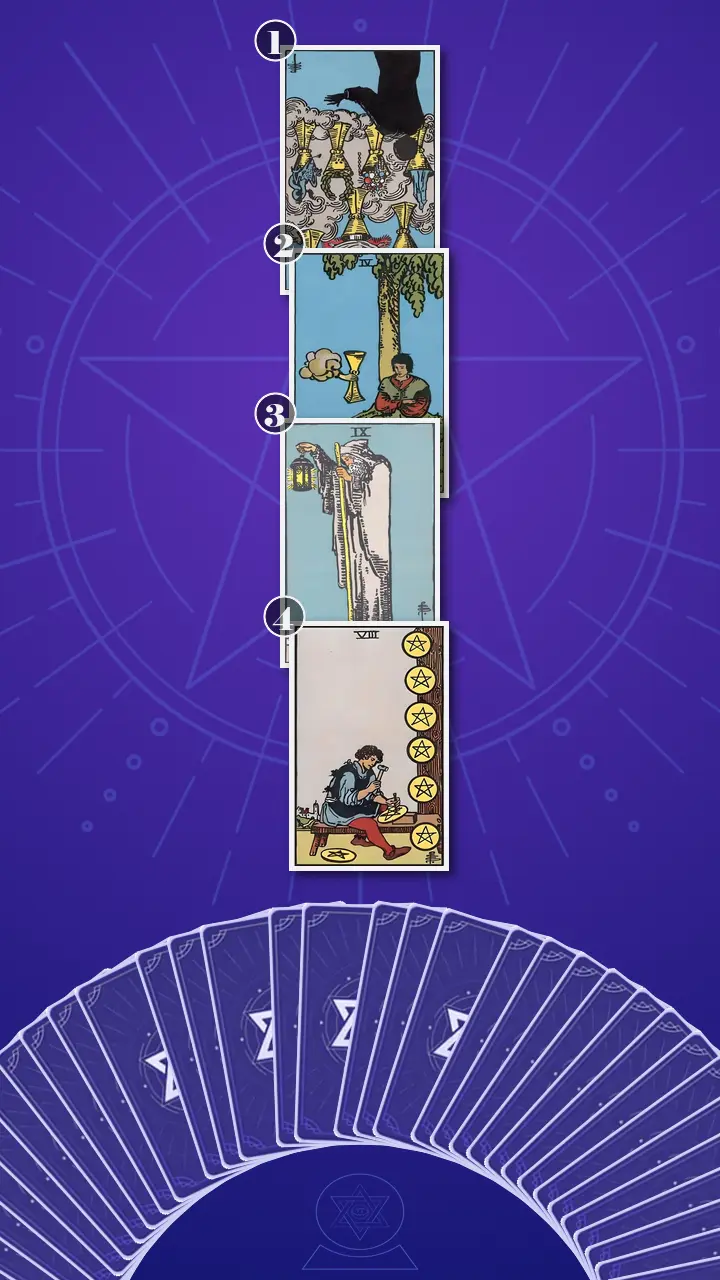
I chose The Shadow Spread · Context Edition, a four-card contextualized Shadow tarot spread for self-contact, discernment, and lived practice. I laid the cards in a vertical line, like a narrow staircase descending from a crowded feed towards something quieter and more tangible.
For anyone wondering how tarot works in a reading like this, I do not treat the cards as verdicts or predictions. I use their symbols as structured prompts. They place an internal pattern on the table, where both of us can examine it with a little more distance. Card meanings in context matter more than dramatic declarations: an image becomes useful only when it connects to observable behaviour, emotional evidence, and choices the querent remains free to make.
This spread was a precise fit because Casey's question was not really about whether self-help was good or bad. It involved four linked layers. The first position would show the visible consumption loop. The second would reveal the feeling or fear being overlooked beneath it. The third would identify the integrating quality capable of meeting that shadow. The fourth would turn the insight into a repeatable practice. A larger predictive spread would have added noise to a question that needed depth, not more options.
"So the cards aren't going to tell me which book to read?" Casey asked, with a small, cautious smile.
"No," I said. "They may help us see why the next recommendation feels safer than your first reaction. What you do with that information will still belong to you."
Reading the Browser with Twenty-Seven Tabs
Position One: The Loop That Looks Like Progress
The card I turned over first represented the observable self-help consumption loop: opening multiple resources, saving advice, and changing systems before any one practice had time to become lived experience. It was the Seven of Cups, reversed.
In the Rider-Waite-Smith image, seven cups float before an uncertain figure, each containing a different promise or projection. Reversed, that field of possibility had become an excess of input and a blockage of discernment. I saw a browser with twenty-seven tabs open, every tab claiming it might explain Casey's identity, while none remained active long enough to become useful.
I described the Northern line scene back to her in the card's language. After an agency day, she had a values podcast, a confidence reel, a boundary worksheet, a book recommendation, and several routine videos spread across her phone. Each option produced a brief lift. By the time the train reached her stop, she had collected seven possible explanations and tested none of them against the day she had actually lived.
"The reversal does not mean curiosity is a flaw," I said. "It shows curiosity becoming scattered enough to block selection. You are receiving the emotional reward of discovery before taking the risk of finding out whether one idea fits you."
I gave the loop its familiar inner soundtrack: Maybe this episode will finally explain it. Maybe this book will make the answer feel safe. Maybe I shouldn't have to decide yet. The language sounded hopeful, but it kept one important event from happening: Casey never had to let an ordinary preference carry weight before an expert approved it.
She gave a short laugh, but it landed without humour. "That's so accurate it's a bit brutal," she said. "My saved folder is basically a museum of people I thought I might become."
I watched her press her fingertips together and then pull them apart. "We can be precise without being cruel," I said. "This pattern gave you relief and structure. It makes sense that you kept using it. We are only checking whether the price has become higher than the protection."
I also named the reversal's overcorrection risk. Deleting every podcast, abandoning every book, and imposing a rigid content detox could turn discernment into another perfectionist performance. The useful question was not, "How do I stop learning?" It was, "Can I choose one experience before I collect another explanation?"
Position Two: The Feeling Waiting Beside the Dashboard
The next card represented the hidden driver beneath the visible loop: Casey's habit of overlooking an immediate feeling or preference because outside guidance seemed more trustworthy than direct self-contact. I turned over the Four of Cups, upright.
The figure on the card sits with folded arms. Three cups are already grounded in front of them, while a fourth is offered from outside the frame. Upright, the image held a stable but withdrawn emotional posture. The energy was not absent; Casey's capacity to receive it was blocked. She was waiting for an insight impressive enough to feel legitimate while ordinary information from her own days sat within reach.
I brought her to Sunday at 6:12 PM in her compact rented flat. Rain tapped the kitchen window, the radiator clicked, and a Notion template reflected blue light into tired eyes. She already had three meaningful observations from the week: a particular client call had drained her, a cancelled meeting had brought relief, and one kind of editing work had made her noticeably more animated. Instead of receiving those signals, she rebuilt pages for values, routines, and emotional check-ins while a new video loaded beside them.
"This card is not saying you have no access to yourself," I told her. "It is showing how quickly you dismiss what is already available. A quiet reaction feels too small, too messy, or too unverified, so you wait for a more convincing cup."
I heard the loop again: Maybe this episode will finally explain it. Maybe this book will make the answer feel safe. Maybe I should not have to decide yet. The first card multiplied the possible answers. The second kept Casey emotionally seated while she waited for an outside source to make one answer feel legitimate.
"What were you already feeling before you redesigned the dashboard?" I asked. "Not the theory. Not what the feeling means. Just the first word."
Casey's breath shortened. She looked at the card rather than at me, and her crossed arms tightened for a second before loosening. "Angry," she said. Then, after a pause, "And embarrassed that I was angry. The client changed everything at the last minute, and I told myself I should be adaptable."
That answer mattered because the psychological blind spot was beginning to show itself. The search had not been caused by an absence of emotion. It had interrupted anger before the anger could reveal a boundary, a preference, or even a need for rest. The self-help content gave Casey polished language while sparing her the vulnerability of saying, "That did not work for me."
"Another explanation can describe your life without becoming your life," I said. "Before you explain a feeling, you may need to let it exist for five unedited minutes."
When the Hermit Lit Only the Next Few Steps
Position Three: The Inner Light That Does Not Demand Certainty
The room grew quieter as I reached the third position. Even the traffic below seemed to recede, and the small lamp beside the spread cast a concentrated circle over the next card. This position represented the awareness capable of meeting the shadow: the shift from collecting explanations to using personal attention and discernment. I turned over The Hermit, upright.
The figure held one lantern high against a dark mountain. It was not a floodlight, a guru, or a finished map. It offered a small, local light, much like a phone flashlight on an unlit London street: enough to see the next few steps without pretending to reveal the whole route. Upright, its energy was balanced discernment, deliberate solitude, and the ability to hear a personal response before translating it into someone else's vocabulary.
I thought briefly of the years I had spent travelling across cultures. The language people used for identity, duty, independence, and healing changed from place to place, but I kept encountering the same human threshold: the moment when borrowed language fell silent and a person had to decide whether their own unfinished response was allowed to count. The lantern on the table brought me back to that threshold.
I used the card as the frame for a Shadow Integration Audit, one of the ways I map emotions that have been pushed out of sight while continuing to drain psychological bandwidth. I drew three simple rows on a page: what surfaced, what interrupted it, and what the feeling might have been trying to protect. The aim was not to diagnose Casey or force every emotion into a lesson. It was to make anger, shame, and grief visible enough that they no longer had to operate behind a wall of saved content.
Her anger after the client call had been interrupted by a confidence podcast and might have been protecting a need for clearer limits. Her shame after seeing a former colleague's promotion had been interrupted by a purpose newsletter and might have been protecting grief about work she no longer enjoyed. Her restlessness at bedtime had been interrupted by another identity episode and might have been protecting the wish to admit, "I don't want another productivity plan. I want more of the writing I actually like."
I brought us back to 8:47 PM. Casey had highlighted the podcast, added two books, and felt the phone warming in her hand. The content gave her a lift, the carriage doors opened, and she still did not know what she had felt during the day. She had been treating that gap as a request for better information.
I placed one finger beside the lantern and said, "You are not missing the perfect explanation. You are missing enough quiet, unedited contact with your own response for it to become evidence you can trust."
Stop treating the next explanation as your identity; carry The Hermit's lantern into one quiet moment and let your own repeated observations guide the next practice.
The sentence settled into the room. Outside, tyres passed over wet pavement with a soft, steady hiss.
For one beat, Casey did not move. Her breath stopped at the top of an inhale, her right thumb held above her phone as if the screen had gone blank. Then her gaze drifted past the card, and I watched memory settle across her face: the carriage, the agency meeting room, the Sunday dashboard. Her mouth tightened. "But doesn't that mean I've been doing all of this wrong?" she said, anger sharpening the last word. I let the question stand before I answered. "No. It means a strategy that protected you from uncertainty has become too expensive. Protection is not failure." Her fingers curled once, then opened against her thigh. Her eyes shone, her shoulders lowered, and a long breath left her with half a laugh. "Oh," she said. Then, more softly, "If I hear myself, I might have to choose." The relief was real, but so was the exposed stillness of realising that clarity returns responsibility to the chooser.
"Now, using this new perspective, think back to last week," I said. "Was there a moment when this insight could have made the situation feel different?"
Casey told me about a campaign meeting at 10:14 AM. She had preferred the shorter headline because it felt more direct, but before speaking she opened an article about confident communication. By the time she had found the right framework, the team had moved on.
"The lantern version of that moment isn't a perfect argument," I said. "It is one sentence: 'I prefer the shorter version because it feels more direct.' Your reaction can remain provisional and still be real enough to test."
I then made the catalyst concrete. Casey could leave her headphones in her bag for one stop on the Northern line, hear the brakes and her own breathing, and record the first reaction to a work or relationship question before opening an app. The internet could name a pattern; only repeated attention could show her how that pattern lived in her day.
The change was modest by design. "I need to find the right language" could become, "I can notice what is here before I name it perfectly." The urge to search was still allowed to exist. The new freedom was a change in sequence: notice first, then decide whether more input would be useful.
I named the larger movement I could see in the spread: from mental clutter and dependence on borrowed explanations to grounded self-trust through quiet observation and repeated practice. This was not a sudden transformation or a promise that uncertainty would disappear. It was one credible step from restless searching towards trusting the first piece of personal evidence.
At the Workbench, Insight Became Evidence
Position Four: The Practice That Survives the Loss of Novelty
The final position represented the practical way to integrate the insight into everyday life. I turned over the Eight of Pentacles, upright.
A craftsperson bent over a workbench, repeating the same careful act while completed pentacles formed an orderly row. The card carried the balanced energy of apprenticeship: attention becoming skill through repetition. It did not ask Casey to feel inspired every day. It asked her to remain with one modest practice long enough to learn what her own behaviour, body, and choices revealed.
I translated the image into seven ordinary evenings. Instead of changing her journaling system, Casey would return to the same five-minute Notes prompt after work. One night she might notice resentment before opening Slack. Another night she might notice relief after declining an optional plan. Some entries might be plain, unfinished, or contradictory. That would not make them failed insights. Together, they could show a personal pattern no single podcast could supply.
"A practice becomes yours when it gives you lived evidence, not when it gives you another impressive explanation," I said. "Closeness to yourself is built through repeated evidence, not perfect explanations."
Casey glanced towards her phone and made a face. "I can already feel myself turning that into a new tracker, missing Tuesday, and deciding I've ruined the whole thing."
I appreciated the realism of the objection. "Then the tracker is not part of the practice," I said. "No streak, no colour coding, no identity label. Five minutes, one note, close the app. If you miss a day, you return on the next day without analysing the gap. The exercise serves you; you do not serve the exercise."
Her mouth softened at one corner. She picked up the card and studied the worker's hands. I saw recognition mixed with reluctance, the look of someone who understood that repetition would feel less exciting than discovery and might therefore produce something more reliable.
The final card grounded the entire reading. The cups had shown emotional energy scattered across too many imagined answers and then withheld from direct experience. The lantern gathered that energy into one honest observation. The workbench gave the observation a material life. Knowledge was no longer being rejected, but moved through attention, selection, and repetition until it became personal evidence.
The One-Lantern Path Back to Self-Trust
I drew the four images together as one causal story. Casey had been standing in a library with every book open and no page fully read. An uncomfortable feeling would surface, the marketplace of advice would offer twenty-seven possible explanations, and emotional distance would let her postpone choosing among them. The search brought short-term relief, but the lack of lived evidence left her feeling disconnected. That disconnection then appeared to prove that she needed more guidance.
The cognitive blind spot was not a lack of self-awareness. It was the assumption that an unedited personal reaction was less trustworthy than a polished borrowed explanation. Casey could discuss values, boundaries, attachment, and confidence with real intelligence, yet treat "I prefer this," "I don't want that," or "That made me angry" as inadequate data.
The transformation direction was therefore specific: replace explanation collecting with a short interval of noticing, then test one observation in ordinary life. Self-help did not have to disappear. The next idea could be a prompt without becoming her authority. Tarot had not issued a command or revealed a fixed destiny; it had helped us externalise a loop, identify its protective function, and return the next choice to Casey.
I brought the four-card contextualized Shadow tarot spread for self-contact, discernment, and lived practice down to two experiments. Together, they used a quiet interval of unedited noticing and one small lived experiment to build personal evidence.
For the first experiment, I adapted my Active Imagination Protocol into a light, contained dialogue with the part of Casey that reached for more input. The point was not to argue with that part or make it disappear. It was to let the protective voice speak, answer it with direct observation, and stop before reflection became another elaborate system.
- The One-Lantern PauseOn three train rides home this week, before opening a saved podcast, Casey will set a five-minute timer and write four unfinished lines in Notes: "The part of me reaching for input says...", "I notice...", "I want...", and "One small thing I could test is..." When the timer ends, she may freely choose whether to listen.Start with two minutes if five feels exposing. Keep the note private and unpolished. If the feeling becomes too intense, stop, look around the carriage, and return to an ordinary activity.
- One Saved Idea for Seven DaysCasey will choose one idea already saved about values, boundaries, or self-trust and test it once a day in a low-stakes choice, such as selecting lunch, stating a work preference, or declining an optional plan. Afterwards, she will record only what happened, what her body did, and what she would repeat or change.No new book, course, dashboard, or tracker is needed. Missing a day does not invalidate the experiment. The goal is usable evidence, not a perfect streak or a final personality verdict.
"What if my first answer is vague?" Casey asked.
"Then vague is the evidence you have that day," I said. "You do not have to make your first honest reaction impressive before it counts. 'I want to leave the pub, but I don't know why' is enough to support one small choice. Meaning can arrive after contact. It does not have to arrive before permission."
I asked her to treat both experiments as optional. She could revise or stop either one if it became unhelpful. Self-trust would not be built by obeying my method perfectly; it would be built by noticing what happened, deciding what served her, and allowing that decision to matter.

A Week Later, the Phone Stayed Cool
Seven days later, Casey messaged me from the Northern line. Her phone was cool in her bag. She had told her team, "I prefer the shorter headline." She slept through the night, then woke thinking, What if I was wrong? This time, she smiled before making tea.
She had completed five of the seven Notes entries, not all seven. One simply read, "I notice I am relieved this meeting was cancelled." Another said, "I want one evening without improving myself." She had not converted either sentence into a life plan. She had used one of them to decline an optional work event and spend an hour cooking in silence.
"It wasn't a breakthrough," she wrote. "It just felt like I was in the room when I made the choice."
I thought that was the clearest proof the reading could offer. The cards had not manufactured Casey's inner wisdom. They had given us an objective map of the noise around it. She supplied the pause, the observation, and the imperfect action. Her Journey to Clarity remained in progress, but the person carrying the lantern was no longer being mistaken for the person selling the map.
I know how easy it is to keep the headphones in and reach for one more explanation when the alternative is trusting the quiet response already tightening the chest. If that is where you find yourself tonight, I would remember this: noticing the moment you borrow authority is already a form of self-contact. The small lantern does not need to reveal your whole identity. It only needs to make your next honest inch visible.
If your first unedited reaction did not have to be impressive, final, or perfectly explained, what tiny choice might already be leaning into that circle of light in the next ten minutes?