Twelve Tabs, a Deleted Booking, Then One Workshop Became Evidence

The Sunday Night Tabs That Would Not Close
I met Maya at the point where praise had started to sound like an email notification: pleasant, confirming, gone before it could change anything.
At 10:47 on a Sunday night in her Toronto apartment, her Monday presentation was finished. Her laptop was warm against the table; its fan made a thin, tireless hum beneath the faint smell of reheated food. Twelve tabs sat open: writing classes, nonprofit roles, postgraduate programs, extended travel. Maya added a cost column to a Notion comparison sheet, hovered over a trial writing-class booking in Google Calendar, deleted it, and went back to polishing slides that were already good enough.
"Nothing is technically wrong," she said. "Which makes it harder to admit that something feels wrong. I know how to achieve the next thing, but I don't know whether I want it."
I could see the effort of holding herself together in the small lift of her shoulders, as though Monday had already put a hand on the back of her neck. Beneath her sternum, she described a hollow place that opened after a glowing review or a completed milestone, then closed over when she began researching another respectable alternative. The feeling was like standing in a beautifully furnished room with no window you could open.
"That isn't a failure of gratitude or competence," I told her. "It is post-achievement emptiness: success without personal fulfilment, when a socially legible life can still feel personally unchosen. We don't have to decide whether you should leave your job. Today, we can make a map of what is happening and look for a small piece of clarity you can test."

Choosing a Ladder Out of the Airless Room
I asked Maya to let both feet meet the floor, take one unforced breath, and hold her question in plain language: what do I want when the approved life path feels empty? I shuffled slowly, not to summon a verdict, but to give her attention somewhere quieter to land.
I chose the Four-Layer Insight Ladder, a four-card tarot spread for career uncertainty and self-authored life direction. I use it when the question is not really "Which option wins?" but "How did my own preference become so difficult to hear?" A larger spread could have added predictions and outside pressures. Maya did not need more variables. She needed the minimum useful sequence: the visible pattern, the belief beneath it, the insight that changes the pattern, and one grounded next step.
I arranged the cards in a vertical line. At the bottom was the concrete behavior keeping her feeling stuck. Above it sat the approved script beneath that behavior. The third card would show the key transformation: how to evaluate herself honestly without turning her past into a prosecution. The final card would ask for a bounded experiment, not a five-year plan.
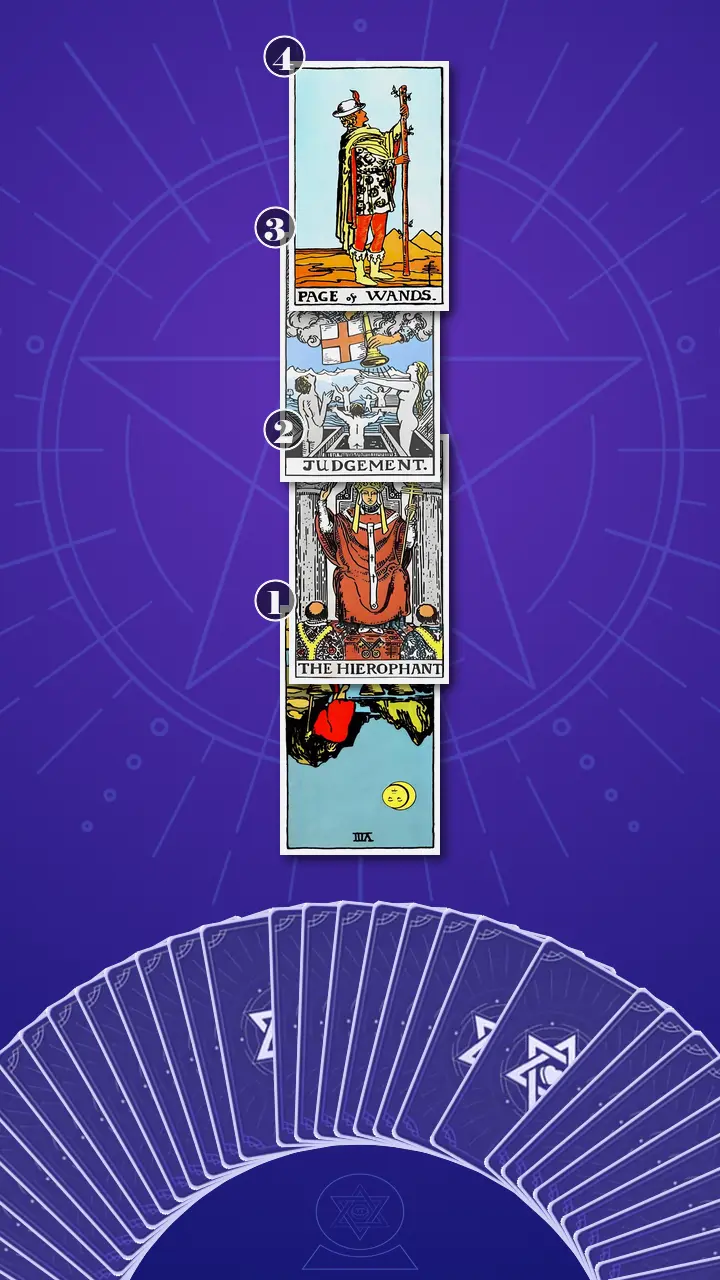
Reading the Map of an Approved Life
The Course Page at the Bottom of the Ladder
"Now I am turning over the card for the visible stuckness: the concrete behavior where you maintain the approved path and research alternatives without testing one."
The Eight of Cups, reversed, lay at the bottom of the ladder. In the familiar image, a red-cloaked figure moves away from eight golden cups under a moonlit sky. Reversed, that movement catches. The person has noticed the missing piece among the cups, but keeps circling back before the path can become experience.
I pointed to the opening in the careful arrangement. "This is your deleted booking. You have a finished presentation, a stable salary, and a path colleagues can recognize. You reach the payment screen for an introductory workshop, imagine yourself there, then return to work because work is easier to explain."
The reversed energy is blocked Water: feeling is present, but it cannot move. Each new comparison column gives a short hit of control, like an infinite-scroll algorithm that makes browsing feel productive while ensuring that nothing is tasted. The pattern is not proof that Maya has no desire. It is a way of protecting herself from the risk of discovering that desire might not arrive with a credential, salary projection, or guaranteed replacement.
Maya gave a quick laugh that had no real amusement in it. "That is so accurate it feels a little rude." Her fingertips tightened around her mug, then loosened. "I am not staying because I want to stay; I am staying because leaving without a guaranteed replacement feels irresponsible."
"Exactly," I said. "You want a lived answer. Your mind thinks it must secure a defensible plan first. Those are different tasks."
The Keys That Became Permission
"Now I am turning over the card for the underlying approved script: the belief structure that ties a valid desire to credentials, social legibility, and external permission."
The Hierophant, upright, appeared between its stone pillars, two acolytes facing a seated teacher and crossed keys resting near his feet.
"The Hierophant is not telling us that structure is bad," I said. "Your analytical career, your salary, and your ability to build a reliable life have given you real support. But the crossed keys have become degrees, job titles, promotion criteria, and the sensible advice your friends offer. They open recognized doors. They cannot tell you whether you want to enter the room."
I thought of the years I had spent moving between cultures, watching how quickly a rule could feel like a natural law when everyone around you repeated it. The Jungian part of my work often begins there: not by attacking the inherited script, but by asking when it became the only speaker at the table.
Maya looked down at the card. "At networking events, I say I want the next leadership level because it is the cleanest answer. If I said I was collecting evidence about writing or community work, I think I would sound... unserious."
"That is the root question," I said. "When did desire start needing to pass an external review before you were allowed to feel it?"
The Hierophant's energy was balanced in one sense, but excessive in authority. It had taught Maya how to build a viable life. Now it was trying to define the whole of meaning. A five-year plan had become a well-formatted permission slip, and her private preferences were being asked to submit a business case before they could exist.
When Judgement's Trumpet Became Audible
The Call That Was Not a Command
The room seemed to become quieter as I turned the third card. Even the radiator's click sounded distant.
"Now I am turning over the card for the key transformation: the self-evaluation that separates recurring personal desire from automatic compliance, without condemning your previous choices."
The Judgement, upright, showed the angel's trumpet above figures rising with their arms open. The white banner hovered in the space between sky and earth. In a tarot reading for finding clarity, this card does not issue a supernatural instruction. It asks for an honest response to what has already been trying to reach your awareness.
I told Maya that Judgement's trumpet was less like an alarm telling her to quit and more like the notification she could not solve with another spreadsheet. It was the thought that returned after a praise-filled meeting ended, after LinkedIn went quiet, after another Sunday comparison session: writing, community work, a slower form of contribution. Not a polished identity. A recurring signal.
For a moment, Maya was back at 10:47 p.m.: Monday's slides complete, the twelve tabs open, the deleted booking sitting invisibly in her calendar history. Her old logic said she had to make the correct decision before she disturbed anything. Her fear had fused itself to her reasoning so tightly that caution and paralysis looked identical.
The approved script is not your verdict; answer Judgement's trumpet by testing the desire that keeps returning instead of demanding proof first.
I let the sentence remain between us.
Maya stopped breathing for a beat. Her fingers hovered above the edge of the card, not touching it. Her gaze slid past the trumpet as if a memory had started replaying somewhere behind it: Thursday's review, her manager saying she was ready for more, the hollow drop that had arrived before the meeting ended. Then her eyes returned to me, wider now, their shine gathering at the lower lids.
"But if I test it," she said, and her voice came out sharper than before, "doesn't that mean I was wrong for six years? That I should have known sooner?"
I kept my voice level. "No. It means the version of you who chose that path had good reasons: stability, skill, rent, belonging, a life you could sustain. Judgement is not a courtroom. It is an update. You are allowed to keep the dignity of your past while noticing what needs investigating now."
Her jaw released first. Then her shoulders lowered a fraction, as though she had put down a bag she had forgotten she was carrying. A breath moved out of her chest with a small, uneven sound. Relief crossed her face, followed by the brief, vertiginous blankness that can come after a burden lifts: if nobody else could make this decision for her, then the next response was also hers to make.
"What if this is not evidence that my past was wrong?" she said quietly. "What if it is information about what needs investigating now?"
"Yes," I said. "Now, with that perspective, think about last week. Was there a moment when this could have changed how you felt?"
She nodded. "The promotion conversation. I could have let it be praise. I didn't have to turn it into proof that I should want another year of the same thing."
This was the first real movement from externally approved achievement, post-achievement emptiness, and defensive overanalysis toward grounded self-trust built through lived evidence. Not certainty. Cautious curiosity.
Separating Fear From Logic
This was where I used the lens I call Fear-Driven Logic Decoupling. Maya's financial caution was real; Toronto rent and a stable income were not imaginary problems to transcend with a slogan. But fear had added hidden terms to every calculation: one workshop became a resignation, one volunteer orientation became a failed identity, one private paragraph became an obligation to monetize it.
"Let's separate the lines in your decision matrix," I told her. "One line asks, 'What does this cost in money and time?' That is useful logic. The other asks, 'What will it mean about me if I try and it does not become a whole new life?' That is fear asking to be treated as a forecast."
She gave a steadier exhale. The distinction did not erase apprehension. It gave it a smaller, more accurate chair at the table.
The Sprouting Wand, Not the Finished Plan
"Now I am turning over the card for the integrated next step: a bounded experiment that gives you direct evidence about interest and meaning without requiring an immediate overhaul."
The Page of Wands, upright, stood in an open landscape, studying a wand that had begun to sprout. The Page did not possess a map, a title, or a monetization strategy. The card's Fire was available but young: curiosity, beginner energy, and the willingness to learn through contact.
"This is the free trial, not the lifetime subscription," I said. "Book one introductory writing workshop. Attend as a beginner. Notice whether your attention sharpens, whether the effort feels useful, and whether you would freely give it another ten minutes afterward. You do not need a replacement life to investigate the one that keeps returning."
The Page of Wands answered the Eight of Cups reversed precisely because it did not demand a dramatic departure. It converted stagnant feeling into a low-stakes trial. In card meanings in context, that is the move Maya had been missing: not more Swords-style analysis or Pentacles-style optimization, but firsthand evidence.
The Evidence That Fits in Fifteen Minutes
I drew the ladder together for Maya. The reversed Eight of Cups showed the surface loop: an empty-feeling achievement structure, followed by research that briefly relieved the risk of choosing while keeping every desire theoretical. The Hierophant showed why that loop had such force: she had learned to mistake recognized success for personal consent. Judgement offered an Approved Script Review, not a rebellion. The Page of Wands made the answer practical: let one living possibility meet real time.
"Your cognitive blind spot is treating every interest as though it is asking for immediate resignation," I said. "That makes stability a reason to avoid learning, when it could be the resource that lets you test safely. The shift is from demanding a fully defensible life answer to gathering one small piece of direct evidence each week."
We agreed on two next steps, designed to protect her money, privacy, and current commitments.
- The Desire Evidence LogOn one evening this week, replace a nonessential comparison column or slide-polishing task with 15 minutes of direct contact: write 200 private words, read a community organization's volunteer page, or take one introductory lesson. In a phone note titled "Desire Evidence," record the time, what you did, and whether your attention sharpened, softened, or disappeared.Keep it private and reversible. If fifteen minutes feels like too much, do the two-minute version; the goal is evidence, not an answer.
- The One-Time Beginner ExperimentBefore Friday, put one free or low-cost Toronto writing workshop, one community orientation, or one online beginner session into Google Calendar as a one-time appointment. Add a 30-minute travel or decompression buffer. Afterward, answer: What held my attention? What felt effortful in a useful way? Would I choose ten more minutes without external praise?Title the calendar event with the activity, not a new identity. "Writing workshop" is enough; it does not need to become "future writer."
Then I offered Maya my Shadow Choice Experiment, a 48-hour paper exercise for when the booking screen made her freeze. On one page, she would write: "For the next 48 hours, I choose to attend one workshop and learn nothing more from it." On the other, she would write: "For the next 48 hours, I choose to stay exactly as I am and never test the interest." She would not act on either statement. She would simply notice which sentence produced relief, resistance, grief, or an argument in her body.
"This is not a trick to force a choice," I said. "It lets the hidden defense mechanisms speak plainly. A first experiment is evidence, not a life sentence."

A Small Light on Line 1
Five days later, Maya sent me a message after work. She had booked a free writing workshop near the west end, attended quietly, and written three sentences in her Desire Evidence note: "Attention sharpened. Shoulders lower. Yes, ten more minutes."
She had not quit. She had not announced a career pivot. On the TTC ride home, she still saw promotion posts and rooftop-launch Stories glowing on her phone. For a few minutes, the comparison reflex returned. Then she put the phone in her coat pocket and watched the dark window hold her reflection.
There was something bittersweet in that first proof. The future was not suddenly bright and solved. But Maya had slept through the night, and when she woke, the old question arrived with less force: What if I am wrong? This time, she smiled a little and answered it with a smaller question: What can I learn next?
That was her Journey to Clarity. Tarot had not handed Maya a destiny or made a stable career meaningless. The cards gave us a clear language for a pattern; Maya supplied the attention, the boundary, and the action. Her agency was never in the deck. It was in the moment she allowed herself to gather lived evidence.
When your shoulders tense before another perfectly reasonable task and your chest goes hollow after the praise arrives, it may be because you are trying to prove you are in control while a more personally chosen life is asking to be noticed. Clarity can begin before a complete answer, when the trumpet of a recurring interest becomes audible enough to answer once.
If one recurring interest were allowed to be Maya's small sprouting wand rather than a decision about your whole future, what would you be curious to spend ten unobserved minutes with this week?