The Study Page Stalled; One Question Turned Effort Into Evidence

The 8:40 p.m. Study Disengagement Spiral
I met Maya (name changed for privacy), a third-year Toronto undergraduate with a part-time service job, after one of those shifts when Career Pivot Anxiety follows you home and sits beside an open course reading. At 8:40 p.m. in the shared apartment kitchen, I watched her highlight one paragraph, type "When would I ever use this?", and then reach for her phone. The fluorescent light buzzed overhead, the dishwasher clicked through its cycle, and the phone felt warm against her palm. Her eyes grew heavy, her shoulders folded toward the table, but her thumb kept scrolling through internship posts.
She looked at me and said, "Why do I keep checking out when studying starts to feel pointless? I can work hard when I know what the work is for. I just cannot keep giving hours to something that will not show me where my life is going."
I heard the contradiction clearly: she wanted study to connect to a meaningful direction, while fearing that continued effort without a visible purpose was wasted time. What she called disengagement looked to me like trying to read a street sign through fog while one hand kept reaching for the brightest screen nearby. I said, "You start by asking whether the work matters, then notice you are doing everything except the work. We do not have to force an answer tonight. We can make the pattern visible first, then find a small way to test what the work can actually offer."

Choosing a Compass: The Shadow Spread for Feeling Stuck
I asked Maya to take one slow breath and place both feet on the floor. I turned her phone face down, shuffled at an ordinary pace, and invited her to hold one question rather than demand a complete explanation of her future. The preparation was a change of attention, not a supernatural performance: a brief boundary between the noise of the evening and the evidence we were about to examine.
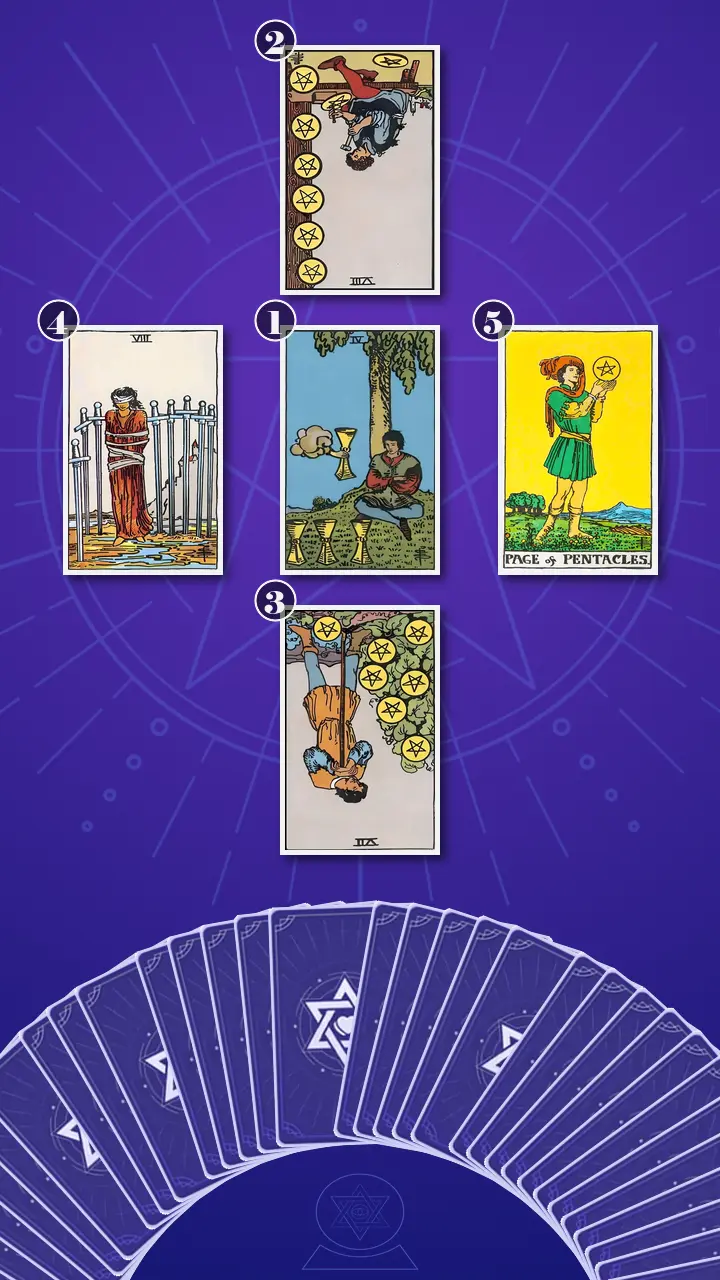
I chose a five-card layout called the Shadow Spread. For anyone wondering how tarot works in a situation like study avoidance, this spread does not predict whether a course will lead to a particular career. It traces a recurring behaviour from its visible form to its trigger, its hidden belief, the vulnerable experience it protects, and a constructive response. That made it a precise fit for Maya's question and a more useful tool than a broad life audit.
I explained that the first position would show the observable checking-out behaviour and the stagnant emotional state beneath it. The second would identify the study experience that broke her working rhythm. The third would reveal the delayed-payoff belief that turned uncertainty into a verdict. The fourth would ask what leaving the task protected her from. The fifth, placed across the horizontal line as the bridge, would offer a bounded and self-directed way to test meaning instead of waiting for a complete guarantee.
Position 1: The Offer She Had Already Dismissed
I said, "The first card represents the observable checking-out behaviour and the stagnant emotional state that appears when studying loses an immediate sense of purpose." I turned the card over. It was the Four of Cups, upright.
In the Rider-Waite-Smith image, the seated figure folds their arms while three cups remain fixed on the ground and a fourth cup enters from a cloud. I connected that picture to Maya's kitchen table: the reading, the assignment brief, and the course portal had already been judged as irrelevant, while a possible fourth option - a useful example, a practical question, or a connection she had not yet tested - arrived outside her field of attention. I told her that this was the moment when she internally crossed her arms and opened her phone, saying, "Nothing useful is being offered."
The upright card did not mean that every assignment was secretly valuable. Its Water was emotionally held in suspension, a blockage rather than a moral failure. Withdrawal protected Maya from the disappointment of investing in a subject that might genuinely be misaligned, but it also prevented her from checking whether any usable value was present. She was trying to make a final decision while her attention was already halfway out of the room.
Maya gave a short, bitter laugh. "Damn, this is exactly what happens," she said. "I open the reading, question the point, check one internship post, and somehow end up watching a study-routine video with the assignment still on the same page."
I did not treat her reaction as proof that the cards had decided anything for her. I treated it as a clear observation. Her fingers stopped moving for a moment, then settled around the edge of her mug. I said, "That pause matters. It gives us a chance to distinguish a genuine no from a fast protective exit."
Position 2: When Practice Starts to Sound Like Static
I moved to the card above the centre and said, "This position identifies the specific study experience that activates disengagement, especially when practice begins to feel repetitive, detached, or unrewarding." The card was the Eight of Pentacles, reversed.
The artisan in the image works at a bench, surrounded by repeated pentacles, with a distant town beyond the workspace. I translated the bench into Maya's study setup. A row of similar exercises appeared to her as output with no visible craft behind it. Instead of repeating the skill, she changed headings, polished a Notion dashboard, searched for a better productivity method, or watched a StudyTok video where somebody else's timer made focus look effortless. The notes became more attractive while the actual practice remained untouched.
Reversed Earth showed a broken apprenticeship rhythm. The energy was not simply absent; it was being diverted into preparation and appearance. Maya could work, but the repetition no longer registered as skill-building, so the task felt like mechanical production. I called this the first part of my Focus Disruption Auditing method. I listened for the specific dissonant chords that shattered her deep-work flow: the external chord of a dull paragraph, the social chord of a LinkedIn internship announcement, and the internal chord insisting that every minute prove its career value immediately.
I said, "Planning feels useful right up until you notice the assignment is still on the same page. The reversal is asking us to look at what planning is doing for you in that moment. Is it organising the work, or giving you a cleaner feeling than the uncertain work itself?"
Maya looked down at the spread. Her thumb rubbed the corner of her phone without turning it over. "It gives me a quick sense that I am back in control," she said. "Then I realise I have spent twenty minutes making the plan prettier."
Position 3: The Return She Demanded Too Soon
I placed my finger on the card below the centre. "This position reveals the limiting belief that equates delayed or invisible payoff with wasted effort and keeps the disengagement cycle running." I turned over the Seven of Pentacles, reversed.
The figure in the card leans on a cultivation tool and evaluates the pentacles growing on the vine. I brought Maya back to a Sunday evening I had heard about from her: the half-finished coffee, the course outline, the calendar showing the night disappearing, and the calculation of how many hours the assignment might consume before she had completed one page. I said, "You look at the vine before the harvest and ask it to prove the whole investment tonight. If it cannot, the absence of a visible return becomes evidence that you are already losing."
The reversed Earth here was impatience with delayed feedback and an overactive cost-benefit audit. It turned a reasonable question - "Is this worth continuing?" - into a premature verdict made before enough practice, recall, feedback, or application had appeared. I named the distinction carefully: a delayed payoff is not proof of a pointless effort, but it is a reason to gather better evidence. I would never ask her to stay indefinitely in work that truly conflicted with her direction.
Maya's hand stopped above the phone. First, she took a shallow breath and left it there. Then her eyes moved back to the vine on the card, as if replaying the moment she had checked job descriptions after one page. Finally, she let out a long breath and said, "I keep asking for proof before the effort has had time to produce any." The sentence sounded less like a confession than a measurement she could use.
Position 4: The Blindfold Made of Requirements
I laid the next card to the left, where the spread's horizontal line moved from protection toward agency. "This position clarifies what checking out is trying to protect you from, especially the feared loss of control involved in continuing work you cannot yet justify." The card was the Eight of Swords, upright.
The blindfold, the loose cloth around the figure's arms, the ring of swords, and the open ground near their feet gave me a careful image of perceived entrapment. I told Maya that the syllabus, deadlines, tuition, work shifts, and delayed grades were real constraints. The card was not asking her to pretend otherwise. It was showing how the word "required" could make the entire assignment feel like a closed enclosure, so leaving the page briefly created relief from the sense that someone else was choosing her future for her.
I described the Toronto version of the blindfold: a course portal on one side of the screen, a TTC commute in the memory behind it, and a browser tab ready for messages or short videos. The fixed part might be the assignment deadline. The flexible part might still be the example, sequence, question, format, or practical application. I asked, "I cannot choose whether this is assigned, but can I choose what I test inside it?"
Maya's hand moved toward the phone, paused, and returned to the table. She looked at the assignment brief as though it had become slightly less solid. I said, "This is not a blame story. Checking out has been giving you a few seconds of relief from investing without control. The useful question is where the binding is genuinely tight and where one small choice is still visible."
When the Page of Pentacles Held One Question
Position 5: The Bridge from Withdrawal to Agency
The room became quiet when I reached for the final card. The refrigerator clicked off, leaving only the faint fluorescent hum and the soft sound of cards against the table. I said, "This position offers an integration stance that turns study into a bounded, self-directed experiment through which meaning can be tested rather than assumed." I turned the card over. It was the Page of Pentacles, upright.
The Page held one pentacle at eye level. Behind them was a cultivated field and, farther away, a mountain. I connected the image to Maya closing the unrelated tabs, writing one question at the top of a reading, and giving that question one focused interval while graduation, employment, and the larger career path remained unresolved in the background. The Page did not promise a predetermined outcome. The Page offered one object of attention, one practice, one observation, and then a chosen next step.
This was the bridge in the spread, carrying grounded curiosity, learner agency, and patient self-trust across the gap between emotional withdrawal and practical engagement. I told Maya that the key was not to prove that every assignment mattered. It was to replace a premature verdict with evidence she could actually gather.
Here I used my signature lens, Cognitive Tempo Calibration. After ten years of sound energy research, I have learned to notice when pressure forces a task to demand a rhythm that does not match the learner's natural neurological rhythm. Maya was not necessarily refusing all effort. The assignment demanded repetitive practice now, while her mind was waiting for career-sized proof at the end. That mismatch created a study-burnout pattern: heavy eyes, restless hands, tab switching, and a search for a stronger stimulus whenever the payoff remained out of sight.
I said, "The Page does not ask you to manufacture motivation. The Page asks you to make the beat smaller. Meaning can be tested at the size of one question and twenty-five minutes."
At 8:40 p.m. in a Toronto apartment kitchen, Maya had highlighted one paragraph, typed "When would I ever use this?", and checked internship posts while her phone warmed her palm. The assignment remained open, but her deeper question had become whether another hour was quietly choosing her future for her.
Meaning is not a feeling you must receive before you begin; examine one real question with the Page's steady gaze and let evidence build purpose.
First, Maya's breath stopped and her fingers stayed suspended above the phone. Her face went still, her pupils widening as the sentence reached the place where she had been waiting for certainty. Then her gaze left the card and fixed on the unfinished reading; I could see the thought moving through a chain of late submissions, internship posts, and the private rule that she had to know the entire destination before taking another step. Finally, her clenched hand opened against the table. Her shoulders lowered by a small but visible amount, and a shaky breath left her chest. "So I do not have to decide my whole future in this block," she said. "I can see what this block teaches me." I asked, "Now, use this new perspective to think back: was there a moment last week when this could have felt different?"
Maya closed one unrelated tab and wrote: "For the next 25 minutes, I am testing whether this task helps me practise one specific skill or answer one specific question." She did not suddenly look inspired. The room did not fill with a dramatic burst of motivation. The mental noise simply became narrow enough for her to choose what to observe. I explained that this was the first step from demanding a complete life-purpose guarantee toward testing meaning through grounded curiosity, one bounded question, and observable evidence.
The Page of Pentacles did not tell Maya to stay in every course or trust every assignment. It gave her a fairer way to find out whether a task was genuinely misaligned or whether withdrawal had closed the investigation too early. That difference returned the decision to her.
The 25-Minute Evidence Test
I gathered the cards into one story. The Four of Cups showed attention folding inward around disappointment. The reversed Eight of Pentacles showed how that withdrawal broke the rhythm of practice, turning note formatting and productivity research into safer substitutes for direct contact with the skill. The reversed Seven of Pentacles revealed the deeper demand for an immediate return, while the Eight of Swords showed how the fear of investing in the wrong future made a fixed requirement feel like total entrapment. The Page of Pentacles offered a smaller relationship with effort: one question, one object, one observable result.
That sequence reminded me of a course recommendation algorithm with no explanation. Maya was being asked to invest attention before the system showed why it had selected this path, while LinkedIn displayed everybody else's finished outcome and left her assignment looking like an unposted draft. I remembered my own sound-energy research and the patterns I had seen for ten years: when an internal rhythm falls out of sync under pressure, increasing the volume rarely helps. A smaller, steadier beat can make the next movement possible.
From Invisible Payoff to Observable Evidence
I named the cognitive blind spot directly. Maya was treating the absence of an immediate feeling of meaning as proof that the task had no meaning at all. Her desire to protect her autonomy was legitimate, but it was also making her leave before evidence could appear. The shift was not from questioning to obedience. It was from demanding a complete reason to study toward running a fair, bounded test.
I told her that grounded clarity could hold two truths at once: some coursework may genuinely be a poor fit, and some coursework may only look pointless because it has not yet been examined through a usable question. Finding clarity did not require a perfect career plan. It required enough learner agency to gather information before making the next decision.
For the next steps, I used my exclusive rhythm protocol, The Syncopated Study Session. It turns an overwhelming academic task into frictionless micro-beats without asking Maya to promise that the course defines her career. I wrote the plan in a form she could use at the kitchen table, on the TTC, or between service shifts.
- Run the Syncopated Study SessionBefore the next study session this week, write one concrete target at the top of the page, such as comparing two theories or explaining one concept without notes. Set a 25-minute timer, use one document, one source, or one problem-set section, and reserve the final three minutes to record what skill you practised and what became clearer, even slightly.If 25 minutes feels too large, start with five minutes and one paragraph. The goal is evidence, not instant enthusiasm.
- Keep a Three-Session Delayed-Return LogChoose one current assignment and write the delayed benefit you are testing, such as clearer data analysis, stronger argument structure, better recall, or greater confidence with a tool. At the end of three separate study blocks, record one change in speed, clarity, memory, or skill before deciding whether the task deserves another block.This is not a demand to invest indefinitely. Use one sentence in your phone notes if a spreadsheet starts becoming another form of avoidance, then reassess at the fixed review point.
- Run a Choice Recovery ScanSpend ten minutes separating one fixed part of the assignment from two flexible parts, such as the example, order of research, question you foreground, or note format. Choose one flexible part and write a boundary sentence: "I am willing to test this for one block; I am not promising that it defines my career."Keep the scan practical and stop after three minutes if it starts becoming another planning ritual. Choose the smallest available option and let the experiment remain small.
I reminded Maya that these next steps were not a new test of worthiness. They were ways to collect better information. She remained the person deciding whether the evidence was useful, whether the task needed a different approach, or whether the course genuinely belonged on a different path.

A Week Later: Ownership, Not Certainty
A week later, Maya messaged me from the same kitchen table: she had completed two 25-minute blocks and recorded that the assignment sharpened her explanation of a data-analysis method. The next morning, she still wondered, "What if I am choosing wrong?" Then she opened the page anyway.
I did not read that message as a solved life. I read it as the first quiet proof that urgency was no longer the only force capable of starting her. The Shadow Spread had helped her move from a closed-off cup, through broken practice and delayed-payoff anxiety, toward the Page's steady gaze. The choice remained hers, and so did the right to change direction when the evidence asked for it.
For me, this Journey to Clarity was not about finding a hidden answer inside the cards. It was about making Maya's own pattern visible enough for her to work with. A study block could now be a small experiment rather than a referendum on her entire future, and meaning could be built through attention instead of demanded as a feeling before she began.
When a study page stays open while your hands keep reaching for your phone, it can feel safer to call the work pointless than risk discovering that your time is being spent on a future you did not choose.
If you let the Page of Pentacles hold one question, rather than a complete career plan, at eye level during your next small study interval, what would you be curious enough to look for?