Three Saved Listings, Sunk-Cost Career Paralysis, One Skill to Test

The Sunday-Night Loop of Sunk-Cost Career Paralysis
At 29, Jordan was the operations person everyone trusted to rescue a broken workflow, train a new hire, or remember the detail that everyone else had missed. Yet her Sunday Scaries had become a private ritual of saving promising jobs and closing every one because starting again might make her tenure feel wasted.
At 8:43 p.m., our video call connected from her small Toronto condo kitchen. Jordan shared a screen holding three project-coordinator listings beside an old performance review; the radiator clicked through her microphone, and she pushed away a mug she said still smelled like yesterday's coffee. The laptop had warmed the skin beneath her wrists, but her finger went still each time it approached Apply.
“I know I've outgrown this role,” she said. “But I have put too much time into it to walk away now. Toronto rent is real, the income is predictable, and if I leave, how do I know those years counted for anything?”
I watched her jaw tighten as she looked back at the listings. Her ambivalence had the physical pull of standing on a subway platform while several trains passed, as though the fare she had already paid belonged to that station instead of the journey. She wanted movement, but every piece of evidence that she could do more had become another reason she believed she could not leave.
This is what I call sunk-cost career paralysis: time already spent stops being part of the history and starts acting like an instruction for the future. It can look rational because it arrives carrying salary figures, benefits, work anniversaries, and years of competent performance. Underneath the arithmetic, however, I could hear a more painful question: “If I change direction, does that prove I chose badly?”
“I am not going to use tarot to tell you whether to resign,” I told her. “The cards cannot assess your finances, workplace conditions, or risk tolerance on your behalf. What they can do is place the decision logic outside your head, where we can examine it without putting your judgment on trial. Let's give this fog a map and look for one piece of clarity you can actually use.”

Choosing a Map Narrow Enough to Be Useful
I invited Jordan to take one slow breath while holding the question, “Why do the years invested keep me in a role I've outgrown?” I shuffled slowly, not to manufacture mystery, but to mark a clean transition from the browser loop into focused reflection.
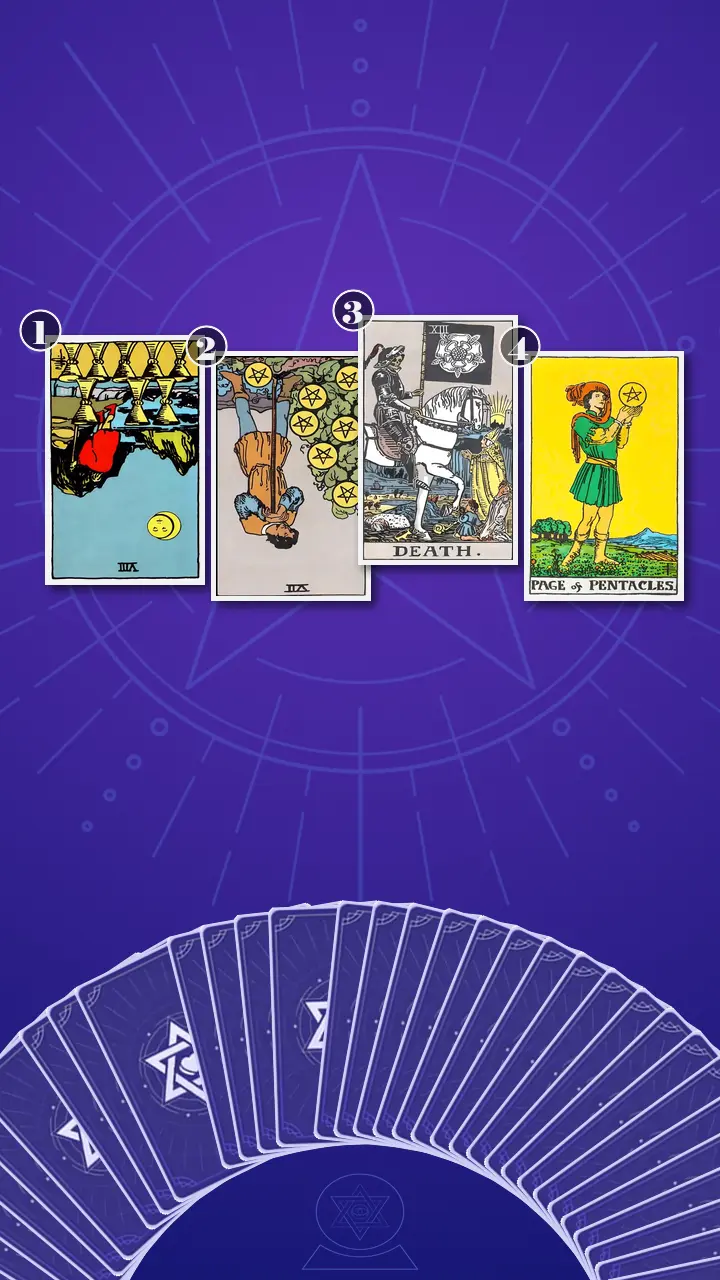
I chose the Four-Layer Insight Ladder · Context Edition, a four-card tarot spread for career sunk-cost reflection. I laid the cards in a straight line from left to right, with the third card slightly raised as the hinge between understanding the pattern and changing how Jordan related to it.
I chose this spread because Jordan did not yet have two fully defined offers to compare. A decision spread would have forced her situation into Option A versus Option B, while a larger Celtic Cross would have added more history and prediction than the question required. This four-card insight ladder was precise enough to reveal the surface blockage, expose the root mechanism, identify the liberating shift, and finish with a grounded experiment.
The first position would show the observable pattern of reviewing tenure and postponing applications. The second would reveal why leaving felt equivalent to wasting the years. The third, our transformation point, would separate transferable learning from continued obligation. The fourth would translate that distinction into one small, reversible next step.
This is how tarot works at its most useful in a career reading: not as an authority issuing a verdict, but as a structured mirror. Card meanings in context help me turn a private loop into something visible enough for the person living it to question, revise, or reject. Jordan would remain the author of every choice that followed.
Reading the Career Loop from Left to Right
Position One: The Tabs That Never Become Applications
I turned over the card representing the presenting blockage: the observable pattern of staying in a role Jordan had outgrown, repeatedly reviewing her tenure, and postponing applications. It was the Eight of Cups, in reversed position.
In the Rider-Waite-Smith image, eight cups stand in the foreground while a cloaked figure attempts to leave beneath the moon. Reversed, the departure does not quite complete itself. The figure may recognise that something has become insufficient, walk toward the threshold, and then return to what is known.
“This looks like your Sunday night,” I said. “Three saved roles, a warm laptop, cold coffee, and your finger hovering before Apply. You feel curiosity about what else might fit, then the thought arrives: 'If I leave after all this time, what happens to everything I built?' Closing the browser gives you immediate relief because your familiar professional identity no longer has to face an outside response.”
The reversed energy was a blockage, not a lack of ambition. Jordan could imagine movement, but the emotional act of leaving had been interrupted by a demand that the past first guarantee the future. Research created the sensation of progress while protecting her from evidence that might challenge the belief that she was stuck.
The card was not advising an abrupt exit. That would only turn the same all-or-nothing thinking in the opposite direction. It was showing me the repeated return: wanting to explore, approaching the threshold, and stepping back into familiar competence before the outside world could answer.
Jordan gave a short laugh, but there was no amusement in it. “That's so accurate it is almost rude,” she said. Her fingers tightened around the cold mug before she added, “I keep calling it research. Really, I am restoring the same browser session every Sunday.”
I did not treat her recognition as a confession. “The loop has been protecting something real,” I said. “Predictable work protects income, and familiar tasks protect your sense of competence. We are not here to shame that protection. We are here to ask whether it is still serving you at its current price.”
I asked her what she was genuinely preserving and what she was maintaining only because it was familiar. Her eyes moved from the cups to the old review on her screen. “The skills are real,” she said after a pause. “But I think I am also preserving the version of me who was proud to get this job.”
Position Two: The Spreadsheet with No Column for Future Fit
I turned over the card representing the root mechanism: the fear that leaving would waste the invested years and the sunk-cost cycle that made additional time feel necessary. It was the Seven of Pentacles, in reversed position.
The card shows a gardener leaning on a tool and assessing a crop of pentacles. Upright, that pause can support patient, honest evaluation. Reversed, evaluation can contract into frustrated accounting: more effort is added because stopping would make the disappointing return feel visible.
I asked Jordan to picture the gardener as herself opening a private spreadsheet of tenure, salary history, raises, benefits, performance reviews, and completed projects. Her inner calculation sounded like this: “If I stay until the next review, the next bonus, or one more anniversary, then the years will finally count. If I leave now, what does that say about my judgment?”
The energy here held an excess of backward-looking evaluation and a deficiency of present-tense evidence. Jordan was not failing to think carefully. She was asking one metric, elapsed time, to answer questions it could not answer: whether the role still supported learning, whether an adjacent role might fit, and what another year of repetition would cost.
For a second, I was back on a Wall Street trading floor, watching a room become emotionally loyal to a position because money and reputation had already gone into it. The historical expenditure could explain how the position was reached, but it could not improve the next return. When ego entered the calculation, an honest review could quietly become an argument for adding more exposure.
“I use a lens called Sunk Cost Neutralization for moments like this,” I told Jordan. “It does not declare the past worthless. It separates past inputs, which cannot be recovered or changed, from future opportunity costs, which are still available for you to choose. Your years belong in the transferable-assets column. The next year belongs in a current-fit decision, not in a repayment plan for the previous ones.”
Jordan's hand went still around the mug. Her gaze unfocused as if an old spreadsheet had opened behind her eyes, then her stomach seemed to drop and she pressed her palm against the counter. “I do this every work anniversary,” she said. “I tell myself that staying one more year will make the earlier years more legitimate.”
“And then that new year joins the total you believe you cannot leave,” I said. “The loop does not need you to choose this role forever. It only needs you to postpone the next reversible action.”
I placed one finger between the Seven of Pentacles and the raised third card. “Past value is not a present-tense contract.”
When Death's White Rose Changed the Accounting
Position Three: The Scythe at the Career Crossroads
The radiator stopped clicking, and the sudden quiet made the space between us feel wider. I turned over the card representing the transformative insight: the shift from defending past investment to treating experience as transferable learning. It was Death, upright.
I clarified the boundary immediately. Death in tarot is not a literal threat, and in this career reading it was not predicting job loss or instructing Jordan to quit. It represented intentional release, identity renewal, and the ending of an outdated form so its useful substance could continue differently.
The black banner rose above the skeletal rider, but a white rose sat at its centre, and a sun was lifting between two distant towers. I moved Jordan's attention from the title printed on her old performance review to the blank resume document beside it. The role-form could end or change; the learning did not have to disappear with it.
I brought Sunk Cost Neutralization fully into the image. On the left, I asked Jordan to place what the years had already produced: operational judgment, process tracking, stakeholder communication, calm under pressure, and follow-through. On the right, I placed the future costs still open to choice: another year of low learning, repeated familiar work, and no outside evidence about where those capabilities might travel. Death's scythe was not cutting through the skills. It was cutting the false equation that said past effort must equal future obligation.
Jordan was still caught inside the demand to make the correct permanent decision. Every listing appeared to ask whether her whole career had been a mistake, so closing the tab felt safer than discovering whether her experience could function outside the title that had produced it.
The years invested do not have to keep you in an outgrown role; let Death's scythe clear the obligation while you carry the learning forward.
I left a few seconds of silence around the sentence, then gave Jordan its practical meaning.
The years can remain valuable without retaining veto power over what you do next.
Jordan's breath stopped. Her index finger stayed suspended above the trackpad, and her pupils widened before her gaze slipped out of focus. I could almost see the replay: the anniversary slide, the old review, and the Monday hand raised before anyone else had unmuted. Then her mouth tightened. “But doesn't that mean I was wrong all those years?” she asked, sharper than before.
I let the anger have room. “No,” I said. “It means the role may have been right for an earlier set of needs, and the current evidence has changed. Updating a decision is not an indictment of the person who made it.” She blinked twice. Her eyes turned glossy; her shoulders lowered; her fist opened one finger at a time. The release left a momentary blankness on her face, almost the light dizziness of setting down a box she had forgotten she was carrying. “Oh,” she said on a long, unsteady breath. “Then I still have to decide, but I don't have to put myself on trial.”
“Now, using this new perspective, think back to last week,” I said. “Was there a moment when this insight could have made you feel different?”
Jordan returned to Monday's Teams stand-up. Her manager had asked who could clean up the same reporting workflow, and she had volunteered before anyone else unmuted. “My shoulders relaxed because I knew I could do it,” she said. “Ten minutes later, they felt heavy again. I thought competence meant I should keep accepting the task. I could have treated that relief as information about familiarity, not an instruction to stay the same.”
That distinction was the first real movement from defensive attachment toward grounded self-trust. It did not resolve her career crossroads or erase the practical risks. It allowed Jordan to stop treating changed fit as evidence of failed judgment. Experience can travel even when the title does not.
Position Four: One Pentacle, One New Fact
I turned over the final card, representing grounded action: one small, reversible career experiment that could create information without requiring a final decision. It was the Page of Pentacles, upright.
The Page holds one pentacle at eye level. Behind the figure, cultivated ground shows that this is not a beginning from nothing. It is an apprentice stance taken on land where experience already exists.
“This looks like choosing one adjacent role, translating one current skill for that context, and gathering real feedback,” I said. “Not six transition articles, a perfect Notion career dashboard, and a complete five-year plan. One role. One skill. One piece of evidence.”
The Page's earth energy was in balance: practical, teachable, and focused enough to avoid turning career exploration into another over-functioning project. The card replaced the Seven's exhausted audit of the whole harvest with direct attention to one usable thing already in Jordan's hands.
“You do not need certainty; you need one piece of information you do not have yet. An exploratory application is not a promise to resign. A twenty-minute conversation is not a commitment to pivot. Starting as a learner in one context is not the same as starting your career from zero.”
Jordan exhaled and opened the Notes app on her phone. “So instead of asking whether project work is my forever answer, I could ask what a normal Tuesday actually looks like,” she said.
“Exactly,” I replied. “The Page does not hand you a destination. It gives you a testable next question. Whether you continue after receiving the answer remains entirely yours.”
Turning the Receipt into a Resource
Read as one story, the spread showed me a clean cause-and-shift sequence. The reversed Eight of Cups revealed Jordan's repeated approach and return: saved jobs, no applications, and familiar tasks that restored competence for a few hours. The reversed Seven of Pentacles showed why the departure stalled: she treated tenure as a harvest that could only be validated by staying longer. Death separated the role from the resources it had produced. The Page then placed one portable skill on practical ground, where direct experience could replace another round of private accounting.
The cognitive blind spot was not simply fear of change. Jordan had been treating a revised decision as proof that the original decision was bad. She also interpreted the absence of external evidence as support for staying, even though avoidance was what kept that evidence from arriving. Her spreadsheet counted every past input but had no column for future fit, energy cost, learning, or ownership.
The transformation direction was therefore smaller and more precise than “leave the job.” It was to separate gratitude from obligation, translate the past into transferable evidence, and run one bounded experiment before asking for a permanent answer. Staying could still be a valid present choice, but it would need current reasons rather than automatic loyalty to elapsed time.
I told Jordan I wanted the actionable advice to respect her income, privacy, and limited energy. I used my Asymmetric Risk-Benefit Analysis to keep the experiment structurally sensible: cap the downside through a short time box, no confidential work, no promise to apply or resign, and a clear right to stop. Preserve the upside by choosing an action capable of producing a new fact, useful language, or a clearer boundary.
“But I do not have seventy-two spare hours for a career project,” Jordan said, her eyebrows lifting.
“Good constraint,” I replied. “Seventy-two hours is the decision window, not the workload. The active version takes less than forty minutes. The minimum version takes two. You are not building a second job; you are interrupting a closed information loop.”
I gave her two options and asked her to choose one, not complete both as homework:
- The Eight-Minute Role-to-Resource AuditOn one private evening this week, open a phone note titled 'Past Value, Present Cost Audit' and set an eight-minute timer. Write three lines under 'This role taught me...' and three under 'This role now limits...'. Add one sentence beginning 'I no longer need this role to prove...', then circle one skill that could travel into an adjacent role.If the exercise feels loaded, stop after one lesson and one present cost. That two-minute version counts. Naming a current limit does not cancel the role's past value.
- The 72-Hour 3rd-Option Leverage TestFor the next seventy-two hours, suspend the false binary between A, staying unchanged forever, and B, quitting now. Define Option C as staying employed while gathering one external data point. Pick one real adjacent-role listing, spend twenty minutes rewriting one operations responsibility in its language without changing the facts, then send one trusted contact a low-pressure request for a twenty-minute conversation about what the work is actually like.Ask for information, not a referral, and give the person an easy way to decline. If outreach feels too exposed, draft the message and three questions without sending them. Success is one new fact or one clearer boundary, not an offer.
“The hidden third option is exploration without immediate separation,” I said. “It protects what genuinely needs protection while refusing to let the sunk-cost loop own every future month. You can run the test, stop it, revise it, or decide that the result supports staying. The test produces evidence; you decide what the evidence means.”

A Week Later, One Quiet Piece of Proof
Five days later, Jordan messaged me: she had sent the low-pressure note, slept through the night, then woke thinking, “What if I am wrong?” She said she laughed, not because the fear vanished, but because it no longer got the only vote.
A former colleague had agreed to a twenty-minute call the following Tuesday. Jordan had not resigned, announced a career pivot, or solved her whole working life. She had simply moved one skill out of a private spreadsheet and into a real conversation. That small act gave her something the saved-job tabs never had: evidence from outside the loop.
I did not see the message as proof that the cards had made something happen. Tarot had provided the map; Jordan had chosen the boundary, written the sentence, and pressed Send. The authorship was hers, including the right to pause after the call or decide that a different direction deserved the next experiment.
For me, that was the honest shape of Jordan's Journey to Clarity: not defensive attachment turning into instant confidence, but past investment becoming portable experience, and curiosity becoming safe enough for one measured contact with reality. Her shoulders could still tighten. The question could still return. What had changed was that the years no longer answered it automatically.
If your shoulders drop after you close another job tab, I know that relief can feel like safety even while part of you aches to move. Merely noticing that the relief and the ache are doing different jobs can be the first thinning of the fog; neither feeling has to be shamed, and neither has to decide your whole future tonight.
If your experience could travel like Death's white rose and rest as one practical skill in the Page's hands, what small, reversible career experiment would you be curious to imagine?