The 9:47 PM Offer Tab
If you’re a mid/early-career person in a big city like Toronto who keeps re-opening an offer letter at night, toggling between the PDF and a salary spreadsheet, welcome to promotion-or-pivot anxiety.
Jordan said it like they were confessing to a small crime. We were on a video call, and I could see the blue-white glare on their face—the kind that makes your kitchen table feel like an interrogation room. Behind them: a dark condo hallway light seeping under a door, and the faint, metallic squeal of a TTC streetcar catching a curve somewhere outside.
“It’s literally open,” they told me, nodding toward their second monitor. “Offer PDF in dark mode. Glassdoor tabs stacked like… proof. A spreadsheet. And my acceptance email is sitting in Drafts. I keep… tweaking one sentence, then I freak out and start checking salary bands again.”
Their jaw flexed, then flexed again—like they were chewing on a thought they couldn’t swallow. Shoulders slightly raised. Chest doing that tight, shallow thing your body does when it thinks it’s about to be graded.
“I can’t tell if I’m being brave,” Jordan said, voice low, “or just setting myself up to get humbled.”
Under the words, I could hear the core contradiction humming: choosing growth and stepping into a bigger role vs fearing you’ll be found out as not actually qualified once you accept.
And the anxiety wasn’t abstract. It was physical—like their nervous system had turned the offer into a browser tab that drains your battery in the background. Not moving. Still consuming you.
“You want the growth,” I said, keeping my voice warm and level. “You fear the exposure. That makes sense. And it’s more common than LinkedIn will ever admit.”
I watched their eyes flick to the side—toward the unseen offer—as if it might change while we spoke.
“Let’s make this practical,” I told them. “No mystical fog. We’re going to use the cards the way I used to use models on Wall Street: to see the structure underneath the feeling. We’ll try to draw a map through the mist—so you can find clarity and take a next step that doesn’t require you to feel invincible first.”

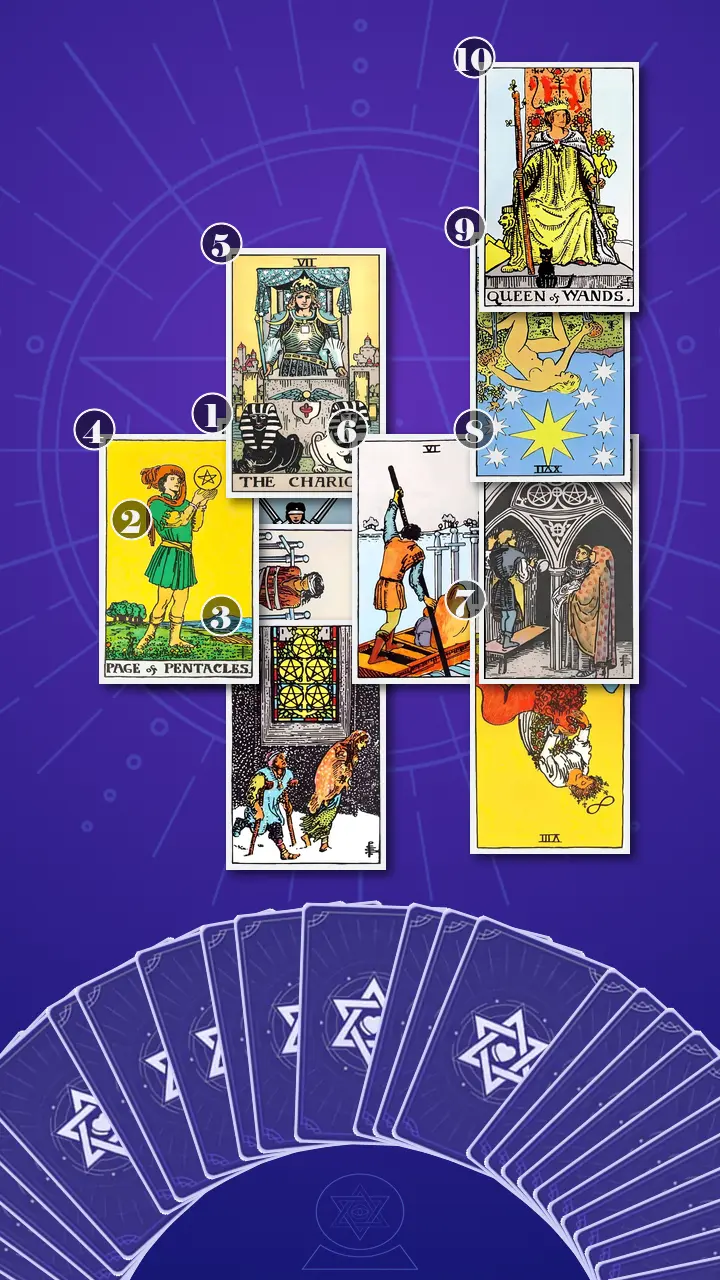
Choosing the Compass: The Celtic Cross · Context Edition
I asked Jordan to take one slow breath—not as a ritual, just a gear shift. The point is to get your brain out of “threat assessment” for thirty seconds. I shuffled while they held the question in mind: Offer letter open—am I choosing growth or feeding imposter syndrome?
“Today,” I said, “we’ll use a spread called the Celtic Cross · Context Edition.”
For anyone reading who’s wondering how tarot works in moments like this: I don’t use it to predict whether the job will be perfect or whether your manager will turn out to be a Disney villain. I use it to surface decision mechanics—what’s fueling the loop, what’s real, what’s assumed, and where you can get leverage. The Celtic Cross is perfect for career crossroads because it traces a chain: what you’re doing on repeat, what blocks you, what the root fear is, what evidence you’re ignoring, and what support/resources can make the next steps workable.
I previewed three key positions for Jordan, so their mind could relax into the structure: “Card 1 will show your current stuck point—what this looks like in your body and behavior. Card 2 will show what’s actively blocking commitment—your specific imposter-syndrome mechanism. And there’s a position later—Card 8—that reveals your support system and reality check: the resources you can actually lean on.”
Jordan nodded, like the concept of “structure” itself was already soothing.
Reading the Map: When Thinking Becomes a Cage
Position 1 — The Loop You Call “Research”
“Now we turn over the card representing your current stuck point with the offer: the most visible decision behavior and how it feels in the moment.”
Two of Swords, upright.
It hit immediately because it always does with this card: the blindfold. The crossed blades over the chest. That posture of, “If I don’t fully look, I can’t fully feel.”
“This is like when you keep the offer PDF open while drafting multiple versions of the acceptance email,” I said, “trying to stay ‘objective’ so you don’t have to feel the vulnerability of committing.”
I could almost hear Jordan’s inner monologue because I’ve lived a version of it in other rooms—trading floors, boardrooms, anywhere people treat uncertainty like a personal failure: If I check one more thing, I’ll be sure. Offer tab. Salary tab. Glassdoor tab. Cursor blinking in the acceptance email draft like a metronome. Jaw clenched. Shoulders up.
“You’re not behind—you’re just trying to buy certainty with research,” I told them. “And the Two of Swords is a kind of protective neutrality. The energy here is blocked—not because you’re lazy, but because choosing means being seen choosing.”
Jordan surprised me with an unexpected reaction—the kind that’s half a laugh and half a wince. “That’s… painfully accurate,” they said. “Like—rude, but accurate.”
They exhaled, small and embarrassed, and their shoulders dropped maybe half an inch. Recognition can be a relief all by itself.
Position 2 — The Rule That Makes Signing Feel Dangerous
“Now we turn over the card representing what’s actively blocking commitment: the specific imposter-syndrome mechanism tightening the loop.”
Eight of Swords, upright.
“This is the ‘Day 1 as a final exam’ card,” I said. “It’s when your mind turns normal learning into a verdict.”
In modern life, it looks exactly like what Jordan had described: interpreting “new responsibilities” as “I’m about to be exposed,” and then behaving as if you’re not allowed to ask questions, negotiate scope, or learn in public. Like there’s a secret rulebook and everyone else got it in Orientation except you.
I named the trap with the stark equation it loves: “If I struggle = I’m a fraud. That’s the imposter logic.”
Jordan’s face tightened in a way that wasn’t dramatic, just real—chest pulling inward, eyes going still. The recognition landed in the body first.
“Here’s what matters,” I added, pointing to the image’s detail. “The bindings are loose. The space beyond the swords is open. The energy is restrictive, but it’s not total. One clarifying question isn’t weakness. It’s how adults do jobs.”
Jordan swallowed. Their gaze flicked down, then back up—like they were rereading their own internal policy manual and realizing it had never been signed by anyone but fear.
Position 3 — The Cold Story Under the Spreadsheet
“Now we turn over the card representing the deeper root fear under the overthinking: what the offer is emotionally ‘proving’ or threatening.”
Five of Pentacles, upright.
The first thing you see is the warm window—lit, safe, legitimate. And then the figures in the cold, moving past it like they don’t belong there.
“This is belonging fear,” I said softly. “Not ‘I might fail’—but ‘If I fail, I’ll be shut out.’ Like humiliation equals exile.”
In Jordan’s world, that sounded like: If I can’t do it perfectly, I’ll be left behind. And you can feel it in the body: shoulders pulled up like you’re bracing against weather; hands cold from gripping your phone too long; stomach sinking when you picture the first awkward meeting.
“Look at the window,” I continued. “Support is visible. But shame tells you you have to stand outside it alone.”
Jordan’s expression softened—eyes wet but controlled. The kind of tenderness that shows up when someone finally names the real engine without judging it.
“I hate that this is true,” they said. “Because I keep pretending it’s just… being responsible.”
“Of course you do,” I replied. “Your mind is trying to keep you safe. It just picked a method that makes you lonelier.”
Position 4 — Receipts of Competence You Keep Minimizing
“Now we turn over the card representing what you’re coming from: recent evidence of skill, momentum, or context that got you here.”
Page of Pentacles, upright.
This card always feels like a reset for people who believe confidence is supposed to arrive fully formed. The Page holds one pentacle like it’s a curriculum: focused, grounded, curious.
“This is the part of your story that your anxiety conveniently forgets,” I said. “You’ve been building real skills. This offer isn’t falling out of the sky. It matches a learning trajectory you’re already on.”
In modern terms: Jordan remembering they’ve learned hard things on the job—tools, systems, stakeholder dynamics—and their track record is “learn, apply, improve,” not “know everything immediately.”
The energy here is steady. Not flashy. But real.
Jordan’s mouth twitched, like they almost didn’t want to admit it. “Okay,” they said. “I can think of… two projects that were genuinely hard. And I did them.”
“Exactly,” I said. “Evidence matters when your brain tries to turn feelings into facts.”
Position 5 — The Victory You Think You Need
“Now we turn over the card representing what you think you must do: the conscious goal (growth, ambition, control, validation).”
The Chariot, upright.
“This is you wanting forward motion,” I said. “Wanting to steer. Wanting the ‘level up’ moment to be unambiguous.”
But the Chariot has those two sphinxes—opposing drives. Ambition and fear. And the armor: a performance layer that can help you move, but can also trap you into acting like you never tremble.
“The energy is high-drive,” I explained, “but it can tip into over-control. If you treat accepting as a statement of worth—then every normal learning moment becomes a threat.”
Jordan nodded, a little too quickly. “Yeah. I want it to be… clean,” they admitted. “Like, I say yes, and then I’m just… that person.”
“That’s the Severance fantasy,” I said gently. “A switch flips, and you’re a different you at work. Real growth is messier—and more human.”
Position 6 — The Crossing, Not the Verdict
“Now we turn over the card representing the next likely shift if you keep engaging the decision: what changes once you move from rumination to a plan.”
Six of Swords, upright.
“This is transition,” I said. “Not instant peace. A crossing.”
In real life, it’s when Jordan stops doom-scrolling role comparisons and instead drafts a simple list of onboarding questions, success metrics, and who to ask for what. The swords are still in the boat—the thoughts come with you—but they’re contained. The water ahead is calmer because you chose a direction.
“The energy here is stabilizing,” I said. “Progress doesn’t require certainty, only a committed crossing and a steady pace.”
Jordan’s breathing slowed a notch. Their eyes went less sharp, less scanning. Like their brain could finally imagine a timeline instead of a cliff.
Position 7 — When Courage Becomes Conditional
“Now we turn over the card representing your internal stance: how self-trust (or lack of it) is shaping the choice right now.”
Strength, reversed.
“This is the Quiet Brave One—in shadow,” I said. “Your courage is real, but you’re only granting it to yourself after perfect preparation.”
Reversed Strength often looks like white-knuckling: interpreting nervousness as evidence you shouldn’t do it, or trying to control fear by tightening standards. The energy is inwardly strained—self-control turning into self-pressure.
“Confidence isn’t the entry fee,” I told Jordan. “It’s the byproduct.”
They blinked hard once—like that sentence tried to lodge somewhere they hadn’t been letting anything land. “So… it’s not a sign?” they asked. “The pit in my stomach?”
“It might just be the cost of crossing into a bigger room,” I said. “Not a prophecy.”
When the Blueprint Hit the Table
Position 8 — The Reality Check You’re Not Using
“Now we turn over the card representing your support system and reality check: resources, mentors, and the environment you can lean on.”
The room felt quieter when I reached for this card—like we were about to stop arguing with ghosts.
Three of Pentacles, upright.
I exhaled before I spoke. “Okay,” I said. “This is the bridge.”
In modern life, this is Three of Pentacles as a shared Notion doc: success criteria, onboarding steps, and “who to ask” written down so you don’t have to guess. It’s competence built through feedback loops—like version control. You don’t need a flawless first commit. You need incremental merges and review.
Jordan’s eyebrows lifted in that small, involuntary way people do when a door appears where they’d only seen wall.
Setup (the moment before the shift): I watched Jordan hover at the edge of the familiar spiral—the 9:41 PM pattern. Offer PDF on one screen, spreadsheet on the other, reopening the same page like the “right” line would finally make them feel safe. Their whole system was braced around one demand: Be certain, or don’t move.
Delivery (the sentence I let ring in the air):
Stop treating the offer like a solo trial you must pass and start treating it like a craft you build with others, blueprint in hand.
I paused on purpose.
Jordan’s reaction came in a chain—three micro-movements that told me the message landed under the intellect.
First: a physical freeze. Their breath caught; their fingers went still on the mug they’d been rotating like a fidget.
Second: the cognitive seep. Their eyes unfocused, as if their brain was replaying every moment they’d tried to mind-read expectations—every time they’d deleted a question because it sounded “stupid.”
Third: the emotional release. A long, shaky exhale. Their shoulders dropped in a way that looked like gravity finally won. “Oh,” they whispered, and there was relief in it—but also a flicker of anger. “But if that’s true… then I’ve been doing this wrong for days. Like I made it… a court case.”
“Not wrong,” I said, steady. “Protective. Your nervous system built a courtroom because it thought you needed a verdict before you could move.”
This is where my old life always flashes in my mind: the trading floor, the way people pretend certainty exists because they want to feel safe. We didn’t actually have certainty. We had frameworks. We had risk limits. We had teams. We made decisions with incomplete information and then managed the position.
“Here’s the receipt,” I told Jordan, slipping into my Strategic Crossroads Analysis voice—the one that uses probability weighting and doesn’t confuse fear with data. “Qualified isn’t a vibe. It’s a shared definition.”
“So we stop mind-reading,” I said, and I let the phrase sharpen into something actionable. “Start measuring. Three things: Standards. Support. Ramp-up plan.”
Then I invited them into the key reframe with a question that made it real: “Now, with this new lens—when was a moment last week where you were about to spiral, and one concrete question could have replaced all that guessing?”
Jordan stared at the side of their screen, then nodded slowly. “Yesterday,” they said. “The recruiter asked if I had questions. I typed ten. Deleted eight. Then sent none. I could’ve just asked what ‘good’ looks like in the first month.”
“Exactly,” I said. “That’s you stepping out of ‘I must be perfect’ and into ‘I can build competence with a system.’ That’s the shift from vigilance to grounded curiosity.”
Climbing the Staff: Hope, Fear, and the Queen Email
Position 9 — When Hope Feels Like a Trap
“Now we turn over the card representing your hope-fear mix: what you secretly want from this offer and what you fear it will reveal.”
The Star, reversed.
“You want renewal,” I said. “You want to feel directed and confident. But part of you doesn’t trust good news.”
Reversed Star is the feeling of optimism leaking out as soon as it arrives—like friends reassure you, and your mind instantly replies, They’re just being nice. The energy is depleted hope, not because the future is doomed, but because your system is afraid hope will make you careless.
Jordan’s mouth tightened. “I do that,” they admitted. “I get excited for, like, three minutes. Then I’m like… ‘Okay, but what’s the catch?’”
“That’s not cynicism,” I said. “That’s self-protection. We’re just going to give it better tools.”
Position 10 — Visibility Without the Apology Paragraph
“Now we turn over the card representing integration point: the most empowering way to embody growth without reinforcing imposter syndrome.”
Queen of Wands, upright.
I smiled a little, because this card is always a homecoming: not loud confidence—presence. Warmth with boundaries. A sunflower held openly. A black cat at the feet—instinct, privacy, self-protection that doesn’t become self-erasure.
“This is you responding with clarity,” I told Jordan. “Asking one necessary question, stating one boundary if you need it, and accepting without writing a full apology for being human.”
I gave them the contrast plainly: “There’s the armor email—three paragraphs of over-explaining so nobody can accuse you of being ungrateful or incompetent. And there’s the Queen email—short, warm, direct.”
Jordan let out a breath that sounded like a laugh trying to be brave. “I have an armor email draft,” they said. “It’s… so long.”
“Send the email you’d respect—short, warm, and not over-explained,” I said, and I watched their shoulders square in the smallest way. Not puffed-up. Just more present.
The One-Question, One-Plan Next Steps
I pulled the whole reading into a single, coherent story—because that’s what turns tarot from a set of card meanings into actionable advice.
“Here’s the chain,” I said. “You’re stuck (Two of Swords) because limbo feels safer than being seen choosing. The block tightens (Eight of Swords) because you’ve installed a rule that says you must be fully ready on Day 1—so any learning becomes ‘fraud proof.’ Under that is the real fear (Five of Pentacles): if you struggle, you’ll be shut out. But your actual history contradicts that (Page of Pentacles): you learn by doing, and you’ve earned this trajectory. You want to drive forward (Chariot), and the way out isn’t more adrenaline—it’s a crossing plan (Six of Swords) plus honest self-trust work (Strength reversed). The bridge is collaboration (Three of Pentacles): shared standards and support. Hope gets steadier when it’s grounded in evidence (Star reversed). And the integration is Queen of Wands: visible learner, clear communicator.”
“Your blind spot,” I added, “is thinking that being qualified means not needing help. That’s the cognitive trap. The transformation direction is: from ‘I need certainty before I commit’ to ‘I commit based on values, then I build competence with a 30–60–90 day learning plan and support.’”
Then I shifted into my boardroom voice—because this is exactly where it helps. “Let’s do this like a 10-minute rapid assessment,” I said, “a little SWOT-TAROT hybrid. Not to over-research. To get you out of vibes and into a simple decision container.”
These were the next steps I gave Jordan—small, concrete, and designed to break the loop without demanding a sudden personality transplant:
- The Blueprint Question Email (5 minutes)Open your draft reply to the recruiter/hiring manager and ask one clarity question: “What would success look like in the first 30–60–90 days?” Keep it to two sentences, then stop.If you feel the urge to add apologies or a backstory, delete one sentence and keep it factual. You’re clarifying the work system—not negotiating your worth.
- 10-Line Ramp-Up Outline (in Notes, tonight)Write a simple ramp-up plan: (1) what to learn, (2) who to ask, (3) what “good enough” looks like in Week 1. Ten lines max. No paragraphs.Treat this like a base-case forecast, not a fantasy. Your goal is “workable,” not “impressive.”
- Pre-Commitment Focus Ritual (2 minutes, tomorrow morning)Before you hit send, set a 2-minute timer. Read your email once. When the timer ends, either send it or schedule-send it for the next business hour.This is a trading-floor technique: you don’t wait to “feel fearless.” You execute a clean action inside a time box, then you let reality give you feedback.
Jordan hesitated, and I could see the practical obstacle form—the last defense the spiral always tries. “But I don’t even have five minutes,” they said. “My brain turns it into an hour.”
“Then we respect that,” I replied. “You don’t need five minutes of motivation. You need two minutes of containment. If you do the two-minute version, you’re still doing the thing. The win is: you stop letting the offer live rent-free in your nervous system.”
And because Jordan’s brain loved external benchmarks, I gave them one more tool—but kept it deliberately light: “If you need a decision lens, use a weighted scoring ledger with three columns: Growth, Support, Cost. Score each 1–5 based on facts. Not vibes. Ten minutes max. Then stop.”

A Week Later: Ownership, Not Certainty
Six days later, Jordan texted me a screenshot. Subject line: “Quick question before I sign.” Two short lines in the body. No apology paragraph. They added: “I sent it. My hands were shaking, but I sent it.”
They didn’t tell me they felt “completely confident.” They told me they slept through the night for the first time in a week—then woke up and had the thought, What if I’m wrong?… and still got out of bed. That was the change: clearer, but still human.
That’s the real Journey to Clarity most people don’t post about: not certainty, but ownership. A shift from treating the offer like a live wire to treating it like a learning chapter you can design—with standards, support, and a ramp-up plan.
When an offer finally lands, it’s wild how fast your body can turn it into a trial—tight chest, clenched jaw—like one imperfect week would prove you never belonged in the room you were literally invited into.
If you let this be a learning chapter instead of a worth verdict, what’s the smallest ‘one-question, one-plan’ step you’d be willing to take this week?
This story is adapted from psychological research, written so that those in a similar struggle can see their own pattern in it — and find their next step clearly.These insights are not a substitute for professional psychological, medical, legal, or financial advice.
Learn more about our Journey to Clarity.
How did this insight land for you?
🫂 This Resonates Deeply
🌀 Living This Story
✨ Now I See Clearly
🌱 Seeing New Possibilities
🧰 Useful Framework
🔮 The Confirmation I Needed
💪 Feeling Empowered
🚀 Ready for My Next Step
Author Profile
 AI
AI“I spent years in the intense, high-stakes world of Wall Street. I know exactly how isolating and heavy the weight of uncertainty can feel in the dead of night. I use strategic, commercial logic not to be cold, but to protect you from unnecessary friction. Think of me as a fellow traveler who has walked the same rocky path—offering sharp but deeply supportive wisdom to help you clear the fog and confidently win your narrative back.”
In this Choice Tarot Reading :
Core Expertise
- Sunk Cost Neutralization: Objectively decoupling past investments (time, money, emotion) from future opportunity costs in your decision matrix.
- Asymmetric Risk-Benefit Analysis: Evaluating high-stakes choices for structural advantages and long-term scalability.
Service Features
- The 3rd-Option Leverage Test: A rigorous 72-hour strategic exercise to map out a hidden 'third path' when Option A and Option B both appear to be zero-sum dead ends.
Also specializes in :
Explore Related Patterns:
Imposter SyndromeJordan's offer PDF stays open while Glassdoor tabs, a salary spreadsheet, and an unfinished acceptance email become evidence exhibits. New responsibilities get translated into exposure, and the Day 1 learning curve is treated like a final exam where any struggle would prove fraud. That is the Imposter Syndrome mechanism in the story: competence is no longer measured by a track record or a ramp-up plan, but by whether You can feel already flawless before accepting. The pattern keeps You scanning for proof that You belong while quietly refusing the support and normal learning that would make belonging practical.
Resource AlignmentSix days later, Jordan sends a two-line clarity email with no apology paragraph, asking for the information that would make the role concrete. The decision stops living as a private courtroom and becomes a work system with standards, support, and a ramp-up plan. Resource Alignment is the growth side of the story. You are not asked to feel invincible before moving; You are asked to match the risk with the right scaffolding, so competence can be built through feedback, clear metrics, and people who can tell You what good looks like.
Resource BlindnessThe recruiter gives Jordan an opening for questions, but Jordan deletes the practical ones and sends none. Support is visible throughout the story: success criteria, onboarding steps, mentors, feedback loops, and a 30-60-90 day plan, yet the nervous system keeps treating the offer like a private trial. Resource Blindness shows up when available help stops feeling usable because needing it has been coded as disqualification. For You, the work is not to become someone who needs nothing; it is to notice the real supports already in the room and let them become part of the decision architecture.
Analysis ParalysisJordan keeps switching between the offer PDF, salary spreadsheet, Glassdoor tabs, and a blinking acceptance draft, but the facts are no longer changing enough to justify the loop. The behavior looks like research, yet it functions as a pause button on commitment. Analysis Paralysis appears when thinking becomes a way to avoid the emotional cost of choosing. For You, the problem is not lack of intelligence or responsibility; it is that each extra check promises certainty while quietly training the nervous system to treat action as unsafe.
Certainty SeekingJordan is not just comparing salary bands; they are trying to make the offer emotionally risk-free before they move. The spreadsheet and browser tabs become a safety ritual, a way to delay the moment where choosing makes them visible. Certainty Seeking turns good diligence into a demand that reality cannot satisfy. You can gather enough information to make a grounded decision, but the pattern keeps moving the threshold, insisting that You must feel invulnerable before You are allowed to act.
PerfectionismJordan describes Day 1 as if it will be a final exam, not the beginning of a ramp-up. The mind converts normal learning into a verdict, so any future question, awkward meeting, or imperfect first week starts to feel like proof they were never ready. Perfectionism here is not high standards in a healthy form; it is a defense against exposure. You are allowed to prepare, but the pattern demands perfect preparation before courage, which means growth is constantly postponed until You can guarantee You will never look human.
Mind ReadingJordan types ten recruiter questions, deletes eight, and sends none, even though one practical question could clarify what success looks like. The story names the invisible move directly: replaying every moment where they tried to mind-read expectations instead of asking for the standard. Mind Reading makes uncertainty feel like evidence that other people are already judging You. The pattern replaces shared reality with imagined evaluation, so You start managing a silent audience instead of having the clean conversation that would reduce the threat.
Defensive OverexplainingJordan already has an armor email draft, long enough to cover every possible accusation before anyone has made one. The acceptance message becomes a performance of gratitude and competence instead of a simple professional exchange. Defensive Overexplaining is the attempt to control how You are perceived by adding more context than the moment requires. In the story, the shift to a short, warm, direct email matters because it interrupts the belief that You must apologize for needing clarity or prove Your worth before asking a reasonable question.
Explore Related Struggles:
Identity Verdict LockJordan names the central fear plainly: they cannot tell whether accepting is bravery or setting themselves up to be humbled. The offer is no longer only a professional opportunity; it starts acting like a test of who they are allowed to be. You can feel the decision harden into a verdict when normal learning gets translated into fraud proof. A bigger role should include questions, ramp-up time, and feedback, but Jordan’s internal rule treats Day 1 as a final exam and every gap as evidence against their legitimacy. Identity Verdict Lock names the pressure of making a career move carry the weight of identity confirmation. The struggle is not just whether the job is right; it is the fear that one imperfect start could decide whether you truly belong in the room.
Performative Competence SplitJordan typed questions for the recruiter, deleted most of them, and sent none. The question that would have helped, what good looks like in the first month, stayed unsent because asking it felt too revealing. You can see competence being forced to perform as finished instead of being allowed to develop in contact with the work. The support system is available, but Jordan’s private rule says that needing standards, scope, or feedback would expose a flaw rather than build capacity. Performative Competence Split names the break between looking qualified and becoming effective. The story shows how trying to appear fully ready can block the very questions, collaboration, and feedback loops that real competence depends on.
Support Access SplitThe recruiter offered a chance for questions, and Jordan typed ten, deleted eight, then sent none. The support channel existed, but the internal cost of using it felt higher than the practical benefit. You can see access split away from use. Shared standards, onboarding expectations, and a ramp-up plan would make the decision more workable, yet Jordan keeps trying to privately guess the rules because asking for clarity has been coded as a weakness. Support Access Split names the blocked bridge in the story. Help is not absent; it is available but psychologically hard to claim until the meaning of support shifts from proof of inadequacy to part of doing the job like an adult.
Certainty-Safety FusionJordan keeps the offer PDF open beside a salary spreadsheet and stacked Glassdoor tabs, while the acceptance email sits in Drafts getting one sentence revised again and again. The visible action is not simple research; it is a stalled attempt to make the choice feel safe enough to inhabit. You can see the friction in the way certainty becomes a gatekeeper. The more Jordan checks, compares, and edits, the less the decision moves, because the real threshold is not information but exposure: accepting means being seen choosing before every risk has been neutralized. Certainty-Safety Fusion captures the lock underneath the loop. You are not just weighing an offer; you are trying to turn certainty into emotional protection, and the story shows how that protection starts costing movement, sleep, and self-trust.
Growth-Exposure SplitJordan wants the level-up and can name the pull toward growth, but the same offer also brings the fear of being found out. The opportunity does not arrive as a clean yes; it arrives with visibility attached. You are seeing two forces occupy the same threshold. One part of the story wants forward motion, a bigger room, and a clearer career trajectory, while another part braces for the exposure that comes with being evaluated in that room before everything feels mastered. Growth-Exposure Split captures the exact career-crossroads tension in the question. The struggle is not a lack of ambition; it is the cost of letting growth make you visible while your nervous system still reads visibility as danger.
Perfect Readiness TrapJordan wants the yes to feel clean, as if accepting the offer should instantly turn them into the person who already knows how to carry it. Nervousness gets treated as a sign to investigate rather than a normal part of crossing into a larger role. You can see readiness being moved just out of reach. The story shows a workable path through one question, one plan, and a contained next step, but Jordan keeps waiting for a feeling state that would make the decision emotionally risk-free. Perfect Readiness Trap captures the stalled threshold. The struggle is the belief that confidence must arrive before action, when the actual movement in the story comes from acting with a plan while still feeling human.
Rumination EntrapmentThe offer stays open at night while Jordan moves between the PDF, salary bands, Glassdoor, and a draft email that never becomes a sent email. Each tab looks useful on its own, but together they form a closed circuit where thought keeps replacing action. You are watching analysis lose its original function. Research is supposed to clarify the next move, yet in Jordan’s loop it becomes a way to delay the moment of being visible, judged, or committed. The mind keeps producing more checks because each check briefly lowers the pressure without changing the structure. Rumination Entrapment fits because the story is not about lacking intelligence or diligence. It is about being trapped inside a mental process that feels responsible while quietly preventing the only feedback that could actually resolve the decision.
Opportunity-Belonging SplitThe offer invites Jordan into a bigger role, yet the story keeps returning to the fear that struggling would mean being shut out. The warm window is visible, but shame places Jordan outside it before the new chapter has even begun. You are not only looking at ambition under pressure. You are looking at opportunity tied to belonging, where good news carries the possibility of exile if performance is not immediately clean. Opportunity-Belonging Split captures the emotional architecture of the crossroads. The offer matters because it opens a door, but it also asks Jordan to tolerate the fear that entering the room will expose whether they are allowed to stay.
Evidence DisconnectionJordan can identify hard projects they learned through and completed, yet those receipts do not carry the same authority as the fear that they might be exposed. Even reassurance gets filtered through the thought that people are just being nice. You are watching evidence fail to update the internal model. Competence is present in the story as a track record of learning, applying, and improving, but fear keeps being treated as more factual than the facts themselves. Evidence Disconnection fits because the problem is not that Jordan has no proof. The proof cannot land with enough weight to reshape the decision, so the offer keeps being judged through a distorted burden of proof that favors doubt over lived capability.
Monitoring-Safety FusionThe offer tab stays open late at night, throwing blue-white light across Jordan’s face while the kitchen table starts to feel like an interrogation room. Monitoring the offer becomes part of the environment, not just something happening on a screen. You can see the safety behavior turn invasive. Keeping the PDF, spreadsheet, and tabs visible seems like a way to stay prepared, but it also keeps the body on alert, as if constant access to the decision could prevent a wrong move. Monitoring-Safety Fusion describes that hidden tradeoff. The more Jordan watches the decision, the more watched they feel by it, until checking stops being clarity-seeking and becomes the mechanism that keeps the nervous system occupied.
Explore Related Emotions:
Belonging ShameThe warm window in the Five of Pentacles lands because Jordan’s deeper fear is not only failure. It is the image of being outside the room if they fail, as though one imperfect week could cancel the invitation they already received. Belonging Shame grows out of that cold inner story. The offer should confirm access, but Jordan’s body translates it into a test of whether they are legitimate enough to stay. Support is visible, yet the reflex is to stand outside it alone. You can hear the shame in the sentence that links struggle with exile. The pain is not merely wanting to do well; it is feeling that needing help, asking questions, or learning in public might prove you never belonged in the first place.
Cautious Self-TrustSix days later, Jordan sends the email with shaking hands. The screenshot matters because it does not show a sudden personality transplant; it shows a short, clear action taken while uncertainty is still present. Cautious Self-Trust is the emotional texture of that moment. Jordan sleeps through the night, wakes up with the thought that they might be wrong, and still gets out of bed. Trust is not treated as a feeling they must fully possess before acting; it becomes something built through a clean, bounded choice. You can see why this answers the original question more honestly than forced confidence would. Choosing growth does not require erasing the tremble. It requires letting the tremble exist without giving it full control of the next step.
Grounded AgencyThe turning point comes when Jordan stops treating the offer like a solo trial and starts treating it like a craft built with standards, support, and a ramp-up plan. The same decision remains, but it is no longer floating in an unbounded field of guesses. Grounded Agency fits because the story’s practical steps are not just productivity hacks. The one clarity question, the ten-line ramp-up outline, and the two-minute timer give Jordan a way to move while still feeling human inside the uncertainty. You can feel the agency in the phrase qualified is a shared definition. The decision becomes something you can participate in, shape, and reality-check, rather than something you must survive alone until perfect confidence finally arrives.
Imposter Exposure FearJordan says they cannot tell whether they are being brave or setting themselves up to get humbled. That line carries the whole emotional architecture of the offer: growth is visible, but so is the imagined moment of being found out. The bigger role is not experienced only as opportunity. It becomes a room where normal learning might be misread as evidence of not belonging there in the first place. New responsibilities start to feel like a spotlight, and the body responds as if it is about to be graded before the work has even begun. Imposter Exposure Fear fits because the central pain is not simple nervousness about a job. It is the feeling that accepting the offer could turn your private self-doubt into public proof, even though the story also shows real evidence of skill, learning, and earned momentum.
Rulebook ShameJordan describes the invisible rulebook perfectly through their behavior: the recruiter invites questions, they type ten, delete eight, and send none. The silence is not empty; it is packed with the assumption that asking what good looks like might reveal something disqualifying. Rulebook Shame appears when competence is imagined as already knowing the hidden standards. Instead of treating a question as part of building the work system, Jordan treats it as a confession that they missed a memo everyone else somehow received. You can see how this shrinks the available support. The very question that could create clarity gets blocked at the edge of the draft, leaving Jordan alone with guessed expectations and a harsher internal policy manual than the actual job has provided.
Verdict DreadThe story keeps returning to courtroom language: the kitchen table feels like an interrogation room, the nervous system builds a courtroom, and the offer becomes something that demands a verdict before movement. Jordan is not just deciding whether to sign; they are bracing for the decision to judge them. Verdict Dread names the specific pressure of turning a career step into a final statement about worth. If Day 1 becomes a final exam, then every ordinary learning moment can feel like a ruling, and every question can feel like evidence against the person asking it. You can feel why the offer tab drains so much energy in the background. The dread is not only about what might happen at work; it is about the fear that the outcome will declare who you are allowed to believe yourself to be.
Visibility PressureJordan’s long armor email says as much as the offer tab does. The extra paragraphs are trying to protect them from being seen as ungrateful, incompetent, too needy, or too unsure before they have even entered the role. Visibility Pressure builds when accepting the offer becomes a public declaration of ambition. The decision is no longer private movement; it becomes something others can witness, evaluate, and remember. That makes every sentence in the email feel heavier than it needs to be. You can see the pressure ease when the Queen email becomes short, warm, and direct. The shift is not about becoming loud or flawless; it is about letting yourself be visible without adding an apology paragraph for being human.
Certainty HungerThe offer PDF stays open beside salary bands, Glassdoor tabs, and a draft email that keeps getting one more sentence adjustment. Nothing in that loop is random; each tab is being asked to deliver the feeling that a human decision can finally become airtight. You can see the pressure in the way research becomes a substitute for movement. The spreadsheet is no longer just information, and the draft is no longer just an email. They become containers for the hope that enough proof will remove the vulnerable part of choosing. Certainty Hunger fits because the story is not about laziness or lack of ambition. It is about needing the decision to feel fully protected before you let yourself step forward, even when the available evidence is already enough to begin a grounded next step.
Choice Paralysis OverwhelmJordan’s acceptance email is already sitting in Drafts, yet the cursor keeps pulling them back into another edit, another salary check, another comparison. Their jaw tightens and their chest stays shallow because the body is carrying the decision as if every option has consequences too large to hold at once. Choice Paralysis Overwhelm emerges when the mind has gathered enough data to act but keeps multiplying possible risks until the next step disappears. The offer is open, the question is clear, and the action is small, but the internal field has become crowded with imagined future errors. You are watching a decision lose its edges. The overwhelm is not just having too many tabs open; it is the sense that every click could become evidence that you chose wrong, moved too soon, or failed to understand what the moment demanded.
Conditional Hope AnxietyJordan admits they get excited for a few minutes and then immediately start looking for the catch. Even reassurance from friends gets translated into people just being nice, as if good news cannot be trusted unless it survives another round of suspicion. Conditional Hope Anxiety names that uneasy bargain with possibility. Hope is allowed to appear only if it stays supervised, qualified, and ready to be revoked. The future cannot simply open; it has to prove it is not setting a trap. You can feel why the offer is so hard to receive cleanly. Wanting renewal is present, but the system keeps treating optimism as a liability, something that might lower your guard and leave you unprepared for disappointment.
Explore Related Contexts:
Career Transition FogJordan is not deciding between a random job and a neat alternative; they are mid/early career with an offer open, salary data spread across tabs, and a draft acceptance email that keeps getting revised at night. You are watching a career move become a whole life-stage checkpoint: growth, income, visibility, and belonging all collapsing into one send button. The fog comes from the role transition lacking a felt bridge. The offer points forward, but the available proof is being used to delay commitment rather than define the path. Naming this as Career Transition Fog puts the focus back on the actual stage you are in: a move into a bigger room that needs criteria, support, and a ramp-up plan, not absolute certainty before the first step.
Performance Criteria Black BoxJordan describes new responsibilities as if Day 1 will be a final exam, then later remembers deleting the question that could have clarified what good looks like in the first month. You are not just looking at fear of work; you are looking at a missing performance contract. When standards stay imaginary, the brain fills the gap with harsher rules than most workplaces would actually write down. Performance Criteria Black Box fits because the pressure is being amplified by undefined expectations: success metrics, scope, support, and ramp-up pace have not been made visible yet.
Sink or Swim PromotionJordan has been invited into a bigger role, but the offer is being treated like a solo trial they must pass before anyone sees them learning. You can hear it in the line between new responsibilities and being exposed: the promotion is framed as immediate proof rather than supported development. Sink or Swim Promotion captures the external script around the move. The risk is not ambition itself; the risk is accepting a larger role while assuming help, questions, and onboarding are disallowed. The more useful frame gives you a promotion with scaffolding: standards, support, and a 30-60-90 day ramp rather than a private endurance test.
Support Access BarrierJordan had a live support channel in front of them when the recruiter asked for questions, but they typed ten, deleted eight, and sent none. Later, the strongest reframe is not to be more confident; it is to ask what success looks like and identify who to ask for what. Support Access Barrier fits because the resources are not absent. They are visible but unused, blocked by the belief that asking would weaken the offer. Your leverage comes from converting vague reassurance into concrete access: a two-sentence question, a named support person, and a learning plan that makes competence shared instead of guessed.
Analysis ParalysisJordan keeps reopening the offer PDF, toggling between the salary spreadsheet and Glassdoor, and editing one sentence in the acceptance draft. You can see the decision system overfeeding itself: every new check promises objectivity, then adds another reason to postpone the action. The external pressure is not a lack of information; it is an offer environment with too many signals and no agreed stop rule. Analysis Paralysis names the point where research stops protecting your agency and starts occupying it, turning a practical career decision into a loop that only breaks when you choose a bounded next action.
Safe Visibility TrialJordan eventually sends a two-line email with no apology paragraph, even with shaking hands. You are watching visibility become safer because it is contained: one question, one plan, and no performance of being endlessly grateful or flawlessly ready. Safe Visibility Trial names the constructive version of this offer stage. The point is not to hide until confidence arrives; it is to practice being clear while still human. That makes visibility an experiment with boundaries, not a courtroom where every sentence must prove your worth.