The 8:47 p.m. Slack Ping
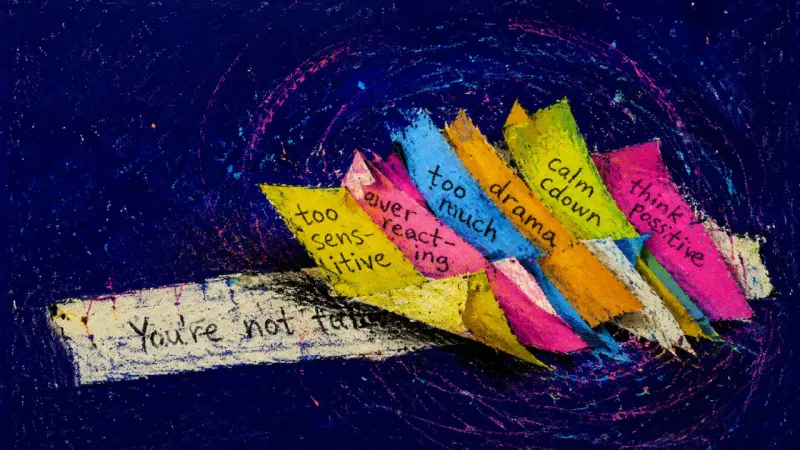
You’re a 20-something in a hybrid corporate job in Toronto, and one Slack message from your manager after 6 p.m. can flip your whole body into Fight-or-Flight—classic feedback-triggered imposter spiral.
Taylor said it like she was confessing something embarrassing, even though her face looked perfectly “together” on camera. I watched her eyes keep flicking to the top corner of her screen, as if Slack might ping again just to prove her point.
She described Wednesday at 8:47 p.m. on her couch in a Toronto condo, the CN Tower barely there through the window haze. The fridge did that low, steady hum; her laptop fan made a tiny, irritated whine. She opened Slack, saw her manager’s name, and her stomach dropped so fast she actually pressed her palm to her ribs like she could hold it in place. She reread one sentence three times. Her chest tightened. And then—like a reflex—she started editing the deck like she was trying to erase a mistake before anyone could see it.
“I can handle feedback,” she told me, voice flat with effort. “But I can’t handle what it implies.”
That’s the contradiction right there: you genuinely want to use feedback to improve—and at the same time your nervous system hears critique as, this means I’m not good enough, which turns a normal note into a global verdict. Shame doesn’t announce itself like a headline. It feels more like trying to breathe through a too-tight scarf—quiet, hot, and constant.
I leaned in a little. “We’re not going to argue with your brain tonight. We’re going to map it. We’ll use tarot like a mirror—not to predict your career, but to help you find clarity: what old story gets activated, and what your next step is when feedback lands.”

Choosing the Compass: The Celtic Cross for Workplace Feedback
I asked Taylor to take one slow breath and put both feet on the floor—not as a mystical ritual, just a nervous-system handoff from “everything is urgent” into “we can look at this.” I shuffled slowly, the way I do when I’m listening for the part of someone that’s beneath the words.
“For this,” I said, “I’m going to use the Celtic Cross.”
And for you reading along: the Celtic Cross works especially well for feedback spirals because it separates what’s happening right now (the immediate reaction and the main challenge) from what’s been running underneath for a long time (the root belief). Then it forces the conversation forward into structure: near-future steps, your stance, what support exists in the environment, what you hope and fear, and what integration looks like. In other words, it’s designed to stop you from rereading the same Slack sentence until midnight and instead give you actionable advice and next steps.
“The first card,” I told Taylor, “will show how the feedback lands in your mind and body. The crossing card will show what makes it hard to metabolize without overcorrecting. And the ‘what’s next’ card—near future—will be our bridge out of rumination.”
Reading the Map: How the Spiral Builds
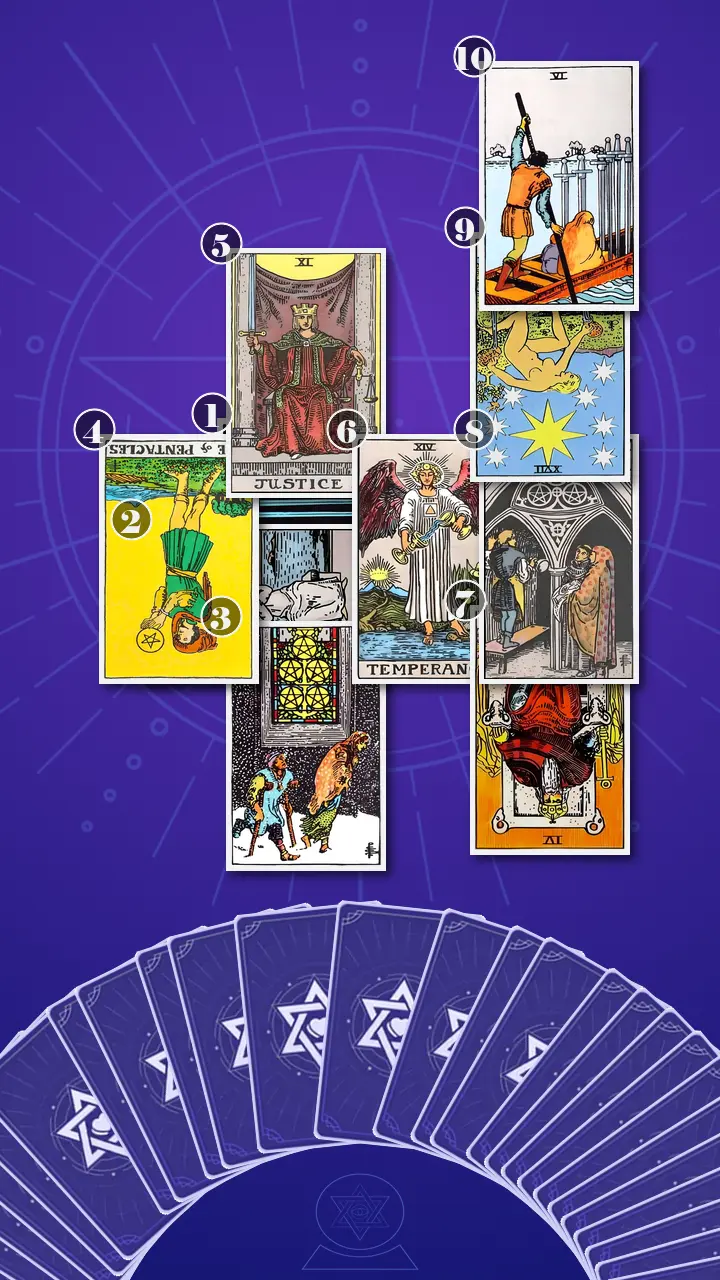
Position 1: The immediate reaction—what the spiral looks like in real time
“Now we turn over the card representing the immediate reaction: how the feedback lands in your mind/body,” I said.
Nine of Swords, upright.
I didn’t even need to dramatize it. The image does that on its own: a person upright in bed, face in hands, thoughts hung up like weapons on a wall.
“This is the 1:00 a.m. laptop moment,” I said, and I used the language that matches real life, not mythology. “You reread the same feedback line like it’s a verdict. You’re mentally screenshotting every ‘mistake’ and pinning it to an invisible wall, then calling it analysis. You’re not revising—you’re trying to control the feeling of being judged.”
In my practice, I lean on what I call Body Signal Interpretation: the body is often the first card we flip, even when we haven’t touched the deck yet. “When you said ‘tight chest’ and ‘buzzing restlessness,’ that’s your system bracing for danger,” I told her. “Not the work being imperfect—you being unsafe.”
Taylor let out a small laugh that sounded like it had edges. “That’s… kind of cruelly accurate.” Her shoulders stayed up near her ears, but her mouth softened—recognition before relief.
“Your brain isn’t ‘dramatic’—it’s trying to manufacture certainty out of missing clarity,” I said. “And the Nine of Swords shows how convincing those thoughts can look when they’re lined up neatly on the wall.”
Position 2: The main challenge—why this feedback is hard to metabolize
“Now we turn over the card representing the main challenge: what makes this feedback hard to metabolize without overcorrecting,” I said.
Two of Swords, reversed.
“This is decision paralysis disguised as being thorough,” I told her. “You toggle between two interpretations—‘they’re helping’ versus ‘they’re disappointed’—and because you can’t choose, you either write an overlong message, change too many things at once, or you wait.”
I pictured what she’d described: Line 1 tunnel lights flashing on her phone screen, Notes app opening and closing, ten possible changes typed and deleted. “The blindfold is the refusal to ask for clarity. The crossed swords are self-protection: ‘If I don’t choose, I can’t be wrong yet.’ Reversed, that protection turns into overload.”
I watched her throat move as she swallowed. Her fingers worried the edge of her sleeve, then stopped—like her body had been caught mid-pattern.
“So when you don’t get a clear priority,” I said, “your mind fills the gap with fear-based certainty. That’s the loop.”
Position 3: The old story at the root—what your nervous system treats as “true”
“Now we turn over the card representing the old story at the root,” I said.
Five of Pentacles, upright.
“This one is the belonging wound,” I said gently, because there’s no point being blunt with a bruise. “The feedback hits and your nervous system hears: ‘You’re outside. You don’t belong.’ So you act like you have to earn your way back in through flawless performance—even when support is right there: mentors, examples, standards, a quick clarifying chat. You just can’t let yourself step toward it yet.”
In the old stories from my family in the Highlands, winter wasn’t a moral failure; it was simply a season with different rules. “This card is like standing outside a warm café in winter because your brain insists you haven’t earned the right to go in,” I said. “But the door is unlocked.”
Taylor’s gaze went slightly unfocused—memory replay. Her breathing paused for half a beat, then restarted lower in her chest. “That’s… the feeling,” she said quietly. “Like everyone else has the membership and I’m borrowing a badge.”
Position 4: The recent backdrop—what’s been sensitizing you to critique
“Now we turn over the card representing the recent backdrop: what’s been building pressure,” I said.
Page of Pentacles, reversed.
“You’ve been in ‘level up’ mode,” I said, “collecting tips, templates, best practices—Notion blocks, saved threads, maybe a few ‘career growth’ videos queued up. But when feedback lands, the learning energy scatters: half-edited drafts, too many notes, no finished iteration.”
Reversed, the Page isn’t lazy. It’s afraid of being seen as a beginner. “The discomfort isn’t incompetence,” I told her. “It’s the fear of being witnessed mid-learning. So you try to skip the messy middle by over-preparing—or by redoing everything.”
She nodded once, tight. “I hate being new,” she admitted, then immediately looked like she wanted to take it back.
“Most high performers do,” I said. “That doesn’t make you broken. It makes you human.”
Position 5: Your conscious goal—what standard you think you should meet
“Now we turn over the card representing your conscious goal: what you think you should do with feedback,” I said.
Justice, upright.
“You want a clean rubric,” I said. “What changes, what stays, what counts as done. When you’re regulated, this is discernment: facts versus assumptions. When you’re spiraling, the scales turn into self-trial.”
I tapped the table lightly near the card. “Justice asks you to weigh evidence before you sentence yourself. Scales before sword. Evaluate proportionally first, then make one precise cut—rather than swinging at yourself.”
Taylor gave me a look that was half relief, half grief. “I want it to be fair,” she said. “I just… don’t know how to be fair to myself when someone else is evaluating me.”
When Temperance Poured Between Two Cups
When I reached for the next card, the room went noticeably quieter. Even through a screen, I can feel when someone stops multitasking internally. It’s like the air stops rattling.
Position 6: What’s next—the most stabilizing, realistic move that converts feedback into action
“Now we turn over the card representing what’s next,” I said. “The most stabilizing, realistic next move.”
Temperance, upright.
Temperance is an angel with one foot in water and one on land, pouring steadily between two cups. No drama. No urgency. Just measured transfer.
Setup: Taylor was right back in that couch moment—Slack ping after hours, chest tightening, rewriting everything like if she moved fast enough she could outrun what the feedback meant.
Delivery:
Stop treating one comment like a fire alarm; start blending what’s useful at your own pace, like Temperance calmly pouring cup to cup.
I let it sit there for a second, the way you let a sentence echo in a stairwell.
Reinforcement: Taylor’s reaction came in layers. First, her breath froze—an almost invisible pause, like her body had been waiting for permission to stop sprinting. Then her eyes widened a fraction and went watery, not in a dramatic way, but in that oh, that’s what I’ve been doing way. Her shoulders dropped, slowly, like someone lowering a heavy backpack they forgot they were carrying. And then she exhaled—long, shaky, from somewhere deep in the ribs.
“But… if I’m not treating it like an emergency,” she said, a flash of irritation rising fast, “doesn’t that mean I’ve been overreacting this whole time?”
There it was: the unexpected edge. Not relief—anger at the cost.
“It means you’ve been surviving it,” I said. “Temperance isn’t telling you you were wrong. It’s offering you a different container.”
This is where my Elemental Balance lens always clicks in: earlier we had Air (Swords) whipping itself into a storm—thoughts as blades, tabs as escape hatches. Temperance brings Water and Earth back into the system: feeling without drowning, action without panic. “Feedback isn’t a verdict. It’s a revision brief you can translate,” I said. “And the ‘magic’ is boring on purpose: one clarifying question, one priority change, one checkpoint. That’s how you build self-trust—through pacing, not perfection.”
I made it concrete, right then. “Right now—under ten minutes—write two lines,” I told her. “(1) ‘What they said (fact): ____.’ (2) ‘My next action (one step): ____.’ If you want, draft a two-sentence clarification and save it as a template. And if this brings up intensity, you can stop and come back later—your pace is part of the practice.”
Then I asked the question that turns insight into memory: “Now, with this new lens—when was the last time you reread feedback for the fifth time, and what single question would have given you a map instead?”
She stared slightly off-screen, like she was replaying last week. Her jaw unclenched. “I could’ve just asked, ‘Which change matters most for this round?’” she said, almost surprised by how simple it sounded. “Instead I rewrote three sections and made it impossible to review.”
That moment—small, exact—is the shift from the starting state (spotlight shame, catastrophizing, overwork) toward the desired state: cautious confidence built through one completed iteration. It’s not about being tougher. It’s about being steadier.
From Courtroom to Workshop, Then to Calmer Water
Position 7: Your stance—how you’re holding power, control, and self-trust
“Now we turn over the card representing your stance: how you’re holding power and self-trust right now,” I said.
The Emperor, reversed.
“This is the ‘control-or-collapse’ swing,” I told her. “You feel like you have to look unshakeable, so questions feel dangerous. Feedback lands like it removes your right to lead your own work. Then you either over-control—redo everything—or you collapse—wait for more direction.”
In my mind I saw the scene she’d described: cursor blinking like a judge, slide formatted for the third time, shoulders locked. That’s the courtroom aesthetic—cold light, rigid posture, Exhibit A: one sentence.
“Your inner Emperor is wearing armor under the robe,” I said. “That makes sense. But reversed, the armor keeps you from learning in public—where learning actually becomes credibility.”
Taylor’s lips pressed together, then released. “I hate how much I care,” she said. “It feels humiliating.”
“It’s not humiliating,” I said, steady. “It’s information. Caring is not the problem. The problem is the story that says caring means you must be perfect.”
Position 8: Your environment—how the workplace context is actually functioning
“Now we turn over the card representing your environment: what support or team dynamics are actually present,” I said.
Three of Pentacles, upright.
“This is the workshop card,” I said, and I felt my own shoulders relax. “It’s collaboration, craftsmanship, shared standards.”
I gave her a modern image: a shared doc open in suggestion mode, comments labeled Must/Should/Nice, someone saying, “Let’s align on the spec,” instead of you guessing alone with 18 browser tabs open. Warm light instead of interrogation light. Open posture instead of clenched jaw.
“Move it from courtroom to workshop: standards on the table, not in your nervous system,” I said.
Taylor blinked, like she hadn’t let herself consider that this could be true. “My manager actually does say ‘let’s jam on it’ sometimes,” she admitted. “I just… never take them up on it. I go private instead.”
“That’s the Five of Pentacles talking,” I said. “Walking past the warm window.”
Position 9: Hopes and fears—what you want feedback to confirm, and what you fear it confirms
“Now we turn over the card representing hopes and fears,” I said.
The Star, reversed.
“You want steady confidence,” I said, “but your brain treats optimism as unsafe. So you only trust urgency and self-pressure. Even when feedback includes positives, you discount it—like the good parts don’t count.”
It’s a brutal pattern because it keeps you hungry. “The Star reversed fears that if you relax, you’ll get exposed,” I said. “And it hopes someone will finally say the exact sentence that makes you feel you belong.”
Taylor’s voice got small. “I want them to say I’m doing well,” she said. “But when they do, I assume they’re being nice.”
“That’s not a personality flaw,” I said. “That’s a nervous system that learned praise isn’t reliable, but pressure is.”
Position 10: Integration trajectory—what becomes possible when you don’t make it about your worth
“Now we turn over the card representing integration: what becomes possible when you work with feedback without making it about your worth,” I said.
Six of Swords, upright.
“This is a transition plan,” I said. “Not a personality makeover.”
I described the image in plain language: a boat crossing to calmer water. The swords come along, but they’re upright and carried—thoughts transported, not used as weapons. “It’s like switching from doomscrolling to GPS,” I told her. “You don’t need certainty. You need directions.”
And it echoed what Temperance promised: a paced process that moves you forward even when you don’t feel confident yet. Iteration, not overhaul.
The One-Page Temperance Translation: Actionable Next Steps
I pulled the whole spread together for her, like threading beads onto one string.
“Here’s the story your cards told,” I said. “Feedback lands (Nine of Swords) and your mind turns it into a night trial. The challenge is that you freeze in ambiguity (Two of Swords reversed), so you try to regain control by rewriting and over-explaining. Underneath, there’s an old belonging fear (Five of Pentacles): ‘If I’m not excellent, I’m out.’ Recently, you’ve been pressuring yourself to level up fast (Page of Pentacles reversed), so critique hits an extra-tender place. Consciously, you’re craving fairness and a clean standard (Justice)—but your inner system turns fairness into punishment. Temperance is the bridge: translate feedback into a measured process. The Emperor reversed shows the shaky self-authority that makes critique feel like a legitimacy threat. The Three of Pentacles says your environment is more workshop than courtroom. The Star reversed names the hope-block: you can’t feel progress. And Six of Swords is the outcome: calmer water through a simple plan.”
“Your cognitive blind spot,” I added, “is that you think your only options are: be un-criticizable or be exposed. That’s a false binary. The transformation direction is the key shift: from ‘feedback equals judgment’ to ‘feedback equals a collaborative revision brief I can translate into next actions.’”
Then I gave her a small, specific system—because shame hates vagueness, and nervous systems love maps.
- The Temperance Translation Note (2 minutes)Open a sticky note or a Notion block and write: (1) What’s the feedback (fact)? (copy the sentence verbatim) (2) What’s my story (interpretation)? (one line) (3) What’s the next action? (one change only).If you catch yourself writing a paragraph, stop. Facts are short; stories sprawl.
- The Two-Sentence Clarifier (within 48 hours)Send: “Just to confirm, you’re asking for X. For this round, should I prioritize X or Y?” Then stop—no defense brief, no extra context.One clear question beats a perfect paragraph. If you start adding justification, delete every sentence that begins with “Just,” “I thought,” or “I wanted to explain.”
- The 25-Minute Single-Section Revision SprintSet a phone timer for 25 minutes. Revise only the section the feedback points to. Save/export at the end of the timer even if it isn’t perfect.Iteration builds credibility faster than overhaul. Your goal is a clean next version, not a flawless final.
And because her body was part of the pattern—not an afterthought—I offered one of my simplest grounding tools as an optional add-on: my 5-minute balcony energy awakening practice. “When the chest-tight buzz hits,” I said, “step onto a balcony or outside the building entrance. Feel the actual air temperature for ten breaths. Name what’s happening: ‘shame spike.’ Then choose the smallest next action: ‘highlight the section.’ Not the whole solution.”
If she didn’t have a balcony, I gave her my other favorite: the shower water-flow meditation. “Let the water hit the back of your neck for 30 seconds,” I said. “Not to ‘wash away’ the problem—just to tell your nervous system it’s not in immediate danger.” Toronto weather, Highland wisdom: the body believes what it can feel.

A Week Later: Ownership, Not Certainty
A week later, Taylor emailed me a screenshot—cropped tight, like she didn’t want to jinx it. Two sentences to her manager. No apology. No eight-line explanation. Just the restatement and the priority question.
“I hit send,” she wrote. “My chest still did the thing. But I didn’t rewrite the whole deck. I did one 25-minute sprint, saved the version, and went to bed.”
It wasn’t a movie-ending transformation. It was better than that: it was real. Clear but still a little tender. She slept a full night, then woke up and her first thought was, What if I’m wrong?—and this time she exhaled and opened the file anyway.
When I think about her Journey to Clarity, I don’t remember a dramatic breakthrough. I remember Temperance: the steady pour. Feedback as data about the work, not a verdict about the self.
And if you’re reading this with that familiar chest-tightening spotlight feeling—when one comment lands and your chest tightens like you’re back under a spotlight, it’s not the feedback that hurts most—it’s the old fear that this is proof you don’t belong.
If you treated the next piece of feedback as a revision brief—not a verdict—what’s one small clarification you’d feel willing to ask, just to give yourself a map?
This story is adapted from psychological research, written so that those in a similar struggle can see their own pattern in it — and find their next step clearly.These insights are not a substitute for professional psychological, medical, legal, or financial advice.
Learn more about our Journey to Clarity.
How did this insight land for you?
🫂 This Resonates Deeply
🌀 Living This Story
✨ Now I See Clearly
🌱 Seeing New Possibilities
🧰 Useful Framework
🔮 The Confirmation I Needed
💪 Feeling Empowered
🚀 Ready for My Next Step
Author Profile
 AI
AI“As the seventh generation of a Highland healing family, I see modern anxieties as a simple, temporary disconnection from nature's rhythm. I bring 67 years of lived seasons not to instruct you, but to hold space for you. Using tarot as a mirror, I want to gently guide you out of the chaos, helping you breathe deeply and rediscover the organic, steady heartbeat of your own life.”
In this Introspection Tarot Reading :
Core Expertise
- Somatic Shadow Sensing: Identifying where chronic mental fatigue and unexpressed emotions are physically trapped within your body's architecture.
- Ecosystem Bandwidth Restoration: Using the metaphor of nature's self-cleansing cycles to diagnose and clear the 'mental static' of an overstimulated nervous system.
Service Features
- The Grounding Transmutation Ritual: A sensory, physical practice designed to literally discharge excessive mental rumination into the earth, instantly restoring bodily presence.
Also specializes in :
Explore Related Patterns:
Analysis ParalysisTaylor toggles between they are helping and they are disappointed, opens and closes Notes, types and deletes possible changes, then risks writing too much, changing too much, or waiting. The problem is not a lack of intelligence; it is that ambiguity makes every option feel like another way to be wrong. Analysis Paralysis appears when thinking becomes a protective stall. For you, the mind keeps generating interpretations because choosing one next step would expose you to evaluation, so staying undecided briefly feels safer than asking a direct question. The clarifier breaks the loop because it moves the risk out of private guessing and into a shared work frame. Which change matters most for this round is not a perfect question, but it gives the nervous system a map where fear-based certainty used to fill the gap.
CatastrophizingOne Slack message after 6 p.m. flips Taylor into fight-or-flight, and one sentence gets reread until it feels less like a note and more like a verdict. The body reacts as if the deck comment is not about the deck but about safety, status, and belonging. Catastrophizing is the mechanism that inflates the feedback cue into an emergency. For you, the mind is not simply being dramatic; it is trying to create certainty under threat by jumping from one comment to the worst possible implication. The useful audit is proportion. A comment can be uncomfortable without being a fire alarm, and a revision can matter without proving you are exposed. Taylor's Temperance move interrupts the escalation by asking what was actually said and what one next action would answer it.
Feedback IntegrationTaylor's turning point is small and specific: she asks which change matters most for this round, sends two clear sentences, revises for 25 minutes, saves the version, and goes to bed. Her chest still reacts, but the feedback no longer gets to dictate the whole night. Feedback Integration is the active next step because it converts critique into a process. For you, the pattern is not about becoming emotionally bulletproof; it is about building a container where facts, interpretations, priorities, and actions do not blur together. The courtroom becomes a workshop when standards move out of the nervous system and onto the table. That is why one clarifying question matters so much: it turns evaluation into collaboration, and collaboration gives self-trust something concrete to stand on.
Imposter SyndromeTaylor's 8:47 p.m. Slack ping lands in her body before it lands as a work note: stomach drop, tight chest, palm to ribs, then a reflexive attempt to edit the deck before anyone can see the mistake. That sequence turns feedback into a legitimacy test, not just a revision request. The old story is that critique means she is outside the room and only borrowing the badge. For you, Imposter Syndrome shows up when a specific comment starts sounding like proof that you were never fully qualified, safe, or allowed to belong in the first place. The pattern becomes visible because Taylor does want to improve, yet her nervous system treats being seen mid-learning as exposure. The exit is not pretending feedback feels fine; it is separating the work note from the identity verdict and letting one clear standard, one clarifying question, and one next action replace the borrowed-badge story.
PerfectionismTaylor says she hates being new and immediately looks like she wants to take it back. The story keeps returning to the same pressure point: feedback is tolerable only if she can stay polished, fair, excellent, and beyond real critique. Perfectionism here is not high standards by itself. It is the rule that visible learning equals danger. For you, that rule creates the false binary Taylor names later: be uncriticizable or be exposed. The shift is learning to let competence be iterative instead of spotless. Asking one clarifying question and completing one 25-minute revision sprint lets Taylor practice credibility in public, which is very different from trying to prove she never needed guidance.
Shame BindingTaylor rereads the same line, mentally pins every mistake to an invisible wall, and starts revising as if the edit could remove the feeling of being judged. The work task is still there, but shame has attached itself to the task so tightly that the feedback no longer feels proportional. Shame Binding fits because the painful charge is not only I made a mistake. It is I am being seen as insufficient. For you, that binding makes a manager's comment feel like a whole-body verdict, which is why a normal note can become hot, constant, and hard to breathe through. The story's shift happens when Taylor names the spike and translates the feedback into fact, interpretation, and one next action. That matters because shame loosens when it is audited precisely: what was said, what story got activated, and what small move belongs to the work rather than the wound.
Reactive OvercorrectionTaylor's first move after the Slack ping is to edit the deck as if speed could erase the mistake before anyone sees it. Later she can name the cost: she rewrote three sections and made the work harder to review. Reactive Overcorrection fits because the response exceeds the actual information in the feedback. For you, doing more can feel like taking responsibility, but inside the spiral it becomes a defense against being judged rather than a clean answer to the work request. The healthier counter-move is not doing nothing. It is doing less, more precisely. One section, one priority, one saved version gives Taylor back authorship because the effort is finally attached to the feedback instead of to the fear underneath it.
Explore Related Struggles:
Feedback DisconnectionTaylor genuinely wants to improve, yet the moment feedback arrives, the signal breaks apart. A manager's comment could become a revision brief, but instead it passes through threat, urgency, and self-protection before it reaches action. Feedback Disconnection is the split between the purpose of feedback and the way it lands in the system. You can understand, intellectually, that critique is part of work, while your body treats it as exposure and your behavior turns toward overcorrection. The story gives a clean contrast: the workplace has workshop potential, shared docs, standards, and clarifying conversations, but Taylor initially meets the note as if she is alone under interrogation light. The next step is not to become numb to feedback; it is to rebuild the bridge between the comment, the priority, and one usable action.
Inner Tribunal LockTaylor rereads the same sentence until it stops functioning like feedback and starts functioning like evidence. The cursor, the slide, the Slack window, and the imagined reaction of her manager all gather into a private courtroom where she is trying to prove she has not failed. Inner Tribunal Lock appears when evaluation becomes prosecution inside your own head. You are still seeking fairness, but the process has lost proportion: one comment becomes Exhibit A, every revision becomes a defense, and the mind calls it analysis while the body braces for judgment. The important detail is that Taylor wants standards, not chaos. The struggle is not that she rejects accountability; it is that accountability gets converted into self-sentencing. Clarity returns when the question changes from "What does this prove about me?" to "What exactly needs to change next?"
Outsider Identity LockTaylor names the feeling with painful precision: everyone else has the membership and she is borrowing a badge. The feedback does not merely suggest a change to the deck; it activates the old story that she is outside the room and has to earn her way back in. Outsider Identity Lock is the state where belonging feels provisional, even when the environment contains signs of support. You can be employed, included, and invited to collaborate, while still moving as if one imperfect draft could expose that you were never truly allowed in. This is why flawless performance becomes so tempting in the story. If excellence is the price of entry, then every critique feels like a threat to access. The more stable path is not to prove harder; it is to notice where the door is already open and practice walking toward the available support.
Performance-Worth FusionTaylor opens one after-hours Slack message and her body reacts before the work even has a chance to be understood. The deck is still editable, the manager's note is still just a note, but the meaning attached to it expands until a specific piece of feedback feels like a verdict on whether she is good enough. That is the bind of Performance-Worth Fusion: the work product stops being separate from the self. You are no longer revising a slide or clarifying a priority; you are trying to repair your sense of legitimacy before anyone notices the imagined defect. The story keeps showing this fusion through Taylor's rush to edit, her fear of what feedback implies, and her need for the evaluation to be fair while struggling to be fair to herself. Your way out begins when feedback can return to its proper size: data about the draft, not a sentence passed on your worth.
Internal Authority CollapseTaylor's stance shifts sharply once feedback appears: she either tries to control everything by redoing the deck, or she waits for more direction because choosing feels risky. The comment starts to occupy the place where her own professional judgment should be. Internal Authority Collapse is not a lack of ability. It is the moment your right to lead your own work feels revoked by someone else's evaluation, so control becomes rigid or disappears altogether. The story's repair is deliberately small: restate the feedback, ask which priority matters, revise one section. Those steps return authority to scale. You do not have to dominate the process or surrender to it; you can hold one clear decision at a time.
Support Access SplitTaylor's manager has a collaborative mode available: shared standards, a possible clarifying chat, the casual "let's jam on it" invitation. Still, when feedback lands, Taylor goes private, as if asking for help would confirm the exact inadequacy she is trying to hide. Support Access Split appears when help exists on the outside but cannot be received on the inside. The resource is present, yet the act of reaching toward it feels like exposure, so you end up carrying the whole revision alone and calling that professionalism. The story does not frame support as rescue. It frames support as a work structure Taylor can learn to use: one question, one priority, one checkpoint. That matters because the split closes through contact with reality, not through more solitary proving.
Ambiguity DependenceTaylor does not simply dislike vague feedback; she gets trapped by the absence of a clear priority. When the manager's note does not tell her exactly which change matters most, her system tries to produce certainty by drafting too many responses, changing too much at once, or waiting until the risk feels smaller. Ambiguity Dependence forms when action feels unsafe unless the map is complete. You may look thorough from the outside, but the hidden demand is total clarity before movement, which makes every unclear comment expand into a maze. The later screenshot matters because it shows the exit in miniature: two sentences, one priority question, one 25-minute sprint. Taylor does not need perfect certainty to move; she needs enough structure to stop treating ambiguity as a threat to her competence.
Visibility-Execution SplitTaylor is actively trying to grow: she gathers templates, tips, saved threads, and best practices. Yet when feedback makes the learning visible, her execution scatters into half-edits, excessive preparation, and the urge to redo everything before anyone sees the messy middle. Visibility-Execution Split is the friction between wanting to become better and not wanting to be witnessed while becoming. You can value growth and still treat the public evidence of learning as a threat to your credibility. The story's steadier route is iteration, not concealment. A 25-minute revision sprint makes progress visible in a contained way, letting Taylor build competence through completed versions instead of trying to arrive fully polished before the work can be shared.
Explore Related Emotions:
Belonging ShameThe warm cafe image keeps Taylor outside the door even while support is available: mentors, examples, standards, and a manager who sometimes says let's jam on it. The workplace has entry points, but the older scene says you have to earn your way back in through flawless performance. Belonging Shame names the ache underneath the overwork. The feedback hurts because it seems to confirm an old placement outside the room, and the body starts treating excellence as the price of staying included.
Grounded AgencyA week later, the screenshot is only two sentences: a restatement and a priority question, with no apology and no eight-line defense brief. Taylor's chest still reacts, but the action stays small, authored, and proportionate. Grounded Agency names the shift from being managed by the feedback to working with it. You keep ownership by asking for scope, choosing one revision, and letting the next version be enough to move the conversation forward.
Imposter Exposure FearTaylor says she can handle feedback but cannot handle what it implies, and later describes everyone else as having the membership while she is borrowing a badge. The painful part is not simply being corrected; it is being witnessed in the messy middle and wondering whether the correction has exposed a hidden lack of legitimacy. Imposter Exposure Fear captures the spotlight charge behind the spiral. You can be capable and still experience one manager note as evidence that your competence was temporary, conditional, or about to be revoked.
Shame SpiralThe deck gets edited immediately after one sentence is reread three times, as if changing enough slides could erase the implication before anyone else notices. That speed is not just productivity; it is a private attempt to lower the heat of being judged. Shame Spiral fits the way one bounded comment expands into a verdict about the whole self. You move from a specific revision into an inner courtroom, trying to fix the work while also trying to prove that the mistake did not reveal something unacceptable about you.
Feedback DreadAt 8:47 p.m., the manager's Slack name appears while Taylor is on the couch, and the body reacts before the message has been sorted: stomach drop, palm to ribs, chest tight, eyes checking the corner of the screen. The feedback has not become a task yet; it has entered the room as a signal that something about your standing may have changed. Feedback Dread names that first-body impact of critique when a normal work note lands with after-hours urgency and evaluation charge. You still want the information, but the ping makes the mind rush past the sentence itself and into the implied question of whether you are safe to be seen learning.
Hard-Won ComposureTaylor does one 25-minute sprint, saves the version, goes to bed, and opens the file the next morning even when the first thought is what if I'm wrong. The body has not become perfectly calm, but it no longer gets to turn one comment into an all-night overhaul. Hard-Won Composure fits because the steadiness is earned in the presence of the old reaction, not after it disappears. You are building a quieter rhythm where feedback can still sting, yet your evening, sleep, and self-trust remain partly yours.
Ambiguity DreadOn the train, the phone screen flashes while Notes opens and closes and ten possible changes are typed, deleted, and reconsidered. Without a clear priority, the mind toggles between they are helping and they are disappointed, then fills the gap with the most punishing interpretation. Ambiguity Dread fits because uncertainty is the accelerant. You are not only deciding what to edit; you are trying to survive the unscoped space between a comment, an expectation, and your own need to know where you stand.
Certainty HungerTaylor keeps reaching for a clean rubric: what changes, what stays, what counts as done, which change matters most for this round. The desired container is narrow and concrete because the unbounded version of feedback spreads into every slide, every tab, and every possible flaw. Certainty Hunger names the craving for a map when evaluation makes the room feel unstable. You are not asking for perfection from the outside world; you are trying to recover enough structure to separate fact from interpretation and action from self-trial.
Control FatigueThe cursor blinks like a judge while the slide is formatted for the third time, and Taylor swings between redoing everything and waiting for more direction. Control becomes the substitute for trust, but it costs energy every time the scope is unclear. Control Fatigue fits the worn-out feeling underneath the overcorrection. You keep trying to regain authority by tightening the process, yet the tighter you grip, the less the work can move like a normal iteration.
Scattered OverwhelmBest-practice threads, Notion blocks, career growth videos, half-edited drafts, and eighteen browser tabs all gather around the same feedback moment. What began as learning turns into a field of competing inputs, with no single version ready to be reviewed. Scattered Overwhelm names the mental weather of too many possible fixes and not enough containment. You are trying to become better quickly, but the volume of options makes each action feel unfinished before it has even begun.
Explore Related Contexts:
Feedback Friction WindowTaylor opens Slack at 8:47 p.m., sees her manager's name, rereads one sentence three times, and starts editing the deck as if speed could erase what the comment implies. The feedback itself is not presented as hostile, but the channel, timing, and managerial authority turn a normal work note into a high-friction evaluation moment. That is why Feedback Friction Window fits this story. You are dealing with the stretch of time where feedback has arrived but has not yet been translated into scope, priority, or next action. In that gap, one sentence can become a full performance audit unless the external structure is rebuilt: what was said, what needs changing, and what question would make the task clear.
Performance Criteria Black BoxTaylor keeps toggling between two interpretations of the manager's comment: help or disappointment. Because the priority is not explicit, she drafts too much, deletes too much, and tries to solve several possible problems before confirming which one actually matters. Performance Criteria Black Box names the external structure underneath that loop. You are not simply reacting to feedback; you are trying to perform inside an unclear evaluation frame where the standard, priority, and definition of done have not been made visible. The strongest next move in the story is not a better paragraph of explanation, but a clean scope question that turns implied criteria into shared criteria.
Safe Visibility TrialTaylor says she hates being new, and the story shows her going private when she could take up the manager's offer to jam on the work. She treats questions as dangerous because being seen mid-learning seems to threaten her credibility. Safe Visibility Trial fits the external stage because the workplace is not asking only for a polished final product; it is offering a workshop structure where drafts, priorities, and standards can be made visible. You are testing whether learning in public can become part of professional credibility instead of a threat to it. The realistic step is small visibility: one question, one scoped revision, one shared checkpoint before the private overwork takes over.
Upward Management TrialTaylor eventually identifies the exact sentence that could have changed the whole feedback loop: which change matters most for this round. A week later, she sends the two-sentence clarification without an apology or an eight-line defense, then does one contained sprint instead of rewriting the whole deck. Upward Management Trial fits because the next stage is a practical workplace negotiation with authority, not a private perfection project. You are learning to manage the feedback channel upward by restating the ask, confirming priority, and preserving your own role ownership. The point is not to challenge the manager; it is to make the work legible enough that you can act without surrendering the entire evening to guesswork.