The 11:40 p.m. Edit: Finding Clarity After a Dealbreaker
You know the Sunday Scaries version of dating: it is 11:40 p.m., your non-negotiables note is open, and you are changing This is a dealbreaker to This might be a dealbreaker depending on context because losing the connection feels worse than losing the clarity. I met Jordan, a twenty-nine-year-old product designer in Toronto, inside that exact edit.
She sat on the edge of her bed in a one-bedroom apartment, one hand wrapped around a phone that had grown warm against her palm. Streetcar brakes hissed beyond the window. A bedside lamp made the Notes page look almost painfully white. Jordan reread the same message thread, opened a direct question she had drafted, deleted it, and replaced it with a casual reply that made everything sound fine.
She had noticed behavior that matched a relationship dealbreaker she had written down before this person crossed it. Still, she kept searching the timestamps, the wording, the possible workload, the possible intention. Her question for me was direct: What do I keep minimizing after a dealbreaker shows up?
I could see the physical cost before she finished explaining. Her chest stayed tight, her breath paused high in her throat, and her jaw held the pressure of a sentence she did not want to say. Her ambivalence felt like trying to keep twelve browser tabs open on the same message while hoping one more refresh would turn the boundary into a different fact.
I told her, You are not looking for more evidence so much as an explanation that lets the connection remain possible.
I did not say that as a verdict. I said it as a place for us to stand. We could look at what happened without making Jordan prove that her reaction was perfect, and we could make a map toward clarity without deciding the entire relationship in one night.

Choosing the Shadow Spread for a Boundary I Already Named
I invited Jordan to put both feet on the floor, take one slow breath, and hold the question in its simplest form. Then I shuffled slowly. For me, this is how tarot works: the cards create an impartial visual language that helps us notice the difference between what happened, what we think it means, and what we are afraid it may require. The practice is a transition into attention, not a performance of supernatural certainty.
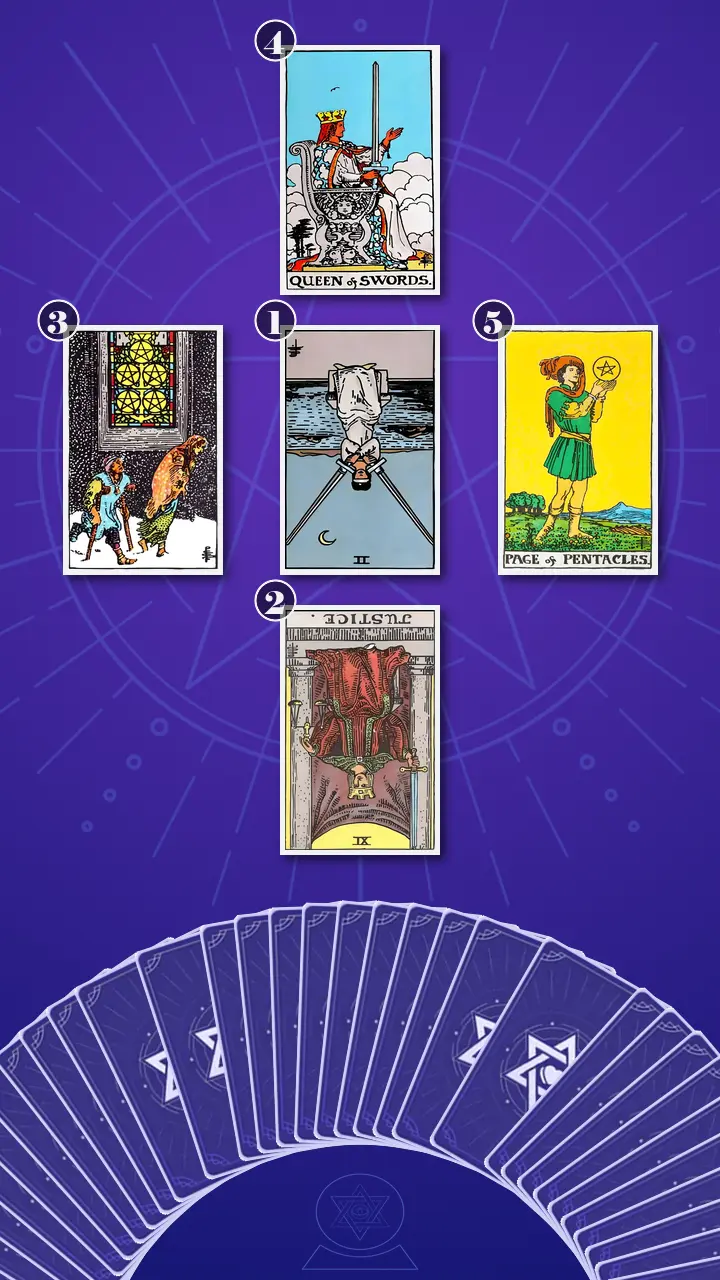
I chose the classic Shadow Spread because this was an F5 Inner Excavation question. Jordan was not really choosing between two external futures yet. She was trying to uncover the defense mechanism that became active after an already recognized dealbreaker appeared. Five cards could hold the full sequence: visible behavior, minimized truth, protective fear, corrective resource, and one grounded act of follow-through.
For the reader, the structure matters. The first position shows the conscious loop currently asking for attention. The second reveals the shadow beneath it: the mismatch between the boundary Jordan stated and the way she discounts evidence when that boundary is tested. The third names the fear protecting the pattern. The fourth offers the inner resource that can restore discernment. The fifth turns insight into a small practice, because clarity becomes trustworthy when it reaches ordinary behavior.
Reading the Map of Exception-Making
The Blindfolded Thread: Two of Swords Reversed
I began with the position that presents the diagnosis-level behavior: reopening a settled standard, searching for exceptions, and postponing a response after the dealbreaker appears. The card was the Two of Swords, in reversed position.
In its familiar image, the blindfolded figure holds two swords crossed over her chest while restless water moves behind her. Reversed, the temporary stalemate has become mental overload. The energy is blocked and overused: thought is no longer helping Jordan weigh a decision; it is acting as a barrier between her and what she has already perceived.
I connected the card to the scene she had described. Jordan kept switching between the message thread, an unsent text, and the note of non-negotiables. Each reread produced another qualifier: maybe the timing was unusual, maybe the wording meant something else, maybe she should wait until she felt less emotional. The visible problem was not that she had no standard. It was that she kept reopening the standard every time it asked her to respond.
I said, This card does not ask you to make an abrupt all-or-nothing decision. It asks you to stop pretending that another reread will remove the conflict. First, write one sentence describing the observable behavior. Then write the boundary it touches. You can decide what comes next after those two sentences exist.
Jordan did not nod. Her breath paused, her eyes moved from the card to her phone as though replaying the message, and then a small, bitter laugh escaped her. She said, That is almost rude. I keep calling it research.
I smiled gently. It may have started as research. It is becoming a way to postpone the moment when your own standard counts.
Her fingers stopped moving over the phone. That small stillness was the first sign that the reading had reached the behavior itself rather than another abstract discussion about whether she was overreacting.
The Tilted Scales: Justice Reversed
I turned to the position that reveals what Jordan keeps minimizing: the mismatch between the boundary she stated and the way she discounts evidence when that boundary is tested. The card was Justice, in reversed position, the denied or insufficiently acknowledged shadow beneath the visible pattern.
Justice usually asks for fairness, accountability, and a balanced relationship between choices and consequences. Reversed, the scales tilt under relational pressure. The energy is distorted evaluation. Jordan was not short on standards; she was changing the scoring system after the evidence arrived, giving the other person's intent, stress, good qualities, and possible explanations more weight than the behavior itself or its impact on her.
She told me about a rainy Thursday on the TTC Red Line. Her damp coat sleeves had pressed against the plastic seat while fluorescent lights buzzed overhead. A friend had texted, Would this feel okay if it happened to you twice?
Jordan's stomach dropped. She began explaining the other person's workload, difficult week, timing, wording, and possible intentions. After several minutes, she realized she had described their context in detail without saying what the incident had done to her.
I asked her to listen to the inner sequence without judging it: Maybe they were stressed. Maybe the timing was bad. Maybe I misunderstood. But what happened was still the behavior you had already named as unacceptable to your close relationships.
Jordan looked down at her hands. I always become their defense attorney,
she said. Then she went quiet, and I watched the recognition move through her in three small stages: her shoulders tightened as if she expected criticism, her gaze went unfocused while the TTC scene replayed, and finally she let out a long breath that seemed to come from beneath her ribs.
I told her, Context can add information. It does not get to delete the fact.
Fairness did not require her to become harsh. It required her to include herself in the evidence. The question was not whether the other person could produce a reasonable explanation. The question was whether an explanation should silently erase the boundary Jordan had chosen before attachment made the answer costly.
The Lit Window in the Snow: Five of Pentacles Upright
I placed the third card in the position that identifies the protective fear sustaining the pattern: the fear that honoring the dealbreaker could cost connection and belonging. The card was the Five of Pentacles, in upright position.
The two figures in the card move through snow beneath an illuminated stained-glass window. One has a crutch; both look absorbed in immediate hardship. I did not read this as a prediction that Jordan would be abandoned. I read it as the embodied experience of exclusion becoming so vivid that one threatened connection starts to feel like the whole supply of warmth in her life.
Jordan described standing in her narrow kitchen at 12:18 a.m. on a Saturday. The range hood hummed. The refrigerator clicked on. A cold mug of tea sat beside the unsent message while she searched am I overreacting relationship boundary
and moved between TikTok clips, Reddit threads, and relationship podcasts. She imagined the direct conversation going badly. Then she imagined being the person who had ruined something promising by taking one incident too seriously.
Her throat tightened as she said, Maybe it is easier to stay uncertain than to find out I am alone again.
I let the sentence remain in the room. The Five of Pentacles showed a deficiency in felt belonging, not proof that support had disappeared. Jordan had friends, meaningful work, a full social life, and a city around her, yet attachment had narrowed her attention until one possible ending looked like a referendum on whether she would ever be chosen. The shadow was not simply fear of losing this person. It was fear that treating the dealbreaker seriously would confirm she lacked secure belonging.
Jordan's hand reached for her phone and stopped halfway. She looked toward the imaginary lit window in the card, then back at the message. Her face held disappointment before anything had technically ended. I said, You are allowed to grieve the possibility that this connection may not become what you hoped. You do not have to call the possibility of grief proof that your boundary is too severe.
When the Queen of Swords Raised Her Sword
The Fact That Survives Context: Queen of Swords Upright
The room became quieter when I turned over the card in the position that embodies the key shift from exception-seeking to clear observation, self-trust, and direct boundary language. Above the central pattern sat the Queen of Swords, in upright position.
Her sword was raised, but her other hand was open. The image did not ask Jordan to reject context. It showed her how to receive information without surrendering discernment. For a Queen of Swords tarot reading about relationship boundaries, this is the corrective perspective: name what happened, compare it with the standard already chosen, listen to the response, and do not edit either the fact or the boundary just because the answer may hurt.
I used my signature Narrative Fork Analysis at this point. I asked Jordan to see her options as competing plotlines rather than as a single terrifying decision. In one plotline, she kept rereading, added another qualifier, sent reassurance, and preserved the connection's possibility for another day. That plotline offered immediate relief, but its character arc required her to move the boundary marker farther from herself each time it was reached. In the other, she recorded the behavior, named the boundary, and asked one direct question. That plotline did not guarantee an outcome, but it let her act as the person she had already decided she wanted to become.
Then I used my Safe-Choice Sabotage Recognition. The apparently safe option may not be neutral,
I told her. Sometimes it is a defense mechanism dressed as logic. It helps you avoid the necessary inciting incident: allowing the fact to change what you do next.
The insight was not that Jordan should leave immediately. It was that postponement had a cost, and calling that cost caution did not make it disappear.
It was late, the message thread was open, and the note where Jordan had once written This is a dealbreaker was open too. Her thumb hovered over a softer version of her own standard because the thought of losing this connection landed in her body before any explanation did. She was trying to solve the whole ending before allowing one event to become real.
You do not need to soften the evidence to preserve connection; state the fact, honor the boundary, and let the Queen's raised sword separate clear observation from protective explanation.
I let the sentence sit between us. Then I added, You do not need to make the evidence smaller to make room for context. A boundary can be taken seriously before you know the whole ending.
For a few seconds, Jordan did not move. Her thumb remained suspended above the phone, and her breath stopped at the collarbone. Then her eyes lost focus as if a series of old message threads had started playing behind them: the original reaction, the careful explanation, the softened boundary. Her fingers tightened around the phone until her knuckles paled, and then slowly opened. A flush rose along her cheeks. Her jaw loosened, though her mouth trembled when she said, But if I let this count, does that mean I have to end it?
I answered immediately, No. It means you have stopped requiring yourself to decide the entire relationship before you are allowed to recognize one fact.
Her eyes grew bright. She looked at the note, then at the Queen's open hand. A sharp exhale left her chest, followed by another, steadier one. Her shoulders lowered with the relief of setting down a weight, but the relief brought a brief dizziness too, a blankness where the endless analysis had been. Clearer did not mean effortless. It meant the responsibility was finally hers in a usable way.
I asked her, Now, use this new perspective to think back to last week. Was there a moment when this insight could have made you feel different, even before you knew how the conversation would end?
Jordan closed her eyes. This time, she did not search for a better explanation. She remembered the first instant her chest had tightened, before she began defending the other person, and let that reaction exist without putting it on trial.
That was the emotional crossing: from contracted ambivalence and repeated self-doubt toward grounded clarity and proportionate boundary follow-through. It was not a final verdict, and it was not a promise that connection would remain. It was a first act of self-trust. Jordan could hear context, but context no longer had permission to erase the fact.
One Pentacle at a Time: Page of Pentacles Upright
I finished with the position that turns insight into an actionable integration practice: one small, observable act of follow-through. The card was the Page of Pentacles, in upright position.
The Page studies one pentacle at eye level while a cultivated field and distant mountains stretch behind them. The energy is grounded learning. It does not demand a dramatic declaration or perfect certainty. It asks Jordan to practice self-trust as a skill: record one observable fact, name the boundary it touches, and take one proportionate action before reopening every possible interpretation.
I connected the card to her everyday life. At work, Jordan could say, That is outside the agreed scope
while a Figma prototype glowed in a glass meeting room. She knew how to use documented criteria when protecting a product. The Page asked her to bring that same modest precision into dating without turning intimacy into a Jira ticket or a courtroom.
I asked her to imagine the next boundary-crossing moment. She would stay with one relevant fact instead of scanning the entire horizon. She might pause before replying, ask one direct question, restate the boundary, or decline to reassure someone before she had processed the information. Her feet moved back beneath her chair. The phone lay face down on the table. Nothing about the relationship had been magically resolved, but the next step had become small enough to hold.
The One-Fact Boundary Check
When I connected the five cards, I saw a clear sequence. Jordan's previous experiences of staying too long in ambiguous situations had taught her to keep a private list of standards, while her design work had trained her to value nuance, iteration, and multiple interpretations. The Two of Swords reversed showed that skill turning into a loop. Justice reversed showed her changing the scoring criteria after the result threatened attachment. The Five of Pentacles revealed the fear underneath: if she honored the dealbreaker, she might have to feel disappointed, lonely, or outside the partnership she wanted. The Queen of Swords restored a clean reference point, and the Page of Pentacles showed how to make that reference point real.
The cognitive blind spot was not simply that Jordan was too forgiving. It was the belief that she needed total certainty before evidence was allowed to count. She treated connection as part of the evidence calculation, so preserving the connection quietly became more important than recording the behavior accurately. Every exception moved the boundary marker farther from her.
I said the sentence I wanted her to carry with her: You were not unclear. You were afraid of what clarity might cost.
That fear deserved kindness, but it did not need to manage the evidence. The transformation direction was practical: move from repeatedly asking whether the dealbreaker was forgivable to recording what happened, comparing it with the boundary already named, and choosing one proportionate response.
I also made the agency explicit. I was not using the Shadow Spread to tell Jordan whether to stay or leave. The cards could help her see the mechanics of exception-making, but Jordan remained the person who knew the relationship, set the standard, and chose the pace. Tarot was a mirror and a structured thinking tool. She was still the author of the next act.
The 24-Hour Creative Mandate
To keep this from becoming another beautiful insight that never reaches ordinary life, I gave Jordan my Protagonist Pivot Action: a 24-hour creative mandate to complete one micro-action aligned with the most daunting but authentic plotline. She did not have to decide the whole future. She had to make one move that proved the old pattern was no longer writing every scene for her.
- The Fact-First Boundary CheckWithin the next week, when you want to open the message thread for a fourth time, set a twenty-minute timer, or use a two-minute version if your body feels flooded. Create a phone note with two headings: Observable fact and Interpretation. Put words, actions, dates, and prior agreements in the first column. Put your explanation of intent or meaning in the second. Then compare the first column with the exact boundary you wrote before the incident. Do not edit the boundary during the comparison.The note is for clarity, not a case you owe anyone. Context can be considered later. If twenty minutes feels too long, write one sentence beginning
What happened was...
, put both feet on the floor, and stop there. - One Direct Boundary QuestionWithin twenty-four hours, choose one person and one concrete incident. Draft a question such as
When you did X after I had shared that Y mattered to me, what did you understand about its impact on me?
Write it in Notes first, remove apologies that make the fact disappear, and send it only when you have enough privacy to read the reply without performing calmness for coworkers, roommates, or friends.Use one question and one example. You do not need to soften the message until it says nothing, and you do not need to send a long explanation that resolves everything at once. You can listen to the answer and take time before choosing the next proportionate response. - The One Pentacle PracticeFor the next boundary-crossing moment, record one fact, name one boundary, and take one small action. The action might be asking the direct question, pausing contact, restating the standard, or declining to reassure the other person before you have processed what happened. Send one factual check-in to a trusted friend:
This happened. My stated boundary is this. Can you reflect back what you hear?
Afterward, log what you did rather than whether the relationship outcome was good or bad.Self-trust grows when one clear fact leads to one real action. Keep the checklist short enough to fit in one phone note. A small step is not insignificant; it is evidence that your observations can guide your behavior.

A Quiet Proof That Self-Trust Is a Practice
Four days later, I received a message from Jordan before her first morning Slack notifications began. She had written the observable fact and the original boundary in two separate lines. She sent one direct question without adding This is probably nothing
or I might be overthinking
. She did not know yet how the other person would respond, but she no longer needed the response to tell her whether the event had been real.
That night she slept through, then woke with the old thought: What if I am wrong?
She smiled, put both feet on the floor, and opened the note anyway. The fear had not vanished; it simply no longer held the pen.
I told Jordan that this was the quiet proof of our Journey to Clarity. The cards had not made her decision for her. They had helped her separate fact from explanation, fear from belonging, and compassion from self-erasure. The next act belonged to her, and it could remain unfinished while still being honest.
There is a particular ache in holding your breath over an open message thread, trying to keep a connection alive by making the part that hurt you sound smaller than it felt. I know that ache, and I do not treat it as proof that you are too sensitive, too difficult, or too much.
If you let one observable fact stay visible without deciding the whole future tonight, what small boundary action would feel most honest to you?
This story is adapted from psychological research, written so that those in a similar struggle can see their own pattern in it — and find their next step clearly.These insights are not a substitute for professional psychological, medical, legal, or financial advice.
Learn more about our Journey to Clarity.
How did this insight land for you?
🫂 This Resonates Deeply
🌀 Living This Story
✨ Now I See Clearly
🌱 Seeing New Possibilities
🧰 Useful Framework
🔮 The Confirmation I Needed
💪 Feeling Empowered
🚀 Ready for My Next Step
Author Profile
 AI
AI“I’ve always felt our lives are films currently in production. As an artist, I know that when you feel stuck, it’s often because you’ve bravely stayed in a painful scene for just a little too long. I’m not here to coldly analyze you. I want to sit closely with you, look at those difficult moments with profound empathy, and gently hand you the pen so you have the courage to write your next beautiful act.”
In this Choice Tarot Reading :
Core Expertise
- Narrative Fork Analysis: Deconstructing your options as competing plotlines to see which genuinely serves your ultimate character growth arc.
- Safe-Choice Sabotage Recognition: Identifying when a seemingly logical option is merely a defense mechanism to avoid a necessary 'inciting incident'.
Service Features
- The Protagonist Pivot Action: A 24-hour creative mandate to execute one micro-action aligned with the most daunting, yet authentic, plotline, effectively breaking analysis paralysis.
Also specializes in :
Explore Related Patterns:
Boundary DiscernmentFour days after the reading, Jordan writes the observable incident and her original boundary on separate lines, then sends one direct question without adding language that makes the incident smaller. The sequence preserves a clear distinction between the fact, the possible explanation, and the limit she had already chosen. When you can hear context without letting it overwrite your standard, a boundary stops functioning as a private ideal and begins guiding real behavior. Boundary discernment does not force an immediate breakup or an all-or-nothing verdict. It allows one fact to count, one boundary to remain visible, and one proportionate response to follow.
Certainty SeekingIn her kitchen after midnight, Jordan moves among TikTok clips, Reddit threads, podcasts, the message thread, and her note while searching for proof that she is not overreacting. She also assumes that allowing one event to count may force an immediate decision about the whole relationship. When you require complete certainty about intent, fairness, and future consequences before honoring a boundary, the impossible standard protects you from having to act under ordinary ambiguity. Certainty seeking keeps promising that one more explanation will remove the emotional cost, but its practical effect is to suspend your own standard whenever the outcome matters most.
Cognitive DissonanceJordan wrote the dealbreaker before the relationship made it expensive, yet after the matching behavior appears she reopens the standard, softens its wording, and sends a reply that communicates that everything is fine. Her prior judgment and current attachment-preserving behavior cannot both operate without friction. When your stated value and immediate response conflict, the mind looks for a way to reduce the pressure. Cognitive dissonance becomes self-erasing here because the standard is revised after the evidence arrives, allowing the connection to continue without requiring the contradiction to be named. The discomfort is not proof that the boundary is wrong. It is information that your belief and behavior have moved out of alignment.
Defensive MinimizationAt 11:40 p.m., Jordan changes 'This is a dealbreaker' into 'This might be a dealbreaker depending on context,' deletes the direct question, and sends a casual reply that makes everything sound fine. On the TTC, she can describe the other person's workload, timing, and possible intent in detail while leaving out what the behavior did to her. When you make the evidence smaller after a boundary becomes costly, minimization protects the connection from immediate disruption but also removes you from the evaluation. The defense does not erase the standard outright. It quietly lowers its weight until the other person's context counts as evidence and your own impact is treated as an inconvenience.
IntellectualizationJordan's chest stays tight, her breath catches high in her throat, and her jaw holds the pressure of an unsaid sentence while she redirects attention toward timestamps, wording, workload, and possible intention. Her ability to work with nuance becomes an elaborate interpretation exercise that keeps the bodily and relational impact outside the frame. When you convert a painful boundary conflict into a complex research problem, analysis can create distance from what the event may require. Intellectualization preserves composure and a sense of control, but in this loop it also prevents your direct experience from becoming usable information. The issue is not thinking too carefully. It is using thought to avoid the emotional consequence of what you have already perceived.
Motivated ReasoningJordan searches the timestamps, wording, workload, difficult week, timing, and possible intention after recognizing behavior that matches a dealbreaker she wrote down in advance. Each new explanation points in the same direction by making continued connection easier to justify, while the observable impact receives progressively less attention. When you call this process neutral research, the hidden objective can remain invisible. Motivated reasoning does not mean every contextual explanation is false. It means the search and weighting process are organized around a preferred conclusion, so explanations that preserve attachment receive more scrutiny and generosity than evidence that may require a boundary response.
Reality TestingJordan's fact-first note separates words, actions, dates, and prior agreements from her theories about workload, stress, or intent. She then asks a direct question while refusing to make the eventual reply responsible for deciding whether the original event happened. When you distinguish observation from interpretation, context can inform your judgment without rewriting the record. Reality testing here is not emotional coldness or courtroom certainty. It is the ability to keep an observable fact stable long enough to compare it with your boundary and decide what additional information is genuinely relevant.
Self-AbandonmentJordan deletes the question she actually wants to ask, sends a casual response that makes everything sound fine, and then becomes the other person's defense attorney while omitting the impact on herself. The boundary still exists in her note, but she withdraws its authority when honoring it might threaten the connection. When you require your reaction to be perfectly justified before it can guide any behavior, you leave your own experience unsupported at the moment support matters. Self-abandonment in this story is not kindness or nuanced perspective taking. It is the repeated transfer of practical loyalty away from your stated limit and toward preserving someone else's access to you.
Uncertainty ToleranceJordan asks whether letting the incident count means she must end the relationship, and the answer separates recognition from final resolution. Four days later, she sends one direct question without knowing what the other person will say, and she lets the relationship remain unfinished while the fact stays visible. When you stop demanding certainty about the entire future before taking one honest step, uncertainty becomes something you can carry rather than something you must eliminate. The corrective pattern is not blind confidence. It is allowing incomplete information, disappointment, and relational possibility to coexist without suspending your boundary indefinitely.
Loss AversionJordan explicitly experiences losing the connection as worse than losing clarity, and she says it may be easier to remain uncertain than to discover she is alone again. One possible ending grows until it feels like a verdict on whether she will ever be chosen, even though friends, meaningful work, and a full social life remain present. When you give a potential relational loss more psychological weight than the ongoing erosion of your boundary, preserving the connection can look like the safer option. Loss aversion narrows the calculation to what might disappear immediately, while making the slower losses of self-trust, clarity, and behavioral alignment feel less urgent than they are.
Analysis ParalysisJordan moves repeatedly between the message thread, an unsent question, and her non-negotiables note, but every reread produces another qualifier instead of a clearer next step. The analysis resembles twelve browser tabs refreshing the same conflict while the direct question is deleted and replaced with a reassuring reply. When thinking no longer changes the quality of the evidence and only delays the moment your standard would guide action, analysis has become a holding pattern. The paralysis offers temporary protection from regret and confrontation, but it also keeps you paying the physical and cognitive cost of a decision that is never allowed to become small enough to approach.
Conflict AvoidanceJordan drafts a direct question, deletes it, and replaces it with a casual reply that makes everything appear fine. Later, she stands beside an unsent message while imagining the conversation going badly and the promising connection ending because she took one incident seriously. When you smooth the interaction before your concern has been acknowledged, immediate tension falls but the unresolved conflict moves inward. Conflict avoidance protects you from the other person's response in the short term, yet it also prevents their response from becoming real information about accountability, compatibility, and whether your boundary can exist inside the relationship.
Internal ValidationAfter sending the direct question, Jordan does not yet know how the other person will respond, but she no longer needs that response to certify that the incident was real. When the thought that she may be wrong returns the next morning, she puts both feet on the floor and reopens her own written record. When you let your observation and chosen standard enter the evidence without first winning someone else's agreement, self-trust becomes behavioral rather than aspirational. Internal validation does not make your interpretation infallible. It means external context can refine your judgment without holding veto power over whether your impact and boundary deserve consideration.
Explore Related Struggles:
Consequence LockJordan asks whether letting the incident count means she has to end the relationship. Until she can solve that entire outcome, she withholds permission to register one event, as though acknowledging a dealbreaker and choosing the most final response must happen in the same instant. When you fuse recognition with its largest possible consequence, clear observation starts to feel irreversible. The resulting lock keeps you debating whether the relationship should end when the immediate task is only to name what happened. Separating the fact, the boundary, and the next proportionate response restores room for agency without requiring you to minimize any of them.
Intention-Impact SplitOn the TTC, Jordan can describe the other person's workload, difficult week, timing, wording, and possible intentions without once saying what the incident did to her. Every plausible explanation gains weight while the observable impact and the standard it touched become harder to see. When you take another person's context seriously but exclude yourself from the same fairness calculation, empathy stops adding information and starts replacing evidence. You are left trying to be fair by minimizing the part of the event that belongs to you, even though intent and impact can both remain visible without either one erasing the other.
Relational Boundary DriftJordan's note begins with "This is a dealbreaker" and becomes "This might be a dealbreaker depending on context" only after the behavior has occurred. Each reread evaluates the boundary again instead of changing the fact, so the standard moves farther away whenever it is needed most. When a boundary becomes negotiable only after attachment makes it expensive, you lose a stable reference point at the exact moment your judgment is under pressure. You remain free to choose a proportionate response, including asking a question or taking time, but the deeper struggle is keeping the boundary still long enough for it to inform that choice.
Truth-Connection SplitJordan has a dealbreaker written down before the relationship crosses it, yet at 11:40 p.m. she edits its wording and replaces a direct question with a casual reply. The observed fact and the wish to keep the connection open pull her behavior in opposite directions. That friction maps to the moments when you can accurately see what happened while making it smaller so the bond does not have to change. The struggle is not an absence of standards or compassion. It is allowing your own truth to retain weight when connection makes that truth costly.
All-or-Nothing BelongingStanding in her narrow kitchen after midnight, Jordan experiences one threatened connection as though it were the whole supply of warmth available to her. Friends, meaningful work, and a full social life remain present, yet the imagined ending expands into a verdict on whether she will ever be chosen. When one bond is made to carry the entire meaning of belonging, a boundary can feel much larger than the relationship event in front of you. You are pulled to protect access to the connection at the expense of your own reference point. Seeing that scale distortion allows the wider evidence of belonging to remain visible while disappointment and uncertainty are given their honest size.
Explore Related Emotions:
Boundary GuiltJordan searches “am I overreacting relationship boundary” and imagines becoming the person who ruined something promising by taking one incident too seriously. You can see her treating the boundary as a potential harm she might inflict, even though it existed before the incident and names what she does not accept in a close relationship. Boundary Guilt turns self-protection into something that feels unfair, severe, or in need of apology. The dealbreaker is minimized because giving it full weight seems to place responsibility for a possible ending on Jordan, rather than allowing the other person's behavior and response to remain part of the evidence.
Cautious Self-TrustFour days later, Jordan writes the observable fact and original boundary on separate lines, then sends one direct question without adding that she is probably overthinking. The next morning, “What if I am wrong?” returns, yet she puts both feet on the floor and opens the note anyway. Cautious Self-Trust allows doubt to remain present without giving it the pen. You do not need complete confidence to let your observation count; trust becomes credible here because one clear fact leads to one measured action while Jordan keeps ownership of the pace and the next decision.
Certainty HungerEach reread sends Jordan back through timestamps, wording, workload, intent, and the imagined ending of the relationship. You can feel her reaching for an explanation complete enough to guarantee that recognizing the event will not produce a regrettable choice. Certainty Hunger is the longing to remove all ambiguity before allowing evidence to guide behavior. Because no interpretation can guarantee the whole future, the search keeps expanding, and the boundary is repeatedly edited to buy another round of analysis rather than being used as the reference point it was meant to provide.
Clarity AmbivalenceAt 11:40 p.m., Jordan changes “This is a dealbreaker” to “This might be a dealbreaker depending on context” while the message thread remains open beside it. You can see two valid impulses pulling at once: the wish to describe what happened accurately and the wish to keep the connection possible. Clarity Ambivalence is the inner weather created when recognition offers orientation but also makes a feared consequence more real. Jordan minimizes the dealbreaker not because the standard is absent, but because allowing the standard to remain clear could narrow a future she still wants.
Conditional Belonging FearIn the narrow kitchen after midnight, Jordan looks at a cold mug of tea, searches whether she is overreacting, and imagines being alone again if the direct conversation goes badly. Although friends, work, and a full social life remain present, her attention contracts until one threatened connection appears to hold the whole promise of being chosen. Conditional Belonging Fear emerges when maintaining closeness seems to require making your own limit easier for someone else to cross. The dealbreaker is minimized because keeping it visible feels linked to exclusion, while softening it offers a fragile way to preserve access to the relationship.
Evidence AnxietyOn the TTC, Jordan answers a friend's question by detailing the other person's workload, difficult week, timing, wording, and possible intentions without naming what the incident did to her. You can trace the tension to the moment when an observable fact stops being neutral information and begins to imply that a response may be needed. Evidence Anxiety names the unease attached to letting the fact count. The evidence is repeatedly minimized because acknowledging it would remove some of the protective ambiguity around the connection, while another explanation promises temporary room to postpone that cost.
Quiet Self-RespectJordan sends one direct question without adding “This is probably nothing” or “I might be overthinking,” then records what she did rather than grading herself by the relationship outcome. The action is small and nearly private, but it leaves her experience intact inside the conversation. Quiet Self-Respect names the inward dignity of including yourself in the evidence. You do not need to become harsh or certain about the ending; respect appears through accurate language, an unedited boundary, and the decision not to make your hurt disappear merely to keep the exchange comfortable.
Self-Betrayal AcheJordan deletes the direct question, sends a casual reply that makes everything sound fine, and later describes herself as the other person's defense attorney. You can locate the inward cost in what disappears from the exchange: the impact on her, the boundary she had already named, and the sentence her body is still holding. Self-Betrayal Ache is not the pain of lacking a standard; it is the pain of watching your own standard lose authority when attachment makes it expensive. What Jordan keeps minimizing is partly the behavior and partly the wound created each time preserving connection requires her to make her own perception smaller.
Clarity ReliefJordan's fingers slowly open and her shoulders lower when she hears that letting one event count does not force her to end the relationship immediately. A sharp exhale is followed by a steadier one as the fact becomes separable from the final verdict. Clarity Relief arrives when recognition stops carrying the impossible job of solving the whole future. You can acknowledge what happened, preserve the boundary, and still take time with the response; that separation gives Jordan enough internal room to move without making the evidence smaller.
Anticipatory GriefJordan's face holds disappointment before anything has technically ended, and the unsent message already carries the possibility that the connection may not become what she hoped. You are witnessing a loss being felt in advance, while the actual relationship outcome remains open. Anticipatory Grief makes uncertainty temporarily attractive because uncertainty keeps the hoped-for future untouched. Minimizing the dealbreaker delays contact with the ache of a possibility narrowing, but it also keeps Jordan suspended between the relationship she has and the one she had begun to imagine.
Regulated CourageJordan puts both feet on the floor, takes one slow breath, and reduces the next move to a single direct question. She does not force an immediate conclusion, perform composure for other people, or add an apology that removes the impact from what she is asking. Regulated Courage is the ability to stay near a difficult fact without rushing toward attack, reassurance, or a total ending. You retain agency by pacing the conversation, choosing privacy, and allowing the response to become new information rather than a command to abandon your own standard.
Cognitive OverwhelmJordan keeps the message thread, an unsent text, and the non-negotiables note open while her chest stays tight and each reread generates another qualifier. You can feel the mind becoming a crowded room: thought is still moving, but it no longer creates a usable distinction between the event, its possible meaning, and its possible consequences. Cognitive Overwhelm names the internal saturation produced when every timestamp, intention, workload, and imagined outcome receives equal airtime. The dealbreaker gets minimized because the volume of interpretation makes one observable fact difficult to hold steadily, even though that fact was what started the loop.
Explore Related Contexts:
Impact Versus Intent ConflictOn the TTC, Jordan answered her friend's question by listing the other person's workload, difficult week, timing, wording, and possible intentions. Several minutes passed before she noticed that she had explained their context in detail without stating the incident's impact on her. The relationship conflict therefore extends beyond the original behavior. Possible intent is being used as the dominant measure of fairness, while the observable impact and the standard established before the incident receive less authority. You are left evaluating whether a plausible explanation should cancel information that remains relevant regardless of why the behavior occurred. You can make room for context without assigning it the power to erase impact. Holding both pieces of information at once creates a fairer basis for the next conversation: what happened remains factual, possible intent remains open to clarification, and your boundary does not have to disappear while that clarification is pending.
Post-Boundary Reassurance LoopJordan deleted the direct question she had drafted and replaced it with a casual reply that made everything sound fine. On the TTC, she also supplied a detailed account of the other person's workload, timing, wording, and possible intentions without naming what the incident had done to her. That sequence places the connection in a post-boundary reassurance loop. The relationship receives normality, patience, and explanatory context immediately after the boundary is crossed, while your actual impact remains outside the exchange and the unresolved standard stays confined to a private note. You are not merely waiting for more information when reassurance repeatedly arrives before acknowledgment. Recognizing that reassurance as a consequential relationship action allows you to pause the loop without forcing a final verdict: the fact can remain visible, the boundary can remain intact, and any further reassurance can wait until the incident has been addressed directly.