Rushing Through a 4:52 p.m. Slack Pivot to Hear the First Signal

The 4:52 p.m. Slack Pivot
I have seen this kind of career pivot anxiety arrive in a single Slack notification: a changed project brief at 4:52 p.m., a request for a revised timeline by morning, and a body that begins moving before the mind has caught up. When Jordan settled into the chair across from me, they described the scene from their downtown Toronto coworking space with unnerving precision: fluorescent lights buzzing overhead, a keyboard still warm beneath their fingertips, a spreadsheet, Slack, Google Calendar, and three browser tabs opening in quick succession.
"I sent the reassuring update before I had figured out whether the new direction was even workable," they told me. "Then I rode home and kept staring at the message like someone else had written it."
I could picture the TTC Line 1 carriage later that evening: the brakes squealing, LinkedIn job announcements glowing on a phone held too tightly, the small signal of relief at the old direction wobbling briefly before another search tab buried it. Jordan's jaw had locked while they spoke. Their shoulders sat high enough to make their neck look braced for impact.
They did not lack competence. They had become very good at turning uncertainty into logistics. But their urgency had the texture of trying to read a platform sign while sprinting through a station: useful directions everywhere, no second spared to ask whether the arriving train was one they wanted.
"If I move fast enough, I will not have to feel the shift," Jordan said, almost as if they were quoting an operating system they had never consciously installed.
I nodded. "You are not failing at change; you may be moving so quickly that your own response cannot catch up. We are not here to make the pivot more dramatic, or to predict your future. We are here to make a map of the moment between the news and the first big response, so you can find clarity without giving up your ability to act."

A Six-Card Map for Sudden Change
I asked Jordan to place both feet on the floor, take three ordinary breaths, and hold the question lightly: what do I keep rushing past in sudden life pivots? I shuffled slowly, not as a performance of mystery, but as a way to move us out of the speed of Slack, notifications, and prepared explanations.
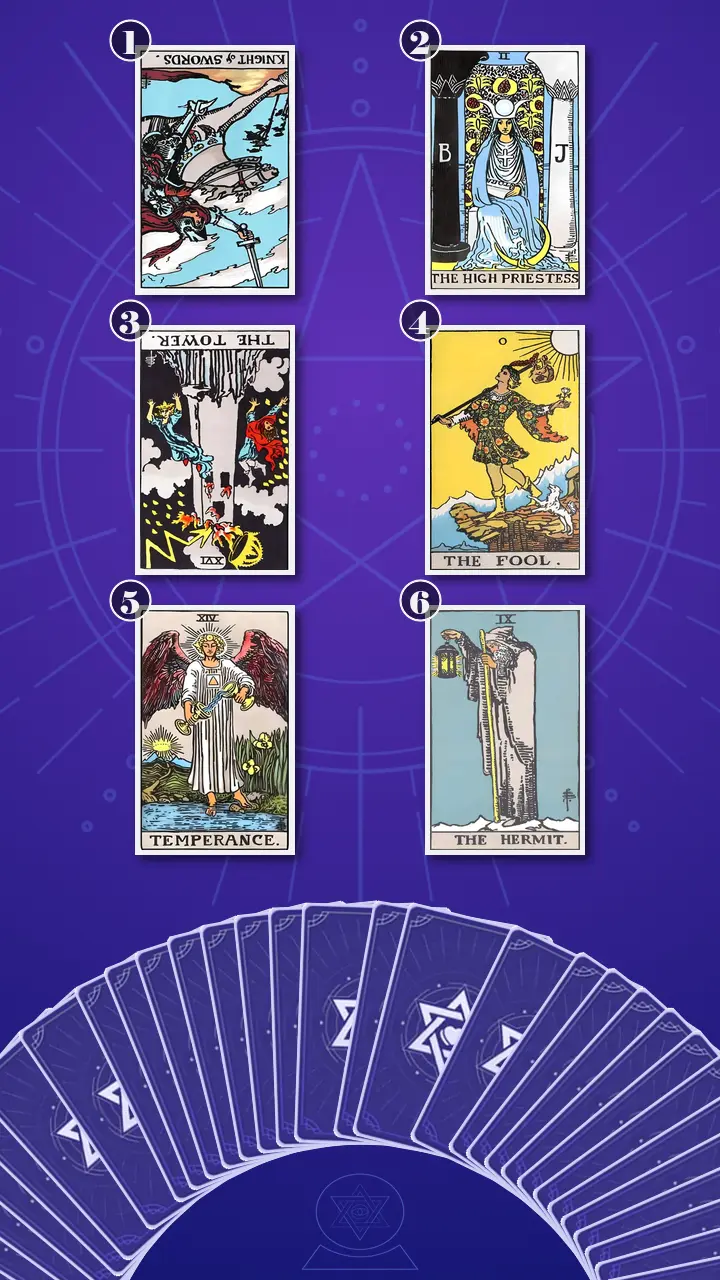
I chose the Transformation Path Grid (6) - Context Edition, a six-card tarot spread for reflecting on sudden life pivots. I use this kind of non-predictive tarot reading when the issue is a recurring loop rather than a single choice. A bigger spread could have invited unnecessary speculation about outcomes. A past-present-future spread could have made the pattern look like a timeline. Jordan did not need either. They needed to see the mechanism that kept repeating: unexpected change, immediate speed, a skipped inner signal, then a new surge of urgency.
I laid the cards in a two-column, three-row grid, like a small staircase crossing a threshold. The first pair would show the visible rush and the signal being bypassed. The middle pair would reveal the fear below the rush and the opening available at the pivot itself. The final pair would give us a paced response and an integrated perspective. It was a map for how tarot works in context: not a verdict from outside Jordan's life, but a structured way to examine the choices already taking shape within it.
Reading the Rush Before It Becomes a Plan
The Charging Horse in the Inbox
I turned over the card representing the presenting pattern: Knight of Swords, reversed.
The raised sword, charging horse, and wind-bent trees gave the room an immediate visual language for Jordan's momentum. In reverse, this was blocked and overdriven Air: thought becoming speed, then speed being mistaken for orientation. It was the 4:52 p.m. Slack message becoming a rapid timeline rebuild, the decisive email standing in for a settled decision, and the belief that another tab could stop uncertainty from catching up.
"Reply now. Make it clear. Fix the next thing." I repeated the fragments Jordan had used to describe a recent Sunday night, when blue phone light caught the edge of their duvet and their thumb hovered over an email. The message they sent was clean and competent. What it did not give them was a sense of direction. Movement had happened; discernment had not.
Jordan let out a short laugh that carried more wear than humor. "That is so accurate it is almost rude." Their fingers tightened around the paper cup beside them, then loosened as they looked down at the horse. "I always call it being adaptable."
"Adaptability is useful," I said. "This card is not calling you reckless or incapable. It is showing the cost of using speed as the only proof that you are capable. A pause is different from paralysis. The question is whether your first action is helping you learn something, or helping you avoid the first feeling."
When the High Priestess Closed the Tabs
The Signal Behind the Veil
The room seemed quieter when I turned over the next card, the bridge of the whole reading. I said, "Now I am turning over the card representing the bypassed signal: The High Priestess, upright."
She sat between her black and white pillars with the veiled curtain behind her, a scroll resting in her hands and a crescent moon at her feet. Where the Knight charged through turbulent air, the High Priestess held stillness without trying to fill it. Her energy was receptive and balanced, but it had been given almost no room in Jordan's process.
I took Jordan back to the train. I described the browser tabs closing one by one until only the warm phone screen and the dark carriage window remained. In that small interval, before replacement roles and salary comparisons, a sentence had appeared: I might be relieved this direction is ending.
"That is not a command to quit," I told them. "It is not a prediction, and it is not a new task for you to optimize. It is information that research cannot produce. The veil here is like putting a phone on Do Not Disturb. It is not disappearance. It is a short boundary between a public response and a private knowing."
My years on Wall Street taught me to look at choices through asymmetric risk-benefit analysis. I brought that same lens to this card. For a message without a genuine deadline, the downside of a ten- or thirty-minute pause is usually limited. The upside can be substantial: Jordan might notice grief, relief, dread, anger, or curiosity before committing to a route that ignores it. The pause was not sentimental indulgence. It was a low-cost way to access high-value information.
Jordan's usual mental loop had been simple and punishing: if they did not produce a complete plan, they would fall behind; if they fell behind, they would lose control; therefore, planning had to come first. I asked them to picture the train again, the changed message open, their thumb already moving toward the next solution. For one beat, I asked, what had appeared before the solution?
You do not regain control by outrunning the unknown; you regain discernment by listening behind the veil before you move.
Jordan did not answer at once. First, their inhale stopped high in their chest, and the hand nearest their phone went completely still. Then their eyes drifted past the cards, not away from the conversation but into it, as though they were replaying a message they had sent too quickly. Their pupils widened slightly. The line about relief seemed to land with a sting; their mouth pressed into a narrow line, then softened. Finally, a long breath left them, shaky at the end, and their shoulders lowered by an inch.
"I thought if I admitted I was relieved, it would mean I had wasted time," they said. Their voice was quieter now. "Or that I had been bad at wanting the right thing."
I let the silence hold. Through the window, a streetcar bell cut cleanly through the late-afternoon traffic, a small sound that felt sharper than the room had been a moment earlier. "Relief does not prosecute your past self," I said. "It simply tells your present self something. The pause is not wasted time. It is where the missing information gets a name."
I invited them to try the new perspective against real life. "Now, with this lens, think back over last week. Was there a moment when listening behind the veil could have made you feel differently before you acted?"
Jordan looked at the card again. "The role-change email. I knew I wanted to ask whether the new responsibilities would actually suit me. But I immediately volunteered to make the transition plan."
That was the first real crossing in the reading: not from urgency to perfect calm, but from urgency-driven control seeking to the beginning of grounded discernment and self-trust. Jordan felt the relief of having a name for the pattern, and the slight dizziness that can follow when a familiar strategy no longer has to run the whole room.
The Crown Jordan Kept Holding Up
I turned to the card representing the underlying fear: The Tower, reversed.
Lightning struck the tower; a crown fell from its top; figures dropped through flame and broken masonry. Reversed, I read this as an inwardly managed fear of upheaval, not a prediction of disaster. The card was asking what Jordan believed would collapse if they stopped making every pivot manageable on sight.
I saw the Saturday-morning kitchen scene they had described: cooling coffee beside an open project-reorganization email, a cleared counter, a fresh Notion board, possible outcomes sorted into neat columns while the kettle clicked off and shallow breathing stayed in the room. Reorganizing the board was easier than naming the loss. The falling crown was the polished identity of being the person who always knew what to do.
"A plan can organize the situation without telling you what the situation means," I said.
I had watched similar logic distort decisions in finance. An investment of time, effort, or reputation can become emotionally expensive enough that people mistake protecting it for evaluating the next move. I call the correction Sunk Cost Neutralization: separating what has already been spent from the opportunity in front of you. For Jordan, the question was not whether the old direction had been worth caring about. It was whether loyalty to the old plan was being asked to decide the new one.
Jordan rubbed their thumb along the cup seam. "If I slow down, I might have to admit that the version of me who could handle everything was not actually handling it."
"Or," I said, "you might discover that capability includes noticing when the structure has changed. You do not need to tear down a workable plan to prove you are present. You only need to stop pretending that a changed structure is unchanged."
The First Turn Is Not the Whole Route
I turned over the card representing the pivot threshold: The Fool, upright.
The Fool stood at the cliff edge with a small bundle, a white rose, an alert dog, and clear sky ahead. This was open Air rather than the Knight's frantic Air. Its energy was available curiosity, not a demand to leap blindly. The pivot did not require Jordan to choose a five-year identity before dinner. It invited one conscious experiment under incomplete information.
"This is one exploratory coffee chat, one application draft, one walk through a possible neighborhood, or one journal page," I explained. "The useful question is not, 'Can I guarantee this?' It is, 'What can this first step teach me?'"
Jordan gave a small, uncertain nod. Their body had not fully relaxed, but the restless bounce in one knee had slowed. "A reversible beta test," they said. "I can understand that. I just keep trying to launch a whole new version of my life overnight."
"Exactly," I said. "You do not need a full route to take one honest, reversible step."
Temperance and the One-Task Response
I turned over the card representing the grounded response: Temperance, upright.
The angel poured steadily between two cups, one foot in water and one on land, with a path leading toward distant mountains. This was balanced energy. Temperance did not ask Jordan to stop being practical; it asked them to stop using practicality to silence every feeling. The two cups became emotional truth and logistical response. Water and ground were allowed to exist in the same decision.
"This card offers a two-part response," I told them. "First, name what the change feels like. Then assign one practical task that matches the amount of information you actually have. Not the entire replacement plan tonight. One task tomorrow."
Jordan breathed out through their nose, almost amused. "That sounds so obvious when you say it. But I make the task list because I am scared the feeling will take over if I let it in."
"The feeling is not being hired to run the project," I said. "It is one input. Temperance is the practice of letting it be an input before you approve the plan."
A Lantern Before the Loudest Voice
I turned over the final card, representing the integrated perspective: The Hermit, upright.
The Hermit stood on a mountain path with a staff for support and a lantern containing a small star. This was grounded Earth: deliberate, private, and sufficient. The lantern did not light the entire city. It gave enough visibility for the next step.
I connected it to a phone-free walk through a Toronto neighborhood after work, or a short reflection written before LinkedIn updates and Instagram Stories could tell Jordan how clean everyone else's next chapter looked. The card's energy was not isolation. It was self-guidance: developing a private point of reference before asking the outside world to confirm it.
"When the notifications, comparison posts, and other people's finished-looking plans go quiet for a few minutes," I said, "what remains true enough to guide one next step? That is the Hermit's lantern."
Jordan looked from the High Priestess to the Hermit. "I do not need the whole map before I move," they said slowly. "I need one sentence that is mine before I borrow everyone else's directions."
I nodded. The spread had moved from the Knight's overloaded motion, through the High Priestess's quiet attention and the Tower's feared revelation, into the Fool's openness, Temperance's measured practice, and the Hermit's self-held light. Jordan did not need to become less responsive to life. They needed to become more present inside their response.
From Panic Planning to a Proportionate Next Step
I gathered the six cards into one clear story. When a sudden change arrived, Jordan's reversed Knight of Swords tried to secure safety through immediate activity. The High Priestess showed the private signal being passed over. The reversed Tower named the deeper fear: that pausing might expose a changed identity, an ending, or a loss of control. The Fool made room for a small experiment, Temperance gave feeling and logistics equal seats at the table, and the Hermit showed how self-trust could be carried under incomplete information.
The cognitive blind spot was not that Jordan planned too much in some moral sense. It was the false equation that activity equals control, while a pause equals failure. The transformation direction was more practical: treat a pivot as a threshold rather than an emergency. Name what is known, what is felt, and what still needs to be learned. Then choose a response proportionate to that information.
I offered Jordan three small practices. None required a grand declaration, and none was a rule. They were experiments designed to make room for the information urgency had been covering up.
- The 30-Minute Pivot Pause When a non-urgent pivot-related Slack message, email, housing note, or difficult text arrives, Jordan can draft the reply without sending it, set a 30-minute timer, and open a Notes page with three headings: Known, Feeling, Need to Learn. One plain sentence under each heading is enough. After the timer, they can choose only one practical task for the following day, such as checking one deadline or asking one clarifying question. Keep the draft open and use a calendar timer. For a real deadline, use a 90-second version. This is not for safety-critical, medical, contractual, or legally time-sensitive communication.
- The High Priestess Ten Minutes Once this week, after work and before social media, Jordan can put their phone on Do Not Disturb for ten minutes and complete this sentence once: "Before I make this manageable, the part I do not want to admit is..." Then they can label the body response with one ordinary word: relief, grief, dread, anger, or curiosity. Cap the practice at ten minutes. No research, no posting, and no obligation to act on the sentence. If it feels too activating, Jordan can stop after one factual observation and return to an ordinary task.
- The 3rd-Option Leverage Test Over 72 hours, Jordan can write the two apparent extremes of a pivot, such as "stay and force it" or "leave immediately," then map one third path that protects learning and reversibility: an informational call, a revised role conversation, a one-week trial, or a single application draft. The question is what this action will help them learn, not what it will prove. I use this test when Option A and Option B look like zero-sum dead ends. Define success as one new piece of information, and leave irreversible announcements for a calmer day whenever possible.
The third option mattered because panic planning often makes a false binary feel urgent: act now or lose everything; preserve the old direction or burn it down. The 3rd-Option Leverage Test gave Jordan another kind of leverage. It did not remove uncertainty. It made room for a response that was both emotionally honest and commercially sensible.

A Week Later, the Quiet Proof
Seven days later, my phone lit up with a message from Jordan: "I left the role-change reply in draft, walked one block without my phone, and wrote that I was relieved. I still woke up wondering if I was wrong, but I did not rebuild my whole life before breakfast."
I read it as the kind of proof that matters: not a solved future, not a personality transplant, and not certainty masquerading as confidence. Jordan had made space for the first honest sentence, asked one clarifying question at work, and allowed the next step to remain revisable. The Tower had not swallowed them. The lantern was small, but it was theirs.
I had watched Jordan's Journey to Clarity move from urgency toward discernment: from trying to outrun every pivot to carrying a private point of reference through it. Tarot had not made the choice for them. It had made their own information easier to hear.
When a sudden pivot tightens your jaw and sends your hands toward a plan, I hope you remember that the part of you still moving may be trying to protect you from discovering how little control you felt. You can move forward without outrunning the part of you that knows the change mattered.
In your next small pivot, if your first response were "I need a minute to know what this means" instead of a complete plan, what might you notice before you decide?