Old Friends and the 11:47 p.m. Rescue Reflex
I knew the pattern before Maya finished explaining it. She worked in customer success, where noticing trouble early and closing every open loop made her excellent at her job. Then an old university friend posted a late-night moving crisis, the group chat went quiet, and Maya began building a solution before checking her own calendar. Her question to me was painfully direct: “Why do I become everyone’s rescuer around old friends again?”
I asked her to take me back to the previous night. At 11:47 p.m., she had been sitting on the edge of her bed in her Toronto apartment, switching between a removal-company search, Google Calendar, and her friend’s voice note. The phone had grown warm in her palm. The radiator clicked behind her while four browser tabs threw cold white light across the room, and her jaw tightened as she offered away Saturday without checking what she had already planned.
“The second they tell me something is wrong, I’m already making a plan,” she said. “I don’t know how to care a normal amount.”
I could hear the contradiction beneath the joke. Maya wanted to return to these friendships as an equal, but part of her feared that if she stopped being the reliable one, she might become merely someone they used to know. The feeling worked like a smoke alarm wired directly to the group chat: another person’s distress sounded in her body as an instruction to move. Her shoulders rose, her attention narrowed, and ordinary limits suddenly felt like evidence of disloyalty.
On our video call, I watched her place the phone face down and then touch it again a few seconds later, as if an unresolved message might escape. I told her, “I’m not going to use tarot to decide whether your friends deserve you or predict which friendships will last. I want us to separate what was said, what you assumed, and what you chose. Let’s give this fog a map.”

Choosing the Bridge: A Five-Card Relationship Spread
I invited Maya to put both feet on the floor and take one unforced breath. I shuffled slowly while she held the question in mind. I do not treat this pause as a mystical performance. It is a practical transition from reacting inside a problem to observing its structure.
For anyone wondering how tarot works with friendship boundaries and emotional labor, I use the cards as structured psychological mirrors. Through a Jungian lens, an image can make a subconscious role visible without declaring that the role is permanent or pathological. Card meanings in context give me a stable set of symbols; Maya’s real behavior, body signals, and choices determine how useful those symbols become.
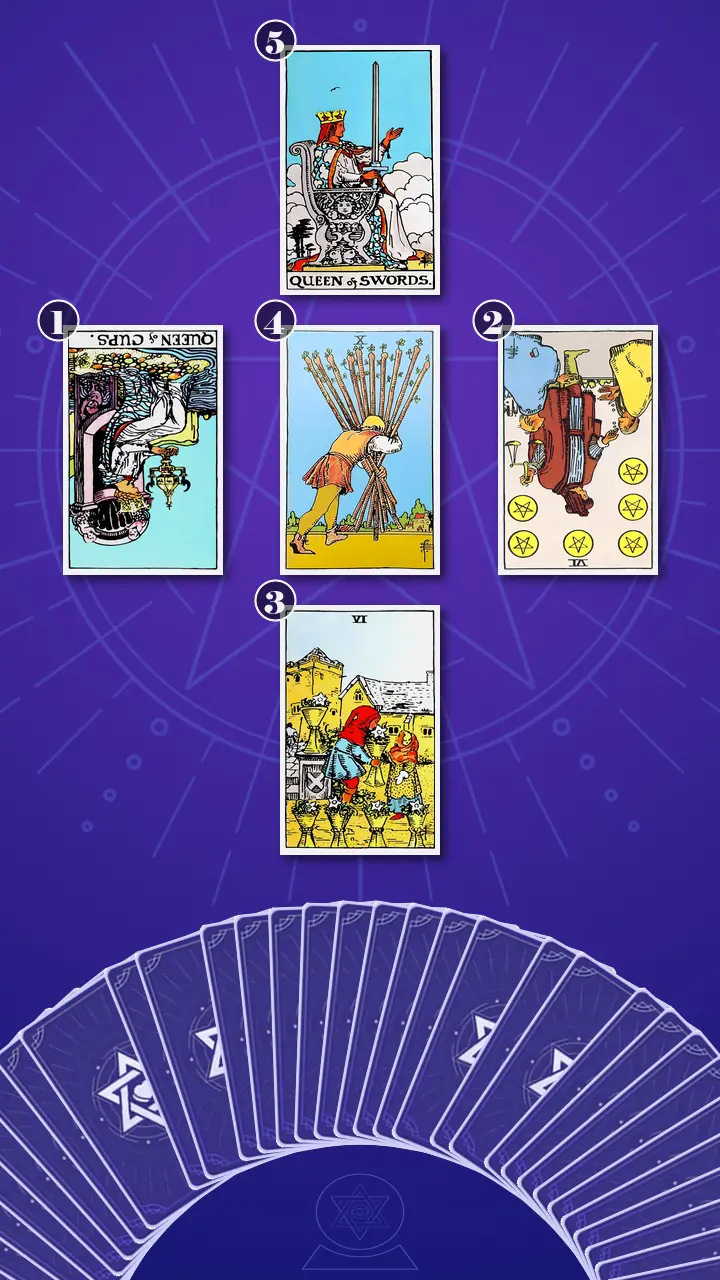
I chose a five-card Relationship Spread because Maya was not asking for a broad forecast. She wanted to understand why one particular role returned around old friends. A larger spread would have introduced future possibilities and outside influences that were not needed. This compact cross could distinguish Maya’s contribution, the cues she perceived from her friends, the shared history beneath the pattern, its present cost, and a constructive way forward.
I arranged the cards like a bridge. The first two would show Maya’s stance and the relational signals she translated into obligation. The card below them would reveal the historical foundation. At the center, I would examine the burden being created now. The card above would act as a signpost toward compassionate boundaries, without predicting what anyone else would do in response.
When Care Quietly Clocked In
Position One: The Cup That Became a Phone
“The card I’m turning now represents your present contribution to the dynamic,” I said, “especially the automatic emotional and practical behaviors through which you become the rescuer.” I revealed the Queen of Cups, reversed.
I pointed to the ornate lidded cup held close to the Queen and to her throne at the water’s edge. “This Queen is capable of sitting near deep feeling,” I explained. “Reversed, her Water is blocked because the container around empathy has become unreliable. She doesn’t merely witness another person’s emotion. She absorbs responsibility for changing it.”
In Maya’s life, that was the 11:47 p.m. voice note. Her phone became the Queen’s precious cup, holding someone else’s distress, but Maya also became the container, planner, researcher, and follow-up system before asking what support her friend wanted. I was careful to make the distinction clear: the card was not advising her to become cold. It was showing how emotional presence leaked into self-assigned labor.
I laid out the inner sequence I could hear in her story: “They’re struggling. I need to do something now. If I pause, I might look uncaring.” A friend’s disclosure had crossed an invisible line and become Maya’s private service ticket.
I call this lens Guilt-Trip Deconstruction. I do not begin by assuming that a friend is deliberately applying pressure. I separate the external trigger from the internal code: a friend expresses difficulty; Maya’s old belonging story translates hesitation into abandonment; guilt then pushes her to donate time, attention, and expertise. Once I made those three stages visible, the guilt stopped looking like a moral verdict and started looking like a pattern that could be interrupted.
Maya gave a small, bitter laugh. Her thumb stopped rubbing the edge of her phone, her eyes dropped to the card, and then she pressed her tongue against her cheek. “That’s so accurate it feels a little cruel,” she said.
“Then let’s keep the accuracy and remove the cruelty,” I replied. “Your sensitivity is real. The issue isn’t that you care too much as a person. It’s that your care is losing the moment in which you get to choose what it becomes.”
Position Two: The Scales No One Consulted
“Now I’m turning the card for the cues you perceive from old friends and the obligations you build from those cues,” I said. “This position does not claim to know anyone else’s private intentions.” The card was the Six of Pentacles, reversed.
The figure on the card held scales in one hand and distributed coins with the other. In Maya’s version, the scales were the capacity check she skipped. The coins were her evening, contacts, professional knowledge, rides, money, and Saturday. A vague message about feeling overwhelmed became an unspoken invitation to research removal companies, draft a packing schedule, and remain available until the problem felt resolved.
The reversed Earth energy showed a blockage in negotiated reciprocity. Maya’s generosity was real, but its scope remained unspoken. No one had assigned her the task, yet she acted as though her name were already attached to the open tab. Afterward, she watched the chat for a heart reaction, an update, or some sign that the effort had secured her place.
I slid the first two cards closer together. “The Queen receives the feeling. The Six converts it into labor. A friend’s distress is a signal, not an assignment.”
Maya inhaled and held the breath high in her chest. Her gaze moved as if she were rereading the previous night’s thread from memory. Then her fingers opened against her knee. “She didn’t actually ask me to find movers,” she said. “She said she didn’t know where to start.”
“Those two things can feel identical when you’re afraid that pausing will cost you closeness,” I said. “But one is what your friend said. The other is the job you created for yourself.”
I also warned her against turning the insight into private scorekeeping. Boundaries were not a test designed to expose who cared more. The purpose was to make requests, consent, capacity, and ownership visible enough that reciprocity could become a conversation rather than a silent accounting system.
Position Three: The Old Login That Still Autofilled
“The next card represents the historical foundation that makes the rescuer role feel familiar, especially the link between old friendship, usefulness, and belonging.” I placed the Six of Cups, upright, below the first pair.
I saw two scenes in its flower-filled cups. In the first, Maya and her friends were crowded around a university kitchen table, laughing over cheap takeaway while everyone’s lives still overlapped. Maya was the organized one who remembered deadlines, found the address, and stayed up when someone cried. In the second, the same names appeared in a present-day WhatsApp thread, but everyone now had separate jobs, rent payments, partners, budgets, and calendars.
The upright Water of the Six of Cups was tender and balanced enough to show that the affection was not fake. Nostalgia simply started the old emotional track before Maya checked whether today’s relationship needed the same arrangement. The card’s catalyst was recognition: the dependable identity was a familiar script, not an inevitable personality.
“Familiar is not the same as requested,” I said. “A shared memory can prove that care existed. It cannot act as an up-to-date contract for who handles today’s problem.”
Her face softened first. Then her fingertips tightened around her sleeve while her eyes drifted away from the spread. Finally, a long breath left her chest. “I loved being the one they could count on,” she said. “It made my place obvious. I don’t know what my place is now.”
I understood the grief inside that sentence. After years of travelling across cultures, I have learned that old roles can feel like a language we once spoke fluently. Letting go of one does not immediately give us a new vocabulary. “You don’t have to insult that earlier version of yourself,” I told her. “She found a workable way to belong. We’re only asking whether she still needs to run every present-day conversation.”
Position Four: Every Reasonable Yes in One Bundle
“The center card represents the current relational mechanism and its cost,” I said, “especially how unrequested responsibility accumulates into burden, resentment, and reduced choice.” I turned over the Ten of Wands, upright.
The figure bent beneath ten staffs, with the bundle blocking almost the entire road ahead. I asked Maya to name her own wands: a call, a spreadsheet, a ride, a deposit, a follow-up message, and a Saturday of physical help. Each yes had sounded manageable on its own. Together, they left no room for sleep, meal prep, newer friendships, rent planning, or a weekend without an assignment.
The Fire here had moved into excess. Action had multiplied beyond perspective. Maya was not carrying one dramatic burden; she was losing sight of her own life under a collection of small responsibilities she had never consciously agreed to hold as a set.
“It has the friendship energy of The Bear,” I said. “You can see every loose end in every station, so your body stays in service mode while everyone else’s problem becomes the next workflow. Competence keeps winning, but you never get to clock out.”
Maya looked at the bent figure and slowly lowered her shoulders. “Then I get resentful,” she said, almost whispering. “And because I volunteered, I decide the resentment means I’m selfish.”
“I hear resentment as delayed information,” I replied. “It may be telling you that your yes was larger than your capacity, not that your care was dishonest. The card is asking which responsibilities were requested, which were chosen, and which can be returned to the person whose life they concern.”
When the Open Hand Met the Upright Sword
Position Five: Warmth Without Takeover
The room became quiet enough for me to hear the soft mechanical hum beneath our call. I turned the final card, which represented the constructive boundary practice that could integrate care, reciprocity, and self-respect without predicting whether any particular friendship would continue. It was the Queen of Swords, upright.
I drew Maya’s attention to the vertical sword in the Queen’s right hand and the open left hand extended toward the relationship. “The open hand says, ‘I’m here.’ The sword says, ‘This part is not mine to carry.’ Upright Air brings balanced discernment: clear language, visible capacity, and enough separation for another adult to retain ownership of their choices.”
I translated the symbols into a text message: “I care about what’s happening, and I can listen for 20 minutes tonight, but I can’t organize the move.” There was no punishment in it, no dramatic withdrawal, and no three-paragraph apology. The message allowed tenderness and limitation to occupy the same screen.
Before going further, I used what I call Savior Complex Auditing. This is not a diagnosis or an accusation that generosity is secretly selfish. I audit the function of the rescue: Was help directly requested? Did personal capacity enter the decision? Was the action serving the friend’s stated need, or was it mainly reducing the rescuer’s discomfort with uncertainty? Would care still feel meaningful if the final decision and outcome remained with the other person?
The audit showed Maya the vulnerable reward beneath overfunctioning. Fixing gave her immediate relief, a defined role, and temporary protection from the question she feared most: “Would I still matter here if I were simply present?” Her care was genuine, but helpfulness had also become proof of belonging.
I took her back to 11:47 p.m.: the moving crisis on her phone, four tabs open, Saturday offered, and her own calendar untouched. I asked her to find the instant when caring had quietly become a job, and when being a good friend had become responsibility for the outcome.
You do not have to earn friendship by carrying every burden; name what you can offer and what you cannot, as the Queen's upright sword separates care from obligation.
I let the sentence remain between us. Maya’s inhale stopped first, and her fingers froze halfway toward the phone. Then her gaze lost focus, as if the university kitchen, the reunion dinners, and every late-night call were replaying on the far side of the screen. Her eyebrows pulled together. “But doesn’t that mean I’ve been doing friendship wrong this whole time?” she asked, her voice suddenly sharper. The anger arrived before the relief.
“No,” I said. “It means a strategy that once gave you security now costs more than you want to pay. We don’t need to put your past self on trial to give your present self a choice.” Her jaw trembled once. Her fist loosened against her knee, her shoulders descended, and her eyes turned bright. She released a breath that sounded relieved but slightly unsteady, like someone setting down a heavy bag and needing a moment to remember how to stand without it.
I asked, “Now, using this new perspective, can you think back to last week and find a moment when this insight could have made the experience feel different?”
Maya remembered a call that had run past midnight. Her friend had wanted to vent about work; Maya had spent the final hour proposing applications, contacts, and a resignation timeline. “I could have asked what she wanted before I became her career coach,” she said. “I could have listened and still gone to bed.”
That recognition was the first meaningful movement from guilt-driven usefulness and self-erasure to equal friendship with clear capacity and shared responsibility. It did not resolve the uncertainty of how every friend might respond. It gave Maya something more durable than certainty: the ability to notice the old script before acting it out.
The Request Before Rescue Protocol
I read the spread as one continuous story. The reversed Queen of Cups absorbed an emotional signal without a firm container. The reversed Six of Pentacles converted that signal into an unequal donation of time and labor. The Six of Cups showed why the exchange still felt loving and natural: it belonged to an earlier language of friendship. The Ten of Wands exposed the accumulated cost. Finally, the Queen of Swords offered the resource Maya had not yet been using consistently, which was direct language that could keep care open while assigning each burden to its actual owner.
The core conflict was not care versus selfishness. It was Maya’s desire to reconnect as an equal versus her fear that abandoning the rescuer role would weaken the bond. Her cognitive blind spot was treating the intensity of a friend’s feeling as evidence of a request, then treating her own competence as consent to take over. The transformation direction was specific: pause before solving and ask, “Do you want listening, ideas, or practical help?”
I shaped the next steps around the Compassionate Detachment Protocol. I explained that detachment did not mean emotional absence. It meant validating what a friend was experiencing, naming one honest capacity, and refusing to absorb ownership of the rest. The protocol gave Maya a sentence she could actually send: “That sounds like a lot. Do you want listening, ideas, or practical help? I can listen for 20 minutes tonight, but I can’t coordinate the next steps.”
- Run a ten-minute Request Before Rescue pause. When the next old-friend problem arrives in WhatsApp or iMessage, set a ten-minute timer before searching, calling, or volunteering. In Notes, write three lines: what the friend said, what they directly requested, and what you can realistically offer tonight. Then ask whether they want listening, ideas, or practical help. Keep the smallest version as the default. During the timer, notice one raised shoulder, tight jaw, or urge to refresh the chat and treat it as a cue to pause, not an instruction to act.
- Make one bounded support offer. Choose one form of help for one person this week, such as a 15-minute call after 7:30 or one moving-company link. State the end point before beginning: “I need to head off at 8:00, but I’m glad we can talk.” When the time ends, do not add a second resource unless the friend directly asks. Pick a limit that is honest rather than impressive. A short offer is not a hidden test of the friendship; it is accurate information about your capacity.
I told Maya to treat both actions as experiments, not moral exams. She could stop, postpone, listen longer by choice, or decide she did not have capacity that day. The aim was not a perfect boundary. It was to restore the missing moment between feeling another person’s distress and assuming responsibility for solving it.

A Message Without a Rescue Plan
Six days later, I received a message from Maya. Another old friend had sent a voice note about a breakup. Maya had felt her shoulders rise and opened a search tab for therapists before remembering the Queen’s sword. She closed the tab, waited ten minutes, and sent: “I care about you. Do you want listening, ideas, or practical help? I can talk for 15 minutes before bed.”
Maya told me the reply was, “Honestly, just listening.” They spoke for 15 minutes. Maya ended the call when she had said she would, made tea, and did not send a follow-up list. Nothing dramatic happened. That ordinariness was the proof.
She slept through the night, but her first morning thought was still, “What if I should have done more?” This time she smiled, noticed the question, and left the phone on the table.
I did not see that week as evidence that every old friendship had been repaired. I saw a smaller and more credible change: Maya had entered one conversation as a participant rather than an emergency service. The five-card Relationship Spread had given her an external map of emotional permeability, unequal giving, nostalgia, burden, and discernment. The cards did not set the boundary for her. Maya noticed the reflex, chose her words, and kept ownership of her time.
For me, that is the heart of a Journey to Clarity. Clarity is not always the disappearance of doubt. Sometimes it is the moment when an old friend’s name lights up the phone, the shoulders begin to rise, and a person finally recognizes that becoming indispensable has felt safer than discovering whether they are still wanted as an equal.
If that support-staff shift begins in your body before you have even opened the chat, what small amount of time, attention, or honesty could your open hand offer, and what part of the outcome could the Queen’s upright sword leave with the person whose life it is?
This story is adapted from psychological research, written so that those in a similar struggle can see their own pattern in it — and find their next step clearly.These insights are not a substitute for professional psychological, medical, legal, or financial advice.
Learn more about our Journey to Clarity.
How did this insight land for you?
🫂 This Resonates Deeply
🌀 Living This Story
✨ Now I See Clearly
🌱 Seeing New Possibilities
🧰 Useful Framework
🔮 The Confirmation I Needed
💪 Feeling Empowered
🚀 Ready for My Next Step
Author Profile
 AI
AI“Having traveled across cultures... I've learned that what we often lack isn't a simple answer, but a moment of being truly understood. I use a Jungian psychological lens to help you deconstruct your subconscious patterns—not to prove anything, but to be the gentle companion who helps you unravel your knots, free of judgment, so you can reconnect with your inner wisdom.”
In this Friendship Tarot Reading :
Core Expertise
- Guilt-Trip Deconstruction: Uncovering the subconscious codependency that forces you to act as an unpaid 'emotional dumping ground' for friends.
- Savior Complex Auditing: Identifying whether your inability to set boundaries stems from a deeply ingrained psychological need to 'fix' others.
Service Features
- The Compassionate Detachment Protocol: A psychological boundary script to validate a friend's emotions while firmly refusing to absorb their psychological toxic waste.
Also specializes in :
Explore Related Patterns:
Emotional Hyper-ResponsibilityMaya heard that her friend did not know where to start and experienced the message as an instruction to search for movers, draft a plan, and remain involved until the situation felt resolved. Her raised shoulders, tight jaw, and narrowed attention show how quickly another person's distress becomes a demand inside her, even when no external demand has been made. You enter emotional hyper-responsibility when empathy becomes evidence that you must regulate the situation, reduce the uncertainty, or secure the outcome for someone else. The mechanism does not make your care insincere; it makes responsibility expand faster than consent. Separating what was disclosed from what was requested allows you to remain emotionally present without treating another adult's difficulty as your private service ticket.
Friendship Role RegressionAt the university kitchen table, Maya was the friend who remembered deadlines, found the address, and stayed up when someone cried. Years later, the same names appearing in a WhatsApp thread restarted that arrangement before she checked whether today's friendship, request, or capacity still matched it. The familiar social setting effectively autofilled an earlier version of her. You may regress into an old friendship role when a historically successful way of belonging activates faster than your present-day judgment. The earlier role was not fake or wrong; it once gave you connection and a clear place in the group. The problem emerges when shared history begins operating like a current contract, causing you to repeat old responsibilities instead of negotiating how two independent adults want to relate now.
Guilt-Driven People-PleasingMaya offered away Saturday before checking her calendar because pausing felt as though it might make her look uncaring. A friend's difficulty triggered an internal sequence in which hesitation meant disloyalty, guilt demanded action, and action expanded into time, research, contacts, money, and follow-up. Her yes was therefore shaped before her actual capacity entered the decision. You are caught in guilt-driven people-pleasing when guilt functions as an enforcement system rather than useful moral information. It pressures you to prove care through compliance even when no one has made a direct request. Once you identify that sequence, a limit no longer has to stand for rejection: it can become accurate information about what you freely choose to offer.
Rescuer IdentityAt 11:47 p.m., Maya had four problem-solving tabs open and had already offered Saturday before checking her calendar, even though her friend had not asked her to organize the move. The same shift happened when a late-night venting call turned into unsolicited applications, contacts, and a resignation timeline. These actions give her an immediate, defined position whenever a friendship feels uncertain: she becomes the person who knows what to do. You may recognize this pattern when helping stops being one choice you can make and becomes the role through which you verify that you still matter. The rescue provides short-term relief from the harder question of whether connection can survive without your usefulness. Naming the role creates a new point of choice: you can offer care as a participant without making indispensability the price of belonging.
Conditional Self-WorthMaya said that being the dependable friend made her place obvious, then admitted that she did not know what her place would be without that function. After giving help, she watched the chat for a reaction or update that might confirm the effort had preserved her importance. The practical labor was doing two jobs at once: addressing a problem and testing whether she still belonged. You experience conditional self-worth when your value in a relationship feels dependent on what you can organize, fix, or carry. This makes ordinary presence feel insufficient and turns usefulness into proof of relational legitimacy. The pattern becomes easier to interrupt when you notice that the question beneath the task is not only, 'How can I help?' but also, 'Would I still matter if I did less?'
People-Pleasing Resentment CycleMaya's separate offers of a call, spreadsheet, ride, deposit, follow-up, and Saturday help each sounded reasonable, but together they crowded out sleep, meals, newer friendships, and time without an assignment. When resentment appeared, she treated it as evidence that she was selfish because she had technically volunteered. That judgment concealed the earlier moment when guilt had made her consent larger than her capacity. You enter a people-pleasing resentment cycle when an automatic yes suppresses boundary information, resentment returns that information later, and shame then attacks you for receiving it. The shame can push you back toward more giving in order to repair your self-image, restarting the loop. Treating resentment as delayed data about consent and capacity allows you to examine the original yes instead of putting your character on trial.
Self-AbandonmentMaya offered Saturday while her own calendar remained unchecked, then accumulated responsibilities that displaced sleep, meal preparation, newer friendships, financial planning, and an unassigned weekend. Her attention included the friend's distress, possible solutions, and signs of appreciation, but excluded the ordinary facts of her own life from the decision. You move into self-abandonment when preserving connection requires your needs, plans, and limits to disappear from your internal field of view. This is more than generosity because your own perspective is not allowed to participate in consent. Restoring that perspective does not require becoming less caring; it means letting your time and capacity count as real information before help is offered.
Mind ReadingMaya's friend said she did not know where to start, but Maya heard an assignment to find movers and coordinate the next steps. She also predicted that pausing would look uncaring and that giving up the reliable role might cost her closeness, although the story contains no direct statement from her friends imposing either condition. You engage in mind reading when ambiguity is filled with an untested prediction about what another person expects or how they will judge you. In this case, the prediction is especially persuasive because it matches an old belonging fear. Asking what kind of support is wanted replaces an imagined relational verdict with observable information, allowing your response to be based on consent rather than anticipated rejection.
Boundary DiscernmentSix days later, Maya noticed her shoulders rise, closed the therapist search tab, and asked whether her friend wanted listening, ideas, or practical help. She offered a 15-minute call, ended it when promised, and did not send an unsolicited follow-up list. Care remained available, but its form, duration, and ownership became explicit. You practise boundary discernment when you distinguish emotional presence from responsibility for another person's decisions and outcomes. The boundary is not a punishment or a test of whether the friendship is real; it is an accurate statement of capacity. This lets warmth and limitation occupy the same conversation, creating the conditions for support to be chosen and reciprocal rather than silently assigned.
Cognitive DissonanceMaya wanted to return to her old friendships as an equal, yet she feared that stopping the rescue work might weaken those same bonds. She also believed her care was genuine while recognizing that usefulness had become proof of belonging. When resentment followed an oversized voluntary commitment, she tried to resolve the conflict by calling herself selfish rather than questioning the rule that a good friend must keep carrying. You experience cognitive dissonance when two important beliefs cannot comfortably coexist: 'I want equal friendship' and 'I may need to be indispensable to remain close.' Immediate rescue reduces that tension for a moment because it confirms the familiar identity, but the cost reappears as resentment and doubt. Holding both beliefs in view lets you audit the rule itself instead of repeatedly using overwork to silence the contradiction.
Explore Related Struggles:
Competence-Obligation FusionMaya brings her customer-success reflex into the group chat: a moving concern becomes removal-company research, a work vent becomes an application strategy, and a breakup voice note opens a therapist search. Her ability to see the next practical step keeps moving ahead of the question of whether that step belongs to her. When knowing how becomes evidence that you should take over, competence stops feeling like a resource you can choose to offer. It begins to function as an assignment. You remain highly effective while losing the moment in which you could separate what you are capable of doing from what the relationship has actually asked you to carry.
False Responsibility LoopMaya is not asked to find movers, design a packing schedule, become a career coach, or search for therapists. Each responsibility appears after she translates another person's difficulty into a private service ticket, and the same translation repeats across different conversations. You can then become accountable for outcomes you neither caused nor agreed to manage. Taking ownership briefly removes uncertainty because there is finally something concrete to do, but the relief is followed by burden and resentment. The loop stays closed until a disclosure can remain someone else's experience without automatically becoming your project.
Guilt-Evidence FusionMaya hears a clear internal verdict before she has made a decision: if she pauses, she may look uncaring; if she sets an ordinary limit, she may be disloyal; if she later resents what she volunteered to do, she may be selfish. Guilt is repeatedly treated as confirmation that the boundary itself would be wrong. When guilt functions as evidence, you lose access to more accurate information about requests, consent, and capacity. The feeling does not merely accompany the choice; it appears to decide the moral meaning of the choice in advance. That structure keeps you rescuing because discomfort is mistaken for proof that saying less would make your care less real.
Nostalgic Belonging LockThe names in Maya's WhatsApp thread belong to the same people who once crowded around a university kitchen table while she remembered deadlines, found addresses, and stayed up when someone cried. The affection is still genuine, but recognition starts the old arrangement before anyone checks whether it fits their separate adult lives now. An old friendship role can feel like continuity itself. You may keep fulfilling a past contract because changing your role seems to threaten the history that made the bond meaningful. The lock forms when memory is allowed to define today's place for you, leaving little room to discover how the friendship might hold you in the present.
Utility-Belonging FusionAt 11:47 p.m., Maya offers away Saturday before checking her calendar because solving an old friend's moving problem gives her an immediate, recognizable place in the relationship. She wants to return as an equal, yet being merely present leaves her facing the question of whether she still matters without a service to provide. When usefulness becomes proof of belonging, you are not simply choosing how much help to offer. You are also testing whether the connection can hold when you are not indispensable. The resulting bind makes practical rescue feel safer than discovering whether warmth, history, and ordinary presence are enough to keep the friendship real.
Self-Erasure ReliabilityMaya's call, spreadsheet, ride, deposit, follow-up message, and Saturday each look reasonable in isolation. Together, they remove sleep, meal preparation, rent planning, newer friendships, and the possibility of a weekend that belongs to her. Even a late-night conversation keeps expanding because ending it would interrupt the dependable role she has promised without speaking. Reliability becomes self-erasing when you remain clearly available to everyone except yourself. Other people can see the help, while your own calendar and recovery needs disappear from the decision. The deeper cost is reduced authorship: your life is repeatedly organized around proving that you can be counted on before you are allowed to ask what you actually have to give.
Explore Related Emotions:
Boundary GuiltAt 11:47 p.m., you offer Saturday and start finding movers before checking your own calendar. A pause is silently translated into disloyalty, so the limit arrives carrying the weight of a verdict about who you are as a friend. Boundary Guilt captures the pressure that makes an unrequested task feel morally necessary. Once what was said, what you assumed, and what you chose can be separated, the limit becomes information about capacity rather than a judgment on care.
Nostalgia Loop AnxietyAn old friend's name enters the WhatsApp thread, and the old login seems to autofill before you have checked what this present-day relationship is asking for. The university version of friendship returns with its familiar division of roles, even though everyone's current life now has separate schedules, budgets, and responsibilities. Nostalgia Loop Anxiety describes the unease of being pulled into a remembered arrangement before a current one has been negotiated. The history can remain meaningful without automatically becoming a contract for who handles the next problem.
Usefulness-Based Belonging FearAt the university kitchen table, being the organized one made your place obvious, and the same dependable role reappears when an old friend's crisis enters the present-day chat. You can feel the relationship narrowing around what you can arrange, remember, and carry, so stepping back begins to resemble disappearing from the friendship. Usefulness-Based Belonging Fear names the pressure beneath the rescue, the worry that simple presence will not be enough to keep you included. Seeing the association between usefulness and belonging gives you a way to inspect the role before you volunteer for it.
Relational UrgencyThe moment an old friend's voice note describes a problem, your shoulders rise and your attention narrows toward the next task. The warm phone, the open tabs, and the return of your hand to the screen show how quickly another person's situation becomes something that must be acted on immediately. Relational Urgency names that felt acceleration before any request has been clarified. It gives you a precise place to pause, between registering another person's distress and treating the first impulse to solve as an obligation.
Grounded AgencySix days later, you notice your shoulders rise, close the search tab, wait ten minutes, and ask whether your friend wants listening, ideas, or practical help. You choose a 15-minute call and keep the end point you named, allowing support to remain deliberate rather than automatic. Grounded Agency is the felt experience of having a choice inside the familiar reflex. You do not need certainty about how every friend will respond before deciding what you can offer and returning the rest of the outcome to the person whose life it concerns.
Quiet Self-RespectWhen your friend says she only wants listening, you speak for 15 minutes, end the call when you said you would, make tea, and do not send a second list of solutions. The ordinary shape of the evening gives your own time a place alongside the friendship. Quiet Self-Respect names the steadiness of letting a small, honest offer be enough. Leaving the phone on the table is not withdrawal from the relationship; it is a decision that your night does not need to remain open until every uncertainty has been handled.
Resentful ExhaustionA call, a spreadsheet, a ride, a deposit, a follow-up message, and a Saturday of physical help each sound manageable when considered alone. Together they occupy the space meant for sleep, meal prep, rent planning, newer friendships, and a weekend without an assignment. Resentful Exhaustion appears when your yes has grown beyond the capacity you actually had, then turns back on you as a judgment because you volunteered. The resentment carries delayed information about the size of the commitment, not proof that your concern for the friend was false.
Self-Betrayal AcheYour own calendar remains untouched while you search for movers, draft a schedule, and offer Saturday. Before your friend has asked for a specific kind of help, your plans have already been removed from the decision. Self-Betrayal Ache names the painful recognition that another person's urgency has been allowed to speak over your own capacity. The useful question is not whether you should care, but which part of your time and attention you are choosing to offer before you give it away.
Mutuality HungerYou say that you want to return to these friendships as an equal, yet the old exchange keeps positioning you as the person who notices every loose end and closes it. The wish for something more mutual is visible in your insistence that affection can remain real while a limit stays on the screen. Mutuality Hunger names the desire for closeness that does not depend on one person becoming the support system. It gives the relationship a constructive direction, where listening, practical help, and ownership can be shared instead of silently assigned.
Cautious Self-TrustYou treat the ten-minute pause and the bounded support offer as experiments instead of moral exams. When you remember that you could listen without becoming your friend's career coach, the old script becomes something you can notice rather than something you must obey. Cautious Self-Trust grows through that small sequence of noticing, choosing, and observing. It does not require you to know whether the friendship will change, only to trust that you can remain present while deciding what belongs to you.
Explore Related Contexts:
Emotional Labor ImbalanceThe 11:47 p.m. voice note occupies Maya's attention long after the message itself has been received. She researches, plans, monitors the chat for an update, and remains mentally attached to whether the problem is moving toward resolution. Another friend's work vent continues past midnight and expands into an hour of career strategy. The unequal load includes more than visible errands. Maya also carries the interpretation of the disclosure, the pressure to formulate a response, the tracking of loose ends, and the expectation that she should remain available until the situation feels contained. Because the scope is never jointly set, the friendship draws on her attention without a shared definition of completion. You may recognise this imbalance when listening quietly becomes responsibility for managing another person's uncertainty. Naming the invisible forms of labor lets you assess the actual size of what entered the relationship and where ownership currently sits.
Fixer Friend DynamicMaya opens removal-company tabs and offers away Saturday before checking her calendar or confirming that practical help was requested. A work vent later becomes applications, contacts, and a resignation timeline, while a breakup voice note prompts an immediate therapist search. These separate episodes show a recurring social role, not an isolated generous gesture. The dynamic converts another person's difficulty into an open task carrying Maya's name. Her competence supplies the planning infrastructure, and usefulness gives her a recognisable position among friends whose adult lives no longer overlap as they did at university. The result is a friendship structure in which care repeatedly arrives as unpaid coordination and responsibility for the outcome. You may recognise this stage when your first response to disclosure is operational ownership. Mapping the exact handoff from message to self-assigned job makes the role visible enough for you to decide what form of participation actually belongs to you.
Friendship Boundary CreepMaya offers Saturday before checking what is already on her calendar. The initial moving disclosure then grows into company research, a packing schedule, possible rides, a deposit, follow-up messages, and physical help. No single addition appears dramatic, yet the complete bundle reaches far beyond the original conversation. The boundary moves through accumulation. A message gains access to the evening, a vague need becomes a project, and each manageable contribution creates the conditions for another. Without an agreed scope or endpoint, the friendship gradually occupies time and practical responsibility that Maya did not evaluate as a whole. You can spot this form of creep by examining the full bundle attached to one disclosure. That wider view makes it possible to see where contact became access, where support became ownership, and which commitments were never consciously established.
Old Friend Role Lock-InAt university, Maya remembered deadlines, found addresses, and stayed up when someone cried. That role made her place in the group obvious. Years later, the same names appear in WhatsApp, while everyone now has separate jobs, partners, rent payments, budgets, and calendars. Shared history gives the present friendship a familiar role map even though its practical conditions have changed. When an old friend reports a problem, Maya can immediately recover her former social position by becoming the dependable organiser. The role offers continuity, but it also keeps present-day contact tied to a division of responsibility formed during a different life stage. You can encounter this lock-in when an older version of a relationship supplies the only available script for reconnecting. Identifying the historical role allows you to examine what the friendship currently requests and what is simply being carried forward through familiarity.
Capacity-First ReliabilityBefore offering help with the breakup, Maya closes the search tab, waits ten minutes, and checks what her friend actually wants. She names 15 minutes of listening as the resource available that evening, keeps the appointment, and ends when she said she would. Reliability is being organised around accurate capacity. The offer has a defined form, a realistic size, and an observable endpoint, which allows both people to understand what support is available. Maya remains dependable through a commitment she can fully deliver while her personal time remains represented in the exchange. You can use this context to distinguish reliability from permanent access. A capacity-first offer gives your relationships truthful information, turns support into something mutually legible, and allows your commitments to remain credible across repeated contact.
Friendship Boundary ResetSix days later, Maya receives a breakup voice note, closes the therapist search tab, waits ten minutes, and asks whether her friend wants listening, ideas, or practical help. Her friend chooses listening. Maya offers 15 minutes, finishes the call at the stated time, and sends no follow-up resource list. The friendship now contains explicit information about support type, capacity, and ownership. Maya's limit is visible before the conversation begins, and the other person retains control of the breakup and its next steps. The reset is grounded in one ordinary interaction, so it represents an active transition rather than a settled relationship rule. You may recognise this stage when an old friendship is learning new operating terms through small, observable exchanges. Each clear request and accurate endpoint gives the relationship current information about how contact can work now.
Planning Labor ImbalanceA friend's moving problem produces removal-company research, a packing schedule, possible transport, a deposit, follow-up messages, and a Saturday of help. In a separate call, a friend's work complaint produces suggested applications, contacts, and a resignation timeline. Maya supplies the coordination layer in both situations. Planning labor is easy to overlook because it appears as tabs, reminders, introductions, and next steps rather than one large visible task. Here, that labor is privately generated and concentrated with Maya before the person facing the decision has asked her to manage it. The imbalance leaves other people's transitions embedded in her calendar and cognitive workload. You may recognise this stage when your contribution includes designing the workflow around someone else's life. Listing the planning tasks as labor reveals their real scale and clarifies which decisions, logistics, and follow-through remain attached to you.