When the Rules Move Mid-Review

Explore Review Criteria Reset through tarot cards and tarot card reading insights about work judged by standards that keep changing.

Review Criteria Reset
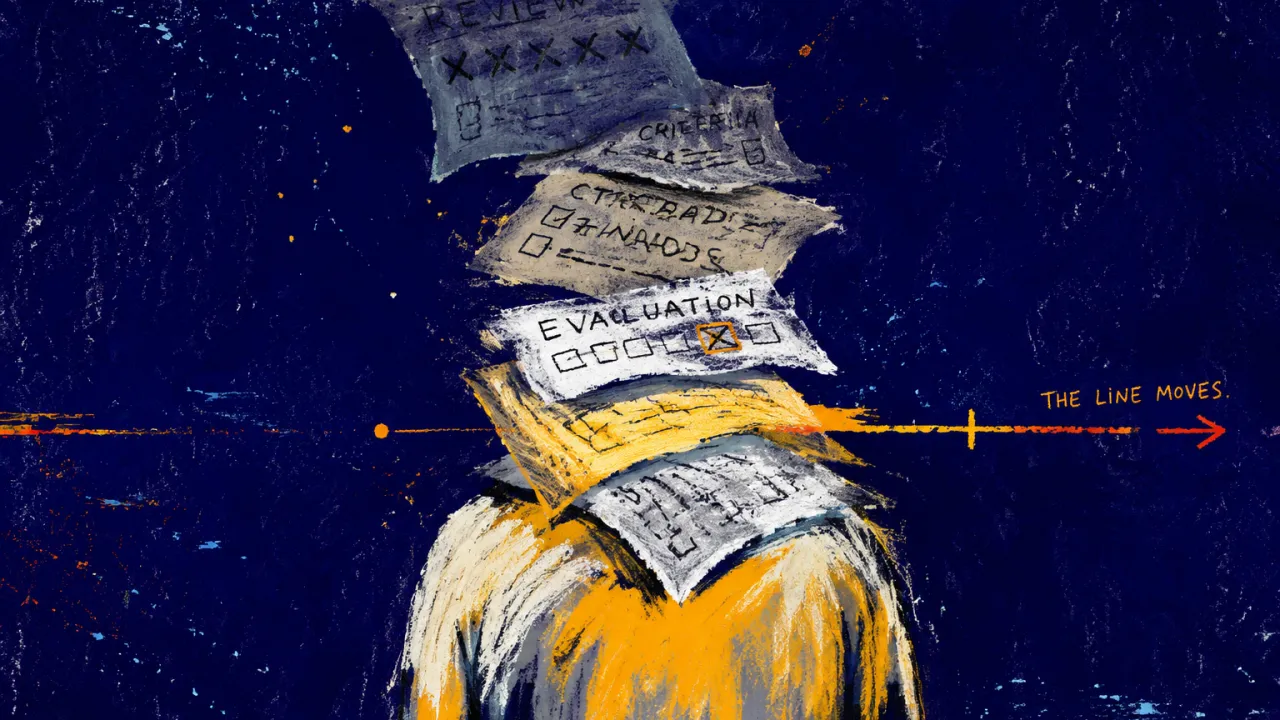
A solitary figure with shoulders lowered beneath score sheets settling from above, cool grey marks over warm paper.

What is this situation?

Review Criteria Reset - you submit a proposal, assignment, portfolio, or report under a brief everyone has agreed to, then the review meeting opens with a new version of what counts. The manager, client, professor, or panel points to standards that were never in the original instructions: more evidence, a different tone, a higher bar, or a missing step you were never asked to take. When you ask when the criteria changed, the answer stays vague - "we've clarified what we're looking for" - while the deadline remains exactly where it was. You revise the work, send it back, and receive another round of notes that quietly moves the target again. The people holding the decision can call this refinement; you are left translating each comment, comparing old messages with new ones, and trying to predict which version will be used next. Meetings become a record of shifting language, your shoulders stay lifted over the keyboard, and even completed work feels provisional because approval depends on standards that keep changing after you meet them. The cost is not simply more editing; it is the time, authority, and clarity absorbed by a review process that keeps its power on the other side of the table, much like the Justice card, where a seated figure holds the scales in one hand and an upright sword in the other, keeping judgment visibly in someone else's hands.

Why it's not you?

Review Criteria Reset is a change in the evaluation setup, not a stable standard you failed to understand. When the brief is revised after submission while the deadline and decision power stay fixed, the uncertainty belongs to the review process itself.

Review Criteria Reset in Tarot Cards

In Review Criteria Reset, the lifted-shoulder pause over the keyboard points back to a review process whose standards move after the work is submitted. This is an environmental and structural dynamic: the decision power stays on the other side of the table while the criteria keep shifting. The cards below reflect that visible arrangement without deciding what you should do. Here are the Tarot Cards that mirror this kind of evaluation pressure.

The High Priestess
Upright
The High Priestess sits between two pillars with a scroll partly hidden behind her veil. The scene makes the academic hidden curriculum concrete: the assignment instructions are visible, while the standard used to judge sophistication remains behind the institutional threshold. You can meet every published requirement and still be told that the work lacks an unspoken step, tone, or evidentiary level. The upright card distinguishes disclosed knowledge from privileged interpretation, showing that the gap is created by the review system's access rules rather than by a failure to study.
The Hierophant
Reversed
The Hierophant sits between pillars with keys and acolytes arranged around a formal teaching ritual. Reversed, the academic authority structure keeps its symbols of continuity while its doctrine changes from one review round to the next. You are asked to meet an institutional norm that was not published when the assignment was designed. The card reveals the power imbalance in that setup: the same people who control academic legitimacy also decide when a new definition of acceptable work has supposedly always been in force.
Justice
Upright
Seated behind the scales, the figure weighs the submitted assignment against a later version of the rubric while the upright sword places marking authority in one hand. The scene turns vague academic clarification into a traceable difference between the instructions issued before submission and the demands introduced afterward. You can compare the syllabus, assignment brief, messages, and feedback to see whether the standard actually existed when the work was produced. The upright card shows that academic review becomes more navigable when evidence and criteria are made explicit, even though the final mark still belongs to the institution.
Reversed
The seated figure holds the scales and sword while their balance no longer offers a dependable measure of academic work. The image captures a marking process where the rubric changes after submission, yet the marker still controls the interpretation and the deadline does not move. You are left translating each comment into a new implied standard and wondering which version will determine the result. The reversed orientation identifies a broken accountability structure in the academic review, where the burden of uncertainty is transferred to the student while the institution preserves decision power.
The Hanged Man
Upright
The figure hangs by one foot from a living tree, haloed but unable to move along the road. The image captures work suspended in a review queue while the deadline stays fixed and the evaluator uses the pause to redefine what completion means. You are asked to wait and revise at the same time, so calendar time advances while decision time remains withheld. The upright card makes the pause legible as a structural hold that can produce a changed perspective, not as proof that the work lacks value.
The Tower
Upright
Lightning splits the crown from the tower, sending figures out of a structure that had appeared settled. The review meeting creates the same rupture when an agreed assignment brief is treated as incomplete only after the submission arrives. You are asked to rebuild the work inside the original academic timeline, while the panel keeps control of the final judgment. The card shows that the disruption is structural: the old grading frame has fallen, and no stable replacement has been supplied before the next revision is due.
Two of Pentacles
Upright
One figure keeps two pentacles moving in an endless loop while ships rise and fall behind him. The loop is the reviewer's moving target and the fixed deadline is the rough water: each new criterion must be folded into the same limited hours. You can keep the submission circulating, but the visible juggling shows why completion keeps becoming provisional. The upright card describes an active capacity problem in the review cycle, where adaptation is possible only while the external standard continues to move.
Three of Pentacles
Reversed
The architect's plan, the craftsman's tools, and the observing figures place academic review inside a shared building project. Reversed, the scene loses alignment: different evaluators appear to be judging against different drawings, so each round of notes quietly changes the assignment. You can complete the requested edits and still receive another specification because the panel has not agreed on what quality means. The card locates the cost in assessment governance, where your study time is used to reconcile institutional disagreement that should have been settled before marking.
Two of Swords
Upright
A blindfolded figure crosses two swords in front of a dark waterline, holding both weapons in the same guarded position. The scene fits the choice between resubmitting, challenging the review, or withdrawing when none of those routes can be evaluated against a stable standard. You can compare the practical costs, but the crossed blades show that the deeper block is the decision frame itself: whichever path you choose may be judged by a criterion revealed later. The upright card holds the conflict in view without turning a structurally constrained choice into a personal failure to decide.
Seven of Swords
Upright
A figure carries five swords away from a camp while two remain behind, leaving the scene divided between what is taken and what is still visible. That split mirrors a brief whose operative rules are removed from the written record and reintroduced later as if they had always governed the submission. You can keep the emails, drafts, and meeting notes, yet the review still rewards the version of the standard held by the other side. The upright image names information asymmetry and strategic ambiguity without requiring a claim that every reviewer is consciously deceptive.
Eight of Swords
Upright
A blindfolded, bound figure stands inside a ring of swords while the castle remains close behind. The visual trap matches a review process where every route forward is technically open but each revision is fenced by criteria the decision-maker can add after the fact. You spend time predicting the next boundary instead of completing the work, while the fixed deadline narrows the room to challenge it. The upright card locates the restriction in the surrounding rules and power arrangement, not in a permanent lack of professional ability.
Five of Wands
Upright
Five wands cross in the same crowded space without a visible referee or common direction. The scene maps a review meeting where each academic voice adds a different evidentiary, structural, or tonal demand, making the standard shift through group friction rather than one clear decision. You can revise toward one comment and immediately expose the work to another competing measure. The upright card names the cost of an unsettled panel: your study time is spent arbitrating among reviewers while the due date continues to function as if the criteria were fixed.
Seven of Wands
Upright
The lone figure stands on higher ground with one wand raised against six others below. The image gives the academic review a clear power map: the submitted argument occupies a defensible position while new criteria arrive from a field that does not share one stable frame. You can distinguish a genuine request for stronger evidence from a demand that changes the assignment after the work is complete. The upright stance preserves your academic position long enough for the original instructions, added expectations, and cost of another submission to be seen separately.

Review Criteria Reset in Tarot Card Reading Insights

People navigating Review Criteria Reset have brought this changing review setting into readings. Here are the Tarot Reading Insights from those sessions.
Psychological Contexts Related to Review Criteria Reset