The 6:40 p.m. Cost of Workplace Peacekeeper Burnout
You know the meeting is going badly before anyone says it is. Voices sharpen, cameras go still, ownership turns vague, and the most emotionally fluent person in the room begins preparing to absorb the impact.
At 6:40 p.m., Jordan joined my video room from the kitchen table of their Toronto apartment. At twenty-nine, they worked in product operations across a hybrid team whose competing priorities followed them from Zoom to Slack to the Notion board. Their phone was warm in their palm. The room smelled faintly of reheated takeout and cold coffee, and every Slack ping made their breath shorten.
They showed me the three-line message they had been rewriting since a tense planning call. The first version said, “I need shared ownership before I can proceed.” The current version said, “No worries, I can put together the full follow-up.” Somewhere between those drafts, their capacity limit had disappeared and the repair plan had quietly become theirs.
“I can see everyone’s point, which is exactly the problem,” Jordan said. “I keep thinking I’ll bring up what I need once everyone calms down. But the meeting ends, and then I’m doing the recap, the scheduling, and the emotional cleanup. I don’t want clarity to sound like an ultimatum.”
I could hear the central tension immediately: Jordan wanted genuine cooperation, yet feared that naming a personal need would intensify the conflict and jeopardize their place on the team. The feeling sat in their body like a Slack typing indicator that never resolved: jaw locked, breath clipped, shoulders held up against a reply that had not arrived.
“It makes sense that the stakes feel real,” I told them. “Professional stability matters, especially when Toronto rent does not leave much room for a casual career crisis. I’m not going to tell you to just speak up or pretend every workplace is safe. What I can do is help us separate the conflict that already belongs to the team from the part you have been carrying alone. Let’s draw a map through the fog and find the next sentence that is actually yours.”

Choosing the Compass: A Relationship Spread for Team Conflict
I asked Jordan to put both feet on the floor, take one ordinary breath, and hold the question in mind: “Why do I keep absorbing team conflict instead of naming my needs?” I shuffled slowly, treating the pause as a way to focus attention rather than as a performance of mystery.
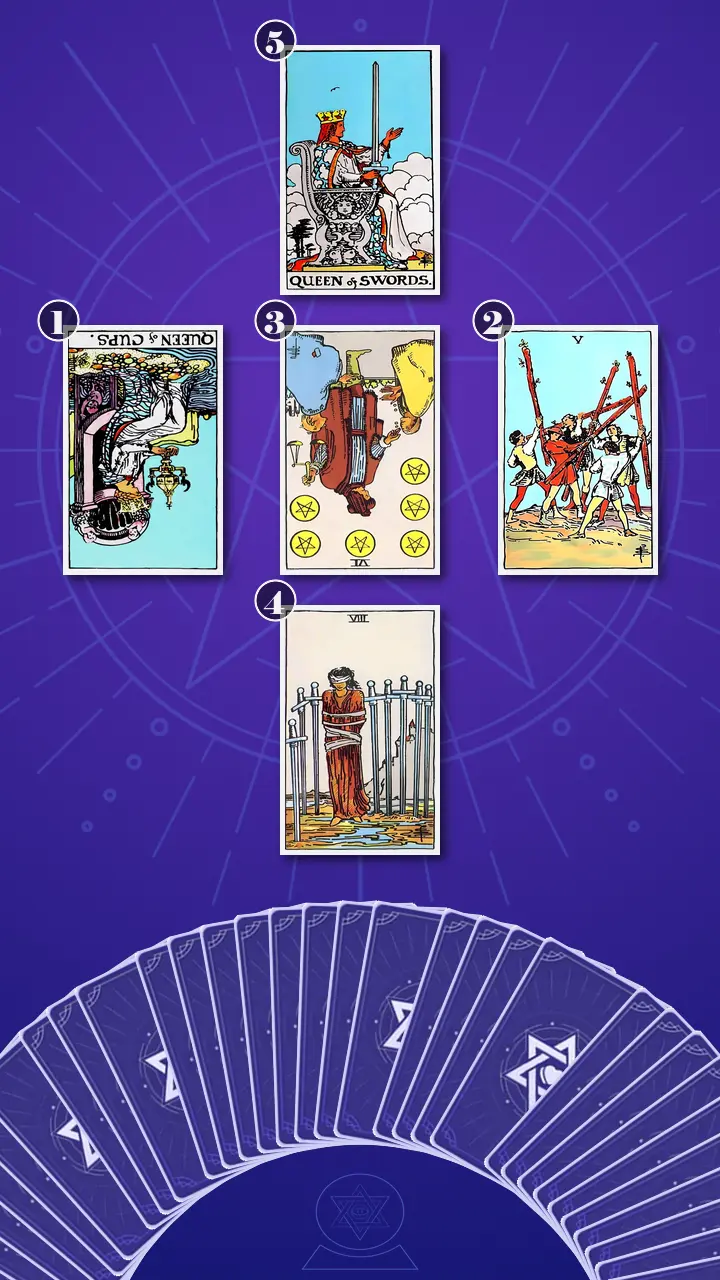
I chose a five-card Relationship Spread. For anyone wondering how tarot works in a workplace reading, I use the cards as a structured reflection tool, not as a prediction machine. This layout was useful because Jordan’s problem was relational and systemic: it needed to distinguish their own response from the team’s contribution, show the exchange those forces created, identify the belief underneath it, and offer a constructive direction.
I placed the third card at the center. Jordan’s stance would sit to the left, the team’s conflict field to the right, the underlying challenge below, and the constructive direction above. The horizontal axis would show who was bringing what into the relationship. The vertical axis would trace the pattern from its root toward a usable workplace boundary.
“These cards won’t decide what you should risk at work,” I said. “They can help us identify the pattern, test your assumptions against evidence, and design next steps. You keep authority over what you say, when you say it, and whom you trust with it.”
Reading the Horizontal Axis: Who Is Holding What?
Position 1: The Closed Cup in the Zoom Gallery
“The card I’m turning now represents your current stance,” I said, “including the emotional monitoring and omission of your own needs that happen when the room becomes tense.” I revealed the Queen of Cups, reversed.
In the image, the Queen studies an ornate closed cup beside moving water. Upright, her receptivity can be compassionate and discerning. Reversed, that Water energy has become overextended: there is an excess of attention directed toward everyone else’s emotional signals and a corresponding deficiency of attention available for Jordan’s own internal message.
I brought Jordan back to a Tuesday meeting at 9:08 a.m. Product and engineering had begun talking over each other. Jordan studied the gallery view, noticed who had stopped nodding, and translated the disagreement into neutral language. By the end of the call, everyone’s position had been acknowledged except Jordan’s. No one had heard that both proposed timelines exceeded their capacity.
“It’s like running a background app that scans everyone else’s mood until it drains the battery you need to state your own request,” I said. “You can accurately sense what the room needs, but compassionate awareness has become confused with responsibility for regulating the room.”
I asked, “In that meeting, what did you name correctly about everyone else, and what sentence about your own capacity never got said?”
Jordan’s breath caught. Their eyes moved away from the card as if they were replaying the gallery view, and then they gave one brief, bitter laugh. “That’s so accurate it’s kind of brutal. I thought I was being emotionally intelligent. But I was basically muting myself while managing everyone else’s volume.”
I let the recognition settle without turning it into blame. “Your sensitivity is not the problem,” I said. “The problem is the old bargain attached to it: belonging in exchange for your voice. It’s a workplace version of The Little Mermaid, except the price is paid in action items and after-hours Slack drafts. Care becomes sustainable only when your own experience remains inside the conversation.”
Position 2: Five Deadlines, No Shared Signal
“The next card represents the team’s side of the dynamic: the competing priorities and visible friction you have been trying to contain.” I turned over the Five of Wands, upright.
Five figures raise their staves in different directions. Product wants speed. Engineering wants technical certainty. Design wants more research. Marketing wants a fixed launch date. Every priority may be legitimate, but the group lacks a shared decision rule. The Fire energy is active and abundant, yet uncoordinated. This is not evil energy or proof of a broken team; it is friction asking for structure.
“When everyone starts defending a different deadline, your inner line becomes, ‘If I can translate this perfectly, maybe nobody will leave angry,’” I said. “But the team does not primarily need private soothing. It needs shared negotiation: Who decides? Which tradeoff is acceptable? What work moves, and what work stops?”
I watched Jordan release a long breath. Their shoulders remained high, but one hand opened on the table. The disagreement was becoming recognizable as group information rather than evidence that they had failed to keep everyone calm.
“If the disagreement already exists,” I asked, “how could naming your capacity be the thing that created it?”
Jordan looked back at the five crossing staves. “It couldn’t,” they said slowly. “I think I’ve been treating ordinary friction like a personal emergency.”
Position 3: The Task Tracker With One Name on Every Line
“The center card represents the relational exchange created when your peacekeeping meets the team’s uncoordinated conflict.” I revealed the Six of Pentacles, reversed.
The scales in the card should measure exchange, but reversed, the Earth energy is imbalanced. Emotional support, meeting notes, scheduling, reassurance, and repair work are moving in one direction. Jordan’s generosity looks collaborative from the outside, while its cost remains invisible to everyone who benefits from it.
I described the familiar post-meeting scene: Jordan sends three reassuring DMs, drafts the recap, schedules the repair conversation, and accepts the revised plan. The shared action list then places their name beside the summary, follow-up, facilitation, and emotional debrief. Everyone contributed to the tension, so how did all the repair work become Jordan’s?
“The room gets calmer; your workload gets louder,” I said. “Invisible needs produce invisible costs.”
Jordan’s fingers paused against the mug. Their gaze lost focus for a moment, moving through what I imagined was a mental count of recent recaps and follow-up calls. Then their mouth tightened. “Last Thursday, four people argued about the roadmap. I somehow left with five tasks.”
This was where I used what I call Workplace Typecasting Analysis. I asked Jordan to imagine the office ecosystem as a production that had learned to cast them in a reliable supporting role: the translator, the continuity editor, the person who keeps every scene from falling apart. The typecasting was reinforced each time the team experienced calm without seeing its cost.
“That role is not your essence,” I told them. “It is a pattern of expectation, partly created by the system and partly maintained by the speed with which you step into unclaimed work. You do not need a dramatic confrontation to disrupt it. The first change is simply to stop accepting the next repair task before ownership is discussed.”
I asked Jordan to picture the next tense call ending and then saying, “Who owns this next step, and what support comes with it?” The question did not accuse anyone. It made the reversed scales visible enough to renegotiate.
The Draft Folder Built From Imagined Replies
Position 4: The Eight of Swords Beneath the Exchange
“The card below the center represents the underlying challenge,” I said, “especially the belief that naming a need will worsen the conflict and threaten your belonging.” I turned over the Eight of Swords, upright.
The figure is blindfolded, loosely bound, and surrounded by an incomplete ring of blades. This is Air in blockage. Jordan’s intelligence is working hard, but it is being used for prediction, rehearsal, and self-censorship instead of communication.
I returned us to 6:40 p.m. The cursor moves through several softened Slack drafts while Jordan mentally simulates irritation, rejection, a colder manager, and the label “difficult.” None of those reactions has happened. Yet every forecast is treated like a screenshot of an event already confirmed, so the direct request is deleted and another task is volunteered for.
Jordan’s jaw tightened again. Their thumb rubbed the edge of the phone case as they said, “But those reactions are possible. I can’t afford to act like workplace politics aren’t real.”
“You’re right,” I said. “The card is not asking you to dismiss power, retaliation, or career security. It is asking you to separate three things: what is possible, what is probable based on evidence, and what has actually happened. Right now, several possible reactions are functioning like the only available outcome.”
I thought of an editing suite and the difference between raw footage and the final cut. Jordan’s mind was taking every feared scene, splicing them together, and screening the result as documentary evidence. The forecast deserved attention, but it did not deserve automatic authorship.
“You are not bad at conflict,” I told them. “You are doing too much of it internally. A low-stakes request can become an information-gathering experiment. You make one reasonable clarification, observe the response, and update the story from evidence.”
Jordan looked down at the loose bindings in the card. Their shoulders did not fully relax, and I was glad they did not pretend the fear had vanished. Instead, they said, “I can see that I’ve been waiting for certainty before I speak. The meeting keeps ending before certainty shows up.”
When the Queen of Swords Raised Her Hand
Position 5: The Sentence That Refused to Disappear
The radiator clicked once and became quiet. Even the Slack notifications seemed to pause as I reached for the card above the center, the reading’s constructive direction and its antidote to Jordan’s self-silencing.
“This card represents the way forward: empathy joined with a visible boundary, a stated need, and a concrete request.” I turned it over. The Queen of Swords, upright.
Her sword rises vertically, making a clean distinction. Her other hand remains open, allowing response. This is Air in balance: thought becomes language, and language becomes structure. The Queen is direct without becoming punitive, receptive without making herself responsible for every reaction.
I told Jordan that clarity is not cruelty with better branding. A clear need does not create the conflict; it gives the room accurate information about where responsibility has to be shared.
Before I went further, I returned us to 6:40 p.m.: the call finished, the Slack draft open, three lines being softened until Jordan’s request vanished and the team’s repair plan became theirs. Their mind was still searching for a perfect sentence that could communicate a limit without producing any discomfort at all.
You do not have to earn harmony by swallowing your needs; name the clean request, and let the Queen's upright sword separate clarity from cruelty.
For one beat, Jordan went completely still. Their inhale stopped halfway, and the fingers curled around their mug stayed suspended. Then their eyes moved away from me and fixed on the dark edge of the laptop, as though several meetings were replaying at once: each careful summary, each unsent limit, each evening quietly surrendered to the follow-up plan. A flush rose into their face.
“But doesn’t that mean I’ve been doing it wrong this whole time?” they asked, sharper than before. The anger lasted only a second before their voice thinned. “I thought being the reasonable one was what made me valuable.”
“It means that a strategy which once protected connection is now charging you too much,” I said. “That is not a moral failure. It is new information.” Their grip loosened finger by finger. Their shoulders lowered, and a breath left from deep in their chest. Relief arrived with a brief, almost dizzy blankness: if they no longer had to manage every reaction, they would also have to tolerate not knowing how the room would respond.
I asked, “Now, with this new perspective, think back to last week. Was there a moment when this insight could have made you feel different?”
Jordan thought for a while. “The roadmap call,” they said. “I knew I couldn’t own both the launch brief and the retro. I just didn’t say it because design and engineering were already tense.”
I placed the reversed Queen of Cups beside the upright Queen of Swords. One held a closed cup and looked down. The other raised a visible blade and extended an open hand. “The cards are not asking you to stop caring how your words land,” I said. “They are asking you to stop making control of every reaction a condition of speaking. You can care how this lands without controlling every reaction.”
Then I offered an ordinary sentence: “The priorities are still split. I can own the launch brief, but I cannot also facilitate the retro. I need another owner confirmed today.”
I watched Jordan sit a little straighter. The sentence held observation, capacity, and request. It contained no accusation and no apology for having limits. It also left silence for the team to answer.
This was Leadership Narrative Construction in its smallest workable form. Jordan’s professional story had cast authority as something other people exercised while they made that authority easier to live with. I invited them to rewrite the sequence: state capacity before translating the room, identify the decision before volunteering process help, and let leadership mean making reality visible rather than making tension disappear.
That did not complete the transformation. It marked the first move from apprehensive conflict absorption and belonging-driven self-silencing toward boundaried clarity, shared responsibility, and steadier collaborative trust. The new vulnerability was real: once the request became visible, Jordan could no longer control the response. But they could finally respond to what happened instead of obeying every feared outcome in advance.
From a Closed Cup to Shared Ownership
I gathered the five cards into one coherent story. The reversed Queen of Cups showed Jordan absorbing the room’s Water until their own message stayed sealed. The Five of Wands showed that the heat belonged to several people with competing priorities. The reversed Six of Pentacles revealed where the conflict landed materially: in Jordan’s calendar, workload, and unpaid emotional attention. The Eight of Swords explained why the pattern continued, with possible rejection treated as established fact. The Queen of Swords turned that private forecasting into one clear boundary and a request the team could actually answer.
Each time Jordan restored short-term calm by taking the repair work, the team learned that their supporting-role performance was available on demand. The calm looked like successful collaboration, while resentment and exhaustion accumulated off-screen. That was the cognitive blind spot: Jordan had been using the room’s reduced tension as proof that the strategy worked, without counting the invisible office housework or asking whether responsibility had become more equitable.
As an artist, I often think of a stuck life as a film that has remained in one painful scene for a little too long. I could see that Jordan did not need to burn down the set or deliver a dramatic monologue. They needed the pen for one line. The transformation direction was precise: move from translating everyone’s discomfort to stating one need, one boundary, and one concrete request while the conversation was still happening.
Two Small Rewrites for the Next Seven Days
Jordan looked at the sample sentence and said, “I know it’s only three lines, but when the meeting is happening, even that feels like a lot.” I adjusted the practice accordingly. The aim was not fearless communication. It was a minimum viable interruption of the old script.
- The Protagonist Reframe Directive Before one cross-departmental meeting this week, take three minutes to write: “What I see is…,” “What I can commit to is…,” and “What I need from the group is….” Say those lines before summarizing everyone else. After the request, leave ten seconds of silence so another person has room to respond. Tip: Keep the first version to three sentences. Remove apologies, extra reassurance, and any new task you volunteered for while drafting. The minimum version is: “I can own X, but I need another owner for Y.”
- The Seven-Minute Forecast-to-Feedback Test Set a seven-minute timer and open one Slack draft you have been softening. Write two short notes: “What I predict will happen” and “What I can actually observe afterward.” Rewrite the message as one observation, one capacity limit, and one request. You decide whether to send it. Tip: If the exercise feels too activating, write only “I need clarity on…” and stop. Start with a low-stakes ownership or deadline question. If the situation involves retaliation, harassment, or a meaningful power risk, document it and choose trusted support or formal channels according to your judgment.
I reminded Jordan that a boundary states capacity; it does not control the other person’s reaction. The practice was not about guaranteeing a warm response. It was about replacing automatic self-erasure with accurate information and letting coworkers hold their share of the tension.

A Week Later: The Quiet Proof
A week later, Jordan messaged me: “I said it before I summarized everyone. My voice shook. Nobody applauded, but Sam took the retro.” They slept through the night; their first morning thought was still, “What if I sounded difficult?” This time, they let the thought pass.
I thought again of the two Queens. The closed cup had not been discarded; Jordan’s empathy was still present. It simply stood beside an upright sword now, where care could inform a boundary without swallowing it.
That was the real Journey to Clarity. Tarot had not predicted a perfect team response or transformed Jordan by magic. The spread had made the hidden pattern visible; Jordan had chosen the sentence, accepted the discomfort, and allowed responsibility to land somewhere more accurate.
When the room gets sharp, some of us feel our jaw lock and our shoulders rise as if keeping everyone calm is the only way to keep our place in it. If that happens to you, remember the closed cup and the open hand: noticing the need you have been protecting already means you are no longer entirely trapped inside the old scene.
If one clear sentence could stand in your next tense room like the Queen’s upright sword beside her open hand, without proving anything about your worth or belonging, what would you want that sentence to say?
This story is adapted from psychological research, written so that those in a similar struggle can see their own pattern in it — and find their next step clearly.These insights are not a substitute for professional psychological, medical, legal, or financial advice.
Learn more about our Journey to Clarity.
How did this insight land for you?
🫂 This Resonates Deeply
🌀 Living This Story
✨ Now I See Clearly
🌱 Seeing New Possibilities
🧰 Useful Framework
🔮 The Confirmation I Needed
💪 Feeling Empowered
🚀 Ready for My Next Step
Author Profile
 AI
AI“I’ve always felt our lives are films currently in production. As an artist, I know that when you feel stuck, it’s often because you’ve bravely stayed in a painful scene for just a little too long. I’m not here to coldly analyze you. I want to sit closely with you, look at those difficult moments with profound empathy, and gently hand you the pen so you have the courage to write your next beautiful act.”
In this Career Tarot Reading :
Core Expertise
- Workplace Typecasting Analysis: Identifying how your office ecosystem has boxed you into a marginalized or undervalued 'supporting role'.
- Leadership Narrative Construction: Rewriting the script of your professional identity to command authority and visibility.
Service Features
- The Protagonist Reframe Directive: A micro-behavioral script for your next cross-departmental meeting to instantly disrupt your established subordinate persona.
Also specializes in :
Explore Related Patterns:
Defensive OverfunctioningAfter tense calls, Jordan sends reassuring messages, drafts the recap, schedules the repair conversation, and accepts the revised plan. When four people argue about the roadmap, Jordan leaves with five tasks, making extra action the method used to contain a conflict the group has not structurally resolved. When you respond to uncertainty by becoming more useful, productivity can operate as a defense against the risk of leaving tension uncontained. Defensive Overfunctioning describes this move from shared ambiguity into disproportionate personal labor. The more quickly you fill every ownership gap, the less opportunity the team has to reveal and correct its own underfunctioning.
Emotional Hyper-ResponsibilityJordan notices who has stopped nodding, tracks the changing tone, and translates product and engineering’s positions into neutral language. That perception is accurate, but the next step turns perception into obligation as Jordan begins acting as though noticing the room’s tension makes them responsible for regulating it. When you treat every emotional signal as a task assigned to you, attention moves outward until your own capacity is no longer represented. Emotional Hyper-Responsibility names the shift from empathy to assumed duty. It allows you to see that understanding another person’s discomfort does not automatically make managing that discomfort your job.
Workplace People-PleasingJordan replaces “I need shared ownership before I can proceed” with “No worries, I can put together the full follow-up.” The revised message lowers the immediate risk of interpersonal friction, but it does so by making Jordan’s capacity disappear and converting a shared repair problem into personal labor. When you preserve belonging through reassurance, accommodation, and rapid compliance, the room’s short-term calm can reward the very response that is draining you. Workplace People-Pleasing describes that reinforcement loop because cooperation is being pursued through self-erasure rather than through an exchange in which your limits remain visible.
Workplace Self-SilencingDuring the Tuesday meeting, Jordan translates every competing position but never says that both proposed timelines exceed their capacity. The same omission appears in the roadmap call and in the Slack draft that is softened until the original need is no longer present. When you can speak fluently for everyone except yourself, silence becomes a defensive way to reduce exposure to judgment. Workplace Self-Silencing captures this mechanism because the problem is not an inability to identify the need. It is the repeated removal of that need from shared reality whenever visibility feels capable of threatening belonging.
CatastrophizingAt 6:40 p.m., Jordan mentally simulates irritation, rejection, a colder manager, and the label difficult before anyone has replied. Those possible outcomes are then given enough authority to delete the direct request and replace it with an offer to do more work. When you treat a worst-case forecast as though it were already documented, caution becomes cognitive confinement rather than informed risk assessment. Catastrophizing here does not mean workplace politics are imaginary. It means possible consequences are being weighted as the only available ending, preventing new evidence from entering the decision.
Certainty SeekingJordan plans to raise their needs once everyone calms down and later recognizes that they have been waiting for certainty before speaking. Meanwhile, the meeting ends, the perfect moment never arrives, and the unsaid limit is converted into another accepted task. When you require a request to guarantee that nobody will react badly, certainty becomes a hidden condition for communication. Certainty Seeking keeps the decision in rehearsal because no sentence can control every workplace response. Naming that condition lets you replace the demand for guaranteed safety with a smaller question about what the available evidence supports.
Conditional Self-WorthJordan asks whether the new insight means they have been doing everything wrong and then says they thought being “the reasonable one” was what made them valuable. That statement reveals why a routine workload boundary carries more weight than the words themselves would suggest. When you tie professional value to being calm, useful, and undemanding, a limit can feel like evidence that you are becoming less worthy of your place. Conditional Self-Worth explains why the supporting role is so difficult to interrupt. The task is not to prove your worth through a better performance, but to notice when worth has been made contingent on absorbing costs that should be shared.
Boundary DiscernmentJordan states that they can own the launch brief but cannot also facilitate the retro, then asks for another owner to be confirmed. The sentence does not withdraw cooperation or dictate another person’s reaction. It separates a chosen contribution from a capacity limit and places the remaining decision back in the group. When you distinguish what you understand, what you can offer, and what another person must decide, empathy no longer requires boundary diffusion. Boundary Discernment is the internal sorting process beneath the sentence. It lets care remain in the conversation without allowing team conflict to determine the size of your workload.
Explore Related Struggles:
Performative HarmonyJordan sends the reassuring messages, drafts the recap, schedules the repair conversation, and accepts the revised plan. The room becomes quieter, but the competing priorities remain unresolved and the shared action list places one name beside nearly every repair task. When you use reduced tension as the main evidence that collaboration worked, private overextension can masquerade as collective agreement. The calmer everyone else becomes, the easier it is for the unequal exchange to disappear from view. You are then caught maintaining a version of harmony that depends on carrying the unresolved conflict somewhere the group does not have to witness it.
Self-Erasure ReliabilityBy the end of the Tuesday call, Jordan has accurately represented everyone else's position while leaving their own capacity outside the conversation. Later, they admit that being "the reasonable one" felt like the source of their value, even when reasonableness required another unsent limit and another evening of follow-up. When your reliability is repeatedly demonstrated through your own disappearance, stating a need can feel like withdrawing the very quality that secures your place. You are not simply deciding whether to accept one more task. You are confronting a role in which being seen as dependable has become structurally dependent on making your limits difficult for other people to see.
Voice-Safety FusionJordan begins with a clear sentence about shared ownership, then edits it until the limit disappears and the full follow-up becomes theirs. They keep waiting for a calm enough moment to name what they need, but every meeting ends while that condition is still pending. When you believe your voice can enter the room only after safety has been guaranteed, speaking and belonging become fused into the same high-stakes decision. The struggle is not a lack of communication skill. It is the pressure to choose between giving accurate information about your capacity and protecting your place in a relationship whose response you cannot control.
Evidence DisconnectionAt 6:40 p.m., Jordan mentally rehearses irritation, rejection, a colder manager, and the label "difficult" while no one has yet replied to the message. Each possible reaction is given enough authority to delete the direct request before the workplace can provide any actual feedback. When forecasts function like confirmed evidence, you must respond to an imagined outcome before reality has a chance to answer. That leaves you waiting for certainty that communication cannot provide, while every unsent limit preserves the original prediction from being tested. The struggle is a closed feedback system in which anticipated consequences govern your choices more strongly than observable responses.
Responsibility-Authority SplitProduct, engineering, design, and marketing bring competing priorities into the meeting, yet Jordan leaves with the recap, facilitation, scheduling, and follow-up. They are expected to make the disagreement workable without being the person who can decide which deadline moves or which tradeoff the team accepts. When you carry responsibility without matching authority, effort cannot reliably produce resolution. You can work harder, translate more carefully, and keep the process moving, but the central decision still belongs elsewhere. The resulting struggle is a position where you absorb the consequences of group choices while lacking the power needed to distribute those consequences accurately.
Unseen Cost BindThe task tracker places Jordan's name beside the summary, follow-up, facilitation, and emotional debrief, while colleagues mainly experience the calmer room that follows. By 6:40 p.m., the cost has traveled into their kitchen, their phone, their remaining attention, and the work that was never visibly counted as part of the exchange. When your labor is designed to remove signs of conflict, success also removes evidence of what the labor cost you. Other people receive the benefit without encountering the load that produced it, so the same expectation is reinforced. You are caught in a bind where making the burden visible can seem to threaten the peace, while keeping the peace ensures that the burden remains yours.
Explore Related Emotions:
Conditional Belonging FearJordan waits for everyone to calm down before naming a need, but the meeting ends and the repair work quietly becomes theirs. Their fear that clarity could sound like an ultimatum or make them seem difficult turns team membership into something that appears to require constant emotional usefulness. When you experience belonging this way, a capacity limit can feel less like ordinary information and more like a threat to your place in the group. Conditional Belonging Fear identifies that inner weather while leaving room to audit the bargain itself: whether acceptance truly depends on swallowing the need, or whether that condition has been operating without enough evidence.
Hypervigilant AnxietyEvery Slack ping shortens Jordan's breath, and the gallery view becomes a field of micro-signals to monitor: sharpened voices, still cameras, missing nods, and possible irritation. When you track the room this closely, your attention is pulled toward detecting and preventing other people's reactions before your own capacity has a chance to register. Hypervigilant Anxiety names the subjective pressure of remaining braced for relational impact even after the meeting ends. Recognizing the difference between an observable response and a forecast gives you a way to reclaim attention without pretending that workplace politics or power differences are unreal.
Resentful ExhaustionAfter the team argues, Jordan sends reassuring messages, drafts the recap, schedules the repair conversation, and finds their name beside nearly every follow-up task. Four people create the roadmap conflict, yet Jordan leaves with five assignments and carries the exchange from Zoom into the evening. When the room gets quieter by making your workload louder, depletion acquires a sharp relational edge. Resentful Exhaustion names the experience of being drained by care that has become one-directional, and it helps you count the hidden cost rather than using reduced group tension as the only measure of whether the strategy worked.
Shocked ClarityJordan's breath catches when they realize that reading the room accurately has also involved muting themselves. Later, several meetings seem to replay at once as they connect every careful summary and unsent limit with the belief that being the reasonable one made them valuable. Shocked Clarity is the jolt of seeing a respected strength and its hidden cost in the same frame. When you can recognize that the strategy protected connection while also charging too much, the insight does not have to become self-blame; it can become precise new information about what needs to change.
Voice Erasure DreadJordan's first draft says, "I need shared ownership before I can proceed," but the final version offers to handle the entire follow-up. The same removal happens in meetings: every competing position is translated into neutral language while the fact that both timelines exceed Jordan's capacity remains unheard. Voice Erasure Dread captures what it feels like to watch your own message disappear through repeated acts of accommodation. The dread is not only about coworkers disagreeing with you; it comes from realizing that your voice is being removed before anyone else has the opportunity to answer it, which makes preserving one clean sentence an act of restoring accurate information.
Grounded AgencyJordan replaces a sequence of imagined replies with one observable fact, one capacity limit, and one request. They remain free to decide whether to send the message, whom to trust, and how much workplace risk is reasonable, while the eventual response provides evidence that another person can take ownership. Grounded Agency feels like standing inside the part of the situation you can actually author. You cannot control how the room reacts, but you can choose whether your capacity enters the record and then update your understanding from what happens rather than from every feared outcome in advance.
Mutuality HungerJordan explicitly wants genuine cooperation, yet their usual peacekeeping leaves support, scheduling, translation, and repair moving toward the team from one person. The question "Who owns this next step, and what support comes with it?" reveals that the deeper wish is not to abandon care but to experience care and responsibility as shared. Mutuality Hunger names the longing for collaboration that does not require your disappearance. Once you distinguish reciprocity from keeping everyone calm, that longing can guide concrete questions about ownership while allowing coworkers to reveal whether they are willing to participate in a more balanced exchange.
Cautious ReliefJordan's grip loosens and a deep breath leaves their chest when the team's disagreement becomes recognizable as shared information rather than a private failure. A week later, they sleep through the night even though the morning thought, "What if I sounded difficult?" still arrives. Cautious Relief is the easing that becomes possible before certainty is complete. You can feel less burdened while acknowledging that visible limits carry real interpersonal uncertainty, and the returning thought can pass without automatically reclaiming authority over your next action.
Regulated CourageA week later, Jordan says the capacity sentence before summarizing everyone else. Their voice shakes, nobody applauds, and Sam takes the retro; the action succeeds without requiring Jordan's body to feel completely settled first. Regulated Courage describes the ability to remain present with apprehension while making a measured request. You are not trying to eliminate discomfort or force agreement; you are allowing your words, capacity, and behavior to line up closely enough for the team to respond to reality.
Suppressed ResentmentJordan's objection surfaces in brief physical flashes: a bitter laugh, a tightened mouth, a moment of sharpness, and then a voice that thins again. Those moments appear beside a repeated exchange in which the team receives reassurance and repair while Jordan's own limits stay outside the conversation. Suppressed Resentment describes the pressure created when anger is compressed to protect an identity built around being reasonable. You do not have to turn that anger into accusation; treating it as information can reveal where consent, workload, or reciprocity has already moved beyond what you can honestly offer.
Explore Related Contexts:
Designated Peacekeeper BurdenDuring tense planning calls, Jordan translates competing positions, notices who has withdrawn, and restores enough calm for the meeting to end. Their own capacity remains unnamed, and the recap, scheduling, and repair work then become theirs. Repetition turns a useful contribution into a designated team role: Jordan is expected to absorb the friction so everyone else can continue. When you become the default peacekeeper, the apparent success of a calmer room can conceal how responsibility is being allocated. Naming the role makes it possible to distinguish voluntary support from work the group has learned to place on you automatically, creating room to ask who owns the conflict, who owns the next step, and what support accompanies it.
Office Housework TrapAfter the roadmap argument, Jordan sends reassuring messages, writes the recap, schedules the repair conversation, and finds their name beside the summary, facilitation, follow-up, and debrief. These tasks are necessary for the team to function, but they are generated by collective conflict and assigned without a collective ownership discussion. When this office housework repeatedly lands with you, the workload can look like ordinary helpfulness because each task is small and professionally presentable. Counting the combined time and naming each task as allocatable work exposes the structural issue: the group is consuming coordination labor while leaving its cost and ownership largely invisible.
Responsibility Without AuthorityThe shared action list places Jordan's name beside the summary, follow-up, facilitation, and emotional debrief even though several departments created the disagreement and no common decision rule resolved it. Jordan carries the consequences of decisions while priority-setting authority remains diffuse or sits with other people. When responsibility reaches you without matching authority, reliability can become an open channel for unclaimed work. Making the mismatch visible allows you to ask which decision has actually been made, who owns it, and what existing commitment must move before you accept implementation or repair responsibility.
Soft Skills TaxJordan notices stalled cameras, sharper voices, and shifts in participation before the group names the problem. That fluency is immediately put to work through neutral translation, reassurance, follow-up messages, and repair planning. Coworkers receive the benefit as smoother collaboration, while Jordan retains the original workload and absorbs the additional coordination cost. A soft skills tax appears when your interpersonal competence repeatedly attracts extra labor without corresponding time, authority, credit, or redistribution. Treating that labor as measurable work protects the value of the skill while giving you a basis for deciding when to offer it, when to share it, and when the team must build its own conflict process.
Competitive Meeting CultureProduct and engineering talk over each other while design, marketing, and product defend different deadlines and standards. Each priority may be legitimate, but the meetings provide no shared rule for deciding which tradeoff governs, what work stops, or who has authority to assign the result. The conflict therefore survives the call and moves into follow-up channels. If you are working inside this meeting culture, clearer personal communication can supply accurate capacity information, but it cannot privately replace a missing decision process. Recognizing that distinction keeps team-level friction attached to the team and directs attention toward explicit decision rights, tradeoffs, and ownership rather than another round of private translation.