Keeping a UX Pivot Private to Protect Support: One Bounded Truth

The 10:47 p.m. Tab: Hiding a Career Direction to Protect Support
If a private Notion page can hold a clear career change while FaceTime turns it into "I am still figuring it out," I know the pressure has a very specific shape. Alex, a 27-year-old junior marketing coordinator in Toronto, brought that exact split into our session.
Alex took me back to 10:47 p.m. in their small apartment. A Google UX Design course glowed beside a marketing brief while the laptop fan hummed against the late-night quiet. When a family video call lit up their warm phone, they minimised the course window, answered, and held their breath through the first question about work.
"I am not hiding the plan because I doubt it," Alex told me. "I just do not know whether their support survives disagreement." Each direct question seemed to pull an invisible drawstring around their throat, tightening until a specific UX plan came out sounding vague and harmless. Alex wanted to live openly in a self-chosen direction, but not at the cost of emotional or practical support that still mattered.
"Being vague buys peace, but it also keeps my life in draft," they said.
I did not tell Alex that secrecy was wrong, or that honesty required revealing everything. The strategy had protected something real: connection under conditions of uncertainty. I told them, "Let us work out what this protection is doing for you, what it is costing you, and whether there is a form of honesty that does not hand anyone else control of your future. We are not forcing an answer tonight. We are drawing a map through the fog."
Choosing a Compass for the Family-Support Fog
I asked Alex to put both feet on the floor, take one slower breath, and hold one question in mind: "Why do I keep hiding my direction to protect my family's support?" I shuffled while they breathed. I use this brief ritual as a transition from mental rehearsal into focused observation, not as a supernatural performance.
I also made the limits of the reading explicit. The cards could not predict whether Alex's family would approve, disagree, or change what they offered. In my practice, this is how tarot works: it gives us a structured external surface on which to examine assumptions, behaviour, fear, and available choices. The card meanings only become useful when read in context, and Alex remained free to decide what to disclose, to whom, and when.
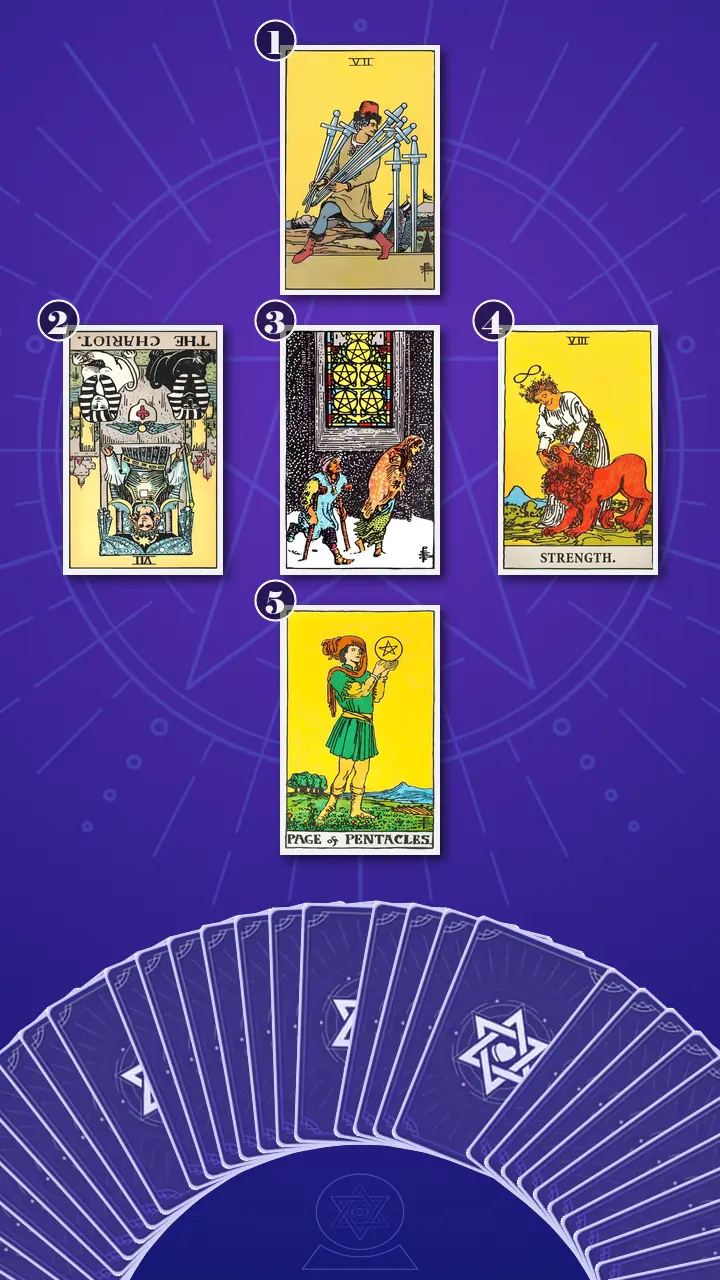
I chose a five-card Shadow Spread because the question was not asking which career to choose. Alex already felt energised by UX in private. We needed a focused symptom-to-root-to-integration sequence: the protective mask, the disowned need, the root fear, the shadow's gift, and integration in practice. A larger predictive spread would have added noise to a question that required careful inner excavation.
I arranged the cards as a cross. The root-fear card sat at the centre like a jammed compass mechanism. Above it would be the behaviour everyone could see; to the left, the self-directed need that had been pushed underground; to the right, the capacity that could release the pattern; and below, the practical route forward. The design let me trace hiding a career plan from visible strategy to emotional cause without pretending to forecast the family's response.
The Backward Glance Behind "Work Is Fine"
Position 1: The Protective Mask
I turned over the card representing Alex's protective mask, the observable behaviour of vague updates, selective disclosure, and private planning. It was the Seven of Swords, upright.
The figure carried five swords away from a camp while looking back over one shoulder. I placed that image beside Alex's modern-life version of it: at 10:42 p.m., they moved five carefully selected facts from a private UX plan into a neutral family update, closed the browser tab before Zoom opened, and checked the family group chat afterward for any sign that the omission had been noticed. The five swords were controlled pieces of information. The backward glance was constant reaction-monitoring. The two swords left behind were the honest direction and the specific support request that never entered the conversation.
The upright card showed strategic Air operating in excess. Selective disclosure can be intelligent, and chosen privacy can protect concentration. Here, however, the strategy had expanded beyond privacy into continuous surveillance. Alex's attention stayed pointed backward at the response they were trying to avoid. The answer bought ten minutes of relief, but the nervous system kept checking whether the danger had really passed.
I asked, "When someone asks what comes next, what exact detail do you remove, and what do you do immediately afterward?"
Alex's breath caught first. Their thumb stopped against the edge of their mug. Their eyes drifted toward the corner of their screen as though the hidden course tab were still there, and then a bitter laugh escaped. "That is too accurate. Honestly, a little brutal."
"I hear that," I said. "The card is not calling you deceptive. It is showing a protection strategy with a real cost. A private plan can protect your focus; a hidden plan can also keep you waiting for permission."
Position 2: Two Destinations, No Movement
I turned over the card representing the disowned need: Alex's suppressed wish to claim authorship of their direction, and the internal split preventing that wish from moving openly. It was The Chariot, reversed.
Alex had completed another UX lesson and researched three possible next steps, yet they repeatedly removed dates before family contact because a dated plan would look too real. The opposing black and white sphinxes became two browser tabs competing for focus. One said, "Move toward UX." The other said, "Do not risk the support you need." The absence of visible reins made the core issue plain: more private control was not producing coordinated movement.
Reversal placed the Chariot's willpower in blockage. Alex did not lack direction. Their direction was being held hostage by the imagined requirement to defend it perfectly. The more tightly they tried to manage every possible response, the less energy remained for one observable step.
I used my Cognitive Spiral Mapping to draw the loop on paper: a family question triggered the minimised tab; vagueness created immediate relief; relief was followed by guilt and stalled progress; Alex then did more research to build an uncriticisable case; the larger case made disclosure feel even more consequential. The loop made a busy mind look productive while returning the plan to the same private orbit.
After a decade of guiding people through cycles, I have learned not to mistake repetition for permanent failure. An orbital path can look like going in circles from a single frame. Sometimes it is the phase in which enough momentum is gathered for a change in trajectory, but that slingshot still needs a deliberate directional move. The cards could identify the loop; Alex would choose the new motion.
"If I move openly, I might lose them," Alex said, looking down at the reversed card. "If I stay vague, I lose momentum." Their shoulders remained high, but their voice had stopped trying to make the conflict sound like ordinary career indecision.
Position 3: Standing Outside a Door That Has Not Been Tested
I turned over the central card representing the root fear: the belief that revealing a different direction could lead to exclusion or the withdrawal of family support. It was the Five of Pentacles, upright.
I described the rent-day scene Alex already knew. They checked their banking app and imagined that naming the career change could remove emotional reassurance, emergency backup, and every practical form of help at once. On the card, two figures crossed the snow beneath an illuminated stained-glass window. In Alex's life, the window became the family video-call screen: connection was visible, but Alex had mentally placed themself outside it before any honest conversation had established whether the door was closed.
I was careful here. "This card names the feared outcome. It does not predict family rejection." The Pentacles' Earth energy had contracted into an excess of scarcity forecasting. One unknown line in the support budget was being processed as a total emergency. That imagined emergency maintained the secrecy because concealment felt financially and emotionally responsible, even though the actual terms of support had never been discussed.
Outside Alex's window, sleet caught the streetlight and briefly made the glass look patterned. The weather seemed to borrow the card's visual language while I asked, "If your family disagreed, what support do you fear losing first? Which parts are confirmed conditions, and which parts are forecasts?"
Alex went still. Their gaze unfocused as rent payments, past encouragement, and hypothetical arguments seemed to move behind their eyes. Then they exhaled and said, "I am planning around being left outside, even though no one has said the door is closed."
That distinction was the catalyst. It did not guarantee that every response would be supportive. It simply separated a possible difficulty from a verdict that Alex's mind had already issued. Facts, requests, contingencies, approval, and belonging could now become different questions instead of one catastrophic answer.
When Strength Met the Lion Without a Fight
Position 4: The Shadow's Gift
The room grew quieter as I turned over the card representing the shadow's gift: the courage to combine honesty, compassion, and firm relational boundaries. It was Strength, upright, the bridge card of the reading.
I pointed to the calm hands resting at the lion's jaws. The figure was not silencing the animal or overpowering it. She was staying in contact with intensity without letting intensity control the entire encounter. In Alex's life, that looked like saying, "I am testing a move into UX through one course and one portfolio project. I am not asking for a verdict tonight." Their hands could remain tense. A family member could have concerns. Alex would not have to over-explain, erase the sentence, or force the conversation to resolve immediately.
Strength showed courageous energy in balance: gentle courage, emotional steadiness, self-respect, and the ability to remain present during disagreement without surrendering direction. It reframed disclosure as a beta release rather than a final product launch. One honest feature could go live; feedback could be observed; the whole future did not have to ship that night.
I then used my Gravity Well Identification lens. The strongest downward pull was not the family itself, because we had no evidence for a predetermined response. It was an obsolete internal rule: "Support remains safe only while my difference stays invisible." A second gravity well was the habit of treating every concerned question as a jury verdict. Strength did not demand escape velocity through one dramatic announcement. It offered a precise course correction: one bounded truth, one request, one pause.
By then, Alex could see that they had been treating disclosure as if it meant placing their belonging in front of a jury. Total concealment felt lonely, but total revelation felt reckless, so their mind kept searching for a flawless third option while their actual direction remained stationary.
Secrecy is not the only way to preserve connection; lead with one bounded truth and the calm hands of Strength instead of wrestling the whole lion at once.
For one beat, Alex did not relax. Their inhale stopped halfway, and both hands tightened around the mug. Their eyes lost focus, as though the 10:47 p.m. call were replaying behind the screen. Then irritation flashed across their face. "But doesn't that mean I have been doing all of this wrong?" they asked, their voice sharper than before. I kept my own tone level. "It means concealment protected something real. We are checking whether it still needs to do every job." Their fingers remained fixed, then loosened one at a time. Their jaw softened; their eyes shone; a breath left from low in their chest. "Oh," they said quietly. Relief arrived with a brief, almost dizzy blankness: if the plan did not need permission, Alex would have to choose its next step. I let that new vulnerability have room. "Now, with this new perspective, think back to last week. Was there a moment when this insight could have made you feel different?" Alex remembered being asked about work and said they could have named the course without defending the whole career change.
I named the crossing I had just witnessed. This was not instant certainty. It was the first movement from apprehensive concealment and stalled self-direction toward bounded honesty, practical self-trust, and connection without self-erasure. Alex could ask for support without handing over authorship.
To reinforce the insight without forcing exposure, I gave it a ten-minute container. I asked Alex to write two lines: "The direction I am exploring is..." and "The support I want is..." They could read the lines privately or to their trusted friend, then stop. They did not have to send anything to family, continue past a body-level pause, or disclose details they wanted to keep private. Choosing the boundary was part of the practice.
The Page Who Refused to Defend Five Years at Once
Position 5: Integration in Practice
I turned over the final card, representing integration in practice: one bounded disclosure, a realistic support map, and a small step that did not require total certainty. It was the Page of Pentacles, upright.
The Page held one pentacle at eye level. Behind them stood a cultivated field; beyond it, distant mountains. I asked Alex to stop presenting a complete future and name one month of practical evidence instead: finish the next UX course module, build one portfolio case-study draft, and review what they had learned. The single pentacle was one concrete object of attention. The worked field was the preparation already underway. The mountains were the longer career path, which did not need to be conquered or explained that night.
Here, Earth returned in balance. In the Five of Pentacles, practical reality had become a forecast of total scarcity. In the Page, reality became testable: one course, one project, one budget line, one support request. The Page prevented Strength from turning into a dramatic confrontation. Courage could become a beginner-level experiment that remained open to revision.
"What if you said, 'I am testing this for one month,' rather than presenting UX as a five-year contract?" I asked.
Alex looked directly at the card instead of at my face. Their hand flattened on the table, and a small crease between their eyebrows eased. "I could say what I am doing without pretending I know where it ends," they said.
"Exactly," I replied. "Name the direction, name the support, and leave the verdict open."
Escaping the Gravity Well in Two Small Moves
I drew a line through the five cards. The repeated success of vague updates had been the past influence: each edited call preserved short-term calm, teaching Alex's nervous system that invisibility protected belonging. The Seven of Swords showed the current mask. The reversed Chariot revealed the jammed self-direction beneath it. The Five of Pentacles named the actual organising fear: anticipated exclusion. Strength restored calm relational courage, and the Page converted that courage into evidence Alex could create in daily life.
The elemental pattern reinforced the story. Swords and Pentacles dominated, while Cups and Wands were absent. Strategic thinking and material risk assessment had crowded out spoken feeling and exploratory action. The answer was not to ignore Toronto rent, practical dependency, or the possibility of disagreement. It was to bring feeling and action back into the system, then use practical thinking for preparation instead of catastrophe.
I told Alex the pattern was like driving toward a known destination with the headlights switched off so nobody could see where the car was going. The darkness did not protect the destination; it slowed the driver. The cognitive blind spot was the belief that a direction must be impossible to criticise before it can be named, combined with the assumption that disagreement would remove every form of support at once.
The transformation direction was narrower and more realistic: map essential dependencies, distinguish confirmed support from imagined loss, and share one concrete piece of direction with one specific request. Alex did not need to choose between total concealment and total rupture. They needed enough light for the next part of the road.
I adapted my Orbit Expansion Strategy into two small moves. Instead of demanding one burst of emotional escape velocity, I asked Alex to identify the current orbit, name the gravity exerting the strongest pull, and choose one timed action that would widen the orbit without requiring a reckless leap.
- Bounded Truth RehearsalOn Monday, open a private note and complete two sentences of fewer than 20 words each: "The direction I am exploring is..." and "The support I still want is..." Read them once to the friend who already knows about UX, either during a Toronto walk or in a five-minute voice note. Do not add a defence.Set a five-minute timer and stop when it ends. The first honest disclosure does not have to be a full presentation, and practising with a friend does not obligate you to tell family.
- Support Map Before DisclosureCreate a three-column Google Sheet or Notion page labelled "confirmed," "unknown," and "replaceable." Spend ten minutes sorting the emotional and practical support you actually need. For one item, identify a second option this week, such as a course payment plan, a realistic budget, a community resource, or a portfolio-review friend.Leave unknowns unknown instead of filling them with worst-case assumptions. Check financial or housing decisions against real terms and trustworthy professional resources, and keep any information private that does not feel safe or useful to share.
I reminded Alex that these were experiments, not moral duties. A boundary could include, "I can tell you what I am exploring, but I am not debating every outcome tonight." If a conversation became disrespectful or threatened a real dependency, Alex could pause, reassess, and use the support map before continuing. Tarot had offered an objective way to see the pattern; it had not taken ownership of the choice.
A Week Later: One Honest Sentence, No Verdict
Six days later, at 7:20 p.m., Alex sent me a short message. They had recorded the two sentences, played them once, and then read them to their friend without opening a ten-minute defence. Their friend had asked, simply, "What support would help?"
Alex had not spoken to family yet, and I considered that part of the progress rather than a failure to finish the assignment. They had chosen a boundary instead of being ruled by avoidance. That night they completed a UX lesson and slept through until morning. Their first waking thought was still, "What if I am wrong?" This time, they smiled at the thought and opened the course anyway.
I did not see a life transformed by a magical card. I saw Alex recover attention that secrecy had kept pointed backward. The Journey to Clarity gave them no guarantee of approval, but it helped them separate privacy from fear, support from permission, and an unfinished direction from an irreversible verdict. The next movement belonged to them.
If a tight throat has ever turned your real plan into "I am still figuring it out," I hope you remember what I saw here: you may not be confused about your direction at all. You may be trying to keep belonging safe by making your own life harder to see. Simply recognising that gravity well means you are no longer moving through it unconsciously.
If you could place one small, unfinished piece of your direction in the Page's open hands, without asking anyone to approve the whole journey, what would feel honest enough to say this week?